


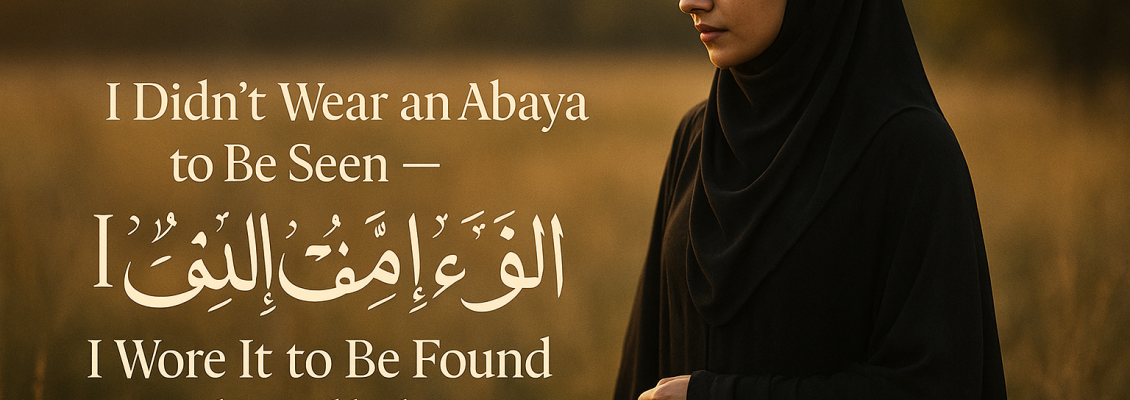
It’s 2025. And somewhere out there, another Muslimah is standing in front of her mirror, holding an abaya in her hands for the very first time. Maybe it’s charcoal black, soft and still. Maybe it was gifted to her. Or maybe she bought it in secret, unsure if she’d ever wear it outside the house. Maybe that Muslimah is you.
I’ve been her too. The one who hesitated. The one who wore a tight top underneath “just in case” she needed to take it off. The one who wasn’t sure if modesty would make her disappear — or make her whole. The one who wondered: *Is this really for me? Or am I just trying to be someone I’m not?*
This blog isn’t about trends. It’s not about which color abaya is in style or what bag to pair it with. This is about something far more sacred — something unseen. It’s about the soul that longed to be found. It’s about the day I chose to wear something not to be noticed — but to be remembered by Allah. The day I covered what the world wanted to consume, and instead offered it back to the One who created me.
If you’ve ever wondered what it means to be seen by Allah... if you’ve ever felt torn between the dunya’s eyes and Allah’s gaze... if you’ve ever worn your niyyah like fabric wrapped around your limbs — then this story is yours, too.
Bismillah, let’s begin.
Table of Contents
- Why did I feel invisible in rooms where I wasn’t even veiled?
- What was I really chasing when I dressed to impress everyone but Allah?
- Why did modesty scare me more than sin?
- Can I admit I judged the abaya before I understood its mercy?
- What broke inside me the day I wore everything *but* peace?
- When did hijab stop being a choice and start feeling like a call?
- What does it mean to be covered — but still lost?
- Why did I think surrendering meant disappearing?
- What was I afraid Allah would see if I gave Him my full self?
- When I looked in the mirror, did I see surrender or shame?
- Why did I cry the first time I wore an abaya in secret?
- What if the abaya wasn’t hiding me — but holding me?
- How did I start feeling seen by Allah instead of stared at by people?
- Can you love beauty and still choose modesty for His sake?
- What does it feel like to walk through the world cloaked in intention?
- Why did covering my body uncover parts of my soul I’d buried?
- What changed when I dressed for Jannah, not the algorithm?
- How did the abaya shift from fabric to fortress?
- Why did Allah feel closer when the dunya felt farther?
- Can something so simple be the start of something so sacred?
- When did I stop dressing out of fear and start dressing out of faith?
- Why does the abaya feel like a du’a I wear daily?
- What does it mean to be found by Allah in a world built to distract?
- How did covering myself lead to uncovering my purpose?
- When I wear my abaya now, what do I really want to be seen as?
People Also Ask (PAA)
Why did I feel invisible in rooms where I wasn’t even veiled?
I used to think I had to show more to be seen. More hair, more skin, more of a curated personality I stitched together from what I thought people wanted. I styled my life like an Instagram post — posed, filtered, touched up just enough to be noticed but not enough to be judged. And still, despite the effort, despite the hours spent choosing the right outfit, the right eyeliner, the right caption... I often walked into rooms and felt like a ghost.
I don’t mean they ignored me on purpose. In fact, they smiled, they complimented, they laughed at the jokes I had rehearsed in my head beforehand. But the kind of "seen" I craved wasn’t applause — it was acknowledgment. A feeling that someone had looked past the outfit and the surface and caught a glimpse of the ache behind my eyes.
I looked around those rooms and saw women dazzling, glowing, radiant in ways I envied. I compared their confidence to my anxiety. Their ease to my internal war. And I thought, *maybe if I looked more like them, I’d feel more like them*. But the truth was... I didn’t even know what “them” was anymore. And I certainly didn’t know who *I* was underneath the curated outer layers.
The irony of exposure
Here’s what I learned in silence, not in noise: there is a kind of invisibility that comes not from hiding, but from trying too hard to be seen.
Let me say that again, for the sister who might need to hear it twice:
There is a kind of invisibility that comes not from hiding — but from trying too hard to be seen by everyone except Allah.
I thought the more I revealed, the more attention I got, the more my worth would rise. But all that attention felt like cheap glitter. It stuck to me, but it didn’t heal me. I was being “seen” — but not witnessed. Liked — but not loved. Not the kind of love that says *I see you even when you’re struggling*. *I see your soul, not just your style.*
A table of what I thought visibility meant — and what it actually was:
| What I Thought Visibility Meant | What I Actually Experienced |
|---|---|
| Wearing bold outfits to “express myself” | Feeling overexposed and still misunderstood |
| Being praised for my “confidence” | Masking deep-rooted insecurities with performance |
| Posting selfies to feel empowered | Refreshing my phone to find fleeting validation |
| Getting compliments from strangers | Still crying alone at night, feeling unseen |
| Following trends to fit in | Still wondering why I always felt “othered” |
What kind of “seen” was I really chasing?
It took me a long time to realize that attention and presence are not the same thing. Attention can be bought, borrowed, stolen. But presence — the kind that makes someone feel real, whole, witnessed — only comes from sincerity. And sincerity rarely screams.
There was this moment I’ll never forget. I was at a friend’s gathering — loud music, laughter, everything curated to feel “fun.” I was dressed like the version of me I had manufactured: trendy, confident, funny. But somewhere between pretending to enjoy the small talk and mentally counting the minutes until I could leave, it hit me: *No one in this room knows who I am. And I’m not even sure I do either.*
That night I walked home in silence. And for the first time, I asked myself something I had never dared to ask before: *What if I’m not invisible because of what I lack — but because of what I hide from myself?*
The layers I wore that no one saw
- I wore comparison like perfume, hoping it’d mask my insecurity.
- I wore ambition that wasn’t mine, chasing paths I didn’t even believe in.
- I wore a smile I had practiced more than my salah.
- I wore clothes that impressed — but didn’t protect.
- I wore silence in the places where my heart wanted to speak of Allah.
I wasn’t veiled — but I was deeply covered in dunya. Covered in expectations, projections, and fears that weren't even mine. That’s a different kind of veil — one that the abaya later helped me remove, not add.
The beginning of being seen
I used to think visibility was a spotlight. Now I understand it as illumination from within. The moment I shifted my gaze from people to Allah — not in shame, but in surrender — was the moment I began to feel visible in the most beautiful way. The abaya didn’t erase me. It introduced me to myself.
Now when I walk into a room, I don’t scan for approval. I whisper a quiet du’a: *Ya Allah, let me be seen by You. Let me be unseen by what distracts, and illuminated by what brings me closer to You.*
To the sister who feels invisible even while uncovered — know that I see you. But more importantly, **Allah sees you**. Even in the quiet moments. Even in the confusion. Especially there.
This is not the end of your journey. It’s the beginning of being seen — for real.
What was I really chasing when I dressed to impress everyone but Allah?
I didn’t want to admit it at first. That underneath the heels, the matching handbags, the carefully layered outfits and the photo-ready hijab styles… I wasn’t just dressing for beauty. I was dressing for belonging. For approval. For love. And somehow, Allah’s gaze — the only one that actually mattered — became an afterthought in a mirror crowded by dunya.
I told myself it was harmless. That modesty was a journey. And it is — but what I didn’t realize was that my journey had a detour: I was taking the scenic route through validation-ville, hoping I could pass through unscathed. But with every outfit I chose for likes, compliments, attention, or envy… I chipped away a little more at my ruh (soul).
The lie beneath the label
I wasn’t shopping for clothing. I was shopping for self-worth — off the rack, on sale, and always one season too late. I'd tell myself, *"Just this one outfit. Just this one occasion. Just this one post."* But it was never just one. It became a cycle. Dress up, show up, get the high… and then crash when the attention faded.
So what was I really chasing?
| What I Thought I Was Chasing | What I Was Actually Seeking |
|---|---|
| Style and fashion inspiration | A sense of personal identity and belonging |
| Admiration from other women | Proof that I was enough — even if I didn’t feel it inside |
| Male attention or being desired | Affirmation that I was lovable, valuable, and seen |
| Fitting in with my peers | Freedom from the loneliness I carried in silence |
| Confidence through beauty | Control over a life that felt spiritually disconnected |
Every time I dressed to impress someone else — and not my Creator — it was like watering a garden that wasn’t even mine. No matter how many compliments I received, they evaporated quickly. The peace didn’t last. The emptiness returned. And my heart would whisper a question I kept ignoring: *If you’re so “empowered,” why do you feel so tired?*
The night that undressed my soul
There was a night — quiet, ordinary, seemingly insignificant — where everything changed. I was getting ready for a wedding. My outfit was beautiful, trendy, expensive. I had styled my hijab in a way that framed my face perfectly. My eyeliner was symmetrical, my heels elongated my legs, and I knew I would turn heads.
But as I stood in front of the mirror, I felt a heaviness I couldn’t explain. A grief that didn’t match the celebration I was dressing for. And out of nowhere, this du’a escaped my lips without warning:
*“Ya Allah… do You like how I look tonight? Or am I just trying to impress everyone but You?”*
I froze. Tears welled in my eyes before I could stop them. It hit me like a tidal wave — the years I had spent chasing acceptance from people who wouldn’t even attend my janazah. The outfits I wore for people whose opinions had no weight in my akhirah. The effort I put into looking beautiful — while neglecting to feel beautiful in my soul.
The heartbreak of conditional beauty
One of the hardest truths I’ve had to face is this: when you dress to impress people, your worth becomes conditional. Conditional on your size. Your skin. Your budget. Your trendiness. It’s a game that never lets you win — because the rules keep changing, and the crowd is never satisfied.
I remember times I left the house feeling amazing — until I saw another sister dressed “better.” Suddenly I felt inadequate again. That’s the trap. When you chase dunya’s applause, your worth inflates and deflates with the mood of the room. But Allah’s love? It is unchanging. Constant. Rooted not in appearance, but in taqwa.
So what shifted my intention?
- I started making wudu before dressing — as a reminder of who I was adorning myself for.
- I whispered “Bismillah” before choosing my clothes — to reset my niyyah.
- I began asking, *“If no one saw me but Allah today, would I still feel radiant?”*
- I chose comfort in obedience over compliments in disobedience.
- I stopped chasing attention and started seeking barakah.
The joy of dressing for Allah
When I began wearing my abaya, I thought I’d feel erased. But subhanAllah — I felt free. I felt protected. And for the first time, I felt like my body wasn’t a billboard for public consumption — it was an amanah. A trust. A secret between me and my Rabb. I wasn’t decorating it for people anymore. I was guarding it for the One who created it.
I still love fashion. I still love color, detail, elegance. But now my outfits are guided by modesty, not masked by it. They reflect something deeper. A calm confidence. A refusal to perform. A sense of sacred responsibility.
And ironically, I now receive more respect, more warmth, more genuine connection from others — not because I’m trying harder to please them, but because I finally stopped trying at all. I dress for Jannah. And that kind of beauty… doesn’t fade.
To the sister still dressing to be seen
If you’re reading this and feel exposed — not physically, but spiritually — know that I’ve been there. And you are not broken. You are being called back. Back to your fitrah. Back to the love of a Lord who doesn’t need your eyeliner, your heels, or your outfit coordination — just your heart, returned to Him, raw and real.
It’s not about throwing your whole wardrobe away overnight. It’s about asking: *Why am I wearing this?* *Who am I hoping will notice?* And slowly, gently, dressing for the One who sees you when no one else does.
Some days will feel conflicted. You might stand in front of your wardrobe and feel torn between the old you and the woman you're becoming. But even that moment of tension is sacred — it means you're aware. It means your heart is awakening.
You are not dressing to disappear. You are dressing to ascend. To honor a soul that was never meant to be clothed in chains of insecurity, comparison, or performance. You were meant to walk in beauty that begins in your sujood — not your selfies.
And one day, inshaAllah, you’ll look back and whisper to your past self: *I wasn’t chasing beauty. I was chasing Allah. And that’s when I finally became beautiful to Him.*
Why did modesty scare me more than sin?
It’s strange to admit this — but there was a time when the idea of modesty scared me more than sin ever did. Not because I didn’t know sin was wrong. I did. I felt it in my gut every time I stepped out in something tight or revealing. I felt it when I smiled for attention or when I caught myself enjoying the gaze of someone who didn’t care for my soul. But sin, somehow, was familiar. It blended in with the world around me. It was easier to justify. Modesty, on the other hand, felt like a sharp and sudden break — from the world, from comfort, from who I thought I was supposed to be.
What was I really afraid of?
When I looked honestly at myself, the fear wasn’t just about clothes. It wasn’t about long dresses or headscarves or changing my wardrobe. The fear was deeper — it was the fear of becoming invisible. The fear of being “too much” for the world and “not enough” for the people I used to want to please. I was terrified that modesty would erase my voice, my confidence, my desirability. That it would make me less expressive, less free, less me.
But the truth I had to confront was this: I had built my identity around being seen. Around approval. Around worldly affirmation. And modesty threatened that illusion. It was asking me to choose: live to be witnessed by people, or live to be seen by Allah?
The myth of empowerment vs. the reality of modesty
We’re told from a young age that showing more skin means owning our bodies. That posting, flaunting, revealing is somehow revolutionary. That if we cover, we must be ashamed. But wallahi — the real shame wasn’t in covering, it was in realizing how much I needed attention to feel whole.
Let’s break this myth down in a way that opened my eyes. I created a table that helped me reflect honestly:
| What I Thought Was Empowerment | What I Found in Modesty |
|---|---|
| Wearing what I want, no matter how revealing | Choosing what pleases Allah, not my nafs |
| Receiving compliments and validation | Receiving peace from Allah and self-respect |
| Using beauty as currency in social spaces | Valuing my soul more than my appearance |
| Freedom to perform femininity for others | Freedom from the need to perform at all |
When I started dressing modestly, I began to notice a shift. I wasn’t performing anymore. I wasn’t in a constant audition for relevance. Suddenly, I had space to be real — to stop curating myself, and start connecting with my soul.
Modesty as a mirror, not a muzzle
Modesty didn’t silence me. It reflected me. It showed me where I was clinging to dunya. It mirrored back the insecurities I hadn’t dealt with. And yes, it hurt at first — because letting go of false identities is painful. But every layer I shed brought me closer to a version of myself I didn’t know I was allowed to be: one who was deeply loved by Allah, not for what she showed the world, but for what she hid from it.
And that’s what modesty really does. It strips away the noise. It shields what is sacred. It dignifies what has been objectified. It quiets the screams of society so you can finally hear your own soul whisper: I was made for more than this.
The day I realized sin felt safer because it didn’t challenge me
I was standing in front of my closet, eyes locked on an abaya I had bought but hadn’t yet worn. It was beautiful — jet black with delicate embroidery, soft and flowing. But every time I reached for it, I heard the voice in my head say: Who do you think you are? That voice wasn’t from Allah. It was from my fears. My pride. My wounds. Because sin never questioned who I was. It never required transformation. Modesty did.
Sin is easy. It rewards you instantly. It gives you likes, attention, smiles, and approval. But it empties you slowly. Quietly. Modesty, on the other hand, builds you in silence. Fills you without noise. Grows you in ways the world might never applaud — but Jannah will.
To the sister who still feels afraid
If you’re reading this and feeling conflicted, know this: your fear doesn’t mean you’re failing. It means your heart is waking up. It means something inside you knows you were made for something higher. And that fear? It’s not the enemy. It’s the signpost.
You are allowed to move slowly. To struggle. To take one piece at a time. Allah sees every intention. Every attempt. Every tear you wipe away when no one’s watching. He is not waiting for you to be perfect — He is waiting for you to be real.
So let your modesty begin with sincerity. Not style. Let it be about your longing, not your labels. Let it be the quiet revolution of your soul returning to its Lord. And let that fear turn into freedom — the kind that no trend or gaze can ever give you.
Can I admit I judged the abaya before I understood its mercy?
Yes. I judged it. Harshly. I looked at women in abayas and thought they were oppressed, overly religious, maybe even trying too hard. I was wrong. Not just in my assumptions about them — but in how little I understood the abaya itself. I didn’t know that the thing I mocked would become the very thing that would help save me. That what I dismissed as ‘too much’ would be the thing that finally made me feel like I was enough.
Back then, the abaya felt like a wall. Like something that divided women like “them” from women like “me.” It seemed like a costume for piety — not a sign of deep inner love. I thought it was for those who were raised in it, or for those who didn’t care about style, or had already ‘arrived’ in their faith. But when I was brave enough to really ask — not about the cloth, but the *why* — everything changed.
I saw it. But I didn’t really see it.
Growing up, I’d pass women in abayas and feel an odd mix of curiosity and discomfort. I noticed how they carried themselves — quiet, confident, purposeful. But instead of wondering what gave them that strength, I assumed they were hiding. That they were quiet because they had no voice. That they dressed modestly because they lacked personality. What I didn’t realize was this:
- They weren’t quiet because they had nothing to say — they were quiet because they had peace.
- They weren’t covering out of shame — they were covering out of honor.
- They weren’t lacking style — they had redefined beauty through sincerity and dignity.
The abaya wasn’t a muzzle. It was a mirror. It showed me how far I’d drifted from valuing myself. It showed me how much I had been performing for attention. It showed me that I didn’t fear modesty — I feared surrender. Because surrender meant I had to let go of the illusion that the world’s gaze could fulfill me.
What I misunderstood about the abaya
To untangle my judgment, I had to confront my misconceptions. I mapped them out one evening in my journal — and the clarity was humbling. Here’s what I found:
| What I Used to Believe | What I Now Know |
|---|---|
| Wearing an abaya means I’m giving up my identity. | The abaya protected my real identity — the one rooted in faith, not fashion. |
| It’s only for women who are already religious or “perfect.” | It’s for the seeker — the struggler — the one who wants to grow closer to Allah. |
| It’s unattractive, boring, or outdated. | It’s timeless, graceful, and powerful in its simplicity. |
| It’s a sign of oppression. | It’s a sign of liberation from society’s gaze and control. |
Seeing the truth laid out like this left me speechless. The abaya wasn’t the problem. My ego was. My misunderstanding was. My fear of becoming ‘too Islamic,’ of being labeled, of losing my worldly value — that was the real block. But subhanAllah, when Allah wants to guide you, He does it with such mercy that even what you once mocked becomes your medicine.
The moment I put it on — not for culture, but for Allah
The first time I wore an abaya intentionally — not for a wedding, not because I was in a masjid, not because someone else expected it — but just because I wanted to honor Allah… it felt like a spiritual rebirth. My body felt safe. My heart felt still. It wasn’t just fabric; it was a flag. A personal declaration of surrender. I wasn’t trying to disappear — I was trying to be seen, finally, by the One who truly sees.
And no, it wasn’t easy at first. There were stares. There were assumptions. There were friends who didn’t understand. But the mercy I felt — that peace that wrapped around me every time I stepped outside shielded and serene — was unlike anything I had known. The abaya didn’t erase me. It revealed me. It told the world: I know who I am now. I don’t need to prove it anymore.
The mercy hidden in surrender
Allah could’ve made obedience feel heavy. But He made it beautiful. He could’ve left us to navigate the world uncovered — spiritually and physically — but He gave us guidance that not only protects us, but dignifies us. The abaya, to me, is not a burden. It’s a barakah. A covering of rahmah that shields not just my body, but my soul from becoming consumed by trends, objectification, and superficial worth.
There’s mercy in knowing your worth isn’t up for negotiation. There’s mercy in walking confidently, knowing your beauty is guarded, your soul is prioritized, and your purpose is clear. And yes — there’s even mercy in the slow, messy journey of getting there. Because Allah doesn’t just reward perfection. He rewards sincere attempts. Honest effort. Quiet, teary, trembling first steps.
To the sister who’s still unsure
If you’re reading this and still feel distant from the idea of the abaya — I see you. I was you. And I don’t blame you. This dunya teaches us to value external freedom over internal liberation. But take one step toward Allah, and watch Him unfold doors you didn’t know existed. Try on that abaya, even just at home. Feel what it feels like to be cloaked in dignity. To walk in intention. To dress, not to impress, but to surrender. That first step may feel foreign — but it might be the doorway to finding who you truly are.
And when you’re ready, you’ll understand — the abaya wasn’t a rejection of beauty. It was a return to it. The kind that never fades. The kind that is seen only by the One who matters. The kind that whispers to your heart, softly but clearly: You are already enough. Come home.
What broke inside me the day I wore everything but peace?
I remember the outfit clearly. It was flawless — on trend, carefully planned, expensive, and applauded. People stared. Complimented. Smiled. But none of it reached me. Not really. Underneath the layers of effort and aesthetics, something cracked. That day, I wore confidence like perfume — visible, appealing, but entirely surface-level. Because inside, I felt naked. Not physically — but spiritually. I was decorated, but I wasn’t dressed in peace.
It’s hard to explain unless you’ve lived it: that feeling of achieving the “look” while losing your center. That moment when you realize you’ve poured hours into pleasing a mirror, but left your soul unattended. That day was a turning point — because I didn’t just feel tired. I felt lost. And when you start to feel lost while wearing your “best,” you know something deeper is misaligned.
It wasn’t the clothes — it was the contradiction
Let’s be honest — beauty isn’t haram. Fashion isn’t evil. But chasing beauty at the cost of your inner stillness? That’s the fracture I didn’t know I was living with. On that particular day, I had achieved the version of myself I thought the world wanted to see. But that version came at a cost:
| What I Wore | What I Lost |
|---|---|
| Flawless makeup | Wudu-friendly skin |
| Curve-hugging dress | Comfort in sujood |
| Heels that impressed | Feet that felt grounded |
| A look made for others | A self made for Allah |
It hit me when I got home that night. I took off each layer, one by one, and with each removal, I felt more fragile. The lashes came off. The dress was folded away. The accessories were placed gently into drawers. And all that was left was me — exhausted, emotionally raw, and wondering why being “seen” never felt so lonely.
The illusion of being admired vs. being whole
There’s a difference between attention and connection. I didn’t know that back then. I thought being admired would make me feel valued. But admiration is cheap if it doesn’t touch the soul. Being “liked” for a look is not the same as being loved for who you truly are. I was becoming a brand, not a believer. And that day, my soul began to protest.
I remember staring at myself in the mirror and not recognizing the woman looking back. I had tried so hard to become what I thought was beautiful — but in doing so, I had starved my soul. I had dressed my body and undressed my heart. That moment of confusion — of deep spiritual homesickness — is what broke me. And alhamdulillah for that break. Because only broken hearts truly begin to seek Allah.
The whispers I ignored
Looking back, there were signs. Quiet ones. Signs that the lifestyle I was chasing wasn’t aligned with who I was becoming. But I silenced them. I drowned them out with playlists, parties, and praise. Here are some of the whispers I buried beneath my style:
- “You pray less when you dress like this.”
- “You check your reflection more than you check your heart.”
- “You’re scared to be seen without makeup.”
- “You say Bismillah, but only when you’re scared you won’t look good enough.”
These weren’t accusations — they were cries from a soul being overlooked. And the day I finally let those whispers rise to the surface, I cried. Not because I was ashamed of who I was, but because I had been neglecting who I was always meant to be.
The mercy in unraveling
It might sound odd, but that day — that heartbreaking realization — was actually a gift. Because once I knew that my “glamorous” life wasn’t fulfilling me, I was finally open to searching for what would. I began to make small changes. Not out of guilt, but out of longing. I wanted clothes that made prayer easy. I wanted makeup that didn’t require 30 minutes and two touch-ups. I wanted to feel clean — not just physically, but spiritually.
It was in that unraveling that I found a new definition of beauty. One that didn’t rely on filters, but on fitrah. One that wasn’t seasonal or trendy, but timeless and sacred.
Redefining what I wear — and why
Eventually, I began dressing differently. It didn’t happen overnight. But every scarf I wrapped, every abaya I chose, every time I said “no” to a trend and “yes” to a sunnah — I felt myself coming home. Not to a version of myself curated for the crowd, but to the one Allah already knew. Already loved. Already accepted.
I stopped dressing to be noticed and started dressing to be protected. I stopped asking, “Does this make me look good?” and started asking, “Does this make it easier to remember Allah?” And in that shift, I didn’t just change my wardrobe — I changed my worldview.
To the sister who feels that same break
If you’ve felt what I felt — if you’ve come home from a night out and felt empty instead of elevated — know that it’s not the end of your story. That crack in your heart is not weakness. It’s an invitation. A sacred signal from your soul saying, “I’m ready to return.”
It’s okay to love beauty. Islam encourages it. But never let beauty be your jailer. Let it be your bridge — from dunya to akhirah, from distraction to dhikr, from image to intimacy with your Creator.
The day I wore everything but peace was painful — but it was also the day I truly began. And I wouldn’t trade that heartbreak for anything. Because in that moment, I stopped performing and started preparing — not for likes, but for the Hereafter. Not for applause, but for acceptance from the One whose opinion never changes. The One who saw through the glamor and still wanted my return. The One whose door remains open even when I slam it shut a thousand times.
That kind of peace — the one born from surrender, not perfection — is what I dress for now. And I hope one day, if you haven’t already, you’ll walk through that door too. Not to become someone else, but to return to who you were always meant to be. A soul dressed in purpose. A heart clothed in sincerity. A woman who no longer wears pain as proof of her worth — but wears faith as her freedom.
When did hijab stop being a choice and start feeling like a call?
I used to say I was “thinking about it.” The hijab, I mean. As if it was an accessory I was debating, like a new hairstyle or a different lipstick shade. It sat in the back of my mind like a tab I never closed — always open, always there, but never urgent enough to act on.
For a long time, it felt like something I had to *choose*. Something I had to be *ready* for. And every time someone brought it up — whether gently or with judgment — I’d smile politely and say, “InshaAllah, one day.”
The illusion of "readiness"
What I didn’t realize then was that “readiness” is often a disguise for resistance. I wasn’t really waiting for the right moment. I was waiting for the fear to go away — the fear of being seen differently, treated differently, misunderstood, or even mocked. I was waiting for the day hijab would feel easy, comfortable, seamless. But that day never came.
Because hijab — like most acts of obedience — doesn’t always arrive wrapped in comfort. Sometimes, it arrives wrapped in discomfort that leads to transformation. A calling that whispers before it ever shouts. A nudge in the soul before it becomes a banner on the body.
The moment the call became louder than the choice
I remember the exact moment the hijab stopped feeling like a personal decision and started feeling like a divine invitation. It wasn’t during a lecture or a dramatic spiritual awakening. It was quiet. Ordinary. I was scrolling through photos on my phone, and in every image, I was smiling — but something about my eyes looked tired. As if they were trying to convince the rest of me that I was okay.
That night, I made wudu and stood for salah. And in sujood, I cried — not because I was sad, but because I felt… seen. Fully. Completely. As if Allah was telling me: “I know how much you’ve tried to hold yourself together. I see the exhaustion behind your ambition. Let go now. Come home to Me.”
From that night on, hijab wasn’t a checklist item. It was a reply. A reply to a call that had been echoing inside me for years. I didn’t wear it because I had all the answers. I wore it because I was finally ready to stop running from the question.
Hijab is not always love at first sight — but it is a love that deepens
People assume hijab is either forced or fully loved. But many of us start in the messy middle. Awkward. Insecure. Unsure if we “look right” or if we’re “doing it wrong.” We wrestle with mirrors and comments. We fluctuate between resolve and retreat. And yet, somehow, through that imperfect path, something sacred begins to grow.
Hijab becomes a shield — not just from the gaze of others, but from the demands of ego. It becomes a mirror — showing you not just your face, but your fears and your faith. And eventually, it becomes a crown — heavy at times, yes, but noble in meaning. Worn not for praise, but for purpose.
Table: How my view of hijab transformed over time
| Phase | My Thoughts | My Feelings | What Changed |
|---|---|---|---|
| Curiosity | “Maybe one day. But not now.” | Detached, neutral | Learning about its meaning |
| Resistance | “I’m not ready. What will people say?” | Fear, anxiety, pressure | Hearing sisters' real stories |
| Conviction | “I want to wear it… but I’m scared.” | Yearning, vulnerability | Sujood, Qur’an, reflection |
| Surrender | “Bismillah. Today is the day.” | Peace, trembling, hope | Trusting Allah over my fears |
| Commitment | “This is who I am now.” | Gratitude, dignity | Seeing the barakah unfold |
To the sister still weighing her heart
If you’re reading this and feel torn — between your past and your future, between your love for Allah and your fear of change — I want you to know something important: the call doesn’t always come with clarity. Sometimes, it comes with discomfort. With a sense of restlessness. With a voice in your soul that won’t go silent.
Hijab doesn’t make you perfect. But it does align you with the pursuit of sincerity. And you are allowed to grow into it. You are allowed to wobble before you walk. You are allowed to wear it with shaking hands as long as your heart is seeking His pleasure.
Don’t wait for perfect understanding. Respond with imperfect obedience. The clarity comes with commitment. The beauty deepens with the struggle. The love is built — not bought.
And when it stops feeling like a burden and starts feeling like a badge of faith — that’s when you’ll know: this wasn’t just a choice. This was your answer to a sacred call that never stopped whispering, “Return to Me.”
What does it mean to be covered — but still lost?
There’s a common assumption — even among us as Muslim women — that the hijab, the abaya, or modest dress is the ultimate proof of closeness to Allah. That the fabric on your body is a mirror of the state of your soul. But the truth is far more tender, more complex. You can be fully covered and still feel completely lost. I know, because I was.
I wore the abaya before I understood what it meant to wear it for Allah. I wore it for culture, for approval, for expectations, for safety, for invisibility. I wore it while my heart wandered, while my prayers were rushed, while my inner life was dry. I looked the part — but I didn’t feel the part. I followed the rules — but I didn’t feel the connection. And that gap… that emptiness… it was haunting.
Outward conformity vs. inward connection
Islam is a complete way of life — inward and outward. But sometimes, especially when we’re raised in environments that prioritize the external, we focus on appearance more than essence. We learn what to wear before we learn Who we’re wearing it for. We follow modesty guidelines like checklists, but we don't internalize the love behind the law. And so we might end up dressed modestly, but spiritually malnourished.
I remember walking into rooms fully covered but feeling completely unseen — not by others, but by myself. I had no idea who I was beyond the clothing. I could quote hadith about modesty, but I couldn’t explain how it made me feel closer to my Lord. Because it didn’t. Not yet.
The moment I realized I was lost in layers
There was one day in particular — a Jummah khutbah. The imam gave a beautiful reminder about the heart and how even the most religious-looking person can be spiritually hollow. He said, “What’s the point of guarding your body if you’ve abandoned your soul?” That sentence struck me like lightning. I cried silently in my niqab, wondering: Had I become more concerned about my image than my inner state? Was I just a silhouette — a shape — without light?
That’s when I knew I had work to do. Not on my wardrobe — but on my worship. Not on how I was seen — but on how I was held by my Lord.
Table: The difference between being covered and being connected
| Aspect | Covered but Lost | Covered and Connected |
|---|---|---|
| Intention | Wearing it for others, habit, or fear | Wearing it for Allah, with love and conviction |
| Emotional State | Empty, pressured, resentful | Peaceful, dignified, secure |
| Spiritual Life | Inconsistent prayer, low dhikr, confusion | Connected prayer, conscious heart, clarity |
| Self-Worth | Defined by others’ opinions | Defined by proximity to Allah |
| Growth | Stagnant, stuck in routine | Progressing, even if slowly |
Why this realization matters
It’s not enough to dress the part. Allah wants your heart. And when you wear hijab or abaya only out of pressure or performance, it becomes heavy — a burden instead of a blessing. But when you wear it out of love, trust, and reverence, it becomes light — a means of nearness to Him.
This doesn’t mean you have to be perfect before you put it on. Not at all. But it does mean that your journey isn’t finished once it’s on. That’s actually where the real journey begins. You cover your body… and then you begin uncovering your soul. Layer by layer. Fear by fear. Until what you wear and who you are align with sincerity.
To the sister who feels lost in her own reflection
If you’re reading this and feel unseen in your modesty — not by others, but by yourself — please know: you are not a hypocrite. You are not a failure. You are a soul in progress. You are a believer being refined.
Maybe you covered before you fully understood. That’s okay. Keep walking. Maybe you feel like your outer self is ahead of your inner self. That’s okay. Keep aligning. Maybe you’ve been doing “everything right” but still feel distant from Allah. That’s okay. He sees the struggle. He honors the effort. And He responds to every whisper of return.
You don’t need to take off your hijab to “find yourself.” You need to return to Allah to remember who you’ve always been — His servant, His creation, His beloved.
Wearing the abaya with purpose, not pressure
These days, I still wear the abaya. But now, I check my heart before I check my sleeves. I dress not just with modesty, but with presence. With dhikr. With intention. I remind myself that covering my body is not the end — it’s the beginning. A symbol of surrender, yes — but also a commitment to keep growing, to keep purifying, to keep walking toward the light, even when I feel lost.
Because covered or not, the only way back is through the heart. And Allah — Al-Hadi, the Guide — will never abandon the one who keeps seeking Him. Even if you’re wrapped in black cloth but still searching for light, His door is always open. He knows when the fabric on your skin doesn’t match the storm in your chest. And still, He waits. He calls. He forgives. Again and again and again.
Why did I think surrendering meant disappearing?
For a long time, I confused surrender with silence. With shrinking. With erasure. I thought that to obey Allah, I had to abandon myself entirely — my voice, my personality, my creativity. I thought that modesty was a kind of spiritual vanishing act. That being a “good Muslim woman” meant fading into the background of the world, seen but not heard, present but not alive.
And so I resisted. Not because I didn’t love Allah, but because I didn’t understand Him. I feared that if I surrendered to His commands — especially the ones around hijab and haya (modesty) — I’d become invisible, irrelevant, erased. But what I later discovered was this: surrender in Islam isn’t about erasing who you are. It’s about finally becoming who you were created to be.
The misconception: Obedience = disappearance
We live in a culture that often paints religious women as weak, passive, and silenced — especially when they observe hijab or wear traditional clothing like the abaya. That image seeped into my subconscious. Every time I looked at a covered woman, I didn’t see power or purpose. I saw absence. I saw sacrifice without joy. I saw someone who had given up everything just to follow rules written centuries ago.
But I never paused to ask: what did she gain in return?
Because if we define surrender only by what is given up, we’ll always see it as a loss. But if we define it by what it gives us — peace, purpose, nearness to our Creator — we’ll see it as the ultimate gain.
What I thought I would lose vs. what I actually gained
| I Thought I’d Lose | But I Actually Gained |
|---|---|
| My voice | A stronger voice rooted in truth |
| My identity | A deeper identity beyond labels and trends |
| My beauty | Respect for my sacredness and dignity |
| Freedom | Freedom from the prison of pleasing everyone |
| Visibility | Visibility in the eyes of Allah |
SubhanAllah, when I began to live Islam from the inside out, I realized something radical: surrender didn’t erase me — it revealed me. It clarified me. It returned me to my fitrah — my natural, unfiltered, God-given self. The parts of me that I’d buried under performance and perfectionism began to rise to the surface. Not in rebellion — but in remembrance.
The fear of becoming “just another veiled woman”
One of the deepest fears I had when considering hijab and abaya was that I’d become forgettable. That I’d blend in with the crowd. That I’d lose my uniqueness. But the irony is, I only started to truly shine when I stopped trying to be seen.
Modesty doesn’t erase your individuality. It refines it. It allows your soul to lead, not your image. It lets your light shine from the inside out, not the outside in. And when people meet you — truly meet you — they meet your essence, not your ego. That’s not disappearing. That’s arriving.
The Prophet ﷺ: The perfect example of empowered surrender
The Prophet Muhammad ﷺ was the most surrendered soul to Allah. And yet, he was the most courageous, the most eloquent, the most visible leader of his time. His surrender did not shrink him — it elevated him. It made him a mercy to the worlds. It gave him confidence, not fear. Power, not weakness.
So why do we think surrendering to Allah will make us small? That it will take away our color, our dreams, our voice? When every prophet, every companion, every righteous woman and man in our history found their true strength only through submission?
To the sister afraid of becoming invisible
If you’re reading this and silently grieving the parts of yourself you think you’ll lose if you surrender to Allah — please know this:
- You are not being called to disappear. You’re being called to appear — in the sight of your Lord.
- You are not being asked to become less. You’re being asked to become whole.
- You are not being silenced. You’re being purified, so your voice can carry truth.
Don’t let society’s warped image of piety blind you to its true beauty. You are allowed to be vibrant, dynamic, intelligent, creative — and still surrendered. In fact, those gifts will only find their highest purpose when they are rooted in obedience to the One who gave them to you.
Surrender is not erasure. It is emergence.
I no longer believe surrendering means disappearing. I believe it means showing up — fully, honestly, and for the first time, without performance. I believe it means saying, “Here I am, Allah. All of me. Not just my curated parts, but my chaos, my fear, my longing — I give it all back to You.”
And from that surrender comes a new kind of strength. Not the loud strength of self-assertion, but the quiet, unshakable strength of someone anchored in their purpose. A woman who wears the abaya not to hide — but to be found. Not to vanish — but to walk with the dignity of someone who knows: her worth isn’t in how brightly she shines for the world. It’s in how softly she walks toward her Lord.
What was I afraid Allah would see if I gave Him my full self?
There’s a vulnerability in standing bare-souled before your Creator. No makeup. No filters. No carefully crafted identity. Just you — raw, flawed, and unguarded. And for the longest time, that terrified me. Because deep down, I feared that if I gave Allah my full self, He’d see what I had tried so hard to hide from even myself: my doubts, my desires, my darkness.
So instead, I performed. I gave Allah the curated version of me — the “good Muslim girl,” the one who fasted on Mondays and wore hijab on Eid and smiled when she wanted to scream. I kept a part of my heart hidden, even from the One who already knew it completely. I feared that surrendering fully meant exposing my mess — and I didn’t believe I was lovable in that state. Not even by Him.
The illusion of selective submission
It’s easy to say “I trust Allah” — until that trust demands your full honesty. Until it asks you to look in the mirror and admit what’s broken. Selective submission is a trap. I gave Allah my prayers, but withheld my pain. I gave Him my duas, but not my decisions. I wanted His help, but I didn’t want His scrutiny.
I thought I had to be perfect before presenting myself to Allah. But Islam doesn’t require perfection — it requires sincerity. And sincerity only begins when we stop pretending, even in front of our Lord.
What I feared He would see
| What I Hid | Why I Hid It | The Truth I Later Learned |
|---|---|---|
| My sinful past | Shame, fear of rejection | Allah is Al-Ghaffar — the Forgiving. He loves those who turn back. |
| My doubts about faith | Guilt, thinking it made me unworthy | Even the prophets had moments of deep questioning. Doubt can be a doorway to certainty. |
| My desires | Assumed they made me dirty | Desire isn’t sin — acting on it against His boundaries is. Allah understands our struggles. |
| My weaknesses | Didn’t want to appear weak or needy | True strength is found in acknowledging dependence on Allah. |
| My anger and resentment | Thought I wasn’t allowed to feel that way | Even anger can be expressed in du’a. Allah doesn’t shame emotion — He transforms it. |
I had built walls to keep Allah out — as if He didn’t already see behind them. But in my deepest heartbreak, I finally broke down. And in that breakdown, I discovered something life-altering: Allah doesn’t reject you when you bring Him your mess. He wraps you in mercy.
The moment I gave Him everything
It wasn’t in a masjid. It wasn’t during Ramadan. It was on my bedroom floor, after a night of pretending to be fine. I had nothing left to offer but tears and confusion. And in that moment, I whispered what felt like a confession and a prayer all at once: “Ya Allah… this is all of me. Not just the parts that worship. The parts that wander too. I don’t know how to fix this, but I want to come home.”
And subhanAllah… I didn’t feel rejection. I felt relief. Because I was finally giving the One who already saw everything permission to hold it all. That was tawbah. That was trust. That was tawakkul.
The truth about surrender
Surrender isn’t about exposing yourself to a judge waiting to condemn. It’s about returning to the only One who never stopped loving you. Allah’s love is not transactional. It’s not based on your image. It’s based on your essence — and your willingness to return.
The Qur’an is filled with stories of people who stumbled, doubted, sinned — and still became beloved. Yunus عليه السلام ran away. Musa عليه السلام made mistakes. Adam عليه السلام disobeyed. But what made them honored wasn’t their perfection. It was their repentance. Their return. Their willingness to give Allah all of themselves, not just the “acceptable” parts.
To the sister hiding her heart
If you’re afraid of what Allah will see if you truly open yourself to Him, I want you to know this: He already sees. And He’s still calling you. Not because He wants to punish you — but because He wants to purify you. Not because He’s disgusted — but because He’s near. Nearer than your jugular vein. Closer than your self-criticism. More merciful than your regrets are loud.
Don’t let shaytan convince you that you must be flawless to be faithful. You just need to be real. And being real with Allah — that’s the most powerful thing you’ll ever do.
Giving Him your full self is not a risk — it’s your rescue
We are not too broken for Allah. We are only too proud to be healed. But the moment we kneel — even if our voice shakes — the healing begins. Not because we’ve changed overnight, but because we’ve finally stopped hiding. And in that surrender, we find peace, purpose, and the deepest kind of love.
I was afraid Allah would see my mess. But He did — and He still chose to guide me. To forgive me. To love me. Not despite my brokenness, but through it.
So don’t be afraid to give Allah all of you. Because He is not waiting for your perfection. He is waiting for your presence.
When I looked in the mirror, did I see surrender or shame?
There was a time in my life when I couldn’t look in the mirror without flinching. Not because I hated my appearance — but because I didn’t recognize the woman staring back. I was dressed, polished, and smiling, but beneath it all, something felt hollow. I wasn’t sure if what I saw was confidence… or concealment. Was it surrender to Allah — or shame buried under style?
Modesty isn’t just about fabric. It’s about the soul that chooses it. And the mirror reflects more than what’s visible — it shows what you believe about yourself, about your worth, and about who you’re really trying to please. When I finally paused to ask myself who I was dressing for, the answer shook me. I wasn’t surrendering. I was surviving. I was covering wounds, not in obedience to Allah, but in fear of being exposed — not just to others, but to myself.
What the mirror revealed — and what it hid
The mirror has a strange kind of power. It doesn’t lie, but it doesn’t tell the full truth either. It can’t show the intentions behind the image. And for years, I thought modest clothing alone made me righteous. I had worn the hijab, then removed it. I had layered fabric, but never peeled back the layers of my nafs. I had posted photos in “modest fashion” — curated, styled, and praised — but still went to bed with spiritual emptiness. So when I looked in the mirror, what I really saw was contradiction. Faith mixed with fear. Image without substance.
That realization didn’t come easily. It took years of painful honesty. Of spiritual fatigue. Of asking questions I’d been avoiding. And the most piercing one was this: Am I dressing to express my deen… or to avoid confronting my disconnection from it?
Mirror vs. Soul: A Table of Internal Conflict
| What I Saw in the Mirror | What I Felt in My Soul | What Allah Wanted from Me |
|---|---|---|
| Stylish outfit, carefully layered | Desperate to feel accepted by others | To find contentment in His acceptance alone |
| Perfectly coordinated hijab | Fear of judgment, not love of obedience | Sincerity over appearance |
| Smile for the camera | Exhaustion from performing | Permission to rest in spiritual honesty |
| Modesty on the outside | Shame on the inside | To cleanse my heart, not just my wardrobe |
| A woman who “looked the part” | A girl still unsure of who she was to Allah | Reconnection, not reputation |
The turning point: when the mirror finally became a place of mercy
One day, after a long season of inner conflict, I stood before my mirror — not to perfect an outfit, but to plead for clarity. I looked at myself not through the eyes of the world, but through the lens of tawbah. And for the first time, I didn’t ask, “Do I look good?” I asked, “Am I being truthful with Allah? Am I dressing for Jannah, or for applause?”
That shift changed everything.
I realized that surrender isn’t supposed to make you feel small — it’s supposed to make you feel safe. When you surrender to Allah, you don’t lose yourself. You meet your truest self. The one He molded, purified, and knows better than you know yourself. Shame was never part of the garment of taqwa. Modesty rooted in shame will suffocate you. But modesty rooted in love, in dignity, in conviction? That liberates you.
The difference between shame and surrender
- Shame says: “You’re not good enough to wear this.”
- Surrender says: “You are enough, because Allah accepts who returns to Him.”
- Shame hides out of fear.
- Surrender veils out of reverence.
- Shame is loud inside — anxiety, doubt, overthinking.
- Surrender is quiet peace — calm, steady, grounded.
When I internalized that truth, I finally chose my clothes from a place of peace. I dressed not to perform, not to be seen, but to be safe — spiritually safe. To remind myself that my beauty was created for Jannah, not for the gaze of strangers.
To the woman still flinching in the mirror
If you’re reading this and you’ve felt the sting of shame — whether because of what you wear or what you’ve done — please know this: Allah sees you beyond the surface. And He never asked you to be perfect. He asked you to be sincere. The mirror may show you where you are. But only Allah can show you where you’re going. Don’t let your reflection define you. Let your repentance refine you.
It’s okay to change slowly. It’s okay to cry in front of your closet. It’s okay to not have all the answers. Just start with one honest question: “Ya Allah… how can I come closer to You today?”
Conclusion: The mirror is no longer my enemy
Now, when I look in the mirror, I still see imperfections — but I no longer see shame. I see a woman who’s walking toward Allah, even if she stumbles. I see someone who surrendered — not because she had it all together, but because she finally trusted the One who holds her together. And that surrender? That is the most beautiful thing I’ve ever worn.
Why did I cry the first time I wore an abaya in secret?
The first time I wore an abaya, it wasn’t in a masjid. It wasn’t in front of people who would applaud me for my “modesty journey.” It was in the privacy of my bedroom, behind a locked door, with trembling hands and a heart full of secrets. I slipped it over my head slowly, quietly, like someone trying not to be caught. And when I looked at myself in the mirror — fully covered, silent, unseen — the tears came without permission.
I didn’t cry because I felt ugly. I cried because, for the first time, I felt seen — by the One who had always seen me. Allah. It was like I was finally saying to Him with my whole body, “Here I am. I’m ready.” But at the same time, I was afraid. Afraid of what it meant. Afraid of how it would change me. Afraid of how others would react if they knew. That moment, though quiet, cracked me open. And I’ve never forgotten it.
Why did I keep it a secret?
Wearing the abaya in secret might sound strange. But for many women, especially those not raised in environments that support visible displays of faith, modesty can feel like a confrontation. A confrontation with family expectations, cultural stigmas, peer pressure, and even internalized beliefs about worth and visibility. I wasn’t hiding it out of shame for Islam — I was hiding because I didn’t know how to explain the shift that was happening inside me. My heart was waking up, but my surroundings hadn’t caught up yet.
At that point, wearing the abaya wasn’t a public declaration. It was a private prayer. It was my whispered “yes” to a calling I couldn’t ignore anymore. A sacred moment just between me and my Lord.
The layers beneath the fabric
The abaya was more than fabric to me that day. It was layered with emotion, history, and longing. Each layer symbolized something deeper — not just covering, but confronting.
| Layer of the Abaya | What It Symbolized | What It Healed |
|---|---|---|
| Outer coverage | A shield from the gaze of the world | My fear of being reduced to my body |
| Loose silhouette | A rejection of the need to perform femininity | My exhaustion from people-pleasing |
| Black color | Neutral, undistracting — pulling focus inward | My obsession with outward beauty |
| Head-to-toe modesty | A statement of spiritual submission | My internal rebellion and confusion |
Each piece told a story. And that story wasn’t about erasure. It was about emergence. I wasn’t losing myself in the abaya — I was finding myself in Allah’s mercy. I was finding the courage to trust His vision of me over the world’s.
The weight of surrender
Surrender isn’t light at first. It feels heavy. Like swallowing your ego, your insecurities, your need for validation — and replacing them with trust. Trust that Allah sees your intention even when no one else does. Trust that you're still beautiful even when the world ignores you. Trust that you are becoming even as others claim you're disappearing.
That day in my room, the tears weren’t just emotion. They were purification. They were years of running finally being met with stillness. They were whispers of istighfar buried deep in my chest, rising to the surface. “Ya Allah… I’ve been away so long. Can I really come back?”
Why the secret mattered
Sometimes, our most sincere acts of worship happen in secret. Away from applause, from commentary, from even our own self-congratulations. That moment was one of the most intimate spiritual acts of my life — not because it was dramatic, but because it was completely honest. I had no one to impress. No one to explain myself to. It was just me, the fabric, and the One who fashioned me in the womb before I ever worried about how I’d be perceived.
And in that private moment, I felt something I hadn’t in a long time: belonging. I belonged to something bigger than myself, bigger than my social circles, bigger than trends. I belonged to Allah. And for the first time, I wasn’t just saying it — I was wearing it.
To the sister hiding her growth
If you’re reading this and you’ve worn your abaya in secret… I want you to know: Allah saw it. That moment counts. That step mattered. And those tears? They were noticed by the King of kings. You are not weak for hiding. You are sacredly unfolding. Don’t rush yourself. But also — don’t underestimate how deeply that moment moved the heavens. Private acts of devotion are some of the most powerful. Let that secret moment become the seed of your strength, not your shame.
One day, you may wear it outside and feel the wind catch its hem and think: “This was once my secret… now it’s my strength.”
Conclusion: From secret to strength
I cried the first time I wore the abaya in secret not because I was afraid of the garment — but because I was finally ready to stop running. That moment marked the beginning of a journey I never imagined I'd have the courage to take. And now, when I wear my abaya in public, I still remember that girl in her room, crying silently, hands shaking — and I smile. Because that moment of secret surrender became the foundation of my spiritual freedom.
What if the abaya wasn’t hiding me — but holding me?
For a long time, I thought of the abaya as a curtain. A fabric wall between me and the world — one that would erase my individuality, conceal my femininity, and silence the voice I’d worked so hard to find. I feared it like one might fear a veil over a painting, afraid that what made me “me” would disappear behind black folds and cultural assumptions.
But what if I misunderstood it completely?
What if the abaya wasn’t a curtain, but a cloak — not hiding me, but holding me? What if it was never meant to erase, but to embrace? To shield, to shelter, to honor? That shift — from fear to trust, from resistance to reverence — changed everything. Because when I stopped looking at the abaya as something that took from me, and started seeing it as something that gave to me, I began to feel held. Held by mercy. Held by dignity. Held by Allah.
The lie of visibility
We live in a world that teaches women that visibility equals value. That the more you show, the more you're seen — and the more you're seen, the more you're worthy. Social media glorifies skin. Fashion thrives on exposure. And somewhere along the way, I started to believe that the parts of me I hid were the parts that would be forgotten.
But that’s a lie. Being seen isn’t the same as being known. Visibility doesn’t always equal intimacy. Sometimes, the more visible I became, the lonelier I felt. Because I wasn’t being celebrated — I was being consumed. Observed, judged, measured, picked apart.
And then came the abaya — silent, simple, defiant. A statement that said, “I do not exist for your gaze.” And in that defiance, I found a gentleness I never expected. I felt like I was finally being held by something stronger than social norms. By something Divine.
The abaya as a source of strength
There’s a misconception that modesty is passive — that it’s something women are forced into, that it silences expression, that it limits power. But for me, the abaya didn’t weaken me. It strengthened me. It was like spiritual armor. A visible reminder of an internal commitment. Not to perfection, but to purpose.
| Myths About the Abaya | The Reality I Discovered |
|---|---|
| It hides your personality. | It highlights your character. |
| It suppresses beauty. | It redefines beauty through a divine lens. |
| It limits your freedom. | It frees you from societal expectations. |
| It erases identity. | It aligns identity with faith, not fashion. |
The abaya, in truth, didn't erase me — it protected what was sacred about me. It filtered out the noise and forced me to ask: Who am I when I’m not performing? Who am I when I’m not curating myself for consumption? And more importantly — who does Allah say I am?
The comfort I didn’t know I needed
It wasn’t just about coverage — it was about comfort. The comfort of not being stared at. The comfort of walking into a room without wondering if my outfit was “too much” or “not enough.” The comfort of knowing I was obeying Allah in a world that demands disobedience. The comfort of knowing that I was dressing for the One who fashioned me, not for people who barely know my name.
There were moments, especially in the early days, where I’d wrap the abaya around myself and feel like I was being hugged. Not by the world — but by my faith. It was like wearing a prayer. A silent du’a that said, “Ya Allah, I choose You. Over trends. Over temptations. Over the parts of me that still want to be liked.”
To the sister who fears losing herself
If you’re reading this and wondering whether the abaya will hide the best parts of you — let me tell you, sis: it won’t. It’ll protect them. It’ll polish them. It’ll redirect your energy from proving yourself to the world to grounding yourself in your Lord. And in that shift, you won’t vanish. You’ll rise. Slowly. Quietly. Authentically.
You don’t have to be perfect to wear it. You just have to be ready to be held. To be held when the world gets loud. When your heart gets heavy. When your ego screams for attention. Let it hold you — not as a punishment, but as a mercy. As a home.
Conclusion: Held, not hidden
The abaya didn’t steal my voice. It deepened it. It didn’t dim my light. It redirected it — toward something eternal. Toward a beauty that doesn’t fade with trends. Toward a strength that isn’t fragile. When I wear it now, I no longer ask, “Am I hiding?” I ask, “What am I being held by?”
And the answer, always, is this: I am being held by surrender. By softness. By a love that doesn’t need me to impress — only to return.
The abaya wasn’t hiding me. It was holding me — steady, safe, and sacred — until I was strong enough to hold myself in the same way.
How did I start feeling seen by Allah instead of stared at by people?
There was a time when I couldn’t leave the house without calculating how I’d be seen — not by Allah, but by people. Would they think I looked “put together”? Would I come across as confident? Stylish? Beautiful? I would scan myself in the mirror, adjusting layers, angles, smiles. But no matter how “ready” I appeared, there was a discomfort that never left. A hyper-awareness. A pressure. Like I was constantly being watched… but never truly seen.
And then something shifted. Slowly, gently, painfully. I began to want something deeper than admiration. I wanted acknowledgment — not from the crowd, but from my Creator. I didn’t just want to be seen. I wanted to be known. And only Allah could offer that kind of sight.
The difference between being stared at and being seen
Let’s be honest: attention can feel like love when we’re starving for connection. Compliments, double-taps, glances from across the room — they can feel like validation. But they’re short-lived. They’re shallow. They don’t nourish the soul, they just feed the ego.
Being stared at is passive. It’s visual. It’s often laced with judgment or desire. But being seen — truly seen — is something else. It’s being witnessed for your essence, not your exterior. It’s being held in the gaze of Someone who knows your thoughts before you speak them, your pain before you name it.
| Stared at by People | Seen by Allah |
|---|---|
| Surface-level attention | Deep spiritual recognition |
| Conditional & fleeting | Unchanging & eternal |
| Based on appearance | Based on sincerity |
| Can lead to insecurity | Leads to inner peace |
| Seeks approval from the creation | Seeks connection with the Creator |
The internal shift
The first time I wore my abaya and hijab with the sincere intention of pleasing Allah, I was terrified. Would I disappear? Would people ignore me? Would I feel erased?
But subhanAllah — the exact opposite happened. I felt seen in the most profound way. Not because the people around me suddenly understood me better, but because I was no longer dressing or behaving to gain their approval. I was aligning myself with something higher, something cleaner. I felt seen by the One who created me, who never looked at my eyeliner or outfit — but always looked straight at my heart.
In that moment, a shift happened deep inside. My mirror checks became less about symmetry and more about sincerity. I began asking myself different questions: “Is this outfit modest?” turned into “Is this intention pure?” “Will they notice me?” turned into “Will Allah be pleased with me?”
Replacing anxiety with awe
The constant anxiety of being watched by others faded into a kind of reverence — a quiet awe that I was being watched by Allah at every moment. Not to punish, but to protect. Not to criticize, but to care.
This level of consciousness — this ihsan — isn’t easy. But it’s liberating. It gives you strength to say “no” to what Allah dislikes, even if it’s popular. And “yes” to what He loves, even if it’s hard. When you start living with the awareness that Allah sees you, your entire inner world transforms. You stop performing and start purifying.
To the sister still caught in the spotlight
If you feel like you’re constantly “on stage,” if your worth feels tied to how others perceive you — know that I understand. That was my reality too. But I promise you, sis, there’s something sweeter than their gaze. It’s His. And it’s always available. You don’t have to earn it with perfection — you just have to return with humility.
Try it. The next time you get dressed, don’t ask, “Will they like this?” Ask, “Would my Lord love this?” When you post, don’t ask, “Is this aesthetic enough?” Ask, “Is this pleasing to Allah?”
And watch what happens — not to your followers, but to your soul.
Conclusion: Seen where it matters most
In a world obsessed with likes, followers, and curated images, choosing to be seen by Allah instead of stared at by people is a quiet rebellion. It’s courage. It’s clarity. And it’s comfort unlike anything else.
Because being stared at is about who you appear to be. But being seen by Allah is about who you really are. And in His sight, you are never too much. Never not enough. You are simply — and beautifully — His.
So when the noise gets loud and the spotlight feels suffocating, remember: you were not created to perform. You were created to worship. And there is no gaze more gentle, more forgiving, more affirming than the gaze of Allah. Be seen there. Be known there. Be whole there.
Can you love beauty and still choose modesty for His sake?
For a long time, I believed beauty and modesty were opposites — like choosing one meant betraying the other. I thought loving style, color, fashion, and detail somehow conflicted with choosing hijab, abaya, or simplicity. And I was scared. Scared that if I leaned into modesty, I would have to erase a part of myself. But I was wrong.
The truth is, Islam never asks us to hate beauty — it invites us to redefine it. To elevate it. To unhook it from the gaze of others and reattach it to the pleasure of Allah. Yes, you can love beauty. Deeply. Passionately. And still choose modesty for His sake. Because modesty isn’t the absence of beauty — it’s the protection of it.
What kind of beauty are we chasing?
To understand this fully, we must ask: what kind of beauty are we craving? Is it the beauty that trends dictate? That society praises? That craves attention, applause, and validation? Or is it the beauty that Allah loves — inner light, humility, dignity, purity?
| Worldly Beauty | Spiritual Beauty |
|---|---|
| Defined by trends | Defined by taqwa (God-consciousness) |
| Temporary & fragile | Timeless & resilient |
| Designed to impress people | Meant to please Allah |
| Focused on external features | Rooted in character and conduct |
| Fuels competition and comparison | Inspires gratitude and contentment |
The Prophet ﷺ said, “Allah is beautiful and loves beauty” (Sahih Muslim). This hadith shifted everything for me. Beauty, when understood and pursued correctly, is not only halal — it’s beloved. But when beauty becomes a tool of vanity, arrogance, or distraction, it stops being a blessing and starts becoming a burden. Modesty, in contrast, reminds us of our essence — not as products to be displayed, but as souls on a journey to our Lord.
From decorating for people to adorning for Allah
There’s something sacred about choosing an outfit, not to turn heads, but to protect your heart. There’s intentionality in layering not for concealment, but for honor. When I began wearing my abaya not out of fear or shame, but as an offering — a decision to place Allah above aesthetic — I felt beautiful in a way I had never known before.
I still love flow, fabric, elegance. But I learned to love them in service of modesty — not in rebellion against it. I found joy in texture that whispers instead of shouts. I began embracing color in ways that calmed rather than competed. I chose structure that preserved my shape, not paraded it. In these details, I found a deeper, more soulful fashion. One that didn’t demand that I be seen — but allowed me to be sacred.
Can a modest woman still be radiant?
Absolutely. Some of the most radiant women I’ve ever met were draped in simplicity — not because they were dull, but because their light wasn’t in their appearance. It was in their eyes, their speech, their kindness. It was in how they carried themselves with purpose, humility, and dignity. It was in how they made others feel — safe, respected, elevated.
Modesty doesn’t mute beauty. It redirects it. It says, “I know I’m beautiful. But I don’t need the world to see it to believe it.” That is power. That is poise. That is a glow that can’t be washed off at night or worn off with time.
To the sister torn between beauty and modesty
I see you. You’ve been told modesty means “less.” Less style. Less self-expression. Less confidence. But that’s a lie sold by a world that profits off our insecurity. The truth is: modesty is more. More purpose. More intention. More peace. More alignment with your fitrah. You don’t have to stop loving fashion — you just have to stop letting it define you.
You can love coordinated tones, textures, embroidery, silks, and still dress in a way that honors your soul and your Lord. Modesty is not about hiding beauty. It’s about dignifying it. It’s about putting your worth where it cannot be touched — not by stares, not by trends, not even by your own ego.
Conclusion: Beauty belongs to the One who made you
You were created with beauty. Not just outside, but within. And every time you choose modesty — not because you're ashamed of that beauty, but because you know it's sacred — you honor the One who gave it to you. You reclaim what society tries to sell. You say, “I know who I am. And I know whose I am.”
So yes, you can love beauty and still choose modesty for His sake. In fact, when you do, you step into a kind of beauty that cannot fade — because it’s not painted on. It’s poured into your heart by the One who called you to cover it.
What does it feel like to walk through the world cloaked in intention?
Walking through the world cloaked in intention isn’t just about what you wear — it’s about *why* you wear it. It’s about being rooted in purpose, not passively floating through trends or societal expectations. And once I understood that, everything changed. The abaya, the hijab, the long sleeves — they weren’t a costume or a cultural relic. They became armor, worship, and silent da’wah. They became my declaration: “I am not here for your gaze. I am here for His.”
Intention — *niyyah* — is at the heart of everything in Islam. The Prophet ﷺ said, “Actions are judged by intentions…” (Bukhari & Muslim). When that principle touched my wardrobe, my presence, my choices — I stopped dressing by accident. I stopped showing up on autopilot. And I started stepping into the world with quiet clarity. There is a profound peace that comes when your outer choices match your inner devotion.
The internal shift: From performance to purpose
Before I walked with intention, I walked with performance. I curated my look for the imagined approval of strangers. I wore things not because they reflected my values, but because they earned me compliments. I was dressing for a script I didn’t write — one that told me I had to be visible to be valuable. But walking with intention taught me to dress for the One who already sees me, already knows me, already loves me — without makeup, without heels, without pretense.
| Without Intention | With Intention |
|---|---|
| Seeking validation | Seeking Allah’s pleasure |
| Fear of judgment | Clarity in purpose |
| Insecurity in appearance | Security in obedience |
| Dressing for people | Dressing with ihsan (excellence) |
| Reacting to trends | Responding to divine values |
What intention looks like — beyond the fabric
Walking with intention isn’t just about modest dress. It’s about modest *presence*. It’s how you lower your gaze, how you speak, how you carry your silence. It’s the dua you make before stepping out the door. It’s choosing to walk with dignity, not because you’re hiding, but because you’re holding something sacred: your soul, your heart, your connection with Allah.
When I dressed without intention, I felt anxious even in the “best” outfits. When I began dressing with intention, I found peace even in the simplest ones. Because suddenly, my clothing wasn’t a competition — it was an extension of ‘ibadah. I wasn’t chasing reactions; I was returning to my fitrah. It’s hard to describe the serenity that comes from wearing garments that guard you, instead of expose you — from knowing that your body, your beauty, your very presence, is an offering to the One who created you.
When intention becomes identity
The most beautiful part? Intention doesn’t just change how you walk. It changes who you become. I no longer feel like I’m playing a role. I’m living my truth. I’m no longer chained to how people perceive me — I’m freed by how Allah sees me. And that shift, that sacred shift, turned hijab from a rule into a relief. Abaya from obligation into liberation. Modesty from fear into empowerment.
And it spills over. Into how I speak. Into how I consume. Into how I spend time. Because intention breeds presence. Presence breeds purpose. And purpose breeds peace.
To the sister walking through the world unsure of her steps
If you’ve been dressing with confusion, showing up with hesitance, or feeling torn between dunya and deen — I’ve been there. And this isn’t about perfection. It’s about alignment. It’s about waking up and asking: *Why am I choosing what I’m choosing? Who am I dressing for? Whose acceptance am I chasing?* And then gently, day by day, re-centering that answer around Allah.
You don’t have to abandon style. But let your style serve your soul — not silence it. You don’t have to walk without beauty. But let your beauty point to your Creator, not distract from Him. Every covered arm, every flowing fold, every quiet, confident step becomes an act of remembrance. That’s what it feels like to walk cloaked in intention — like every breath you take is dhikr.
Conclusion: The world sees fabric — but Allah sees niyyah
People might only see the color of your hijab. The cut of your abaya. The drape of your khimar. But Allah sees the reason you put it on. He sees the battles you fought to choose it. The tears you wiped the first day you wore it. The love that bloomed when you kept showing up, even on the hard days.
Walking through the world cloaked in intention is not about being perfect — it’s about being sincere. It’s about making your walk a prayer. Your presence a remembrance. Your appearance a reflection of who you serve. And when your intention is clear, your path becomes light. Even if the world doesn’t understand, your soul does. And that’s enough.
Why did covering my body uncover parts of my soul I’d buried?
I thought covering my body would feel like erasure. Like tucking myself away into silence. Like fading. But instead — it felt like awakening. Like the beginning of a return. The truth is, before I wore the abaya, I wore layers of insecurity, approval-seeking, fear, and distraction. The cloth didn’t cover me — it revealed me. It exposed the noise I was drowning in, the lies I had internalized, the disconnection I had normalized. And in that unveiling, my soul began to breathe.
Uncovering the buried self
Before modesty became part of my life, I didn’t realize how many parts of myself I had buried — not because I was trying to be fake, but because I was trying to survive. I buried my vulnerability under performance. My faith under fitting in. My longing for Allah under the loudness of the dunya. I covered my body in trends but hid my soul in silence.
But when I started covering intentionally — not because someone told me to, but because I felt called — something shifted. My body was no longer my billboard. And suddenly, all the things I had ignored or numbed for years began to rise to the surface: my hunger for purpose, my guilt, my buried tawbah, my fragile self-worth, and most of all — my desperate need for Allah.
Layers of the soul revealed
| Before Covering | After Covering |
|---|---|
| Performing for people | Reflecting for Allah |
| Over-identifying with appearance | Reconnecting with identity in faith |
| Ignoring internal unrest | Confronting my need for healing |
| Measuring worth by looks | Measuring worth by taqwa |
| Confusion and disconnection | Clarity and spiritual depth |
There is a strange mercy in what modesty reveals — because it makes you feel. And sometimes, feeling is the first step toward healing. When I wasn’t dressing for Allah, I was constantly outsourcing my value to the world. Every compliment felt like oxygen. Every insult, like a dagger. I wasn’t grounded. I was floating from one identity to the next. But the abaya anchored me. It reminded me I was not a canvas for others to critique — I was a servant of the Most Merciful. And that perspective shattered the chains I didn’t know I was dragging.
Why the soul responds when the body is covered
In a world that rewards exposure, choosing to cover is radical. It interrupts the pattern. It demands stillness. And it invites reflection. I began hearing my thoughts more clearly. Not the external noise, but the inner whispers — the kind that speak from the heart when the heart is quiet enough to listen.
I began journaling again. Praying with more khushu'. Crying for no reason except that I missed something I hadn’t named: closeness to Allah. My clothing changed, but it wasn’t about fabric. It was about surrender. And surrender opens a thousand doors that ego had slammed shut.
To the sister afraid to uncover her own depth
If you’re afraid that covering your body will make you invisible — I promise you, it won’t. You’ll be more *you* than you’ve ever been. Not because you’ll be seen by the world, but because you’ll be held by the One who sees what’s unseen.
Yes, it’s hard. The mirror may look unfamiliar. The comments may sting. Your reflection might whisper, “You’ve changed.” But maybe that’s the point. Maybe your soul has been waiting for that change. And maybe this version of you — the one who dresses for Allah, the one who shows up with intention, the one who dares to live beneath the surface — is who you were always meant to be.
The body as a veil, not a prison
Our culture teaches us to see the body as our defining reality. But in Islam, the body is a vessel — honored, yes, but not ultimate. It’s not who we are; it’s what we’ve been given to protect something deeper. When I started covering, I didn’t lose myself. I found myself hidden beneath all the roles I thought I had to play. My soul had been waiting for space to speak. And finally, it was heard.
The abaya didn’t mute me. It amplified my truth. The hijab didn’t erase me. It illuminated what matters most. It gave me the courage to ask questions I was too distracted to face before: *What am I doing here? Who am I serving? And am I ready to return to Him?*
Conclusion: The beauty beneath the veil
Covering your body isn’t the end of beauty — it’s the beginning of recognizing a deeper one. One that doesn’t fade with age. One that doesn’t depend on skin, size, or status. One that radiates from a heart in submission.
When I started wearing the abaya, I began to walk differently — not because of how I looked, but because of what I remembered: that I am not just flesh and features. I am soul. I am servant. I am seen by Allah.
And with every step I took in those flowing layers of intention, a part of my soul that had been buried slowly began to rise. And for the first time in years… I felt whole.
What changed when I dressed for Jannah, not the algorithm?
Before I dressed for Jannah, I dressed for the feed. The mirror. The comments section. I measured my beauty by how well my outfit fit the frame. How perfectly I matched the trends. How quickly I captured attention. Every morning felt like a campaign — not for authenticity, but for applause. And with every scroll, I unknowingly let the algorithm decide what was worthy of being seen, celebrated, or clicked. It wasn’t just clothing. It was identity curation.
But the day I chose to dress for Jannah, everything shifted. And not just on the outside. My entire compass turned inward and upward. I began to ask: *What does Allah think of this?* Not, *Will this go viral?* I dressed not for validation, but for vision — a vision of akhirah, of taqwa, of a soul clothed in sincerity.
Algorithm vs. Afterlife: A Heart Shift
Let’s break it down honestly. Here’s how dressing for the algorithm versus dressing for Jannah plays out on a soul-deep level:
| Dressing for the Algorithm | Dressing for Jannah |
|---|---|
| Chasing trends and approval | Chasing timelessness and Allah’s pleasure |
| Outfits designed for attention | Outfits guided by modesty and intention |
| Fear of missing out | Peace in divine obedience |
| Constant comparison | Quiet contentment |
| Temporary likes | Eternal light |
It wasn’t that I stopped loving beauty — I just stopped letting popularity define it. I began to feel more beautiful when my heart was aligned with His commands than when my outfit aligned with influencers. That’s what dressing for Jannah means: dressing like you know Who you’re walking toward, not who’s watching you.
The mental peace of letting go
There’s a strange kind of exhaustion in constantly being “on.” Perfect hair. Perfect skin. Perfect poses. But the moment I dressed with the akhirah in mind, I stopped auditioning. I found a freedom in not being a spectacle. The pressure to look a certain way, to stay relevant, to maintain a curated image — it all fell away. I wasn’t performing anymore. I was preparing. For Jannah. For meeting my Rabb. And with that intention came relief. I could breathe.
I wasn’t chained to filters. I didn’t need the latest lookbook. My self-worth wasn't swayed by likes or comments. I knew Who I was dressing for. And that confidence? It’s deeper than any fabric. It’s the softness of humility stitched with strength. It’s what happens when your reflection doesn’t just ask, *How do I look?* — it whispers, *Is Allah pleased with me today?*
Community response: Unexpected blessings
Ironically, when I stopped trying to be seen, I started being noticed — for the right reasons. Sisters reached out, asking what changed. Strangers commented on the nur I seemed to carry. My presence softened. My conversations became deeper. I no longer entered spaces to impress. I entered them to serve. And Allah put barakah in that switch.
Some people misunderstood. They called it “losing yourself.” But I knew the truth — I wasn’t lost. I had just redirected my spotlight. From the screen to the sky. From the world’s gaze to the One who sees in the dark of night and the silence of sujood.
To the sister dressing for dopamine
If you’re reading this while scrolling between hauls, struggling to post or delete, wondering if your modesty makes you less seen — let me tell you what I wish someone had told me: You were never created to be consumed. You were created to be honored. And your honor doesn’t increase with attention — it increases with obedience.
The dopamine rush of a like fades fast. But the serenity of dressing for Jannah? It lingers. It walks with you. It holds your gaze in the mirror and reminds you: *You are enough — not because you are perfect, but because you are trying.*
When fashion becomes ibadah
It’s not about discarding beauty. It’s about elevating it. Making it sacred. When I chose abaya over aesthetics, when I chose coverage over couture, it wasn’t a rejection of beauty — it was a redefinition. I still choose pieces with care. I still love drapes and fabrics and flow. But now, each piece is worn with purpose. Each look is a prayer wrapped in cloth. And that’s the most profound glow-up I’ve ever known.
Conclusion: What changed? Everything.
What changed when I dressed for Jannah and not the algorithm? My posture. My pace. My peace. My priorities. I stopped looking sideways. I started looking upward. I realized I don’t need to trend to matter. I need to be true to my Rabb.
And the most beautiful part? When you dress for Jannah, you begin to resemble it — not in fabric, but in spirit. You carry dignity, not demand. You bring softness, not spectacle. You walk not to be noticed, but to notice who you are becoming. And that is the kind of transformation no algorithm can replicate. Only Allah can reward it.
How did the abaya shift from fabric to fortress?
When I first saw the abaya, I saw fabric — long, black, heavy. A covering, yes, but nothing more. I thought of it as something external, maybe even cultural. It wasn’t hostile to me, but it didn’t feel like mine. I saw women wear it with grace, but I didn’t yet understand the story it was telling. It seemed too much — too quiet, too invisible, too erased. But then… life happened. My soul grew tired of being paraded. My body grew weary of being politicized. My heart grew thirsty for sanctuary. And suddenly, the abaya stopped being fabric. It became fortress.
Fabric is worn. Fortresses are entered.
When I wore it the first time, I remember checking mirrors, watching how it flowed, wondering if it looked "too much." But I was still thinking of the outside. Still evaluating how I looked, not how I felt. That changed the moment I walked down the street — and for the first time, I didn’t feel like prey. I wasn’t on display. No catcalls. No glances. Just stillness. It was like I had stepped into a bubble — not a prison, but a peace I hadn’t known I was missing. That’s when the shift began.
| Fabric | Fortress |
|---|---|
| Focuses on appearance | Focuses on protection |
| Worn to be seen | Worn to remember Allah |
| Feels like restriction | Feels like liberation |
| External only | Deeply internal |
| Reacting to culture | Responding to revelation |
The fortress that guards more than skin
The abaya isn’t just cloth — it’s a barrier. Not between me and the world, but between my soul and what harms it. It covers more than skin. It shields dignity. It conceals beauty so that beauty can thrive in its rightful context. My modesty became my strength, not my silence. The abaya didn’t mute me — it magnified the parts of me that mattered: my speech, my adab, my intentions, my du’as.
Every time I put it on now, I don’t just feel dressed — I feel defended. Defended from stares. From judgment. From the insatiable need to perform femininity through filters and fashion. I feel like I’ve stepped into a sacred contract. A reminder that I am not for sale, not for spectacle, not for everyone. I am for Him. And I am enough.
What people don’t see is what matters most
Outsiders often say things like, “Aren’t you hot in that?” or “You don’t have to hide.” But what they don’t realize is: I’m not hiding — I’m healing. The abaya allowed me to reclaim my narrative. To choose what to reveal, and when. To walk through this dunya with the dignity of discretion. What they call hiding, I call honoring. What they call restriction, I call clarity. I dress not to erase myself, but to remember myself — as a servant of Allah, as a soul on a journey, not a body to be consumed.
From insecurity to security
Before the abaya, I was always anxious: Am I enough? Do I look okay? Is this trendy? But with the abaya, my questions changed: Is this pleasing to Allah? Is this an act of ‘ibadah? Am I walking in taqwa today? That mental shift rewired everything. I no longer needed to dress up pain just to post a smile. I no longer needed to scan for approval. I had the ultimate approval to seek — and it was above the clouds, not behind the screen.
The more I wore it, the stronger I felt. Not strong like power. Strong like presence. I wasn’t apologizing for being visible — I was choosing how I was seen. Not on their terms, but His.
To the sister unsure if she’s ready
If the abaya still feels like a fabric to you — heavy, intimidating, foreign — I want you to know: that’s okay. That’s where I began too. You don’t have to feel perfect in it. You just have to be willing to explore what it could mean for you. Not culturally. Not socially. But spiritually. Ask yourself not how it makes you look, but how it makes you feel when you think of standing before Allah. Is there peace? Is there surrender? Is there something being awakened that’s worth uncovering in private?
Conclusion: My fortress, my freedom
The abaya didn’t take anything from me — it gave me everything. It gave me dignity, clarity, protection, and peace. It gave me a visual reminder of my inner purpose. And now, when I walk, I don’t feel smaller. I feel fortified. Because my body isn’t just covered — my heart is guarded too.
And in a world constantly trying to strip us down to pixels, pieces, and posts, that is the truest kind of strength a woman can carry: not fabric, but fortress.
Why did Allah feel closer when the dunya felt farther?
There was a time when my life was full of noise — notifications, endless plans, social obligations, fashion choices, and the pressure to perform. I was constantly trying to balance the dunya: to maintain a curated version of myself that everyone could approve of. But in all that crowding, I couldn’t feel Allah. Not because He wasn’t near — but because I had filled my world so tightly that there was no room left to notice Him.
It wasn’t until the dunya started to feel farther — when I stopped being invited, stopped dressing for likes, stopped centering myself in worldly validation — that I began to feel something else: closeness. Not isolation, but intimacy. The silence that once scared me became sacred. The absence of attention from people became the presence of something far more meaningful: the attention of my Creator.
The paradox of spiritual nearness
This experience taught me a powerful paradox: the farther you walk from the dunya, the nearer Allah feels. Not because He moves, but because your heart does. The distractions fall away. The hunger for approval fades. The yearning shifts — from being seen by people to being known by Him. The Quran describes Allah as "closer to us than our jugular vein" (Qur’an 50:16), but we only recognize that closeness when the world stops drowning out His voice.
| When dunya is close | When dunya is far |
|---|---|
| Busy with image | Present with purpose |
| Surrounded, yet lonely | Alone, yet fulfilled |
| Approval-driven | Akhirah-focused |
| Performative worship | Sincere connection |
| Surface-level beauty | Deep spiritual grounding |
From distraction to devotion
There’s something deeply honest about losing the dunya. When you no longer feel chosen, admired, or validated by the crowd, you’re forced to ask: who am I without them? And in that question, you uncover something more meaningful — you begin to ask, “Who am I to Allah?” That question hits differently. It cuts through the noise. It brings you to your knees in du’a, not as performance, but as lifeline. You start to talk to Allah like He’s your only refuge — because in that moment, He is.
The dunya didn’t disappear completely — but its pull weakened. Its lights dimmed. And I realized: I was never supposed to belong here in the first place. I’m not dunya-born; I’m akhirah-bound. My soul came from Jannah. It remembers. And when I strip the dunya away, that memory returns. I stop chasing illusion and start walking toward Truth.
Loneliness as a divine invitation
So many of us fear being left out. We fear not being seen. We fear fading into the background. But what if that fading is not rejection — but redirection? What if that loneliness is not punishment — but positioning? What if being removed from certain circles was Allah’s mercy, not His wrath?
In solitude, there is sincerity. You learn to listen not just to your heart, but to your soul. And your soul doesn’t crave parties or praise — it craves proximity to its Source. That’s why when the dunya slips away, Allah feels nearer. Because the heart, unburdened by distractions, finally turns fully toward Him. That’s the secret. That’s the mercy. That’s the reason tears fall more easily in quiet prayer than in crowded rooms — because Allah sees you whole, not as an image, but as His creation calling home.
The mercy in subtraction
I used to beg Allah to bring certain people back, to give me certain opportunities again, to reopen doors that He clearly closed. I didn’t know then that some doors must remain shut for the heart to open. That subtraction is sometimes the greatest act of divine mercy. That in taking people, plans, platforms, and performances away — Allah was actually clearing a path back to Him.
Now, I don’t pray for more dunya. I pray for more awareness of Him. More stillness in my heart. More moments where I feel His closeness — not because I’ve earned it, but because I’ve emptied enough space in my life to finally notice it.
To the sister who feels far from people
If you’re in that space — where friends have faded, where invites have stopped, where life feels quieter than you thought it would — I want to say: congratulations. Not because the pain isn’t real, but because the opening is. You are not being erased. You are being re-centered. And the One you’re drawing near to will never ghost you, never use you, never ask you to trade your worth for attention.
When the dunya fades, Allah glows. When the applause dies, His mercy sings louder. And when the world forgets your name, your angels still record your every sincere breath, every silent du’a, every quiet act of returning.
Conclusion: Nearness in the emptiness
The dunya used to fill my hours, but it never filled my heart. Now, even when I have less — less noise, less praise, less “visibility” — I feel full. Because I’m not trying to be everywhere. I’m just trying to be near the One who is always with me.
And in that nearness, I’ve found a richness the dunya could never give: peace. May we all be emptied of what distracts, so we can be filled with what connects. May the distance from the world be the beginning of the journey back to Allah.
Can something so simple be the start of something so sacred?
It was just fabric. That’s what I told myself the first time I picked up an abaya. It was just black cloth. Seam and stitch. Nothing flashy, nothing fashionable. And yet, the moment I slipped it over my shoulders, something inside me shifted. It was as though I had pressed pause on a life I had been sprinting through. As if, beneath that simple garment, I had entered a sacred space where only Allah could see me — truly see me. And in that moment, I felt… found.
It’s wild how simple things — a scarf, a prayer mat, a whispered du’a — can carry the weight of entire spiritual revolutions. The world teaches us to look for transformation in grand gestures. Flashy beginnings. Social media milestones. But Allah works in subtleties. And sometimes, the most profound journeys begin in the quiet decision to cover, to surrender, to return.
The deceptive simplicity of spiritual beginnings
There’s something disarming about how ordinary the start of sacredness can look. We expect fireworks and epiphanies. But most often, it’s the smallest shift that sets off the biggest change. A single verse that lingers. A tear that slips during sujood. A walk home where the dunya finally feels too loud. A black abaya in your hands that you never imagined you’d wear — until you do.
And suddenly, what once felt foreign begins to feel like home.
| Simple Act | Sacred Shift |
|---|---|
| Wearing an abaya | Realizing your body is an amanah, not an accessory |
| Praying on time | Living life centered around Allah, not chaos |
| Whispering "Astaghfirullah" | Inviting mercy into your most hidden mistakes |
| Lowering your gaze | Reclaiming your eyes as portals to your soul |
| Covering your hair | Choosing His pleasure over the world’s praise |
The false glamour of “grand” transformations
Social media and modern storytelling often make us believe that real change has to be dramatic. That we must renounce everything overnight, post a before-and-after picture, announce our transformation. But that’s not how most spiritual awakenings unfold. They begin in quiet defiance of the self that wants ease and applause. They begin when no one’s watching.
The day I wore my abaya for the first time, no one knew. I wasn’t ready for the world’s questions or stares. But in that silence, something grew. A kind of stillness. A kind of knowing. I began to walk slower. To notice the rhythm of my steps. To hear my own heart again — not beating for approval, but for Allah.
Why Allah loves small deeds
In Islam, we are taught that the most beloved actions to Allah are those done consistently, even if they are small. There’s profound wisdom in that. Because small deeds done with sincerity chip away at our ego, build our habits, and slowly reorient our hearts.
Sometimes the abaya doesn't feel like a monumental act. It feels like cloth. It feels like hot days and awkward glances. But when you wear it with intention, it becomes an act of worship. A way of walking dhikr. Every fold, every step, every covered inch says, “Ya Allah, I choose You.” And that intention transforms the simple into the sacred.
The secret of hidden beginnings
I used to think I had to announce every change. To validate it through visibility. But some of the most powerful transformations need time in the dark — like seeds. They need to grow roots before they bloom. Wearing the abaya didn’t make me a perfect Muslim. It didn’t erase my doubts or struggles. But it planted something. And over time, that seed became a shelter. A shield. A fortress.
And one day, without realizing it, I looked in the mirror and saw someone I hadn’t met before. Someone softer. Someone stronger. Someone who didn’t need the world’s approval because she was finally trying to earn Allah’s pleasure instead.
To the sister wondering if it’s “enough”
If you’re reading this wondering if your small beginning is worthy — let me tell you: it is. Allah sees your whisper before you scream. He counts the step you took even if you fell after. He records the tear you wiped before anyone could see it. You don’t need a massive gesture. You need a sincere one. Because sincerity sanctifies even the smallest act.
Don’t underestimate the power of a simple garment worn for Allah. Don’t downplay the victory of showing up to fajr after a night of tears. Don’t dismiss your first Quran verse memorized after years of forgetting. These are not just moments. They are monuments — in the eyes of the One who sees everything.
Conclusion: The sacred in the simple
Yes, something so simple can be the start of something so sacred. A black abaya. A silent prayer. A quiet surrender. These are not small things in the eyes of the One who knows your heart. They are the beginning of everything. And maybe, just maybe, that’s why simplicity feels so heavy — because it’s carrying the weight of your return.
So wear it. Whisper it. Begin it. Not because you feel ready, but because you’re willing. And watch what Allah builds through your smallest, most sincere step. What starts as fabric can become fortress. What starts in silence can echo for eternity.
When did I stop dressing out of fear and start dressing out of faith?
There was a time when getting dressed felt like a performance. Every outfit was calculated, every detail overthought. Not because I loved beauty — though I did — but because I feared being seen the wrong way. I feared judgment. I feared rejection. I feared being invisible if I wasn’t “pretty enough.” And strangely, I also feared being too visible — too modest, too different, too much “that girl” who covers.
I lived between two extremes: pleasing people or avoiding their discomfort. Fear had its claws in both directions. Fear of being stared at. Fear of being ignored. Fear of being labeled, misunderstood, or unwanted. But it was never really about the clothes. It was about the condition of my heart.
Fear-based dressing: a quiet prison
It’s easy to say “I wear what I want,” but hard to admit how much what we wear is influenced by who we think is watching. Social norms. Beauty standards. Cultural expectations. The algorithm. The male gaze. Even the Muslim gaze. When fear dictates how we dress, we lose ourselves in fragments — a version of ourselves shaped by everyone but Allah.
| Fear-Based Dressing | Faith-Based Dressing |
|---|---|
| “What will they think of me?” | “What will Allah think of me?” |
| Wearing to blend in or stand out | Wearing to submit and reflect purpose |
| Anxiety before leaving the house | Peace before stepping into the world |
| Outfits shaped by trends | Outfits shaped by taqwa (God-consciousness) |
| Covering to avoid shame | Covering to seek honor in Allah’s eyes |
I used to dress to dodge criticism. I wore what I thought would keep the peace, avoid the stares, escape the comments. But I never felt peace myself. There was always a nervous tug at my sleeves, an insecurity in my reflection. Modesty felt like a burden because I was wearing it for people — not for my Lord.
The quiet turning point
It didn’t happen overnight. There wasn’t one magical day where I suddenly felt confident and pure and certain. It started with one prayer whispered from the edge of burnout: “Ya Allah, I don’t want to live afraid anymore.”
I was tired of dressing reactively — reacting to expectations, judgments, inner critics. I wanted to dress proactively. To clothe myself in intention. To wear what would draw me closer to Allah, even if it pulled me away from the comfort of blending in.
And that meant one day, quietly and without posting about it, I chose my outfit for Jannah, not for Instagram. I slipped into my abaya, not because I feared hellfire, but because I craved nearness. Because I wanted to reflect something sacred — not trendy, not loud, but firm and rooted in devotion.
From fear to faith: What actually changed?
Faith didn’t erase my fear. It redirected it. I still worried sometimes — about people, perceptions, awkward moments. But faith gave me something stronger than fear: purpose. It redefined what success looked like. It wasn’t being admired. It was being remembered by Allah.
The moment I stopped dressing out of fear and started dressing out of faith was the moment I realized I’m not auditioning for this world. I’m preparing for the next. And modesty isn’t a performance — it’s a form of worship. A daily declaration that I belong to no one but Him.
The beauty that faith unlocks
Ironically, when I stopped trying to look beautiful for everyone else, I began to feel truly beautiful for the first time. Not in a way that demanded validation. But in a way that felt sacred and settled. Like Allah had wrapped me in dignity. Like I was finally aligned with my soul.
There is a deep, indescribable lightness that comes with choosing your clothing not out of fear of people, but out of love for Allah. It’s like breathing out after years of holding your breath. It’s standing tall because your heart is bowed to the One who made it.
To the sister still navigating fear
If you’re still dressing out of fear — fear of being judged, fear of standing out, fear of not fitting in — please know: I see you. I was you. And you are not weak for feeling that fear. But you are stronger than you know when you choose faith anyway.
You don’t have to be fearless to be faithful. You just have to trust that Allah sees your effort — the trembling steps, the nervous prayers, the quiet courage it takes to wear something that honors Him even when it confuses the world.
Conclusion: Dressing with ihsan (excellence)
I no longer get dressed to be seen by the world. I get dressed to be remembered by the One who sees everything. And that is a shift no mirror can measure. Fear told me I was too much. Faith told me I was made for more. Fear dressed me for approval. Faith dresses me for the akhirah.
So to the sister on this path — take your time. Let your heart shift slowly. Let your intention be your compass. And when you dress tomorrow, ask not what the world will think. Ask what your Rabb will record. That’s where real beauty begins.
Why does the abaya feel like a du’a I wear daily?
There’s a sacred silence in the early hours of dawn — when the world still sleeps, and you wrap yourself in your abaya before Fajr. It’s not just fabric. It’s not just routine. It feels like something more. Something weightless and heavy all at once. And the moment you tie that garment around you, it becomes your du’a — wordless, but pleading. Soft, but powerful. Invisible, but heard.
For years, I saw the abaya as an obligation. Later, I viewed it as a shield. But now? It has transformed into something even more intimate: a daily du’a. A whisper stitched into my life, declaring, “Ya Allah, count me among those who choose You first. Who walk through this dunya wrapped in Your mercy.”
The abaya as a prayer beyond words
Du’a is not limited to hands raised. Sometimes, it’s the body bowed. The eyes lowered. The steps taken in private obedience. The abaya, to me, is one of those unspoken prayers. When I put it on, I am not just covering my body — I am unveiling my intention. I’m saying with my actions what my lips may not always articulate: “I want to belong to You, Allah, in every breath and every thread.”
It’s a prayer for humility, for purity, for sincerity. A prayer that says, “Protect me from the eyes of the world and the whispers of my own nafs. Let me be seen not for my shape, but for my striving.”
| Form of Du’a | Expression through the Abaya |
|---|---|
| Du’a for protection | “Ya Allah, shield me from harm.” The abaya becomes physical modesty and spiritual armor. |
| Du’a for nearness | “Ya Allah, bring me close.” Each time I choose the abaya, I choose to prioritize Him over fashion or approval. |
| Du’a for sincerity | “Ya Allah, make my actions pure.” Wearing the abaya with love, not compulsion, becomes a testament of ikhlas (sincerity). |
| Du’a for courage | “Ya Allah, give me strength.” Walking into uncomfortable spaces covered and confident becomes an act of bravery and belief. |
Wearing submission, not suppression
One of the most beautiful things the abaya has taught me is that submission is not silence. It’s surrender. It’s not erasing myself — it’s anchoring myself in who I was created to be. I don’t wear the abaya because I am less. I wear it because I want less distraction between me and my Lord.
And yes — it is a daily struggle. Some days, my nafs resists. Some days, my heart races in rooms where people stare or whisper. But the abaya steadies me. Not because it makes me invisible, but because it makes me visible to Allah in the way I hope matters most — sincere, obedient, reaching.
The unspoken dua of consistency
We often talk about du’a as a moment — a tearful conversation, a plea in sujood. But du’a can also be discipline. Choosing the abaya each morning, especially when it’s hard, is a form of consistent du’a. It says, “Ya Allah, I’m not perfect, but I’m trying. Accept this attempt as worship. Let this cloth be my rope back to You.”
And just like how daily salah slowly transforms the soul, wearing the abaya day after day transforms the heart. You start to crave what brings you closer to Allah. You start to feel unease in anything that distances you from Him. The abaya becomes not just a garment — but a signpost. A lifestyle. A pledge.
When beauty and prayer intertwine
Some may assume the abaya is about restriction, but subhanAllah — I have never felt more elegant than when I wear it with intention. The grace, the flow, the modesty — it reflects an inner beauty that no designer could ever replicate. Because this beauty is rooted in taqwa.
The abaya is my answer to the du’a for guidance. The du’a for dignity. The du’a for a heart that longs for Allah more than applause. It doesn’t erase my personality or style — it reframes them. I can still love detail, fabric, beauty — but now I love it within the container of modesty. And that balance is a prayer in itself.
To the sister who doesn’t feel “ready”
If you’re reading this and the abaya feels too far away, too heavy, or too difficult — I see you. I was you. And you are not less loved by Allah because you’re still figuring it out. Start with intention. Start with one step. Because even the desire to wear it can be a du’a.
It’s not about forcing yourself into perfection. It’s about growing toward sincerity. And sometimes, your baby steps in modesty are louder than someone else’s loudest post. Allah sees your wrestle. And He rewards it.
Conclusion: A prayer worn with purpose
The abaya is no longer just part of my wardrobe. It’s part of my worship. It speaks when my lips fall silent. It asks when my heart is too tired to raise its hands. It shields, reminds, and elevates me — not because it’s a costume, but because it’s a choice I make for my Creator.
And so, every day that I wear it — whether boldly or quietly, with confidence or trembling — I pray: “Ya Allah, let this be my du’a in action. Let it testify for me, not against me. Let it bring me home to You.”
What does it mean to be found by Allah in a world built to distract?
In a world buzzing with constant noise — notifications, deadlines, trends, opinions — it’s easy to become spiritually disoriented. We scroll endlessly but feel hollow. We dress up to be noticed, but deep down, we feel unseen. We chase validation, but never feel truly affirmed. The dunya is designed like a carnival: flashing lights, spinning distractions, and loud voices pulling us in every direction — except inward. Except upward.
So what does it mean to be found by Allah in this chaos? It means to be called back — gently, lovingly — to what is eternal. It means to be pulled out of the crowd and reminded: “You were not created for noise. You were created for nearness.”
The signs of being found
Being found by Allah doesn’t always look dramatic. It often starts quietly. A moment of discomfort in a place you used to enjoy. A pang of guilt after something you used to brush off. A sudden tear during a prayer you barely focused on. These are signs. They’re not weakness. They’re wake-up calls from the Most Merciful.
Here’s a table illustrating how the shift can happen:
| Before Being Found | After Being Found |
|---|---|
| Busy, but spiritually empty | Slower, more intentional — filled with barakah |
| Obsessed with likes and comments | Concerned more with pleasing Allah |
| Dressing to impress others | Dressing as an act of devotion |
| Performing Islam outwardly | Internalizing faith sincerely |
| Feeling lost in the crowd | Feeling seen by the One who knows the unseen |
The distractions that pull us away
Distraction today doesn’t just come from haram acts — it comes from *excess*. Excess comparison. Excess content. Excess pressure to keep up. We compare our lives to curated images, forgetting that Allah didn’t create us to be duplicates. He created us for devotion. He wrote our story differently on purpose.
When we’re distracted, we start to feel distant. Prayer feels robotic. The heart feels numb. We crave depth but keep choosing surface. And that’s where being “found” by Allah becomes a mercy — a pull back into meaning, into presence, into connection.
Being found means being remembered
There is a verse that holds incredible weight:
“So remember Me; I will remember you.” — [Surah Al-Baqarah, 2:152]
To be found by Allah is to be remembered by Him. Can you imagine that? The One who created the stars, the oceans, the galaxies — remembers *you*. Not for your followers. Not for your outfits. Not for your status. But for your quiet return. Your whispered du’a. Your trembling repentance. Your struggle to wear the abaya when your friends don’t understand. Your efforts, however small — they echo in the heavens.
When I began to feel found
I didn’t wake up one day perfectly transformed. It started with spiritual friction. I’d scroll through social media and feel a strange emptiness. I’d wear something beautiful, get compliments, and still feel unseen. I’d go out with friends but come home feeling spiritually homesick. That’s when I realized: I didn’t want to be seen by people — I wanted to be found by Allah.
That realization pushed me toward more sincerity. My salah became slower. My dhikr became deeper. I began wearing the abaya more consistently — not for an image, but for intimacy with the Divine. I stopped asking, “Will they approve?” and started asking, “Will He accept?”
To be found is to finally feel at home
There’s a peace that hits differently when you know you are living for something higher. The abaya on your shoulders feels like a flag: not of shame, but of surrender. A gentle, firm whisper to the world — “I have been found. And I don’t need to be seen by you to feel complete.”
To be found by Allah doesn’t mean you’ve arrived. It means you’re on your way back. And that journey is the most beautiful one a soul can take.
To the one still waiting to be found
If you feel distant right now, if your heart feels cluttered or confused — you are not forgotten. The very fact that you’re here, reading this, seeking, means you are already being found. That desire to return? It’s His invitation.
You don’t have to change everything overnight. But take one step. Even if it’s small. Even if it’s shaky. Wear the abaya for Him, not for aesthetics. Whisper a du’a even if you don’t have the words. Sit in silence and just say, “Ya Allah, find me. I’m tired of hiding.”
Conclusion: Being found is not a destination — it’s a relationship
To be found by Allah in a world built to distract is one of the greatest mercies. It means you are remembered, guided, pulled back, and held close. It means your worth is no longer tied to applause — but to your ‘ibadah. Your identity isn’t wrapped in trends — it’s wrapped in taqwa.
And when Allah finds you — truly finds you — even the loudest noise can’t shake your peace. Because you no longer walk to be seen. You walk to be near. You walk with intention. With mercy. With purpose. And the abaya? It becomes your banner — not of perfection, but of pursuit. Not of performance, but of presence. A garment of hope. A prayer in motion. A quiet, radiant, “I am His.”
How did covering myself lead to uncovering my purpose?
For most of my life, I thought purpose had to look a certain way — polished, prestigious, and visible to the world. I thought it was about career goals, accolades, and being "known" for something. But the day I put on the abaya — quietly, privately, without an audience or applause — something shifted inside me. I began to understand that purpose wasn’t always public. Sometimes, it’s sacred. Sometimes, it's silent. Sometimes, it’s stitched into every moment of surrender.
Before I covered, I dressed like someone desperate to be chosen. I didn’t realize how much I was trying to prove myself — to society, to men, to women, to strangers who wouldn’t remember me the next day. I wanted to be worthy, beautiful, relevant. But ironically, the more I revealed of myself to others, the less I knew myself internally. The noise outside drowned the questions within.
And then one day, I stopped. I picked up the fabric not just to wear something new, but to let go of something old. That was the moment my journey into purpose truly began.
Clothing and Clarity: A Personal Table of Contrast
| Before Abaya | After Abaya |
|---|---|
| Validated by likes and compliments | Content with quiet approval from Allah |
| Dressed to impress others | Dressed to honor my Creator |
| Confused about who I really was | Clarity about my identity as a servant of Allah |
| Afraid of being overlooked | At peace with being unseen by the dunya |
| Chasing attention | Chasing sincerity |
Purpose wasn't a destination — it was a decision
We often think that discovering purpose will come through a eureka moment or a career breakthrough. But when I began covering, I realized something deep: purpose is found when you decide to live according to your principles, even if the world doesn’t understand them. My abaya became a daily commitment to obedience — not just to cover my body, but to align my actions, words, and time with my ultimate goal: the pleasure of Allah.
I realized that real purpose isn’t necessarily glamorous — it’s grounded. It’s being the sister who helps her family find ease. The woman who chooses sabr over spectacle. The believer who resists temptation not because it’s easy, but because it’s worth it. In a world urging me to show more, I chose to conceal — not out of fear, but out of faith.
And in that concealment, I found a version of myself I had buried. A version that wasn’t performing. A version that wasn’t afraid. A version that felt... whole.
But did I lose anything?
Yes. I lost the applause of people who never really saw me. I lost the fake confidence that came from being validated for my appearance. I lost the anxiety of constantly comparing myself to other women. But those weren’t losses — they were liberation. Because what I gained was infinitely more valuable: peace of heart. Clarity of direction. Intimacy with Allah.
I stopped asking, "What do they think of me?" and started asking, "Is Allah pleased with me?" That shift changed my prayers. It changed how I spend my time. It changed who I seek approval from. And that, to me, is the essence of purpose — living each day as if it's a page in your book of deeds, not a post in someone else’s feed.
To the sister still searching for meaning
Maybe you’ve been chasing something, too — a career, a relationship, a reputation. Maybe you’ve been defining your purpose by other people’s expectations. I want to tell you this with love: you are not behind. You are not late. And you are not broken.
Sometimes, covering is the first step not just in dressing differently — but in thinking, feeling, and living differently. You don’t have to abandon beauty, or confidence, or creativity. You just begin to offer those things to Allah, rather than the world. And that subtle shift opens doors you never expected. Not external ones — but internal ones, the ones that matter most.
Your purpose is not something you find “out there.” It’s something that’s uncovered when you peel away what’s been distracting you from it all along.
Conclusion: Covered, called, and clear
I used to think I had to be someone important in the eyes of people to matter. But now, I know the truth: being important in the eyes of Allah is the only purpose that brings peace. The abaya didn’t erase me — it revealed me. It didn’t silence me — it sanctified me. It didn’t limit me — it liberated me.
Because when I covered myself for His sake, I uncovered a life that finally felt like mine.
When I wear my abaya now, what do I really want to be seen as?
There was a time when I wore to attract. I dressed to turn heads, to signal success, beauty, trendiness. The reflection I hoped to shape was one filtered through the eyes of others — a collage of what the world called “valuable.” But somewhere along the way, that value felt increasingly hollow. I began to wonder: When I walk into a room, do I want to be admired… or recognized by the angels? Do I want to be seen… or seen through?
Now, when I wear my abaya, my intention has shifted entirely. It’s no longer about how the world sees me — it’s about how I want to be seen in the eyes of my Creator. I want to be seen as sincere. As surrendered. As someone who is trying — not to impress, but to please. I don’t wear my abaya now to blend in or to stand out. I wear it to belong — not to a trend, but to a truth.
The mirror and the meaning: What do I reflect now?
The abaya doesn’t just cover my body — it unveils my values. It tells a story long before I speak. But unlike the outfits I once obsessed over, this story isn’t curated by culture — it’s anchored in conviction. So when I step out, I ask myself: What am I really representing? What do I want someone to assume about me if all they see is the silhouette of my modesty?
Let me show you the shift — not just in style, but in soul.
| Before Abaya (What I wanted to be seen as) | Now in Abaya (What I want to be seen as) |
|---|---|
| Trendy | Timeless |
| Desirable | Devoted |
| Confident (externally) | Content (internally) |
| Powerful in appearance | Powerful in purpose |
| Liked by many | Loved by Allah |
The quiet dignity of submission
In a world obsessed with visibility, the abaya taught me the power of invisibility — not in the sense of being ignored, but in the sense of being hidden for protection. What’s modest is not less. It’s more. It’s guarded. It’s sacred. And there’s something indescribably empowering about choosing to conceal what others flaunt, not because you’re ashamed — but because you are honoring your worth.
I used to think being “seen” meant being admired. But now I know: it means being known. Known by the One who fashioned me. Known for my taqwa, not my trend. Known by the angels who record my intention before my reflection. And known by the believers who recognize not my brand — but my striving.
So what do I want to be seen as now? A woman of iman. A soul in submission. Someone who isn’t perfect, but is present in her efforts — sincere in her walk, humble in her dress, radiant in her restraint.
The psychology of intentional dress
We are always being read. Every outfit is a message, a projection, a mirror of our internal state. And once I realized that, I asked myself: What am I unconsciously teaching the world about me? Am I inviting curiosity about my body — or reflection about my values? Am I aligning with the dunya’s obsession with image — or aligning myself with the akhira’s focus on essence?
Hijab, and the abaya specifically, redirected my energy. Instead of constantly adjusting my outfit, I started adjusting my niyyah. Instead of standing in front of the mirror wondering, “Do I look good enough?” — I began to ask, “Is this pleasing to Allah?” And somehow, that felt more affirming than any compliment could ever offer.
To the sister still figuring out what she wants to be seen as
If you’re unsure right now — if you're caught between wanting to be loved and wanting to be righteous — know that you’re not alone. That space of tension is where so many of us begin. You don’t have to choose between beauty and belief. Islam never asked you to erase your elegance. It simply asked you to elevate it.
You can still be graceful. Still be intelligent. Still be warm and expressive and unique. But your worth doesn’t come from what others see — it comes from what you protect. And that, dear sister, is a kind of beauty this world can’t understand but Jannah will reward endlessly.
Conclusion: More than fabric, more than form
When I wear my abaya now, I don’t hope to be admired. I hope to be recognized by the angels. I hope my walk says “ya Allah, I’m trying.” I hope my modesty makes space for my soul to speak louder than my silhouette. I hope that my body, covered, becomes a canvas for my deen — not my ego.
I used to dress to be seen. Now, I dress to be sincere. And that shift has redefined everything about who I am — and who I hope to become.
Closing Reflection: A Fabric of Faith, A Legacy of Love
If this journey through the abaya taught me anything, it’s this: we wear fabric, but what we’re truly cloaked in is intention. We don’t just cover — we uncover meaning, depth, and purpose. And in a world hungry for attention, choosing modesty becomes a quiet rebellion. It becomes our way of whispering to the world, "I belong to something bigger. I dress not to impress, but to express — devotion, dignity, and deep remembrance."
But this journey isn’t just personal. It’s communal. It’s legacy. And it’s rooted in love — the kind that lives on long after we leave this earth. Which is why we at Amani's don’t just sell clothing. We continue a legacy of compassion, humility, and unwavering commitment to serving those who are often forgotten.
Inna lillahi wa inna ilayhi raji'un. “Verily we belong to Allah, and verily to Him do we return.” On 22/12/2020, our beloved mother — the founder of Amani’s — returned to her Creator. She was a woman of deep charity, love, and faith. And though her physical presence is missed, her spirit is ever-present in every stitch we sew, every order we pack, and every life we aim to uplift.
In her honour, we have committed to giving a portion of all proceeds to causes she held dear — helping the desperate, quenching thirst through community water wells, and building a madrasa to provide children with free education. We don't just want to dress women outwardly — we want to clothe hearts in hope. To bring warmth where there was cold. To give light where there was once none.
If this blog spoke to you — if the words wrapped around your heart like a familiar du’a — then know that this is your invitation too. To wear with purpose. To walk with conviction. And to give in memory of someone who gave so much. Together, we can continue a legacy that outlives us all.
Learn how your purchase gives back to those in need. With every order, you are not just buying clothing. You are building wells. Educating futures. Honoring a mother’s legacy. And most of all — answering the call to be found by Allah in a world built to distract.
As-salamu alaykum wa rahmatullahi wa barakahtu,
May peace and mercy be upon you — wherever you are, and however you choose to begin again.
???? About the Author

Amani is a passionate advocate for spiritual elegance and modest fashion. Her Islamic journey began not in a moment, but in a series of heart-altering realisations — each step stitched with longing for closeness to Allah and a desire to live in alignment with His guidance.
As the voice behind Amani’s — a modest fashion house born from the legacy of a deeply giving mother — Amani combines timeless faith with elegant expression. Her writing is shaped by lived experience, emotional honesty, and an unwavering belief that modesty is not the absence of beauty, but the presence of barakah.
Through curated garments, soul-rich reflections, and giving initiatives, Amani invites women to reclaim their dignity, strengthen their connection to the Divine, and walk clothed not just in fabric, but in purpose.
"May what you wear lead you closer to who you were always meant to be — beloved, guided, and found."
Frequently Asked Questions
1. Is wearing an abaya mandatory in Islam?
Many sisters wonder: “Do I have to wear an abaya? Or is it enough to dress modestly?” To answer fully, we must understand Islamic guidance on modesty and covering. The Qur’an commands women to draw “their khimar over their bosoms” (24:31) and to “draw their outer garments around them” (33:59)—but it does not specify an exact garment by name. Scholars differ on whether this refers to the abaya, jilbab, chador, or simply any loose, non-transparent garment that covers the body.
In some cultures—like Saudi Arabia and certain Gulf countries—the abaya is the cultural expression of the jilbab and khimar requirements. In other regions, modesty is seen through jilbab or long coats. But the spiritual essence remains the same: women are called to honor Allah through dignity, humility, and awareness in dress, guided by intention.
Wearing the abaya becomes significant when it comes from niyyah—intention—rather than Arabic obligation or peer pressure. It’s not the fabric or its cultural identity that earns spiritual reward—it’s the intent, sincerity, and self-accountability behind choosing to wear it for Allah’s sake. If a sister covers with taqwa—meaning a heart aware of Allah—even if she isn’t wearing an abaya, she fulfills the Qur’anic goal of modesty.
Personally, I chose the abaya after long reflection. It wasn’t out of fear or coercion, but after asking: “Do I want my clothing to be a reminder of my obedience, a barrier to clutter, a signature that I belong first to my Rabb?” When the desire to cover came from love and submission—and not obligation—I felt the fabric become freedom.
That said, if you feel you can’t wear an abaya due to environment, family, job, or internal readiness, please don’t despair. Modesty is not one-size-fits-all. What matters is that your dress is loose, opaque, covers the body appropriately, and is worn with sincerity to honour Allah. The garment is not what sanctifies you—your intention is. So sisters in hijab, abaya, jilbab, or modest dress—all are walking the same path when their hands bow, their hearts intend, and their eyes are lowered before Allah.
In short: No, the abaya itself is not mandatory everywhere. But if it helps your heart and soul connect to Allah—and is to be worn with purpose and humility—then it becomes a beloved form of worship in every stitch.
2. How do I balance modern modest fashion with sincerity to Allah?
The question of balancing modern modest fashion with spiritual sincerity comes from a place of heart. On one hand, fashion is part of our identity and creativity. On the other, Islam reminds us that sincerity (ikhlas) matters most. To navigate this, I found it helpful to ask myself key questions: “Am I dressing for Allah? Am I prioritizing His comfort over the world’s? Is my intention to obey and protect, or to perform and please?”
To ground these questions, I created a simple yet transformative checklist:
- Intention check: Do I feel calm praying dhuhr in my outfit? What is my niyyah?
- Coverage confirmation: Is the clothing loose? Does it cling or reveal my shape? Are areas of hijab covered?
- Material consideration: Is the fabric opaque? Can I see through it in sunlight? Is it cheap-seeming or fine-quality that lasts?
- Mindful accessorizing: Is my hijab pinned delicately, not to draw attention? Am I avoiding flashy accessories?
This brought clarity. I discovered that modest fashion isn't about hiding beauty—it's about elevating it. A flowy abaya, a gently pinned khimar, a soft color palette—they became extensions of my spirituality. Choosing simple but elegant fabrics reinforced my identity without asking for attention.
Styling with sincerity, I realized, isn’t about giving up creativity—it’s about re-channeling it. I began layering with purpose: a structured coat, a satin abaya, minimalist jewelry, muted colors. My wardrobe became less of a billboard and more of a prayer. Each piece I wore, I asked: “Is this pleasing to Allah? Am I safe? Am I present?” That brought confidence that came from certainty, not performance.
I also found community in sisters doing the same. I stopped scrolling through endless haul videos for affirmation. Instead, I joined small circles where modesty was defined by obedience and sincerity. When we walked side by side, our abayas weren’t identical—but our intention was. And that aligned form and faith beautifully.
So to balance modest fashion with sincerity: let intention guide your style. Choose what reflects who you are when no one else is watching. Use beauty as a form of dawah—to the soul, to sisters, to your Creator—not as a billboard. Dress with purpose. Dress with presence. And let your creativity become worship.
You can love fashion without being owned by it. Let your abaya say you are intentional. And may your heart say you are intentional. Not for applause, but for Allah.
3. What if I feel judged or misunderstood for choosing the abaya?
Choosing to wear the abaya in environments where it's rare can feel isolating. You might encounter stares, questions, judgment—from friends, family, colleagues, or strangers. I remember walking into a boutique in London, feeling the curious glances—and later questioning whether I had made the “right” choice. But I also remember the silence that followed—when a sister wiped tears from her eyes and thanked me for my example. That balance is difficult, but it taught me resilience and perspective.
Here are reflections and practical suggestions when facing judgment:
- Ground yourself in intention: When you know the reason behind dressing with abaya—obedience, protection, identity—it becomes an internal compass. The world may misinterpret you, but your heart remains aligned.
- Be prepared yet kind: People may say things like “You look cold” or “Why wear that in summer?” Craft a gentle response: “I wore it as a reminder to myself and for Allah. It helps me live aligned with my values.” Sometimes that’s enough to shift the glance.
- Find quiet alliances: Seek out other sisters—local or virtual—who understand. A word of encouragement, a shared dua, or even a like on a modest fashion post can feel like manna when you feel misunderstood.
- Turn judgment into invitation: When someone asks, “Why are you dressed like that?” see it as an opportunity—not confrontation—to share modesty’s heart, not its rules.
Yes, the initial discomfort can be heavy. But often, over time, respect grows where understanding doesn’t. People begin to see your calm. Your kindness. Your consistency. And they may ask: “How do you do that with such humility?” And you can honestly reply: “I’m just walking home.”
Sister, you deserve safety, dignity, respect—and any loss of comfort is a form of growth, not punishment. Your body is yours. Your faith is yours. Wear the abaya as a means of self-respect—not self-erasure. And remember: Allah sees your heart, while the world only sees your fabric. Hold onto His vision when theirs falters.
4. Does wearing an abaya make me less creative or expressive?
Creativity is often associated with visibility—color, form, nuance. So it’s understandable to worry that modest dressing might mute your expression. But what I’ve discovered is that the abaya isn’t a creative block—it’s a creative canvas. Covering doesn’t limit beauty—it liberates it in unseen ways.
Consider these creative possibilities that opened up for me:
- Texture & Detail: Embroidery, piping, contrast stitching—detail can be intimate, not ostentatious.
- Layering: Playing with light jackets, structured coats, kimonos—without drawing focus to body outline.
- Color palettes: Muted tones can feel understated yet elegant. Jewel tones—ruby, emerald—can speak softly through suitcases not skin.
- Headpiece draping: The way you tie your hijab speaks volumes. Are you minimalist? Bohemian? Sophisticated? Express again.
I started experimenting—with a cream cap underneath, a patterned abaya, a statement belt, even unexpected under-layers. I realized expression isn’t erased by covering—it’s refined. When your goal isn’t to grab attention, subtlety becomes magnetic. It invites curiosity and fosters depth.
I still wear beauty—but beauty that is rooted in restraint, not exhibition. And in that tension, I found my voice: No longer shouting to be heard—but choosing my tone with purpose.
If you love art, design, color—absolutely, you can express it under the abaya eyebrow. Let your style be a whisper, not a shout. You’ll find that sincerity is the truest kind of libidos.
5. How can I manage practical, daily challenges of wearing the abaya?
Many sisters worry—“What about driving? Work? Gym? Heat?” Covering doesn’t have to feel impractical or uncomfortable. My wardrobe—and routine—shifted in ways that honored both dignity and daily life. Here are tools I found essential:
| Challenge | Tip or Fix |
|---|---|
| Driving | Choose abayas with side slits or asymmetric front so you can move freely. Keep them lightweight for mobility. |
| Work environment | Wear structured coats in neutral tones over trousers and abaya. Choose smart, clean lines. |
| Warm climate | Use breathable fabrics like rayon, linen blends, or Texlene. Avoid polyester in high heat. Stay hydrated. |
| Exercise | Wear long, loose athletic abayas with capri leggings underneath. Same intent, same identity, same heart. |
| Modesty at home | Drape a thin cardigan or loose abaya for guests. Keep exercise orwear more fitted—intention stays. Modesty stays. |
These small adjustments transformed my routine. The abaya wasn’t meant to inconvenience—it was meant to command presence, not prove comfort. By tweaking fabric, fit, layers, and flow, I realized that covering can be entirely practical and even empowering.
So sister, you can absolutely live fully—work, drive, run, mom, rise—while wearing your abaya. Just blend intention with innovation. You honor your faith and your life.
6. Can I start wearing the abaya even if my faith feels weak right now?
Absolutely — and in fact, that might be the most beautiful time to start. The journey to Allah doesn’t begin after you “fix” yourself. It begins when you turn to Him while still broken, still unsure, still longing. Too often we wait until we feel perfect to approach what is sacred. But that’s not Islam. Islam is about starting where you are, with what you have, and trusting that Allah will meet you there — and carry you the rest of the way.
Wearing the abaya when your faith feels weak is not hypocrisy. It’s courage. It’s intention. It’s a quiet, trembling declaration that says, “Ya Allah, I’m trying.” It’s not about how strong your iman is at the moment you wear it. It’s about what direction your heart is facing — and whether you’re facing Him at all. Allah doesn’t ask you to be perfect before you come to Him. He asks you to come to Him so He can perfect you. Let your abaya be one of your steps toward that closeness, even if you’re still stumbling.
7. Is it cultural or religious to wear the abaya?
The abaya has both cultural roots and religious relevance. In some parts of the world, the abaya is a cultural expression of modesty — a traditional outer garment worn by Muslim women. But its deeper value lies in its alignment with the Islamic principle of hijab: not just a piece of fabric, but a way of guarding modesty, dignity, and faith.
Islam doesn’t mandate a specific style like the abaya universally, but it does command that both men and women observe modesty in their dress. For women, this includes covering the body with loose-fitting clothing and avoiding attire that attracts unnecessary attention. The abaya fulfills this command beautifully. So while the cut, color, or style might vary culturally, the religious intent behind it — modesty, sincerity, obedience — transcends all cultures. What matters most is the heart behind the fabric.
8. What if people judge me when I start dressing more modestly?
Unfortunately, judgment from others — whether from those within or outside the Muslim community — is a real concern. You might hear comments like “You’ve changed,” or “Why are you suddenly acting so religious?” But here’s the truth: change is part of growth. And growth often makes others uncomfortable, especially when it reflects a shift away from shared habits or environments.
When you start dressing modestly, you’re not just changing your wardrobe — you’re often signaling a deeper shift in values. And that can challenge people’s perceptions, even their own identities. But remember this: You are not dressing for people. You’re dressing for Allah. And His opinion of you is the only one that lasts. You’re not responsible for other people’s discomfort with your obedience. You’re responsible for your intentions and your choices. Let your modesty be your shield — not just from stares, but from unnecessary doubt. Hold your head high. You’re walking in purpose, not performance.
9. How can I deal with my own inner resistance to dressing modestly?
Resistance is part of transformation. Sometimes it’s not the outer world that challenges us — it’s the inner world: our doubts, fears, and discomfort. Maybe dressing modestly feels like “losing yourself.” Maybe you associate it with restriction instead of liberation. These are real emotions, and they deserve to be unpacked with honesty and compassion.
Start by asking yourself what you fear. Is it judgment? Loss of identity? Missing out? Often, what we fear losing is not freedom, but attachment — to an image, a version of ourselves we’ve outgrown. The truth is, dressing modestly doesn’t erase your identity. It refines it. It anchors it in something deeper than trend or validation. It becomes a form of self-definition rooted in devotion. When you surrender, you don’t disappear — you reappear in your most authentic form. Let your resistance be the starting point of reflection, not the end point of your journey.
10. What’s the difference between hijab and abaya?
The terms “hijab” and “abaya” are often used interchangeably, but they refer to different things. Hijab is a broader concept. It refers to the principle of modesty in Islam — in dress, speech, behavior, and interaction. In terms of clothing, hijab typically includes covering the hair, neck, and body in a way that is loose-fitting and not designed to attract attention.
Abaya, on the other hand, is a specific garment — a long, flowing cloak worn by many Muslim women, particularly in the Middle East and parts of Africa and South Asia. An abaya is often worn over regular clothes and is paired with a hijab to complete the modest ensemble. While wearing an abaya is not the only way to fulfill hijab requirements, it is one of the most comprehensive and accessible ways to meet the Islamic standard of modest dress.
In essence, the abaya is a tool for living hijab outwardly — but hijab itself is ultimately about inward modesty too. Both are connected. One is the garment. The other is the principle.
11. Can I still look beautiful while dressing modestly?
Absolutely. Islam never forbids beauty — it redirects it. The Prophet ﷺ said, “Allah is beautiful and loves beauty” (Muslim). What Islam emphasizes is not erasing beauty, but dignifying it. Modesty doesn't ask you to abandon grace, elegance, or femininity. It invites you to express those qualities in a way that is honorable, sincere, and rooted in taqwa (God-consciousness).
Wearing the abaya, or dressing modestly, doesn't mean wearing dull, unattractive clothes. Many women find creative ways to express their style within the bounds of modesty — through color, texture, accessories, and fabric choice. What changes is not the presence of beauty — but the purpose of it. You’re no longer seeking to be gazed at. You’re dressing with dignity, refinement, and intention. And that is a kind of beauty that resonates far deeper than appearance. It’s a beauty that earns barakah — not just attention.
12. What if I wear the abaya but still struggle internally?
This is an important question. Wearing the abaya or dressing modestly is a powerful step — but it doesn’t instantly solve all spiritual or emotional struggles. It’s possible to be externally observant and still feel lost internally. That doesn’t make you a hypocrite. It makes you human.
External changes often precede internal healing. The abaya can act like a door — opening you up to a deeper relationship with Allah. But you still need to walk through it with intentionality. Keep building your inner world through prayer, dhikr, seeking knowledge, and surrounding yourself with sincere companions. Don’t let your struggles make you feel unworthy of the garment. Let them remind you why you chose it — because you’re seeking, you’re growing, and you’re walking home to Allah, one thread at a time.
13. How can I maintain my commitment to modesty in a society that promotes the opposite?
This is one of the hardest and holiest struggles of our time — living for Allah in a world that lives for the nafs. But it is also one of the most rewarding. The Prophet ﷺ said that holding onto faith in the end times would be like holding onto burning coal. That means if you are striving for modesty, purity, and sincerity in this era — you are incredibly honored in the eyes of Allah.
To maintain your commitment, you need three things: remembrance, community, and intention. Remembrance (dhikr and salah) keeps your heart tethered to the Divine. Community gives you strength and support when you feel alone. And intention purifies your efforts so you don’t just wear modesty, you live it. Whenever you feel tired, remind yourself: you are not covering for culture, for trend, or even for people. You are covering for your King. And that purpose is more powerful than any pressure the world can throw at you.
People Also Ask (PAA)
1. Can wearing an abaya bring someone closer to Allah?
Yes, wearing an abaya can be a deeply spiritual act that draws someone closer to Allah — not because of the fabric itself, but because of the intention behind it. In Islam, every act can become an act of worship if done sincerely for Allah's sake. Clothing that fulfills the criteria of modesty (haya) is a physical manifestation of one's submission, reverence, and consciousness of the Divine. For many women, putting on the abaya is not just about dressing modestly; it's a symbolic declaration: “I choose my Lord over societal trends.” The abaya is a visible reminder of taqwa — God-consciousness. When worn with the intention to obey Allah and seek His pleasure, it becomes a shield against the world’s gaze and a cloak of remembrance. Every time a woman chooses her abaya over something more revealing, she's making a small jihad (struggle) against her nafs (ego), against vanity, and against a society that often equates worth with appearance. Moreover, modest dress increases mindfulness. One becomes more aware of her body, her movements, her interactions — not in a way that creates shame, but in a way that breeds dignity. This mindfulness naturally nurtures a stronger spiritual connection. It's not that the abaya itself is sacred — it’s that it becomes sacred through the sincerity of the person who wears it. Many women testify that after wearing the abaya consistently, they began praying more regularly, making more du’a, and even returning to the Qur’an. The abaya often acts as a gateway — it symbolizes the return, the reawakening, the quiet revolution of the soul. It serves as a veil between the heart and the world’s chaos. However, it’s also important to understand that closeness to Allah is not limited to clothing. A woman can wear an abaya and still feel lost spiritually if her heart isn’t in the right place. Conversely, a woman not yet wearing it may have a heart ablaze with sincerity. But for many, the abaya becomes an outer reflection of an inner transformation — one stitch at a time.
2. What is the spiritual significance of choosing modesty over fashion trends?
Choosing modesty over fashion trends is not a renunciation of beauty — it's a redefinition of it. In a world where beauty is often commercialized and hypersexualized, modesty becomes a quiet form of resistance. Spiritually, this choice signifies a powerful shift from external validation to internal contentment, from ego to essence. In Islam, Allah is Al-Jameel — The Most Beautiful — and He loves beauty. But Islamic beauty is not the fleeting kind paraded on billboards. It is rooted in humility, dignity, and sincerity. When a woman chooses modesty, she's saying: “My beauty is not for public consumption. It’s a trust from my Creator.” Spiritually, this decision liberates. It severs the emotional chains tied to people's approval and instead links one’s identity to divine purpose. It realigns a woman’s self-worth with her soul, not her selfies. In choosing modesty, she declares that her body is not a canvas for societal ideals but a sanctuary for divine presence. Moreover, fashion trends change by the season, but the concept of modesty in Islam is timeless. That stability brings peace. A woman no longer chases trends; she chases taqwa. That pursuit deepens her relationship with Allah because it is intentional, conscious, and consistent. Choosing modesty also sharpens the intention behind every outfit. Instead of asking, “Will they like this?” a modest woman asks, “Will Allah be pleased?” That shift in question changes the entire emotional and spiritual trajectory of her life. And in that way, modesty isn’t just clothing — it becomes a lifestyle of purpose.
3. Why do some women cry the first time they wear an abaya?
Tears are often the soul's language when words are not enough. For many women, the first time they wear an abaya — especially in secret or in a moment of deep spiritual yearning — it marks a turning point. The tears they shed aren’t just about the act of dressing differently. They’re about what the abaya represents: surrender, transformation, and coming home. Some women cry because they’ve fought the pull of modesty for so long, fearing judgment, misunderstanding, or social rejection. When they finally wear the abaya, it feels like releasing a weight they didn’t even realize they were carrying. It’s a moment of vulnerability — but also of strength. It’s a physical act that says: “Ya Allah, I’m ready.” Others cry because it’s a symbol of healing. Many sisters come to the abaya after years of inner conflict — dressing for others, hiding their faith, or feeling like they don’t belong. The abaya feels like a covering of compassion, a blanket of mercy. In that moment, they don’t just feel covered — they feel seen. Not by people, but by their Lord. Still, some tears are bittersweet. The abaya can bring a sense of loss — of identity, of freedom, of belonging to a society that might not understand. But within that loss is a sacred gain. And those tears water the seeds of a new self — rooted in faith, not fear. The first time a woman wears her abaya, she may cry — not because she’s hiding who she is, but because she’s finally revealing who she’s always been underneath the noise of the world.
4. How does the abaya affect a woman’s self-esteem and confidence?
Contrary to mainstream assumptions, the abaya doesn’t strip a woman of her identity or confidence — it can enhance it, deeply and authentically. In many cases, wearing the abaya redefines confidence entirely. Instead of being tied to appearance, validation, or desirability, confidence becomes rooted in values, purpose, and presence. The abaya allows a woman to walk into a room without needing to perform. Her worth isn’t tied to how much skin she shows or how trend-forward her outfit is. She is no longer in competition with the world’s impossible beauty standards — because her goal isn’t to be admired, but to be dignified. This creates a deep sense of self-esteem. The abaya communicates: “I know who I am. I know whose I am.” That clarity is magnetic. It also offers protection — not just physically, but emotionally. She’s no longer subject to the constant gaze and judgment of a beauty-obsessed world. She reclaims her body, her story, her space. Over time, the abaya builds a kind of confidence that cannot be shaken by public opinion. It teaches a woman to walk with purpose, not to blend in or stand out, but to rise above. And that’s a confidence born not from ego, but from faith. Not from self-worship, but self-respect. Women who embrace the abaya often report feeling more empowered, not less. Their self-esteem grows not because they’ve hidden themselves — but because they’ve honored themselves. They’ve dressed not for applause, but for accountability. And that shift creates a strength that glows from the inside out.
5. Can wearing an abaya help me resist peer pressure and societal expectations?
Wearing an abaya isn’t just a fashion choice—it’s a statement of conviction. In a society that often rewards conformity or celebrates exposure, choosing modesty becomes a profound act of resistance. The abaya serves as a visible boundary that communicates, “This is my line.”
Peer pressure can be subtle—a co-worker’s compliment on your exposed arms, a friend’s Instagram post advocating a minimalistic style, or the quiet feeling that you’re missing out. But when you wear an abaya with intention, you give yourself permission to say “no” without guilt. You’re trusting Allah’s approval over public acceptance.
Over time, the abaya builds resilience—not through rigidity, but through consistency. It becomes less of a garment and more of a dialogue: this is me choosing my standards. And when your boundaries are reflected in your clothing, your words and actions follow. You learn to speak kindly but firmly. You learn to stand for what matters. And that rootedness disarms the world’s pressures—because you’re no longer an echo of its demands.
So yes—the abaya helps. Not because it’s a magical wardrobe fix, but because it’s an everyday reminder of who you belong to and what you're walking toward. It re-centers you when expectations pull you outward. And it supports you in living your identity—not a borrowed one, but a chosen one rooted in faith.
6. How can I stay comfortable while wearing an abaya in hot climates?
Wearing an abaya in warm weather doesn’t have to mean discomfort. With thoughtful choices, you can maintain both modesty and comfort. The key lies in fabric, fit, and layering—and the result is a style that breathes with ease.
Choose breathable fabrics: Opt for linen, cotton blends, bamboo, rayon, or technical modest fabrics designed for breathability. Avoid dense polyester or thick knits that trap heat. Look for fabric swatches labeled “breathable” or “cool-touch.”
Favor flow over bulk: Wide-cut abayas allow air to circulate. Side slits, open-front styles, and layered ensembles with cropped pieces underneath help with movement and airflow.
Use loose underlayers: Lightweight maxi dresses, culotte jumpsuits, leggings with breathable moisture-wicking blends—they add coverage without adding warmth. Long-sleeve tees in bamboo or modal can feel like air on your skin.
Mind your color palette: Light shades—white, ivory, tan, pastels—reflect heat and feel fresh. Think linen thobe with soft hijab, paired with wide-leg pants and sandals.
Layer intentionally: Instead of a heavy single hijab, layer two thin viscose or lawn fabrics to create gentle volume without bulk.
With these choices, wearing your abaya feels not like a compromise but a mindful practice—balancing modesty, devotion, and practical comfort, wherever you are.
7. How do I style an abaya for special occasions while maintaining modesty?
Special occasions—iftar dinners, Eid parties, family gatherings—bring a desire to look beautiful while remaining true to modest values. Styling the abaya for these moments is about choosing elegance over excess, and intention over indulgence.
Start with luxe textures: Satin-hemmed abayas, crepe capes, or organza sleeves add sophistication. Choose refined fabrics rather than glitter or crystals that bring attention to the body.
Focus on color],[balance]: One muted jewel-tone piece—emerald, sapphire, burgundy—can be elevated with neutral accessories.
Accessorize with purpose: A classy belt defines the waist modestly; a single pendant hijab pin adds polish without flashing.
Pursue simplicity in detailing: Embroidery along sleeves or the collar, tone-on-tone appliqué, or subtle lace trims accentuate without revealing. A sheer shayla draped gracefully adds softness while ensuring coverage.
Enhanced modest styling does not need to hide — it enhances. It's about refinement more than trend, presence more than performance, dignity more than display.
8. Is wearing an abaya enough, or do I also need to work on my character?
Wearing an abaya is powerful—but only when it’s paired with Qur’an-centered character. Modesty in dress must be accompanied by modesty in speech, humility in behavior, kindness in intention, and sincerity in actions. Without that, the abaya risks becoming an empty symbol rather than a holistic symbol of submission.
The Prophet ﷺ emphasized that no act is complete without good manners. He said, "The best among you is the one with the best character" (Tirmidhi). So your abaya becomes a vessel—a promise to be kind, gentle, patient, sincere, forgiving.
Instead of asking “Am I covered enough?” ask “Is my tongue guarded?” “Is my gaze respectful?” “Am I truthful in my dealings?” Character defines your modesty. It amplifies your appearance into genuine leadership. When modest dress meets a modest heart, the result is a soul-centered radiance that draws others—not to the fabric, but to the faith that animates it.
9. Does wearing the abaya change how others treat you — and how you treat yourself?
Absolutely. Wearing an abaya has a dual effect — it subtly influences how the world sees you, and more profoundly, how you see yourself. This garment isn't just fabric; it’s a physical representation of a boundary, a value system, and a mindset. And once that shift happens outwardly, the internal transformation follows.
First, let's speak to how others treat you. When you wear an abaya, you’re instantly positioned differently in the social space. People may lower their gaze, become more respectful in tone, or speak with you more cautiously. These aren't accidental interactions. The abaya carries a symbolism that others instinctively respond to. It signals that you carry yourself with intention — not to entertain, not to please, not to perform. But to serve, to submit, and to seek something higher.
On the other side, not every response will be respectful. Some people may stereotype you, dismiss your intelligence, or assume you’re oppressed. But in those moments, the abaya becomes a spiritual armor. It challenges you to rise above pettiness. To remember that your worth is not defined by those who misunderstand you, but by the One who created you.
And how you treat yourself? That’s where the deeper transformation happens. When you walk out cloaked in modesty, you’re walking in remembrance. You hold your head a little higher. You walk with a bit more dignity. You speak with intention, laugh less to be liked and more to connect. You become aware of your limbs — your hands, your tongue, your gaze — and you start to ask: “Is this pleasing to Allah?” And over time, that reflection seeps into everything.
The abaya becomes a catalyst. Not the final destination — but a signpost reminding you to keep your heart clean, your character humble, and your purpose aligned. And that is how it changes you, from the outside in and the inside out.
10. What do I do if I want to wear an abaya but fear judgment from my family or friends?
Wanting to wear the abaya while fearing backlash is a deeply personal struggle. For many women, family dynamics, cultural expectations, or friend groups create pressure to conform — to dress a certain way, to stay “relatable,” or to avoid being “too religious.” But know this: if you feel that longing to wear the abaya for the sake of Allah, that’s not a fleeting idea — that’s guidance knocking at your heart.
The first step is intention. Renew it. Strengthen it. Remind yourself that your aim is not to rebel against people, but to respond to your Creator. Say to yourself: “I wear this for Allah, not against anyone else.” That clarity will help you navigate emotional conflict with gentleness.
Second, don’t rush the announcement. Sometimes starting small — wearing it at specific events, or gradually transitioning your wardrobe — softens the adjustment for those around you. Use calm moments to have one-on-one conversations. Share your why. Let them see that this is not a phase or a rejection of them, but a journey back to yourself.
Third, brace for discomfort. The beginning might feel lonely. But that’s the weight of sincerity: doing something not because it’s easy, but because it’s right. The same people who question you today may admire your conviction tomorrow.
Lastly, remember you’re not alone. Many women before you stood at this crossroad and chose Allah — and were honored by Him in this world and the next. Walk that path with faith. Allah sees your struggle. And He will compensate you, often through the very relationships you feared losing.
11. Can wearing the abaya strengthen my connection with the Qur’an and salah?
Surprisingly, yes — wearing an abaya can deepen your spiritual habits like Qur’an recitation and salah. Why? Because modest clothing, when worn with intention, becomes a physical form of remembrance. It conditions the heart to slow down, reflect, and draw inward. That shift in pace can open a door to more conscious worship.
First, the abaya changes your environment. When you're covered, you naturally disengage from environments that are excessively loud, flashy, or disorienting. You begin to gravitate toward quieter spaces, inward-facing activities. And in that silence, the Qur’an can speak to you louder.
Second, the abaya reinforces discipline. It takes commitment to wear it consistently, especially when it's not culturally normalized or socially praised. That same discipline strengthens your prayer habits. The mindset of “I do this for Allah, not for convenience” spills into your salah — helping you pray on time, with focus, and sincerity.
Third, it triggers remembrance. Every time you adjust your scarf, or feel the fabric in the wind, you remember your purpose. That remembrance leads to dhikr. And dhikr leads to Qur’an. The loop is spiritual and self-sustaining.
Finally, the abaya makes salah easier logistically. You’re always prayer-ready. Whether you're out shopping, at work, or traveling, you can step aside and perform salah without scrambling to find coverage.
So yes, wearing an abaya can be the very thing that draws you closer to Allah — not because it’s magic, but because it reconnects you to your role as His servant. And when you carry that reminder with you all day, every day, it becomes easier to hold onto His words and bow to Him regularly.
12. Is wearing an abaya an act of da’wah — even if I don’t say a word?
Yes, wearing an abaya can absolutely be a form of silent da’wah. In a world saturated with image obsession, hyper-individualism, and exposure, your quiet decision to dress modestly speaks volumes. Without uttering a word, you declare: “I belong to Allah. My body is not up for public consumption. My soul is sovereign.”
This silent statement can reach hearts more powerfully than speeches. A curious co-worker may ask about your choice. A neighbor may reflect on their own spirituality. Even someone scrolling past your photo online might pause—not because you’re showing, but because you’re shielding.
The best da’wah is not performance — it’s consistency. When people see you dress the same on days you’re praised and on days you’re mocked, they witness integrity. When they see you walking with joy, covered and confident, they confront the lie that modesty is misery.
And even when no one notices — the angels do. Allah does. Every step you take in that abaya is counted. Every breath you take in sincerity is recorded. You become a walking reminder, not of yourself, but of Him.
So yes — wear it quietly. Wear it proudly. And let it be your da’wah — a fabric that doesn’t silence you, but amplifies His message through you.
Soulful Journeys Through Style 6 16 176 496
Explore more meanings behind what we wear with love. 6 16 176 496
- How to Care for and Maintain the Quality of Traditional Arabic Clothing Pieces — A spiritually enriching look at how to care for and maintain the quality of traditional arabic clothing pieces.
- The Beauty of Arabic Traditional Dress Unveiling Its Charm — A spiritually enriching look at the beauty of arabic traditional dress unveiling its charm.
- Why Muslim Women Wear Headscarves — A spiritually enriching look at why muslim women wear headscarves.
- Who Are the Influencers Rocking the Model Long Dress Hijab Terbaru Look — A spiritually enriching look at who are the influencers rocking the model long dress hijab terbaru look.
- Did You Know Abayas are a Cultural Symbol in Morocco — A spiritually enriching look at did you know abayas are a cultural symbol in morocco.
Dress your soul in what uplifts it. 6 16 176 496
Leave a Comment