-300x93.png "Amani's Islamic Design House")


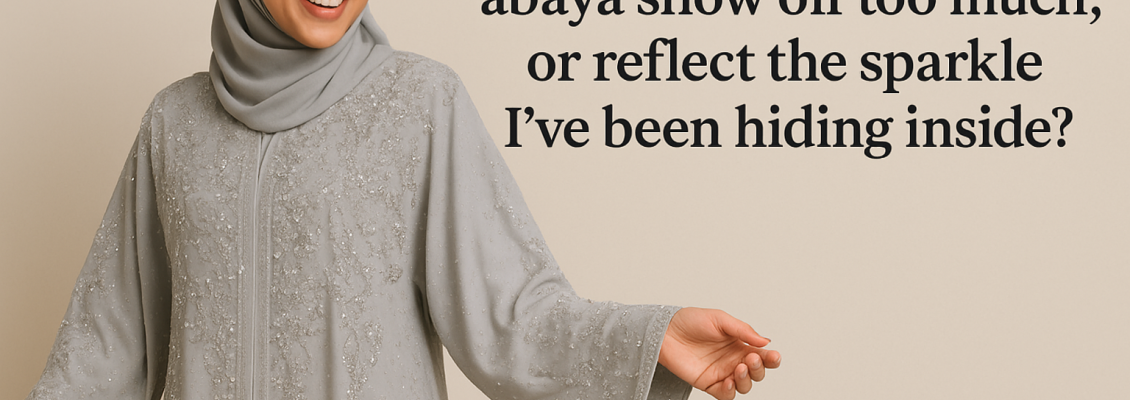
Bismillah. The morning light spilled through the blinds in a way that made the sequins on my abaya shimmer from across the room. It was a quiet moment, yet something inside me stirred. Not just the usual rush of fajr thoughts or a to-do list building — but something deeper, more tender. A memory? A wound? Maybe both.
It’s June 16th, 2025 — though the calendar never said it aloud, my heart knew it was time. Time to speak about something I’ve never fully voiced: this tension I carry between modesty and beauty, between concealment and expression. I’ve spent years choosing black over color, matte over shine, safe over soulful. And yet, when I ran my fingers along the delicate embellishments of the abaya hanging on my door… I wondered: what if this isn’t vanity? What if it’s healing?
This isn’t a post about fashion. It’s a post about freedom. About the feeling of walking into a masjid and wondering if your sisters see you as striving — or slipping. About the way we edit our shine to stay acceptable, even in sacred spaces. I don’t claim to have answers. But I’ve lived this. And I’m still learning.
So, if you’ve ever held an embellished abaya in your hands and wondered, “Is this too much?” — come walk with me. Let’s unravel the thread together, stitch by shimmering stitch.
Table of Contents
Why did I feel like even my embellished abaya made me too visible?I used to think modesty meant shrinking myself — when did that start?
Am I hiding behind plainness, or is it hiding me?
I saw a sparkle in the mirror, and for a moment, I was afraid it was mine
When did beauty become something I had to apologize for?
Can an embellished abaya carry both reverence and radiance?
My wardrobe was obedient — but was my heart suffocating?
I whispered du’a in the dressing room, wondering if Allah heard my confusion
Why do I feel guilty when I wear something I love?
Does my embellished abaya dishonor or dignify my niyyah?
Was I afraid of judgment, or afraid of being truly seen?
The day I chose the embellished abaya — and the voice in my head said “too much”
I never knew clothing could feel like a battlefield between dunya and deen
What does it mean to “shine” without seeking attention?
Every stitch in this embellished abaya felt like a reclamation
Am I adorning my soul, or just the surface?
I wore it for Eid, but it felt like I was finally honoring who I’ve become
Is it possible that my embellished abaya is part of my healing?
When I stopped dressing to disappear, I began dressing with ihsan
I used to fear being “extra” — now I fear being ungrateful
Could an embellished abaya be my quiet act of defiance against shame?
That moment a sister complimented me, and I realized I wasn’t alone
I don’t dress to impress — I dress to express gratitude
My embellished abaya didn’t change me — it revealed me
When I embraced beauty with humility, I finally felt whole
Frequently Asked Questions
People Also Ask (PAA)
Why did I feel like even my embellished abaya made me too visible?
I still remember the exact moment. I was standing at the edge of the sisters’ entrance at the masjid, my heart pounding under the weight of what should have been just fabric. My embellished abaya — black with soft silver detailing along the cuffs and a delicate shimmer around the neckline — suddenly felt louder than my voice. I hesitated before stepping in. Not because of the crowd. Not because of fear of Allah. But because I felt… seen. Too seen. And I didn’t know if that was okay.
For years, I thought modesty was about being unseen. Blending in. Minimizing. I was taught — both directly and indirectly — that to be a “good” Muslim woman meant to be quiet in both tone and presence. That anything extra was suspect. Anything beautiful might be mistaken for pride. Anything sparkly might attract “the wrong attention.” So I trained myself to disappear. I wore plain, oversized, unstructured abayas. Not out of joy — but out of fear.
But something shifted after I started healing. I began reading Qur’an not just for rulings, but for reminders of Allah’s mercy. I started seeing the stories of the Sahabiyat through new eyes — eyes that noticed strength, presence, and even grace. Khadijah (RA), the wealthy businesswoman. Aisha (RA), the scholar and teacher. They weren’t invisible. They were radiant. They were present. They were seen. But with purpose.
What was I really afraid of?
I had to sit with this question. Long and hard. Why did a few beads on my sleeves make me feel like I was doing something wrong? Was it because I feared Allah — or because I feared people? Was it because I didn’t want to be vain — or because I didn’t want to be talked about? Was I dressing for Allah… or dressing to avoid being judged by others who claimed to speak in His name?
These questions burned quietly inside me. And when I finally started writing about them in my journal, I realized the real tension wasn’t between the abaya and the deen — it was between my heart and my conditioning.
Modesty versus invisibility: A table of emotional contrasts
| Modesty (Haya') | Invisibility (Erasure) |
|---|---|
| Clothing chosen with intention and dignity | Clothing chosen to avoid criticism or suspicion |
| Desire to please Allah and express gratitude | Fear of people’s opinions and social policing |
| Balance between concealment and self-respect | Suppression of individuality to be “safe” |
| Rooted in tawakkul and spiritual self-worth | Rooted in insecurity, shame, and people-pleasing |
I had confused invisibility with righteousness. And the moment my abaya sparkled just a little — not in excess, not in arrogance — but just enough to reflect some of who I truly was… I felt that invisible wall shake. The wall that told me I couldn’t be beautiful and faithful. The wall that said femininity had to be hidden to be accepted.
The gaze of others… and the gaze of Allah
There is a deep, spiritual wound that many Muslim women carry — the feeling that our worth is conditional. That we are only “good” when we erase ourselves. That anything expressive is an invitation for scrutiny. I remember the way some aunties would look me up and down. The way their faces shifted when their eyes landed on the embroidery. The unspoken, “She thinks she’s something.” Or worse: “Astaghfirullah, that’s not modest.”
But I also remember standing in prayer that same day — after walking through that door with trembling legs — and realizing that none of those women knew my niyyah. None of them knew how I cried while buying that abaya. None of them knew how hard I worked to find something that felt like worship and self-love, wrapped in one. And yet… Allah knew.
He knew the nights I begged Him to help me love myself without ego. To help me heal from years of self-erasure. To help me feel like I belonged to this ummah even when I didn’t dress like a shadow. He knew. And in that moment, as I stood in sujood with my embellished abaya folded beneath me, I felt more hidden in Him than I ever had when hiding from people.
My abaya was not a performance. It was a prayer.
I didn’t choose it to impress. I chose it to express something sacred. A silent du’a stitched in silver thread: Ya Allah, let me be both humble and whole. Let me show up in the world without shrinking. Let me love the deen without losing myself.
If you’ve ever felt like your beauty was a threat to your iman, I want to tell you — it isn’t. Shaytan thrives on extremes. Either we worship our appearance or we run from it in shame. But Islam teaches balance. Ihsan. And if your abaya — embellished or simple — was chosen with sincerity and awe of Allah, then wallahi, you’re on the path. Even if you tremble.
A reflection for the sister who’s still unsure
- Do you dress to seek attention, or to reflect your gratitude?
- Do you fear standing out because of Allah, or because of others?
- Have you made space for Allah’s mercy in how you dress — not just His wrath?
- Have you asked yourself what you’re hiding — and what He might want you to honor?
The day I wore that embellished abaya, I didn’t become less modest. I became more honest. And that visibility I feared? Maybe it wasn’t about others seeing me. Maybe it was about me finally seeing myself — and choosing not to flinch.
Ya Allah, let our modesty never be rooted in fear, but in love. Let our beauty never be a weapon, but a whisper of Your perfection. And let our garments — embellished or not — be a means of nearness to You, not distance from each other.
I used to think modesty meant shrinking myself — when did that start?
It’s a question I only recently had the courage to ask myself — and not just rhetorically. I sat down with a blank journal page, stared at it for a long while, and finally wrote at the top: When did I first believe that being modest meant becoming small? The memories came quickly. Not all at once, but in sharp, vivid fragments. I remembered my first Jumu'ah in a long black abaya, the way I hunched my shoulders and avoided eye contact. I remembered someone telling me, “Mashallah, you look so pious now — like you don’t want to be noticed.” And I remembered how proud I felt. Not because I felt close to Allah, but because I had succeeded in disappearing.
That was the moment, I think. When I started confusing self-erasure with taqwa. And from that point on, my spiritual growth became tangled in a fear of being too much — too loud, too opinionated, too visible, too emotional, too... me.
Tracing the roots of quiet compliance
The seed was planted early. Maybe in a school assembly where I was praised for being “well-behaved” — code for silent. Maybe when I saw how girls who were expressive were called names, while those who blended in were respected. Maybe when I heard, “A good Muslim woman doesn’t seek attention” repeated so often that I believed the opposite must be true: that to be noticed at all was a spiritual fault.
By the time I was old enough to buy my own clothes, I had learned how to shop for invisibility. I instinctively reached for oversized, dull-colored garments — not because I liked them, but because they kept me safe. They allowed me to exist without explanation. And I called it modesty.
Modesty versus self-erasure: what I never questioned
| What I Believed Was Modesty | What It Actually Was |
|---|---|
| Wearing clothes that made me unnoticed | Choosing invisibility over intentionality |
| Staying silent in discussions, even if I had something to say | Suppressing my voice to avoid discomfort |
| Letting others lead so I wouldn’t seem bossy | Internalized guilt around feminine confidence |
| Avoiding any clothing with beauty or detail | Mistaking fear of judgment for piety |
But didn’t the Prophet ﷺ say modesty is part of faith?
Yes, he did. And I held onto that hadith like a lifeline. But I misunderstood it. Because no one ever explained to me that modesty (haya') isn’t about making yourself small — it’s about anchoring yourself in dignity. It’s not about disappearing; it’s about appearing with purpose. The Prophet ﷺ had haya’ — but he still stood up for truth. He still led. He still loved, laughed, wept, and grieved in public. His modesty never made him less. It made him more sincere, more present, more deeply connected to Allah and to others.
So where did I get the idea that a modest woman must shrink herself into silence? That her beauty — internal or external — must be hidden so thoroughly that she forgets it exists?
Was it Islam I was following — or the expectations of others?
It’s uncomfortable to admit, but I think much of my early practice of “modesty” was performative. I wasn’t dressing for Allah. I was dressing to avoid disapproval. I wasn’t quiet because I was spiritually grounded. I was quiet because I was afraid. And fear, no matter how sacred we dress it, does not bring us closer to Allah — it distances us from His mercy.
There’s a difference between humility and humiliation. One draws you closer to your Rabb. The other convinces you that you’re unworthy of being seen — even by Him.
Relearning modesty through love, not fear
Healing began when I started asking myself deeper questions:
- What would modesty look like if I trusted Allah more than I feared people?
- What if modesty wasn’t about shrinking, but standing with grace?
- What if I believed that Allah gave me beauty — inward and outward — not to flaunt, but not to bury either?
Slowly, I began to reclaim my choices. I allowed myself to wear a muted rose-colored abaya one day — nothing flashy, just a soft reminder that I didn’t have to live in grayscale. I smiled more freely. I allowed myself to speak up in halaqahs. To raise my hand. To disagree respectfully. To take up space in service of good. To trust that I could be visible without being vain.
What I wish someone had told me
If I could write a letter to my younger self, it would say this:
“Sweet girl, modesty is not about becoming invisible. It’s about becoming intentional. Don’t confuse humility with hiding. Allah created you with nur — don’t dim it to make others comfortable. Dress with dignity, yes — but also with joy. Speak with truth. Walk with purpose. Your presence is not a burden. It’s a gift. Own it.”
The path forward: integrating love and light into my modesty
Now, when I choose an embellished abaya, I no longer ask, “Will this make me too visible?” I ask, “Does this reflect the woman I am becoming — graceful, God-conscious, unafraid?” I let myself choose beauty that whispers instead of screams. I let my niyyah be my compass, not the imagined judgment of strangers. I make dua before I dress. I ask Allah to cover me in His mercy and guide me in His wisdom.
And I remind myself: I am not too much. I am not too visible. I am a Muslimah trying her best, walking the path of balance, guided by the One who sees my heart long before He sees my garments.
Modesty, I’ve come to learn, was never about shrinking. It was about standing in full awareness of the One I worship — with my soul clothed in sincerity, and my body in beauty that honors Him.
Am I hiding behind plainness, or is it hiding me?
There was a time when I thought wearing plain black abayas made me more righteous — more modest, more invisible, more “right” in the eyes of Allah. No embellishments, no colors, no textures. Just fabric that absorbed light and attention, like I hoped it would absorb my insecurities too. I believed that plainness was a badge of humility. But at some point, I started to wonder — was I really choosing simplicity for the sake of Allah… or was I hiding behind it because I didn’t feel worthy of being seen?
The distinction matters more than I ever realized. Because somewhere along the way, I started disappearing — not only from public spaces, but from myself.
The slow vanishing act: how plainness became my shield
It didn’t happen overnight. The shift was so subtle, I barely noticed it. One year, I was experimenting with soft blush tones and elegant cuts; the next, I had reduced myself to a uniform: black abaya, black khimar, minimal everything. And then I started shrinking in other ways too — turning down gatherings, not speaking up in circles of knowledge, hesitating to post anything online. Not because I was guarding my haya, but because I didn’t want to invite scrutiny.
I told myself it was piety. But deep down, I knew it was fear — fear of being misunderstood, of being called vain or attention-seeking, of failing to meet the impossible expectations placed on visible Muslim women. Especially those who choose to wear beauty with intention.
What does “plain” really mean, and why was I clinging to it?
| What I Thought Plainness Represented | What It Might Have Been Hiding |
|---|---|
| Spiritual humility | Deep insecurity and fear of judgment |
| Detachment from dunya | Lack of confidence in my own identity |
| Commitment to modesty | Misunderstanding of what modesty actually requires |
| Desire for simplicity | Fear of taking up space, literally and emotionally |
It’s sobering to admit this — but I wasn’t always dressing plain for Allah. I was dressing plain because I didn’t think I had the right to show up as someone beautiful, confident, or expressive. Even within the bounds of modesty. I thought it would be easier to avoid the risk altogether. But in the process, I silenced parts of my soul that yearned to connect, to express, to reflect the Divine artistry that Allah placed in all creation — including me.
Who told me that visibility was shameful?
I think many of us inherit this fear without realizing it. Maybe it’s the auntie who whispered, “She’s a little too stylish to be sincere.” Or the way society polices Muslim women’s modesty with a microscope — as if our garments must prove our piety, while our male counterparts are given room to be seen, speak, lead. Maybe it’s our own internal critic, sharpened by years of shame disguised as sincerity.
So we choose plainness — not from peace, but from panic. Not from connection to Allah, but from a desperate desire to not be seen the “wrong” way.
But what if I allowed beauty to be part of my ‘ibadah?
The turning point for me came in Ramadan last year. I had donated several gently-used abayas to a local revert support group, including a dusty lavender embellished abaya that I had never worn. A sister picked it out joyfully and said, “SubhanAllah, I’ve never felt so feminine in my life.” That stopped me in my tracks.
Why did I equate femininity with weakness? Or spiritual danger? Why did I assume that simplicity had to mean severity — that softness had no place in submission?
The Qur’an tells us, “Say: Who has forbidden the adornment of Allah which He has produced for His servants?” (Surah Al-A'raf, 7:32). That verse rattled something in me. I had been living as though my existence needed to be edited down — when Allah Himself had created me as a reflection of His mercy, His artistry, His intentionality.
Finding balance: what I’ve learned about dressing with depth
Today, I still value simplicity — but not at the cost of self-erasure. I still wear black, but now it’s sometimes embroidered or paired with a silk khimar. I still keep things minimal, but not as an apology. I’ve learned to ask myself:
- Am I dressing plainly out of spiritual clarity — or emotional hiding?
- Do I feel connected to Allah in what I wear — or disconnected from myself?
- Would I feel ashamed if someone complimented my outfit — or would I say “Alhamdulillah” and smile?
The answers are not always comfortable. But they are honest. And honesty is where growth begins.
My niyyah has changed — and so has my wardrobe
I no longer wear only what helps me disappear. I wear what helps me remember who I am — a servant of Allah, a woman of ihsan, a soul trying to reflect inner beauty outwardly in a way that is both modest and meaningful. Sometimes that’s a plain abaya. Sometimes it’s an embellished abaya that reminds me that Allah placed beauty in me, and that I am not sinful for reflecting it — so long as it’s done with intention, not ego.
I am learning that plainness is not a virtue in itself. It is only virtuous when it’s paired with sincerity. And sincerity sometimes means being seen. Not to show off, but to show up. To take my place in the world as a Muslim woman who doesn’t shrink — but who stands, softly and surely, in the shade of her Lord.
So no, I no longer hide behind plainness. And I no longer let it hide me. I choose what I wear — not out of fear, but out of love for the One who sees me always. Even when I couldn’t bear to see myself.
I saw a sparkle in the mirror, and for a moment, I was afraid it was mine
It happened in the quiet pause between Asr and Maghrib — that fragile moment when the day softens and the evening beckons. I was preparing for a small gathering with sisters, a time to share hearts and du’as, nothing grand but enough to stir a little joy in my soul. I reached for an embellished abaya tucked at the back of my wardrobe — a piece I had reserved for “special occasions” but rarely wore. Its delicate sequins caught the fading light, casting tiny reflections that danced on the walls like whispered promises. And then I caught my reflection.
For a moment, I didn’t recognize her. There was a sparkle in my eyes that I had not seen in a long time, and for the first time in ages, I felt a flicker of pride — but also a flash of fear. The sparkle was mine. And I was afraid of it.
Why was I afraid of my own light?
This question haunted me for days. Was I afraid that my sparkle would make me too visible? Too vulnerable? Did I worry that my radiance would draw unwanted attention or, worse, accusations of vanity? The very idea that my inner light — a gift from Allah — could be a source of fear felt both heartbreaking and deeply human.
For years, I had walked a tightrope between modesty and invisibility, believing that to be truly humble, I must dim every bright edge of myself. Yet, here I was, confronted with a reflection that suggested otherwise: that maybe humility didn’t mean hiding my light, but rather honoring it and channeling it with sincere intention.
The spiritual paradox of the embellished abaya
The embellished abaya had become a symbol for me — a paradox I wrestled with daily. On one hand, it felt like an invitation to express beauty, creativity, and dignity. On the other, it stirred insecurities about pride and exposure. It was as if each shimmering bead held a secret: a story of hope wrapped in hesitation.
| What the Embellished Abaya Represents | What I Felt Inside |
|---|---|
| A reflection of the Divine spark within me | Fear that I was being too bold or immodest |
| A form of self-expression aligned with faith | Worry that others might misjudge my intentions |
| A source of joy and confidence | Shame and doubt about my worthiness to shine |
| A reminder of Allah’s artistry | An inner voice telling me to stay small and unseen |
This tension is familiar to so many Muslim women. We are taught that beauty is a blessing, but also warned against arrogance. We are encouraged to adorn ourselves for our spouses and loved ones, but cautioned to avoid drawing “unnecessary” attention. The embellished abaya — with its subtle sparkle — became a battleground where my soul wrestled with these competing truths.
How I learned to embrace the sparkle as a form of worship
The breakthrough came not in an instant, but in small moments of prayer and reflection. I began to understand that the light Allah placed in me was not a temptation to be feared, but a trust to be nurtured. Modesty is not about erasing my shine, but about polishing it with humility and sincerity.
I asked myself: “Is this sparkle a form of arrogance, or a reflection of gratitude?” Slowly, the answer became clearer. When I wear my embellished abaya with the intention of honoring Allah’s gifts, of celebrating His creation without seeking praise from people, my light becomes an act of worship rather than display.
This shift in mindset was freeing. It meant I could wear my sparkle unapologetically, not for the eyes of the world, but as a testimony to the beauty that faith cultivates inside us.
Embracing the balance: humility and confidence
Finding this balance isn’t always easy. I still have moments of doubt, when the fear of judgment tries to dim my light. But I remind myself that sincerity is the key. The embellished abaya, like any outward expression, is only as pure as the intention behind it.
- Humility: I wear my abaya remembering that all beauty comes from Allah alone.
- Confidence: I accept that Allah made me to reflect His light uniquely.
- Gratitude: I cherish the chance to honor my body and soul through modest fashion.
- Connection: I use my sparkle to feel closer to my Creator and my sisters in faith.
The moment my fear transformed into faith
I remember that evening clearly. Standing before the mirror, I took a deep breath, whispered “Bismillah,” and smiled at the sparkle I saw. I wasn’t just seeing a shimmering abaya — I was seeing a woman rediscovering her dignity, her faith, and her joy.
The sparkle was mine. A gift. A reminder. A call to step into the light with grace.
And in that moment, I was ready to stop hiding — not just behind fabric, but behind fear — and begin truly reflecting the beauty Allah has placed inside me.
When did beauty become something I had to apologize for?
There was a time when beauty was pure and uncomplicated—a natural gift from Allah, something to be quietly cherished and humbly appreciated. But somewhere along the way, in conversations both whispered and loud, I began to feel as if my beauty was a burden I had to carry with shame. I learned, almost unknowingly, that showing my beauty—even modestly—meant inviting judgment, suspicion, or worse, accusations of vanity. When did beauty become something I had to apologize for? This question has echoed through my heart more times than I can count.
Growing up, modesty was taught as a shield. It was a way to protect myself from the harshness of the world and from the sometimes intrusive gaze of others. But this shield gradually felt heavier, as if beauty was a secret too dangerous to reveal, a treasure I had to lock away. I remember moments when I caught myself apologizing for wearing an embellished abaya — as if the delicate sparkle was a crime instead of a celebration of the Divine artistry within me.
The weight of cultural expectations and internalized modesty
The lines between cultural expectations and religious teachings often blurred. What started as sincere advice to “be modest” sometimes morphed into subtle messages that beauty equaled temptation, and that temptation was a fault. I began to feel responsible not just for my own actions, but for how others perceived me, as if my beauty carried consequences beyond my control.
This internalized modesty created an invisible cage. I learned to downplay my sparkle, to avoid drawing attention—even positive attention—because the fear of misunderstanding outweighed the joy of self-expression. It was a lonely place where beauty became a source of guilt rather than gratitude.
| Before | After |
|---|---|
| Beauty as a divine gift and a source of self-love | Beauty as a temptation and a reason for judgment |
| Wearing an embellished abaya with pride and joy | Feeling the need to apologize for any sparkle or shine |
| Confidence rooted in faith and gratitude | Insecurity fueled by fear of others’ opinions |
| Expressing identity through modest fashion | Suppressing self-expression to avoid criticism |
When modesty was mistaken for shrinking
I used to believe that modesty meant making myself smaller—less noticeable, less significant. This belief seeped into how I viewed my beauty. I convinced myself that to be truly modest, I must dim my sparkle, tone down my personality, and hide any hint of elegance or artistry. The embellished abaya, with its shimmer and grace, felt almost rebellious—like a loud announcement when I was supposed to whisper.
But over time, I realized that modesty is not about shrinking; it is about honoring and protecting what Allah has blessed me with. Modesty calls for respect—not self-denial. It invites me to express my faith and identity with dignity, not fear.
Reclaiming beauty as a form of worship
The turning point came when I understood that beauty, when embraced with the right intention, is an act of gratitude to Allah. It is a way of acknowledging His craftsmanship and the blessing of being created in His image. Wearing an embellished abaya is not about seeking attention; it is about celebrating the light Allah placed within me while remaining conscious of His guidance.
This mindset transformed how I see myself and my beauty. Instead of apologizing for my sparkle, I thank Allah for it. Instead of hiding behind plainness, I wear my abaya with pride and humility, knowing that true beauty shines from within and that my outer adornment is a reflection of my inner light.
- Beauty is a trust: It is entrusted to me by Allah to honor and protect.
- Intention matters: Wearing embellishments with sincere intention turns it into an act of worship.
- Confidence in faith: My confidence grows when rooted in tawakkul and gratitude.
- Rejecting shame: I refuse to let societal pressure make me apologize for Allah’s blessings.
How to balance beauty and humility in everyday life
Balancing beauty and humility is a delicate dance. It requires constant self-reflection and a heart connected to Allah’s guidance. Here are some practices that helped me embrace this balance:
| Practice | How It Helps |
|---|---|
| Daily du’a for sincerity (ikhlas) | Keeps intentions pure and focused on pleasing Allah alone |
| Reflection on Quranic verses about beauty and humility | Reinforces that beauty is from Allah and humility is a virtue |
| Seeking counsel from trusted sisters and scholars | Provides perspective and reassurance during moments of doubt |
| Mindful dressing with purpose | Transforms wearing embellished abayas into conscious acts of gratitude |
Letting go of the need to apologize
Ultimately, the day I stopped apologizing for my beauty was the day I reclaimed my identity as a Muslim woman who is proud, humble, and faithful. I learned to accept that my sparkle is a blessing, not a fault. It is not arrogance to shine when your light comes from Allah; it is a celebration of His mercy and artistry.
If you find yourself apologizing for your embellished abaya or any expression of beauty, sister, know you are not alone. Let us remind one another gently that beauty is a gift, meant to be honored, not hidden or denied. Together, we can redefine modesty — not as shrinking or apologizing, but as radiant, confident submission to Allah’s will.
When did beauty become something I had to apologize for? I don’t have all the answers, but I know this: beauty is not a sin. It is a sacred trust. And today, I choose to wear my embellished abaya with love, faith, and no apologies.
Can an embellished abaya carry both reverence and radiance?
The embellished abaya has long stood at a crossroads between tradition and modernity, modesty and expression, reverence and radiance. For many Muslim women, it poses a question that goes beyond fabric and design: Can an embellished abaya truly carry both reverence and radiance? Is it possible to honor the sacred essence of modesty while embracing the beauty and sparkle that come from subtle adornment? This question is deeply personal and spiritual, and it resonates in the hearts of countless sisters seeking to reconcile faith with self-expression.
The abaya itself is more than just clothing; it is a symbol. It represents a commitment to modesty, humility, and devotion to Allah, but also the individuality, creativity, and dignity of the woman who wears it. Embellishment, in this context, becomes a delicate dance: how to enhance without excess, to shine without arrogance, and to celebrate without compromising sincerity.
Understanding Reverence and Radiance
Before we dive deeper, it helps to clarify what we mean by reverence and radiance. Reverence is rooted in respect, humility, and a conscious awareness of the sacred. It is the solemn acknowledgment of Allah’s commands, and the mindful submission to His will in how we present ourselves to the world. Radiance, on the other hand, speaks to the light within us — a light that shines through joy, confidence, and the beauty Allah has instilled in His creation.
| Reverence | Radiance |
|---|---|
| Humility in presence | Confidence in identity |
| Respect for Allah’s guidance | Expression of joy and gratitude |
| Mindful restraint | Subtle celebration of beauty |
| Focus on inward spirituality | Manifestation of inner light outwardly |
On the surface, reverence and radiance might seem like opposing forces — one pulling toward concealment and humility, the other toward visibility and celebration. But they can coexist, beautifully and harmoniously, when grounded in the right intention and understanding.
The Embellished Abaya as a Medium of Balance
An embellished abaya is not inherently extravagant or immodest. The key lies in the style, intention, and context of wearing it. When chosen thoughtfully, it becomes a vessel that carries the values of both reverence and radiance, allowing a woman to express her devotion to Allah and her unique identity simultaneously.
Take, for example, an abaya adorned with delicate beadwork or subtle embroidery along the sleeves or hem—details that catch the light softly, not glaringly. Such embellishments highlight craftsmanship and artistry without overpowering the garment’s modest silhouette. The result is a graceful garment that honors tradition while acknowledging personal expression.
Why does this balance matter?
In the journey of faith, balance is vital. Overemphasizing reverence without allowing space for radiance can lead to a sense of suppression, of hiding away the light Allah placed within us. Conversely, leaning too much into radiance without reverence can cause a loss of humility and detachment from spiritual purpose. The embellished abaya, as a symbol, invites us to embody both, harmonizing outward appearance with inward devotion.
Personal reflections on wearing embellished abayas
When I first began wearing embellished abayas, I wrestled with the fear of appearing vain or drawing unnecessary attention. Yet, every time I wore one with a sincere heart, I felt a unique peace—a radiance that was quiet but undeniable. It wasn’t about seeking approval; it was about feeling aligned with my faith and honoring the beauty that Allah gifted me.
Through trial and reflection, I learned to view embellishment as an expression of gratitude, a way to uplift my spirit and inspire confidence without compromising humility. Each bead or sequined detail was a reminder of the intricate care Allah takes in creating all things, including me.
Practical tips for embodying reverence and radiance through your abaya
| Practice | How It Supports Reverence | How It Supports Radiance |
|---|---|---|
| Choose subtle embellishments | Maintains modesty and humility | Allows your beauty to gently shine |
| Wear with sincere intention | Ensures your adornment is for Allah’s pleasure | Fosters inner confidence and joy |
| Pair with simple accessories | Keeps focus on spiritual values | Enhances elegance without excess |
| Reflect regularly on intentions | Keeps you grounded in faith | Reaffirms your right to express your light |
What Islamic teachings say about balance and beauty
Islam teaches us that beauty is a blessing from Allah to be appreciated and honored responsibly. The Prophet Muhammad (peace be upon him) said: "Allah is beautiful and loves beauty." This hadith encourages us to embrace beauty in all forms—whether in nature, character, or dress—as long as it is within the boundaries set by Allah.
The Qur'an reminds us of the balance between modesty and adornment: "And say to the believing women that they should lower their gaze and guard their modesty; that they should not display their beauty except what is apparent of it..." (Surah An-Nur 24:31) This verse guides us to balance public modesty with personal dignity, leaving room for tasteful adornment that does not contradict the spirit of humility.
Conclusion: Embracing both reverence and radiance
Yes, an embellished abaya can carry both reverence and radiance. It is a living testament to the complex, beautiful journey of Muslim women navigating faith and self-expression. By embracing both qualities, we honor our Creator’s guidance and celebrate the light He placed within us. We step into the world with garments that reflect not only our commitment to modesty but also our unique identity and joy.
In every bead, every shimmer, there is a story—a story of balance, intention, and faith. And when we wear that story with sincerity, our embellished abayas become more than clothing; they become declarations of reverence and radiance united.
My wardrobe was obedient — but was my heart suffocating?
There was a time when my wardrobe followed every rule meticulously. Every abaya was carefully chosen to be plain, loose, and unassuming—strictly aligned with what I believed was “obedient” modesty. My clothes reflected a disciplined exterior, a commitment to faith that was outwardly visible. Yet, behind the fabric and folds, my heart often felt stifled, suffocated by invisible chains of restriction and unspoken expectations.
This conflict between external obedience and internal suffocation is one many Muslim women silently wrestle with. The garments we wear are not just clothes; they are expressions of identity, mood, and spirituality. When the wardrobe is obedient but the heart is suffocating, it signals a deeper struggle — a disconnect between how we present ourselves and how we truly feel inside.
The obedient wardrobe: What it looked like for me
My wardrobe was a catalog of dark colors, simple cuts, and minimal detail. No shimmer, no embellishment, no hint of sparkle. Every outfit was chosen with the intention to avoid any attention — good or bad. It was as if wearing something plain was synonymous with piety. But over time, this strict adherence felt less like devotion and more like a self-imposed prison.
| What I Wore | What I Felt |
|---|---|
| Plain black abayas without any decoration | Invisible and disconnected from my own beauty |
| Simple scarves in muted colors | Constricted, like I was hiding parts of myself |
| No accessories or personal touches | Emotionally restrained and isolated |
| Wore outfits to please others’ expectations | Empty, lacking joy and self-acceptance |
Why did my heart feel suffocated?
The root of this suffocation wasn’t the wardrobe itself, but the disconnect between my inner self and the external image I projected. My clothes became a mask that hid my feelings, creativity, and light. I was obedient to cultural and religious norms, yes—but I wasn’t being obedient to my own heart and soul.
This contradiction bred a quiet loneliness. I craved to wear something that reflected my personality and faith simultaneously. I longed for garments that could carry both my devotion and my dignity — clothes that allowed me to breathe spiritually and emotionally.
The emotional toll of suppressing expression
Suppressing my desire to express myself through my wardrobe took an emotional toll. It seeped into other areas of life: my confidence wavered, my joy dimmed, and my sense of self was fragmented. It felt like I was living in a shadow of my true potential, where outward obedience masked an inward struggle.
I remember looking in the mirror and feeling a disconnect between the woman I saw and the woman I felt inside. The obedient wardrobe was not a reflection of my vibrant, faith-filled soul; it was a shell that muffled my light.
How I began to reconcile obedience with joy
The turning point came when I started to understand that obedience in Islam is deeply connected to intention (niyyah) and sincerity (ikhlas). It’s not about wearing the darkest, plainest clothes to avoid all attention, but about dressing in a way that honors Allah, respects modesty, and nurtures the soul.
I began to experiment with subtle embellishments, softer colors, and fabrics that felt comfortable and beautiful to me. I learned that obedience does not mean suffocation — it means balance. When my wardrobe aligned with my heart, I found a newfound peace and confidence.
| Before | After |
|---|---|
| Wearing clothes to avoid attention | Wearing clothes to honor my faith and myself |
| Rigid and joyless outfits | Comfortable, beautiful, and meaningful attire |
| Feeling disconnected from identity | Feeling aligned with inner self and spirituality |
| Obedience felt like sacrifice | Obedience felt like devotion |
Lessons learned from this journey
- Obedience is a heart matter: True submission to Allah must include nurturing your emotional and spiritual well-being.
- Modesty is not monotony: It’s possible to be modest and still wear clothes that make you feel beautiful and alive.
- Self-expression matters: How you dress can be a form of worship when your intention is sincere.
- Balance is key: Seek harmony between external compliance and internal joy.
A final reflection
My wardrobe was obedient, but my heart was suffocating — until I learned that faith does not demand the dimming of my light. It invites me to shine, with humility and gratitude. My embellished abaya became more than a garment; it became a symbol of my journey toward authenticity, peace, and love for Allah and myself.
To every sister feeling this tension, know that your heart’s longing is valid. Obedience in Islam is not about restriction alone — it’s about freedom within divine boundaries. Let your wardrobe be a reflection of your faith and your soul’s beauty, both obedient and alive.
I whispered du’a in the dressing room, wondering if Allah heard my confusion
I still remember that moment vividly—the sterile lighting of the dressing room casting sharp shadows across the walls, the faint rustle of fabric as I slipped into yet another abaya. The mirror in front of me reflected more than just my image; it reflected the turmoil within my heart. With every glance, a question gnawed at my soul: Am I doing this right? Am I honoring Allah through what I wear, or am I lost in my own confusion?
In that quiet, almost sacred space, I whispered a du’a—my humble plea to Allah, hoping He would hear the trembling vulnerability behind my words. "Ya Allah, guide me. Show me the path to modesty that feels true, that protects my heart and honors You." But inside, I wondered if my whispered du’a could pierce the uncertainty, the fear, and the hesitation that clouded my mind.
The dressing room as a place of vulnerability
For many women, the dressing room is simply a practical space—a place to try on clothes before making a purchase. But for me, and for many Muslim women navigating modest fashion, it became a symbol of vulnerability. It is a liminal space where external appearance meets internal identity, where personal faith confronts cultural expectations and societal pressures.
In that small room, behind the curtain, I wrestled with conflicting feelings:
- Desire for beauty: I longed to wear something that made me feel radiant and alive.
- Fear of judgment: Would others see me as immodest or vain?
- Confusion about intention: Was I dressing for Allah’s pleasure, or to satisfy my own desires or societal norms?
- Yearning for authenticity: Could I find a style that truly reflected my faith and my soul?
Why did I feel so confused about modesty and fashion?
The confusion I felt was not just about fabric or fashion—it was about identity and spirituality. The lines between modesty and self-expression blurred, making every choice feel heavy with meaning and consequence. I realized that modest fashion is not a one-size-fits-all journey; it is deeply personal and shaped by many factors including culture, family, community, and individual understanding of faith.
This confusion is common among Muslim women worldwide, who must navigate multiple, sometimes contradictory messages:
| Source of Message | Message About Modesty | Impact on Women’s Choices |
|---|---|---|
| Religious Texts | Emphasize modesty to protect dignity and spirituality | Encourages wearing loose, non-revealing clothing |
| Family & Culture | Often promote traditional dress codes and colors | May limit experimentation or personal expression |
| Fashion Industry | Offers modern, embellished, and stylish modest wear | Provides new options but can create pressure to “look perfect” |
| Social Media & Peers | Showcase diverse interpretations of modesty | Can inspire but also cause comparison and doubt |
The role of intention in resolving confusion
What helped me most was remembering that Islam places profound importance on intention—niyyah. The Prophet Muhammad (peace be upon him) said: "Actions are judged by intentions." This meant that the clothes I wore were not inherently good or bad; what mattered was the heart behind the choice.
So in that dressing room, my whispered du’a became a moment to realign my heart’s intention with my faith. I reminded myself:
- To seek Allah’s pleasure above all else.
- To honor my body as an amanah (trust) from Allah.
- To choose clothing that reflects humility, dignity, and respect.
- To allow beauty and joy to coexist with modesty.
Learning to trust Allah’s guidance
As I stepped out of the dressing room, the confusion didn’t vanish instantly. But my du’a opened a door—a doorway to trust that Allah understands my doubts, my struggles, and my sincere efforts. It reminded me that faith is a journey, not a destination, and that Allah’s mercy and guidance are always near.
I learned that it is okay to feel unsure sometimes. It is okay to ask for help and seek knowledge. And most importantly, it is okay to grow and evolve in my understanding of modesty and self-expression.
Practical steps I took after that moment
| Step | Description | Impact on My Journey |
|---|---|---|
| Seeking Knowledge | Read Islamic teachings and consulted scholars about modesty and intention | Gained clarity on what truly matters in my dress and demeanor |
| Reflecting on Intention | Regularly made du’a and self-checks to align choices with faith | Fostered sincerity and peace in my fashion decisions |
| Experimenting Thoughtfully | Chose modest yet beautiful abayas with subtle embellishments | Found joy and confidence while maintaining reverence |
| Connecting with Supportive Community | Shared experiences with sisters navigating similar struggles | Received encouragement and reduced feelings of isolation |
Final reflections
That whispered du’a in the dressing room was a turning point—a small but profound moment of surrender and hope. It reminded me that Allah hears every whispered plea, every silent cry, and every heartfelt question. In moments of confusion, turning to Him is the greatest source of comfort and clarity.
To every sister who finds herself caught between tradition and modernity, humility and self-expression, fear and hope: your whispered du’a matters. Allah is near. He understands your heart, your confusion, and your sincere desire to walk the path of modesty with grace and authenticity.
Let us embrace our journeys, trusting that with every whispered du’a, we draw closer to the guidance and peace that only Allah can provide.
Why do I feel guilty when I wear something I love?
There’s a quiet ache that creeps in whenever I slip on an embellished abaya I truly adore—an unexpected guilt that whispers, “Is this too much? Am I showing off? Should I be more humble?” That feeling isn’t just about the fabric or the sparkle sewn onto it; it’s about the complex dance between love for beauty and fear of judgment, between personal joy and spiritual responsibility. It’s a tension many Muslim women feel deeply but rarely speak about aloud.
I want to understand this guilt because it’s not just a fleeting emotion—it shapes how I see myself, how I move through the world, and even how I relate to my faith. Why does loving what I wear sometimes feel like a burden? And how can I reconcile that love with a heart that strives for sincerity and humility in Allah’s eyes?
The roots of guilt: Between societal expectations and personal expression
In many cultures, modesty is often narrowly defined as a suppression of self—an erasure of personality, glamour, or visible joy. From childhood, many of us internalize messages that to be truly modest, we must shrink, fade, or hide our unique light. So when we wear something beautiful—like an embellished abaya that sparkles and catches the eye—we may instinctively feel that we’re stepping outside those boundaries.
The guilt arises because:
- We fear being misunderstood: That others will see our love for beauty as vanity or arrogance.
- We struggle with internalized judgment: Messages from family, community, or even self-criticism whisper that modesty means restraint, not celebration.
- We feel torn between faith and self: Loving beauty can feel selfish or contradictory to spiritual humility.
How guilt affects our spiritual and emotional well-being
When guilt attaches itself to something as personal as what we wear, it can quietly chip away at our confidence and peace. It breeds self-doubt and sometimes even shame. Instead of feeling joyful in our choices, we feel anxious, fearful of how we might be perceived.
Here’s a simple table that shows how this guilt might play out in everyday moments:
| Situation | Internal Guilt Response | Impact on Behavior |
|---|---|---|
| Wearing a richly embellished abaya to a family gathering | "Am I showing off? Should I have chosen something plainer?" | Feeling self-conscious, avoiding compliments, or second-guessing outfit choice |
| Receiving praise for modest fashion on social media | "Is this pride creeping in? Should I hide this joy?" | Deleting posts, hiding photos, or downplaying achievements |
| Choosing a luxurious fabric or embellishment | "Am I being wasteful or vain?" | Limiting self-expression, settling for duller options, suppressing creativity |
Finding peace through intention and self-compassion
The turning point for me was learning to return to niyyah—the intention behind every action. Islam teaches that what truly matters is the heart’s sincerity. When I wear something I love, I began asking myself:
- Am I seeking to honor Allah with this choice?
- Does this make me feel confident without arrogance?
- Am I expressing gratitude for the blessings Allah has given me?
- Does this help me engage with the world while maintaining humility?
Answering these questions honestly helped shift my perspective. Wearing an embellished abaya or any beautiful garment is not inherently wrong or prideful—it’s the intention and the heart behind it that define its value.
Balancing love for beauty with spiritual humility
Islam celebrates beauty—it is part of Allah’s creation and a source of joy. The Prophet Muhammad (peace be upon him) said, "Allah is beautiful and loves beauty." This means that loving to dress beautifully can be an act of gratitude and worship when done with the right mindset.
But it requires balance, self-awareness, and continuous reflection. Here are some practical ways I nurture this balance in my daily life:
- Regular du’a: Asking Allah to purify my intention and protect me from pride.
- Gratitude journaling: Noting moments when my clothing made me feel thankful for Allah’s blessings.
- Mindful dressing: Choosing garments that align with both modesty and joy, rather than just pleasing others or myself.
- Seeking sisterhood: Surrounding myself with women who uplift without judgment.
When guilt signals growth—and when it needs healing
Guilt is not always harmful. Sometimes, it signals a conscience awake to spiritual growth. It can prompt us to reassess and realign with our values. But unchecked, it can become paralyzing and toxic, leading to self-repression.
Recognizing this difference was liberating. I learned to listen to guilt as a guide, not a jailer:
| Guilt as a Guide | Guilt as a Jailer |
|---|---|
| Encourages reflection and intention-checking | Leads to shame and self-hate |
| Prompts sincere du’a and growth | Suppresses joy and creativity |
| Helps identify areas for spiritual improvement | Creates fear of judgment and isolation |
| Fosters humility and gratitude | Blocks self-acceptance and peace |
Final thoughts: Embracing the beauty of balance
I no longer see the guilt I feel when wearing something I love as a sign of weakness or failure. Instead, I recognize it as part of a sacred journey—a dynamic interplay between my love for Allah, my desire for modesty, and my natural human joy in beauty and self-expression.
If you’ve ever felt this same guilt, know you are not alone. It’s okay to love your clothes, your style, your sparkle. What matters is how you hold that love in your heart and how you turn it into worship and gratitude.
May we all find peace in this balance, trusting that Allah sees our intentions, loves our sincere efforts, and delights in the beauty He created within and around us.
Does my embellished abaya dishonor or dignify my niyyah?
This question has lingered in my heart for a long time—an inner dialogue that feels both sacred and heavy. When I stand before the mirror, draped in an embellished abaya that gleams softly under the light, I find myself asking: Does this garment honor the pure intention I hold inside, or does it betray it? Am I dignifying my niyyah, or inadvertently dishonoring it?
Niyyah—the sincere intention behind every action—is the heart of our worship and our identity as Muslims. It is the invisible thread that weaves our outward deeds into acts beloved by Allah. But how do we measure the alignment between what we wear and the sacred purpose behind it? Can a richly adorned abaya, sparkling with delicate embellishments, embody humility and reverence? Or does its beauty risk overshadowing the niyyah it carries?
Understanding niyyah: The foundation of our actions
In Islam, the Prophet Muhammad (peace be upon him) reminded us that “Actions are judged by intentions.” This means that the outward act—whether it is prayer, charity, or wearing a garment—gains its true value through the sincerity of the heart. Without niyyah, actions become hollow, merely ritualistic or showy.
So before I choose what to wear, especially when it’s an embellished abaya, I pause and ask myself:
- Why am I drawn to this particular abaya today?
- Is it to please Allah and feel confident in my modesty?
- Or am I seeking validation from others, even subconsciously?
- Does this garment help me embody humility or pride?
These reflections help me reconnect with the core of my faith and remind me that beauty and modesty are not opposing forces but can coexist when guided by pure intention.
When embellishment dignifies niyyah
An embellished abaya can be a powerful expression of dignity, faith, and gratitude. When chosen with mindful intention, it becomes more than just clothing—it is a manifestation of the blessings Allah has granted us, an outward symbol of our inward light.
Here’s how an embellished abaya can dignify niyyah:
- Celebrating Allah’s creation: Wearing beauty is a way to honor the artistry of the Creator and the gifts He has given us.
- Expressing gratitude: Choosing a garment that uplifts the spirit can be a quiet act of thanks for our health, modesty, and freedom.
- Uplifting confidence: Feeling dignified and respected can strengthen our resolve to maintain modesty in speech, behavior, and character.
- Inspiring others: Showing that modest fashion can be elegant and expressive may encourage sisters to embrace their identity without fear.
When embellishment risks dishonoring niyyah
However, if the heart’s intention slips away from Allah’s pleasure, an embellished abaya can unintentionally become a barrier rather than a bridge. When the focus shifts from niyyah to self-display, pride, or competing for attention, the garment’s beauty loses its sacredness and risks dishonoring our intention.
Signs that embellishment may be dishonoring niyyah include:
- Seeking approval: Wearing the abaya mainly to impress or attract attention from others.
- Feeling superior: Allowing the garment to become a tool for comparison or self-exaltation.
- Ignoring modesty: Choosing embellishments that draw excessive or inappropriate attention.
- Disregarding the heart: Neglecting du’a, humility, and reflection while focusing only on outward appearance.
Balancing beauty and niyyah: A personal checklist
Over time, I developed a simple checklist to evaluate whether my embellished abaya dignifies my niyyah or not. This helps me pause before dressing and reflect on my heart’s posture:
| Question | Signs My Niyyah Is Dignified | Signs My Niyyah Needs Re-alignment |
|---|---|---|
| Why am I wearing this abaya? | To feel grateful and modest, honoring Allah’s blessings. | To stand out or compete with others. |
| How do I feel while wearing it? | Peaceful, humble, and confident. | Anxious, prideful, or self-conscious. |
| Am I mindful of Allah’s gaze? | Yes, I remember that He sees my heart and intentions. | No, I focus more on others’ opinions than Allah’s. |
| Does this abaya inspire me to better myself? | Yes, it motivates me to embody modesty in actions and character. | No, it distracts me from spiritual growth. |
| Have I sought Allah’s guidance through du’a? | Yes, I ask Him to purify my intentions. | No, I rely only on my own desires. |
Stories from the heart: Realizing dignity in my choices
I remember one day when I wore a particularly beautiful embellished abaya to an Islamic gathering. At first, I felt nervous—was it too much? But I whispered a du’a, seeking Allah’s guidance, and reminded myself of my intention: to honor Him by presenting myself with dignity and confidence. Throughout the event, I felt a deep sense of peace. Compliments came, but they no longer unsettled me because my focus was on the niyyah behind the attire.
That experience became a turning point. I understood that dignity comes not from hiding beauty but from wearing it with a heart anchored in sincerity and humility.
Embracing the journey: Trusting Allah’s mercy and guidance
The path to aligning our outward expression with our innermost intentions is ongoing. There will be moments of doubt, moments of growth, and moments of reflection. It is natural to question whether our embellished abaya reflects our niyyah or not.
What comforts me most is the knowledge that Allah is Most Merciful and understands the sincerity in our hearts—even when our steps falter. By continually renewing our intention, asking for forgiveness, and striving for humility, we honor the spirit of niyyah.
In the end, my embellished abaya is not just a garment; it is a canvas on which I seek to paint my faith, my gratitude, and my commitment to walk humbly and beautifully in this world. The question is not whether the abaya itself dignifies or dishonors my niyyah—it is whether my heart, my intention, and my actions align with Allah’s pleasure.
May we all find peace in that alignment, wearing our beauty with sincerity, dignity, and faith.
Was I afraid of judgment, or afraid of being truly seen?
There was a moment, standing before the mirror, when I realized my hesitation wasn’t just about what others might think of my embellished abaya. It was deeper. It wasn’t just the fear of judgment—it was the fear of being truly seen. Not only by the world, but by myself. That vulnerability shook something inside me. Was I ready to confront the reflection, the sparkle, the fullness of who I am beneath the fabric and sequins?
This fear of being seen is subtle, yet powerful. Judgment is external—people’s whispers, stares, or assumptions. But being truly seen? That’s internal. It means allowing my soul to be visible, flaws and all, without the safety net of invisibility. The embellished abaya, with its shimmer and grace, threatens to unravel the carefully woven cloak of invisibility I’d worn for years.
The difference between judgment and being seen
It’s important to distinguish these two fears because they come from different places and require different responses:
| Fear of Judgment | Fear of Being Truly Seen |
|---|---|
| Concerned with others’ opinions and possible criticism. | Concerned with my own vulnerability and self-acceptance. |
| Can be managed by changing appearance or behavior. | Requires deep inner work and honesty with myself. |
| Often rooted in insecurity and social pressure. | Rooted in fear of exposure, authenticity, and shame. |
| May lead to hiding or conforming outwardly. | Calls for courage to embrace my true identity. |
For years, I lived caught between these two fears—modifying my clothes to avoid judgment, yet shrinking from the light that might reveal the real me. The embellished abaya brought this tension into sharp focus. It wasn’t just a piece of clothing; it was a mirror reflecting my struggle to be authentic.
Why am I afraid of judgment?
Judgment is a natural human fear. We seek acceptance and belonging, especially within our communities and faith circles. When I think about my embellished abaya, I remember the moments of hesitation—wondering if my sparkle might be seen as vanity, or if others would label me as ‘showing off.’ The fear of negative judgment made me question whether it was safer to blend into the crowd, to dress plainly, to avoid attracting attention.
This fear often stems from:
- The pressure to conform to certain standards of modesty that feel rigid or narrow
- Past experiences of criticism or harsh comments
- A desire to avoid gossip, whispers, or misunderstanding
- Uncertainty about what Allah truly accepts and loves
I’ve realized that while fear of judgment can sometimes protect us from careless harm, it can also cage our spirits and mute our unique beauty.
Why am I afraid of being truly seen?
The fear of being truly seen runs even deeper. It is the fear that if I peel back my layers, my imperfections, my doubts, and my dreams, I might be rejected—not by others, but by myself. It’s the fear of confronting my own worthiness and embracing my light fully.
This fear includes:
- Worrying that my true self isn’t enough
- Feeling vulnerable in my uniqueness and individuality
- Fear that acceptance from others is conditional, so I guard my true essence
- Uncertainty about embracing joy, beauty, and confidence without guilt
Wearing an embellished abaya challenged me to face this. It became a symbol of stepping into visibility—not just socially, but spiritually and emotionally.
How can I move from fear to freedom?
Acknowledging these fears was the first step toward healing. I found myself whispering du’as for courage and clarity, asking Allah to help me embrace the light He has placed within me without shame or fear.
Here are some reflections and practices that helped me transform fear into freedom:
- Remember Allah’s Mercy: Knowing He sees me fully and loves me unconditionally calms the fear of judgment.
- Practice self-compassion: Accepting my flaws and strengths as part of my divine design.
- Redefine modesty: Seeing it as authenticity and dignity, not just invisibility.
- Celebrate small acts of courage: Each time I wear my embellished abaya with intention, it becomes a victory over fear.
- Surround myself with supportive sisters: Community that uplifts rather than judges makes visibility safe.
The sparkle beyond the abaya
Ultimately, the embellished abaya is a metaphor for my soul’s journey from hiding to shining. It taught me that the fear of judgment can be real, but it doesn’t have to define me. And that being truly seen—by Allah, by myself, and by my sisters—is not something to dread, but to embrace with faith.
I’ve come to believe that true modesty is not about erasing my sparkle, but about letting it shine in a way that honors my Creator and my unique path. It’s about wearing my abaya, and my soul, with courage, grace, and love.
May we all find the strength to be seen fully, without fear, and to live authentically in the light of Allah’s mercy.
The Day I Chose the Embellished Abaya — and the Voice in My Head Said “Too Much”
I remember the exact shade of the abaya—deep charcoal with silver threads winding up the sleeves like delicate vines. It shimmered without being loud, graceful yet confident. My fingers lingered on the fabric in the shop as if they were asking it for permission. I held it up, admired the embroidery, then heard it—that voice. Not anyone around me, but the one inside. The voice I had unknowingly given authority over my self-expression. It whispered, “Too much.”
“Too much” what? Too beautiful? Too bold? Too confident? Too unlike the version of myself I was trained to present—modest, yes, but also muted. I looked around the boutique. No one was staring. No one said a word. But the louder the silence, the louder the internal guilt. I wasn’t just trying on an abaya—I was confronting the inner script that told me my radiance was only allowed in small, dim doses.
Where did the “too much” come from?
That phrase—“too much”—isn't mine. It was planted over years, watered by cultural expectations, religious interpretations, and internalized shame. Somewhere along the way, I began to equate modesty with invisibility. And whenever I tried to choose something that allowed even a glimmer of light, I heard the warning: “Stay small. Stay quiet. Stay hidden.”
| Sources of the “Too Much” Voice | How It Affected Me |
|---|---|
| Community norms around "proper" abaya choices | Fear of appearing vain or "attention-seeking" |
| Over-simplified religious messaging | Belief that beauty and piety must conflict |
| Internalized self-doubt and guilt | Second-guessing every joyful expression of self |
| Lack of positive female role models in faith spaces | No examples of women who embraced both elegance and spirituality |
Choosing the abaya anyway
I hesitated, heart pounding. Then, almost in defiance—or perhaps in longing—I took it to the counter and paid for it. The bag felt heavier than it should have. It wasn’t the fabric. It was the weight of choosing something my soul desired while still carrying the burden of guilt. I wondered: if Allah is beautiful and loves beauty, why am I afraid of mine?
Wearing that abaya for the first time felt like standing in a spotlight, even though it was subtle. No glitter. No rhinestones. Just enough shimmer to catch the sun in the right moment. I caught my reflection in a window and froze—not because I looked immodest, but because I looked… like me. The me I had been afraid to be.
When modesty is mistaken for erasure
I had been taught that modesty was about covering, about humility. But no one told me that modesty should never become erasure. That dressing with dignity should not require me to extinguish every spark of personality. That wearing a beautifully crafted abaya, with intention and grace, can be as much an act of devotion as a whispered du’a.
And yet, the voice still lingered. At the masjid, I worried I stood out. Among friends, I wondered if they'd think I was trying to impress. At home, I asked myself if I was really dressing for Allah or for some part of me I didn’t fully understand.
Quieting the voice, honoring the heart
Over time, I learned to question that voice. Not by silencing it with defensiveness, but by gently interrogating its source. I asked: Is this voice rooted in taqwa (God-consciousness), or is it rooted in fear? Is it guiding me toward sincerity or toward shame?
Here’s how I started shifting my inner dialogue:
- Reframe "too much": What if “too much” is actually “just enough” for me to feel confident and connected?
- Center intention: I began asking myself, “Why am I choosing this? What is my niyyah?”
- Embrace Allah’s names: Al-Jameel (The Beautiful) reminded me that beauty, when sincere and rooted in humility, is sacred.
- Seek balance, not approval: My goal shifted from pleasing people to honoring Allah and staying authentic.
Reclaiming the right to joy
Wearing that embellished abaya didn’t turn me into someone else. It allowed me to return to myself. A self who loves elegance without arrogance. A self who seeks approval from her Rabb, not the shifting standards of others. A self who believes that joy and spirituality can walk hand in hand.
I still hear the voice sometimes. But now I recognize it for what it is: a ghost of a version of me that was afraid to shine. And instead of shrinking, I exhale, adjust my abaya, and walk forward. Not to impress. Not to hide. But to simply be.
A final reflection
If you've ever held something beautiful in your hands and hesitated—fearing it was “too much”—know this: Your heart’s longing for joy, for grace, for visibility, is not a betrayal of your faith. It is part of it. As long as your intention is sincere, your beauty can be a reflection of the divine.
The day I chose the embellished abaya was the day I started choosing myself—not in vanity, but in truth. And that choice was not too much. It was finally enough.
I Never Knew Clothing Could Feel Like a Battlefield Between Dunya and Deen
I always thought choosing what to wear was a simple, practical decision—fabric, color, cut, comfort. But the day I began wearing the abaya with intentionality, I discovered something I hadn’t expected: a quiet war inside me. It wasn’t about fashion. It was about allegiance. Each outfit began to feel like a negotiation between who I wanted to be in this world (the dunya) and who I longed to be in the next (the deen). The battlefield? My own body.
I would stand in front of my wardrobe and feel torn—between elegance and restraint, visibility and humility, self-expression and submission. And often, the simplest decisions began to carry immense emotional weight. Could I wear this color without being “attention-seeking”? Could I wear this fabric without leaning into pride? Was my intention sincere—or subtly entangled with ego?
Clothing as a spiritual mirror
They say clothes don't define a person. But what if they reflect her struggle? With every thread and every embellishment, I realized I wasn’t just dressing for people—I was trying to align myself with Allah while navigating my presence in a world that often demanded contradiction.
To be seen without seeking attention. To be beautiful without being performative. To be confident without being prideful. These weren't just style choices. They were spiritual calculations.
| Aspect of Clothing | Dunya Pull | Deen Response |
|---|---|---|
| Color and Pattern | Desire for visual appeal, compliments, trends | Reflection on modesty, humility, and niyyah |
| Fabric and Texture | Luxury, status signaling, indulgence | Simplicity, accessibility, avoiding excess |
| Fit and Silhouette | Desire to flatter figure, feel attractive | Guarding one’s modesty and inner dignity |
| Accessories and Embellishment | Need for attention, uniqueness, admiration | Balancing self-respect with sincerity of worship |
The internal tug-of-war
It was like being pulled in two directions—one hand grasping for softness, style, and presence, and the other clinging to the rope of Allah, fearing misstep. And no matter what I wore, I could hear the whispers of both sides. “You’re being too flashy,” one would say. “You’re dimming your light,” said the other. I felt like I was constantly apologizing—for too much fabric or too little sparkle.
This conflict wasn't about what others saw. It was about what I feared Allah saw in my intentions. That maybe even when I dressed “right,” I was wrong inside. That maybe I couldn’t fully love something beautiful without crossing a boundary. And worst of all, that maybe loving fashion—even modest fashion—meant I loved dunya too much.
Reframing the battlefield
But slowly, I started to realize: this wasn’t a battlefield. It was a testing ground. And tests don’t always mean punishment—they often signal growth. Instead of seeing my closet as a war zone, I began to see it as a sacred space for reflection. Every choice became a moment of du’a, of introspection, of alignment. I started asking better questions—not “Is this too much?” but “Does this help me walk closer to Allah today?”
And in those moments, I learned that my love for aesthetics didn’t have to be in opposition to my deen. Islam doesn’t vilify beauty; it dignifies it when it’s worn with humility, intention, and gratitude.
- Yes, I could love an embellished abaya and still be spiritually grounded.
- Yes, I could enjoy elegant fabrics and still reject pride.
- Yes, I could take up space thoughtfully and still be modest.
Worship through beauty
The Prophet ﷺ himself appreciated beauty—he was known for his care in appearance, his preference for cleanliness and pleasant scents. Islam, in its essence, isn’t about stripping us of our humanity. It’s about elevating it. That includes the way we dress.
So now, when I feel that familiar anxiety—“Is this dunya or deen?”—I return to one truth: Allah knows my heart. And if my heart is seeking Him through every thread I wear, through every intention I check, then even fashion becomes a form of worship.
Letting the heart lead
Not every day is perfect. Some days I still overthink, still hear the old voices of guilt. But now, I offer that struggle to Allah. I say, “Ya Rabb, You know I’m trying.” I let my du’a echo in my choices. I remind myself that balance is not static—it’s a daily recalibration. And I remember that the battlefield was never outside—it was always in the space between my desires and my devotion.
And that’s okay. Because even in the tension, there is tenderness. Even in the struggle, there is submission.
The day I stopped fearing my love for clothing was the day I understood something deeper: that dunya and deen do not always have to be adversaries. Sometimes, with the right heart, the dunya becomes a vehicle for the deen.
What Does It Mean to “Shine” Without Seeking Attention?
For most of my life, I associated shining with being seen—being recognized, affirmed, celebrated. But somewhere along my journey with modesty, with my faith, and with the fabric that cloaked my frame, I began to question: What if shining isn’t about who sees you at all? What if it’s about who you are when no one is looking—especially when no one is looking?
As a Muslim woman, especially one who wears the abaya, I often stand at the crossroads of two seemingly conflicting ideas: modesty and radiance. Can a woman who veils herself still shine? Can she walk into a room with quiet dignity and still carry the presence of someone who belongs, who matters, who lights up the space?
The false binary of visibility vs. invisibility
The world teaches us to shine by being loud, bold, and front-facing. It teaches us that success looks like visibility, and that if you’re not noticed, you’re irrelevant. But Islam offers a different kind of shine—one that isn’t concerned with applause but with intention. It doesn’t ask you to hide your light; it asks you to purify its source.
I began to reflect deeply on this. I wanted to shine—but not at the cost of humility. I wanted to be seen—but not in ways that compromised my haya. I wanted to wear something beautiful—not to demand admiration, but to honor my self-worth.
| Form of “Shine” | Worldly Definition | Spiritual Redefinition |
|---|---|---|
| Confidence | Outspoken, dominant, always visible | Grounded, poised, anchored in tawakkul |
| Beauty | Maximized appearance, trend-aligned, performative | Cleanliness, dignity, self-respect with humility |
| Success | Titles, fame, wealth, public admiration | Ikhlas (sincerity), quiet excellence, barakah |
| Presence | Stage, spotlight, followers | Character, adab, integrity |
The abaya as a quiet glow
One day I wore an embellished abaya with delicate beadwork stitched along the cuffs and hem. It shimmered subtly when light caught it—nothing gaudy or extravagant, just enough to feel elegant. When I passed by a mirror, I paused. There was a glow. It startled me, and I had to ask myself: “Is this too much?”
That question has followed me more times than I can count. But slowly, I’ve realized that the question isn’t really about fabric or shine—it’s about my heart. Am I wearing this because I feel insecure and need praise? Or because it makes me stand straighter, softer, more sincere? The same abaya can either veil arrogance or reveal dignity, depending on the intention wrapped within it.
The Prophet ﷺ and the beauty of balance
The Prophet Muhammad ﷺ once said: “Allah is beautiful and loves beauty.” He was known to wear clean, presentable clothing, to enjoy perfume, and to appreciate elegance. Yet he was the humblest of people. His light came not from what he wore, but from who he was—and how deeply he connected to Allah.
This hadith changed how I saw myself. I didn’t have to dim my light—I had to refine it. I didn’t have to shrink—I had to root my radiance in sincerity. I could wear something that made me feel beautiful, but I had to be honest about why. Was I worshiping through it—or feeding my ego?
Signs of a woman who shines for Allah
- She walks with humility, but doesn’t hide herself in shame.
- She wears garments with dignity, not desperation.
- She speaks with gentleness, but her words carry weight.
- She prays in quiet corners, and it’s there her light is lit.
- She listens more than she demands to be heard.
- She forgives easily—not because she’s weak, but because she’s radiant.
The glow that needs no spotlight
The greatest shine I’ve ever felt didn’t come from my outfit. It came from sujood. It came after crying out to Allah in whispered du’a, after sacrificing something hard for His sake. It came from those unseen victories—when I chose patience over pride, or said nothing when I could have clapped back. That’s when I felt radiant.
And the beautiful paradox? When you stop dressing for attention, you begin dressing with real presence. When you stop speaking to impress, your words start holding meaning. When you shine from the inside out, people may not always notice—but the angels record every glimmer.
Letting yourself reflect Allah’s light
Islam doesn’t ask us to be invisible. It asks us to be intentional. It gives us permission to shine, as long as we shine for Him. And just like the moon reflects the light of the sun without producing it, we too can reflect the light of Allah in everything we do—in how we walk, speak, serve, and yes, even in how we dress.
So what does it mean to shine without seeking attention? It means to walk in a way that honors the divine light within you—not to be praised by others, but to please the One who sees all.
And that kind of shine? It doesn’t fade. It doesn’t fluctuate. It glows quietly, eternally—on the face of the one who has placed her trust, her love, and her identity in the hands of the Most Beautiful.
Every stitch in this embellished abaya felt like a reclamation
It didn’t happen all at once. Healing rarely does. But the day I slipped on that embellished abaya — the one with delicate gold thread tracing along the sleeves like whispered du’as, the one I had tucked in the back of my wardrobe for months — something in me shifted. It wasn’t loud. It was the quiet kind of shift, the type that feels like a gentle unbinding. I looked at myself in the mirror, and for the first time in a long while, I didn’t rush to turn away.
I had always associated embellishment with extravagance. With being “too much.” I was taught to guard my modesty — a lesson I took so deeply to heart that I began to fear beauty altogether. I confused humility with hiding. I believed the less seen I was, the more sincere my faith must be. But in doing so, I slowly erased parts of myself — my creativity, my femininity, my joy.
It was in the small details of this abaya that I began to reclaim them.
The Fabric of Memory and Intention
This wasn’t just an abaya. It was a story, hand-stitched. The hem reminded me of my grandmother’s sewing circles in Damascus, where women would gather with laughter and Qur’an recitation, threading more than fabric — threading legacy. The shimmering trim near the cuffs? It reminded me of the Eid mornings as a little girl, when my mother would dust perfume behind my ears and press a gold bracelet into my palm, saying, “You are no less radiant just because you are covered.”
Each thread felt like a strand of my own voice, woven back into me after years of silencing it.
Plainness vs. Presence: What Modesty Had Come to Mean
For so long, I equated modesty with invisibility. As if the more I muted my light, the more righteous I was becoming. But this abaya, this slightly glimmering, softly draping, soul-soothing piece of fabric — it didn’t make me less modest. It made me more present. Present with my Lord. Present with myself. Present with the parts of me I had neglected in the name of an image of piety I thought I had to uphold.
| Before Wearing the Embellished Abaya | After Reclaiming It with Intention |
|---|---|
| Fear of being seen | Comfort in being known by Allah |
| Compulsion to blend in | Permission to express sincerity through beauty |
| Internalized guilt around appearance | Gratitude for my body and being |
| Rigid interpretation of modesty | Holistic, heart-centered modesty |
Spiritual Reclamation Through Fabric
When I walked out in that abaya, no one gasped. The world didn’t stop. But I did. I paused. I stood a little taller. I walked a little slower. Because for the first time, what I wore reflected something that had been buried inside: peace. Beauty, not as performance, but as reflection. My intention was not to attract — it was to align.
And in that alignment, I found space for both humility and elegance. For both simplicity and celebration. For both taqwa and personal expression. This wasn’t rebellion. This was tawbah — returning to who I truly was beneath the shame, the fear, the societal whispers that said a woman’s light should be dimmed to be dignified.
The Du’a Woven Between the Seams
I remember making du’a before I wore it outside. “Ya Allah, let my clothing be a means of drawing closer to You, not away. Let this abaya, with its beauty and barakah, remind me that You are the source of all adornment.” I didn’t want attention. I wanted alignment. I didn’t want to turn heads. I wanted to turn my heart back to the One who gave me this soul — this soul that yearned to worship even in what I wore.
And that’s what made every stitch feel like a reclamation — because for the first time, I wasn’t dressing from fear. I was dressing from love.
When Sisters Noticed, They Didn’t Judge
I thought I would be met with side-eyes, quiet judgment, maybe even reminders to “tone it down.” But what I received was unexpected: sisterhood. One sister said, “You look like your du’a was answered.” Another hugged me and whispered, “You reminded me it’s okay to enjoy dressing again.” We weren't praising the abaya. We were witnessing each other return to our fitrah — to our love for ihsan (excellence) in all things, even in what we wear.
Final Thoughts: Modesty is Not Muting the Soul
Every stitch in that embellished abaya didn’t just reclaim my relationship with clothing. It reclaimed my relationship with myself, with femininity, with softness, with joy — and ultimately, with Allah. My niyyah was clear: to please Him, to honor what He gave me, to walk in this world as a servant not afraid to shine in His light.
So if you’re holding onto a piece in your wardrobe that you love, but you’re scared it says “too much,” ask yourself instead: does it reflect something Allah already placed within me?
Because maybe it’s not the embellishment that’s loud — maybe it’s just the sound of your soul waking up.
Am I adorning my soul, or just the surface?
I remember the first time I stood in front of the mirror wearing an embellished abaya that shimmered softly under the store lights. My heart swelled with a strange mix of joy and guilt. It was beautiful — undeniably so. The embroidery felt like a whispered dua stitched into every thread. But a voice inside whispered back, “Is this for your soul, or just your nafs?”
That question haunted me more than I expected. Because the truth is, modesty has always been more than a dress code to me. It’s been a compass, a shield, and at times… a hiding place. I wasn’t just trying to cover my body — I was trying to guard my heart. But somewhere along the way, I began to wonder if I was hiding behind plainness or if I was being hidden from myself entirely. When I started reaching for clothes that spoke to both my faith and my femininity, I found myself asking: am I beautifying my soul… or just decorating my reflection?
The Layers We Wear — Inside and Out
Let’s be honest: many of us were taught that anything too pretty, too sparkly, too "noticeable" meant we were drifting away from hayaa. But beauty, in Islam, is not forbidden. It’s a divine attribute — *Al-Jameel*, the One who is Beautiful. So where do we draw the line? And more importantly, who gets to draw it?
Here’s a reflection table I made one night in my journal, trying to make sense of my own intentions:
| Surface Adornment | Soul Adornment |
|---|---|
| Choosing an embellished abaya for external validation | Choosing an embellished abaya to honor my God-given femininity |
| Worrying more about trends than sincerity | Choosing fabrics and designs that feel aligned with my identity |
| Fearing judgment or seeking praise | Dressing with the intention to embody ihsan — beauty with purpose |
| Overthinking every choice because of others’ opinions | Choosing what brings sakinah to my heart and reflects barakah in my being |
I began to realize that the same garment can mean different things depending on the heart that wears it. For one sister, an embellished abaya may be an act of vanity. For another, it may be her quiet rebellion against years of erasure — a declaration that she, too, is allowed to be radiant while still being righteous.
My Niyyah Was the Turning Point
I had to confront my own niyyah. Was I adorning myself to be seen by others? Or was I responding to a whisper from within — a yearning to feel whole again? SubhanAllah, when I made the intention to wear beauty as a form of gratitude to Allah, everything changed. My clothes stopped being costumes, and started becoming calligraphy — writing stories of return across the fabric of my life.
We often forget that our Prophet ﷺ wore garments gifted to him, accepted fine cloth, and even wore a striped Yemeni cloak that had elegance. His ﷺ modesty was not in rejecting beauty, but in never using beauty to assert ego. That’s the balance I now try to seek — adorning the soul first, so that whatever touches the surface is simply a reflection, not a mask.
How I Know It’s for My Soul Now
- I check my intention every time I reach for something beautiful. Do I feel uplifted spiritually, or just inflated by vanity?
- I ask myself: will this help me walk into a space with dignity and humility — not demanding attention, but not denying my presence?
- I notice the afterglow: when I wear this abaya, do I remember Allah more? Do I carry myself with more sakinah and shukr?
When Beauty Becomes a Reminder
Now, when I wear my embellished abaya, I see it as a dhikr — a reminder that I am allowed to exist in light, not just shadows. That my femininity was never meant to be erased for the sake of piety, but rather refined through it. That Allah is not asking me to disappear — only to appear with sincerity, taqwa, and purpose.
I no longer believe modesty means dullness. I believe it means intentionality. I believe it means aligning our outer layers with our inner compass. And yes, sometimes — maybe often — it means wearing something beautiful, because it helps you remember that your soul was made by Al-Musawwir, the Fashioner of all creation. And beauty, when rooted in remembrance, is never superficial. It becomes a form of worship.
“Allah is Beautiful and loves beauty.” — Sahih Muslim
So the next time someone looks at my embellished abaya and wonders, “Isn’t that too much?” — I’ll smile gently, knowing that for me, it’s not too much at all. It’s just enough to remind me of who I’m becoming — not just on the surface, but in the depths of my soul.
I wore it for Eid, but it felt like I was finally honoring who I’ve become
There’s something about Eid morning that stirs the soul in a way nothing else does. It’s not just the smell of warm cardamom-laced kahwa or the echoes of takbir filling the house. It’s not just the flurry of messages from family, or the pressure of coordinating outfits. No — Eid is deeply personal. It is the soft exhale after a month of restraint. It’s the inward blooming of a soul that has been humbled, purified, and made tender by Ramadan.
This year, I chose to wear an embellished abaya for Eid. Not just any abaya — *the* one. The one I had seen in the boutique months ago and walked past several times, whispering, “Maybe next year.” It shimmered with muted gold thread along the sleeves and hem, with delicate hand-stitched beads that caught the light just enough to feel alive — not loud. It wasn’t extravagant. But it was intentional. And when I finally wore it for Eid, it didn’t feel like just a choice of clothing. It felt like a choice to honor who I had become.
A Dress That Reflected an Inner Journey
I had spent so long trying to shrink myself under the guise of humility. I thought piety meant invisibility, that faith looked like restraint in all its forms — including self-expression. But this abaya helped me realize that Allah doesn’t ask us to dim our light; He asks us to redirect it. And for me, this shimmer wasn’t vanity. It was remembrance.
Wearing it wasn’t about showing up for others — it was about showing up for myself. After a month of reflecting on my intentions, my habits, my heart — I felt ready to mark the moment with beauty. With softness. With something that felt like *me*. And for the first time, I felt no guilt about it. Just gratitude.
My Eid Outfit vs My Inner Self: A Table of Alignment
| Outward Expression | Inward Reflection |
|---|---|
| Embellished gold thread | Confidence in the woman I am becoming |
| Flowing silhouette | Ease in my own skin and identity |
| Soft chiffon layer | A softened heart after a month of worship |
| Delicate beading | Intention woven into every choice I made |
We often separate the “dunya” from the “deen” in our lives, but that morning, everything felt integrated. I had just completed Ramadan with sincerity, if not perfection. I had whispered more duas than I could count — some tearful, some hopeful. I had turned inward, repeatedly asking Allah to soften what had become hardened. And on Eid, I felt that inner work needed to be reflected, if only subtly, on the outside. My clothing became a translation of my soul.
The Sacredness of Celebrating Growth
Many of us struggle to celebrate ourselves, especially as Muslim women. We’re taught to serve, to sacrifice, to stay modest — and rightly so. But sometimes, those teachings get tangled up with guilt. We forget that joy is a form of ibadah too. That celebrating what Allah has brought us through is not arrogance — it’s gratitude.
On Eid, I didn’t just wear something beautiful. I claimed the space I used to avoid. I walked into the musalla with peace in my step. Not because I thought I looked good — but because I felt aligned. I had been through valleys in my iman, wrestled with questions about modesty and expression, and I came out more rooted, not less. That’s what I was honoring.
“Indeed, with hardship comes ease.” (Qur’an 94:6)
This verse echoed in my mind all day. That abaya — with its shimmer and flow — felt like the “ease” that followed the hardship. It felt like Allah giving me permission to feel radiant again, not because I earned it, but because He is merciful.
The Voice in My Head Was Quiet For Once
Usually, whenever I wear something even slightly special, that inner voice chimes in: “Too much.” “Who are you trying to impress?” “This isn’t modest enough.” But on that Eid morning, the voice was quiet. Or maybe it had finally evolved. Because deep down, I knew I wasn’t doing this for approval. I wasn’t performing. I wasn’t competing. I was simply honoring the woman I had prayed to become — the one who could finally see beauty as a gift, not a threat to her spirituality.
Eid Is for Celebrating Mercy — Including Mercy to Ourselves
One of the greatest gifts Islam gives us is a rhythm of renewal. We fast and break fast. We restrain and then celebrate. We humble ourselves before Allah, and then we step into His generosity. So why not wear something that honors that entire spiritual cycle?
That embellished abaya wasn’t “too much.” It was a small gesture of celebrating Allah’s mercy. It was a way to say: I am still here. I am still trying. And I am thankful.
Next Eid, I might wear something simpler. Or maybe not. But what matters most is the niyyah behind it — the quiet knowing that I’m no longer dressing to disappear, nor dressing to impress. I’m dressing to honor growth. To mark transformation. To give thanks to the One who brings beauty even out of our most difficult seasons.
Because sometimes, the most modest thing we can do is walk in our truth — with grace, with gratitude, and yes, even with a little shimmer.
Is it possible that my embellished abaya is part of my healing?
When I first held that embellished abaya in my hands, the delicate fabric shimmering under the soft boutique lights, I couldn’t help but wonder: could this garment actually be part of my healing journey? It felt almost surreal to consider that something as outward as clothing—often seen as superficial or even contradictory to modesty—might hold such profound significance. But as I reflect deeper, I realize that healing is rarely a straight path; it is multi-layered, encompassing the body, the mind, the heart, and yes, even the way we present ourselves to the world.
Our clothes, especially for Muslim women, carry so much more than just physical coverage. They are woven with cultural meanings, spiritual intentions, personal histories, and emotional responses. For me, the embellished abaya came to symbolize more than fabric and thread—it became a tangible marker of transformation, courage, and reclaiming my identity.
Healing Through Expression: Why Clothes Matter
Healing is about reclaiming agency, about stepping back into the fullness of who we are after trauma, shame, or long-held doubts. It’s about honoring the parts of ourselves that may have been hidden or silenced. And clothing can be one of the most powerful tools in this reclamation.
Consider this:
- Clothing communicates identity. It’s a language without words that tells the world who we are, or who we want to be.
- Clothing can foster self-respect. Choosing to wear something meaningful can remind us of our worth.
- Clothing can be a physical boundary. It creates a safe space around our bodies where we feel protected.
When I wear my embellished abaya, I am not just dressing up—I am declaring, “I am healing. I am worthy. I am seen.”
What Healing Looks Like: A Reflection Table
| Healing Aspect | Traditional View | My Experience with the Embellished Abaya |
|---|---|---|
| Emotional Healing | Often internal and private, involving prayer, therapy, or reflection | Externalized in the choice to embrace beauty and softness without shame |
| Spiritual Healing | Renewed connection with Allah through worship and patience | Visual expression of faith and gratitude through intentional adornment |
| Social Healing | Rebuilding relationships and boundaries | Walking confidently in community while honoring personal growth |
| Self-Image Healing | Often a slow rebuilding of confidence | Immediate affirmation through wearing a garment that feels both modest and radiant |
The Journey from Pain to Permission
Before this, my relationship with clothing was fraught with contradictions. On one hand, I longed to feel beautiful and seen; on the other, I wrestled with guilt and fear of judgment. Healing required that I give myself permission to embrace the parts of me I had buried beneath layers of plainness and doubt. My embellished abaya became the physical manifestation of that permission.
Wearing it was an act of self-compassion. It was saying, “I am allowed to celebrate my journey. I am allowed to shine with humility and grace.” Each bead and stitch reminded me that healing doesn’t mean perfection—it means embracing wholeness, including the desire for beauty and expression.
Breaking Free from Old Narratives
Our cultural and religious teachings sometimes inadvertently link modesty with invisibility. But healing demands that we rewrite those narratives for ourselves. I began to understand that modesty is not about erasing myself, but about honoring both my inner and outer worlds authentically.
My embellished abaya was a tool for breaking free from shame-based thinking. It helped me redefine modesty on my own terms—not as suppression but as empowerment. This shift was essential for healing old wounds related to body image, societal expectations, and self-worth.
How Healing and Modesty Coexist
Many ask, “Can embellishment be modest?” The answer lies in intention and heart. Modesty is as much an internal state as an external one. When my embellished abaya reflects my sincere intention to honor Allah, respect myself, and serve as a witness to my growth, it becomes an extension of my healing.
To better understand this balance, here’s a simple guide:
| Element | Healing Aspect | Modesty Principle | How They Intersect |
|---|---|---|---|
| Choice of Fabric | Soft textures that soothe the skin and soul | Opaque and non-revealing | Comfortable yet respectful fabrics that foster self-love |
| Embellishment | Subtle sparkle that brings joy | Not flashy or provocative | Delicate details that reflect inner beauty without seeking attention |
| Fit and Silhouette | Loose, flowing shapes that promote ease and confidence | Non-tight and non-body revealing | Balance of elegance and modesty to express healing dignity |
| Color | Soft, comforting hues that uplift | Not overly bright or distracting | Colors that nourish the spirit and honor modesty |
Wearing Healing, Every Day
My embellished abaya isn’t just reserved for special occasions. Sometimes, wearing it for a simple outing feels like wrapping myself in a warm embrace. It’s a reminder that healing is ongoing. That progress is not linear. That every day holds the potential to choose love over fear, light over doubt.
For me, this abaya symbolizes that healing isn’t just about what happens inside therapy rooms or during heartfelt duas—it can also be found in the ordinary acts of self-care and self-expression. It’s a declaration that my journey matters, my body matters, and my spirituality is alive and evolving.
In Conclusion
Is it possible that my embellished abaya is part of my healing? Absolutely. It is a garment infused with intention, growth, and mercy. It carries my story, my struggles, and my triumphs in every thread. Wearing it reminds me that healing can be beautiful and visible, modest yet radiant. It teaches me that faith and self-love are not at odds but deeply intertwined.
So, if you find yourself hesitating to embrace the sparkle, the softness, the adornment — know that it might just be a step toward your own healing too. Sometimes, the most profound recovery is wrapped in fabric, stitched with care, and worn with a heart open to grace.
When I stopped dressing to disappear, I began dressing with ihsan
For years, my relationship with clothing was shaped by one dominant impulse: to disappear. To blend into the background so completely that no one would notice me. I thought this was the essence of modesty — to minimize my presence, to make myself small, invisible even. But that urge to vanish, to cloak myself in plainness and self-denial, gradually started to feel like a cage. It limited not only my wardrobe but my spirit.
It took time, self-reflection, and spiritual growth to realize that modesty does not mean erasing myself. Instead, it means embodying ihsan — excellence and beauty in how we present ourselves, in alignment with our faith and values. When I shifted from dressing to disappear to dressing with ihsan, everything changed. I found freedom, confidence, and a deeper connection to my faith.
What is Ihsan?
The word ihsan is rooted deeply in Islamic spirituality. It means to do something with excellence, beauty, and sincerity, going beyond the minimum required. The Prophet Muhammad (peace be upon him) defined ihsan as “to worship Allah as if you see Him, and if you cannot achieve this state of devotion, then know that He sees you.” It is a call to embody beauty in all acts, including how we present ourselves to the world.
Applying ihsan to clothing means dressing with intentionality — honoring our bodies, our faith, and our surroundings. It means choosing garments that reflect not only modesty but also respect for ourselves and others.
The Burden of Disappearing
Dressing to disappear often stems from fear — fear of judgment, fear of attention, fear of not being “good enough.” I recall countless moments when I deliberately chose dull, shapeless clothes, hoping they would erase me from sight. I wanted to avoid any hint of vanity or pride. But in doing so, I felt fragmented — disconnected from the joy of self-expression and the dignity of honoring myself as a creation of Allah.
This table outlines the difference between dressing to disappear and dressing with ihsan:
| Aspect | Dressing to Disappear | Dressing with Ihsan |
|---|---|---|
| Intent | To avoid notice, minimize presence | To honor Allah, oneself, and others with beauty and sincerity |
| Emotional Impact | Shame, invisibility, self-denial | Confidence, peace, self-respect |
| Relationship to Self | Disconnection, suppression | Integration, celebration |
| Relationship to Others | Withdrawal, fear of judgment | Openness, humility |
| Spiritual Connection | Obligation without joy | Devotion with beauty |
Discovering Ihsan Through My Embellished Abaya
When I chose to wear my embellished abaya, it was a turning point. Instead of hiding, I was embracing. Instead of shrinking, I was shining — not for vanity, but with ihsan. The gentle shimmer of the beads, the flowing fabric, the careful craftsmanship — all spoke to a deeper truth that modesty and beauty are not mutually exclusive.
Dressing with ihsan means recognizing that Allah appreciates beauty and that taking care of one’s appearance is a form of gratitude for the body He has blessed us with. It means that every stitch, every sparkle, every fold of the abaya carries intention and love.
How Dressing with Ihsan Transforms Our Mindset
Before, I saw modest clothing as a limitation — a series of rules designed to restrict my freedom. After embracing ihsan, modesty became a canvas for creativity, spirituality, and self-love. This transformation reshaped how I saw myself and how I interacted with the world.
Here’s how dressing with ihsan can transform different areas of our life:
| Area of Life | Before: Dressing to Disappear | After: Dressing with Ihsan |
|---|---|---|
| Self-Perception | Insecurity, self-criticism | Confidence, acceptance |
| Spiritual Practice | Obligation, routine | Joy, intention |
| Social Interaction | Withdrawal, fear | Engagement, humility |
| Personal Style | Monotony, blandness | Expression, creativity |
The Balance Between Visibility and Humility
Dressing with ihsan is not about seeking attention or pride. It is a delicate balance between honoring oneself and maintaining humility. It’s about being present in the world authentically, not as a shadow, but as a light — a light that reflects the beauty of faith and character.
Through this lens, my embellished abaya is neither too much nor too little. It is exactly what I need to express my spiritual and personal growth. It is a manifestation of my commitment to live with excellence, sincerity, and beauty — both inside and out.
Practical Tips for Dressing with Ihsan
If you’re wondering how to begin this journey, here are some practical reflections to guide you:
- Set your intention. Ask yourself why you choose each garment. Is it to honor yourself and Allah?
- Choose quality over quantity. Focus on pieces that reflect your values and make you feel dignified.
- Embrace creativity. Find modest ways to express your personality and joy through colors, textures, and details.
- Practice self-compassion. Let go of shame or fear tied to appearance; instead, celebrate your journey.
- Remember humility. Ihsan involves excellence with humility — let your beauty be a reflection of your inner light, not vanity.
Conclusion
When I stopped dressing to disappear and began dressing with ihsan, I stepped into a new chapter of self-love, spiritual depth, and authentic expression. The embellished abaya became more than a garment — it became a symbol of excellence in faith, a celebration of my identity, and a beacon of inner and outer beauty.
Dressing with ihsan invites every Muslim woman to reclaim her power, dignity, and grace without compromising her values. It reminds us that modesty is not about hiding but about honoring — honoring our souls, our faith, and the unique light that Allah has placed within each of us.
I used to fear being “extra” — now I fear being ungrateful
Growing up, I often heard warnings against being “extra.” To stand out too much, to draw attention, or to indulge in anything flashy was seen as a form of vanity or arrogance. The cultural messages, intertwined with my personal insecurities, led me to fear anything that seemed “too much.” This fear shaped my choices in how I dressed, acted, and even how I expressed joy or pride in my achievements. I shrunk myself, dimmed my light, and tried to blend into the background, all in an effort to avoid judgment or shame.
But as I’ve grown spiritually and emotionally, that fear has transformed into something deeper and more profound. I no longer fear being extra; instead, I fear being ungrateful. I fear not recognizing or appreciating the blessings that Allah has bestowed upon me, including the gift of beauty, creativity, and the ability to express myself. This shift has changed everything about how I approach my embellished abaya, my faith, and my relationship with myself.
The Fear of Being “Extra” — Origins and Impact
To understand this transformation, it’s important to explore where the fear of being “extra” comes from. It is often rooted in:
- Modesty misunderstood: The idea that modesty means plainness or invisibility rather than balance and respect.
- Social pressure: Fear of judgment from family, community, or peers who equate simplicity with piety.
- Internalized shame: A feeling that expressing joy or beauty might be selfish or prideful.
These influences created an environment where expressing myself fully felt risky. I learned to equate “extra” with negative traits like arrogance or frivolity. This often meant settling for less — less color, less embellishment, less confidence — in order to avoid criticism.
The Shift: From Fear of “Extra” to Fear of Ungratefulness
Over time, through prayer, reflection, and learning, I began to see a new perspective. The ability to wear something beautiful, like my embellished abaya, is a blessing — a form of rizq (provision) from Allah. To hide or reject that blessing out of fear felt like denying His generosity.
Instead of fearing to be “extra,” I started fearing that I might be ungrateful — that I might fail to appreciate the richness of my life and the gifts I have been given. This realization was liberating. It allowed me to embrace my love for beauty, art, and self-expression as acts of gratitude rather than indulgence.
Comparing Fear of “Extra” vs. Fear of Ungratefulness
The following table contrasts these two fears to illustrate how this transformation has reshaped my mindset and actions:
| Aspect | Fear of Being “Extra” | Fear of Being Ungrateful |
|---|---|---|
| Motivation | Avoid attention, judgment, criticism | Express thanks, honor blessings, celebrate gifts |
| Emotional State | Anxiety, self-doubt, shame | Joy, humility, peace |
| Relationship to Appearance | Minimization, plainness, hiding | Embracing beauty, celebrating self |
| Spiritual Outlook | Modesty as restriction | Modesty as gratitude |
| Effect on Confidence | Lowered self-esteem | Empowered self-love |
How This Fear of Ungratefulness Changed My Wardrobe and Mindset
My embellished abaya, once a source of anxiety, became a source of spiritual joy. Wearing it was no longer about showing off or seeking approval; it was about honoring the blessings Allah has bestowed upon me — my creativity, my health, my identity as a Muslim woman.
This change in mindset helped me navigate difficult questions like:
- Is it wrong to enjoy beauty?
- Can modesty coexist with elegance?
- How do I balance humility with self-respect?
The answer lies in intention and gratitude. When I put on my embellished abaya with a sincere heart, I am not being “extra” in a negative way; I am embodying gratitude and ihsan, excellence in all I do.
Reflection: Gratitude as a Source of True Modesty
Gratitude transforms modesty from a list of prohibitions into a vibrant practice of appreciation. It encourages me to see my outward appearance as a reflection of inner blessings. This shift allows me to embrace my identity fully — including my love for embellishment and beauty — without guilt.
In fact, gratitude opens the door to more authentic modesty because it acknowledges the divine gifts we have been given, rather than hiding them out of fear.
Practical Ways to Cultivate Gratitude Through Clothing
- Mindful selection: Choose clothes that make you feel thankful and dignified.
- Intention setting: Before dressing, remind yourself of the blessings your clothing represents.
- Reflect on purpose: Recognize that dressing well can be an act of worship when done with the right heart.
- Share blessings: Use your style to inspire others, support ethical fashion, or give charity.
- Practice humility: Let your outward beauty be balanced with inner modesty and kindness.
Conclusion
The journey from fearing to be “extra” to fearing being ungrateful has been profound and healing. It taught me that modesty is not about shrinking or hiding but about expressing gratitude for the gifts Allah has granted us. My embellished abaya is a daily reminder to celebrate these blessings and to wear them with sincerity, humility, and joy.
May we all find peace in embracing our beauty as a reflection of Allah’s mercy, and may our hearts be filled with gratitude for every stitch, every sparkle, and every moment we get to shine — not for ourselves, but for the glory of the One who created us.
Could an embellished abaya be my quiet act of defiance against shame?
Shame is a quiet but heavy companion for many Muslim women. It often creeps into our thoughts about how we present ourselves in the world—how we dress, how we carry ourselves, and how visible we allow ourselves to be. For me, shame was an invisible barrier that whispered that to be noticed, to be adorned, or to express joy through my clothing was somehow wrong, immodest, or attention-seeking in a way that deserved censure.
And yet, here I am, wrapped in an embellished abaya—intricately decorated, sparkling softly under the light—wondering if this very act of wearing something so visibly beautiful could be my quiet rebellion. Could this garment, laden with stitches and shimmering details, be my subtle but powerful refusal to let shame dictate my self-worth or my relationship with beauty?
The Weight of Shame: A Historical and Cultural Context
Shame in relation to women’s bodies and appearance is not new. Across cultures and centuries, female expression through dress has been policed and scrutinized, often by patriarchal standards that aim to control rather than celebrate. Within many Muslim communities, modesty (haya) is deeply valued and rightly emphasized, but shame can sometimes distort that value into a weapon — one that shames women into shrinking, hiding, or disavowing parts of themselves that seek expression or joy.
My embellished abaya stands in tension with these forces. It challenges the unspoken rule that modesty means invisibility, dullness, or the denial of beauty. Instead, it whispers of a different possibility: that beauty and modesty are not enemies, but companions that can coexist with dignity and purpose.
Understanding Defiance and Its Forms
Defiance does not always roar; sometimes it is a soft whisper, a subtle act that quietly changes the narrative. My embellished abaya is one such act. By choosing to adorn myself with something beautiful and noticeable, I am quietly refusing to accept the narrative that beauty should be hidden or that my desire to express myself is shameful.
| Aspect | Traditional Expectation | Quiet Act of Defiance |
|---|---|---|
| Expression | Keep it plain, unobtrusive | Embrace embellishment as art and joy |
| Visibility | Avoid standing out | Shine softly with dignity |
| Self-Worth | Quiet self-effacement | Celebrate inherent worth through adornment |
| Community Pressure | Conform to expectations of plainness | Honor personal choices respectfully |
| Relationship with Modesty | Modesty equals invisibility | Modesty embraces beauty with intention |
Shame’s Impact on My Relationship with Clothing
Shame made me hesitant to buy or wear anything that felt “too much.” I would second-guess my choices, wonder if people would think I was showing off or being frivolous. The embellished abaya, with its delicate threads and subtle sparkle, once felt like it was shouting in a world that told me to whisper.
But the deeper I reflected, the more I realized that the shame was not mine to carry alone — it was a social burden that I had internalized. It whispered lies that my joy in beauty was selfish or that my adornment was a betrayal of my faith. The truth I now hold is different: expressing beauty through my abaya is an act of honoring the gifts Allah has given me.
The Spiritual Dimensions of Defying Shame
Choosing to wear my embellished abaya with intention and prayer is an act of spiritual defiance against shame. It says:
- “I will not be diminished by societal fears.”
- “My joy in beauty is part of my worship.”
- “I embrace my identity fully, without apology.”
It transforms shame into a catalyst for empowerment, teaching me that modesty and confidence are not mutually exclusive. Instead, they are two sides of a coin, both necessary for a balanced, meaningful expression of self.
How the Embellished Abaya Became a Symbol of Healing
Every stitch in the abaya felt like a reclaiming of my narrative — no longer bound by shame, but free to express gratitude, beauty, and strength. It became a reminder that I am worthy of joy and celebration, that my faith encompasses love for myself as well as devotion to Allah.
This transformation did not happen overnight. It required continuous self-reflection, dua, and support from others who encouraged me to see beyond shame’s limiting lens. Wearing my embellished abaya is now a daily affirmation that I am allowed to be seen, to shine, and to live unapologetically.
Reflection Table: Shame vs. Defiance Through Embellishment
| Feeling | Under Shame | Through Defiance |
|---|---|---|
| Emotional Experience | Fear, hesitation, self-doubt | Confidence, peace, joy |
| Social Interaction | Withdrawal, silence | Respectful visibility, connection |
| Faith Relationship | Guilt, confusion | Empowerment, clarity |
| Self-Image | Invisible, diminished | Whole, radiant |
Conclusion: The Power of Quiet Defiance
My embellished abaya is more than just clothing — it is a quiet act of defiance against the heavy, invisible chains of shame. It represents a choice to live with courage, dignity, and gratitude. It is a reminder that modesty does not mean invisibility and that embracing beauty can be a deeply spiritual act.
In a world that often pressures Muslim women to hide or diminish themselves, choosing to adorn myself with grace and intentionality is my way of reclaiming my narrative. It is a peaceful yet powerful refusal to let shame dictate how I see myself or how I move through the world.
May this act inspire others to find their own quiet rebellions, to wear their stories with pride, and to shine in ways that honor both their deen and their dunya.
That moment a sister complimented me, and I realized I wasn’t alone
There are moments in life so small yet so profound that they change the way we see ourselves and the world around us. For me, one such moment came unexpectedly, wrapped in a simple act—a sincere compliment from a sister. It was a day when I wore my embellished abaya, the one I had chosen with a mix of excitement and hesitation, unsure if it was too much or just enough. As I stood quietly in the gathering, feeling the familiar weight of self-consciousness, a voice from nearby broke through my thoughts.
“SubhanAllah, your abaya is beautiful,” she said with genuine warmth. Those words, soft and unassuming, struck a chord deep within me. In that instant, I realized I was not alone—not in my love for beauty, not in my struggles with modesty, and not in the complicated emotions that come with adorning myself in a way that felt both spiritual and personal.
The Power of a Sister’s Compliment
In many Muslim communities, compliments can carry an unspoken significance, especially when they come from another woman who understands the delicate balance we walk between expressing our individuality and honoring our faith. When a sister appreciates your choice, it validates more than just the outward appearance; it affirms your identity, your intentions, and your journey.
For me, this compliment was like a gentle reassurance, a light shining through the shadows of doubt and societal pressure. It spoke to the universal desire for acceptance—not just from others but from within ourselves.
Why Compliments Matter: More Than Surface Praise
Compliments often get dismissed as simple niceties, but when rooted in sincerity, they have the power to heal, uplift, and connect. Here’s why this matters so much:
- Validation of Intentions: When a sister compliments my embellished abaya, she is recognizing the care and intention behind my choice, not just the fabric or decoration.
- Breaking Stereotypes: It challenges the assumption that modest dressing must be plain or dull. The compliment affirms that beauty and faith can coexist harmoniously.
- Creating Sisterhood: It fosters a sense of belonging and mutual support, reminding me that I am part of a larger community of women navigating similar feelings and choices.
- Encouragement to Embrace Self-Expression: The acknowledgment encourages me to continue embracing my style without guilt or fear.
How This Moment Shifted My Perspective
Before that day, I had often felt isolated in my appreciation for embellished abayas. I worried that my love for intricate details might be seen as vanity or a lack of humility. I thought my choices might draw unnecessary attention or invite judgment. But the sister’s compliment pierced through that fear, revealing a hidden truth: I was not alone in my feelings, nor in my desire to reconcile beauty with modesty.
This realization sparked a transformation in my heart. I began to see my embellished abaya not as a source of shame or conflict, but as a symbol of my unique journey—a bridge between tradition and modernity, spirituality and self-expression.
Table: Emotional Journey Before and After the Compliment
| Aspect | Before the Compliment | After the Compliment |
|---|---|---|
| Self-Doubt | High — worried about judgment and visibility | Reduced — feeling validated and accepted |
| Connection | Feeling isolated and misunderstood | Sense of sisterhood and belonging |
| Relationship with Clothing | Conflicted — love mixed with fear | Embraced — pride and joy in choices |
| Modesty | Rigid interpretation, linked to invisibility | Flexible and personal, honoring both faith and self |
The Role of Sisterhood in Our Personal Journeys
Muslim sisterhood is a powerful source of strength and healing. Our shared experiences, values, and struggles create a unique bond that transcends surface interactions. Compliments, support, and understanding from sisters can be transformative, encouraging us to embrace who we are fully.
That day, when I received the compliment, it felt like an invitation to be more open, more confident, and more forgiving toward myself. It was a reminder that I don’t have to navigate this complex relationship with modesty and beauty alone.
Why We Should Celebrate Each Other More Often
Compliments are more than kind words—they are acts of love and encouragement. In a world where women often face scrutiny and judgment for their choices, celebrating each other becomes a radical act. By uplifting one another, we create a culture that honors individuality within the framework of faith.
When a sister compliments another, she is not just praising an outfit—she is validating a story, a struggle, a triumph. She is reminding her fellow sister that she is seen, appreciated, and valued.
Moving Forward: Embracing Solidarity and Self-Love
Since that moment, I have been more intentional about both giving and receiving compliments. I’ve learned that by recognizing the beauty and strength in others, I also affirm these qualities within myself. The embellished abaya became a symbol not just of personal style, but of a shared journey toward healing, confidence, and faith.
In this light, wearing my embellished abaya is no longer just about fabric or fashion—it is a celebration of sisterhood, resilience, and the quiet power of a heartfelt compliment.
May we all find moments like these—where a simple word of kindness helps us realize we are never truly alone.
I don’t dress to impress — I dress to express gratitude
In a world where appearance is often judged and scrutinized, the way we choose to dress can feel loaded with expectations—whether to impress, to conform, or to fit in. For years, I wrestled with these pressures, questioning the intention behind every piece of clothing I wore. Was I dressing to attract attention? To meet someone else’s standards? To avoid judgment? The journey with my embellished abaya, however, helped me discover a deeper, more spiritual purpose behind my clothing: I don’t dress to impress—I dress to express gratitude.
This shift in mindset transformed not only how I view my wardrobe but how I experience my faith and my connection to Allah. Dressing became less about outward approval and more about inward thankfulness. In this section, I want to share what it means to dress as an act of gratitude, and how this intention can bring peace, dignity, and joy to the seemingly simple act of choosing what to wear.
Understanding the Difference: Impress vs. Express
At first glance, dressing to impress and dressing to express might seem similar. Both involve attention to appearance. But their roots and outcomes are profoundly different:
| Aspect | Dressing to Impress | Dressing to Express Gratitude |
|---|---|---|
| Motivation | Seeking approval or admiration from others | Acknowledging and appreciating blessings from Allah |
| Focus | External validation and societal standards | Internal peace and spiritual connection |
| Emotional Impact | Anxiety, self-doubt, fear of judgment | Contentment, confidence, humility |
| Outcome | Temporary satisfaction, potential insecurity | Lasting joy and sincere self-expression |
By consciously shifting my intention from impressing others to expressing gratitude, I reclaimed the sacredness of my daily choices. The embellished abaya, once a source of uncertainty, became a canvas to reflect my thankfulness for health, identity, faith, and the ability to adorn myself within the limits of modesty.
The Spiritual Roots of Dressing with Gratitude
In Islam, gratitude (shukr) is a profound act of worship. It is a recognition of Allah’s countless blessings, often expressed through prayer, charity, and behavior. But it also extends to how we care for ourselves, including how we dress.
When I put on my embellished abaya, I remind myself of the gift of being able to choose, to create beauty, and to reflect dignity. This act becomes a form of du’a, silently thanking Allah for providing sustenance, creativity, and purpose. It is a quiet but powerful way of honoring the body and soul He has entrusted to me.
Wearing something beautiful, then, is not about vanity. It is about honoring the blessings of existence and nurturing self-respect. My embellished abaya symbolizes that I am grateful—not just for the fabric and embellishments, but for the deeper spiritual and emotional growth it represents.
How Dressing with Gratitude Changes the Experience
When I focus on gratitude, the anxiety around how I look diminishes. Instead of questioning if I am “too much” or “too plain,” I center my mind on the blessing of being able to wear what I love while maintaining my values.
This perspective makes the process of dressing a mindful practice, like a meditation. I choose my abaya with intention, appreciating its design, the craftsmanship, and the way it makes me feel connected to both my faith and my individuality.
Practical Ways to Dress with Gratitude
If you’re inspired to shift your mindset, here are some ways to begin:
- Reflect Before Dressing: Take a moment each day to silently thank Allah for your clothing and the ability to dress modestly.
- Choose Intentionally: Select pieces that honor your values and bring you joy, rather than those dictated by fleeting trends or external pressure.
- Care for Your Clothing: Treat your garments with respect, appreciating the effort that went into making them.
- Express Yourself Authentically: Let your clothing be a reflection of your unique identity and spiritual journey.
- Share Gratitude: Compliment and uplift other sisters, fostering a community of mutual appreciation.
The Healing Power of Gratitude in Fashion
For many women, fashion is intertwined with complex emotions—shame, fear, guilt, or pride. When gratitude becomes the foundation, these emotions can soften and transform.
Gratitude allows us to forgive ourselves for past judgments, to release the burden of others’ expectations, and to embrace a more compassionate view of our choices. My embellished abaya, once a source of confusion, now feels like a celebration—a thankfulness stitched into every thread.
Table: Emotional Transformation through Gratitude
| Before Gratitude | After Gratitude |
|---|---|
| Self-consciousness about appearance | Confidence rooted in thankfulness |
| Fear of judgment and misunderstanding | Peace with personal choices |
| Pressure to conform or hide | Freedom to express individuality modestly |
| Conflicted feelings about beauty and faith | Harmony between outward and inward expression |
Final Reflections
Choosing to dress with gratitude has been a subtle but powerful revolution in my life. It freed me from the exhausting cycle of trying to impress, allowing me to focus on what truly matters—my connection to Allah, my respect for myself, and the joy of living authentically.
So when I wear my embellished abaya, I no longer see it as a statement for others, but as a heartfelt expression of gratitude—for my journey, my faith, and the beauty that Allah has allowed me to enjoy in this life.
May we all find the peace that comes from dressing not to impress, but to express sincere thankfulness for the gifts we have been given.
My embellished abaya didn’t change me — it revealed me
There’s a common misconception that the clothes we wear somehow change who we are—transforming our identity or masking our true selves behind fabric and thread. For many years, I believed this too. I thought that donning an embellished abaya was an attempt to appear different, to cover insecurities, or to seek approval. But over time, I realized something more profound: my embellished abaya didn’t change me — it revealed me.
This revelation came not overnight, but through a journey of self-reflection, emotional struggles, and spiritual growth. The embellished abaya, once a source of anxiety and confusion, became a mirror reflecting my inner world—my hopes, my fears, and ultimately, my authentic self.
The Illusion of Change Through Clothing
From a young age, many of us are taught that what we wear affects how others see us—and sometimes, even how we see ourselves. This can create a pressure to use clothing as a shield or a mask, to “change” into the version of ourselves that we want the world to accept. This is especially true for women navigating modest fashion within cultural and religious frameworks.
When I first embraced the embellished abaya, I feared it would make me seem “too much” or “not modest enough.” I worried it would draw unwanted attention or create misconceptions. In my mind, wearing something so expressive felt like stepping into a role, putting on a costume to hide behind.
But what I didn’t realize then was that the abaya wasn’t a disguise. It wasn’t a character I was playing. Instead, it was a lens through which my true self came into focus.
How the Embellished Abaya Revealed My Identity
The embellished abaya revealed layers of myself I had long kept hidden or denied. It unveiled:
- My Courage: Choosing to wear something that felt bold in a culture of subtlety showed me my own bravery in embracing who I am.
- My Spiritual Connection: The abaya was not just a garment; it became a symbol of my commitment to faith, modesty, and dignity.
- My Creativity and Joy: The sparkle and detail reflected my appreciation for beauty and the joy of expressing it within Islamic principles.
- My Desire for Authenticity: It reminded me that I didn’t have to shrink to fit in or hide my light to be accepted.
Table: What My Embellished Abaya Revealed About Me
| Aspect of Self | How It Was Revealed | Impact on Me |
|---|---|---|
| Courage | Wearing a bold, embellished garment despite fear of judgment | Empowered me to embrace vulnerability and strength |
| Spirituality | Choosing modesty with beauty as an act of worship | Deepened my connection with Allah and my faith |
| Creativity | Appreciating the artistic details and personal expression | Allowed me to celebrate my unique identity |
| Authenticity | Rejecting societal pressure to be “invisible” or “plain” | Gave me freedom to be myself without apology |
The Spiritual Lesson: Clothes as a Reflection, Not a Transformation
In Islam, modesty is not just about fabric or coverage; it’s about the intention of the heart. My embellished abaya reminded me that clothing is an outward reflection of an inward state. It does not create identity, but rather reveals the soul beneath.
This realization freed me from the burden of trying to “change” myself through appearance. Instead, I embraced my abaya as a celebration of the self Allah created—flawed yet beautiful, humble yet dignified.
From Fear to Acceptance: Embracing My Reflection
Initially, when I caught my reflection in the mirror wearing the embellished abaya, I felt exposed and uncertain. Was this really me? Was I ready to be seen so vividly?
But gradually, I learned to accept this reflection. The sparkle, the elegance, and the modesty woven into my abaya reflected the harmony I was striving for between my outer presentation and inner values.
What once felt like a mask became a mirror showing my truth.
The Journey Continues: Wearing My Truth with Pride
Every time I wear my embellished abaya, I am reminded that I am not defined by others’ perceptions. I am defined by my own values, my faith, and my gratitude for the person I am becoming.
The abaya has become a companion on my journey of self-discovery, a symbol of courage to be fully seen and fully accepted.
Final Thoughts
My embellished abaya didn’t change me; it revealed me. It showed me the layers of strength, spirituality, creativity, and authenticity that were already within me. Through it, I learned that true beauty comes from embracing who we are—without fear, without apology, and with a heart full of gratitude.
For every sister who hesitates to adorn herself for fear of judgment or misunderstanding, I hope this truth offers comfort: your clothing is not a mask, but a revelation of your beautiful soul.
When I embraced beauty with humility, I finally felt whole
For years, I wrestled with a paradox that many Muslim women face: how to honor beauty while maintaining humility. It often seemed like an impossible balancing act — either I hid myself completely, burying every trace of my natural radiance, or I risked being seen as immodest or prideful when I chose to wear something beautiful, like my embellished abaya. This inner tension left me feeling fragmented and incomplete. It was as if I was always split between two extremes, never fully embracing one without feeling guilt about the other.
But one transformative moment changed everything for me: when I embraced beauty with humility, I finally felt whole.
The Cultural and Spiritual Tug-of-War
Within many Muslim communities, modesty is held as a cherished virtue, and rightly so. It is a shield that protects dignity and a symbol of devotion to Allah. Yet, modesty is often misunderstood as the suppression of beauty or self-expression, especially for women. This misunderstanding can turn into a harsh internal dialogue — is admiring beauty a form of vanity? Is wearing something adorned with sparkle an act of arrogance?
This tug-of-war created a conflict within me, between my desire to express joy through beautiful clothing and the fear of stepping outside the narrow definition of “modesty.” It wasn’t just about the abaya; it was about my sense of self, faith, and belonging.
Discovering the True Meaning of Beauty in Islam
Islam celebrates beauty — not superficial beauty, but beauty rooted in sincerity, intention, and humility. The Prophet Muhammad (peace be upon him) encouraged cleanliness, good manners, and adorning oneself in ways that honor both self and Creator. The Qur’an itself speaks of Allah as the Most Beautiful, and His creation as a manifestation of divine artistry.
Through reflection and study, I came to understand that beauty is not the enemy of humility. Rather, beauty can be a vehicle for humility if it is paired with the right niyyah (intention) and awareness.
How I Learned to Embrace Beauty with Humility
The shift began with a simple but profound realization: humility is not about erasing yourself, but about recognizing your place in the grand design — a servant of Allah, grateful and mindful. When I wore my embellished abaya with this mindset, it no longer felt like I was showing off or competing for attention. Instead, it became a quiet celebration of the blessings Allah has bestowed upon me.
I started asking myself questions that helped align my outer appearance with my inner values:
- Am I wearing this to honor Allah’s gift of beauty?
- Does this choice reflect gratitude for who I am?
- Is my intention sincere, free from pride or vanity?
- Am I mindful of the impact my appearance has on others?
With these questions, wearing an embellished abaya transformed from a source of anxiety into an act of worship — a physical expression of my faith and self-love intertwined.
Table: Contrasting Approaches to Beauty and Humility
| Approach | Mindset | Effect on Self | Effect on Spirituality |
|---|---|---|---|
| Suppressing Beauty | Fear of judgment and pride | Fragmentation, self-denial | Potential loss of joy in faith |
| Displaying Beauty without Humility | Seeking approval or attention | Possible arrogance or insecurity | Disconnect from sincere worship |
| Embracing Beauty with Humility | Gratitude and mindfulness | Wholeness, confidence, peace | Deepened spiritual connection |
Wholeness: A Feeling Beyond Appearance
When I finally embraced beauty with humility, the sensation was nothing short of profound. It wasn’t just about how I looked or how others perceived me; it was an internal harmony that soothed the anxiety I had long carried. My embellished abaya became more than a garment — it was a symbol of my integration, where my external presentation mirrored my inner faith and values.
For the first time, I felt whole — no longer torn between hiding and shining, but standing firmly in a space where modesty and beauty coexist beautifully.
Lessons for Every Sister Struggling with This Balance
If you are reading this and feel that familiar tug-of-war, know that you are not alone. Many of us have grappled with the fear of being “too much” or “not enough.” The key lies in intention and self-compassion.
Try this simple practice:
- Reflect honestly on your intentions before dressing.
- Remember that your beauty is a blessing, not a burden.
- Choose humility not as self-erasure, but as sincere gratitude.
- Allow yourself to feel joy in your appearance as an expression of faith.
Final Reflection
Embracing beauty with humility was a turning point on my spiritual and emotional journey. It taught me that modesty is not about suppression or fear, but about balance and intention. It taught me that beauty and humility are not opposites, but partners in the dance of faith.
When I wear my embellished abaya now, I do so with a heart full of gratitude, a spirit grounded in humility, and a soul that finally feels whole.
Frequently Asked Questions about Embellished Abaya
1. What exactly is an embellished abaya, and how does it differ from a regular abaya?
An embellished abaya is a traditional outer garment worn by Muslim women, distinguished by decorative elements such as embroidery, beadwork, sequins, appliqués, crystals, or other artistic details that add a layer of beauty and individuality to the classic, modest silhouette of a plain abaya. Unlike a regular abaya—which is typically simple, plain, and designed to cover the body modestly—an embellished abaya integrates subtle or bold adornments that reflect personal style while still adhering to Islamic guidelines of modesty.
The embellished abaya can range from minimalist touches like delicate embroidery along the sleeves or hemline, to lavish, full-body beadwork and patterns that shimmer under light. These embellishments serve not only as an expression of fashion but also as an extension of spiritual identity, where each stitch, bead, or thread can symbolize intention (niyyah), dignity, and empowerment. The decorated abaya allows women to embrace their individuality while honoring modesty in their everyday or special occasion wear.
While the core purpose of both embellished and plain abayas remains rooted in modesty and respect for Islamic values, the embellished abaya invites a beautiful balance between tradition and modern self-expression. It bridges the gap between the inner spiritual adornment and the outer visual grace, providing Muslim women with the opportunity to shine quietly, confidently, and respectfully in their communities.
2. How can I choose an embellished abaya that aligns with Islamic principles of modesty?
Choosing an embellished abaya that aligns with Islamic principles requires a thoughtful approach that balances aesthetics with the core values of modesty (haya) and intention (niyyah). The primary Islamic guideline for women’s clothing emphasizes covering the awrah (parts of the body to be covered) and ensuring the clothing is not tight or transparent, to avoid drawing undue attention.
When selecting an embellished abaya, consider these factors to maintain alignment with modesty:
- Subtlety in Embellishments: Choose embellishments that enhance without being overly flashy or revealing. Delicate embroidery or small beadwork placed strategically (e.g., along the sleeves, collar, or hemline) can provide elegance without overwhelming the outfit.
- Coverage and Fit: The abaya should provide full coverage and a loose fit that doesn’t outline the body shape. Embellishments should not compromise the modest cut by making it clingy or tight in any area.
- Material Choice: Opt for opaque fabrics that do not reveal the skin beneath, even in bright light. Embellishments should not make the fabric see-through or reduce its quality.
- Niyyah (Intention): Reflect on your intention for wearing the embellished abaya—is it to express gratitude, confidence, or celebrate faith? When the niyyah is sincere and grounded in humility, the outfit becomes a spiritual act rather than just a fashion statement.
- Community and Cultural Sensitivity: Consider local cultural norms and community expectations. In some societies, subtle embellishments are encouraged, while others may view them as excessive. Striking a balance based on your environment helps maintain respect and harmony.
3. Are embellished abayas appropriate for everyday wear or only for special occasions?
Embellished abayas have traditionally been associated with special occasions such as Eid, weddings, or religious celebrations due to their ornate designs. However, modern modest fashion has evolved, allowing for a wider variety of embellished abayas suitable for everyday wear as well.
The key to appropriateness lies in the level and style of embellishment. Light, minimal embellishments like subtle embroidery, lace trims, or small beads can be incorporated into everyday abayas, adding a touch of elegance without overwhelming simplicity or modesty. These versions can brighten routine days while preserving comfort and modesty.
On the other hand, heavily embellished abayas with crystals, sequins, or extensive beadwork tend to be more suitable for formal events where such grandeur is culturally expected and celebrated. Wearing a richly adorned abaya daily might draw excessive attention and could feel impractical.
Many Muslim women now mix and match their wardrobe with both plain and embellished abayas, choosing according to occasion, mood, or personal expression. This flexible approach allows modest fashion to serve both spiritual and social purposes, reflecting identity with grace.
Therefore, embellished abayas can absolutely be appropriate for everyday wear if chosen thoughtfully — emphasizing subtlety, comfort, and respect for one’s environment and values.
4. How do I care for and maintain the delicate embellishments on my abaya?
Maintaining the beauty and longevity of an embellished abaya requires gentle and mindful care, especially since the delicate embroidery, beads, or sequins can be vulnerable to damage. Proper maintenance ensures your abaya remains a cherished garment that continues to reflect your modesty and style.
Here are essential tips for caring for embellished abayas:
- Hand Washing: Whenever possible, hand wash your embellished abaya in cold water using mild detergent. Avoid harsh scrubbing to prevent loosening or damaging the embellishments.
- Spot Cleaning: For minor stains, spot cleaning with a damp cloth and gentle detergent can protect the embroidery or beads from unnecessary wear.
- Avoid Machine Washing: Machine washing, even on gentle cycles, can cause friction and dislodge beads or threads.
- Drying: Lay the abaya flat to dry on a clean towel, away from direct sunlight, to avoid fabric fading and damage to embellishments. Hanging heavy embellished abayas may stretch the fabric or distort the design.
- Storage: Store your abaya in a breathable garment bag, ideally hanging it on padded hangers to preserve shape without stressing delicate areas. Avoid cramming it with other clothes to prevent snagging.
- Ironing: Use a low heat setting or steam from the reverse side. Direct heat can melt sequins or weaken threads. Place a cloth between the iron and the fabric for extra protection.
- Professional Cleaning: For heavily embellished or designer abayas, professional dry cleaning is advisable. Inform the cleaner about the delicate embellishments to ensure they handle it appropriately.
5. Can wearing an embellished abaya affect how others perceive my modesty or faith?
Wearing an embellished abaya can sometimes influence how others perceive your modesty or faith, but this perception is deeply subjective and shaped by cultural, social, and individual lenses. It is important to remember that modesty in Islam is fundamentally about the intention of the heart (niyyah) and sincere faith rather than just outward appearances.
Some people might view embellished abayas as a beautiful form of self-expression that honors one’s identity and spirituality. They can symbolize confidence, pride in one’s faith, and a joyful celebration of beauty within Islamic guidelines.
However, others might misunderstand embellishments as extravagance or ostentation, especially if cultural expectations favor plainness as a sign of humility. This can sometimes lead to judgment or assumptions about a person’s sincerity or piety.
Ultimately, what matters most is how you feel wearing your embellished abaya—does it uplift your spirit, align with your faith, and empower your modesty? When your intention is humble and rooted in love for Allah and yourself, external perceptions become less significant.
It's also an opportunity to educate and inspire others by showing that modest fashion can be both respectful and beautifully expressive. Your embellished abaya can break stereotypes, inviting more inclusive understandings of faith and modesty.
6. How can I style my embellished abaya to maintain a balance between elegance and modesty?
Styling an embellished abaya with balance is an art that combines respect for modesty with a celebration of personal style. Achieving this harmony helps you present yourself confidently while honoring your values.
Here are practical tips for styling your embellished abaya elegantly yet modestly:
- Keep Accessories Minimal: Since the abaya itself is adorned, complement it with subtle accessories like simple earrings, a classic watch, or a delicate ring to avoid overwhelming the look.
- Neutral Hijab Choices: Pair your embellished abaya with neutral or solid-colored hijabs that do not compete with the embellishments. Matte fabrics like chiffon, cotton, or silk work well without adding shine.
- Footwear: Opt for elegant flats or low heels in understated colors that coordinate with the abaya’s tone. Avoid overly flashy shoes to keep the focus balanced.
- Layer Smartly: If your abaya is richly decorated, wear plain inner layers and avoid additional outer layers that add bulk or clutter the silhouette.
- Confidence in Posture: Elegance is not just about clothing but how you carry yourself. Walk with poise, smile genuinely, and maintain a humble demeanor to truly embody modest grace.
7. Are there cultural differences in the designs and embellishments of abayas around the world?
Yes, the designs and embellishments of abayas vary widely across cultures and regions, reflecting local customs, traditions, and aesthetic preferences. While the fundamental purpose of the abaya—to ensure modesty—remains consistent, its expression through embellishments can differ significantly.
For example:
| Region | Common Embellishment Styles | Cultural Notes |
|---|---|---|
| Gulf Countries (UAE, Saudi Arabia) | Gold and silver thread embroidery, sequins, crystals | Often luxurious and elaborate, reflecting local wealth and prestige; favored for special occasions. |
| North Africa (Morocco, Egypt) | Geometric embroidery, lace trims, intricate stitching | Influenced by Berber and Islamic art, often featuring bold patterns with cultural symbolism. |
| South Asia (Pakistan, India) | Zari work, mirror embellishments, beadwork | Rich in colorful, ornate details blending local traditional crafts with Islamic modest wear. |
| Southeast Asia (Malaysia, Indonesia) | Delicate floral embroidery, bead accents | Often more understated, integrating local batik or songket fabrics with modesty in mind. |
8. Can an embellished abaya be a form of self-expression without compromising humility?
Absolutely. An embellished abaya can be a profound form of self-expression that complements rather than compromises humility. The key lies in the intention behind wearing it and how it is styled and perceived.
Islamic teachings emphasize the importance of niyyah (intention). When the intention is to honor Allah by presenting oneself neatly and respectfully, and not to boast or seek undue attention, wearing a beautifully embellished abaya becomes an act of gratitude and self-love aligned with humility.
Self-expression through modest fashion can empower Muslim women to embrace their identity fully, allowing them to feel confident and dignified without violating principles of modesty. Embellishments can reflect cultural pride, artistic appreciation, or personal milestones—turning the abaya into a living memoir of faith and life.
Furthermore, humility is an inward state of the heart and a way of interacting with others. Wearing an embellished abaya with grace, kindness, and respect reinforces humility externally.
Thus, the embellished abaya bridges the soul’s adornment and the outer appearance, enabling women to shine modestly and authentically.
9. What occasions are best suited for wearing a heavily embellished abaya?
Heavily embellished abayas are typically reserved for significant occasions where celebration and elegance are culturally appreciated and expected. Such occasions include religious holidays (Eid al-Fitr, Eid al-Adha), weddings, engagement ceremonies, special family gatherings, and important community events.
These events provide the perfect backdrop for showcasing the craftsmanship and beauty of heavily adorned abayas. The embellishments—be they crystals, sequins, metallic embroidery, or intricate beadwork—reflect the joyous nature of the occasion, honoring the moment with splendor.
Wearing such abayas in everyday contexts may not be practical or culturally appropriate due to their weight, delicacy, and the attention they attract. Additionally, their cost and maintenance needs make them special-occasion garments.
Choosing the right occasion for your heavily embellished abaya ensures that your attire aligns with the event’s spirit while maintaining modesty and respect for social norms.
10. How do I handle criticism or judgment when wearing an embellished abaya?
Facing criticism or judgment when wearing an embellished abaya can be challenging, especially when such clothing intersects with deeply held personal and religious values. It is important to approach these situations with patience, confidence, and understanding.
Firstly, remember that modesty is about the heart’s intention and relationship with Allah, not merely others’ opinions. If your embellished abaya reflects your sincere niyyah and respects Islamic guidelines, external criticism often stems from misunderstandings or cultural differences.
Secondly, engage with empathy and education. Use these moments as opportunities to explain your perspective on modest fashion, your reasons for choosing embellishments, and how it aligns with your faith and identity.
Thirdly, seek support from like-minded sisters or communities who appreciate diverse expressions of modesty. Sharing experiences can provide reassurance and strengthen your resolve.
Lastly, practice self-compassion and confidence. Your choice to wear an embellished abaya is a form of self-respect and spiritual expression. Letting go of others’ judgments fosters inner peace and allows you to fully embrace your unique journey.
Navigating criticism with grace and knowledge turns challenges into growth, empowering you to wear your embellished abaya with pride and humility.
11. Are embellished abayas more expensive, and is the cost justified?
Embellished abayas often come with a higher price tag compared to plain abayas due to the labor-intensive craftsmanship, quality of materials, and artistic detailing involved. The cost includes hand embroidery, beadwork, sequins, or crystals—all of which require skilled artisans and time.
While the initial investment might seem high, the value goes beyond material cost. Each embellished abaya carries cultural heritage, spiritual significance, and personal meaning that plain garments may not convey.
Consider the following to evaluate if the cost is justified:
- Craftsmanship: Handcrafted embellishments support traditional artisans and preserve cultural arts.
- Longevity: Quality fabrics and detailing often mean the abaya lasts longer with proper care, becoming a treasured heirloom.
- Emotional Value: Wearing an embellished abaya can boost confidence, serve as a spiritual reminder, and celebrate milestones.
- Versatility: Some embellished abayas can be styled for multiple occasions, increasing their utility.
12. How do I find modest yet stylish embellished abayas that fit my personal style?
Finding modest and stylish embellished abayas that resonate with your personal style involves research, reflection, and knowing your preferences. The burgeoning modest fashion industry has expanded options, but making the right choice requires deliberate consideration.
Steps to finding your perfect embellished abaya:
- Define Your Style: Identify whether you prefer minimalist, classic, modern, or traditionally ornate designs.
- Explore Designers and Brands: Many modest fashion designers specialize in embellished abayas. Follow their collections online, read reviews, and seek recommendations.
- Consider Fabric and Fit: Choose fabrics that suit your climate and comfort preferences, and ensure the fit respects modesty and flatters your shape without clinging.
- Customization: Some designers offer bespoke services allowing you to select embellishment types, colors, and placements to express your individuality.
- Budget and Quality: Balance price with craftsmanship quality to find an abaya that serves both your wallet and your wardrobe.
- Community and Social Media: Platforms like Instagram, Pinterest, and modest fashion forums provide inspiration and direct access to sellers.
13. How can wearing an embellished abaya inspire other Muslim women to embrace modest fashion?
Wearing an embellished abaya can be a powerful source of inspiration for other Muslim women to embrace modest fashion by demonstrating that modesty and beauty are not mutually exclusive but beautifully intertwined. When women proudly wear embellished abayas with confidence and humility, they break stereotypes and broaden perceptions about modest fashion.
This visible affirmation encourages others to explore their own expressions of faith through style. It fosters a community where diversity in modest dressing is celebrated, allowing women to feel empowered rather than restricted.
Moreover, embellished abayas serve as conversation starters—enabling women to share stories of faith, identity, and self-love. This sharing nurtures understanding, support, and solidarity among Muslim women.
Ultimately, by wearing an embellished abaya, you become a living example of how faith, culture, and personal expression can coexist harmoniously. Your journey can motivate sisters to find their own unique paths in modest fashion, enhancing their spiritual confidence and sense of belonging.
This ripple effect transforms modest fashion from merely clothing into a movement of empowerment and grace.
People Also Ask (PAA) about Embellished Abaya
1. What makes an embellished abaya special compared to a plain abaya?
An embellished abaya stands out from a plain abaya through its intricate decorative elements that add both aesthetic appeal and personal expression to the traditional modest garment. While a plain abaya is designed to cover and maintain modesty simply and uniformly, an embellished abaya incorporates adornments like embroidery, beads, sequins, crystals, or lace. These embellishments create visual interest, allow for cultural and artistic expression, and enhance the wearer’s confidence and individuality.
The special nature of an embellished abaya lies not only in its external beauty but also in what it represents: a harmonious balance between tradition and modernity, modesty and self-expression. Many women find joy in wearing embellished abayas because they feel both respectful of their faith and uniquely stylish. The embellishments can range from subtle details that highlight the edges and sleeves to lavish full-body designs that suit special occasions.
Ultimately, what makes an embellished abaya special is its ability to honor Islamic values of modesty while empowering women to celebrate their identity and creativity. It is a garment that bridges inner spirituality with outward elegance.
2. How do I choose the right embellished abaya for different occasions?
Choosing the right embellished abaya depends on the occasion, the level of formality, cultural expectations, and personal comfort. For everyday wear, select abayas with minimal, subtle embellishments like delicate embroidery or small bead accents. These provide a touch of elegance without drawing excessive attention, ensuring comfort and modesty.
For formal events such as weddings, Eid celebrations, or religious gatherings, heavier embellishments such as sequins, crystals, and intricate threadwork are appropriate. These create a luxurious and festive appearance, reflecting the significance of the occasion.
Consider also the fabric and color: lighter fabrics with soft embellishments work well in warm climates and casual settings, while richer fabrics like silk or velvet with ornate details suit colder weather and special events.
Additionally, think about cultural norms and community values when selecting your abaya. Some cultures may favor simpler adornments, while others encourage lavish designs.
By matching the embellishment style and fabric choice to the occasion, you maintain modesty, respect tradition, and express your personal style with grace.
3. Can embellished abayas be customized, and how does this affect pricing?
Yes, embellished abayas can often be customized to reflect individual preferences in design, fabric, color, and type of embellishment. Many designers and boutiques offer bespoke services where clients can select specific embroidery patterns, beadwork placements, or even request unique artistic elements to make the abaya truly personal.
Customization elevates the abaya beyond off-the-rack options, allowing it to embody personal identity, cultural heritage, or special symbolic meanings. This process may include consultations with artisans, fabric selection, fitting sessions, and adjustments to ensure the perfect balance of modesty and style.
However, customization generally increases the price due to the additional labor, exclusive materials, and time investment. Hand embroidery and intricate beadwork are time-consuming crafts requiring skilled artisanship, which is reflected in the cost.
For many, the higher price is justified by the uniqueness and emotional value of a custom embellished abaya that fits perfectly and tells their story.
If budget is a concern, exploring semi-custom options or limited-edition designs can offer a compromise between personalization and affordability.
4. How do I care for and store an embellished abaya to keep it looking new?
Proper care and storage are essential for preserving the delicate embellishments on your abaya and extending its lifespan. Here are detailed guidelines:
- Washing: Hand washing in cold water with a mild detergent is the safest method. Avoid machine washing, which can damage beads and embroidery through friction.
- Spot Cleaning: Address small stains promptly with gentle spot cleaning using a soft cloth and mild soap.
- Drying: Lay the abaya flat on a clean towel to dry, away from direct sunlight, which can fade colors and weaken threads.
- Ironing: Iron on low heat from the reverse side or use a steamer to avoid direct contact with embellishments.
- Storage: Use padded hangers and breathable garment bags to prevent snagging and dust accumulation. Avoid overcrowding in closets.
- Handling: Handle with clean hands and avoid wearing jewelry that could catch on the embellishments.
5. Are embellished abayas suitable for all body types and sizes?
Embellished abayas can be styled and tailored to suit all body types and sizes, making them a versatile and inclusive option for modest fashion. The loose, flowing nature of abayas inherently flatters many shapes by providing coverage without clinging.
When selecting or customizing an embellished abaya, consider the placement of embellishments carefully. For example, vertical embroidery or beadwork can create a lengthening effect, while dense decorations around the neckline or sleeves draw attention to those areas.
For plus-size women, embellishments that are well-spaced and not overly bulky can enhance elegance without adding visual weight. Lightweight fabrics with strategically placed adornments help maintain comfort.
Petite women may prefer simpler embellishments to avoid overwhelming their frame.
Ultimately, finding an embellished abaya that complements your shape involves thoughtful design choices and sometimes professional tailoring to ensure modesty, comfort, and style coexist beautifully.
Consulting with designers who understand diverse body types can also help you achieve the perfect balance.
6. How do embellished abayas reflect cultural and religious identities?
Embellished abayas serve as cultural and religious symbols that communicate identity, heritage, and faith. Across Muslim-majority regions, the styles, materials, and adornment techniques vary widely, reflecting local traditions and artistic expressions.
For example, Gulf countries often favor luxurious gold and silver thread embroidery to signify status and celebration, while South Asian abayas may include intricate beadwork and mirror work reflecting regional craftsmanship.
Religiously, the abaya represents modesty and submission to Islamic principles, and embellishments are viewed as a means to beautify oneself in a respectful manner. The intentional balance between adornment and modesty highlights a spiritual journey—where inner faith is mirrored in external dignity.
Wearing an embellished abaya can thus be an act of pride, connecting the wearer to their cultural roots and Islamic identity simultaneously.
It also fosters communal belonging and can open conversations about the diversity and richness of Muslim cultures around the world.
7. What are the latest trends in embellished abayas?
The modest fashion industry has seen a surge in creative and modern embellished abaya designs, blending traditional modesty with contemporary style. Recent trends include:
- Minimalist Embellishments: Subtle and delicate embroidery along cuffs, collars, and hems instead of full-body adornment for everyday elegance.
- Floral and Geometric Patterns: Combining classic Islamic motifs with modern floral designs in embroidery and beadwork.
- Mixing Fabrics: Layering sheer fabrics with opaque bases, accented with embroidered or beaded details.
- Pastel and Earth Tones: Moving beyond traditional black, incorporating soft colors to refresh the abaya palette.
- Asymmetric Designs: Embellishments concentrated on one side or sleeve to create dynamic visual interest.
- Eco-Friendly Materials: Sustainable fabrics and natural dyes paired with handcrafted embellishments.
8. Can I wear an embellished abaya with accessories, and how should I style them?
Yes, embellished abayas can be beautifully complemented with accessories, but styling should maintain balance to uphold modesty and elegance.
Since embellished abayas already feature decorative elements, accessories should be minimal and thoughtfully chosen:
- Hijabs: Opt for solid-colored hijabs in matte fabrics like chiffon or cotton to avoid clashing with embellishments.
- Jewelry: Simple stud earrings, thin bracelets, or delicate rings work best. Avoid large, flashy pieces that compete with the abaya.
- Bags and Shoes: Choose understated designs and neutral colors to complement rather than overshadow your look.
- Belts: If wearing a belt, select one that is plain or subtly textured to highlight the waist without overpowering the abaya’s embellishments.
9. How do embellished abayas contribute to a Muslim woman’s confidence and identity?
Embellished abayas contribute significantly to a Muslim woman’s confidence and identity by allowing her to express both her faith and individuality in a visible yet respectful way. Wearing an abaya adorned with thoughtful details makes a woman feel beautiful and dignified, fostering self-esteem.
The embellishments transform a traditional garment into a statement of empowerment—one that aligns with religious values while embracing creativity and personal style.
This duality nurtures a strong sense of self, bridging inner spirituality with outer expression.
Furthermore, the positive reactions and compliments often received when wearing a beautifully embellished abaya reinforce feelings of pride and belonging.
In communities where modest fashion is gaining prominence, embellished abayas become symbols of a confident, modern Muslim woman who honors her roots and embraces her unique journey.
10. Are embellished abayas appropriate for professional settings?
Embellished abayas can be appropriate for professional settings when chosen with subtlety and tailored to reflect a polished, modest appearance. For everyday office wear, it is advisable to opt for abayas with minimal and delicate embellishments, focusing on quality fabric and clean cuts.
Excessively ornate or shiny embellishments might draw unwanted attention or appear too festive for formal workplaces. Instead, small embroidered details on sleeves, collars, or hems add sophistication without compromising professionalism.
Pairing the embellished abaya with simple accessories and neutral-toned hijabs can further enhance a professional look.
In Muslim-majority countries or workplaces embracing cultural diversity, embellished abayas can serve as elegant and respectful attire.
Ultimately, understanding your workplace culture and choosing embellishments that maintain modesty and professionalism ensures appropriateness.
11. What fabrics are best suited for embellished abayas?
Choosing the right fabric for an embellished abaya is crucial because it affects comfort, appearance, and how well the embellishments hold.
Popular fabrics include:
- Crepe: Lightweight, opaque, and wrinkle-resistant, crepe drapes well and supports detailed embroidery.
- Chiffon: Sheer and flowy, chiffon is often used as overlay with embellishments; best layered over solid fabrics for modesty.
- Silk and Satin: Luxurious and smooth, ideal for formal embellished abayas but may require careful handling.
- Georgette: Textured and lightweight, good for intricate beadwork and embroidery.
- Velvet: Thick and plush, perfect for winter and heavy embellishments but less breathable.
Fabrics with some stretch are generally avoided to maintain modesty and shape. The right fabric enhances the abaya’s elegance while ensuring comfort and durability.
12. How do I maintain modesty while wearing a heavily embellished abaya?
Maintaining modesty while wearing a heavily embellished abaya requires thoughtful choices to balance adornment with Islamic principles of modesty.
Here are some tips:
- Choose Loose Fits: Ensure the abaya is not form-fitting despite embellishments. The silhouette should conceal the body shape.
- Layer Smartly: Use inner garments or under-scarves to prevent transparency, especially when embellishments involve sheer fabrics.
- Avoid Excessive Exposure: Cover the neck, wrists, and ankles appropriately even if the abaya is heavily decorated.
- Minimal Makeup and Accessories: Keep other aspects of your appearance simple to avoid drawing too much attention away from the garment’s message of modesty.
- Intentional Wearing: Wear the embellished abaya with the intention of honoring your faith and dignity, not just to attract attention.
Wrapped in Purposeful Grace 5 25 65 145 305
These curated pieces are chosen to uplift your spirit. 5 25 65 145 305
- Topi Wala Burqas Where Tradition Meets Modest Innovation — A spiritually enriching look at topi wala burqas where tradition meets modest innovation.
- How Do I Choose an Abaya As Per the Climatic Conditions 1 — A spiritually enriching look at how do i choose an abaya as per the climatic conditions 1.
- How to Express Personal Style and Individuality in Traditional Islamic Bridal Attire — A spiritually enriching look at how to express personal style and individuality in traditional islamic bridal attire.
- The History of the Abaya Its Origin and Evolution — A spiritually enriching look at the history of the abaya its origin and evolution.
- The Hijab in Pop Culture Representation and Stereotypes — A spiritually enriching look at the hijab in pop culture representation and stereotypes.
Let each word echo your devotion. 5 25 65 145 305
Leave a Comment