


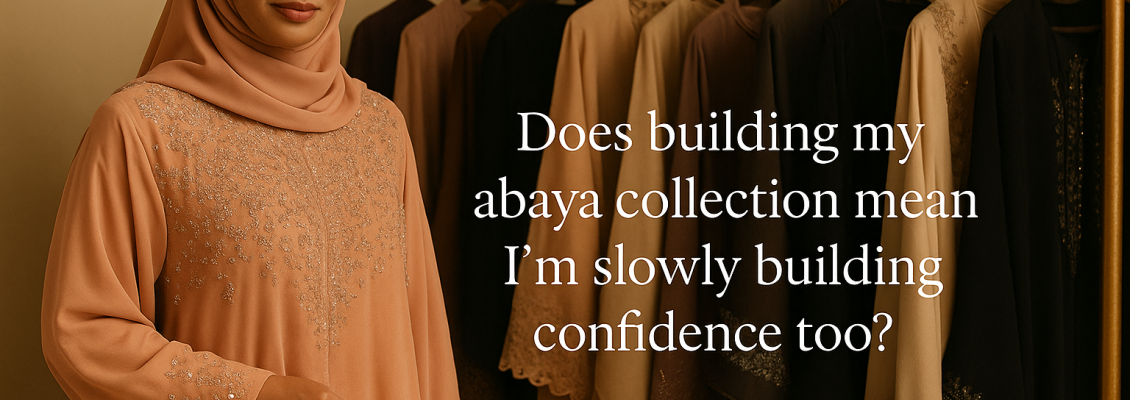
Bismillah. I remember the way the light came through my curtains this morning — soft, golden, unbothered by whether or not I had it all figured out. There was a kind of hush in the air, like the world was inviting me to listen more than speak. June 23rd, 2025 — though I didn’t write it down, I felt it in the way my heart paused before I reached for the abaya hanging at the end of my wardrobe.
Some mornings, the question comes uninvited: “Am I dressing this way because I’m confident, or because I’m trying to be?” I don’t always know the answer. But what I do know is this: every time I reach for another abaya — black, sand, olive, linen — I’m reaching for something beyond fabric. I’m reaching for dignity. For stability. For a version of myself I don’t always see, but deeply hope to meet.
This post is my heart unfolded. It’s not about fashion advice or trends. It’s about that sacred, private, quiet journey of growing into ourselves — through what we wear, through what we let go of, and through what we choose to carry. If you've ever stood in front of your wardrobe and felt like the abaya in your hand carried a secret, this is for you. Come walk with me.
Table of Contents
- Why did I feel so exposed wearing my first abaya?
- I used to think modesty meant hiding — was I wrong?
- What if my hesitation wasn’t about the abaya, but about being seen differently?
- Can a piece of cloth carry the weight of identity?
- I bought one abaya. Then another. Was it a shield or a whisper of who I’m becoming?
- How did my abaya collection begin to reflect a healing I hadn’t named?
- Why did I cry the first time I saw myself in the mirror and felt beautiful — covered?
- Am I dressing to disappear, or dressing to belong to myself?
- What does it mean when my wardrobe starts to look like my du’as?
- How did my abaya collection become a form of silent da’wah?
- Is it possible my confidence was never missing — just waiting for a safe place to bloom?
- Why do I keep reaching for the black one, even when color calls?
- Could growing my abaya collection be the way I learned to love my body without showing it?
- Have I mistaken minimalism for detachment — or is this simplicity finally bringing me peace?
- Why do I still fear being judged for what covers me instead of what reveals me?
- Am I allowed to feel elegant in my abaya, or is that vanity in disguise?
- When did my abaya collection become a visual record of my inner rebirth?
- Can one feel both soft and strong inside folds of fabric?
- Why does putting on an abaya now feel like returning home?
- Is my confidence growing, or am I just more willing to be seen in truth?
- What lessons did my abaya collection teach me about letting go of trends — and holding on to tawakkul?
- When I pack for travel now, why does the abaya come first?
- Is my growing abaya collection quietly preparing me for something greater?
- How did choosing abayas over outfits help me choose purpose over performance?
- Am I finally dressing like the woman I’ve been making du’a to become?
- Frequently Asked Questions
- People Also Ask (PAA)
Why did I feel so exposed wearing my first abaya?
I didn’t expect to feel naked the day I wore my first abaya.
Not physically, of course — it covered me more than anything else I’d ever worn. It was jet black, loose, opaque. Everything the books said it should be. Everything the aunties whispered it had to be. And yet, as I walked out of my front door, heart thudding, hands trembling slightly against the soft sleeves, I felt like every part of me was on display. It was a strange kind of vulnerability — not the kind that comes from showing too much skin, but from suddenly standing out in a way that begged questions I wasn’t ready to answer.
“Is she one of *those* girls now?” I imagined someone saying. “Religious.” “Strict.” “Trying too hard.”
It wasn’t modesty that scared me. It was being seen.
Growing up, modesty was something we talked about in rules. Necklines. Hemlines. Sleeve lengths. And later — with more gravity — what made something ‘Islamic enough.’ But no one really prepared me for the emotional earthquake that would come with actually *choosing* to live those rules outwardly, unapologetically. No one talked about the identity shift — how one piece of clothing could make the whole world treat you differently. How you could go from invisible to over-examined in a single step.
In the mirror that morning, I thought I looked... soft. Peaceful, even. Like the girl I kept searching for in between social media comparisons and spiritual doubt. But the moment I stepped outside, that softness met friction. It scraped against the eyes of strangers. It felt too loud. Too obvious. Too much like a statement I wasn’t sure I was ready to defend.
I used to think modesty was about hiding. But what I quickly learned is that modesty, when chosen with intention, can actually make you more visible. It forces you to ask: Who am I when I’m not dressing to please them? Who am I when I stop using my wardrobe to blend in?
The Hidden Fear Behind “Covering Up”
It’s a strange contradiction. We say we’re covering for Allah — but so many of us, myself included, start by covering to protect ourselves from something else. Judgement. Objectification. The gaze. The gossip. The girl who wears less and gets more attention. The girl who wears more and is labeled extreme.
I wish I could say my first abaya moment was full of spiritual certainty. It wasn’t. It was full of doubt. Not about Allah, but about myself. Was I doing it for Him — or for an idea of who I thought I should be? Was this surrender, or was it performance? And if it was both... was that okay?
I remember walking into the masjid later that day, the abaya billowing slightly with each step. An older woman smiled at me. Warm, gentle, like she saw something in me I couldn’t see yet. And then two girls near the shoe rack glanced up, whispered, giggled. That tiny sound — so familiar, so sharp — cracked something inside me.
Suddenly, I wasn’t worshipping. I was performing. Checking my posture. Wondering if my walk looked awkward. Hoping my scarf wasn’t slipping. Wondering if I looked like someone trying too hard to be pious. And worst of all, I caught myself thinking: “Would I feel this nervous if I was just wearing jeans?”
Modesty as Fabric vs. Modesty as Fear
| Modesty as Fabric | Modesty as Fear |
|---|---|
| Choosing garments to please Allah | Choosing garments to avoid judgment |
| Feeling dignified and unseen in a freeing way | Feeling hyper-visible and misjudged |
| Walking with purpose, inwardly focused | Walking with anxiety, checking how others see you |
| Making peace with your niyyah | Performing righteousness without feeling rooted |
There was a moment — weeks after that first day — when I found myself in a shopping centre’s changing room. I had picked up an abaya on sale, navy blue with a delicate embroidery trim. I slipped it on and looked at myself. And something shifted. I wasn’t thinking about how people would see me. I was wondering how Allah saw me. I whispered, almost without thinking: “Ya Allah, let this be for You. Let it be for love, not fear.”
It was a moment I return to often — that changing room du’a. It didn’t solve everything. It didn’t erase the fear. But it redirected it. Instead of fearing judgement from creation, I started focusing on seeking pleasure from the Creator.
The Spiritual Cost of People-Pleasing in Modesty
It’s exhausting, isn’t it? The double-consciousness. Trying to be “modest enough” for the Muslims, but “not too extreme” for the non-Muslims. Trying to avoid male gaze but also dodge female criticism. Feeling like you need to know the fiqh, the fashion, the unspoken rules. But what if all of that noise is just... distraction?
In the Qur’an, Allah says: “And the clothing of taqwa — that is best.” (Surah Al-A’raf, 7:26)
Not the clothing of trends. Not the clothing of guilt. Not the clothing of performance. The clothing of taqwa — God-consciousness. That verse stripped everything else away for me. It brought me back to the core. What matters isn’t what they think. What matters is Who I’m trying to be seen by — even when no one else is watching.
From Shame to Sakinah
I wore the abaya again the next day. And the next. Sometimes with shaky confidence. Sometimes with joy. And sometimes with that old anxiety knocking at the back of my mind. But slowly, slowly, something else began to take root. Stillness. Sakinah. A kind of quiet inner nobility that said: “Even if they misunderstand you, Allah never will.”
To the sister reading this, who is scared she’s not enough or too much — I see you. I *was* you. Maybe I still am. But I know this: when your abaya becomes more than just fabric — when it becomes a garment of trust, of surrender, of intimacy with Allah — you stop feeling so exposed. Not because you’re hidden, but because you’re held. Covered not by thread, but by intention. By du’a. By love.
You’re not hiding. You’re arriving. One step, one fold of fabric at a time.
I used to think modesty meant hiding — was I wrong?
There was a time I equated modesty with invisibility. Like if I dressed “right,” I could disappear. Blend. Be safe. Not just from stares or judgement — but from being misunderstood. From being too much or too loud or too soft or too unsure. I didn’t know, back then, that I was wrapping fear around my limbs and calling it faith.
It started in the early days of my journey, when my heart was quietly shifting toward Allah but my identity hadn’t yet caught up. I remember scrolling through Instagram, eyes half-hopeful, half-defeated. Hijab tutorials, modest outfit reels, abaya hauls. So many sisters glowing in elegance and grace — it looked effortless. But I wasn’t looking for inspiration. I was looking for a template. A way to dress that would keep me from being noticed and judged all at once.
I chose loose cuts, muted tones, and pieces that almost swallowed me. Not because I loved them yet, but because I was afraid to be seen. I convinced myself that disappearing was the point. That maybe if I was small enough — quiet enough — Allah would see me, even if no one else did.
When Modesty Becomes a Mask
I wore that “safe” outfit to a family gathering once — an oversized black jilbab, my face bare, my voice lowered. I didn’t want to be the one who had “changed.” I wanted to be devout without being divisive. Present, but unseen. One of my cousins looked at me and said, half-jokingly, “Why are you hiding behind all that?”
It stung. Not because she was wrong, but because a part of me had been asking the same thing. Was I dressing like this out of devotion… or out of fear?
That night, I cried in the shower. Not loud sobs — just silent ones, where your body shakes but your lips stay sealed. I wasn’t sad about the jilbab. I was sad that somewhere along the way, I had mistaken shrinking for submission. That I thought Allah wanted me small, muted, erased. But deep down, I knew He didn’t create me to hide. He created me to rise — covered, yes, but never caged.
People-Pleasing in the Name of Modesty
There’s a certain loneliness that comes when you realize your niyyah might be tangled. I wanted to be accepted — by the practicing crowd, by the cultural crowd, by the Instagram modesty crowd. I was customizing my faith, tailoring it not to fit me, but to fit their gaze. I wasn’t dressing for Allah. I was dressing to be left alone. To be approved. To not rock the boat.
And it cost me something. A slow, aching erosion of self-trust. A disconnect between my outer and inner state. Because when you wear fear long enough, it starts to feel like obedience — even when it’s not. I looked modest, but I didn’t feel peaceful. I felt like I was constantly auditioning. For who, though?
Fabric or Fear? A Table of Reflection
| Modesty as Devotion | Modesty as Hiding |
|---|---|
| Clothing chosen to honour Allah | Clothing chosen to avoid scrutiny |
| Joyful surrender in covering | Emotional numbness masked as humility |
| Confidence grounded in purpose | Insecurity wrapped in religious language |
| A conscious act of worship | A subconscious retreat from the world |
The Moment I Felt Most Exposed
It wasn’t when I wore a bright abaya. It wasn’t when I walked into a gathering alone. It was at a masjid door — when I overheard two sisters whispering, “She thinks she’s better than us now.”
I had just started wearing black abayas more regularly, with khimars that draped lower. Not niqab — not even particularly bold. But it was different from how they had last seen me. And in that moment, I felt stripped. Not of my modesty — but of the softness I had hoped to bring with it. Their words weren’t cruel, just casual. But they pierced deeper than they knew.
I almost turned around and left. But instead, I stepped inside. And I prayed. Not just the fardh. I prayed the du’a of a girl trying to become a woman whose intentions are pure. I asked, “Ya Allah, protect me from dressing for anyone but You. Let me never weaponize modesty — not against others, not against myself.”
Letting Modesty Become Light Again
It took time. So much time. And still, I slip. But I started asking myself different questions. Does this outfit help me remember Allah? Does it allow me to walk with dignity? Am I shrinking, or am I standing taller in surrender?
I learned that modesty is not the absence of beauty. It’s the channeling of it. It’s taking what Allah made beautiful and honouring it, not hiding it out of shame. We’ve inherited so many mixed messages — culture, trends, judgement — but when I go back to the Qur’an, I don’t find shame. I find clarity. Protection. Nobility. And love.
Allah says in Surah Al-Ahzab, “O Prophet, tell your wives and your daughters and the women of the believers to bring down over themselves part of their outer garments. That is more suitable that they will be known and not be abused.” (33:59)
“That they will be known.” Not erased. Not hidden. Known.
To the sister who feels like she’s disappearing in the name of modesty — pause. Breathe. Allah sees you. Not the version you try to be for others. You. The one who aches to be authentic. The one who wants modesty to feel like worship again. You're not wrong for wanting to be covered and seen — not by everyone, but by the One who matters most.
So no, modesty isn’t hiding. Not when done with sincerity. It’s emergence. It’s stepping into your purpose with humility, not self-erasure. It’s walking boldly in softness, because you’ve chosen something eternal over something easy.
And if it doesn’t feel like that yet — that’s okay. Let it be a journey. Let it be yours. Let it unfold gently, like the folds of your abaya, catching the wind as you move forward. Never backward. Always homeward.
What if my hesitation wasn’t about the abaya, but about being seen differently?
There’s a kind of hesitation that doesn’t live in fabric. It doesn’t come from the texture of an abaya or the cut of a khimar. It lives deeper — tucked quietly in the folds of our perception, our relationships, our past. And it whispers, “Will they still love me if I look like this?”
I remember the first time I held an abaya in my hands not as a gift or a dress-up piece from Eid, but as a decision. A statement. A declaration of who I was trying to become. It was black — soft cotton with a slight shimmer that caught the light in a way that made it feel both humble and regal. I wanted to wear it. I *wanted* to. But I didn’t. I hung it up. Closed the door. Told myself I’d wear it “next week.”
And the truth is… I wasn’t afraid of the abaya. I was afraid of what it would make people assume about me.
Not the Clothes — the Perception
“Oh wow, you’re becoming really religious now.”
“Do you have to wear that *everywhere*?”
“You’re starting to look a bit... extreme.”
It’s strange how fabric can make people redefine you — even before you’ve had a chance to redefine yourself. I didn’t want to be boxed. Or pitied. Or put on some imaginary pedestal I didn’t ask for. I was still me — soft-spoken, clumsy in wudu, fumbling in my Arabic. But one black abaya and suddenly I was *representing something.*
And that weight scared me. Not because I didn’t love my faith. But because I didn’t feel ready to carry it on my sleeve — literally.
Was I Dressing for Allah, or for Approval?
The question haunted me. Especially in the quiet moments — after I’d posted a photo, after I’d gotten praise or likes or mashallahs. Was I seeking Allah’s pleasure… or validation? Was I hiding in layers, or was I revealing something sacred?
Sometimes I would stand in the mirror with an abaya draped over my shoulders and just stare. Not adjusting it. Not fixing my scarf. Just… staring. And asking myself the question I didn’t want to answer: “Am I afraid of them seeing *me*, or am I afraid of *me* seeing me?”
I thought my hesitation was about clothing. But it was really about identity. About the social cost of spiritual evolution. About how changing on the outside before you’ve caught up on the inside feels like walking barefoot through public opinion.
Real-Life Moments of Tension
- In the changing room, staring at a dusty pink abaya that made me feel beautiful but wondering if others would call it “too much.”
- In the masjid, walking past girls in jeans and feeling their eyes on me — not in judgment, but in curiosity. And not knowing how to carry it with grace.
- On social media, watching modest fashion reels that felt more like performance than presence, and wondering if I was falling into the same trap.
It was never just about the abaya. It was about how people respond to what the abaya *means*. About how we project ideas — of religiosity, of arrogance, of perfection — onto women who are just trying to take one step closer to Allah.
Fear Has a Fabric Too
Fear dresses us sometimes more than clothing ever could. We fear being misunderstood. We fear being too much for some and not enough for others. We fear the label of “practicing” because we’re scared of falling short. We fear the stares, the comments, the silence. And all of it gathers into one simple act: hesitation.
But the abaya — like hijab, like salah, like du’a — is not meant to showcase perfection. It’s a garment of process. A sign of submission. A clothing of honour.
Modesty as Projection vs. Modesty as Presence
| Modesty as Projection | Modesty as Presence |
|---|---|
| Worn to be seen as righteous | Worn to feel nearer to Allah |
| Driven by fear of judgment | Rooted in love and sincerity |
| Reactive to others’ opinions | Responsive to inner convictions |
| Heavy with anxiety | Light with intention |
The Inner Du’a
One night, long after everyone had gone to bed, I sat on the prayer mat in an abaya I hadn’t worn outside yet. It felt like a test. Like I needed to prove to myself that I could wear it without pretending. Without fearing. I remember whispering, “Ya Allah… I don’t want this to be for them. I want it to be for You. Please, strip the fear and leave only sincerity.”
It wasn’t a fancy du’a. It didn’t come from eloquence. It came from exhaustion. From being tired of performing, tired of pretending I wasn’t afraid. I wanted to be seen — not by people, but by Allah. I wanted my intention to stop hiding behind approval.
That prayer didn’t turn me into a perfect woman. But it did something else. It softened my fear. It made me brave enough to wear that abaya to the masjid the next day. I didn’t walk in with confidence, but I walked in with surrender. And that was enough.
Being Seen by the Right Eyes
To the sister who’s afraid of being seen differently — I want you to know that you’re not alone. That hesitation you feel? It’s not weakness. It’s sensitivity. It’s your soul asking you to be honest. Let it. Ask the hard questions. Sit in the stillness. And when you do take that step, let it be for the One who sees you completely — and loves you still.
Allah never asks us to perform. He asks us to return. To remember. To clothe ourselves not in performance, but in taqwa. And He promises us: “Whoever is conscious of Allah — He will make a way for them.” (Surah At-Talaq, 65:2)
So take the step, even if your hands tremble. Wear the garment, even if your heart pounds. You are not meant to disappear. You are meant to be seen — by the One who knows every version of you and still calls you back with love.
Can a piece of cloth carry the weight of identity?
I used to think clothing was simple. Just cotton and thread, stitched into shapes that kept us warm or covered or styled. But somewhere along the way, one piece of cloth started to carry something heavier — identity, belonging, conviction, fear, pride, shame, and sometimes even rebellion. The abaya, to me, stopped being just a garment. It became a mirror I didn’t always know how to look into.
It’s strange how something so silent — a piece of fabric — can say so much. Before I even open my mouth, people read my outfit. They see the abaya and assume things: that I’m religious, conservative, married, extreme, submissive, confident. It changes depending on who’s doing the looking. And that used to terrify me — that people would reduce me to what I wore before even meeting my soul.
But maybe the fear wasn’t about the cloth. Maybe it was about what the cloth revealed — not of my skin, but of my stance.
The First Time I Felt Its Weight
I remember the first time I wore a white abaya. It was for Umrah. The color felt so... bold. Vulnerable. I was used to black — the shield, the invisibility, the comfort of knowing I could walk past people without them really seeing me. But white? It felt like exposure. Like I was standing under a spotlight, even though I was completely covered.
At first, I hesitated to pack it. I stood in front of the wardrobe, fingers grazing the sleeve. “Do I really want to be the girl in white?” I whispered to myself. “Do I really want them to look and think things about me?”
But in Makkah, it all changed. As I stood before the Kaaba, wrapped in white like the others — men in ihram, women in soft fabrics of light — I realized the cloth wasn’t the weight. The gaze was. The assumptions were. The fear was.
But when I let all that fall away — when I remembered that Allah alone knew my niyyah — the white felt weightless. Like no one else was watching. Like I could finally wear something for Him, not for or against them.
When Modesty Became a Burden
Back home, it was harder. The streets weren’t full of worshippers. They were full of watchers. Critics. Or sometimes worse — those who simply didn’t see me at all. I wore an abaya to a friend’s engagement party once. It was navy with silver buttons, loose and lovely. But when I walked in, all the chatter dipped. Not because I looked strange — but because I looked different. “Oh, mashallah,” someone said. But I heard the “but” in her tone. I felt the divide being drawn. I was no longer “one of them.” I was the religious one. The reminder. The outlier.
It’s exhausting carrying that. Not the abaya. The identity it’s forced to wear.
When Fabric Feels Like a Flag
Sometimes I wonder: why do people assume that dressing modestly is a final destination instead of a fragile beginning? I’m still learning. Still falling. Still doubting. But put on an abaya and suddenly I become the spokesperson for Islam, for hijab, for perfection. It’s not fair. But it’s also reality.
And I won’t lie — that pressure used to make me want to take it off. Not because I stopped believing, but because I didn’t want to perform. I didn’t want to hold a flag I wasn’t ready to wave. But then I realized something. The abaya doesn’t have to be a flag. It can be a veil of mercy. A shield of softness. A quiet statement of intention — not identity.
Modesty as Fabric vs. Modesty as Fear
| Modesty as Fabric | Modesty as Fear |
|---|---|
| Chosen as a private form of devotion | Worn to protect from public judgment |
| Feels grounding and soul-aligned | Feels heavy and performative |
| Reflects inward sincerity | Masks inner confusion or self-doubt |
| Leads to peace and closeness with Allah | Leads to anxiety and constant people-pleasing |
Wrestling with Niyyah
There were nights I cried after wearing it out. Not because anything bad happened. But because I didn’t know if I was doing it for the right reasons. I’d scroll online and see sisters with perfectly curated “modest fashion” feeds, wondering if my intention had gotten blurry. Had I started dressing for the likes? The affirmations? The idea of what a good Muslim girl should look like?
I would whisper to Allah in sujood: “Ya Rabb, let this be for You. Let me clothe myself not in expectation, but in sincerity. Not in fear, but in faith.”
And slowly, the fear loosened its grip.
Can a Cloth Carry My Identity?
The answer is yes — and no.
Yes, because we all carry markers. The hijab, the abaya, the pins on our bags, the verses we keep folded in our wallets. They signal who we are, what we believe, where we’re headed. But also no — because no cloth can contain the whole of you. You are more than a silhouette. You are more than your style. You are a soul in motion, returning, repenting, re-learning. And Allah never judges you by your fabric. He judges you by your heart.
The cloth can reflect the heart. But it can’t replace the heart. And sometimes, the most modest woman is the one crying in secret, begging Allah to help her mean it this time. That counts. That’s real. That’s weighty.
To the Sister Who Feels Misunderstood
You’re not wrong for wearing it and still wrestling. You’re not weak for hesitating. You’re not a hypocrite for questioning your niyyah. You’re human. You’re healing. And maybe the cloth isn’t the weight — maybe it’s the world that wants to label you. But remember, Allah doesn’t need you to wear perfection. He needs you to wear sincerity.
So can a piece of cloth carry the weight of identity? Maybe. But you don’t have to let it carry it alone. Let it be accompanied by prayer. By presence. By honesty. Let your abaya be a companion on your journey, not your identity itself. Because you, dear sister, are more than what you wear — but what you wear can still be part of your worship.
I bought one abaya. Then another. Was it a shield or a whisper of who I’m becoming?
It started quietly. I didn’t set out to “build a collection.” I wasn’t trying to make a statement. I just wanted something that made me feel safe. Covered. Grounded. I bought one abaya — black, of course. A familiar softness, a shade that blended easily into the background. It felt like a sigh of relief. Like exhaling after holding my breath for too long.
But then something unexpected happened. I wore it. And I liked who I was in it.
I liked how it made me slow down. How it softened my footsteps, how it anchored me. It wasn’t just the modesty — it was the weight of intention. A quiet, almost imperceptible nudge toward a version of myself I’d longed for but wasn’t sure I deserved.
So I bought another one. A softer fabric this time. More fluid. Then one in deep olive — still modest, still loose, but with a subtle elegance that made me feel… seen. Not in a flashy way, but in a deeply personal, deeply spiritual way. Like the abaya was holding up a mirror to my niyyah and saying, “Is this who you’re ready to be?”
The Inner Dialogue No One Sees
Every time I added a new abaya to my wardrobe, I asked myself the same question: “Is this for Allah or for appearances?” Was I cultivating devotion… or curating an image? Sometimes I couldn’t tell. Sometimes it felt like both.
I remember scrolling through my camera roll, trying to choose a photo to send to my sister. One where I was wearing my charcoal-grey butterfly abaya — the one I secretly loved but always second-guessed. “Is this too styled?” I asked. “Too attention-seeking?” But the truth was, I wasn’t trying to impress anyone. I just wanted to feel like myself. Like someone who belonged to something deeper than trends or applause.
That’s when I realized something crucial: sometimes we dress not to hide, but to hold ourselves accountable to who we’re trying to become.
Modesty as Mirror or Mask?
It’s so easy to confuse them — mirror and mask. One reflects your soul. The other hides it. One draws you nearer to Allah. The other pulls you into the labyrinth of people-pleasing. But they can look identical on the outside. The same folds, the same flowing silhouette. What separates them is intention — and the relentless work of purifying it.
There were days I wore my abaya and felt proud — not in a boastful way, but in a deeply peaceful way. Like I was in harmony with myself. And then there were days when I wore it and felt numb. Disconnected. Like I was cosplaying a version of me I hadn’t caught up to yet. Those were the hardest days — when my body was dressed, but my heart felt bare.
Modesty as Fabric vs. Modesty as Fear
| Modesty as Fabric | Modesty as Fear |
|---|---|
| Chosen with intentional love for Allah | Chosen to avoid being judged |
| Feels like a gentle companion | Feels like a heavy disguise |
| Encourages spiritual accountability | Fuels anxiety and self-doubt |
| Uplifts, softens, roots you | Constrains, hides, distances you |
The Day I Was Misunderstood
There was one moment that stays with me. I wore my cream-colored linen abaya to a community event. It was a summer day, and the lightness of it made sense. I wasn’t trying to stand out — I was just trying to feel comfortable, covered, and calm. But a sister came up to me with a half-smile and said, “Mashallah, fashion show today?”
I know she didn’t mean harm. But it cut me. Not because I was offended — but because I realized how fragile my intentions were. One comment and I felt exposed. Like maybe I was doing too much. Like maybe I’d overstepped into performative territory. I left early that day. Not because I was guilty, but because I was confused. And confusion, I’m learning, is a signal to turn inward — not to run away.
Who Am I Becoming?
I ask this every time I hang a new abaya. Not in shame. Not in scrutiny. But in surrender. Because the truth is: buying that second, third, fourth abaya wasn’t about fashion. It was about formation. A slow shaping of the self. A gentle stepping into a role I hadn’t rehearsed for — but one my soul recognized deeply.
Like the white abaya I wore for Umrah — it felt like a rehearsal for my soul. Like every piece I wore after that was echoing a future I hadn’t lived yet, but already loved.
A Du’a from the Fitting Room
“Ya Allah… if this garment helps me remember You, let it be my robe of taqwa. And if it distracts me from You, remove the desire gently from my heart.”
I made that du’a in a fitting room once. Quietly. Half-whispered as I stared into the mirror, unsure whether the person looking back at me was humble or just hiding. I didn’t want to be either extreme — not lost in image, and not lost to myself. I wanted balance. Beauty rooted in obedience. Simplicity laced with ihsan.
So Was It a Shield or a Whisper?
Maybe both.
Maybe the abayas were a shield from a world that wanted me exposed. Maybe they were a whisper from my fitrah, calling me home. Maybe they were my way of building confidence — thread by thread, choice by choice. Not loud. Not perfect. But present. And sincere.
To the sister reading this, wondering if she’s doing too much, or not enough — I see you. I am you. And maybe you didn’t buy that second abaya just because it was pretty. Maybe your soul recognized something in it. Maybe it reminded you of who you’re becoming. Don’t dismiss that. Don’t rush it. Let the fabric speak. Let the intention unfold. Let the journey shape you gently.
You are not dressing up. You are dressing in — into the woman you were always meant to be.
How did my abaya collection begin to reflect a healing I hadn’t named?
I never thought a wardrobe could speak back to me. But one day, as I slid my fingers across the rail of abayas hanging in my room — black, navy, sand, olive, bone-white — I felt something different. Not vanity. Not anxiety. Not even style. I felt... gentleness. Like these garments were no longer just outfits. They were milestones. Witnesses. Pieces of my healing stitched into fabric I didn’t even know was sacred yet.
At first, I thought I was just buying abayas. A practical decision. Modesty, coverage, a way to blend in or feel aligned. But somewhere along the way, each purchase became a reflection of a wound I was tending to. A fear I was facing. A softness I was reclaiming. My abaya collection wasn’t just a fashion evolution — it was a quiet therapy I didn’t have words for yet.
What Was I Hiding — and What Was I Revealing?
In the beginning, modesty felt like hiding. I had internalized this idea that to be “modest” meant to shrink. To erase. To not be seen. So I wore black. Always black. Not because I didn’t love other colors, but because it felt safer. Black was my shield. My invisibility cloak. The color of “don’t ask questions” and “leave me alone.”
But that wasn’t healing — that was survival.
It took me years to notice the shift. The first abaya I chose that wasn’t black was a muted dusty rose. I almost didn’t wear it. I remember holding it in the store, my heart thudding in my chest like I was holding a rebellion in my hands. “This isn’t me,” I whispered. “I’m not brave enough.” But something in me — something softer — whispered back: “Maybe you are.”
The First Step Towards Healing Was Color
That rose abaya wasn’t loud. It wasn’t glamorous. But for me, it was revolutionary. I wore it on a Friday to Jumu’ah. And as I stepped into the masjid courtyard, the sun hitting the fabric just right, I felt like a flower blooming in a place I had once wilted.
No one said anything. No one stared. The world didn’t collapse. And I felt something crack — a wall I didn’t know I had built. A belief that modesty and beauty couldn’t coexist. That femininity was a threat. That softness made me weak. That healing wasn’t part of hijrah.
My Abaya Collection as a Map of My Inner Self
When I look at my abayas now, I see my story. Each one holds something I was too afraid to write. The navy one reminds me of Ramadan nights where I wept in qiyam and whispered, “Ya Allah, please make me sincere.” The sage green one reminds me of my first da’wah circle — nervous and unsure, but showing up anyway. The oatmeal-colored one reminds me of the day I forgave someone who never apologized, and still chose softness over anger.
They are more than garments. They are pages of a spiritual memoir I didn’t even know I was writing.
Modesty as Fabric vs. Modesty as Fear
| Modesty as Fabric | Modesty as Fear |
|---|---|
| Chosen with love and remembrance of Allah | Driven by shame or societal pressure |
| Feels calming, expressive, free | Feels constricting, muted, anxious |
| Aligns with healing and self-compassion | Disconnects from beauty and intention |
| Grows and shifts with spiritual maturity | Freezes in fear of being “too much” |
When Modesty Became a Performance
Somewhere in my journey, I did lose my way. I started collecting abayas the way people collect compliments. Matching belt with scarf, choosing fabrics that looked good in photos. At first it felt empowering — like I was expressing my identity. But slowly, subtly, it became about being perceived a certain way. Sisters would comment, “Mashallah, your abaya style is goals.” And instead of feeling connected, I felt pressure.
Pressure to maintain an image. To never look messy. To always “represent.” Even when I was spiritually empty, even when I was barely praying, I felt like I had to perform the part. Because my closet said I was practicing. Because my abaya said I was righteous. But my heart? It was dry. Desperate. Confused.
Until One Day, I Broke Down in the Masjid
It was after Asr. The masjid was quiet. I had come wearing my nicest open abaya — satin beige, delicate embroidery. I looked put together. But inside I was unraveling. I sat in the back row, pulled my scarf low, and sobbed. Not because of anything specific. Just… because the performance had become unbearable.
I whispered in sujood: “Ya Allah, strip the performance. Let me wear my sincerity again.”
That du’a changed everything.
The Return to Intention
Since then, my abaya choices have changed — not drastically, but deeply. I still love beauty. I still choose soft colors and elegant cuts. But I ask myself now, every time: “Will this bring me closer to Allah, or to people’s approval?” I still stumble. I still get distracted. But the niyyah is different now. Softer. Sincere. Less afraid of being seen — more invested in being known, truly, by my Creator.
Healing I Hadn’t Named
I didn’t know I was healing when I chose that first colored abaya. I didn’t know I was shedding old shame when I started wearing fabrics that flowed instead of concealed. I didn’t know I was reclaiming softness, beauty, presence. But now I see it clearly: every abaya I chose with love, not fear, was a step toward wholeness. A thread pulling me back to my fitrah.
To the sister reading this who doesn’t know why she feels emotional about a piece of clothing — I want to tell you, you’re not strange. You’re not vain. You’re not overthinking. You’re becoming. And becoming is always emotional. Always holy.
Let your abaya collection be your healing. Let it hold your growth. Let it dress not just your body, but your becoming.
You are not building a closet — you’re building a soul that knows how to return. Gently. Softly. In beauty and in barakah.
Why did I cry the first time I saw myself in the mirror and felt beautiful — covered?
I wasn’t expecting tears that day. I thought I was just trying on another abaya. Just another outfit, another layer, another attempt at putting myself together. But when I caught my reflection — really saw myself — something cracked. Something soft. Something holy. And before I could even name it, the tears started falling. Not out of sadness. Not even joy. But recognition. Of a self I hadn’t known how to love until that moment.
I had spent years believing beauty had to look a certain way — sculpted, styled, palatable. Like it needed permission from the world before I could claim it. My modesty, for so long, felt like rebellion against that. But in rebellion, I had built another prison: one where I wasn’t allowed to feel beautiful, only hidden. Only obedient. Only invisible. And for a long time, I accepted that trade. I thought I had to choose between covering and beauty — that I couldn’t have both.
Was I Dressing for Allah — Or Disappearing From the World?
That’s a question I never wanted to ask myself, but always knew was lingering beneath the surface. The first time I wore hijab, I felt empowered. But slowly, as the stares came, the whispers behind my back, the pressure to “look the part” of a modest woman — something shifted. I began to shrink. Not my clothing, ironically, but my sense of self. My softness. My joy.
And so when I wore that abaya — soft grey, gently cinched at the waist, flowing sleeves that moved like du’a — I wasn’t just trying on a garment. I was trying on a question: Could I feel beautiful and devout at the same time?
And the mirror answered for me. Not with vanity, but with presence.
I saw a woman who wasn’t trying to perform. Who wasn’t trying to be anything but sincere. A woman who had prayed, wept, struggled, whispered “Ya Allah, guide me” on nights when she didn’t know how to dress her pain. And there she was — still standing, still covered, still trying.
And I loved her.
The First Time Modesty Felt Like Love, Not Loss
That mirror moment marked a shift. Modesty, for once, didn’t feel like something I was doing to earn acceptance — it felt like something I was doing to honor who I already was. I didn’t cry because I felt ugly. I cried because for the first time, I saw that I wasn’t. And I didn’t need the world’s confirmation anymore to believe that.
I had believed so long that to cover meant to disappear. But the truth? It helped me finally appear — fully, honestly, and on my terms.
Modesty as Fabric vs. Modesty as Fear
| Modesty as Fabric | Modesty as Fear |
|---|---|
| Chosen as an expression of love for Allah | Driven by fear of judgment or rejection |
| Embraces beauty without shame | Hides femininity to avoid attention |
| Heals the heart while honoring the body | Suppresses identity to feel “worthy” |
| Feels freeing, expressive, deeply personal | Feels obligatory, distant, disconnected |
The Cost of People-Pleasing in the Name of Modesty
I think back to the early days when I was drowning in trying to “get it right.” Making sure nothing was too tight. Avoiding certain fabrics. Watching other sisters on Instagram with their elegant, flowing jilbabs and wondering if I was being too plain… or too much. I let the opinions of people — most of whom didn’t even know me — shape how I practiced my modesty. And that, I’ve learned, is one of the most subtle forms of spiritual harm.
Because it’s easy to mistake religious performance for piety. To look the part but feel empty inside. To dress for acceptance instead of for presence with Allah. But that kind of modesty doesn’t last. It burns you out. It disconnects you from your own niyyah.
The Day I Felt Seen by Allah, Not the World
I’ll never forget a moment after Maghrib — still wrapped in that same grey abaya, still emotional from earlier. I stood by the window, watching the sky fade from indigo to black. And I whispered, “Ya Allah, if this is what it feels like to be covered for You… I don’t ever want to take it off.”
Not the fabric — the feeling. The clarity. The quiet joy of dressing for the One who already knows my heart.
It wasn’t about beauty in the worldly sense. It was about wholeness. About harmony between the inner and outer. About finally not being at war with myself.
To the Sister Who’s Never Felt Beautiful in Her Hijab
I want to say this gently, because I’ve been there: It’s not your face. It’s not your body. It’s the weight of expectations you’ve carried for too long. The belief that beauty and modesty are opposites. The fear that you’ll never “fit” the image of what a good Muslim woman should look like.
But here’s the truth I found in the mirror that day: Allah didn’t ask you to disappear. He asked you to draw near. And He never once said that beauty and taqwa couldn’t co-exist.
So if you’ve never cried at your reflection, not because you were broken — but because you finally felt whole — just know, that moment is still waiting for you. It might come with a new abaya. Or with an old one you’ve never really looked at. Or with nothing new at all, just a changed heart and a softened gaze.
When it comes, don’t run. Don’t dismiss it. Let the tears fall. Let the self be seen. Let the beauty of your modesty be something you taste — not just wear.
This Is What a Dress Rehearsal for the Soul Feels Like
They say the white abaya of Umrah strips away ego. But sometimes it’s the everyday abaya that strips away self-doubt. That reveals what the world tried to cover — your softness, your presence, your sacred femininity that was never meant to be silenced.
So maybe that moment in the mirror wasn’t the end of a journey — maybe it was the beginning. Of healing. Of remembrance. Of reclaiming what modesty was always meant to be: not a prison, not a performance, but a prayer stitched in fabric. A whisper of Jannah on earth.
Am I dressing to disappear, or dressing to belong to myself?
It’s a question that crept up slowly — like a whisper beneath the noise of daily life, a flicker of doubt in moments when I felt most certain. Standing in front of my closet, surrounded by folds of fabric meant to cover, protect, and express modesty, I asked myself: Am I dressing to disappear, or am I dressing to belong — truly belong — to myself?
For so long, modesty felt like a refuge, a shield from the gaze of a world that can be harsh, judgmental, and unforgiving. The black abaya was my armor, my way of telling the world, “Don’t look too close.” But as I peeled back the layers — both literally and metaphorically — I realized that hiding doesn’t equal healing. Disappearing doesn’t always mean safety.
The Weight of Disappearing
When I dressed to disappear, I was carrying more than fabric on my body. I carried fear. Fear of judgment. Fear of attention. Fear of failing as a Muslimah. Fear that if I let even a sliver of color or personality show, I might be “too much” — too bold, too flawed, too human.
I remember the countless times I stared at myself in the changing room mirror, tugging at the folds of an abaya, wishing I could vanish beneath it. The coolness of the fabric against my skin was a reminder: this was protection, but it was also a cage. The cage of expectations — from family, community, social media, and sometimes myself.
And so I dressed for the world’s comfort, for their peace of mind, for their version of “good Muslimah.” I dressed in ways that made me small, quiet, and unnoticeable. But inside, I felt the opposite: fragmented, unseen, lonely.
Belonging to Myself — A Radical Act
But what if modesty wasn’t about disappearing? What if it was about belonging? Belonging to the body Allah gifted me, to the soul He breathed into me, to the journey I’m on — flawed, beautiful, evolving?
This realization didn’t come all at once. It came in quiet moments — a prayer whispered before dawn, a conversation with a sister who saw me beyond my clothes, a day when I dared to wear soft pastel instead of all black. Slowly, the armor softened into something else.
Dressing to belong means choosing garments that reflect not just protection but presence. It means honoring my inner world as much as the outer. It means embracing my scars, my hopes, my doubts — all wrapped in fabric that feels like a home, not a hiding place.
Modesty as Fabric vs. Modesty as Fear
| Modesty as Fabric | Modesty as Fear |
|---|---|
| Chosen with intention and love for Allah | Driven by fear of judgment or scrutiny |
| Fosters confidence and self-respect | Feeds anxiety and self-doubt |
| Encourages authentic self-expression within boundaries | Promotes silence and invisibility |
| Reflects spiritual growth and healing | Mask for insecurity and shame |
The Spiritual Cost of People-Pleasing
When we dress to please others, even in the name of faith, we risk losing sight of who we really are. I’ve felt it — the exhaustion of trying to balance what others expect with what my heart needs. The tightrope walk between “acceptable” modesty and self-expression. The tug-of-war between faith and fear.
I remember scrolling through social media, comparing my abayas to those of sisters who seemed effortlessly elegant, wondering if my choices were good enough, modest enough, worthy enough. The endless question in my mind: “Am I doing this for Allah, or for their approval?”
The answer was never easy. But it was necessary.
Turning Inward: Wrestling With My Niyyah
One night after Tahajjud, I sat quietly with my du’a. I asked Allah to purify my intentions, to help me dress not for eyes that judge, but for the One who sees my heart. I asked for courage to belong to myself — to show up as I am, with all my imperfections, wrapped in modesty that nourishes rather than hides.
That night, the mirror became a place of acceptance, not fear. The abaya on my shoulders became a garment of grace, not a shield of shame.
A Moment of Being Seen — Yet Misunderstood
There was a day when I wore a beautifully embroidered abaya to the mosque. I felt radiant inside it, connected to my faith and my self. But I caught a sideways glance, a whispered comment, a judgment in a sister’s eyes. It stung. Deeply.
Despite “covering up,” I felt exposed. Misunderstood. As if my choice to belong to myself was a rebellion rather than a right.
But I learned something precious that day: belonging to yourself means holding space for those who may not understand, without shrinking your light. It means staying true to your journey, even when it’s lonely.
Belonging Is an Act of Worship
When we dress with sincerity, intention, and love for Allah, we are worshipping with our whole being — body, heart, and soul. Belonging to ourselves is not selfish. It’s sacred. It’s the first step toward belonging to the community, the ummah, and ultimately, to our Creator.
So today, as I stand in front of my closet, I ask myself again: Am I dressing to disappear? Or am I dressing to belong — fully, bravely, beautifully — to myself?
And with every abaya I choose, every prayer I whisper, every moment I embrace my true self, I move closer to the answer.
What does it mean when my wardrobe starts to look like my du’as?
There was a moment — quiet, unassuming, but profound — when I looked into my closet and realized my abayas, my scarves, even my shoes seemed to echo the whispers of my heart. They weren’t just clothes anymore; they were prayers I wore. Du’as folded into fabric, intentions sewn into every seam.
I remember the soft grey abaya that felt like surrender, the deep emerald one that carried hope for healing, the gentle blush pink that spoke of forgiveness. Each piece reflected a part of me — my struggles, my growth, my yearning to be seen not just by the world, but by Allah.
The Transformation from Fabric to Faith
Modesty began for me as an external act — a dress code, a set of rules to follow. But over time, it became an intimate dialogue between my soul and my Creator. What started as fabric and form slowly turned into an outward expression of inner du’a.
I began to see that modesty isn’t merely about what covers the body, but what uncovers the heart. It’s a garment for the soul as much as it is for the skin.
The Spiritual Cost of Dressing to Please Others
There were days when I dressed to avoid judgment, to silence the whispers, to fit a mold created by others. These were days when modesty felt heavy — a performance, a burden. The softness and beauty I once associated with covering were replaced by fear and shame.
Scrolling through social media, I’d see images of “perfect” modest fashion and wonder if I was enough — if my niyyah was pure or if I was merely hiding behind layers to escape eyes that judge rather than hearts that understand.
Modesty as Fabric vs. Modesty as Fear
| Modesty as Fabric | Modesty as Fear |
|---|---|
| Chosen from love, devotion, and intentionality | Driven by anxiety, shame, and people-pleasing |
| Reflects inner healing and spiritual growth | Masks insecurity and spiritual disconnect |
| Embraces beauty as a form of worship | Suppresses identity out of fear of judgment |
| Fosters confidence and belonging | Encourages invisibility and self-doubt |
The Personal Wrestle with Niyyah
Was I dressing for Allah — or was I hiding from people? That question haunted me during quiet nights after prayer. Sometimes I caught myself adjusting my scarf not because it was uncomfortable, but because I worried what others might think. Sometimes I chose darker colors not for modesty, but because I feared standing out.
In those moments, my du’as became urgent pleas for clarity and sincerity. “Ya Allah, purify my heart. Help me dress in a way that honors You, not just hides me.”
A Moment of Exposure Despite Covering
Once, after putting on what I thought was a modest, respectful outfit, I entered the masjid and felt a strange vulnerability. Despite every layer, every fold, I felt unseen — misunderstood. It wasn’t the fabric that protected me; it was my intention, my niyyah. And that had to be stronger than any garment.
When Wardrobe and Du’a Become One
Now, each time I choose an abaya, I silently whisper a du’a — for patience, for strength, for mercy. My wardrobe has become a sacred space where my faith and my fashion meet. It’s no longer about hiding or performing; it’s about embodying the softness and dignity I seek in my prayers.
And sister, if your clothes could speak, what du’as would they tell?
How did my abaya collection become a form of silent da’wah?
There was a time when my abaya collection was just that — a collection. Pieces of fabric hanging quietly in my wardrobe, chosen for comfort, for modesty, or maybe just to fit in. But slowly, something deeper began to stir beneath the surface, something I hadn’t named yet. My abayas became more than clothes; they became a language. A silent da’wah spoken through threads and folds, calling not just to others but reminding me of who I am and who I aspire to be.
It started with intention — that subtle shift from dressing merely out of obligation or fear, to dressing as an act of worship, an offering to Allah. I began to see each abaya as a statement of identity rooted in faith, a humble invitation for others to witness the beauty of modesty without a single word spoken.
The Journey from Performance to Devotion
In the beginning, modesty felt heavy, like a performance. I worried about what others thought — was my abaya too plain? Too flashy? Would my hijab sit “just right” or betray my insecurities? Social media fueled this pressure with endless images of perfection, of modest fashion influencers whose wardrobes seemed to sparkle with effortless elegance.
But as I wrestled with my niyyah, I realized that modesty isn’t about performance. It’s not a show for the world. It’s a quiet devotion, a personal covenant between me and my Creator. When I dressed for Allah alone, the fear and judgment faded, replaced by a soft confidence that radiated without trying.
Modesty as Fabric vs. Modesty as Fear
| Modesty as Fabric | Modesty as Fear |
|---|---|
| Chosen with sincerity and love for Allah | Driven by anxiety about others’ opinions |
| Reflects inner peace and spiritual strength | Feeds self-doubt and insecurity |
| Embraces personal identity and authenticity | Masks true self behind layers of fear |
| Encourages connection and inspiration | Creates distance and misunderstanding |
A Moment of Clarity at the Masjid
I remember walking into the masjid one quiet afternoon, wearing a simple abaya that I had chosen that morning after sincere du’a. There was no embellishment, no flash — just the gentle sway of fabric and the humility in my heart. A sister approached me, her eyes warm and curious, and said, “Your abaya reminds me of the peace I’ve been seeking.”
That moment shook me. It was then I understood: my abaya wasn’t just covering my body; it was silently inviting others to see the dignity and beauty that modesty can hold. Without saying a word, my clothes were telling a story of faith, healing, and hope.
Social Media’s Double-Edged Sword
Scrolling through Instagram, I often felt caught between two worlds — the polished, curated images of modest fashion and my own imperfect reality. Sometimes I compared my humble abaya collection to those of others and felt lacking. But gradually, I began to use social media not as a place of comparison, but as a platform for authentic sharing.
I posted pictures of my abayas not to boast, but to show sisters that modesty can be both beautiful and real. That the silent da’wah of our clothes can inspire, comfort, and connect us. That modest fashion is not about perfection, but about sincerity.
The Spiritual Cost of People-Pleasing
The cost of dressing for others — even in the name of modesty — can be steep. It drains the soul, blurs our intentions, and leaves us disconnected from the true essence of our faith. I’ve been there: choosing a certain abaya because it was “acceptable,” hiding my personality beneath layers that weren’t mine, seeking validation instead of barakah.
But when I realigned my intentions, when I dressed to honor Allah and to express my authentic self, the entire dynamic changed. The fear lifted. The shame softened. The silent da’wah of my abaya collection became a source of strength, not stress.
My Personal Wrestle with Niyyah
Every morning before I step into my clothes, I pause. I ask Allah to purify my heart and to make my modesty a means of drawing closer to Him. “Ya Allah, help me wear my abayas with love, sincerity, and purpose. Let them be a reflection of my inner healing and a beacon for others seeking light.”
This prayer is more than words — it’s the foundation of my journey. Without it, fabric is just fabric. With it, my abayas become a tapestry of faith, woven with hope, struggle, and devotion.
The Quiet Power of Silent Da’wah
There’s something profoundly powerful about da’wah that doesn’t shout. About inviting others through presence and example rather than loud proclamation. My abayas have become this kind of da’wah — quiet, humble, consistent.
Each time I wear one, I remember that modesty is not a burden, but a blessing. That through my collection, I can reflect the mercy and beauty of Islam without uttering a single word. That my faith can be seen, felt, and honored in the way I carry myself.
So sister, if you find yourself wondering how your own modesty might be a form of da’wah, know this: it begins with intention. It grows with sincerity. And it shines brightest when you let your true self, wrapped in fabric and faith, speak silently to the hearts around you.
Is it possible my confidence was never missing — just waiting for a safe place to bloom?
There was a time I thought my confidence was lost, buried beneath layers of doubt and fear, like a fragile seed trapped in hard soil. I looked at my reflection — sometimes obscured by a veil, sometimes unveiled — and wondered if I’d ever truly feel whole or radiant in my modesty. But slowly, through quiet moments and gentle du’as, I began to sense that maybe, just maybe, my confidence was never really missing. It was merely waiting. Waiting for a safe place to bloom.
I recall those early days when modesty felt like a performance, a careful balancing act between devotion and fear. I dressed not to express my faith, but to hide from judgment — from the world, from myself. The layers I wore were both shield and cage. And beneath them, my spirit struggled to breathe.
The Emotional Shift: Devotion or Performance?
Modesty, in its purest form, is a devotion — a beautiful surrender to Allah’s command, a loving protection of one’s dignity. But what happens when modesty shifts into performance? When fear replaces softness, and shame overshadows beauty? I lived that tension daily, caught between wanting to please Allah and fearing what others might say or think.
Scrolling through social media, I often found myself comparing my humble abaya collection to those glossy images of perfection. I wondered if my efforts were enough, if my modesty was sincere, or just another mask to hide behind.
Modesty as Fabric vs. Modesty as Fear
| Modesty as Fabric | Modesty as Fear |
|---|---|
| Chosen with intentional love for Allah | Driven by anxiety and people-pleasing |
| Reflects inner healing and confidence | Masks insecurity and self-doubt |
| Encourages authenticity and peace | Creates distance and anxiety |
| Fosters spiritual connection and belonging | Feeds isolation and judgment |
Finding Safe Soil to Bloom
Confidence needs safety to grow — a safe space where the soul can be seen and accepted without fear. For me, that safe space was found in moments of sincere du’a, quiet reflection after tahajjud, and in sisterhood where vulnerability was met with love, not judgment.
I remember sitting in the changing room, fingers trembling as I tried on yet another abaya. The mirror reflected a hesitant woman, but inside, I whispered, “Ya Allah, help me find peace in my modesty.” Those prayers were the gentle rain that softened the soil of my heart, allowing confidence to take root.
The Spiritual Cost of People-Pleasing
Trying to please everyone comes at a spiritual cost. It steals joy, dims light, and fractures intention. I’ve felt it — dressing to meet expectations, wearing abayas that felt foreign to my spirit, silencing my uniqueness to blend into the crowd.
But when I shifted my focus back to Allah, when I dressed to please Him alone, I felt a quiet power growing inside. Confidence was no longer something I needed to chase; it was quietly unfolding within me.
A Moment of Exposure Despite Covering
There was a time I stood at the masjid entrance, layered and covered, yet felt unbearably exposed. Not because of my clothes, but because my heart was unsettled. It wasn’t the fabric that protected me — it was my niyyah. And that had to be stronger than any layer.
Confidence as a Blossom of Faith
Today, my abaya collection is more than just fabric. It’s a garden where confidence blooms — nurtured by faith, intention, and self-love. Each piece is a petal in the flower of my identity, rooted in the soil of sincere devotion.
Sister, if you feel your confidence is missing, look again. It may be waiting quietly within you, longing only for the safe soil of faith and authenticity to bloom.
Why do I keep reaching for the black one, even when color calls?
It’s strange, isn’t it? How the black abaya, simple and steady, can feel like both armor and refuge when the vibrant hues beckon from the closet. I’ve often found myself staring at a spectrum of colors — soft pastels, rich jewel tones, playful prints — yet my hand unconsciously drifts toward the black one. Why is that? Why does this timeless shade call me back, even when the world invites me to embrace the joy of color?
In the quiet moments before Fajr, wrapped in my favorite black abaya, I pondered this question deeply. It felt like a mirror reflecting not just my outer choices, but the inner journey I’ve been on — the delicate dance between modesty as a spiritual devotion and modesty as a performance, between soft beauty and harsh judgment.
The Emotional Weight of Black
Black isn’t just a color. For me, it has been a language of protection, a sanctuary when vulnerability feels overwhelming. It carries a sense of anonymity, a way to step quietly into the world without inviting scrutiny. Yet, paradoxically, this choice can sometimes mask the light within, replacing the softness and warmth of intention with a shield forged from fear.
There were days when I wore black out of habit, almost like armor against judgment — from others and, most painfully, from myself. In those moments, modesty felt less like an act of worship and more like a performance designed to please the watchers rather than the One I seek to please.
Modesty as Fabric vs. Modesty as Fear
| Modesty as Fabric | Modesty as Fear |
|---|---|
| Chosen with love and spiritual intention | Driven by anxiety about others' perceptions |
| Reflects inner peace and confidence | Masks insecurity and self-doubt |
| Encourages authenticity and self-expression | Limits joy and personal freedom |
| Invites connection through humility | Creates distance through fear |
A Moment of Truth in the Changing Room
I remember one afternoon in a bustling boutique, surrounded by racks of colorful abayas, feeling both excited and unsettled. I slipped on a deep emerald green, its fabric whispering promises of joy and renewal. But when I looked up at the mirror, my eyes searched for the familiar black garment nearby. My heart ached with confusion — was I afraid to stand out? Was I hiding behind tradition, or had I lost sight of my true intention?
In that moment, I whispered a quiet du’a: “Ya Allah, help me wear what pleases You and reflects the beauty You have placed within me.” The tears that followed were not just for the fabric I wore, but for the freedom I longed to embrace — the freedom to be both modest and vibrant, confident and authentic.
The Spiritual Cost of People-Pleasing
Choosing black out of fear or habit can be a subtle form of people-pleasing. It is dressing not to honor Allah’s command with sincerity, but to avoid attention, judgment, or misunderstanding. I have felt the weight of this cost — a heaviness in my soul, a dulling of the light that modesty is meant to cultivate.
Yet, when I shift my niyyah, when I choose my abayas with the prayerful intention to serve Allah and honor myself as His creation, color becomes a celebration of faith rather than a source of anxiety.
A Prayer for Authenticity
Each day, as I fold my abayas and prepare my garments, I make a silent du’a: “O Allah, guide me to dress for You alone. Let my clothes be a reflection of my faith, my hope, and my joy. Remove from my heart the fear that dims my light, and replace it with the confidence to embrace Your blessings fully.”
The Invitation to Sisterhood and Belonging
To my sisters who reach for the black abaya even when color calls — know that you are not alone. The path from fear to faith is delicate and personal. It is okay to seek refuge in familiar shades while quietly inviting the vibrant hues to enter when the time is right.
Modesty is not a uniform, but a living, breathing journey. It is the space where our souls can grow in faith, confidence, and love — wrapped in the fabric of our choosing, whether it be black or a thousand colors.
So the next time you find yourself reaching for the black one, ask gently: Is this choice born from devotion or fear? And trust that Allah’s mercy is vast enough to hold you wherever you are, guiding you gently towards the fullness of your own modesty — radiant, authentic, and free.
Could growing my abaya collection be the way I learned to love my body without showing it?
For so long, I wrestled with the relationship between my body and my faith. I grew up surrounded by mixed messages — some that praised beauty openly, others that seemed to bury it beneath layers of shame and silence. When I began building my abaya collection, I didn’t realize I was also beginning a tender, complicated journey toward loving my body on my own terms — without showing it to the world.
At first, my abayas were shields. Heavy, loose, black fabric that seemed to swallow me whole. I thought that if I hid my curves, my shape, my very form, I could protect myself from judgment and feel safe. But the truth was more complicated. While I was covering up, I was also unknowingly pushing away the very love I longed to feel for my own reflection.
The Emotional Shift: From Fear to Devotion
Modesty, when rooted in devotion, is not about rejection of the body. It is about honoring the trust Allah has given us — a trust that includes caring for ourselves spiritually, emotionally, and physically. But when modesty shifts into performance or fear, it becomes a heavy burden. I found myself wondering: Was I dressing for Allah, or was I hiding from the world’s gaze and my own insecurities?
This struggle played out in small moments: in the dim lighting of changing rooms, the hesitant glances at mirrors, and the endless scroll through social media where idealized images made me question my worth. Each time I chose an abaya, I asked myself quietly — was this a choice born from self-love or from a desire to disappear?
Modesty as Fabric vs. Modesty as Fear
| Modesty as Fabric | Modesty as Fear |
|---|---|
| Clothing chosen with love and respect for the body | Clothing chosen to hide, mask, or reject the body |
| Reflects acceptance and spiritual connection | Reflects insecurity and avoidance |
| Allows freedom within boundaries | Creates limitation and shame |
| Encourages a healthy relationship with self | Feeds cycles of self-criticism and doubt |
A Turning Point in the Mirror
One evening, I stood before the mirror in my favorite abaya — a soft, flowing garment that wrapped me like a gentle embrace. For the first time, I didn’t see just a body to be hidden. I saw the hands that prayed, the eyes that sought knowledge, the heart that yearned for peace. Tears welled up as I whispered a du’a: “Ya Allah, help me love the body You gave me, not for others, but for You.”
That night marked a quiet healing. My abaya collection grew, yes — but it grew with intention. Each piece became a testament not to hiding, but to honoring. To loving my body in a way that transcended mere appearance.
The Spiritual Cost of People-Pleasing
I’ve learned that people-pleasing — dressing to meet others’ expectations — can fracture our niyyah and distance us from the love Allah wants us to feel for ourselves. When modesty becomes a performance, we lose the softness that makes it beautiful.
But when we dress with intention, letting go of fear and embracing faith, our garments become prayers woven in fabric, blessings that clothe us both inside and out.
Lessons from the Qur’an and Du’a
“Indeed, Allah loves those who are constantly repentant and loves those who purify themselves.” (Qur’an 2:222) This verse reminds me that purification is not just external but internal — cleansing our hearts of doubt and fear so that love can flourish.
My private du’as have become anchors in this journey — asking for strength to embrace my body as a gift, to see beauty in modesty, and to walk confidently in the path set before me.
Final Reflection: Loving Without Showing
Growing my abaya collection wasn’t just about adding fabric to my closet. It was about cultivating a sacred relationship with my body — one that didn’t require revealing to feel whole or loved. Through each garment, I learned that modesty can be an act of love, a daily affirmation that I am more than my shape or appearance.
Sister, if you find yourself struggling with this balance, know that you are not alone. Your body is a trust, a gift, a home for your spirit. May your journey with modesty be one of healing, love, and peace — wrapped in the beauty of your own unique story.
Have I mistaken minimalism for detachment — or is this simplicity finally bringing me peace?
There was a time when my wardrobe was overflowing — fabrics, colors, styles all clamoring for attention. Each piece of clothing felt like a statement, a mask, a carefully curated image I wanted to project. But somewhere along the way, that abundance began to feel like a weight — a distraction from the quiet whispers of my soul. I started to question: Was I seeking simplicity, or was I running away? Was I practicing minimalism, or detaching from myself in fear?
This question gnaws at me still, as I sit wrapped in the folds of my abaya collection — a collection that once felt like armor, now evolving into a symbol of calm. The journey from excess to essence was not a smooth one. It was riddled with moments of doubt, of loss, and of rediscovery.
The Emotional Shift: From Performance to Peace
Modesty, at its core, is an act of devotion. But when modesty becomes a performance — dressing to fit a mold, to please others, or to hide insecurities — it loses its softness. I realized I had been performing for years, selecting garments not from a place of peace, but from a place of fear and shame. This made my abundant wardrobe feel like a cage rather than a comfort.
Turning towards minimalism felt like liberation. Fewer pieces. Simpler silhouettes. A pared-down palette. But the question lingered: was I simplifying to embrace peace, or was I detaching to avoid the vulnerability that comes with truly loving myself?
Modesty as Fabric vs. Modesty as Fear
| Modesty as Fabric | Modesty as Fear |
|---|---|
| Clothing chosen with intention and love | Clothing chosen to conceal or escape |
| Reflects spiritual connection and confidence | Reflects anxiety and people-pleasing |
| Creates freedom within boundaries | Creates restriction and judgment |
| Fosters authenticity and self-care | Feeds insecurity and avoidance |
A Moment of Realization
I remember standing before the mirror one early morning, soft light spilling in through the window. My gaze rested not on the reflection alone, but on the intention behind my choice of abaya that day — a simple, elegant piece, free from embellishment but rich in meaning. It felt like a prayer in fabric, an invitation to live authentically rather than performatively.
That morning, I whispered a du’a: “Ya Allah, guide me to simplicity that heals, not detachment that hides.” The peace that followed was profound — a balm for a heart long burdened by doubt.
The Spiritual Cost of People-Pleasing
When modesty becomes about meeting others’ expectations — a constant striving to fit in or avoid judgment — we sacrifice our own inner peace. I learned that people-pleasing can fracture niyyah, turning a sacred act into a heavy performance.
Minimalism, when embraced with sincere intention, can restore that sacred connection. It can remind us that less is often more — more space to breathe, more room to grow, more freedom to be ourselves under Allah’s watchful care.
Lessons from the Qur’an and Du’a
The Qur’an teaches us: “Indeed, with hardship comes ease.” (94:6) This verse became a beacon for me, reminding me that simplicity is not about withdrawal, but about easing the burdens we place on ourselves.
My private du’as grew deeper — asking for strength to shed not just material excess, but emotional baggage; to find peace in simplicity, and to embrace the modesty that flows from faith, not fear.
Final Reflection: Finding Peace in Simplicity
Minimalism is not detachment. It is a gentle invitation to choose what truly matters — in clothing, in faith, in life. As my abaya collection became more intentional, so did my relationship with myself and my Creator.
Dear sister, if you find yourself caught between the desire for simplicity and the fear of letting go, know that this journey is sacred. May your steps be guided by niyyah, your heart wrapped in love, and your soul find rest in the beautiful balance of modesty that is about fabric, not fear.
Why do I still fear being judged for what covers me instead of what reveals me?
There are moments when I look at myself fully covered, my abaya flowing around me like a cloak of protection, and yet I feel raw—exposed not because of what I wear, but because of how others might see me. I catch myself wondering: why does the fear of judgment still linger so heavily on my heart? Why do I tremble not from shame of revealing, but from anxiety over what my covering might provoke in others?
This fear is complex, deeply rooted in a world that often values outward appearance over inner truth. Modesty, once a tender act of devotion to Allah, sometimes feels distorted into a performance where every fold of fabric becomes a statement not just about faith, but about others’ opinions. I wrestle with this daily — am I dressing to please my Lord, or to shield myself from the harsh gaze of society?
The Emotional Shift: From Devotion to Performance
When I first embraced covering, my heart was soft, filled with hope and sincerity. My niyyah was pure: to obey Allah, to guard my dignity, and to seek closeness to my Creator. But slowly, the space between intention and action began to narrow as I noticed the weight of eyes and whispers. I started to dress not only to worship, but to protect myself from judgment.
This shift is subtle but powerful. Modesty stops being about an intimate conversation between soul and Sustainer, and becomes a public dialogue about conformity, acceptance, and image. The softness of intention is replaced by the hardness of scrutiny. The beautiful balance of modesty tilts towards fear — fear of standing out, fear of being misunderstood, fear of rejection.
Modesty as Fabric vs. Modesty as Fear
| Modesty as Fabric | Modesty as Fear |
|---|---|
| Clothing chosen from love and faith | Clothing chosen to avoid judgment |
| Expression of inner dignity and peace | Shield against external criticism |
| Confidence rooted in Allah’s approval | Anxiety rooted in people’s opinions |
| Freedom to be vulnerable and authentic | Restriction through self-censorship |
The Spiritual Cost of People-Pleasing
People-pleasing is a thief of the soul. I have felt its sting many times: the urge to soften my covering so as not to provoke, the temptation to conform to fashion trends to gain approval, the heavy burden of fearing what my sisters, family, or strangers might think. This cost is more than just emotional—it chips away at sincerity, at the sacred bond I hold with Allah.
Behind every outfit choice lurks the question: “Am I dressing for Him, or for them?” When the answer leans toward the latter, the heart grows restless, the spirit feels constrained, and the act of covering loses its spiritual beauty.
Tangible Moments of Struggle
I remember the tightness in my chest in the changing room, fumbling with layers, wondering if this abaya was “modest enough” for the judgmental eyes I feared outside the door. Walking through the masjid, feeling eyes linger a little longer on my covered form, I questioned if I truly belonged.
Scrolling through social media was a double-edged sword—seeing sisters embrace their modest fashion with confidence yet feeling my own insecurities deepen. The curated images sometimes whispered lies: that modesty demands perfection, that mistakes are unforgivable, that vulnerability is weakness.
Private Du’as and Inner Monologues
In the quiet of the night, I whispered to Allah: “Ya Rabb, soften my heart to Your approval alone. Let me find freedom in Your love, not chains in others’ opinions.”
These du’as became lifelines, fragile yet fierce, as I wrestled with my niyyah. Was I covering to hide, or to heal? Was I silencing my spirit to blend in, or was I yearning to stand tall in truth?
A Moment of Being Seen Yet Misunderstood
Once, a sister complimented my abaya but then added, “Are you sure you want to stand out like this?” The words stung like cold wind. Here I was, covered, vulnerable, and still feeling misunderstood. The paradox struck me deeply: that modesty, meant to guard my dignity, sometimes made me a target of suspicion or judgment rather than acceptance.
Finding Clarity and Compassion
Through reflection and prayer, I am learning to release the heavy burden of others’ approval. I remind myself of the beautiful words of the Prophet Muhammad (peace be upon him): “Actions are judged by intentions.” This sacred teaching is my anchor, my compass, when doubt creeps in.
Dear sister, if you feel this fear too, know that you are not alone. Our struggle with judgment is part of a larger journey toward embracing the freedom modesty truly offers—a freedom rooted in faith, not fear.
May we all find the courage to dress for our Creator’s gaze alone, to love ourselves as He loves us, and to walk through this world wrapped not just in fabric, but in peace.
Am I allowed to feel elegant in my abaya, or is that vanity in disguise?
There was a moment — maybe more than one — when I caught myself standing in front of the mirror, draped in my abaya, and felt something unexpected. Not just modesty or duty, but an undeniable flicker of elegance. And with that flicker came a shadow of doubt. Am I allowed to feel this way? Is feeling elegant while covered a blessing or a trap? Is it a soft whisper of self-love, or is it vanity in disguise?
For so long, I believed that modesty was a sacrifice, a humble shroud designed to erase myself from the eyes of the world. Elegance? That felt like the opposite — a spark that could ignite pride, vanity, or worse, a performance meant to please others. So many times, I wrestled with this: Was my abaya a shield of devotion, or a mask hiding a desperate need to be noticed? Was I dressing for Allah, or for the anxious eyes of society?
The emotional landscape of modesty is complex. At first, it was devotion — a quiet love language between my soul and my Creator. The fabric was just fabric; the heart’s intention, the real veil. But as days passed, I noticed a shift. The softness of intention got replaced by fear. Fear of judgment. Fear of not fitting in. Fear of being misunderstood. And in that fear, elegance began to feel dangerous, like a forbidden fruit.
It’s ironic, isn’t it? That what is meant to be a garment of peace sometimes becomes a stage for performance. I found myself scrolling through social media, where every abaya-clad sister seemed to be living their best life — flawless hijabs, perfect poses, expensive fabrics. Was I supposed to feel less if I didn’t sparkle the same way? Could feeling elegant be a step towards vanity or simply a reflection of my own healing and confidence?
Let’s pause here and look at a table that helped me wrestle with these feelings:
| Modesty as Fabric | Modesty as Fear |
|---|---|
| Clothing as an act of devotion to Allah | Clothing as a way to avoid judgment or attention |
| Feeling elegant as self-respect and honoring oneself | Suppressing elegance to avoid being labeled vain |
| Softness, beauty, and intention guide choices | Fear, shame, and performance dictate choices |
| Confidence rooted in faith | Confidence shaken by societal expectations |
This table was a mirror to my soul — showing me how easily my heart could slip from worship to worry. But it also whispered hope: that feeling elegant and modest could coexist. Elegance is not vanity if it springs from love, respect, and gratitude.
I remember a private moment in the changing room, alone except for my reflection and the quiet hum of the shop. I tried on a new abaya, a soft fabric that flowed like a prayer. As I wrapped it around myself, a wave of peace washed over me. I was not trying to impress anyone. I was not hiding in shame. I was simply honoring the vessel that carries my spirit through this world. Tears came — not from guilt, but from recognition. This elegance was a gift, a language of self-love spoken in the silence between folds.
My du’a in that moment was simple but profound: "O Allah, let my clothes be a means of closeness to You, not a barrier. Let my elegance reflect Your beauty within me, not the world’s fleeting gaze." That du’a reminded me that our intention — the niyyah — is the heart of modesty.
Yet, the struggle remains. When I step out wearing that same elegant abaya, sometimes I catch the sideways glance, the whispered questions. “Is she dressing for Allah, or for herself?” “Is this humility or hubris?” These moments sting because they challenge my confidence. They force me to ask: Am I dressing to disappear or to belong to myself? Is elegance a rebellion or a reconciliation?
But here’s the truth I’m learning to embrace: Elegance is not the enemy. Vanity is not the only alternative to modesty. There is a sacred space in between — where feeling beautiful in your abaya is an act of worship itself, where honoring your body and soul is not selfish but soulful. Where elegance can be a quiet declaration that you belong — to yourself, to your faith, and to the Divine.
So, sister, if you find yourself reaching for that elegant abaya, unsure if it’s love or pride, remember this: You are allowed to feel elegant. You are allowed to love how you look in the mirror — not because the world tells you so, but because your Creator made you beautiful in every form, every fold of fabric. And when your heart is aligned, that elegance becomes a prayer, a light, a soft strength.
In the end, modesty is not about erasing your beauty but about reflecting the beauty that Allah placed inside you. Elegance in your abaya is not vanity in disguise — it’s your soul’s quiet song, a whispered “yes” to yourself and to the One who sees all, loves all, and clothes you in mercy.
When did my abaya collection become a visual record of my inner rebirth?
I never imagined my abaya collection would quietly map the story of my soul’s healing — each fold, each thread, a chapter of my inner rebirth. At first, the abayas were just garments, practical and modest, worn in devotion, a shield and a sign of my faith. But over time, as the layers of my spirit deepened, my collection became much more than fabric; it became a visual diary, a testament to the shifts within me — from fear to freedom, from people-pleasing to authenticity, from concealment to confident softness.
In the beginning, modesty was simply about covering. It was about protecting myself from judgment, and perhaps even from myself. I’d stand in front of the mirror, unsure whether I was dressing for Allah or dressing to hide, balancing between the delicate tension of spiritual intention and the heavy weight of societal expectation. My first few abayas were basic, mostly black and unadorned, mirroring the hesitation I felt inside — a silent retreat, a cautiousness wrapped in fabric.
But as the years passed, each new addition to my collection reflected a small victory, a step towards reclaiming my self-worth and redefining what modesty meant for me. The soft fabrics, gentle colors, subtle embellishments — they whispered of a soul slowly healing, no longer shackled by fear but embracing beauty with intention and grace. My abayas stopped being just protection; they became celebration. Celebration of my identity as a woman, a believer, and a person worthy of elegance and dignity.
Yet this journey was far from linear. There were moments when modesty slipped back into performance — when I felt the pressure of people-pleasing weigh heavily on my choices. I scrolled through social media, comparing, questioning if my abaya was ‘enough’ or ‘too much.’ I caught myself hesitating in changing rooms, wrestling with thoughts: “Is this fabric humble enough? Does this style reflect piety or vanity?” It was a daily wrestle with my niyyah, the sincerity of my heart’s intention.
Sometimes, despite being fully covered, I felt exposed — vulnerable to the eyes of others and to my own insecurities. I remember standing at the masjid door, heart pounding, questioning if my modesty was sincere or just another mask to fit in. But slowly, through private du’as whispered in quiet moments, I asked Allah for clarity and strength. “Ya Allah, let my modesty be a reflection of my love for You, not a performance for them.”
This inward dialogue was pivotal. It taught me that modesty is not just about fabric, but about the heart’s posture. It is not about shrinking or disappearing, but about standing in truth — soft yet strong, humble yet radiant.
| Modesty as Fabric | Modesty as Fear |
|---|---|
| Soft, flowing fabrics that feel like an embrace | Rigid, uncomfortable garments chosen to hide or avoid |
| Colors that reflect serenity and inner peace | Dark tones worn out of obligation or fear of judgment |
| Wearing modesty with intention and love for Allah | Wearing modesty as armor against the world’s gaze |
Looking back, each abaya marks a spiritual milestone. The ones I chose in haste or fear tell stories of my early struggles with shame and judgment. The ones I now pick with calm intention speak to a heart learning to trust itself and its Creator. The collection in my wardrobe is no longer just a selection of clothes — it’s a visual record of my rebirth.
There was a moment, standing before my closet, when it hit me. These garments held my prayers, my tears, my quiet victories. They symbolized the softness I longed to embrace and the strength I was cultivating. My abayas had become living prayers, worn not to disappear, but to declare a renewed self — vulnerable, courageous, and beautifully aligned with the divine.
This transformation echoes a verse from the Qur’an that has comforted me deeply: “Indeed, Allah will not change the condition of a people until they change what is in themselves.” (13:11). My outward garments shifted in harmony with the inner changes of my soul. My modesty is no longer a fearful hiding place but a sacred expression of my evolving faith and identity.
To the sister reading this, wrestling with her own fabric and fears, know this: You are allowed to feel elegant, to wear your abaya as an extension of your dignity and love for Allah. Elegance is not vanity when it springs from a heart seeking beauty in submission. It is a gift, a grace, a quiet rebellion against the shame that tries to silence us.
So when you reach for your abaya tomorrow — whether black or bright, plain or adorned — ask yourself: Is this choice born from fear, or from the soft strength of a reborn soul? Because true modesty is not just about what covers us, but what blooms within us. And sometimes, that bloom looks like elegance.
Can one feel both soft and strong inside folds of fabric?
I used to think strength had to feel sharp — like steel pressed against the skin. Assertive. Angular. Loud, even. But the longer I spent wrapped in abayas, the more I realized that softness can be a quieter kind of strength. It doesn’t push its way into the room. It arrives. It breathes. It makes space — first for others, then for yourself.
The first time I wore a silk-like abaya, I almost didn’t recognize myself. It wasn’t just the texture or the way it caught the light — it was the way I stood straighter. Taller. I felt protected, but not hidden. Beautiful, but not exposed. And somehow… powerful. Not in the way the world defines power — domination, speed, visibility — but in the way the soul defines it: alignment, safety, ease. And for a moment, I wondered: is this what it means to feel both soft and strong?
Because the truth is, I didn’t always feel that way in fabric. There were years when modesty felt more like a performance than a protection. I’d choose the stiffer cuts, the darker tones, the oversized silhouettes — not because they reflected who I was, but because I was afraid of being misunderstood if I chose otherwise. I wasn’t covering for Allah. I was covering for people — and losing myself in the process.
It wasn’t until I began reclaiming softness that I noticed the shift. Softer fabrics. Softer colors. Softer speech. Softer eyes in the mirror. And paradoxically, with every layer of softness I chose, I found a deeper layer of strength underneath.
Let me show you what I mean:
| Modesty as Fabric | Modesty as Fear |
|---|---|
| A flowing abaya chosen with love | A stiff abaya chosen out of guilt |
| Intentional color to uplift the soul | Only black, to avoid judgment |
| Beauty as a whisper of Allah’s artistry | Beauty as something to hide or shrink from |
| Dressing to reflect inner peace | Dressing to avoid being seen |
I used to think I had to disappear to be righteous. That the less visible I was, the more “modest” I became. But all it did was make me small — in voice, in presence, in prayer. I forgot that the Prophet ﷺ was soft with his ummah. That softness is not weakness — it’s a sunnah.
Now, when I pick up a blush pink abaya or let my hands run across linen that feels like dua whispered onto fabric, I ask myself: Is this helping me remember who I am with Allah? Or is this helping me hide from the world? The answer is everything.
One moment I’ll never forget: I was in the masjid foyer, removing my shoes. A woman passing by paused and whispered, “MashaAllah, you look like peace.” I hadn’t been trying to look like anything. But in that moment, her words became a mirror. I realized that I had, somewhere along the way, stopped dressing from fear and started dressing from healing. I was no longer layering fabric to disappear — I was layering it to honor myself, to dress the soul I was nurturing inside.
We don’t talk enough about how hard it is to find that balance. How even within ourselves, we teeter between feeling like we’ve done too much or not enough. But maybe strength isn’t about getting it perfect. Maybe it’s just about being willing to be seen by Allah exactly as we are — trembling, healing, becoming.
So yes, sister, you can be soft. You can be wrapped in gentle folds and still walk like you know the ground was made for you. You can choose elegance — not as vanity, but as a testimony that you believe you were crafted by the Most Beautiful (Al-Jameel). You can feel strong in stillness. And you can feel held — not just by the abaya, but by the One who sees why you chose it in the first place.
This is what it means to feel both soft and strong inside folds of fabric. It’s not just about what you wear. It’s about what you carry within it.
Why does putting on an abaya now feel like returning home?
I didn’t always feel this way. There was a time when the abaya felt foreign on my shoulders—too heavy, too symbolic, too much pressure to get it right. I remember standing in front of my mirror, tugging at the sleeves, adjusting the fall of the fabric, questioning every choice. “Am I doing this for Allah or for them?” The question haunted me.
But now… now it feels different. Now, slipping into an abaya feels like exhaling after holding my breath in the world. Like returning home—not to a place, but to a part of myself I had forgotten. The part that speaks to Allah in silence. The part that blooms in private. The part that doesn’t need to be seen to be certain of its worth.
And I think the change happened when I stopped seeing the abaya as a uniform and started seeing it as an invitation. Not to perform, but to pause. To realign. To remember. When I walk through my home and catch the rustle of fabric brushing past me, it's as if my soul is whispering: “You are safe here.”
It wasn’t always this intimate. There were days I wore it stiffly, afraid of being judged by those inside and outside my faith. In changing rooms, I’d hold my breath as I layered piece after piece, wondering if I looked “modest enough.” On social media, I’d scroll past curated hijab tutorials and feel the weight of not measuring up—too simple, too plain, not enough edge, not enough tradition. And in masjid foyers, I’d shrink, worried I was either too much or not enough. Always too something.
But the real shift came when I realized that my abaya was never supposed to be a costume. It was supposed to be a comfort. A covering, yes—but one that cloaks me in remembrance, not restriction.
Now, when I reach for one of my abayas—black, ivory, taupe, dusty rose—I feel like I’m returning to my own rhythm. Like I’m stepping into a slower, sacred pace that the world doesn’t understand but my heart desperately needs. I choose fabrics that feel like du’a, cuts that let me move gently through spaces, colors that reflect my healing—not my hiding.
And this is where it gets real: the moment it started to feel like home was the moment I realized I didn’t have to earn the right to feel beautiful in it. I didn’t need someone’s approval to say, “You look good.” I had to learn to say it to myself. To look at my reflection and see a woman who chose softness over spectacle, depth over display, peace over performance.
Let me tell you, sis, there’s power in that. In not needing to be seen to feel seen. In not needing to be praised to feel beautiful. There’s power in waking up, slipping into your abaya, and feeling the way it settles around you like mercy. Like a hug from your past self saying, “You made it back.”
Sometimes I wonder—was it always meant to feel this way? Maybe the abaya was never just fabric. Maybe it was always a map. One that led me through years of confusion, striving, people-pleasing, and quiet spiritual ache, back to the place where I could just be. Where I could be hidden and held. Where I could be small before Allah but whole in myself.
Now, when I leave the house, it’s not armor. It’s home. It’s not a hiding place. It’s a holding place. A place where I can gather my intentions before stepping into the noise of the dunya. A place where I remember my worth isn’t tangled in how much skin I show or how much style I serve. My worth is in how much I return. Again and again. To Allah. To truth. To stillness. To me.
This is why the abaya feels like home. Because it doesn’t demand that I be anything more than I already am—a soul in surrender. A heart in process. A woman walking herself back to Jannah, one fold of fabric at a time.
Is my confidence growing, or am I just more willing to be seen in truth?
I used to wait for confidence like it was a bus that would eventually arrive. I thought one day I’d wake up and suddenly walk taller, speak louder, and choose the brighter abaya in the wardrobe without flinching. But confidence never came in the way I expected. What came instead was something quieter, subtler — a willingness. A slow unfolding. Not to be “confident” as the world defines it, but to be seen. Fully. Honestly. Even when that truth wasn’t polished or perfect.
Sometimes, the black abaya was my shield. The looser the sleeves, the tighter I was holding myself. Not in elegance — but in fear. Fear of being noticed. Fear of being judged. Fear of being told I was too much or not enough. I thought modesty was the opposite of visibility. So I disappeared. Not because I was humble, but because I was scared.
But one morning, I reached for the soft sand-colored abaya instead. It was simple, but different for me. Lighter. Warmer. I hesitated. Then I wore it. And for the first time in a long time, I didn’t feel like I was hiding. I felt like I was showing up — not for people, but for myself. For who I was becoming. For who I’d always been underneath the fear.
This is where the transformation began — not in louder choices, but in truer ones.
Let me show you what that shift looked like:
| Modesty as Fabric | Modesty as Fear |
|---|---|
| Choosing what aligns with your soul | Choosing what silences your fear |
| Dressing with intention and peace | Dressing to avoid criticism |
| Allowing beauty to reflect inward growth | Erasing beauty in the name of safety |
| Owning your presence with gentleness | Hiding your presence with guilt |
Sometimes I ask myself: Was I really lacking confidence all those years? Or was I just afraid of being known without control over the narrative? There is something terrifying about showing up in your softness. In saying: “This is who I am. This is what I love. This is how I worship.” Because it means giving up the act. It means dressing from your heart, not from other people’s expectations. And that’s vulnerable. That’s raw. That’s real.
But that’s where the healing lives, too.
I remember walking into the masjid once wearing a white linen abaya. Nothing elaborate. No heavy embroidery. Just clean, airy fabric and a soul that felt light enough to breathe. A woman glanced at me and smiled. Not the kind that measured. The kind that recognized. And I thought: maybe I don’t have to armor up to be respected. Maybe I can just show up — real, intentional, dressed for Allah — and that can be enough.
Confidence, I’m learning, isn’t about always knowing. It’s about being willing to keep showing up even when you don’t. It’s not a loud roar. It’s a quiet yes. A soft return to yourself, over and over again. It’s putting your hand on that abaya that feels like your most authentic skin, even when the voice in your head whispers, “Will they understand?”
Maybe the question isn’t: “Is my confidence growing?” Maybe it’s: “Am I trusting Allah more with who I really am?” Because that’s where the confidence was always hiding — not in proving myself, but in letting go. Not in controlling perception, but in anchoring intention.
I look back now and realize: I wasn’t broken. I was just buried. Under layers of fear. Under people’s standards. Under my own misunderstanding of what it meant to be seen and still be spiritual. And the more I peeled those layers back, the more I saw the girl I used to be — quiet, tender, faithful — and the woman I’m still becoming — bold, deliberate, deeply rooted in her why.
So to the sister reading this who’s been waiting for confidence to arrive, I want you to know: maybe it’s not about becoming more confident. Maybe it’s about becoming more willing. More willing to be seen, more willing to be misunderstood, more willing to be real. And in that willingness, you will find a strength that doesn’t need applause. A confidence that doesn’t demand permission. Just folds of fabric wrapped around a heart that is finally safe enough to bloom.
What lessons did my abaya collection teach me about letting go of trends — and holding on to tawakkul?
There was a time when I couldn’t walk past a mirror without checking if I looked “put together” — not because I was vain, but because I was afraid. Afraid of not being taken seriously. Afraid of seeming out of touch. Afraid that looking too “traditional” meant looking irrelevant. I didn’t know then that my pursuit of aesthetic relevance was slowly eroding my spiritual resilience. And I certainly didn’t know that something as seemingly simple as an abaya — soft, sweeping, silent — would be the thing that would teach me the art of letting go. The art of tawakkul.
Let me be honest. I didn’t arrive at this realization gracefully. I didn’t wake up one day and toss aside every trend-chasing instinct for the serenity of trusting Allah. No. I wrestled with it. There were long nights of online scrolling, adding things to my cart that I knew weren’t me. Flowy maxis in muted tones I’d never wear. Edgy, bold cuts that screamed for visibility when all I really craved was invisibility — not to disappear, but to be held in safety. To be wrapped in presence. To be unseen in the world but deeply seen by the One who created me.
And then something shifted. It didn’t come in a grand moment. It came in small decisions. A deep olive abaya that reminded me of Jannah’s gardens. A linen one that felt like du’a in motion. A soft beige piece that whispered ease. These weren’t just clothes. They were conversations. They were affirmations. And slowly, I stopped chasing trends and started chasing tranquility. I stopped trying to match the mood of social media and started tuning in to the softness of sujood.
Here’s what my abaya collection began to teach me — not all at once, but through repetition, through sincerity, through the quiet unfolding of intention:
| Modesty as Fabric | Modesty as Fear |
|---|---|
| “I dress to please Allah.” | “I dress to not offend others.” |
| Choosing pieces that bring sakinah. | Choosing outfits to avoid judgment. |
| Confident in quiet, simple beauty. | Terrified of being ‘too much’ or ‘too little.’ |
| Rooted in purpose, not performance. | Rooted in fear of not fitting in. |
Tawakkul, for me, began not with a grand declaration of faith, but with a black abaya on a hanger. I remember picking it up during a sale — a simple, flowing silhouette with no embellishments, no theatrics. Just peace. And when I wore it, something happened. I didn’t feel small. I didn’t feel invisible. I felt carried. I felt like I had finally stopped negotiating with the world and started surrendering to the Divine.
That’s the quiet power of dressing with tawakkul. It’s not about pretending fashion doesn’t matter. It’s about not letting it matter more than your soul’s serenity. It’s about choosing ease over ego. It’s about wearing garments that hold your du’as, not your insecurities. It’s about asking: “What does Allah love on me?” rather than “What will they think of me?”
I think about the ayah in Surah Al-Ahzab: “O Prophet, tell your wives and your daughters and the women of the believers to bring down over themselves [part] of their outer garments. That is more suitable that they will be known and not be abused.” (33:59). What a mercy. What a protection. What a reminder that covering isn’t about hiding, but about being preserved. Honored. Recognized in the way that matters most — by Allah.
There’s a kind of healing that comes from letting go. From no longer using clothes to curate an identity, but instead, to honor a journey. From no longer using abayas to conceal doubt, but to manifest submission. From no longer asking fabric to do the work of worthiness, but instead, allowing it to simply reflect the peace you’ve found inside.
Sometimes, when I look at my closet, I see the stages of my du’as. The black one I wore when I felt lost, praying for direction. The grey one I reached for during Ramadhan nights, begging for mercy. The white one that felt like a blank slate on the day I returned from Umrah — a dress rehearsal for a soul reborn. They aren’t just garments. They’re milestones. They’re mini-seerahs. They are, truly, acts of dawah — not just to others, but to myself.
If you’re struggling with letting go of trends, dear sister, if you’re wondering if simplicity means being left behind, I want you to know: it doesn’t. It means being carried. It means trusting that what Allah has for you is gentler, richer, deeper than what the world can offer. It means dressing with trust. Living with trust. Walking into every room not with fear, but with faith.
And maybe, just maybe — it begins with an abaya.
When I pack for travel now, why does the abaya come first?
I used to start packing with anxiety. Outfits laid out like strategies. Layers folded to anticipate climates, cultures, and camera angles. I’d check the itinerary and calculate how many social versions of myself I’d need to present. There were always too many shoes. Too many "just in case" jackets. But never — not once — did I begin with an abaya.
That changed the first time I traveled with a quieter heart. It wasn’t a grand trip — just a weekend in a nearby city. But something had shifted in me. I remember placing my black abaya into the suitcase before anything else, like it had earned the right to go before the shoes and the scarves and the curated ‘looks.’ It was instinctive. And it felt like home, folding it in gently. Like I wasn’t packing fabric — I was packing peace. Packing intention. Packing identity I no longer needed to explain.
Now, the abaya comes first. Every time.
Because now I know that when I step off the plane or out of the car or into a strange room — it’s not my outfit that speaks for me. It’s my stillness. And the abaya has become the garment I wear when I want to carry my stillness out loud.
I didn’t always see it that way. There were years where packing was performative. My suitcase held a careful balance between wanting to be seen and wanting to disappear. I’d bring clothes that mirrored who I thought I had to be in certain spaces. Chic for the cafes. Neat for the masjid. A little daring for the girls’ night in. I was dressing in fragments. Costuming approval. And it left me fragmented, too.
The abaya changed all that. Not overnight. But over time. I began to realize that every time I reached for it — I felt something settle inside me. Like I didn’t need to do anything extra. Like I wasn’t shrinking — I was finally expanding into something more whole. Modesty not as erasure, but as embodiment. The kind of presence that makes no noise but anchors a room.
Let me be honest, sister: I didn’t pack my abaya first out of confidence at first. I packed it first out of *need*. Out of exhaustion. Out of desperation for simplicity. But that need taught me something sacred — the abaya doesn’t need to be dressed up. It carries weight because it carries submission. It carries a whisper of tawakkul. It reminds me that Allah beautifies the one who seeks Him. And that’s enough.
Sometimes I think of all the airports where I wore the abaya and walked past people who didn’t understand what it meant. The stares. The assumptions. The polite awkwardness. And still — I was calm. Because the abaya wasn’t just clothing. It was covering. Not from sight, but from performance. It was a soft veil between me and the exhausting need to be fashionable, trendy, explainable.
I remember standing at a train station in Europe once — cold air slicing through me, even with layers. I was wearing a beige wool abaya, soft and thick and long. A woman looked at me and asked, “Aren’t you too warm in that?” And I smiled because she saw heat, but I felt shelter. She saw restriction, but I felt protected. She saw uniform — but I knew I was wrapped in a silent du’a that said: *“Ya Allah, let them see You in me, not just me in fabric.”*
This is why the abaya comes first now. It’s not because I don’t love style. I do. It’s not because I’ve forsaken colors and creativity. I haven’t. But the abaya taught me that I don’t need to dress to narrate who I am. It speaks for me in a way the trendiest outfit never could. It says, “I belong — not to this world, but to something higher.”
In a way, it’s like I’m packing prayer. Not in the literal sense — though it reminds me to pack my prayer garments too — but spiritually. When I pack the abaya first, I’m telling myself: “This trip, this journey, this day... is Allah-led.” I’m dressing like a traveler who knows she’s a traveler — not just through cities, but through life.
And so, my suitcase no longer looks like a collection of identities. It looks like one woman who’s found peace in one. I still add things, of course. Scarves. Comfortable shoes. A few other pieces. But they’re accessories now — not the anchors. The anchor is the abaya. The anchor is the heart that wears it not to be hidden, but to be witnessed — by the One who sees everything.
So, if you’re packing soon, dear sister — whether for Umrah, or a holiday, or just for a weekend away — I want to invite you to try something. Don’t start with the shoes. Don’t start with the weather forecast. Start with your niyyah. Then pick your abaya — the one that feels like home. Fold it gently. Place it first. And feel how the rest of your choices begin to align.
Because maybe the way we pack is also the way we pray. Quietly. Intentionally. With love in every layer.
Is my growing abaya collection quietly preparing me for something greater?
Sometimes I catch myself standing in front of my wardrobe, fingers brushing over the fabrics. Black, ivory, sand, dusk-rose, olive. One by one, they whisper different seasons of my soul. And lately, I’ve been asking myself — why do I keep reaching for more abayas? Why do I feel a pull toward them, even when I’m not shopping? Why does my growing collection feel less like fashion — and more like preparation?
Is it possible... that my abaya collection is quietly preparing me for something greater?
It didn’t start out as a spiritual pursuit. It began, if I’m honest, with a longing to feel covered and still beautiful. I was tired of compromising. Tired of pulling sleeves down and adjusting hems. Tired of wondering if this was modest enough for a masjid visit, or too plain for a dinner with friends. The abaya simplified things. It said: “Start here. Let your presence be felt, not seen.”
But over time, something deeper shifted.
The more I wore abayas — not just as outfits, but as offerings — the more I started to feel like I was rehearsing something sacred. Not performative. Not rigid. But intentional. Purposeful. As if each abaya I folded onto a hanger was a quiet note to my soul: “You’re being prepared. Keep going.”
Each one carried a moment. A prayer. A breakthrough. The soft blue one I wore after a long period of grief, when joy finally felt safe again. The crisp white one I bought for Eid, when I wanted to feel new in every sense. The flowing black one I took on Umrah — that still smells faintly of Zamzam and desperation and hope. These weren’t just garments. They were milestones.
There is a kind of silence that comes with the abaya. Not the silence of invisibility — but the silence of groundedness. The abaya makes room for the internal voice to rise. And as that voice grew louder, I began hearing questions in my heart that I had buried under busyness: “Are you ready to surrender deeper?” “Are you dressing for Allah, or to be perceived?” “Are you willing to be unseen by the world — to be witnessed by the Divine?”
These weren’t gentle questions. But the abayas made space for me to sit with them.
And maybe that’s the point. Maybe each abaya I’ve brought home wasn’t just for comfort, or elegance, or ease. Maybe it was a step toward something my soul already knows is coming. A kind of readiness I can’t name yet. But I feel it.
I think about this often when I pack. The abayas go in first — not because I want to look put together, but because they help me *feel* put together. Covered. Anchored. Unshaken. They remind me that my femininity can be sacred. That beauty isn’t something I need to prove. That confidence can exist in folds, not flashes. That strength can feel like softness when it’s rooted in faith.
Let me show you something that helped clarify this for me — a table I wrote in my journal the night before Umrah:
| Modesty as Fabric | Modesty as Fear |
|---|---|
| Choosing what honors Allah | Choosing what hides me from judgment |
| Dressing from love | Dressing from anxiety |
| Clothing that nourishes dignity | Clothing that silences expression |
| Outfits that align with purpose | Outfits that avoid attention |
| Wearing what brings peace | Wearing what pleases people |
When I read that table back now, I realize my abaya collection has slowly helped me migrate from fear to freedom. Not because of what others see — but because of what I see in myself. I see a woman letting go. Of trends. Of comparison. Of the pressure to be noticed. And in doing so, she’s making room. For something greater. Maybe even something eternal.
There’s a du’a I whisper often now when I hang a new abaya in my wardrobe:
“Ya Allah, let this not just cover me. Let it carry me toward You.”
Because ultimately, what we wear isn’t about fabric — it’s about direction. Every outfit is a compass. And the abaya has quietly reoriented my heart toward Jannah. Toward service. Toward softness. Toward surrender.
So yes, I think my abaya collection is preparing me. Not for a stage. Not for applause. But for depth. For du’a. For a kind of quiet presence that can walk into any room and need no introduction — because it has already been seen by Allah.
And maybe — just maybe — that’s the real purpose of modesty. Not to disappear. But to become unmistakably whole in the sight of the One who made you.
How did choosing abayas over outfits help me choose purpose over performance?
There was a time when my wardrobe was a battlefield of decisions, each outfit a mask carefully chosen to fit expectations — both mine and others’. The dazzling colors, the trendy cuts, the constant need to reinvent myself in fabric and style all screamed for attention, validation, and acceptance. But then came the abaya. Not just as a garment, but as a quiet revolution.
Choosing abayas over outfits wasn’t just about changing what I wore; it was about shifting *why* I wore anything at all. The abaya whispered a different kind of story — one not about performance or pleasing, but about purpose and presence. It was a way to say, “I am here for something deeper.”
At first, the choice felt limiting. I worried: would I be invisible? Would I be judged for choosing simplicity over flamboyance? Would my personality get lost beneath layers? But then, paradoxically, the more I embraced the abaya, the more I found my authentic self emerging — not in flashes or poses, but in moments of stillness, sincerity, and self-respect.
In the abaya, I discovered the power of intentionality. No longer dressing to impress or to avoid, I began dressing to reflect a heart aligned with Allah’s vision — not the world’s spotlight. This wasn’t about erasing beauty or femininity but redefining it. It was about honoring my dignity and the sacred trust I carry as a Muslimah.
Each time I step into an abaya, I remind myself that this fabric is more than cloth. It’s a banner of my faith and my values. And this choice helps me disentangle myself from the exhausting cycle of performance that social media and society often demand. No more curated looks to garner likes, no more anxiety about whether I’m “modest enough” or “fashionable enough.”
One real-life moment stays etched in my memory. I was in the changing room, holding two outfits — one flashy, one simple — and I hesitated. The flashy one promised attention, but my heart ached for the calm assurance of the simple abaya. When I chose the abaya, it felt like choosing peace over noise, purpose over performance.
It’s important to recognize the spiritual cost of people-pleasing in the name of modesty. When our choices revolve around others’ opinions, we risk losing our essence. The abaya has been my safeguard against this erosion — a reminder that modesty is not a performance, but a devotion.
Reflecting on this journey, I see how choosing abayas has been a spiritual practice — a constant turning back to niyyah, my intention. Am I dressing for Allah’s pleasure, or to hide from eyes that judge? This question keeps me honest.
Let me share a simple table that crystallizes this inner shift:
| Modesty as Performance | Modesty as Purpose |
|---|---|
| Dressing to meet others’ standards | Dressing to honor Allah’s guidance |
| Seeking validation through appearance | Seeking contentment through intention |
| Focusing on trends and approval | Focusing on inner peace and authenticity |
| Clothing as armor against judgment | Clothing as expression of faith |
There are days when I still wrestle with this balance. Moments when the world’s noise tries to pull me back into performance. But the abaya — my trusted companion — grounds me. It invites me to remember that purpose outshines appearance, that sincerity transcends style.
And so, choosing abayas over outfits isn’t just a wardrobe decision. It’s a soulful declaration. A way to live modesty not as a show, but as a sanctuary. A place where I can be soft yet strong, hidden yet radiant, covered yet wholly present.
In the folds of fabric, I find freedom. Not from beauty, but from the chains of vanity and fear. And in that freedom, my purpose blooms — quietly, deeply, and beautifully.
Am I finally dressing like the woman I’ve been making du’a to become?
There’s a quiet moment that comes after years of longing, prayer, and searching — when you catch yourself in the mirror and wonder, “Is this who I prayed to become?” The woman I’ve been making du’a to become — is she reflected in the way I carry myself, the way I dress, the way I show up in this world?
For so long, my wardrobe was a collection of contradictions. Pieces chosen out of fear, out of habit, out of the relentless pressure to fit in or disappear. I dressed not for myself, but to hide, to protect, to perform a version of modesty that felt heavy, imposed, sometimes even punitive. The fabric that covered me was thick — not just in thread, but in layers of shame, judgment, and the anxiety of constant scrutiny.
But du’a — that tender conversation with Allah — began to shift something inside. I started to ask not only for guidance in prayer, but for transformation in my very being. For the strength to shed the burden of others’ expectations. For the courage to embrace softness and strength simultaneously. For the wisdom to dress in a way that honors both my faith and my individuality.
When I stand before the mirror now, wrapped in the folds of my abaya, I see more than fabric. I see the silhouette of a soul on a journey. A woman who is learning to balance elegance with humility, confidence with submission. The abaya is no longer just a garment; it is a symbol of my evolving identity, a daily act of embodying the du’a I have poured from my heart.
This transformation didn’t happen overnight. It was slow, sometimes painful — moments of wrestling with the question: Am I dressing for Allah’s pleasure, or am I still hiding from the eyes of people? Was I dressing in performance, or was this finally devotion?
There was a day I’ll never forget — walking into the masjid wearing an abaya that felt truly *mine*. Not flashy, but elegant; not loud, but purposeful. And yet, the whispers and sideways glances lingered in my mind. Despite this, I felt a profound sense of peace, knowing that my intention was sincere. The fabric I wore was no longer a shield against judgment but a banner of my prayer-filled journey.
This inner evolution calls for a table that clarifies the heart’s transformation:
| Dressing as Fear | Dressing as Devotion |
|---|---|
| Choosing garments to avoid attention | Choosing garments that reflect inner peace |
| Wearing outfits to hide perceived flaws | Wearing clothes that honor self-love and faith |
| Clothing dictated by societal pressure | Clothing chosen with sincere intention |
| Feeling exposed despite covering up | Feeling whole and connected in every fold |
Through private du’as whispered in quiet moments, I have asked Allah to help me align my outer self with the woman I am becoming inside — patient, humble, graceful, resilient. This alignment is a sacred form of worship, a tangible expression of tawakkul and sincerity.
Sometimes, the struggle remains. Social media scrolls that trigger doubt, changing rooms that amplify insecurities, the ever-watchful eyes of the world that judge more than they understand. Yet, each time, I return to my du’a, my intention, my faith. It grounds me.
So, yes — I am dressing like the woman I’ve been making du’a to become. Not perfectly, not without stumbles, but with a heart increasingly full of hope, courage, and grace. The abaya, the fabric, the folds — they are no longer barriers. They are the language of a soul finally stepping into her own divine story.
Frequently Asked Questions about Abaya Collection
1. How do I start building an abaya collection that reflects my personal faith and style?
Starting an abaya collection that truly reflects your personal faith and style is a deeply personal journey that involves introspection, intention, and thoughtful choices. Before you even select your first abaya, ask yourself: Why do I want to build this collection? Is it to feel spiritually connected, comfortable in my modesty, or to express my identity as a Muslimah? When your intention (niyyah) is sincere and centered on Allah, each abaya becomes more than a garment — it becomes a symbol of your spiritual journey. To begin, prioritize quality over quantity. Seek fabrics that feel soft and breathable, allowing you to move with ease and grace. Look for designs that honor your modesty but also make you feel confident and beautiful without compromising your values. Timeless styles often outlast fleeting trends, so invest in pieces that can be worn across seasons and occasions. Consider starting with versatile colors like black, navy, or earth tones, then gradually introduce subtle variations or accents that speak to your personality. Avoid rushing into purchases driven by social media trends or peer pressure — instead, let your collection grow organically, reflecting your evolving faith and comfort. Also, take care to maintain your abayas well, understanding that preserving them is part of respecting your spiritual investment. Your collection is a visual diary of your modesty journey, and over time, you will notice how your choices mirror your growth, resilience, and deeper connection with Allah. Remember, building an abaya collection is not about perfection or impressing others — it’s about cultivating self-love, confidence, and spiritual alignment. Let your abayas be a source of peace, strength, and elegance that honors who you are inside and out.
2. What does it mean when my abaya collection starts to feel like a form of silent da’wah?
When your abaya collection transforms into a form of silent da’wah, it means your personal expression of modesty is inviting others toward curiosity, respect, and reflection without words. Da’wah, the call to Islam, is often thought of as verbal preaching, but your presence, behavior, and even your clothing can communicate profound messages about your faith. An abaya collection rooted in sincerity and spiritual intention becomes a visual testimony of your commitment to Allah. It is an unspoken invitation to witness modesty not as restriction but as empowerment. As you wear your abayas with grace, humility, and confidence, you challenge stereotypes and misconceptions about Muslim women. This silent da’wah occurs when your style radiates kindness, dignity, and strength, inspiring others to reconsider their assumptions or feel inspired to explore modesty in their own lives. The way you choose fabrics, colors, and cuts becomes a language of faith — reflecting your inner peace and submission. However, silent da’wah also comes with a caution: your intention must remain pure. Wearing abayas to please others or to gain approval turns the act into performance, which risks diluting the spiritual impact. When you dress for Allah alone, your abaya collection naturally embodies authentic da’wah. Ultimately, your abayas can become a gentle, ongoing reminder that modesty is a beautiful part of faith. They create a space where faith and fashion coexist, enabling you to live your truth while inviting others to witness the beauty of Islam through your example.
3. How can I overcome the fear and judgment associated with wearing abayas?
The fear and judgment that often accompany wearing abayas are real and deeply felt by many Muslim women navigating public spaces. Overcoming this fear requires patience, self-compassion, and a grounded understanding of your purpose and worth. First, recognize that fear of judgment is rooted in external societal pressures and internal insecurities. It’s natural to want acceptance, but remember that your primary accountability is to Allah, not to the opinions of others. Reaffirm your intention each day: Are you dressing for Allah’s pleasure or to avoid people’s criticism? Building a supportive community is vital. Surround yourself with sisters who respect and uplift your choices, who celebrate modesty without judgment. This environment provides strength to resist negative voices and self-doubt. Practice gentle self-talk and self-love. When you catch yourself feeling exposed or misunderstood, pause and remind yourself of the Qur’anic truths about dignity, modesty, and the honor granted to believers. Remember Surah Al-Ahzab (33:59): “O Prophet, tell your wives and your daughters and the women of the believers to bring down over themselves [part] of their outer garments...” This divine guidance is a source of protection and empowerment, not shame. Engage in private du’as asking Allah to fortify your heart against fear and to increase your confidence in walking your path. Spiritual practices such as dhikr, prayer, and reflection help anchor you in your faith rather than worldly opinions. Also, allow yourself grace. It’s okay to have days of doubt or vulnerability. These moments are part of growth. When fear arises, observe it without harsh judgment, then gently return your focus to the spiritual meaning behind your abaya. Lastly, remember that modesty is not about hiding but about honoring yourself and your Creator. Your abaya is a shield of softness and strength, and by embracing it fully, you reclaim your power from fear and step into your authentic identity.
4. What spiritual lessons can an evolving abaya collection teach about tawakkul (trust in God)?
An evolving abaya collection often mirrors the spiritual lessons of tawakkul, or trust in Allah, teaching patience, surrender, and reliance on divine wisdom. At first, choosing abayas might feel like a superficial exercise in fashion, but over time, the process reveals deeper truths about letting go of worldly control and embracing spiritual dependence. Letting go of fleeting trends is one key lesson. As your collection matures, you learn to resist the temptation of chasing every new style or social media fad. This restraint mirrors tawakkul — trusting that Allah’s provision and timing are best, rather than striving anxiously to keep up appearances or social expectations. You also learn to cherish the abayas you already own, recognizing them as blessings rather than burdens. This gratitude softens the heart and nurtures contentment, essential components of true reliance on Allah. In moments of indecision — whether about which abaya to wear or how to present yourself — you practice surrender. Instead of controlling every detail, you submit your worries to Allah and trust He will guide you. This spiritual surrender transforms your wardrobe decisions into acts of worship. Private du’as become intertwined with your clothing choices. You might find yourself silently asking Allah for ease, confidence, and sincerity when you dress, reinforcing the connection between outward appearance and inner faith. Moreover, your abaya collection can teach you resilience. Just as you weather changes in style and seasons, you develop spiritual patience amid life’s uncertainties. You hold onto tawakkul as your foundation, knowing that outer beauty is temporary but trust in Allah is everlasting. Ultimately, your growing collection becomes a physical manifestation of your evolving tawakkul — a reminder that true security comes not from fabric or fashion but from unwavering faith and reliance on the One who knows best.
5. How do I maintain sincerity (niyyah) when choosing and wearing my abayas?
Maintaining sincerity, or niyyah, when choosing and wearing abayas is essential to ensure that your modesty remains an act of worship rather than a performance. This requires continuous self-reflection and spiritual mindfulness. Begin each day by renewing your intention. Before selecting your abaya, pause and ask yourself: Am I dressing for Allah’s pleasure or to impress others? This moment of honesty keeps your heart aligned and your actions meaningful. Avoid falling into the trap of people-pleasing, which shifts modesty from devotion to performance. Social media can exacerbate this, encouraging comparisons and external validation. To counteract this, limit exposure to sources that trigger insecurity and instead seek spiritual content that uplifts your heart. Remember that modesty is about inner purity and humility, not just fabric or style. Your abayas should support this by allowing you to feel comfortable, dignified, and connected to your faith. If you notice pride or vanity creeping in — for example, delighting excessively in compliments or showing off your collection — gently bring your focus back to Allah and the humble roots of modesty. Incorporate private du’as asking Allah to purify your heart and grant you steadfastness in your niyyah. Reflect on Qur’anic verses like Surah Al-Mu’minun (23:1-2), “Successful indeed are the believers who are humble in their prayers,” reminding you that sincerity precedes outward acts. Finally, accept that maintaining niyyah is a lifelong process, with ebbs and flows. When you falter, seek forgiveness and renew your commitment. Let your abayas be vessels carrying your sincere worship, not empty costumes for performance.
6. Why does choosing abayas sometimes feel more like performance than devotion?
Choosing abayas can sometimes feel like performance rather than devotion due to societal pressures, internal fears, and the pervasive influence of social media. Modesty, ideally an intimate act of faith, can become overshadowed by the desire for acceptance or admiration. When fear, shame, or judgment enter the equation, the focus shifts from heartfelt worship to managing perceptions. You might find yourself selecting abayas based on trends or what others expect, rather than what feels spiritually authentic. The changing rooms become stages of anxiety: Will this abaya make me look ‘modest enough’? Will others approve? These questions reflect a performance mindset that erodes the softness and beauty of sincere modesty. Scrolling through social media can intensify this, as curated images set unrealistic standards. The risk is that you start dressing to fit an ideal rather than your true self, making abayas symbols of people-pleasing rather than spiritual expression. Recognizing this shift is the first step toward reclaiming devotion. Reflect on your intentions regularly, grounding your choices in your relationship with Allah. Remember the spiritual cost: when modesty becomes performance, it can drain your soul and leave you feeling disconnected, exhausted, and exposed despite ‘covering up.’ Seek to restore balance by embracing modesty as a source of freedom and peace, not a stage for judgment. Let your abayas serve your devotion, not your performance.
7. How can I balance feeling elegant in my abaya without falling into vanity?
Balancing elegance with humility in your abaya wardrobe is a delicate, deeply personal process. Elegance — feeling beautiful, graceful, and confident — is not inherently vain. In fact, it can be a form of honoring the body Allah gave you, reflecting self-respect and care. Vanity occurs when this sense of elegance turns into pride or arrogance, seeking validation or superiority over others. To navigate this, root your elegance in gratitude and humility. Start by recognizing that Allah created beauty, and feeling elegant is a way to celebrate His creation. When you wear your abaya with intention to please Allah, you elevate elegance to worship. Practice mindfulness: when you admire your reflection or receive compliments, silently thank Allah rather than letting pride inflate your ego. Choose abayas that make you feel good without excessive adornment or flashy details that might draw undue attention. Simplicity often embodies true elegance. Remember the Prophet Muhammad’s (peace be upon him) advice on humility — “No one who has an atom’s weight of arrogance in his heart will enter Paradise.” Let humility temper your elegance. Seek feedback from trusted sisters who can lovingly remind you if you stray into vanity. Ultimately, elegance and modesty can coexist beautifully when your heart is sincere and your intention is pure.
8. How does social media impact my relationship with my abaya collection and modesty?
Social media plays a complex role in shaping your relationship with your abaya collection and sense of modesty. On one hand, it can be a source of inspiration, community, and learning. On the other, it can trigger comparison, insecurity, and performance anxiety. Scrolling through perfectly curated abaya posts can create unrealistic expectations. You might feel pressured to keep up with trends or present a flawless image that masks your true feelings. This can shift modesty from an inward act of devotion to an outward performance aimed at likes, comments, or followers. The constant exposure to edited images and idealized styles risks breeding self-doubt, envy, and disconnection from your own authentic style and niyyah. To counter this, set boundaries: limit your social media use, curate your feed with authentic voices, and remind yourself that your worth and modesty are not defined by online validation. Use social media intentionally — to learn, connect, and grow spiritually rather than to seek approval. Cultivate offline practices like journaling, prayer, and community gatherings to ground your relationship with modesty in real life. By consciously navigating social media, you protect your heart and preserve the sacredness of your abaya journey.
9. Can an abaya collection help me love my body without showing it?
Yes, an abaya collection can be a powerful tool for loving your body without revealing it. In a society obsessed with exposure and external validation, modest clothing like abayas provides a sanctuary where you can honor and cherish your body privately. Wearing abayas allows you to shift focus from physical appearance to inner beauty and spiritual worth. The folds of fabric become a gentle embrace, fostering respect rather than scrutiny. This protective layer can help heal body insecurities by removing the pressure to conform to societal beauty standards that often demand revealing clothing. Choosing abayas that make you feel comfortable and elegant encourages self-care and appreciation. It’s a way of saying, “My body is precious, and I choose to protect it.” Over time, this practice nurtures confidence rooted in self-respect and faith, rather than external approval. Moreover, loving your body through modesty is an act of worship — it aligns with the Qur’anic principle of honouring the creation of Allah. Your abaya collection becomes a visual expression of this love, a daily reminder that your worth is not tied to what is seen but to who you are inside.
10. How do I know if I am dressing for Allah or hiding from people?
Distinguishing whether you’re dressing for Allah or hiding from people requires honest self-reflection and spiritual insight. Dressing for Allah comes from a place of sincerity, peace, and devotion. It feels freeing, empowering, and aligned with your values. Hiding from people, by contrast, is motivated by fear, shame, or avoidance. It can feel heavy, anxious, and isolating. Ask yourself: When I choose my abaya, what emotions arise? Is it calmness and gratitude or stress and self-consciousness? Observe your reactions in social settings. Do you feel confident and connected to your faith, or do you shrink, fearing judgment? Reflect on your niyyah daily. Pray to Allah for clarity and purity of intention. Look for signs of people-pleasing — changing your style to fit in or avoid criticism. Remember, modesty is about honoring yourself and Allah, not erasing yourself. When your clothing choices become an authentic expression of your faith and identity, you are dressing for Allah. This awareness grows over time with patience, prayer, and self-compassion.
11. What role do Qur’anic teachings play in shaping a modest and elegant abaya collection?
Qur’anic teachings are foundational in shaping a modest and elegant abaya collection. The Qur’an instructs believing women to dress with dignity, covering themselves in a way that preserves their honor and fosters spiritual consciousness. For example, Surah An-Nur (24:31) advises women to draw their jilbabs over themselves to avoid harassment and maintain modesty. This guidance isn’t just about physical covering but about embodying humility, respect, and self-worth. Integrating Qur’anic principles means choosing abayas that honor these values — designs that are neither flashy nor restrictive but balanced in modesty and grace. Elegance in this context is rooted in the heart’s purity and reflected in simple, tasteful clothing that uplifts rather than draws undue attention. Many women find strength in memorizing verses and du’as that affirm their identity and help anchor their intention. The Qur’an encourages believers to view modesty as an act of worship, a shield that protects the soul and nurtures dignity. Thus, your abaya collection becomes a physical manifestation of Qur’anic wisdom, connecting your outer appearance with inner faith.
12. How can I care for my abayas to honor the spiritual significance they carry?
Caring for your abayas with respect honors the spiritual significance they carry as garments of modesty and devotion. Proper care extends their life and preserves their beauty, reflecting gratitude to Allah for the blessings of clothing. Start by following fabric care instructions carefully — gentle washing, avoiding harsh chemicals, and storing abayas properly to prevent damage. Consider the intention behind care as an act of worship — treating each piece as sacred, not just a possession. Avoid careless handling or neglect, which can symbolize a lack of respect for your modesty journey. When traveling, pack your abayas thoughtfully to protect them, recognizing they are part of your spiritual armor. Regularly assess your collection, donating or repairing pieces as needed, fostering a mindful relationship rather than consumerism. Some women incorporate du’as when wearing or caring for their abayas, reinforcing the spiritual connection. Caring well for your abayas nurtures a deeper appreciation for modesty as a holistic practice — physical, emotional, and spiritual.
13. How does my abaya collection reflect my spiritual growth over time?
Your abaya collection often mirrors your spiritual growth in profound ways. At first, your choices might be tentative or influenced by external factors, but as your faith deepens, your collection evolves into a visual diary of your inner journey. The styles you select reflect your growing understanding of modesty as not just fabric but an expression of identity, humility, and devotion. You may notice a shift from trendy or performative pieces to timeless, soulful garments that resonate with your heart. Colors, fabrics, and cuts become metaphors for phases of your spiritual life — softness during healing, strength during trials, simplicity during clarity. Your niyyah matures, infusing each abaya with meaning beyond appearance. Through trials, doubts, and triumphs, your collection stands witness to your resilience and commitment to Allah. This evolving wardrobe reminds you of how far you’ve come and encourages continued growth, embodying the sacred dance between outer fabric and inner soul.
People Also Ask (PAA) about Abaya Collection
1. What is the significance of building an abaya collection for Muslim women?
Building an abaya collection holds deep significance for Muslim women beyond just accumulating garments. It symbolizes a personal journey toward embodying modesty, faith, and identity in everyday life. The abaya is not merely clothing; it represents an outward expression of inner spirituality and devotion to Allah’s guidance on modesty. For many women, starting an abaya collection marks a conscious decision to align appearance with values, allowing them to move through the world with dignity and confidence. The abaya serves as a protective layer, a reminder of the sacredness of one’s body, and a symbol of submission to divine commandments. As the collection grows, it often reflects spiritual evolution — transitioning from simply covering up to embracing elegance, comfort, and authenticity. Each abaya can embody a chapter in a woman’s faith journey, holding memories of prayers, milestones, and personal growth. Furthermore, the collection becomes a source of empowerment, enabling women to reclaim control over their presentation in a way that honors both religious principles and personal style. It can also foster community, connecting sisters through shared values and experiences. In essence, building an abaya collection is a form of worship, an intimate dialogue between the outer fabric and the inner soul, marking Muslim women’s pursuit of beauty within the boundaries of modesty.
2. How can an abaya collection reflect a woman’s spiritual transformation?
An abaya collection often serves as a visual and tactile reflection of a woman’s spiritual transformation. Initially, choices might be influenced by cultural expectations or social norms, but as a woman’s faith deepens, her collection begins to mirror her evolving relationship with Allah and self. Each abaya can symbolize a phase of growth — from tentative steps in modesty to confident, intentional expressions of faith. The colors, fabrics, and styles chosen reflect changing moods, insights, and lessons learned. For example, a simple black abaya might represent a season of introspection and humility, while a more elegant, softer fabric may indicate self-acceptance and celebration of inner beauty. This transformation is not merely external but deeply internal: the abayas become vessels carrying the wearer’s prayers, struggles, and triumphs. The collection also reveals shifts in niyyah (intention), moving from dressing out of fear or obligation to dressing with love and sincerity for Allah. Thus, an abaya collection becomes a sacred diary, chronicling spiritual evolution and inviting reflection on the ongoing journey toward tawakkul (trust) and purpose.
3. What are common challenges women face when curating their abaya collection?
Curating an abaya collection is often a complex, emotionally layered process that comes with several challenges. One significant struggle is balancing personal faith with societal expectations, which can create confusion about what modesty truly means. Many women face pressure to conform to certain styles or trends popularized on social media, risking their collection becoming more about performance than devotion. The fear of judgment, both from within the Muslim community and outside it, can lead to anxiety around choosing abayas that satisfy everyone. Another challenge is navigating feelings of insecurity or shame, which sometimes makes women dress to hide rather than to express genuine spirituality. The changing rooms can become spaces of self-criticism, where comparisons to others amplify self-doubt. Financial considerations also play a role; investing in quality abayas while avoiding consumerism requires thoughtful restraint. Finally, maintaining niyyah consistently is difficult. It’s easy to slip into vanity or people-pleasing, especially when receiving compliments or seeking approval. Overcoming these challenges involves self-awareness, prayer, and surrounding oneself with supportive sisters who uphold authentic modesty and faith.
4. How do I ensure my abaya collection remains authentic to my faith and not influenced by trends?
Ensuring your abaya collection stays authentic to your faith rather than driven by trends requires intentionality, self-reflection, and discipline. Start by grounding your wardrobe choices in clear spiritual goals: dressing to please Allah, express modesty, and nurture self-respect. Limit exposure to fast-changing social media trends or influencers who may promote styles misaligned with your values. Curate your feed with voices that emphasize spirituality and timeless modesty. Invest time in understanding Qur’anic teachings on modesty and reflect on how these principles shape your choices. Choose versatile, quality pieces over numerous trendy items, focusing on comfort, simplicity, and dignity. Regularly assess your collection: does each abaya support your intention, or is it a response to external pressure? Incorporate private du’as asking Allah to keep your heart sincere and protect you from vanity. Surround yourself with a community that values faith-driven modesty to reinforce your path. By consciously resisting consumerism and people-pleasing, your collection will grow as a true reflection of your devotion, not a performance for others.
5. What are the spiritual benefits of investing in quality abayas?
Investing in quality abayas offers numerous spiritual benefits that extend beyond material value. First, quality garments enhance comfort and dignity, allowing the wearer to move freely and focus on worship rather than distraction or discomfort. High-quality fabrics often last longer, reducing waste and reflecting stewardship of Allah’s blessings. This aligns with the Islamic principle of avoiding extravagance while honoring the gift of clothing. Caring for quality abayas becomes a mindful practice — treating each piece with respect as a physical manifestation of modesty. Spiritually, investing thoughtfully encourages gratitude and contentment, guarding against impulsiveness and consumerism, which can distract from sincere faith. Wearing well-made abayas can boost confidence and inner peace, supporting a humble yet empowered presence in public spaces. Ultimately, quality over quantity aligns with the heart of tawakkul and niyyah, fostering a wardrobe that supports rather than hinders spiritual growth.
6. How can I create an abaya collection that balances tradition and personal expression?
Creating an abaya collection that honors tradition while allowing personal expression requires thoughtful integration of cultural heritage with individual identity. Start by respecting traditional styles and colors that connect you to the broader Muslim community and history. These elements provide grounding and a sense of belonging. Simultaneously, identify subtle ways to express your personality — through fabric choices, modest embellishments, or layering techniques — without compromising the principles of modesty. Reflect on how your collection can tell your unique story within the shared narrative of faith. Avoid extremes of either rigid conformity or excessive deviation, aiming instead for harmony between reverence and creativity. Seek inspiration from Islamic art, calligraphy, or nature to infuse spiritual beauty. Regularly assess your niyyah to ensure personal expression remains an act of worship rather than self-indulgence. This balance nurtures a collection that is both timeless and authentically you.
7. How do I navigate criticism about my abaya choices from family or community?
Navigating criticism about your abaya choices from family or community can be emotionally taxing but is a common experience. Start by affirming your niyyah, remembering that your clothing is primarily for Allah’s pleasure, not human approval. Listen to concerns with an open heart but evaluate if they stem from valid advice or unfounded judgment. Seek to communicate respectfully about your intentions, helping others understand your spiritual perspective. Maintain boundaries to protect your peace while showing empathy toward differing views. Turn to Qur’anic guidance on patience and perseverance during trials. Engage in du’a for wisdom, strength, and reconciliation. Find support among sisters or mentors who share your values and can provide encouragement. Ultimately, you cannot control others’ opinions but can control your response — choosing grace over conflict, and faith over fear.
8. How do abayas serve as a tool for self-confidence in Muslim women?
Abayas serve as powerful tools for self-confidence among Muslim women by providing a tangible way to embody faith, identity, and modesty simultaneously. Wearing an abaya can create a protective barrier against societal objectification, allowing women to feel safe and in control of their bodies. This control fosters empowerment, as women reclaim their right to define beauty on their own terms. The elegance and grace of a well-chosen abaya can boost self-esteem, helping women stand tall in their spiritual and social environments. Moreover, abayas encourage focus on character and intellect over appearance, reinforcing inner confidence. The process of building and curating an abaya collection also nurtures self-awareness and intentionality, further enhancing self-worth. Through prayerful intention and thoughtful selection, abayas become armor of confidence grounded in faith.
9. How can I incorporate my cultural heritage into my abaya collection?
Incorporating cultural heritage into your abaya collection enriches your wardrobe with meaning and connection to your roots. Start by exploring traditional fabrics, patterns, or embroidery unique to your culture. Blend these elements with Islamic principles of modesty, ensuring balance between expression and faith. Consider heritage colors or symbolic motifs that resonate with your family history. You might also include abayas crafted by artisans from your community, supporting cultural preservation. This integration fosters pride, identity, and continuity across generations. Reflect on how your abaya choices honor both your faith and your lineage, creating a harmonious narrative. Sharing stories behind your abayas can deepen relationships and inspire others. Ultimately, your collection becomes a bridge between past and present, faith and culture.
10. What role do private du’as play in my abaya collection journey?
Private du’as are vital companions on the journey of building and wearing an abaya collection. They nurture the spiritual heart behind each choice and garment. Before wearing an abaya, a silent prayer can reaffirm your niyyah, asking Allah for sincerity, humility, and protection. Du’as during moments of insecurity or judgment help fortify your heart against fear and doubt. They also foster gratitude for the blessing of clothing and the ability to observe modesty. Invoking Allah’s guidance in curating your collection ensures your choices align with divine wisdom rather than worldly influence. Over time, du’as create a sacred rhythm, transforming your wardrobe into a tool of worship and connection. This spiritual dialogue deepens your love for modesty and sustains your confidence.
11. How do changing seasons affect my abaya collection choices?
Changing seasons influence your abaya collection by prompting practical and spiritual reflection on adaptability and gratitude. Seasonal shifts require selecting fabrics and styles suited to temperature and comfort, ensuring your modesty does not compromise health or ease. This necessity encourages mindful purchasing—prioritizing versatility and durability. Spiritually, changing seasons remind you of life’s cycles and the importance of flexibility in faith. Your collection becomes a metaphor for renewal and resilience. Using layers or accessories, you can creatively express modesty without excessive consumption. Seasonal care routines for your abayas also foster mindfulness and respect for your garments. Ultimately, adapting your collection with the seasons mirrors your ongoing spiritual growth.
12. How can I make my abaya collection a source of inspiration for other Muslim women?
Your abaya collection can inspire other Muslim women when rooted in authenticity, sincerity, and thoughtful sharing. Lead by example: wear your abayas with confidence, humility, and kindness. Share your journey openly, including struggles and lessons, to normalize the complexities of modesty. Avoid promoting perfection; instead, emphasize growth and intention. Use social media or community spaces to showcase how modesty and elegance coexist. Offer guidance on curating sincere collections, resisting consumerism, and nurturing niyyah. Encourage sisters to explore their unique styles aligned with faith. Your collection becomes a beacon of hope, demonstrating that modesty can be beautiful, empowering, and deeply spiritual. By uplifting others, you multiply the blessings of your own journey.
Leave a Comment