


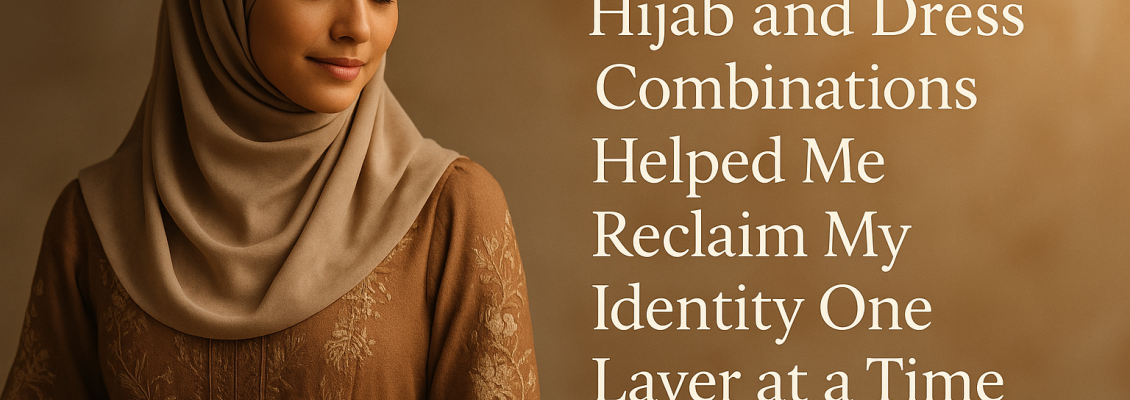
The air outside was heavy with the warmth of early summer, and as I stood by my bedroom window, fingers nervously tracing the delicate embroidery on my abaya, I realized how far I'd come. It was June 13th, 2025, though the date itself felt insignificant compared to the storm of emotions stirring inside me. The birds sang their morning praises while my heart whispered a quiet, trembling dua: “Ya Allah, help me walk this path sincerely.”
I never imagined that fabric could carry so much weight — not physical weight, but emotional, spiritual, and even generational. My journey with hijab and dress combinations wasn’t a simple matter of fashion or compliance. It was a reclaiming. A return. A restoration of an identity that had been buried under layers of doubt, fear, and societal pressure. Every layer of fabric I added became a layer of healing, of safety, of belonging. But it was not always easy.
There were days I felt like I was drowning beneath expectations — my own, my family's, my culture's, and strangers'. There were nights I whispered through tears, asking Allah if I was strong enough to continue. But somewhere between the trembling beginnings and today's quiet confidence, I found something far deeper than style — I found myself.
This post is my heart laid bare — a reflection of how hijab and dress combinations became my spiritual anchor. If you're walking a similar path, dear sister, know that you're not alone. Let's walk this road together, one layer at a time.
Table of Contents
- Was I Hiding or Lost? The Day I Feared My Reflection
- Can Clothes Really Speak for My Soul?
- When Modesty Felt Like a Mountain I Couldn't Climb
- Why Did Hijab and Dress Feel So Heavy in My Hands?
- The Moment I Cried in the Dressing Room, Asking Allah for Guidance
- Is Covering My Hair Enough to Heal My Heart?
- How Hijab and Dress Started Whispering My Worth Back to Me
- Why Did I Long for Beauty While Fearing Displeasing Allah?
- The First Time I Walked Outside Fully Covered — And Trembled
- Can Hijab and Dress Truly Help Me Belong in Both Worlds?
- The Silent Du'as I Made Each Morning While Pinning My Hijab
- When Hijab and Dress Became My Armor Against Society's Gaze
- How I Faced My Family’s Questions Without Losing My Peace
- Is It Weak to Feel Lonely on the Path of Modesty?
- The Unexpected Joy of Finding Sisters Who Love Hijab and Dress Too
- What if My Modesty Journey Never Feels Perfect?
- How Hijab and Dress Taught Me to See My Reflection Differently
- The Secret Struggles Behind My Smiles in Hijab Tutorials
- Can Modesty Coexist with My Love for Fashion?
- How Hijab and Dress Helped Me Surrender Control to Allah
- The Day I Finally Wore My Jilbab With Confidence — For Him Alone
- How Hijab and Dress Transformed My Definition of Beauty
- Am I Enough — Even When I Stumble on This Path?
- When Hijab and Dress Became My Silent Dawah to the World
- The Sweet Peace of Dressing for My Lord, Not Their Opinions
- Frequently Asked Questions
- People Also Ask (PAA)
Was I Hiding or Lost? The Day I Feared My Reflection
I still remember the flicker of fluorescent lights in that tiny dressing room. The full-length mirror stood before me like a silent judge, reflecting back not only my physical form but the heavy questions tangled within my heart. My fingers trembled as I adjusted the scarf on my head, trying to imagine what it would feel like to wear it outside — not for a picture, not for pretend, but as part of my everyday existence. And in that moment, as my own eyes stared back at me, I asked myself the question I had been avoiding for so long: Was I hiding, or was I lost?
Growing up, I always admired women who wore the hijab. Their grace, their conviction, their calm sense of identity felt like something from another world. But for me, the thought of covering felt foreign, even frightening. I didn’t know who I was beneath the layers I was supposed to wear. Was I strong enough? Was I worthy? Or was I simply conforming to what others expected of me?
The Mirror That Didn't Lie
Standing there, I saw not just my reflection but the years of confusion that led me here. I saw a girl who desperately wanted to be seen and accepted, but who also yearned for the comfort of invisibility. The world had taught me that beauty was currency, that exposure was freedom, and that baring more skin meant owning my femininity. Yet deep inside, something felt broken every time I tried to live that narrative.
It wasn’t that I didn’t love fashion — I adored it. The textures, the colors, the creativity of assembling an outfit gave me joy. But my soul was torn. The more I dressed to attract compliments and attention, the emptier I felt. And the more I tried to dress modestly without sincerity, the more I felt like an imposter. Who was I trying to please? Myself? My family? My community? Allah?
Hiding Versus Losing
It took me years to realize that hiding and being lost are not the same thing. Hiding is a choice born from fear. Losing oneself is what happens when you no longer recognize your own values. That day, facing my reflection, I saw both. I had been hiding behind society’s definitions of beauty, chasing approval in fleeting compliments and shallow connections. And I was lost because I didn’t know where my true identity lived anymore.
As I stood there gripping the soft chiffon of my scarf, I silently whispered: "Ya Allah, guide me. Show me who I am beneath all these layers — the visible ones and the invisible ones."
The Weight of Expectations
So many of us carry invisible burdens when we consider adopting hijab and dress combinations. Family expectations. Cultural norms. Social media narratives. Personal insecurities. They all press against our hearts, making every decision feel heavier than the fabric itself.
Here’s what weighed on me most in that moment:
| Source of Pressure | Inner Question |
|---|---|
| Family | "Will my parents be proud or will they think I’ve gone too extreme?" |
| Friends | "Will they distance themselves or mock me behind my back?" |
| Social Media | "Will I still be seen as stylish? Will I lose followers?" |
| Myself | "Am I doing this for Allah or for validation?" |
| Shaytan (Whispers) | "You’re not pure enough to wear hijab. You’ll fail and be a hypocrite." |
Each voice competed for space inside my mind, but only one voice truly mattered — the quiet call of my fitrah, my natural disposition toward Allah’s guidance. That voice whispered beneath the noise: “Come back to Me.”
The Day My Dua Became Louder Than My Doubts
I stood frozen for what felt like hours, the world blurring around me. And then, like a fragile bloom breaking through hardened soil, I felt it — a small surge of courage. I didn’t need to have all the answers that day. I didn’t need perfect confidence. I only needed one sincere intention: to begin for the sake of Allah, and let Him carry me through the rest.
So I closed my eyes, placed the scarf fully around my head, and softly whispered, “Bismillah.” In that simple act, I wasn’t hiding anymore. I was choosing. Choosing to trust. Choosing to submit. Choosing to step into the unknown with my Lord beside me.
Hiding is Easy. Reclaiming is Hard.
Now when I look back at that trembling girl in the mirror, I don’t see weakness — I see bravery. Because it takes more courage to admit you’re lost than to pretend you have it all figured out. And it takes immense tawakkul (trust in Allah) to begin a journey where you may stumble, be misunderstood, or feel isolated. But every layer of fabric I wrapped that day wasn’t just covering my body — it was gently uncovering my true self.
Hijab and dress combinations were never about erasing who I was. They became the canvas upon which Allah painted my real identity. I wasn’t losing myself — I was finding myself, one layer at a time.
Reflection for You, My Sister
If you find yourself standing before your own mirror today, trembling as I once did, know that you are not weak. You are standing at the doorway of transformation. The first step isn’t about being perfectly ready — it’s about trusting that Allah will meet you exactly where you are.
Don’t wait for full certainty to begin. Let your first step be your first dua. And know that every layer you add is not a prison — it’s a sanctuary.
Can Clothes Really Speak for My Soul?
I used to believe that clothing was nothing more than fabric stitched together — something external, something worldly. But as I stood at the crossroads of my modesty journey, I realized that my clothes had become one of the most powerful mirrors of my inner state. Could it be, I wondered, that clothing was never meant to simply cover the body? Could it be that clothing was created to speak for the soul?
This question haunted me for months as I grappled with my niyyah (intention) behind wearing the hijab and dressing modestly. Was I adopting hijab and dress combinations to conform to culture? To please my family? To fit in with a certain crowd? Or was it deeper than that — a whispered conversation between my heart and my Creator?
Every Stitch, A Reflection
When I first started experimenting with hijab and modest dresses, I quickly realized that my choices reflected more than just fashion sense. They echoed my inner struggles and triumphs. The flowing abaya that made me feel safe, the soft chiffon scarf that gently framed my face, the neutral tones that calmed my anxious heart — each piece became an extension of my spiritual state.
My clothes began to speak for me when words couldn’t. They became my silent dua to Allah: “I want to be close to You. I want to protect the gift of my beauty You’ve given me. I want to honor my dignity as a Muslim woman.”
But along the way, I learned that this wasn’t unique to me. Across cultures and generations, Muslim women have used their hijab and dress to express deeply personal spiritual intentions. Let me share some of these with you:
| Clothing Element | What It Speaks for the Soul |
|---|---|
| Flowing Abaya | “Ya Allah, allow me to walk through the world with dignity and humility.” |
| Simple, Minimalist Colors | “Let my presence not distract, but reflect serenity and focus on You.” |
| Elegant Hijab Styles | “I still cherish beauty, but now I direct it inward for Your sake.” |
| Loose-Fitting Dresses | “My worth is not defined by the contours of my body, but by my taqwa.” |
| Layered Outer Garments | “Every layer is a barrier between me and temptation, and a shield of protection.” |
The Language of Submission
What I came to realize is that modest clothing isn’t simply a fashion statement — it’s a language of submission. Every morning, when I choose what to wear, I’m engaged in a silent act of ibadah (worship). I’m reminding myself: my body is an amanah (trust) from Allah, not a commodity for public consumption.
Before embracing hijab and dress, I didn’t fully grasp how my clothing choices were shaping my relationship with Allah. But once I internalized that every outfit I wear can be a form of silent dhikr (remembrance), my entire perspective changed. Even my hesitation to over-accessorize or to blend too deeply into worldly trends wasn’t about fear — it was about a yearning for sincerity.
When The World Misunderstands
Yet, not everyone understands this sacred conversation between a woman and her Lord. Many times I’ve heard comments like:
- "You’re hiding your beauty. You should feel free."
- "You must be oppressed."
- "Don’t you feel restricted?"
These remarks used to sting, until I realized that they were seeing only with the eyes of dunya (the worldly life), while I was striving to see with the eyes of akhirah (the eternal life). My hijab and dress were not hiding me — they were unveiling my devotion, my discipline, and my freedom from external validation.
The true oppression, I learned, was in being enslaved to the gaze of others, constantly adjusting my appearance to meet shifting standards of beauty. My soul longed to be free of that. And my clothes — simple, loose, and dignified — became the physical manifestation of that freedom.
The Day My Clothes Began to Heal Me
There was a turning point I’ll never forget. I was sitting in a circle of sisters at the masjid after dhuhr prayer. Each of us was adorned differently — some in bold colors, others in soft pastels, some fully covered in jilbab, others in beautiful maxi dresses with perfectly wrapped hijabs. Yet despite these differences, a radiant peace filled the room. We were all wrapped in layers of devotion, each garment speaking its own dua to Allah.
In that circle, I saw myself for the first time — not as a girl struggling with modesty, but as a woman embraced by Allah’s mercy. I was no longer dressing out of fear, confusion, or cultural pressure. I was dressing as an act of love. My soul was finally at rest.
What My Clothes Speak for Me Now
Now, when I walk into the world draped in my hijab and dress, I am fully aware that I am silently proclaiming:
- “I am a servant of Allah first.”
- “I honor my femininity with dignity, not display.”
- “I choose submission over trends.”
- “I find my confidence in His pleasure, not theirs.”
It has taken time, mistakes, tears, and countless whispered duas to reach this point. But now I know with certainty: Yes — clothes can speak for the soul. And when chosen with sincerity, they speak volumes.
For You, My Sister
If you ever wonder whether your hijab, your dress, your choice of modesty matters — know that it does. Even if no one sees your intention, Allah does. Even if others misunderstand, your garments are wrapping you in obedience, humility, and honor before your Lord. And that is the most beautiful conversation your soul can ever have.
May every thread you wear be heavy with reward. May every step you take in modesty be counted as a step closer to Him. And may your clothes always speak the language of your heart: “Labbaik Allahumma labbaik — I am here, my Lord, I am here.”
When Modesty Felt Like a Mountain I Couldn't Climb
There was a time when the idea of modesty felt so heavy, so overwhelming, that even thinking about it brought tears to my eyes. The sisters around me made it look so easy—gliding in their graceful abayas, wrapping their hijabs effortlessly, radiating a serenity I deeply craved. But inside my heart, modesty felt like an enormous mountain I couldn’t possibly climb.
Why did something so beautiful feel so impossible for me?
I would sit alone in my room, scrolling through endless photos of elegant hijab and dress combinations, admiring the colors, the flow, the beauty of it all. Yet every time I tried to take that first step, doubts wrapped themselves around me like chains.
The Weight I Carried
Modesty, for me, was never just about clothes. It was a reflection of my entire relationship with Allah. And that made it feel even heavier. Every thought sounded like a whisper of self-doubt:
- “You’re not religious enough yet.”
- “You still struggle with your prayers, how can you wear hijab?”
- “You’ll never be able to stay consistent.”
- “What will your friends think? Your coworkers? Strangers?”
Each one of these thoughts piled higher and higher, building the mountain that stood before me. And the more I delayed, the larger it grew in my mind.
The False Narratives I Believed
One of the hardest parts of my struggle was the false image I had built about what a modest woman "should" be. In my head, she was someone perfect — always in khushu during salah, memorizing Qur'an with ease, never struggling with her nafs. But I was not that woman. I was messy, inconsistent, still learning, still falling, still crawling back to my Lord. How could someone like me deserve to wear the garments of modesty?
And then came the whispers of Shaytan:
- “You’ll be a hypocrite if you wear it now.”
- “Wait until you’re perfect first.”
- “You’ll take it off eventually, so why start?”
These whispers paralyzed me for years, convincing me that the mountain of modesty was reserved only for the saints, not for the broken souls like mine.
What Helped Me Begin Climbing
One evening, I sat in a halaqah, listening to a sister share her journey. She spoke softly but firmly:
“You don’t wear hijab because you’re perfect. You wear it because you’re trying to please the One who is perfect.”
Her words pierced my heart. Suddenly, I realized that the mountain wasn’t meant to be climbed in one giant leap. It was meant to be taken one step, one breath, one sincere intention at a time.
So I started small. I began to explore different hijab and dress combinations that felt both beautiful and attainable. I experimented with fabrics that made me feel comfortable. I practiced wearing hijab at home, slowly building my confidence. And with every tiny step, the mountain shrank just a little.
My Personal Struggles at Each Stage
To be fully honest, my journey wasn't linear. There were stages I passed through, and each one carried its own unique test:
| Stage | Struggle | Solution That Helped |
|---|---|---|
| Thinking About It | Fear of judgment from others | Remembering that Allah sees my intention, not the whispers of people |
| First Trial Wear | Feeling uncomfortable or "fake" | Wearing it around safe spaces at first, like family or sisters-only gatherings |
| Going Public | Facing stares and comments | Making constant dua for courage and strength, reminding myself of my "why" |
| Maintaining Consistency | Struggling on hard days to stay committed | Seeking sisterhood and reminders that consistency grows with patience |
Every Struggle Is a Form of Worship
One of the most beautiful things I learned on this journey is that even my struggles counted. The days I felt weak, the tears I cried in frustration, the moments of hesitation — they were not failures. They were acts of worship. Because every time I pushed through, even a little, I was turning back to Allah. And He sees every attempt, every effort, every trembling first step.
Allah says in the Qur’an:
"As for those who strive in Our cause—We will surely guide them along Our Way. And Allah is certainly with the good-doers." (Surah Al-Ankabut 29:69)
This ayah became my anchor. As long as I was sincerely striving, Allah promised His guidance. The mountain was no longer an impossible peak — it became a journey of companionship with my Lord.
The View from Higher Ground
Now, when I look back at where I started, I smile with gratitude. What once felt like an unclimbable mountain now feels like a path paved with mercy. I still stumble. I still have days where the whispers return. But the view from higher ground is filled with something I never expected: peace.
Peace in knowing that my worth is no longer tied to external approval. Peace in dressing for Allah’s pleasure. Peace in realizing that my imperfect journey is still beautiful in His sight.
For My Sister Who Stands at the Foot of Her Own Mountain
If you, my sister, feel like modesty is a mountain you can’t climb, please know this:
- You don’t need to reach the top today.
- Every sincere step counts as worship.
- Allah is more Merciful than your mistakes are plentiful.
- Perfection is not a requirement — sincerity is.
Take one step today, and trust that Allah will carry you the rest of the way. And one day, you too will look back and realize that the mountain you feared was simply a pathway to His closeness all along.
May your journey be lightened, your heart be strengthened, and your steps be blessed. Ameen.
Why Did Hijab and Dress Feel So Heavy in My Hands?
There was a moment I’ll never forget: standing before the mirror, hijab in one hand, dress in the other, my heart pounding. They weren’t heavy in the physical sense — fabric is light, after all — but they felt unbearably weighty in my trembling hands. I couldn’t understand why something so soft could feel like it carried the weight of the world.
It took me years to unravel what made those simple garments feel so overwhelmingly heavy. The heaviness wasn’t in the fabric — it was in what they represented. My hijab and dress carried every fear, every expectation, every judgment, and every silent battle I had stored inside me.
The Weight of Expectations
In my mind, wearing hijab and dressing modestly came with an invisible list of expectations:
- Be a perfect Muslimah.
- Never struggle in your faith.
- Be a flawless representation of Islam to everyone around you.
- Face criticism with endless patience.
These unrealistic expectations crushed me before I even began. I felt like the moment I wore hijab and dress, I would become an ambassador of Islam — whether I wanted that role or not. The pressure to be perfect under the gaze of family, community, strangers, and even my own self was suffocating.
And so the fabric felt heavy — not because of its weight, but because I thought I had to carry perfection along with it.
The Fear of Judgments and Whispers
There was also the looming fear of what others would say. The world can be both harsh and ignorant:
- “You look oppressed.”
- “Aren’t you too young to wear that?”
- “Are you even ready for that commitment?”
- “What if you take it off later? Won’t that be embarrassing?”
Each comment, whether spoken or imagined, added weight to my hands as I stood holding the hijab and dress. I feared being watched, labeled, misunderstood. I feared the silent expectations placed upon every woman who chooses modesty — that we must always smile, never falter, never fall, and never reveal our human struggles.
The Battle Between My Heart and Nafs
What made the weight feel even greater was the internal conflict within myself. My heart longed for Allah’s pleasure, but my nafs whispered every excuse to delay:
- “You’re not good enough yet.”
- “You’ll stand out too much.”
- “You’ll lose your friends.”
- “You’ll regret it.”
This constant tug-of-war exhausted me. Every time I tried to take a step forward, my nafs would pull me back. And so I stood frozen, hijab and dress still in my hands, paralyzed by my own fears.
Breaking Down the Heaviness
One day, during a late-night dua, I cried out to Allah: “Ya Rabb, why does this feel so hard?” And in that vulnerable moment, I realized — I had been carrying burdens that weren’t mine to carry. The heaviness came from:
| Burden | Reality |
|---|---|
| Fear of judgment | Only Allah’s judgment matters. |
| Need for perfection | Allah loves sincere effort, not perfection. |
| Pressure to represent Islam flawlessly | We are all imperfect representatives; guidance comes from Allah. |
| Fear of what others will say | Their opinions do not control my akhirah. |
| Self-doubt and nafs | Struggle is part of the journey; Allah sees my striving. |
With every realization, the load grew lighter. Not because the challenges disappeared, but because I stopped adding unnecessary weight onto my heart.
The Moment I Finally Wore It
It wasn’t a grand ceremony. There were no cameras, no applause, no big announcement. Just me, my reflection, and Allah. I whispered Bismillah, wrapped the hijab around my head, smoothed the dress over my frame, and stood there — trembling, but standing.
At that moment, I didn’t feel like a different person. I still carried my struggles, my insecurities, my unanswered questions. But I also carried a seed of courage, planted firmly in my heart. And that seed was enough to begin.
The Heaviness Transformed
What surprised me most was how quickly the heaviness began to transform. The hijab that once felt like a burden began to feel like protection. The dress that once felt overwhelming began to feel freeing. Instead of hiding me, they began to unveil a part of me I hadn’t known — my quiet strength, my longing for sincerity, my deep connection with my Lord.
In those garments, I found my dignity. Not because I had suddenly become perfect, but because I had chosen to honor Allah even while still broken and learning.
Lessons for My Sisters
For any sister standing where I once stood, trembling with hijab and dress in your hands, know this:
- You are not weak for struggling — you are courageous for even considering the step.
- Perfection is not a prerequisite — sincerity is.
- Every whisper of fear is an opportunity for dua.
- Allah sees your trembling hands — and He is Most Merciful.
Remember that your journey is unique. There is no set timeline. Some wear it overnight, others take years. What matters is that each step you take is for His sake, with a heart seeking closeness to Him.
From Heavy to Light
Now, when I hold my hijab and dress each morning, they feel light in my hands. Not because the world has changed, but because my heart has. The same fabric that once felt too heavy now feels like a warm embrace from my Lord — reminding me every day: "You chose Me."
May Allah make your journey easy, your steps firm, and your heart at peace. Ameen.
The Moment I Cried in the Dressing Room, Asking Allah for Guidance
I never expected that a small, brightly lit dressing room in a modest boutique would become the place where my heart would crack wide open. But Allah chooses our moments of awakening in ways we don’t plan, and for me, it was behind that thin curtain, alone, trembling, and desperately in need of His guidance.
For weeks, I had been struggling internally. The desire to wear hijab and dress modestly was burning inside me, but so were the fears. Every time I thought I was ready, a wave of doubts would pull me back: What if I fail? What if people stare? What if I’m not worthy? The heaviness I carried in my heart had followed me everywhere, even here, to this little store filled with beautiful, flowing fabrics.
Facing My Reflection — And My Fear
I remember holding a deep green abaya in my hands — the color of Jannah, the shop assistant had sweetly said. My heart wanted it, my soul yearned for it, but my nafs fought back fiercely. As I slipped it on, my breath caught. In the mirror stood a version of me I barely recognized. Was this truly me? Could I carry this identity? Could I wear my faith so openly?
The mirror reflected more than my image. It showed my insecurities, my confusion, my longing, and my fear all tangled together.
The Tears I Couldn’t Hold Back
And then the tears came, quietly at first, like a soft rain — warm, steady, unstoppable. My chest tightened as I whispered under my breath, my voice cracking, "Ya Allah… I don't know if I can do this. I’m scared. Please help me."
In that moment, the world outside the dressing room disappeared. It was just me and my Lord. The walls closed in, but His mercy expanded within my heart. It was not the abaya that overwhelmed me — it was the weight of the decision, the responsibility, and the surrender that hijab and dress symbolize.
The Du’a That Poured from My Heart
Between my tears, I whispered:
"Ya Allah, You know my heart. You know my weaknesses, my fears, my desires. If this is pleasing to You, strengthen me. Purify my intentions. Protect me from the whispers of Shaytan. Make me among those who walk toward You, even if my steps are shaky."
That du’a wasn’t rehearsed. It wasn’t elegant. But it was sincere. And sometimes, that’s all Allah asks of us — sincerity in the rawest form.
What Made That Dressing Room So Heavy?
As I stood there, I realized the dressing room was simply the physical space where all my internal battles converged. The heaviness wasn’t from the walls or the fabric — it was from years of unspoken fears:
| Fear | Root Cause |
|---|---|
| Fear of Change | Leaving the comfort of my old identity. |
| Fear of Judgment | Worrying about others’ opinions more than Allah’s pleasure. |
| Fear of Failure | Believing I wouldn’t stay consistent and fearing hypocrisy. |
| Fear of Isolation | Wondering if I would lose friends or be misunderstood. |
Each fear whispered doubts into my mind, making that small dressing room feel like a mountain. But in the midst of it all, Allah was gently peeling those fears away through my tears and du’a.
His Mercy Was Closer Than My Breath
As I stood there crying, a strange calm washed over me. Not because my fears had vanished, but because I felt His presence — so close, so near. Allah says in the Qur’an:
"And when My servants ask you concerning Me, indeed I am near. I respond to the invocation of the supplicant when he calls upon Me." (Surah Al-Baqarah 2:186)
In that moment, I felt heard. My weakness wasn’t something to be ashamed of — it was an invitation to draw closer to Him. My tears were not signs of failure; they were signs of surrender.
Leaving the Dressing Room — A New Beginning
After what felt like hours but was probably just minutes, I wiped my face, adjusted the abaya, and looked in the mirror once more. My eyes were swollen, but my heart was lighter. I took a deep breath and whispered, "Bismillah."
That single word carried the weight of my entire journey up to that point. It was my declaration: "I’m ready to try, Ya Allah. I trust You."
I purchased the abaya that day — not because I was fully ready, but because I was finally willing. Willing to begin, to fall, to get back up, and to keep walking toward Him.
The Power of Private Moments
What I learned that day is something I hold onto even now: some of the most powerful moments of our lives happen in private — in dressing rooms, in late-night sujood, in silent tears, in whispered du’as no one hears but Allah.
We don’t need grand stages to make life-changing decisions. Sometimes, all we need is an intimate conversation with our Creator, raw and unfiltered. That is where real transformation begins.
For My Sister Standing in Her Own Dressing Room
To you, my dear sister, who may one day stand in your own dressing room holding your own hijab and dress, I offer these gentle reminders:
- Your tears are not signs of weakness; they are signs of your heart’s sincerity.
- It’s okay to be scared. Courage is not the absence of fear; it’s moving forward despite it.
- Allah sees you, hears you, and loves your striving.
- Perfection is not required — only a sincere intention to please Him.
Take your time, but don’t delay forever. Let your dressing room moment become your moment of surrender, just as it was for me. And when you step out, whether today, tomorrow, or years from now — know that you are walking under the gaze of the Most Merciful.
May your journey be easy, your heart be strengthened, and your steps guided. Ameen.
Is Covering My Hair Enough to Heal My Heart?
When I first wrapped the hijab around my head, I thought everything inside me would immediately shift. I expected instant peace, clarity, and healing — as though this single act would erase the wounds I carried for years. But as I looked at my reflection, now modestly covered, I realized something painful: while my hair was covered, my heart was still bruised, restless, and searching.
That moment forced me to confront a hard question: is covering my hair enough to heal my heart?
The Outer and Inner Arenas
In Islam, we are taught that both the inner and the outer matter. The hijab is an act of obedience — a beautiful, visible form of worship. But true healing happens deeper, in the quiet spaces of the soul where no one but Allah can see.
I quickly learned that covering my hair was only one piece of a much larger spiritual journey. I had focused so much on the external transformation, believing that once I put on the hijab, my insecurities would vanish, my doubts would disappear, and my past wounds would fade. But the hijab didn’t erase my struggles — it exposed them.
The Silent Wounds Beneath the Fabric
As I wore my hijab daily, I began to notice the emotional wounds I had never properly addressed:
| Emotional Wound | Underlying Pain |
|---|---|
| Insecurity | Fear of not being enough for others or for Allah. |
| Perfectionism | The need to always “get it right” or risk feeling like a hypocrite. |
| Fear of Judgment | Worrying constantly about how others perceive me. |
| Shame | Lingering guilt from my past mistakes. |
| Loneliness | Feeling disconnected even among fellow Muslims. |
These pains weren’t suddenly fixed by simply covering my hair. If anything, the hijab drew attention to them. But instead of seeing this as failure, I slowly began to realize — perhaps this is exactly where healing begins: by confronting, not avoiding, what lies within.
Hijab as a Doorway, Not a Destination
One of the most profound shifts I experienced was understanding that hijab isn’t the finish line — it’s a doorway. It’s not the end of my journey but the beginning of an invitation to deeper sincerity, deeper connection, and deeper healing with my Lord.
The Prophet Muhammad (peace be upon him) said:
"Verily, in the body there is a piece of flesh which, if it is sound, the whole body is sound; and if it is corrupt, the whole body is corrupt. Verily, it is the heart." (Bukhari & Muslim)
This hadith reminded me that my heart is the true battleground. Covering my hair was an act of obedience, but tending to my heart was an act of love and surrender. I needed both.
The Layers of True Healing
As I walked deeper into my journey, I found that healing my heart required layers of effort alongside wearing the hijab:
- Daily Qur’an: Letting Allah’s words wash over my heart, offering comfort and clarity.
- Istighfar: Seeking forgiveness daily, releasing the shame of my past.
- Salah with Presence: Slowing down, feeling every word, speaking to my Lord sincerely.
- Company of the Righteous: Surrounding myself with sisters who uplift, not criticize.
- Private Du’a: Pouring my heart out in sujood, where my tears fell in secret conversations with Allah.
Slowly, I felt the chains around my heart loosen. The pain didn’t vanish overnight, but Allah placed tranquility (sakinah) where anxiety once lived. And through this, I understood: healing is not a single moment. It is a daily returning to Allah.
The Danger of Only Focusing on the Outer
At one point, I realized how easily we can fall into the trap of thinking that our appearance alone is proof of our nearness to Allah. I had been so focused on wearing my hijab correctly that I neglected parts of my character that desperately needed refining.
The Prophet (peace be upon him) reminded us:
"Indeed, Allah does not look at your appearance or your wealth, but He looks at your hearts and your deeds." (Muslim)
This doesn’t mean the outer isn’t important — it absolutely is. But if my hijab became simply cloth while my heart remained hard, had I truly submitted? The hijab on my head needed to reflect the hijab of my eyes, my tongue, my thoughts, and my actions. That’s where true healing flourishes.
Small Acts That Slowly Healed My Heart
Looking back, it was not grand gestures but simple daily practices that mended me:
- Listening to Qur’an while preparing for the day
- Quiet morning dhikr before the world awakened
- Writing heartfelt du’as in my journal
- Learning about Allah’s Names and Attributes
- Finding joy in small acts of kindness
These small moments anchored me, grounding me even when my emotions wavered. The more I nurtured my relationship with Allah privately, the more my public appearance in hijab began to reflect a deeper inner peace.
My Answer Today: A Gentle Truth
If you were to ask me now, "Is covering your hair enough to heal your heart?" — I would smile softly and say:
No, it’s not enough on its own. But it is one of the most beautiful beginnings you can offer yourself. It’s an act of obedience that opens the door to healing, but walking through that door requires daily surrender, daily remembrance, and daily connection with your Lord.
Covering your hair shields you outwardly, but only constant remembrance and worship will heal you inwardly. And the two were always meant to walk hand in hand — together leading us home to Allah.
May Allah purify our hearts, strengthen our intentions, and make every piece of fabric we wear a witness for us on the Day of Judgment. Ameen.
How Hijab and Dress Started Whispering My Worth Back to Me
There was a time when I measured my worth by how others saw me — how desirable I appeared, how many compliments I received, how well I blended into the standards of beauty that were never made for me. The world whispered its own definition of worth into my ear: flawless skin, perfect body, trendy outfits, the right shade of lipstick. I chased those standards for years, but no matter how hard I tried, I always felt hollow.
When I began my journey into hijab and dress, I never imagined that these simple, modest garments would become the gentle voices that would slowly start whispering my true worth back to me — not as the world defined it, but as my Creator defined it.
The Silence After the Noise
Wearing hijab and dressing modestly felt like turning down the world’s volume. For the first time, I wasn’t dressing to impress. I wasn’t trying to be seen, desired, or envied. I was dressing to please Allah. The constant comparison faded little by little. The pressure to look a certain way began to lose its grip on my heart. In the silence that followed, I began hearing something softer, something truer.
Hijab Became a Shield and a Teacher
At first, hijab felt like a heavy armor — something I carried on my body. But slowly, I realized it was more like a protective whisper reminding me:
"You are not for the gaze of this world. You are already enough, simply because you are His."
As I walked through crowded streets and entered spaces where beauty was currency, my hijab became both a shield and a teacher. It protected me from the shallow judgments of others, and it taught me to seek a deeper kind of validation — one that could not be taken away by age, trends, or public opinion.
Shifting My Definition of Beauty
One of the biggest transformations was how hijab and dress slowly redefined beauty in my mind. I started asking myself questions I had never dared to before:
| Old Standard | New Understanding |
|---|---|
| Do others find me attractive? | Does Allah find my heart sincere? |
| Am I trendy enough? | Am I modest and dignified in my appearance? |
| Am I thin enough? | Am I content and healthy as Allah created me? |
| Will people compliment my outfit? | Will my outfit reflect taqwa (God-consciousness)? |
This internal shift was slow and gentle, but it was life-changing. I stopped chasing unattainable ideals and started chasing sincerity and inner peace. Hijab became not just cloth, but clarity.
Discovering My True Audience
Before hijab, I dressed for people — friends, strangers, even for people I would never meet. Every outfit was silently asking, “Do you approve of me?” But hijab rewired my heart. Now, every time I place it on my head, I feel like I’m whispering back to my Creator:
"Ya Allah, this is for You. You are my true audience."
Knowing that Allah sees me — truly sees me — changed everything. His gaze is not harsh or critical, but full of mercy. And because He sees my efforts, my stumbles, my intentions, and my tears, I no longer need the applause of people who only see my surface.
The Soft Confidence That Grew Within
Strangely, as I covered more of my body, I uncovered a quiet confidence within my soul. Modesty taught me to walk with dignity, not arrogance. My confidence no longer came from how many heads turned when I entered a room, but from knowing I was walking in obedience to the One who created me.
My worth was no longer tied to temporary things. Hijab whispered to me every morning:
- "You are honored as a servant of Allah."
- "Your value is not reduced by your imperfections."
- "You are beautiful in ways this world cannot define."
- "Your body is a trust, not a product for public consumption."
This was worth more to me than any passing compliment ever could be.
Confronting the World’s Gaze
Of course, the world didn’t stop watching. There were still curious stares, awkward questions, and moments of discomfort. But even in those moments, hijab continued to whisper strength into my ear:
"Let them look. My worth is not up for their judgment."
It was as though every stare became a moment of silent dhikr — an opportunity to remember Who I was doing this for. The world could see my modesty, but only Allah could see the sincerity behind it.
Healing the Broken Narrative
Before hijab, I believed the lie that I had to constantly prove my worth. That I was never quite enough. That if I wasn’t beautiful enough, I wasn’t valuable. But hijab and dress became the tools Allah used to rewrite that broken narrative within me.
Through modesty, I learned that I was already enough. Not because of how I looked, but because Allah had already honored me when He created me as a Muslimah.
The Prophet (peace be upon him) said:
"Indeed, the most honored of you in the sight of Allah is the most righteous of you." (Surah Al-Hujurat 49:13)
Righteousness, not appearance, defines our worth with Allah. And that truth freed me from years of painful self-comparison.
A Whisper for My Sisters
To you, my dear sister who may still be struggling with your worth — listen carefully:
- You are not invisible in hijab; you are elevated.
- Your modesty is not your weakness; it is your strength.
- Your worth is not for this world to measure; it is defined by the One who created your soul.
May your hijab whisper these truths to you every single day, just as mine continues to do for me. May it remind you that you are a servant of the Most High, and that alone makes you priceless.
And on the Day when all externalities fade away, may your hijab stand as a witness for you, testifying that you chose your worth according to His standards, not the world’s. Ameen.
Why Did I Long for Beauty While Fearing Displeasing Allah?
There was a constant tug-of-war within me—a quiet battle I carried in my chest every time I stood in front of the mirror. On one side was my natural longing to feel beautiful, elegant, and admired. On the other was the weight of my conscience, gently reminding me of my responsibility to honor the boundaries Allah has set. I often whispered to myself: how do I reconcile these two voices without tearing myself apart?
Islam never denied my love for beauty. In fact, our faith embraces beauty. The Prophet Muhammad (peace be upon him) said:
"Allah is beautiful and loves beauty." (Sahih Muslim)
But my problem wasn’t simply the love of beauty. It was the kind of beauty I was chasing — a beauty shaped by worldly standards, by social media, by unrealistic ideals that seemed to demand my complete submission. The more I tried to fit into those molds, the more I felt like I was betraying my soul. My longing for beauty became entangled with my fear of displeasing Allah, creating a painful knot I didn’t know how to untangle.
The Heavy Burden of Dual Expectations
Everywhere I looked, the world told me: "Be beautiful, but not too modest. Be confident, but not too covered. Be admired, but not for your piety." At the same time, my iman whispered: "Honor your body. Guard your modesty. Seek Allah’s pleasure first."
Balancing both voices was exhausting. I began to feel like no matter what I did, I would disappoint someone—either society or my Lord. The weight of these dual expectations suffocated me at times.
| Worldly Standards | Islamic Guidance |
|---|---|
| "Show your beauty to attract attention." | "Lower your gaze and guard your modesty." (Qur’an 24:30-31) |
| "Wear form-fitting, revealing clothing." | "Draw your veils over your chest." (Qur’an 24:31) |
| "Your value is in how others see you." | "Your value is in your taqwa." (Qur’an 49:13) |
| "Beauty means exposure." | "Beauty lies in dignity and concealment." |
The Subtle Influence of Social Pressures
Social media complicated everything even more. The influencers I followed looked so effortlessly perfect — the flawless makeup, the tailored abayas that somehow still accentuated every curve, the photoshoots that screamed luxury. They spoke of modesty, but sometimes what they modeled felt closer to performance than true hijab. And I fell for it too, many times.
I would order outfits hoping they’d give me that same elegant, graceful vibe, only to feel guilty once they arrived. "Is this really hijab?" I would ask myself. Was I dressing for Allah or for likes and compliments? The lines blurred so easily.
The Deeper Longing Behind My Longing
As I reflected deeply, I realized my longing for beauty wasn’t entirely shallow. Underneath it was something pure: I wanted to feel cherished. I wanted to feel seen. I wanted to feel worthy.
But instead of chasing those feelings through fleeting attention, Allah was inviting me to seek it through Him. He is Al-Jameel, The Most Beautiful. He is Al-Wadud, The Most Loving. True beauty and worth were always found in my relationship with Him, not in my reflection.
Shaytan’s Whisper: The Fear of Missing Out
Shaytan is subtle. His whispers are not always obvious disobedience. Sometimes, they sound like: "Just this once. Just a little makeup. Just this slightly tighter dress. You’re still wearing hijab, aren’t you?"
And the moment I listened, guilt followed me. My salah felt heavy. My du’as felt hollow. I would look into the mirror and no longer recognize my intentions. Was I seeking the pleasure of my Creator, or the fleeting approval of creation?
Learning to Redefine Beauty as Iman
What finally brought me peace was understanding that modesty itself is a form of beauty — a beauty that transcends physicality. Modesty reflects a beautiful soul, a heart that chooses Allah over dunya, a person who values their worth so deeply that they do not auction it to the lowest bidder.
- Beauty is lowering my gaze and protecting my heart.
- Beauty is feeling peace in prayer, knowing I’m covered in obedience.
- Beauty is being adorned in haya (shyness) and dignity.
- Beauty is trusting that what I give up for Allah, He replaces with something far better.
The Gentle Mercy of Balance
Islam is a path of balance — not extremes. I learned that I didn’t have to erase my desire to feel beautiful. Rather, I had to realign it toward what Allah permits and loves. I could still wear beautiful fabrics, elegant abayas, tasteful colors, lovely scarves. But always within the bounds of modesty, dignity, and intention.
There is a beautiful du’a that captures this balance so perfectly:
"O Allah, beautify my character as You have beautified my appearance."
In this du’a, the emphasis is not solely on the external. We seek beauty, but primarily where it matters most — in our hearts and conduct.
The Healing Power of Niyyah (Intention)
Every time I get dressed now, I pause and set my niyyah. I say softly:
"Ya Allah, let this outfit be a form of worship. Let it reflect my love for You. Let it protect me from pride and vanity. Let it remind me of my purpose."
That small moment of intention shifts everything. It takes my daily act of dressing from a place of anxiety to a place of ibadah (worship).
What I Would Tell My Younger Self
If I could sit down with my younger self, lost in this struggle, I would hold her hands gently and say:
- "It’s okay to love beauty — Allah created you with that desire."
- "But the world’s definition of beauty will never fill you — only Allah can."
- "What you give up for His sake is not deprivation — it’s elevation."
- "True beauty is not in being admired but in being content and seen by Allah."
A Lifelong Journey of Balancing Love and Fear
I have learned that longing for beauty while fearing to displease Allah is not a contradiction — it’s part of being human. The key is in navigating that longing with humility, sincerity, and trust in His mercy.
Now, when I feel that familiar tug-of-war, I don’t fight it alone. I turn to Allah, the One who understands every whisper of my heart. And I ask:
"Ya Allah, allow me to love beauty in a way that brings me closer to You, not further away."
And every time I ask, I feel His gentle guidance whispering back: "Walk toward Me, and I will take care of your heart."
The First Time I Walked Outside Fully Covered — And Trembled
The moment I stepped outside my front door fully covered for the first time is etched deeply in my memory. It wasn’t just a physical act; it was a spiritual threshold, a crossing into a new chapter of my life. My heart pounded loudly, and my legs trembled beneath me as I faced the world differently — wrapped in the fabric of my faith, visible in a way I had never been before.
The Weight of Visible Faith
Before that day, my hijab and dress had been private acts of devotion, worn mostly at home or in familiar spaces. But stepping into public, fully covered, was like stepping onto a stage with no script. Suddenly, I became a symbol — of modesty, of religious identity, of beliefs that many around me didn’t understand or sometimes even rejected.
That first step outside was both liberating and terrifying. I was proud, yet vulnerable. Free, yet exposed. It was a paradox I hadn’t anticipated.
Why the Trembling? The Many Layers Behind It
My trembling wasn’t just physical. It was the sum of emotions, fears, and hopes intertwined:
- Fear of Judgment: What would people say? Would they stare? Whisper? Judge my choices?
- Fear of Rejection: Would my friends still accept me? Would my coworkers treat me differently?
- Fear of Mistakes: Was my hijab perfect? Was I doing this “right”? Was I truly ready?
- Excitement: I was embracing a new identity, stepping into a promise I had made to Allah.
- Hope: That this act would bring me closer to my Creator, that it would heal parts of me.
The Social Reality of Public Modesty
In many places, walking outside fully covered can evoke strong reactions — some respectful, others hurtful. I quickly learned that modesty isn’t just a personal choice; it’s a public declaration that often challenges societal norms.
| Experience | Possible Reactions | My Feelings |
|---|---|---|
| Walking into a busy shopping mall | Curious glances, whispered comments | Uneasy but determined |
| Meeting acquaintances unexpectedly | Surprise, sometimes awkward questions | Nervous but proud |
| Public transportation rides | Mixed — some respectful, some dismissive | Guarded yet hopeful |
| Walking alone at dusk | Occasional stares, rare smiles | Vulnerable but strong |
Facing Internal Doubts and External Voices
Every step outside was a confrontation — with my own insecurities and with the voices of those around me. At times, I caught myself wondering if the fear was worth it. Was I ready for the social cost? Was this path truly mine or imposed by others?
But then I reminded myself of the reasons why I had chosen this path:
- My Faith: The desire to obey Allah’s commands sincerely.
- My Identity: To express who I am beyond superficial labels.
- My Peace: To find serenity in submission and trust.
That trembling began to fade, replaced by a quiet strength that grew with each passing day.
The Role of Preparation and Support
Preparation made a huge difference in that first outing:
- Practicing wearing my hijab and dress at home until comfortable
- Choosing clothes that were modest yet made me feel confident
- Praying deeply for courage and patience
- Sharing my intentions with close family or friends who supported me
Support mattered immensely. Knowing that I was not alone — that many women before me had walked this path — gave me courage. Sometimes, just a kind word or smile from a stranger could transform my trembling into hope.
The Transformative Power of That First Step
Walking outside fully covered for the first time was not the end of a journey but the beginning of a transformation. It marked a moment when I decided to live visibly according to my beliefs, accepting both the challenges and the blessings that come with it.
That trembling was a sign of my humanity — my vulnerability and courage intertwined. It was a reminder that faith isn’t about perfection but about sincere effort and trust.
Lessons I Learned from That Day
| Lesson | Insight |
|---|---|
| Fear is natural | Every new step requires courage; trembling doesn’t mean weakness |
| Visibility brings responsibility | Being covered publicly invites questions but also opportunities to represent Islam gently |
| Support systems are vital | Having family, friends, or community support eases the transition |
| Self-compassion is key | Accept imperfections and be kind to yourself during adjustment |
| Faith grows through action | Taking the step strengthens iman and builds resilience |
A Prayer for Every Woman Taking That First Step
For every sister who feels that trembling, I offer this du’a from my heart:
“O Allah, strengthen her heart, ease her path, and surround her with Your mercy. Let her find beauty in obedience and courage in vulnerability. Guide her steps and grant her peace in the knowledge that You are with her always.”
Final Thoughts: Embracing the Journey
The first time I walked outside fully covered, trembling, was a milestone of growth, humility, and faith. It was a moment when my inner world met the outer reality in a new and profound way.
Since that day, every step has become a little easier — not because the world changed, but because I changed. I learned to carry my hijab and dress not as a burden but as a beautiful emblem of my commitment to Allah. And while the trembling may still visit sometimes, it is now a reminder of how far I have come and the strength I have gained.
Can Hijab and Dress Truly Help Me Belong in Both Worlds?
One of the most profound struggles for many Muslim women who choose to wear the hijab and dress modestly is the feeling of being caught between two worlds. On one hand, there is the spiritual, inner world of faith — a realm deeply personal and sacred. On the other hand, there is the external, often secular world of modern society, with its expectations, norms, and pressures. The question arises: Can hijab and dress truly help me belong in both worlds?
The Two Worlds Defined
Before diving into the complexities of belonging, it’s important to define what these “two worlds” mean:
| World | Description | Challenges |
|---|---|---|
| Spiritual/Religious World | A realm centered around faith, devotion, submission to Allah, and internal peace. | Living in alignment with Islamic values, resisting cultural pressures that conflict with faith. |
| Secular/Societal World | The broader social and cultural environment, including work, education, social gatherings, and media. | Conforming to mainstream fashion, social acceptance, avoiding prejudice or alienation. |
For a woman wearing hijab and modest dress, the goal is often to harmonize these two realms, not to sacrifice one for the other.
The Hijab as a Bridge — Or a Barrier?
The hijab and modest dress are sometimes perceived by society as symbols of separation or difference. But for many women, these garments represent a bridge:
- Bridge to Faith: An outward expression of an inner commitment.
- Bridge to Identity: A public declaration of belonging to the Muslim community and a personal identity rooted in spirituality.
- Bridge to Empowerment: Choosing one’s own standards of beauty and dignity.
However, these same visible signs can also feel like barriers:
- Barriers in social integration or acceptance.
- Barriers in professional or educational settings due to stereotypes or discrimination.
- Barriers in casual social interactions due to misconceptions.
The Internal Conflict: Belonging vs. Authenticity
The desire to belong is a fundamental human need. We want to be accepted, loved, and understood. But what happens when belonging seems to demand compromising authenticity?
Many Muslim women wrestle with this question deeply. Wearing hijab and modest dress is an authentic expression of their faith, yet it may make them feel like outsiders in certain environments. The tension between fitting in and staying true to oneself can be exhausting.
Here’s a closer look at the internal conflict:
| Desire | Challenge | Potential Resolution |
|---|---|---|
| To be socially accepted | Pressure to conform to mainstream fashion and behaviors | Find communities and friends who appreciate modesty and diversity |
| To maintain religious values | Feeling isolated or misunderstood | Embrace the hijab as a source of strength, not separation |
| To balance professional success | Discrimination or unconscious bias | Demonstrate excellence and professionalism while confidently wearing hijab |
Real-Life Experiences: Stories of Belonging and Challenge
Many Muslim women have shared their journeys of navigating these two worlds. Some have found that wearing hijab opened doors to new friendships and respect within their faith community, while others faced skepticism or prejudice outside it.
For instance, a young Muslim woman shared how she initially feared that her hijab would hinder her career opportunities. But over time, her professionalism and dedication helped colleagues see beyond the hijab to the person within. She became a symbol of how faith and ambition can coexist harmoniously.
Another woman spoke about finding belonging through online communities of modest fashion, where hijab became a point of connection rather than division.
How Hijab and Dress Cultivate a Dual Sense of Belonging
Hijab and modest dress, while marking a visible difference, also cultivate a deep internal belonging in two important ways:
- Belonging to the Ummah (Muslim Community): These garments link women to millions of Muslim sisters around the world, past and present, creating a profound sense of spiritual solidarity.
- Belonging to Oneself: Choosing to wear hijab and modest dress is an act of reclaiming agency, self-respect, and personal faith, reinforcing self-belonging.
Strategies for Navigating Both Worlds
To belong in both worlds while wearing hijab and modest dress, intentional strategies can help:
| Challenge | Strategy | Benefit |
|---|---|---|
| Social alienation or misunderstanding | Seek supportive friends and diverse communities | Build a sense of acceptance and reduce loneliness |
| Professional bias or stereotyping | Excel professionally and educate others gently about hijab | Earn respect and break down misconceptions |
| Balancing faith and modernity | Incorporate modest fashion that aligns with contemporary styles | Feel authentic and confident while respecting faith |
The Psychological Impact of Belonging in Both Worlds
Belonging is tied to mental and emotional well-being. For women who successfully navigate these dual identities, the psychological rewards are immense:
- Enhanced self-esteem
- Reduced anxiety about social rejection
- Greater resilience against prejudice
- Stronger spiritual fulfillment
Conversely, failure to find belonging can lead to feelings of isolation, confusion, and spiritual struggle.
Faith as the Anchor
Ultimately, faith itself is the anchor that holds everything together. When hijab and dress are worn as acts of devotion, the external challenges become easier to endure because the internal connection to Allah provides purpose, comfort, and strength.
Belonging in both worlds isn’t about perfect acceptance from everyone. It’s about finding peace in your identity, walking with dignity, and knowing that your commitment to Allah transcends societal pressures.
Final Reflection
Can hijab and dress truly help me belong in both worlds? The answer is complex and deeply personal. While they may create visible distinctions, they also serve as powerful tools for authentic belonging — connecting a woman to her faith, her community, and most importantly, to herself.
Belonging in both worlds is less about blending in perfectly and more about embracing the beauty of standing out with confidence and grace.
The Silent Du'as I Made Each Morning While Pinning My Hijab
There is a quiet, sacred moment each morning for many Muslim women who wear the hijab—a moment filled with intention, reflection, and silent prayer. It’s the instant when the hijab is carefully pinned in place, signaling not just a physical covering but a spiritual armor. The act of pinning the hijab is often accompanied by heartfelt du'as (supplications), whispered quietly or held deeply within the heart. These silent prayers become a powerful ritual that shapes the day ahead.
The Spiritual Weight Behind a Simple Act
At first glance, pinning the hijab might seem like a routine, mechanical task—simply adjusting fabric or securing a scarf. But for many women, this moment carries profound significance:
- A Symbol of Surrender: By covering the hair, one symbolically surrenders to Allah’s will, seeking to embody modesty and devotion.
- An Act of Empowerment: Despite external judgments, choosing to wear the hijab is a reclaiming of identity and faith.
- A Moment of Mindfulness: The physical act requires focus, grounding the wearer in the present moment, setting a spiritual tone for the day.
In this simple yet intimate act, countless silent du'as are made—prayers for strength, patience, guidance, and protection.
The Nature of Silent Du'as
Silent du'as are unique. They do not require vocalization or recitation of formal supplications. Instead, they emerge naturally, spontaneously, and personally. Some common themes include:
| Type of Du'a | Purpose | Example or Feeling |
|---|---|---|
| Seeking Guidance | To ask Allah for direction in decisions, interactions, and intentions | "O Allah, guide my steps and soften my heart today." |
| Asking for Patience | To endure challenges with calm and faith | "Grant me patience when faced with hardship." |
| Requesting Protection | To be shielded from harm, negativity, and temptation | "Protect me from all that displeases You." |
| Expressing Gratitude | To acknowledge blessings and nurture a thankful heart | "Thank You for the gift of this day." |
| Renewing Intention | To reaffirm the commitment behind wearing the hijab and living modestly | "Let this hijab be a symbol of my devotion." |
Why These Du'as Matter
These silent prayers are more than just words or thoughts. They serve several vital roles:
- They Center the Soul: Beginning the day with prayer cultivates calmness, clarity, and spiritual focus.
- They Empower Action: Intentions set in these moments guide behavior throughout the day, inspiring kindness, humility, and perseverance.
- They Build Resilience: Knowing one is seeking divine support helps face challenges with courage and grace.
Moreover, these quiet du'as deepen the personal relationship with Allah, reinforcing the wearer’s identity beyond mere appearance.
Integrating Du'as with the Hijab Routine
For many women, the hijab routine is a mindful ritual that naturally includes du'as. Here’s a simple breakdown of how the process often unfolds:
| Step | Action | Du'a or Thought |
|---|---|---|
| Preparation | Choosing the hijab and preparing pins | "May I select what pleases You, O Allah." |
| Placement | Positioning the hijab on the head | "Let this be a symbol of my submission." |
| Pinning | Securing the hijab carefully | "Grant me strength and dignity as I wear this." |
| Final Adjustment | Ensuring the hijab feels comfortable and secure | "Protect me from harm and negativity today." |
| Reflection | A moment of silence before stepping out | "Help me to walk with confidence and faith." |
Personal Stories: The Power Behind Silent Du'as
Many women recount how these silent prayers made a tangible difference in their daily lives. One woman shared how she felt anxious before a difficult meeting, but the simple act of pinning her hijab while silently asking Allah for calmness transformed her mindset.
Another woman described how morning du'as made her feel connected to her faith, even on days when external circumstances felt overwhelming. The hijab became not just a garment but a spiritual armor fortified by prayer.
Du'as that Transcend Language
One of the beautiful aspects of silent du'as is their universality. They do not require perfect Arabic pronunciation or memorization. Instead, they come from the heart, transcending language barriers and cultural differences.
This makes the ritual accessible to all Muslim women—whether they grew up speaking Arabic or learned about Islam later in life. The heart speaks in its own language, and Allah hears the silent whispers just as deeply as spoken words.
How to Cultivate Your Own Silent Du'a Practice
If you are seeking to develop this practice, here are some tips to make your hijab pinning a moment of spiritual connection:
- Set an Intention: Before you begin, silently remind yourself why you wear the hijab and what you hope to achieve spiritually each day.
- Focus on Breath: Breathe deeply and calmly as you pin your hijab, allowing your mind to center on the moment.
- Speak from the Heart: Allow whatever du'as come naturally, even if they are simple words or feelings.
- Be Consistent: Turn this ritual into a daily habit, creating a rhythm that strengthens your faith.
The Transformative Power of Silent Du'as
While the world may only see a woman pinning her hijab, within her heart unfolds a sacred dialogue with her Creator. These silent du'as transform a daily routine into a spiritual experience. They remind her that she is never alone, that every challenge can be met with divine support, and that her faith is woven into the fabric of her everyday life.
Final Reflection
The silent du'as made each morning while pinning the hijab are intimate, powerful moments of connection, surrender, and renewal. They ground a woman’s identity in faith and prepare her to face the world with grace and resilience.
These quiet prayers are a testament to the profound spiritual journey that the hijab represents—not just as a piece of cloth, but as a lifelong act of devotion, hope, and trust in Allah’s mercy.
When Hijab and Dress Became My Armor Against Society's Gaze
Wearing hijab and modest dress is often described as a personal act of faith and devotion, but for many women, it also becomes a form of armor—a shield against the often critical, judgmental, or curious eyes of society. The moment the hijab touches the scalp and the modest dress covers the body, a protective barrier forms, not just physically but emotionally and spiritually.
This transformation from simply “wearing” clothes to wearing “armor” is deeply rooted in personal experiences, societal pressures, and the profound need for self-preservation. This section explores how hijab and modest dress serve as a fortress, offering security, dignity, and a way to navigate a world that may not always understand or accept the choice.
The Societal Gaze: An Unseen but Heavy Burden
The “gaze” is an invisible force—society’s collective stare, opinions, and assumptions about how a woman should look or behave. For Muslim women who wear hijab, this gaze can feel intense, intrusive, and often misinformed.
- Curiosity and Misunderstanding: People may stare out of curiosity, not knowing the meaning or intention behind hijab.
- Judgment and Stereotyping: Negative stereotypes—about oppression, extremism, or backwardness—can create barriers in everyday interactions.
- Discrimination and Exclusion: In some contexts, wearing hijab can lead to overt discrimination, exclusion from opportunities, or social alienation.
These realities make the hijab and modest dress more than religious symbols; they become psychological armor, helping women maintain their inner peace and confidence amidst external scrutiny.
Hijab and Dress as Armor: A Multifaceted Shield
The concept of “armor” can be understood on several levels:
| Aspect | Description | Effect |
|---|---|---|
| Physical Armor | Hijab and modest clothing cover the body, creating a visible boundary. | Reduces unwanted physical attention and fosters modesty. |
| Emotional Armor | The hijab provides emotional strength and confidence. | Helps manage anxiety, fear, or discomfort caused by judgmental looks or comments. |
| Spiritual Armor | A reminder of faith and submission to Allah’s will. | Supports resilience and inner peace despite societal challenges. |
| Social Armor | Defines identity and belonging within a faith community. | Creates a sense of solidarity and support among fellow believers. |
Personal Reflections: Becoming Armor-Clad
Many women describe a gradual process of internalizing the protective qualities of hijab and modest dress. It often begins as a personal spiritual commitment, but over time, it becomes a crucial tool to face the external world confidently.
"When I first started wearing hijab, I felt vulnerable. The stares, the questions—they made me doubt. But slowly, my hijab became my shield. It reminded me who I am and why I chose this path. It protected me from harsh words and empowered me to stand tall."
This transformation is a powerful journey from vulnerability to empowerment, with the hijab and dress as steadfast companions.
Challenges and Triumphs Wearing Armor
Wearing hijab as armor is not without its challenges. It requires resilience to navigate a society that may be unkind or ignorant. Common challenges include:
- Feeling Isolated: Experiencing social exclusion or feeling different from peers.
- Facing Prejudice: Encountering discrimination in workplaces, schools, or public spaces.
- Managing Internal Doubts: Wrestling with moments of insecurity or fear about standing out.
Yet, many find triumph in overcoming these obstacles, as the armor of hijab fosters self-respect and clarity of purpose. The challenges, while real, become part of the story of strength and faith.
Strategies to Strengthen Your Armor
For those who wear hijab and modest dress, developing and maintaining this “armor” requires intentional effort. Here are some practical strategies:
| Strategy | Description | Benefit |
|---|---|---|
| Building Community | Surround yourself with supportive family, friends, and faith groups. | Creates a network of encouragement and shared experiences. |
| Learning About Faith | Deepen understanding of Islamic teachings on modesty and identity. | Strengthens spiritual conviction and reduces doubts. |
| Self-Care and Confidence | Engage in activities that boost self-esteem and well-being. | Enhances emotional resilience to societal pressures. |
| Setting Boundaries | Politely but firmly respond to intrusive questions or discrimination. | Maintains dignity and protects emotional health. |
Hijab and Dress Beyond Protection: A Statement of Identity
While hijab serves as armor, it is also a bold declaration of identity. It announces, "This is who I am, rooted in faith and values." It can inspire dialogue, challenge misconceptions, and educate those around us.
In this way, hijab and modest dress are not merely defensive tools but also bridges—connecting Muslim women with their communities and the wider world.
Final Thoughts
When hijab and dress become armor, they transform the wearer’s experience in society. What might have begun as a personal act of devotion becomes a protective shield against misunderstanding and prejudice. This armor allows Muslim women to navigate the complexities of modern life with dignity, confidence, and faith.
Understanding this layered armor helps us appreciate the courage it takes to wear hijab and modest dress openly. It also invites empathy, respect, and support from society as a whole.
How I Faced My Family’s Questions Without Losing My Peace
Choosing to wear the hijab and dress modestly is a deeply personal and spiritual decision. Yet, for many women, this choice does not exist in a vacuum. It often invites questions, concerns, and sometimes resistance from family members. Navigating these delicate conversations without losing one’s peace requires patience, understanding, and emotional resilience.
In this section, I share my journey of facing my family’s questions and doubts while maintaining calm and respect. This experience taught me invaluable lessons about communication, empathy, and self-assurance that can help others in similar situations.
The Complexity of Family Dynamics
Family relationships are layered with love, expectations, and cultural traditions. When a Muslim woman decides to adopt the hijab, family members may respond in varied ways, depending on their beliefs, knowledge, and emotional readiness.
- Curiosity: Genuine questions seeking to understand the “why.”
- Concern: Worries about social challenges, safety, or identity.
- Disapproval: Rooted in cultural or generational differences.
- Support: Acceptance and encouragement, even if hesitant.
Recognizing these motivations helped me approach conversations with compassion rather than defensiveness.
Common Family Questions and How I Responded
Family members often ask questions out of care, confusion, or even fear. Here are some common questions I faced and examples of calm, thoughtful responses that kept peace intact:
| Family Question | Possible Emotional Underpinning | Peaceful Response Example |
|---|---|---|
| “Why do you want to wear hijab now?” | Curiosity; seeking understanding | “I feel it brings me closer to Allah and helps me live with greater purpose.” |
| “Are you sure you won’t feel restricted or judged?” | Concern about social pressure | “I know it might be challenging, but my faith gives me strength to face it.” |
| “Won’t this change how people see you in the family or community?” | Fear of social stigma | “I hope they’ll understand, but I’m choosing this for my own peace and identity.” |
| “Is this really necessary? You’re already a good person.” | Misunderstanding of spiritual practice | “Hijab is part of my faith journey and expression of my values.” |
Strategies I Used to Maintain Peace
Facing these questions repeatedly could have been draining, but certain strategies helped me keep calm and preserve my inner peace:
| Strategy | Description | How It Helped |
|---|---|---|
| Active Listening | Truly hearing their concerns without interrupting. | Built trust and showed respect, softening resistance. |
| Setting Boundaries | Politely redirecting conversations when they became too personal or harsh. | Protected emotional well-being and avoided conflict escalation. |
| Patience and Time | Recognizing that acceptance takes time and allowing space. | Reduced pressure on everyone and allowed gradual understanding. |
| Educating Gently | Sharing knowledge about the spiritual and personal meaning of hijab. | Addressed misconceptions without sounding confrontational. |
| Seeking Support | Turning to friends, mentors, or faith communities for encouragement. | Maintained emotional resilience during difficult moments. |
The Emotional Rollercoaster: From Doubt to Confidence
It was natural to feel moments of doubt, sadness, or frustration. Sometimes, family questions would feel like judgment or rejection. I learned to identify these emotions without letting them overwhelm me.
Techniques such as prayer, meditation, and journaling became crucial tools for emotional balance. I also reminded myself that my peace was not dependent on immediate family approval but on my connection with Allah and my own sense of purpose.
Transforming Questions into Conversations
Instead of viewing family questions as challenges or attacks, I started to see them as invitations for dialogue. This shift allowed me to engage more openly and compassionately:
- Asked questions back: “What worries you the most about this change?”
- Shared my feelings: “It means a lot to me, and I hope you can understand that.”
- Found common ground: “We all want the best for each other and peace in our lives.”
This approach softened defenses and sometimes sparked mutual growth in understanding.
When Peace Feels Fragile
Not every conversation ended peacefully. There were times when tensions rose, misunderstandings deepened, and I felt isolated. During those moments, I reminded myself of the following truths:
- My choice is rooted in faith and conviction.
- Peace within comes from acceptance of Allah’s plan.
- Family dynamics can change over time, sometimes slowly.
- Self-compassion is key; it’s okay to feel hurt but important to forgive and move forward.
Accepting that peace is a process, not a permanent state, helped me navigate these tough moments with grace.
Conclusion: Peace as a Foundation for Faith
Facing family questions about hijab and modest dress is a deeply human experience involving emotions, relationships, and faith. Maintaining peace through it all is both a challenge and an opportunity for growth.
By approaching conversations with patience, empathy, and clarity, and by protecting my emotional well-being, I found that I could uphold my choices without fracturing family bonds. This balance between conviction and compassion is a powerful example of how faith can guide us through life’s complex relationships.
For anyone navigating similar questions, remember: your peace is precious. Protect it with wisdom and kindness, and trust that with time, understanding will grow.
Is It Weak to Feel Lonely on the Path of Modesty?
The path of modesty, especially when it involves adopting the hijab or modest dress, is a journey filled with profound personal and spiritual growth. Yet, despite the strength it demands, many women encounter a deep sense of loneliness along the way. This feeling can sometimes cause doubt and confusion: Is it weak to feel lonely? Or does loneliness simply reflect the complexity of walking a path that not everyone understands?
In this section, I explore the emotional landscape of loneliness on the path of modesty, why it’s a natural experience rather than a weakness, and how to navigate it with courage and grace.
The Reality of Loneliness in a Unique Spiritual Journey
Choosing modesty often means stepping outside familiar social norms or family expectations. This can result in feeling isolated or misunderstood by peers, friends, or even loved ones. The loneliness stems not from a lack of social interaction but from a feeling that one’s inner transformation is not fully seen or shared by others.
Loneliness on this path manifests in various ways:
- Feeling disconnected: A sense that others don’t fully grasp the spiritual or emotional significance of modesty.
- Experiencing judgment: Facing criticism or unsolicited opinions that deepen feelings of separation.
- Missing community: Longing for companionship with those who share similar values and experiences.
Recognizing that loneliness is a natural companion on this journey can bring relief rather than shame.
Why Loneliness Is Not Weakness
It’s important to reframe loneliness not as a personal flaw or failure but as a sign of courage and growth. Here are some reasons why feeling lonely is actually a mark of strength:
| Perspective | Explanation |
|---|---|
| Loneliness Reflects Authenticity | Walking your own spiritual path often means moving away from the crowd to remain true to yourself and your beliefs. |
| Strength to Stand Apart | Choosing modesty despite social pressures requires inner resilience and self-confidence. |
| Opportunity for Deeper Connection | Loneliness encourages turning inward and upward—to Allah—for strength and companionship beyond the physical. |
| Growth Through Solitude | Moments of solitude foster self-reflection, spiritual growth, and emotional healing. |
Feeling lonely is not the absence of strength; rather, it is often the space in which strength is forged.
Common Sources of Loneliness on the Path of Modesty
Understanding why loneliness arises can help you address it more compassionately. Some common sources include:
- Social Isolation: Friends or family may not share or support your commitment to modesty.
- Misunderstanding and Judgment: Negative comments or stereotypes about hijab and modest dress can alienate you.
- Internal Conflict: Feeling torn between personal beliefs and societal expectations.
- Limited Representation: A lack of visible role models or community members who embody your values.
Strategies to Overcome or Embrace Loneliness
While loneliness can feel heavy, there are ways to transform it into a source of strength and peace. Below is a table outlining practical strategies:
| Strategy | Description | Benefit |
|---|---|---|
| Seeking Like-Minded Community | Join local or online groups focused on modesty and Islamic spirituality. | Builds supportive relationships and shared understanding. |
| Deepening Spiritual Practices | Engage in prayer, Quran reading, and dhikr to nurture your soul. | Provides comfort and a sense of divine companionship. |
| Expressing Emotions Creatively | Use journaling, art, or poetry to process feelings of loneliness. | Facilitates emotional release and self-awareness. |
| Setting Realistic Expectations | Accept that not everyone will understand your journey immediately. | Reduces frustration and promotes patience. |
| Seeking Guidance | Reach out to trusted mentors, counselors, or religious scholars. | Offers perspective and encouragement. |
Reflections: When Loneliness Became a Source of Strength
Looking back, the moments I felt most alone on the path of modesty became turning points in my growth. The silence allowed me to hear my heart more clearly and to lean more fully into my faith.
Loneliness pushed me to develop deeper trust in Allah’s plan and to appreciate the beauty of solitude as a time for renewal. This shift in perspective transformed loneliness from a burden into a gift.
Embracing Compassion for Yourself
Feeling lonely can sometimes trigger self-judgment or shame, but self-compassion is key. Here are some gentle reminders:
- Your feelings are valid and part of your unique journey.
- You are not alone in your experience, even if it feels that way.
- Allow yourself grace—strength includes acknowledging vulnerability.
- Faith communities often have others walking similar paths; reaching out can connect you.
Conclusion: Loneliness as a Natural and Noble Part of Modesty
Loneliness on the path of modesty is not a sign of weakness but a profound sign of commitment to authenticity and spiritual growth. It reveals the courage to stand apart and the willingness to endure temporary discomfort for lasting peace.
By embracing loneliness with awareness and care, seeking supportive communities, and deepening your spiritual connection, loneliness can become a source of inner strength rather than despair.
Remember: in moments of solitude, you are never truly alone. Allah’s presence surrounds you, offering endless comfort and guidance. Your journey is sacred, and feeling lonely at times is simply a reflection of the unique and brave path you have chosen.
The Unexpected Joy of Finding Sisters Who Love Hijab and Dress Too
Embarking on the journey of modesty can sometimes feel solitary. The world outside may not always understand your choice to wear hijab or dress modestly, and even your closest circles might lack those who share the same commitment or passion. But then, unexpectedly, you find a sisterhood—a community of women who love hijab and modest dress just as much as you do. This discovery can transform your experience, filling it with encouragement, joy, and belonging.
In this section, I share the transformative power of connecting with sisters who cherish hijab and modesty. I explore why these bonds are so important, how they uplift the spirit, and practical ways to nurture these precious relationships.
Why Finding Sisters Who Love Hijab and Dress Matters
Choosing hijab and modest dress is more than a physical act—it’s a spiritual and emotional commitment. Finding others who walk a similar path provides:
- Shared Understanding: When sisters understand the meaning behind your choices, there is an immediate sense of acceptance.
- Mutual Support: Encouragement in moments of doubt, celebration in moments of triumph.
- Collective Strength: Together, you face societal challenges with greater confidence.
- Inspiration: Seeing diverse expressions of modesty broadens your perspective and creativity.
These connections create a safe space where vulnerability is met with kindness, and faith is nurtured collectively.
The Emotional Impact of Sisterhood
Meeting sisters who love hijab and dress as you do often leads to deep emotional benefits. Consider these reflections:
- Feeling Seen: No longer feeling invisible or judged for your choices.
- Healing Loneliness: Replacing isolation with companionship and empathy.
- Boosted Confidence: Affirmation from peers empowers you to embrace your identity more fully.
- Spiritual Growth: Sharing du’as, experiences, and advice strengthens your faith journey.
This emotional upliftment often leads to renewed motivation and joy in your modesty practice.
How to Find and Build Sisterhood in Modesty
Sometimes, finding sisters who share your love for hijab and dress requires intentional effort. Here are some effective ways:
| Method | How It Helps | Tips for Success |
|---|---|---|
| Local Islamic Centers and Mosques | Offer opportunities to meet women in your community who practice modesty. | Attend women-only events, classes, or social gatherings. |
| Online Communities | Connect with sisters worldwide who share your values. | Join Facebook groups, Instagram communities, or forums focused on modest fashion and hijab. |
| Modest Fashion Events and Workshops | Meet sisters passionate about modest clothing and styling. | Look for hijab styling classes, modest fashion shows, or pop-up shops. |
| Volunteering Together | Build bonds through shared service and purpose. | Participate in charity drives, mosque volunteer programs, or community outreach. |
| Creating Your Own Group | Empowers you to cultivate a space that reflects your values. | Start a book club, prayer circle, or modest fashion swap. |
The Joy That Blossoms From Sisterhood
Once you find your sisters, the joy of shared journeys often manifests in beautiful, everyday ways. Here are some joyful moments you might experience:
- Hijab Swaps and Styling Sessions: Sharing scarves, tips, and new ways to express modesty creatively.
- Du’a Circles: Praying together for each other’s success, health, and spiritual growth.
- Celebrating Milestones: Supporting each other through life events like hijab anniversaries, graduations, or new beginnings.
- Learning Together: Attending lectures, reading Islamic books, and growing in knowledge as a group.
These shared experiences deepen bonds and create lifelong friendships rooted in faith and love.
Personal Reflections: How Sisterhood Changed My Journey
When I first embraced modesty, I felt isolated and uncertain. But meeting sisters who loved hijab and dress changed everything. Their encouragement lifted my spirits during challenging days. Our shared laughter over hijab mishaps, heartfelt discussions about faith, and collective du’as gave me a profound sense of belonging.
This sisterhood helped me see that modesty is not a burden but a beautiful expression of faith and identity. It became a source of joy rather than obligation.
Balancing Sisterhood and Individuality
While sisterhood provides immense comfort, it’s also important to honor your unique path within the collective. Here are some gentle reminders:
- Your journey is personal—embrace what feels authentic to you.
- Celebrate differences within the sisterhood; diversity strengthens the community.
- Use sisterhood as a source of inspiration, not pressure.
- Continue seeking your own connection with Allah, alongside communal bonds.
Conclusion: The Unexpected Gift of Sisters Who Share Your Modesty
Finding sisters who love hijab and dress too is one of the most unexpected and treasured gifts on the path of modesty. These relationships infuse the journey with joy, support, and strength, reminding you that you are never truly alone.
Through shared experiences, mutual encouragement, and collective faith, sisterhood turns what could be a lonely path into a vibrant community of love and light. If you haven’t yet found your sisters, know that they are out there—and the joy of discovery awaits.
What if My Modesty Journey Never Feels Perfect?
Embarking on the path of modesty, especially when it comes to hijab and dress, often brings a mix of hope, excitement, and sometimes doubt. Many women dream of a smooth, flawless journey where their modesty practice feels effortless and pure. But what happens when that journey never feels perfect? When the inner conflicts, societal pressures, or personal struggles seem constant? This question weighs heavily on many hearts and minds.
In this section, I want to gently explore the reality of imperfection in the modesty journey, normalize the challenges, and offer compassionate guidance for embracing the beautiful messiness of growth.
The Myth of Perfection in Modesty
Our society—and sometimes even our own minds—can set impossible standards for what modesty “should” look like. Social media often showcases impeccably styled hijabs, flawless makeup, and seemingly effortless modest fashion. This can create unrealistic expectations that we must always present ourselves perfectly in modesty.
But modesty is not a fashion show. It is a deeply personal and spiritual journey, intertwined with daily struggles, emotions, and growth. The myth of perfection can lead to:
- Self-Doubt: Feeling like you are failing if your hijab slips, your intentions waver, or your style isn’t “on point.”
- Shame and Guilt: Believing you’re less worthy because your modesty isn’t flawless.
- Discouragement: Thinking the journey is too hard and considering giving up.
Recognizing these myths is the first step toward a healthier, more compassionate modesty experience.
Why Imperfection Is Part of Every Journey
Every meaningful journey—whether spiritual, personal, or physical—includes moments of imperfection. Growth itself requires challenge and change, which are rarely linear or smooth.
Here are some reasons why imperfection is normal and even necessary on the path of modesty:
| Reason | Explanation |
|---|---|
| Human Nature | We are all imperfect beings learning and evolving every day. |
| Spiritual Growth | Trials and setbacks build resilience and deepen sincerity. |
| Personal Authenticity | Struggles help clarify what modesty truly means for you personally. |
| Flexibility | Imperfection allows for adaptation to life’s changing circumstances. |
Common Imperfections Women Experience in Their Modesty Journey
Understanding common struggles can help you feel less alone and more empowered to face them with grace:
- Inconsistent Practice: Sometimes feeling motivated, other times struggling to keep hijab or dress modestly.
- External Pressure: Balancing family expectations, cultural norms, and societal judgment.
- Internal Doubt: Questioning if your intentions are sincere or if you’re doing it “right.”
- Fashion Challenges: Feeling conflicted between expressing personal style and adhering to modesty principles.
- Social Isolation: Experiencing loneliness or misunderstanding from peers or community.
How to Embrace Imperfection and Keep Moving Forward
Rather than striving for an unrealistic ideal, consider these compassionate strategies to navigate your modesty journey:
| Strategy | Description | Practical Tips |
|---|---|---|
| Practice Self-Compassion | Be gentle with yourself when things feel hard or imperfect. | Use affirmations, remind yourself of Allah’s mercy, and avoid harsh self-criticism. |
| Focus on Intentions | Remember that sincerity matters more than perfection. | Regularly renew your niyyah (intention) and seek Allah’s guidance through du’a. |
| Set Realistic Goals | Break down your modesty goals into achievable steps. | Celebrate small wins, like wearing hijab consistently for a week or styling modestly in new ways. |
| Seek Support | Connect with sisters or mentors who understand your journey. | Join communities, attend workshops, or find an accountability partner. |
| Embrace Growth Mindset | View setbacks as opportunities to learn rather than failures. | Reflect on challenges and what they teach you about your values and faith. |
What Islamic Teachings Say About Imperfection
Islam acknowledges human imperfection and encourages perseverance:
- Allah’s Mercy Is Boundless: The Qur’an reminds us that Allah’s mercy surpasses all mistakes and shortcomings. (Qur’an 39:53)
- The Prophet’s Example: Even the Prophet Muhammad (peace be upon him) faced challenges, showing patience and forgiveness.
- The Importance of Consistency: Small, consistent acts are beloved to Allah more than sporadic perfection. (Hadith: Sahih Bukhari)
These teachings provide comfort and motivation to continue without fear of imperfection.
Personal Reflections: Embracing My Own Imperfect Journey
There were days when I doubted if my modesty journey was “good enough.” I stumbled, wore hijab inconsistently, and felt frustrated with myself. But over time, I learned to see imperfection as part of the process, not the end. Embracing my flaws brought me closer to Allah and gave me peace. I realized that my sincerity and persistence mattered far more than outward perfection.
Conclusion: Perfection Is Not the Destination—Growth Is
If your modesty journey never feels perfect, know that you are not alone—and that imperfection is a natural part of human growth. Instead of chasing an impossible ideal, embrace your unique path with compassion, patience, and faith.
Your journey, with all its ups and downs, is a beautiful testimony of your striving heart. Keep moving forward, celebrate every step, and remember that Allah’s mercy and love are with you every moment.
How Hijab and Dress Taught Me to See My Reflection Differently
Looking into a mirror is often more than just a glance at our outward appearance. For many of us, it is a moment filled with emotion, self-judgment, and reflection—both literally and figuratively. For a long time, my reflection was a source of insecurity, doubt, and confusion. But the journey of adopting hijab and modest dress transformed the way I viewed myself in profound ways.
In this section, I want to share how hijab and dress became more than fabric and style—they became a mirror that reflected my worth, my identity, and my faith in ways I had never imagined.
The Mirror Before Hijab: Struggling with Self-Image
Before embracing hijab, my reflection often felt like an enemy. I was hyper-aware of flaws—real or imagined—that shaped my self-esteem. The pressure to conform to society’s standards of beauty weighed heavily on me. My reflection was a reminder of what I didn’t have or what I thought was wrong with me.
- Comparison: Constantly comparing myself to media images and peers.
- Insecurity: Focusing on imperfections and trying to “fix” them through makeup or trends.
- Disconnection: Feeling that my outward self didn’t match my inner values or spirituality.
It was a difficult relationship with my reflection—one that left me feeling fragmented and uncertain.
The Moment of Change: Wearing Hijab for the First Time
The first time I put on the hijab, I didn’t immediately feel transformed. The reflection in the mirror still felt strange, unfamiliar, and vulnerable. But as days passed, something remarkable happened. The hijab started to reshape not only how I looked, but how I saw myself.
Instead of hiding, I began to see the hijab as a symbol of strength and dignity—a physical reminder that my worth was more than skin deep. It helped me reconnect with my spirituality and values, grounding me in a sense of purpose and identity.
How Dress and Hijab Shifted My Reflection
The transformation wasn’t just external; it was an inward shift that rewired my self-perception in several important ways:
| Aspect | Before Hijab | After Hijab and Modest Dress |
|---|---|---|
| Self-Worth | Based on appearance and societal approval. | Rooted in faith, character, and inner beauty. |
| Identity | Fragmented and confused by external pressures. | Unified with personal values and spirituality. |
| Reflection in the Mirror | A source of anxiety and self-criticism. | A moment of affirmation and self-respect. |
| Purpose of Appearance | To fit in or be admired. | To honor Allah and protect modesty. |
The Spiritual Reflection: Seeing Beyond the Surface
Hijab and modest dress taught me that my reflection was not just about physical beauty but about my soul’s light shining through. It became a reminder that true beauty comes from:
- Sincerity: The intention behind how I present myself.
- Humility: Accepting my imperfections with grace.
- Strength: Choosing modesty despite challenges.
- Connection: Feeling closer to Allah and aligned with His guidance.
This spiritual reflection allowed me to find peace in my appearance and embrace my unique journey.
Dealing with Doubts and External Opinions
Even with this positive shift, doubts and societal judgments sometimes crept in. I had to learn to:
- Filter Opinions: Recognize that not everyone understands the meaning of hijab and dress for me.
- Trust Myself: Believe in my choices and values over fleeting trends or criticism.
- Seek Support: Surround myself with sisters who uplift and understand the journey.
This resilience helped me maintain a healthy relationship with my reflection and with myself.
Practical Ways Hijab and Dress Helped Me Reclaim My Reflection
Here are some practical ways modest dress reshaped my self-image, which you might find helpful:
| Practice | Impact on Reflection | How to Implement |
|---|---|---|
| Mindful Dressing | Increases awareness of intention behind appearance. | Choose outfits that feel comfortable and align with your values. |
| Daily Affirmations | Builds positive self-talk and confidence. | Look in the mirror and say kind words about yourself. |
| Journaling Reflections | Tracks emotional shifts and growth. | Write about how you feel each day when you see your reflection. |
| Prayer and Du’a | Strengthens spiritual connection and peace. | Ask Allah to guide your heart and soften your self-perception. |
Conclusion: A Reflection of Growth and Grace
Hijab and modest dress taught me to see my reflection not as a source of judgment but as a mirror reflecting my growth, faith, and resilience. They invited me to slow down, appreciate the layers beneath the surface, and cherish the journey of becoming the best version of myself.
If you find yourself struggling with your reflection, remember it is a journey—sometimes challenging, often rewarding. Your hijab and dress are not just coverings; they are symbols of a deeper transformation that reflects your heart and soul.
The Secret Struggles Behind My Smiles in Hijab Tutorials
At first glance, hijab tutorials on social media seem like a world full of beauty, confidence, and effortless grace. The creators smile warmly as they wrap their scarves in elegant styles, radiating joy and inspiration. But behind those smiles lie untold stories—complex struggles, doubts, and moments of vulnerability that don’t always make it into the camera frame.
In this section, I want to share the hidden battles behind the joyful facade of hijab tutorials, exploring how smiling while teaching modesty can sometimes mask deeper emotional challenges. If you’ve ever felt conflicted or overwhelmed on your hijab journey, you’re not alone. This is for you.
The Public vs. Private Self: The Smile as a Mask
Hijab tutorials are often created for public audiences—whether it’s family, friends, or a larger community online. This creates a natural tension between the polished, confident image presented and the more complicated private feelings.
- Public Persona: The smile, the perfect hijab folds, the neat background, and the friendly tone.
- Private Reality: Moments of insecurity, questions about faith, frustration with imperfections, and even physical discomfort.
Many hijab creators use their tutorials as a way to inspire others, but this doesn’t mean their journeys are without hardship. The smile becomes a form of armor, a way to connect while concealing the inner turmoil.
Common Struggles Behind the Scenes
Here are some of the secret struggles many hijab tutorial creators (including myself at times) face:
| Struggle | Description | Impact on Creator |
|---|---|---|
| Self-Doubt | Worrying if the hijab style suits their face, personality, or faith level. | Leads to hesitation, repeated takes, or avoiding videos altogether. |
| Body Image | Feeling uncomfortable or critical of how their body looks in modest clothing. | Causes stress and sometimes self-isolation. |
| Judgment and Criticism | Fear of harsh comments from viewers or acquaintances. | Creates anxiety and sometimes discourages sharing. |
| Spiritual Struggles | Questioning sincerity and fearing hypocrisy. | Brings emotional vulnerability and guilt. |
| Physical Discomfort | Hijab headaches, itchiness, or discomfort with certain fabrics. | Reduces enthusiasm for filming and daily wear. |
Balancing Authenticity and Inspiration
As creators, there is a delicate balance between being authentic and providing encouragement. It’s tempting to only show the “highlight reel” of hijab life—perfect scarves, flawless tutorials, and confident smiles—because that is what inspires others.
But over time, I realized that showing vulnerability can be even more powerful. Sharing my struggles behind the smiles has helped me connect with sisters who face the same challenges but feel isolated by social media’s polished images.
How I Manage These Struggles While Smiling On Camera
Here are some strategies I’ve learned to cope with the hidden difficulties while continuing to inspire others:
| Strategy | Description | Benefit |
|---|---|---|
| Self-Compassion | Allowing myself to feel imperfect and embrace it. | Reduces pressure to be flawless. |
| Setting Boundaries | Limiting exposure to negative comments or toxic environments. | Protects mental and emotional health. |
| Sharing Real Moments | Occasionally posting about struggles and doubts. | Builds authentic connections and trust. |
| Prayers and Reflection | Turning to Allah for patience, strength, and guidance. | Provides inner peace and resilience. |
| Support Networks | Connecting with friends and fellow creators for encouragement. | Fosters a sense of belonging and motivation. |
The Emotional Rollercoaster Behind a Smile
It’s important to recognize that the hijab journey is rarely linear or easy. Behind every smile in a tutorial video, there may be:
- Moments of doubt about identity and appearance.
- Feelings of loneliness or isolation in the choice to wear hijab.
- Struggles to balance faith with modern life pressures.
- Internal conversations about worthiness and acceptance.
Embracing these emotions as part of the process transforms the hijab experience from a performance to a deeply personal and healing journey.
Encouragement for Sisters Watching Hijab Tutorials
If you watch hijab tutorials and see creators smiling effortlessly, remember this:
- They are human, with struggles you may never see.
- Their smiles often reflect strength gained through overcoming hardship.
- Your own journey is unique and valid, no matter how it looks.
- It’s okay to feel both joy and struggle in your path toward modesty.
Let these tutorials inspire you, but don’t compare your behind-the-scenes to someone else’s highlight reel. Your sincerity and heart matter most in the eyes of Allah.
Conclusion: Embracing the Whole Journey
The secret struggles behind my smiles in hijab tutorials taught me a powerful lesson: beauty and vulnerability can coexist. Wearing hijab publicly is a brave act that comes with its own set of challenges. But by embracing both the smiles and the struggles, we honor our journey in its entirety.
So next time you watch a hijab tutorial, know that behind every fold and every smile is a story of faith, resilience, and growth—just like yours.
Can Modesty Coexist with My Love for Fashion?
For many Muslim women, embracing hijab and modest dress often raises a heartfelt question: “Can I still love fashion and express my personal style while honoring the principles of modesty?” The perceived tension between modesty and fashion is a common struggle, and it can sometimes feel like these two desires pull us in opposite directions.
Yet, this question is more than just about clothing choices—it’s about identity, creativity, spirituality, and self-expression. In this section, we will explore how modesty and fashion are not mutually exclusive. Instead, they can harmoniously coexist, enriching each other and allowing a woman to feel both faithful and fabulous.
Understanding Modesty in the Context of Fashion
Modesty, in Islamic terms, primarily emphasizes humility, dignity, and respect for oneself and others. It is not about limiting creativity or suppressing beauty but about maintaining boundaries that protect the soul and character.
Fashion, on the other hand, is a form of art and self-expression. It allows us to communicate who we are without words, showing our mood, creativity, and personality. The key is finding a balance that honors both.
Common Misconceptions About Modesty and Fashion
Let’s address some common myths:
| Myth | Reality |
|---|---|
| Modesty means dressing in dull, boring clothes. | Modesty encourages elegance and simplicity but doesn’t forbid colors, patterns, or style. Modest fashion can be vibrant and creative. |
| Fashion is only about showing off and vanity. | Fashion can be a healthy form of self-expression and confidence-building without crossing the lines of modesty. |
| You have to choose between modesty and staying trendy. | Many modest fashion brands and creators blend tradition with contemporary trends beautifully. |
How I Learned to Blend Modesty and Fashion
When I first started wearing hijab, I struggled to find clothing that felt modest yet allowed me to express my love for style. It was a learning curve filled with trial and error, but over time, I discovered practical ways to harmonize these two passions.
Here are some key approaches I embraced:
| Approach | Description | Example |
|---|---|---|
| Layering | Using layers to ensure modest coverage without sacrificing trendy pieces. | Wearing a long cardigan or kimono over a fashionable dress or top. |
| Choosing Fabrics | Selecting materials that provide coverage but also feel luxurious and stylish. | Flowy chiffons, soft cotton blends, or textured knits. |
| Accessorizing | Enhancing modest outfits with scarves, belts, jewelry, or shoes. | A colorful hijab paired with statement earrings and a chic handbag. |
| Mixing Modern and Traditional | Incorporating cultural heritage pieces with modern silhouettes. | Pairing a classic abaya with trendy sneakers or a denim jacket. |
| Playing with Colors and Patterns | Using color blocking, floral prints, or geometric designs while maintaining modest cuts. | Wearing a patterned maxi skirt with a solid color blouse and matching hijab. |
The Emotional Benefits of Combining Modesty and Fashion
Finding this balance brought me more than just style satisfaction—it boosted my confidence and deepened my sense of identity. Here are some emotional and spiritual benefits I experienced:
- Empowerment: Feeling beautiful and faithful simultaneously enhanced my self-worth.
- Joy: Experimenting with modest fashion became a creative outlet that lifted my spirits.
- Connection: Joining modest fashion communities online and offline helped me find sisters who share my values and passions.
- Gratitude: Appreciating the blessing of modesty through the lens of style deepened my spiritual gratitude.
Tips for Anyone Struggling to Harmonize Modesty and Fashion
If you’re unsure how to start, here are practical tips to help you feel at ease and inspired:
- Reflect on Your Values: Define what modesty means personally and spiritually for you.
- Explore Modest Fashion Influencers: Follow creators who align with your style and faith.
- Start Small: Experiment with simple layering or accessories first before overhauling your wardrobe.
- Be Patient: Your style will evolve as you grow in your journey.
- Focus on Comfort: Choose clothing that feels good physically and spiritually.
Table: Comparing Fashion Choices — Modest vs. Immodest Styles
| Aspect | Modest Fashion | Immodest Fashion |
|---|---|---|
| Coverage | Loose-fitting, covers the body except face, hands, and feet (in most cases). | Tight-fitting or revealing clothing. |
| Purpose | To honor spiritual values and self-respect. | Primarily to attract attention or showcase physical features. |
| Style | Elegant, creative, often layered. | Trendy, sometimes provocative. |
| Comfort | Prioritizes ease of movement and comfort. | Varies; sometimes uncomfortable to achieve a look. |
| Community | Often embraced in supportive modest fashion communities. | May invite mixed social reactions depending on culture. |
Final Thoughts: Embracing Both Faith and Fashion
Modesty and fashion are not opposing forces; rather, they can beautifully complement one another when approached with intention and sincerity. Modest fashion offers a platform to celebrate your identity while honoring your spiritual values. It allows for creativity, joy, and empowerment without compromising what matters most.
Remember, your journey is unique. There is no single way to “do modest fashion” — it’s about finding what aligns with your heart, faith, and personality. Whether you prefer simple elegance or bold statements within modesty’s framework, you can love fashion and stay true to your principles.
Ultimately, the harmony between modesty and fashion enriches your confidence, nurtures your soul, and enables you to walk your path with grace, beauty, and authenticity.
How Hijab and Dress Helped Me Surrender Control to Allah
The journey of wearing hijab and dressing modestly is far more than a physical change—it is a profound spiritual transformation. For me, it became the pathway through which I learned to surrender control to Allah, the Most Merciful and Wise.
At first, the decision to don hijab felt like a huge responsibility, almost a burden. I wrestled with the fear of judgment, the pressure to look a certain way, and the anxiety of stepping into an unknown chapter. Yet, slowly and gently, my hijab and modest dress taught me that surrendering control wasn’t about giving up; it was about trusting deeply, finding peace in the Divine plan, and embracing humility in a world that often craves control.
The Illusion of Control in Our Lives
Many of us live under the illusion that we can control every aspect of our lives—from how others perceive us to the outcomes of our decisions. But true control belongs only to Allah.
Hijab and modest dress became daily reminders that no matter how much I plan or worry, there is a higher wisdom guiding my path. This realization was humbling but also liberating. It helped me release my grip on superficial worries and put my trust where it truly belongs.
The Spiritual Meaning Behind Wearing Hijab and Dress
More than fabric and style, hijab symbolizes obedience, devotion, and submission to Allah’s command. It is an outward sign of an inward commitment.
By wearing hijab, I consciously chose to submit to the Divine will, recognizing that Allah knows what is best for me. This surrender was not passive but active—a daily, intentional act of faith.
Stages of Surrender Through Modest Dress
The surrender to Allah through hijab and modest dress is not a single moment but a journey with stages that many sisters experience. Here is a table summarizing these stages:
| Stage | Description | Emotional/Spiritual Experience |
|---|---|---|
| Resistance | Feeling reluctant or fearful about wearing hijab and modest dress. | Anxiety, confusion, internal struggle. |
| Acceptance | Deciding to wear hijab despite fears and doubts. | Relief mixed with vulnerability and courage. |
| Commitment | Consistently dressing modestly and embracing hijab as part of identity. | Growing confidence and spiritual peace. |
| Surrender | Fully trusting Allah’s wisdom in this choice, releasing control. | Deep serenity, humility, and empowerment. |
| Empowerment | Feeling that hijab and modest dress are sources of strength, not limitation. | Joy, self-respect, and renewed purpose. |
How Hijab Became My Daily Du'a of Surrender
Every morning, as I pinned my hijab, I silently whispered a prayer. It was a moment of surrender where I acknowledged that my strength comes from Allah alone. The simple act of covering my hair became a ritual of trust:
“Ya Allah, help me to trust Your plan. Help me to let go of my fears and control. Make this hijab a shield for my heart and a symbol of my submission to You.”
This prayer anchored me during difficult days when self-doubt or social pressures threatened to shake my faith. It reminded me that modesty was not a restriction but a connection to my Creator.
The Role of Hijab and Dress in Building Tawakkul (Trust in Allah)
Tawakkul is a cornerstone of Islamic spirituality—placing full trust in Allah while doing our part. Wearing hijab and modest dress cultivated this trust within me. I learned to:
- Let go of the need to control others’ opinions, knowing Allah is the best judge.
- Focus on pleasing Allah rather than seeking worldly approval.
- Remain patient through challenges, believing that every test has purpose.
- Feel gratitude for the guidance that modesty provides.
Challenges on the Path and How Surrender Helped Me Overcome Them
On this path, the challenges can be overwhelming. From judgment by family or community to internal doubts, the struggle to maintain hijab and modesty can shake one’s resolve. But surrendering control to Allah helped me face these challenges with resilience.
Instead of fighting every hardship with my own limited strength, I learned to:
- Make du'a consistently for patience and guidance.
- Seek support from sisters and trusted mentors.
- Remember that hardships are a test and opportunity for growth.
- Trust that Allah’s plan is always for my benefit, even when unclear.
Hijab and Dress as Acts of Worship and Submission
Understanding hijab and modest dress as acts of worship transformed my perspective. Instead of seeing them as external rules, I embraced them as intimate, spiritual practices—ways to honor Allah with my body and choices.
This mindset shift deepened my connection to the Divine and empowered me to surrender control without fear.
Summary Table: How Hijab and Dress Facilitate Surrender
| Aspect | Impact on Surrender | Example |
|---|---|---|
| Daily Reminder | Keeps focus on Allah and spiritual goals. | Morning hijab pinning with silent du'a. |
| Physical Boundary | Protects from worldly distractions and pressures. | Choosing modest fabrics and styles. |
| Identity Anchor | Builds self-respect rooted in faith, not societal approval. | Consistent modest dressing despite social challenges. |
| Spiritual Practice | Transforms clothing into worship and submission. | Intentional wearing as an act of obedience to Allah. |
| Source of Strength | Provides empowerment through trust in Divine wisdom. | Facing criticism with patience and humility. |
Final Reflections
Hijab and modest dress taught me the delicate art of surrender—not as weakness, but as a courageous, beautiful act of faith. They helped me shift from anxiety about control to serenity in trust, from fear of judgment to joy in submission.
This journey is deeply personal and ever-evolving. If you find yourself struggling with control or doubt, know that you are not alone. Through hijab and modest dress, surrendering control to Allah is not just a command—it is an invitation to peace, strength, and connection that transforms every part of your life.
The Day I Finally Wore My Jilbab With Confidence — For Him Alone
The jilbab—an elegant, flowing garment that drapes over the body—is more than just a piece of clothing. It symbolizes a commitment, a statement of faith, and a visible marker of modesty in Islam. For many Muslim women, wearing the jilbab is a deeply personal decision intertwined with spirituality, identity, and sometimes, struggle.
For me, the day I finally wore my jilbab with true confidence marked a pivotal moment in my spiritual journey. It was a day not motivated by social expectations or external pressures, but by a heartfelt intention to please Allah alone.
The Journey Leading Up to That Day
Before that day, my relationship with the jilbab was complicated. I admired its modest elegance but hesitated to wear it consistently. Sometimes, I felt overwhelmed by self-consciousness, societal judgment, or even my own doubts about whether I was “ready” to embrace it fully.
There were many moments of hesitation — when the mirror reflected uncertainty rather than conviction, when family or friends questioned my choice, or when the outside world’s gaze felt heavy and critical.
Yet through it all, I kept returning to the intention behind the jilbab: a sincere desire to follow Allah’s guidance and protect my heart and dignity.
Why Confidence Was Elusive at First
Confidence in wearing the jilbab isn’t just about fashion or appearance. It is deeply rooted in internal peace, clarity of purpose, and spiritual conviction. Here are some reasons why confidence felt elusive initially:
- Fear of Judgment: Worry about how family, friends, and strangers might perceive me.
- Self-Doubt: Questioning if I was sincere or strong enough to uphold the commitment.
- Societal Pressure: Navigating a culture that often misunderstands or stigmatizes modest dress.
- Lack of Support: Feeling isolated without a community that encouraged my choice.
The Turning Point: Realizing It Was For Him Alone
The shift came when I finally realized the jilbab wasn’t meant to impress anyone else—not my family, not my friends, not the people I passed on the street. It was meant to please Allah—the One who sees the unseen and knows my heart better than anyone else.
This realization was like a weight lifting off my shoulders. I began to understand that true confidence comes from intention and connection with Allah, not from seeking approval or fearing criticism.
The Emotional and Spiritual Impact of Wearing My Jilbab for Allah Alone
Once I embraced this mindset, wearing the jilbab became an act of worship, a daily reminder of my faith, and a source of strength rather than anxiety.
Here’s a table highlighting the emotional and spiritual transformation before and after this realization:
| Aspect | Before Wearing Jilbab with Confidence | After Wearing Jilbab for Allah Alone |
|---|---|---|
| Motivation | External approval, fear of judgment. | Sincere devotion to Allah. |
| Emotional State | Self-doubt, anxiety, insecurity. | Peace, empowerment, serenity. |
| Social Interaction | Worry about others’ opinions. | Compassionate detachment from criticism. |
| Sense of Identity | Uncertain, searching. | Rooted in faith and purpose. |
| Connection with Allah | Fragile, inconsistent. | Strong, steady, heartfelt. |
How I Prepared Mentally and Spiritually
Wearing the jilbab with confidence required intentional preparation. I adopted several practices that helped me strengthen my resolve:
- Consistent Du'a: Praying for strength, clarity, and acceptance from Allah.
- Reflection on Intentions: Regularly reminding myself why I chose this path.
- Seeking Knowledge: Learning more about the spiritual significance and benefits of modest dress.
- Connecting with Sisters: Finding support and encouragement in communities that embraced hijab and jilbab.
- Affirmations: Positive self-talk to build inner confidence and reduce fear.
The Day I Wore My Jilbab Fully: What It Felt Like
The moment I stepped outside fully covered in my jilbab, I remember a flood of emotions—nervousness, excitement, humility, and above all, a deep sense of surrender.
Though my hands trembled slightly, my heart was steady. I was no longer dressing for the world’s eyes, but for the eyes of Allah, who guides and protects.
Every step I took felt like a declaration of faith and a reclaiming of my dignity.
Dealing with Reactions and Staying Grounded
Not everyone responded positively—some were curious, some critical, and some indifferent. But my confidence grew because I kept my focus on my relationship with Allah rather than external opinions.
When faced with questions or misunderstandings, I responded calmly and gently, knowing that my sincerity would shine through over time.
How Wearing the Jilbab for Allah Alone Transformed My Life
Since that day, the jilbab has become more than clothing; it is a source of spiritual strength, a shield against negativity, and a daily affirmation of my identity as a Muslim woman.
This transformation has rippled into other areas of my life:
- Improved self-respect and self-love rooted in faith.
- Stronger connection to prayer and spiritual practices.
- Increased resilience to societal pressures and stereotypes.
- A deeper sense of purpose and belonging.
Summary Table: Key Lessons From Wearing Jilbab With Confidence
| Lesson | Description |
|---|---|
| Intentions Matter Most | Wear the jilbab sincerely to please Allah, not people. |
| Confidence Comes from Faith | True confidence arises from trusting Allah and knowing your worth. |
| Community Support Helps | Connect with sisters who uplift and encourage your journey. |
| Patience Is Essential | Challenges and judgments are part of growth; respond with patience. |
| Surrender Brings Peace | Let go of control and accept Allah’s plan wholeheartedly. |
Final Thoughts
Wearing my jilbab with confidence for Him alone has been one of the most empowering and spiritually fulfilling experiences of my life. It taught me that modesty is not about hiding but about revealing the deepest parts of faith and identity.
If you are on this path or considering it, remember that confidence is cultivated through intention, patience, and surrender. Let your jilbab be a symbol of your beautiful relationship with Allah, a garment of dignity and devotion that shines through every challenge and every step you take.
How Hijab and Dress Transformed My Definition of Beauty
Beauty is a concept shaped by culture, media, and personal experience. Before embracing hijab and modest dress, my understanding of beauty was largely influenced by mainstream standards—shiny hair, flawless skin, form-fitting clothes, and outward glamour. But the day I fully committed to hijab and modest dress, everything changed.
Hijab and dress didn’t just alter how I presented myself to the world—they transformed how I perceived beauty itself. This transformation reached deep inside my heart and mind, shifting my focus from superficial appearance to inner radiance, dignity, and spiritual grace.
The Pre-Hijab Definition of Beauty: External and Fleeting
Before adopting hijab and modest dress, my beauty ideals were externally focused and often stressful to maintain. I chased trends, felt pressure to conform, and sometimes compared myself harshly to others.
| Aspect | Pre-Hijab Beauty Definition |
|---|---|
| Focus | Physical appearance, trends, societal approval |
| Emotional Impact | Insecurity, comparison, anxiety |
| Expression | Makeup, revealing or tight clothing, styling |
| Motivation | To fit in, be admired, and avoid criticism |
| Longevity | Temporary, changing with trends and age |
This narrow and external focus often left me feeling hollow, caught in a cycle of trying to look “perfect” while ignoring the deeper aspects of self-worth and dignity.
How Hijab and Modest Dress Changed That
Wearing the hijab and choosing modest dress compelled me to re-evaluate what beauty truly means. Instead of external validation, I began to value qualities that are timeless and meaningful:
- Inner Peace: A serene heart shines brighter than any outfit.
- Dignity: Holding myself with respect and honor.
- Humility: Acknowledging that beauty is a gift from Allah.
- Confidence: Feeling secure in who I am without exposing myself to judgment.
- Authenticity: Embracing my unique identity, faith, and values.
Hijab became a powerful reminder that true beauty radiates from the soul and the character, not just the surface.
The Spiritual Connection to Beauty
Islam teaches that Allah created beauty in all forms and that modesty enhances this beauty by protecting dignity and promoting humility. This spiritual framework helped me see beauty as a holistic concept that involves:
- Respect for the body: Treating my body as a trust from Allah.
- Respect for others: Avoiding causing unnecessary attention or distraction.
- Connection to Allah: Seeking His pleasure and mercy through how I present myself.
Hijab and modest dress became an act of worship, elevating my sense of beauty beyond the physical.
How the Transformation Affected My Confidence and Self-Image
As I internalized this new definition of beauty, my self-confidence blossomed. I no longer depended on fleeting compliments or comparisons. Instead, I drew strength from my faith and my commitment to modesty.
| Before Hijab | After Embracing Hijab and Modest Dress |
|---|---|
| Self-esteem fluctuated with external approval. | Self-worth anchored in faith and intention. |
| Beauty felt conditional and fragile. | Beauty felt unconditional and rooted in the soul. |
| Appearance was a source of anxiety. | Appearance was a source of peace and empowerment. |
| Defined by trends and peers. | Defined by spiritual values and personal integrity. |
Through this evolution, I developed a healthier relationship with my reflection and with myself overall.
The Broader Impact: Changing Perspectives Around Me
Not only did my view of beauty change, but my example began to influence others around me—family, friends, and even strangers. Some admired the confidence and serenity that modest dress projected, challenging their own preconceived notions.
This ripple effect highlighted how personal transformation through hijab and dress can extend beyond the individual to impact community perceptions of beauty and modesty.
Practical Tips for Embracing a Transformed Definition of Beauty
If you are navigating your own journey with modesty and beauty, here are some steps that helped me cultivate this new mindset:
| Step | Description |
|---|---|
| Reflect Daily | Spend time contemplating the spiritual meanings behind modest dress and beauty. |
| Focus on Character | Prioritize kindness, humility, and integrity over physical appearance. |
| Practice Gratitude | Thank Allah for the unique beauty He has bestowed on you. |
| Seek Support | Connect with others who value modesty and share positive experiences. |
| Reframe Media Consumption | Limit exposure to unrealistic beauty standards and instead follow empowering role models. |
Final Thoughts
The transformation brought about by hijab and modest dress is profound and life-changing. It redefines beauty not as a shallow or temporary quality, but as an enduring reflection of faith, dignity, and inner peace.
Through this journey, I learned that beauty is not about fitting into a mold but about breaking free from superficial standards to embrace a deeper, richer, and more authentic version of myself.
May every woman who embarks on this path find the same peace and empowerment that hijab and modesty brought to my life.
Am I Enough — Even When I Stumble on This Path?
The journey of modesty and faith is a profound one, filled with moments of triumph and times of struggle. One question often echoes in my heart during moments of doubt: Am I enough — even when I stumble on this path?
Stumbling is inevitable in any journey, especially one as personal and transformative as embracing hijab and modest dress. It’s not a straight road but a winding path filled with challenges, doubts, and moments of weakness. Yet, the core question remains: does stumbling mean I’m less worthy? Less faithful? Less capable of walking this path with grace?
Understanding What ‘Enough’ Means in the Context of Modesty
In a world that constantly demands perfection, the idea of being “enough” can feel elusive. For many women embracing hijab and modesty, “enough” is tied to strict adherence to rules, flawless appearances, and unwavering confidence. But spiritual and personal growth rarely follows a flawless pattern.
Being “enough” means embracing your humanity — including your mistakes, doubts, and struggles. It means recognizing that perfection is not the standard Allah demands; rather, He values sincere effort, humility, and persistence.
| Common Misconceptions About ‘Being Enough’ | Reality Rooted in Faith and Self-Compassion |
|---|---|
| “I must never stumble to be worthy.” | Everyone stumbles; what matters is to rise and continue the journey. |
| “My worth is tied to my external appearance and actions.” | True worth lies in the intention and effort, not perfection. |
| “Struggling means I lack faith.” | Struggles can deepen faith by fostering reliance on Allah and self-reflection. |
| “I am alone in my doubts.” | Many others face similar doubts and can be sources of support and encouragement. |
Why Stumbling Is a Natural Part of Growth
Growth on the path of modesty is much like learning any new skill or forming a habit. It involves trial and error, setbacks, and moments of uncertainty. Every stumble offers a chance to learn more about yourself, your limits, and your strength.
In fact, stumbling can be a sign of progress. It shows you are engaged in the process, aware of the challenges, and striving to improve. Without stumbling, there may be little growth or self-awareness.
Islam teaches us through the stories of the Prophets and companions that setbacks are not failures but opportunities for deeper connection with Allah. For example, Prophet Yunus (Jonah) found mercy after his moment of despair, reminding us that Allah’s forgiveness is vast and always accessible.
How to Embrace Your Imperfections on This Journey
Here are practical ways to embrace being “enough” despite your stumbles:
| Step | Action | Benefit |
|---|---|---|
| Practice Self-Compassion | Speak to yourself kindly and avoid harsh self-judgment when you stumble. | Reduces guilt and encourages growth. |
| Renew Your Intentions | Revisit why you started this journey to reconnect with your purpose. | Strengthens motivation and focus. |
| Seek Support | Talk to trusted sisters, mentors, or counselors who understand your journey. | Provides encouragement and perspective. |
| Make Dua for Strength and Forgiveness | Ask Allah for patience, guidance, and mercy in your journey. | Deepens spiritual connection and hope. |
| Celebrate Small Wins | Acknowledge progress, no matter how small. | Builds confidence and momentum. |
The Role of Faith in Overcoming Doubts About ‘Enoughness’
Faith is the anchor that reassures us when the winds of doubt blow strongest. Trusting in Allah’s wisdom and mercy helps us recognize that He sees beyond our imperfections. The Quran beautifully reminds us:
“Indeed, Allah does not change the condition of a people until they change what is in themselves.” — Surah Ar-Ra’d (13:11)
This verse encourages us to keep trying and improving ourselves, knowing that Allah’s acceptance is linked to sincere effort, not flawless success.
Moreover, the Prophet Muhammad (peace be upon him) said:
“The most beloved of deeds to Allah is the most consistent, even if it is little.” — Sahih Bukhari
This highlights the value of steady perseverance over perfection, reminding us that every small step forward counts.
Personal Reflections: Learning to Love Myself Despite My Stumbles
On my own path, I’ve faced moments of guilt and self-doubt—times when I questioned if I was “enough.” But gradually, I learned to embrace my imperfections and see them as part of my story, not the end of it.
I realized that Allah’s love is unconditional and that stumbling doesn’t diminish my value. Instead, each stumble became a reminder to lean more on Him, be gentle with myself, and continue moving forward with hope.
Summary: You Are Enough — Just As You Are
To every sister walking this path, remember: you are enough, even when you falter. Your worth is not measured by perfection, but by your sincere intentions, your efforts to grow, and your trust in Allah’s mercy.
Stumbling is not a failure; it’s a vital part of the journey. Embrace your imperfections, renew your faith, and surround yourself with support. The path of modesty and spirituality is long and winding, but you are never alone — and you are always enough.
When Hijab and Dress Became My Silent Dawah to the World
In a world that often values loud declarations and visible activism, the idea of silent dawah — inviting others to Islam through quiet, sincere actions — can sometimes feel overlooked. Yet, for many women who wear hijab and choose modest dress, their very presence becomes a powerful, unspoken form of dawah.
My journey with hijab and modest clothing transformed over time from a personal spiritual commitment to an inadvertent but profound invitation to others. This silent dawah carries a message that words often cannot fully capture: a message of identity, faith, resilience, and beauty in modesty.
What is Silent Dawah?
Dawah, or the invitation to Islam, is often thought of as verbal — sharing the message through speech or teaching. However, dawah can also be expressed silently, through our conduct, demeanor, and the way we carry ourselves.
Silent dawah means that the way we live our lives, the choices we make, and the respect we show toward our values speak louder than words. For many hijabis, their modest dress becomes a symbol of their faith, sparking curiosity, questions, and sometimes inspiration in others.
| Forms of Dawah | Description |
|---|---|
| Verbal Dawah | Direct communication through speech, writing, teaching, or dialogue about Islam. |
| Silent Dawah | Demonstrating Islamic values through behavior, appearance, and character without explicit preaching. |
| Active Dawah | Engagement in community work, charity, or organized dawah activities. |
| Passive Dawah | Inadvertent invitation through personal example and lifestyle. |
How Hijab and Dress Became My Silent Dawah
When I first embraced hijab, my primary focus was personal: a commitment to Allah, an expression of my identity and spirituality. I wasn’t initially thinking about how others would perceive it or what message it might send.
But as I began to walk outside fully covered, I noticed the reactions — curious glances, respectful nods, sometimes questions from strangers or acquaintances. My hijab and modest dress started opening doors to conversations I hadn’t anticipated. Even without saying a word, I was inviting others to consider Islam’s values of dignity and respect.
This realization deepened my understanding of how powerful silent dawah can be. Each day, the simple act of dressing modestly became an unspoken testimony, a living sermon on the importance of faith, modesty, and self-respect.
Challenges and Rewards of Silent Dawah
While silent dawah through hijab and dress is beautiful, it is not without challenges:
- Misunderstanding and Judgment: Not everyone understands the meaning behind hijab. Sometimes it leads to stereotypes or unfair judgments.
- Pressure to Explain: People often expect explanations, which can be exhausting or intrusive.
- Internal Struggles: Doubts and insecurities about whether one’s appearance truly reflects one’s faith.
However, the rewards are equally significant:
- Inspiring Others: Some see your commitment and are inspired to explore their own faith or respect your values.
- Personal Empowerment: Dressing with intention strengthens your own identity and faith.
- Building Bridges: Silent dawah fosters curiosity and dialogue, opening hearts gently.
Table: Silent Dawah — Challenges vs. Rewards
| Challenges | Rewards |
|---|---|
| Misunderstanding from others | Inspiring curiosity and respect |
| Feeling isolated or singled out | Strengthening personal faith and identity |
| Pressure to constantly explain choices | Building bridges through quiet example |
| Internal doubts about appearance and faith | Experiencing deep spiritual fulfillment |
The Impact of Silent Dawah on My Life and Others
Over time, I began to notice how my silent dawah rippled beyond my own experience. Friends and family members began asking questions, sometimes out of curiosity, sometimes out of genuine interest in understanding my choices. Strangers offered compliments or shared their own journeys toward faith.
One particularly moving moment was when a colleague confided in me that seeing my hijab made her feel more comfortable exploring her own spirituality. Another time, a young woman approached me to say that my modest fashion gave her confidence to embrace her own identity.
These moments revealed to me the profound impact of silent dawah: it’s a quiet invitation that encourages others to find their own path, their own relationship with faith and modesty.
Tips for Embracing Silent Dawah Through Hijab and Dress
If you are on the path of modesty and want your dress to be a form of silent dawah, here are some tips to help you embrace this role with grace and confidence:
| Tip | How It Helps |
|---|---|
| Wear Your Hijab with Intention | Deepens your connection to your faith and strengthens the sincerity of your dawah. |
| Maintain Kindness and Humility | Reflects the beautiful character of Islam, making your dawah more impactful. |
| Be Patient with Questions | Allows space for curiosity and respectful dialogue without pressure. |
| Share Your Story When Appropriate | Personal stories make your dawah relatable and meaningful. |
| Stay True to Yourself | Authenticity resonates more powerfully than perfection. |
Final Reflections
Hijab and modest dress are much more than pieces of cloth or fashion statements; they are powerful symbols of faith and identity. When embraced with sincerity, they become silent yet eloquent dawah tools — speaking volumes about who we are, what we believe, and the beauty of submission to Allah.
Though silent, this dawah is not silent in impact. It reaches hearts, sparks questions, and builds bridges of understanding across cultures and beliefs. For me, wearing hijab is a daily reminder that even without words, my life can be a testament to faith, dignity, and hope.
To every sister walking this path: your hijab and dress are more than what meets the eye. They are your silent, beautiful invitation to a world that is always listening — sometimes quietly, sometimes curiously — ready to see the light shining through you.
The Sweet Peace of Dressing for My Lord, Not Their Opinions
One of the most profound moments in my journey with hijab and modest dress was discovering the peace that comes from dressing for Allah alone — not for the approval, judgment, or opinions of others. This realization was both freeing and transformative, enabling me to step into a confidence rooted in faith rather than societal validation.
In a world saturated with social media, fashion trends, and constant scrutiny, it can be incredibly challenging to maintain modesty for the sake of Allah alone. Often, external voices drown out the quiet whisper of our hearts, telling us to conform, to seek approval, or to justify our choices to others.
Why Dressing for Others Creates Turmoil
When we dress according to others’ expectations or to avoid criticism, it places our identity and peace in unstable hands. The opinions of people fluctuate — what’s admired today might be mocked tomorrow. This creates a cycle of insecurity and anxiety that distracts from our spiritual growth.
Consider this simple comparison:
| When Dressing for Others | When Dressing for Allah |
|---|---|
| Constant worry about judgment | Calm confidence rooted in faith |
| Changing style to fit trends or peers | Consistency in modesty and values |
| Seeking validation through appearance | Seeking reward from Allah alone |
| Feeling pressured and anxious | Feeling peaceful and empowered |
How I Learned to Dress for My Lord
Early in my hijab journey, I struggled deeply with the opinions of family, friends, and strangers. Comments ranged from subtle criticisms to outright questions about my choices. I found myself second-guessing my outfits and adjusting my hijab styles to avoid standing out.
But slowly, through prayer and reflection, I realized that my true purpose was not to please people, but to obey and seek closeness to Allah. The Quran reminds us:
“Whoever fears Allah — He will make for him a way out and will provide for him from where he does not expect.” (Quran 65:2-3)
This verse became a cornerstone for me. Dressing modestly is a form of worship — an act done sincerely for Allah, not for applause or acceptance.
The Sweet Peace That Followed
When I consciously shifted my focus to pleasing Allah alone, a remarkable peace settled over me. The weight of others’ opinions lessened, and my confidence grew. I found joy in the simplicity of my choices, knowing they were sincere.
Instead of fearing judgment, I embraced my identity proudly. The hijab became not just a garment but a symbol of my devotion and strength. This peace was sweet because it was born from submission — a surrender to the One whose opinion truly matters.
Common Challenges on This Path
- Facing Criticism: Negative comments or stereotypes can sting, but they test your sincerity and patience.
- Balancing Social Life: Navigating social situations where modesty is uncommon requires resilience.
- Internal Doubts: Sometimes, the desire for acceptance clashes with spiritual goals.
Practical Steps to Cultivate Peace in Dressing for Allah
| Step | How It Helps |
|---|---|
| Renew Your Intention (Niyyah) Daily | Reminds you that dressing modestly is worship, not a performance. |
| Limit Exposure to Negative Opinions | Protects your heart from unnecessary anxiety and distraction. |
| Surround Yourself with Supportive People | Encourages perseverance and reinforces your values. |
| Reflect on Quran and Sunnah | Strengthens your understanding of modesty’s spiritual significance. |
| Practice Self-Compassion | Accept your journey’s ups and downs without harsh judgment. |
Real-Life Reflection: A Turning Point
I recall a moment when I was invited to a family gathering. I chose to wear my jilbab and hijab fully, despite knowing some relatives might raise eyebrows. In the past, I might have altered my dress to avoid discomfort or questions.
But this time, I reminded myself: I dress for Allah, not for their opinions. The result was surprising — while some expressed curiosity, others respected my decision quietly. I felt an inner calm that no compliment or criticism could shake. This peace became my greatest victory.
Why This Peace Matters
Choosing to dress for Allah frees us from the exhausting chase of societal acceptance. It anchors us in a deeper purpose, aligning our outer actions with inner faith. This alignment creates harmony in our lives — a harmony that radiates outward and influences others positively.
In embracing this peace, we embody a powerful message: that our worth is defined not by fleeting opinions but by our commitment to our Creator.
Summary Table: Dressing for Allah vs. Dressing for Opinions
| Aspect | Dressing for Others | Dressing for Allah |
|---|---|---|
| Motivation | Seeking approval, avoiding criticism | Obedience, worship, personal growth |
| Emotional Impact | Anxiety, insecurity, frustration | Peace, confidence, contentment |
| Consistency | Variable, based on circumstances | Steady and sincere |
| Outcome | Temporary satisfaction, potential regret | Long-term spiritual fulfillment and reward |
Final Thoughts
The journey of modesty is deeply personal and often challenging. Yet, dressing for Allah alone is a source of sweet peace that sustains us through trials and triumphs. It teaches us to value our relationship with Allah above all else and to find strength in sincerity.
For every sister walking this path, may you find comfort in knowing that your efforts are seen by the One who matters most. The peace that comes from dressing for your Lord, not their opinions, is unmatched — a precious gift that transforms not only how you dress but how you live.
A Legacy of Giving: Our Heart and Purpose at Amani’s
As-salamu alaykum wa rahmatullahi wa barakatuh — May the peace and mercy of Allah be upon you.
Inna lillahi wa inna ilayhi raji’un.
"Verily we belong to Allah, and verily to Him do we return."
On 22nd December 2020, our beloved mother and founder of Amani’s returned to her Creator. A woman of immense generosity and faith, her passion for charity and helping others has left a lasting legacy — one we are proud to continue every day.
At Amani’s, we don’t just offer modest, beautiful Islamic clothing. We strive to make every purchase a step toward positive change. That’s why a portion of all our proceeds goes directly to those in desperate need — providing basic essentials, hope, and dignity.
But our mission goes even further. With your support, we are working to build a community water well, ensuring access to clean, life-sustaining water — a fundamental human right. Alongside that, we aim to establish a madarasa where children can receive free education, empowering the next generation with knowledge and faith, Insha Allah (God willing).
Your choice to shop with Amani’s is more than just a purchase — it’s a partnership in compassion and change. Together, we can honor our mother’s legacy, uplift communities, and build a better future.
Discover more about our journey and how you can help at:
www.amanis.co.uk |
Sadaqah — Giving Back
Thank you for being part of the Amani’s family. Together, we spread kindness, hope, and faith — one step at a time.
About the Author: Amani
Assalamu alaykum wa rahmatullahi wa barakatuh. I’m Amani — a passionate believer, lifelong seeker of knowledge, and advocate for modest fashion that empowers and inspires. My Islamic journey began at a young age, rooted deeply in faith, community, and the beautiful teachings of the Quran and Sunnah.
Over the years, I have embraced modest fashion not just as a style choice, but as a reflection of my values — dignity, respect, and mindfulness. Through Amani’s, I strive to bring you clothing that honors these principles while offering elegance and comfort, helping sisters feel confident and connected to their faith every day.
Thank you for joining me on this journey. May Allah bless you and your loved ones abundantly.
With love and dua,
Amani
Frequently Asked Questions
How do I stay consistent with my hijab and dress journey when my iman fluctuates?
Consistency in hijab and dress, like any act of worship, is not a straight line. Our iman (faith) is naturally prone to ebb and flow, and with it, sometimes our external expressions can feel heavy or even burdensome. I remember so many mornings standing in front of my mirror, asking myself: "Can I keep doing this?" Especially on days when I felt spiritually distant, emotionally drained, or socially pressured.
The first step is to acknowledge that these feelings are part of being human. The Prophet Muhammad (peace be upon him) reminded us that iman rises and falls. What matters is not perfection, but the sincere effort to return, to realign, and to seek Allah’s pleasure even when it feels hard.
When I struggled most, I found solace in building small but consistent habits that anchored my heart:
- Daily Du’a: I would make du’a every morning, asking Allah to help me wear my hijab with love and sincerity, not mere obligation.
- Reconnecting with Purpose: I reminded myself that hijab wasn’t a cultural rule or societal expectation—it was my private contract with Allah, a sign of obedience and devotion.
- Seeking Knowledge: I started listening to talks about modesty, female companions, and the deeper spiritual meanings behind covering. Understanding the ‘why’ behind hijab helped my heart stay connected even when my emotions wavered.
- Surrounding Myself with Supportive Sisters: Having a small circle of sisters who also value hijab made a huge difference. On days when I felt weak, their strength uplifted me without judgment.
Fluctuations in iman don't define failure; they’re invitations to renew intention. Even when I stumble, returning to hijab each day is an act of courage and love for my Creator.
What should I do when my family disapproves of my choice to wear hijab and dress modestly?
Facing family resistance is one of the most painful tests on this path. Our hearts naturally long for family approval, and it feels especially heavy when those closest to us misunderstand or disapprove of our modesty journey.
In my early days of wearing hijab, my parents gently (and sometimes not-so-gently) questioned my choice. "You’re so young," they said. "Why make life harder for yourself? You can wear it when you're older." I struggled between my yearning to please Allah and my desire to avoid hurting them.
Here’s what helped me navigate that emotional tightrope:
- Gentle Conversations: I spoke openly about my reasons, focusing not on rules but on my inner peace, my desire to please Allah, and how hijab made me feel safe and empowered.
- Patience and Consistency: Over time, as my family saw how consistent I remained—and how peaceful I was—they began to soften. Actions often speak louder than words.
- Du’a for Their Hearts: I consistently made du’a for Allah to open their hearts and guide them to understanding.
- Respecting Their Emotions: I tried to validate their concerns while still standing firm in my commitment. “I understand you worry about my future, but this brings me closer to Allah.”
Every family is different, but remember: Allah sees your struggle. Your respectful firmness can plant seeds that blossom in their hearts over time. And even if their full support never comes, your sincerity will be a source of reward, inshaAllah.
Is it normal to feel unattractive or invisible while dressing modestly?
Yes, this is one of the unspoken struggles many sisters face, even if they’re deeply committed to modesty. Before hijab, I was accustomed to compliments on my hair, my figure, my style. The first months of covering, I wrestled with a strange sense of invisibility. Was I less beautiful? Did people see me at all?
What I had to slowly learn was this: my definition of beauty had been shaped by worldly eyes, not divine perspective. Hijab invited me to shift from being ‘seen’ to being ‘known’—for my character, my faith, my intellect.
To reframe my perception, I leaned into these reflections:
| Worldly Beauty | Spiritual Beauty |
|---|---|
| Temporary compliments | Eternal reward |
| External validation | Inner peace and self-respect |
| Trend-driven | Timeless obedience |
| Fleeting attention | Consistent dignity |
Some days, I still felt unseen. But slowly, I noticed something more powerful—how peaceful my heart felt. I realized I wasn’t seeking validation from fleeting gazes but from my Rabb, whose approval is far more lasting.
Attractiveness didn’t disappear—it was redefined. And the kind of beauty that blossoms from modesty is a beauty the world can’t always see, but Allah always does.
How can I handle the pressure of modern fashion trends while staying modest?
Modern fashion constantly pulls us in conflicting directions—high-waisted jeans, crop tops, plunging necklines. As a woman who loves style, I often felt caught between expressing creativity and maintaining my modesty. Could I really balance both?
The short answer is: Yes, but it requires intentionality, creativity, and strong boundaries.
Here’s how I found my balance:
- Finding Modest Fashion Role Models: I sought out Muslim fashion influencers who were not compromising their standards for likes but were beautifully integrating faith and style.
- Layering: I learned the art of layering—long cardigans, tunics, wide-leg pants, maxi skirts—all allowed me to remain fashionable while fully covered.
- Tailoring Trends: Not every trend needs to be adopted. Instead, I took elements (color palettes, textures, accessories) and made them work within my modest framework.
- Remembering My 'Why': On days when temptation whispered, I reminded myself that fashion fades but my accountability before Allah remains.
Modest fashion isn’t about dullness or deprivation. It’s about honoring my femininity within the protective boundaries of my faith. Over time, I found immense joy in discovering my own unique, modest style—one that felt authentic, beautiful, and spiritually fulfilling.
Can wearing hijab strengthen my relationship with Allah?
Absolutely. Wearing hijab can be one of the most powerful acts that brings you closer to Allah, but not because the fabric itself holds magical power. It’s the intention, the surrender, and the continuous struggle that make it a pathway to spiritual growth. I often describe hijab as a physical reminder of my servitude to Allah, visible to the world but deeply rooted in my heart.
Every time I pin my scarf, it feels like a silent act of worship, a daily renewal of my promise to Allah. Hijab trains your heart in ways that few other practices do. It reminds you that your body is a trust (amanah) from Allah. It protects your gaze and often disciplines your speech, because you are mindful of representing your deen.
Wearing hijab also pushes you to turn to Allah in moments of weakness. When facing stares, judgments, or inner doubts, you naturally call on Him for strength. This reliance fosters a relationship built on constant du’a and tawakkul (trust).
In a world that often prioritizes physical appearance, hijab allows you to shift your focus towards spiritual beauty. You start to measure your worth not by how others perceive you but by how your Creator sees you. This continuous internal dialogue strengthens your iman and reshapes your connection with Allah on a daily basis.
How do I respond to non-Muslims who ask about my hijab?
One of the most common experiences while wearing hijab, especially in non-Muslim countries, is fielding questions from curious or misinformed people. While some questions may be innocent, others may come from misconceptions or even hostility. How you respond can turn these moments into beautiful opportunities for dawah (inviting others to Islam).
First, stay calm and remember your intention: to represent Islam with grace. When someone asks, "Why do you wear that?" I usually begin by explaining that hijab is an act of worship and obedience to Allah. I clarify that it allows me to be judged for my character rather than my appearance, and that it's a symbol of my submission, not oppression.
Here’s a simple structure I often use:
- Faith-based reason: “I wear hijab because it’s a command from God, similar to how people of other faiths follow their own religious dress codes.”
- Personal benefit: “It gives me peace, dignity, and freedom from societal beauty standards.”
- Breaking stereotypes: “Hijab doesn’t limit me; I work, study, and engage with the world like anyone else.”
Approach each conversation as an opportunity, not a confrontation. Your calmness, confidence, and sincerity can leave lasting impressions that challenge existing prejudices and misconceptions about Islam.
How can I overcome the fear of judgment when starting to wear hijab?
Fear of judgment is one of the biggest hurdles when beginning the hijab journey. I vividly remember the night before I wore my hijab to work for the first time. I hardly slept, worried about what my colleagues would say or how my friends would react. This fear can be paralyzing, but overcoming it can become one of the most empowering victories of your life.
The first step is to shift your focus from people’s opinions to Allah’s pleasure. Remember that the One who commanded hijab is far greater than any human critic. Recite Quranic verses that strengthen your heart, such as:
“Indeed, Allah is with those who fear Him and those who are doers of good.” (Quran 16:128)
Secondly, remind yourself that judgments are often temporary. People may initially react, but eventually, hijab becomes part of how they see you. Your consistent character will overshadow their initial biases.
Lastly, surround yourself with supportive friends or online communities who understand your journey. Share your fears with Allah in your du’as, and trust that every step you take for His sake is recorded and rewarded.
What do I do if I feel like taking off my hijab?
There may come moments when you feel overwhelmed and tempted to remove your hijab. These feelings are not uncommon, and acknowledging them without guilt is the first step to addressing them.
Often, these emotions stem from external pressures—societal judgment, family tension, or personal insecurities. In such moments, revisit your initial intention. Why did you start wearing hijab? What spiritual convictions moved you then? Reconnect with those feelings.
Also, realize that you don’t have to face these struggles alone. Seek support from trusted sisters, scholars, or counselors who can provide spiritual guidance without judgment. Strengthen your iman through Quran recitation, du’a, and learning about the women who wore hijab during the time of the Prophet (peace be upon him).
Ultimately, hijab is not a one-time decision but a continuous commitment. You may stumble, but each time you choose to persevere, you grow stronger in faith and devotion.
Can I still express my personality while wearing hijab?
Absolutely. Modesty does not mean erasing your individuality. In fact, hijab offers a beautiful canvas for expressing your personality in a way that aligns with your values. Your choice of colors, fabrics, and styles can reflect your taste without compromising your modesty.
For example, some sisters prefer neutral tones and simple styles that reflect their calm demeanor, while others enjoy bright colors and intricate designs that showcase their creative spirit. Accessories like modest jewelry, handbags, and shoes can also express your style while maintaining your commitment to modesty.
The key is balance. Always ask yourself if your choices draw unnecessary attention or compromise your hijab’s purpose. But within those boundaries, there’s ample room for creativity, self-expression, and joy.
How do I deal with feelings of hypocrisy when struggling with other aspects of faith while wearing hijab?
This is a very common struggle. Many sisters feel like hypocrites when they wear hijab but struggle with other aspects of faith such as prayer, character, or sins. But hijab is not a certificate of perfection; it’s a step in your ongoing journey toward Allah.
The Prophet Muhammad (peace be upon him) taught us that iman has levels and fluctuates. Wearing hijab while striving to improve in other areas is a sign of your sincerity, not hypocrisy. If anything, hijab can serve as a reminder that you are actively choosing obedience even while working on your shortcomings.
Rather than being paralyzed by guilt, use your hijab as motivation to work on your inner self. Celebrate the steps you've taken while seeking Allah’s forgiveness and guidance for areas where you struggle.
Why does society often view hijab as oppression?
The idea that hijab is oppressive often stems from misinformation, media bias, and cultural misunderstandings. In many parts of the world, women’s empowerment is mistakenly equated with revealing clothing, and modesty is seen as forced submission rather than voluntary devotion.
What many fail to recognize is that for countless Muslim women, hijab is a conscious, empowered choice. It allows us to reclaim control over our bodies, remove ourselves from societal objectification, and define our worth by our character and faith.
When I speak to non-Muslims about hijab, I emphasize the freedom it gives me from constantly chasing beauty standards, being sexualized, or needing external validation. Instead of oppression, hijab feels like liberation—a quiet resistance to a world that demands too much from women’s appearances.
How can I support a friend or family member who is starting their hijab journey?
The support of loved ones can make a profound difference for a woman starting her hijab journey. Simple acts of encouragement, non-judgmental listening, and emotional reassurance can help build her confidence.
Offer practical help, such as shopping for modest clothing together or helping her experiment with scarf styles that suit her face shape and comfort. Validate her feelings if she expresses fear or self-doubt. Avoid forcing advice, but gently share Islamic reminders about Allah’s rewards for sacrifice and obedience.
Most importantly, make du’a for her. Ask Allah to strengthen her heart, increase her iman, and make her journey easy and fulfilling. Your sincere care can become part of her spiritual support system, helping her persevere in this beautiful act of worship.
People Also Ask (PAA)
1. What is the significance of wearing hijab in Islam?
Wearing the hijab in Islam holds profound spiritual, cultural, and personal significance for Muslim women. At its core, hijab is more than just a piece of cloth; it represents a commitment to modesty, dignity, and a visible manifestation of faith. The Quran mentions the concept of hijab in verses such as Surah An-Nur (24:31), where believing women are instructed to "draw their veils over their bosoms and not display their beauty except what is apparent." This directive emphasizes the importance of modesty not only in dress but in behavior and interaction.
The hijab serves multiple purposes. Spiritually, it is an act of obedience to Allah’s command, fostering mindfulness and a reminder to uphold Islamic values in daily life. It also helps to cultivate humility and detachment from worldly vanity, allowing the wearer to focus on inner beauty and character rather than physical appearance. In many Muslim communities, hijab symbolizes a woman's identity as a believer, connecting her to a global sisterhood bound by shared faith.
Beyond the spiritual realm, hijab has social and psychological implications. For many women, donning the hijab instills a sense of empowerment and self-respect, as it provides control over how they present themselves to society. It challenges prevailing beauty norms by redefining what it means to be beautiful and worthy of respect. However, this journey is not without challenges; women often navigate societal misconceptions, stereotypes, and sometimes discrimination.
The hijab’s significance is therefore layered—rooted in scripture, enriched by personal conviction, and shaped by social context. It is a visible pledge to live according to Islamic ethics and an emblem of spiritual resilience in a diverse, often complex world.
Ultimately, wearing the hijab is a deeply personal decision that reflects a woman's unique relationship with Allah and her understanding of modesty, identity, and faith.
2. How can hijab and modest dress help build self-confidence?
Hijab and modest dress can significantly influence a Muslim woman’s self-confidence by fostering a sense of purpose, identity, and inner strength. When a woman chooses to wear hijab, she aligns her outward appearance with her spiritual values, which often leads to a harmonious relationship between her inner self and external expression. This alignment is a powerful source of confidence.
First, wearing modest clothing provides a protective boundary that empowers women to control how they are perceived and engaged by others. Instead of relying on physical appearance as a primary source of validation, the hijab encourages women to cultivate qualities such as kindness, intelligence, and character, which can strengthen self-esteem in more enduring ways.
Furthermore, hijab can serve as armor against societal pressures that emphasize superficial beauty standards. By choosing modest dress, women reclaim their narrative and resist objectification, which can enhance their confidence by valuing themselves beyond physical traits. The daily act of donning the hijab becomes a ritual of self-respect and spiritual mindfulness, which can boost inner peace and resilience.
Additionally, many women find that the hijab creates a sense of belonging to a supportive community of sisters who share similar values. This collective identity can foster encouragement and affirmation, contributing to increased confidence.
However, it is important to recognize that self-confidence is a journey. Women may face external challenges such as societal misunderstanding or prejudice, and internal struggles with self-doubt. Overcoming these obstacles through faith, self-compassion, and community support can deepen confidence rooted in authenticity and spiritual purpose.
3. What are the common struggles faced by women when starting to wear hijab?
Starting to wear the hijab is a profound milestone for many Muslim women, but it also comes with a unique set of challenges—both internal and external. Understanding these struggles can provide empathy and guidance for those on this path.
One common struggle is the internal conflict between personal desire and fear. Many women experience anxiety about how their family, friends, or community will react. Will they be accepted, or will they face criticism or misunderstanding? This fear can create hesitation or doubt, sometimes accompanied by feelings of vulnerability or insecurity.
Another internal challenge is the process of self-acceptance. Wearing hijab often requires embracing a new identity and reshaping one’s relationship with body image and self-expression. This can lead to moments of loneliness or confusion as women reconcile their past self-image with their evolving spirituality.
Externally, women may face societal prejudice or stereotypes, especially in non-Muslim majority contexts. They might encounter intrusive questions, stares, or even discrimination in public spaces or workplaces. Navigating these responses requires resilience and often necessitates developing skills in communication and boundary-setting.
Practical challenges also exist, such as learning to style the hijab in ways that are comfortable, appropriate, and reflective of personal taste while adhering to modesty. Additionally, financial constraints or access to suitable clothing can pose difficulties.
Support systems—whether through family, friends, mentors, or online communities—play a critical role in easing these struggles. Women often find strength in sharing their experiences, gaining knowledge, and receiving encouragement.
Ultimately, these struggles are part of a transformative journey that cultivates spiritual growth, resilience, and a deeper connection to faith.
4. How does wearing hijab impact a Muslim woman’s sense of identity?
Wearing hijab can profoundly impact a Muslim woman’s sense of identity by providing a tangible expression of her faith, values, and cultural heritage. It serves as a powerful symbol that encapsulates multiple dimensions of identity—spiritual, personal, social, and cultural.
Spiritually, hijab is a visible manifestation of a woman’s submission to Allah’s guidance, anchoring her identity in religious conviction. It transforms identity from an abstract concept to a lived experience where faith is integrated into everyday life. This visibility can enhance self-awareness and commitment to spiritual principles.
On a personal level, hijab often represents a deliberate choice that affirms self-respect, dignity, and autonomy. For many women, deciding to wear hijab is a moment of empowerment—an act of owning their narrative and defining beauty and worth on their own terms.
Socially, hijab can affect how women navigate different environments. It can foster a sense of belonging within Muslim communities, creating bonds of sisterhood rooted in shared beliefs. Conversely, in societies where hijab is misunderstood, it can lead to feelings of isolation or the need to negotiate complex social dynamics.
Culturally, hijab connects women to rich traditions, history, and collective memory. It can be a source of pride that links generations and reflects cultural identity in diverse ways around the world.
However, the impact on identity is not static; it evolves as women grow spiritually and socially. Some may experience tensions or moments of questioning as they balance the multiple roles they occupy in life. Yet, the hijab remains a constant reminder of their journey, values, and aspirations.
In essence, hijab shapes identity by intertwining faith with everyday expression, offering a source of meaning, confidence, and community.
5. Can modest fashion be stylish and trendy while adhering to Islamic guidelines?
Absolutely, modest fashion can be both stylish and trendy while fully respecting Islamic guidelines. The idea that modest dressing is dull or outdated is a misconception that has been challenged by a growing movement of Muslim designers, influencers, and fashion enthusiasts worldwide.
Modest fashion prioritizes covering the body in ways that maintain dignity and privacy, as prescribed by Islamic teachings. However, within these guidelines, there is immense room for creativity, elegance, and personal expression. Designers are innovating with cuts, fabrics, colors, and layering techniques to create clothing that is modern, chic, and reflective of individual style.
Many Muslim women use modest fashion to blend cultural heritage with contemporary trends, showcasing how faith and fashion can coexist harmoniously. For example, loose dresses with intricate embroidery, flowing abayas with bold patterns, and beautifully styled hijabs with complementary accessories illustrate this fusion.
The rise of modest fashion brands and online communities has made it easier than ever to access stylish options that meet religious requirements. Influencers share tutorials, outfit inspirations, and shopping tips that celebrate diversity and inclusivity.
Importantly, modest fashion encourages women to define beauty on their own terms without compromising their beliefs. It empowers them to embrace trends in ways that uplift confidence and honor spirituality.
Ultimately, modesty and style are not mutually exclusive but rather intertwined in a dynamic fashion landscape that reflects faith, identity, and creativity.
6. How can Muslim women overcome societal stigma related to wearing hijab?
Overcoming societal stigma related to wearing the hijab requires a multifaceted approach grounded in education, resilience, and community support. Muslim women who choose to wear hijab often face misunderstandings, stereotypes, or even hostility in some environments. Addressing these challenges is essential to foster acceptance and personal peace.
One effective way to combat stigma is through education and dialogue. When people understand the religious, cultural, and personal significance of the hijab, they are less likely to harbor misconceptions. Muslim women can engage in conversations, share their stories, and gently correct stereotypes to foster empathy and awareness.
Building a strong sense of self-confidence and faith is crucial. Women who wear hijab as a conscious, empowered choice often radiate assurance that can deflect negativity. This inner strength is nurtured by spiritual practices such as prayer, reflection, and connection with supportive communities.
Finding or creating supportive environments—whether through local Muslim groups, online forums, or friendships—helps counter feelings of isolation. Shared experiences provide encouragement and practical advice for navigating stigma.
Additionally, confronting discrimination through legal channels or advocacy groups where available is important for protecting rights and fostering systemic change.
On a personal level, practicing patience and forgiveness can help manage emotional responses to prejudice. Remembering that challenges are part of a spiritual test can bring solace and motivation.
In summary, overcoming stigma is a journey of educating others, cultivating resilience, seeking community, and advocating for justice—all grounded in unwavering faith.
7. What role does hijab play in a Muslim woman’s spiritual growth?
The hijab is often deeply intertwined with a Muslim woman’s spiritual growth, serving as a constant, tangible reminder of her faith and commitment to Allah. Beyond its physical form, the hijab symbolizes an internal transformation and ongoing journey toward spiritual maturity.
Wearing hijab encourages mindfulness and self-discipline, two critical elements of spiritual development. Each time a woman dons her hijab, she renews her intention to live in accordance with Islamic principles, consciously choosing modesty and humility. This daily ritual fosters a stronger connection to Allah and a heightened awareness of one's actions and thoughts.
The hijab also acts as a shield against distractions and temptations that can divert a believer from their spiritual path. By covering the body, it minimizes focus on external appearances and redirects attention inward, encouraging a focus on character, kindness, and good deeds.
For many women, wearing hijab initiates or deepens a process of self-reflection and self-improvement. It challenges them to align their outer behavior with inner values, promoting authenticity and integrity.
Additionally, the hijab can open doors to increased community involvement and spiritual solidarity. Participating in congregational prayers, religious classes, and sisterhood groups can enrich faith and provide support.
The challenges faced while wearing hijab—such as societal judgment or personal doubts—can also become catalysts for spiritual resilience, patience, and trust in Allah’s wisdom.
Ultimately, the hijab is more than attire; it is a spiritual tool that nurtures growth, humility, and a deeper, more conscious relationship with the Divine.
8. How can parents support their daughters when they decide to wear the hijab?
When a daughter decides to wear the hijab, parents play a crucial role in supporting her emotionally, spiritually, and practically. Their encouragement can strengthen her confidence and help her navigate the challenges of this important transition.
Emotional support is fundamental. Parents should listen with open hearts and without judgment, validating their daughter's feelings and decisions. This fosters a trusting environment where she feels safe to express doubts or concerns.
Parents can also provide spiritual guidance by sharing knowledge about the significance of hijab in Islam, reinforcing that it is a deeply personal act of worship and identity. Praying together and encouraging patience and faith during challenging times can create a strong spiritual bond.
Practical assistance might include helping find comfortable, appropriate hijabs, teaching styling techniques, or connecting her with community resources such as sisterhood groups or mentorship programs.
Open family communication about societal realities—both supportive and challenging—prepares daughters for what to expect and builds resilience.
Parents should also be mindful of their own attitudes and behaviors, modeling respect and pride for hijab to set a positive example.
Ultimately, parental support affirms the daughter's autonomy and faith journey, enhancing her sense of belonging and peace.
9. What are the practical tips for styling hijab in hot climates?
Styling hijab in hot climates can be challenging, but with thoughtful choices, Muslim women can stay comfortable while maintaining modesty and style. Here are practical tips to navigate warm weather conditions:
1. **Choose Lightweight Fabrics:** Opt for breathable materials such as cotton, chiffon, linen, or bamboo blends. These fabrics allow air circulation and wick moisture away, reducing heat buildup.
2. **Light Colors:** Light colors reflect sunlight better than dark ones, helping to keep the head cool.
3. **Loose Styling:** Avoid tight wrapping styles that trap heat. Loose, airy draping allows for better ventilation.
4. **Underscarves:** Use thin, breathable underscarves or avoid them if possible to reduce layers.
5. **Sun Protection:** Consider wearing wide-brimmed hats or UV-protective scarves for outdoor activities.
6. **Hydration:** Remember that clothing is just one factor—staying hydrated and avoiding direct sun exposure during peak heat are essential.
7. **Quick-Dry Fabrics:** For active lifestyles, moisture-wicking scarves designed for sports can be practical.
8. **Minimal Accessories:** Avoid heavy pins or jewelry that can cause discomfort or heat retention.
9. **Experiment:** Try different styles at home to find what feels most comfortable while adhering to modesty.
By combining these tips, women can confidently wear hijab in hot climates without compromising their health or modesty.
10. How does hijab foster a sense of community among Muslim women?
Hijab fosters a unique sense of community among Muslim women by serving as a shared symbol of faith, modesty, and identity. This commonality often acts as a bridge across cultural, linguistic, and geographic divides, creating a global sisterhood.
Wearing hijab often leads women to connect with others who share similar values and experiences, whether in mosques, social groups, or online forums. This connection provides emotional support, friendship, and a sense of belonging.
Through collective activities such as prayer circles, religious classes, and charitable work, hijab-wearing women build bonds that reinforce their spiritual and social lives. These relationships encourage mutual encouragement, accountability, and growth.
The hijab also helps women recognize each other in public spaces, sometimes sparking spontaneous conversations or gestures of solidarity. In environments where Muslims are minorities, this recognition is especially powerful.
Beyond interpersonal connections, hijab helps women participate in a broader cultural and religious narrative, linking them to centuries of tradition and shared heritage.
This sense of community can be a vital source of strength when facing external challenges such as discrimination or misunderstanding, as it reminds women they are not alone.
In sum, hijab is not only a personal expression of faith but also a social connector that nurtures belonging and sisterhood.
Soulful Journeys Through Style 6 16 36 76 236
Explore more meanings behind what we wear with love. 6 16 36 76 236
- Awrah and Modanisa Prayer Outfits — A spiritually enriching look at awrah and modanisa prayer outfits.
- Cute Cartoon Girl Wearing Hijab A Detailed Guide — A spiritually enriching look at cute cartoon girl wearing hijab a detailed guide.
- Abaya Fashion A Guide to the Hottest Trends of the Season — A spiritually enriching look at abaya fashion a guide to the hottest trends of the season.
- Modesty and Chic The Beauty of Hijab Chador Niqab and Burqa — A spiritually enriching look at modesty and chic the beauty of hijab chador niqab and burqa.
- Hijab in Islam Beyond a Veil What Does It Symbolize — A spiritually enriching look at hijab in islam beyond a veil what does it symbolize.
Dress your soul in what uplifts it. 6 16 36 76 236
Leave a Comment