


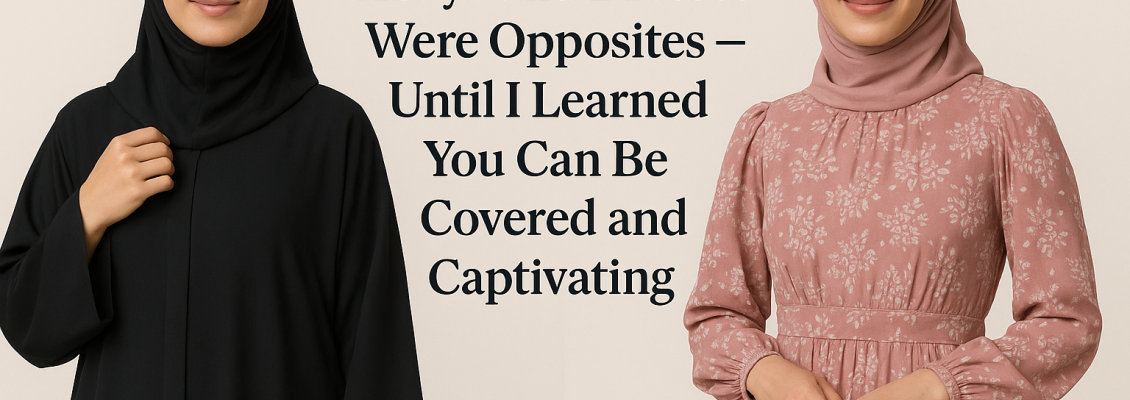
Bismillah, wa salatu wa salamu ‘ala Rasulillah —
The breeze this afternoon carries the scent of jasmine through the half-open window. The call to Dhuhr has just softened into silence, and I find myself sitting on the edge of my bed, fingertips brushing the sleeve of my charcoal abaya. It’s June 11th, 2025, but more than the date, it’s the weight of the past few years that presses on my chest — the confusion, the growth, the letting go.
There was a time — not long ago — when I believed “fashion” and “faith” were two separate cities, with a wide, barren desert between them. In one, there were flowy dresses and curated looks. In the other, black abayas and blunt dismissals of femininity. I didn’t know then that the road between the two wasn’t meant to be travelled in fear, but in love. In longing for Allah.
What you’re about to read is not a how-to guide or a trend forecast. This is a memoir — a journey across heart-terrains I didn’t think I’d survive. From identity loss in changing rooms to spiritual epiphanies on Eid morning. From tears over outfits that felt like betrayals to the quiet joy of finally finding garments that aligned with both my soul and my style.
If you’ve ever looked at your wardrobe and wondered who it was serving… If you’ve ever struggled to make your outer reflect your inner… If you’ve ever felt caught between being seen and being sacred — then this is for you, beloved sister.
Let’s walk this path together — covered, captivating, and deeply connected to our Rabb.
Table of Contents
- Why did I grow up believing abaya and dresses could never belong in the same wardrobe?
- Was I wrong to think modesty meant sacrificing my sense of self?
- The moment I stood in front of my closet and whispered, “Nothing here feels like me”
- Why did I feel like I had to choose between deen and design?
- When I stopped trying to impress people and started dressing for my soul
- Can abaya and dresses really reflect both dignity and desire for beauty?
- The first time I saw a woman radiate noor — fully covered, undeniably captivating
- What does it mean to be seen by Allah but hidden from the world?
- Why does dressing modestly sometimes feel like erasing yourself?
- The silent du’a I made in the dressing room when nothing felt right
- Why I stopped asking “Is this trendy?” and started asking “Is this pleasing to Allah?”
- The emotional tension between fashion blogs and fiqh classes
- What finally convinced me that abaya and dresses don’t compete — they complete
- My turning point: when I wore my abaya like armour, not punishment
- Can I really dress for Jannah and still feel beautiful here?
- The subtle strength of sisters who wear abaya and dresses with purpose
- What I learned from borrowing my mother’s prayer dress at a low point
- Why abaya and dresses became more than fabric — they became forgiveness
- Do you ever cry over clothes that no longer represent who you are?
- How my abaya taught me to walk slower, speak softer, live higher
- The unexpected joy of finally feeling like “this is me” in both abaya and dresses
- What if modesty isn’t just about how we dress, but how we carry our pain?
- The day I wore my abaya and didn’t apologise for taking up space
- Why abaya and dresses are now the most honest parts of my wardrobe
- Covered, captivating, and content — what I wish I could tell my younger self
People Also Ask (PAA)
Why did I grow up believing abaya and dresses could never belong in the same wardrobe?
It began with a question I didn’t know I was even asking — a question silently stitched into the hem of every Eid dress and whispered behind every curtained changing room: Is femininity something I must surrender to be faithful?
Growing up in a world that offered few harmonies between spiritual devotion and sartorial expression, I was taught, both directly and subtly, that abayas and dresses were not siblings — they were strangers. At best, distant cousins. One represented discipline, the other desire. One was for Allah. The other, for the dunya.
And so I lived with a mental wardrobe split down the middle. On the left: colourful dresses I wore at weddings, family gatherings, and days when I longed to feel "pretty." On the right: black abayas I wore to the masjid, religious events, or when I felt guilty. There was no bridge, only a silent conflict — a binary that left my heart torn between modesty and identity, deen and design, presence and polish.
The Roots of the Divide: A Table of Influences
| Source | Message Internalized | Impact on My Beliefs |
|---|---|---|
| Islamic School Lectures | Modesty = simplicity; beauty invites fitnah | Associated elegance with sin or distraction |
| Social Media Trends | Fashion = expression; faith = restriction | Felt forced to pick one: visibility or virtue |
| Cultural Norms | Abayas are "religious wear", not everyday wear | Believed abayas lacked femininity or flair |
| Family Narratives | Dresses are for special occasions only | Felt indulgent or inappropriate in elegant clothes |
| Fashion Industry | Modesty is outdated or niche | Internalized shame for not "keeping up" |
Warring Wardrobes: What I Wore vs. What I Wanted
In secondary school, I remember standing in front of my wardrobe before a cousin’s walima. I had two options: a sleek emerald dress that fit like a dream but showed too much of my shape, or a plain abaya that hid everything but made me feel invisible. I held the dress in one hand and the abaya in the other, torn between two versions of myself. One that wanted to be admired. One that wanted to be spiritually safe.
That night, I chose the abaya — and cried quietly in the car. Not because I didn’t love Allah, but because I didn’t love how I felt in that abaya. I didn’t feel radiant. I felt erased.
Looking back, I realise I wasn’t crying about clothes. I was mourning the false dichotomy. I was grieving a deeper belief I had unknowingly inherited: that I had to pick one — either obedience or beauty. I couldn’t have both.
Islam Didn’t Create the Divide — We Did
One of the most liberating things I’ve come to understand is that Islam never told us we couldn’t be beautiful. In fact, the Prophet ﷺ said, “Allah is Beautiful and loves beauty.” [Muslim]
The faith that gave us intricate Islamic architecture, poetic language, and perfumed traditions is not afraid of beauty. It honours it. But it guides us in how to embody it — with dignity, purpose, and boundaries. The problem wasn't the abaya or the dress. It was the way we framed them as opposites instead of allies.
Abaya is not anti-style. And dresses aren’t inherently immodest. The heart and the intention behind what we wear — the silhouette, the fit, the way it flows or conceals — these are the conversations we were never taught to have.
The Forgotten Middle: Where Faith Meets Femininity
What no one told me growing up was that the two could meet. That there were abayas that swayed like dresses and dresses that humbled you like abayas. That fabrics could be both soft and strong. That cuts could be both elegant and ethical. That your clothing could reflect both your reverence for Allah and your appreciation for artistry.
But to get to that place, I had to unlearn. I had to unteach myself the idea that fashion was frivolous and that faith was frumpy. I had to rediscover that covering wasn’t about hiding — it was about honouring. And that modesty wasn’t about shrinking — it was about refining.
When I Began Asking Better Questions
The shift happened when I stopped asking, “Can I still look beautiful in modest clothes?” and started asking, “What kind of beauty am I trying to achieve?”
Was I seeking the fleeting admiration of people or the eternal pleasure of my Lord? Was I using my clothing to display myself or to discipline my nafs? Was I afraid that modesty would hide me — or did I fear it would reveal the version of me I hadn’t yet embraced?
In asking those deeper questions, I found something remarkable: abayas and dresses weren’t in competition. They were two languages. And when woven together with wisdom, they created a dialect I didn’t know I had permission to speak — one of embodied devotion.
Today’s Wardrobe: A Reclamation
Today, my wardrobe is no longer split. I own dresses with abaya-inspired silhouettes. I wear abayas in satin, linen, and soft neutrals. I choose flow not just for fashion, but for forgiveness. I still love beauty — but now, I love it on Allah’s terms. And that has made all the difference.
If you’re reading this with a similar ache in your chest, unsure if your desire to look beautiful is a betrayal of your modesty — let me offer you this: You are not alone. And you do not have to choose between honouring your femininity and your faith.
Abaya and dresses are not enemies. They are instruments. Let your heart be the composer, and let your taqwa be the rhythm that makes every outfit a verse of dhikr.
Because, dear sister — you were never meant to be divided. You were always meant to be whole.
Was I wrong to think modesty meant sacrificing my sense of self?
For years, I believed that embracing modesty meant waving goodbye to the version of me I once loved — the expressive, vibrant, imaginative girl who chose her outfits like they were poetry. Somewhere along the way, I started to believe that if I wanted to grow closer to Allah, I had to cut ties with colour, creativity, and anything that remotely resembled self-expression.
I used to look at my closet and feel like it mirrored the inner war I couldn’t articulate: the tension between the woman who longed to walk in taqwa and the girl who missed dressing like her soul danced. And in that silent war, modesty became the villain. But now, looking back with the softness of hindsight, I realize I had misunderstood the assignment. It wasn’t modesty that asked me to erase myself — it was fear, disguised as piety.
The Early Confusion: Was This Surrender or Self-Erosion?
When I first started dressing modestly, I thought I was doing it “right” only when I felt small, dull, or disconnected. If I liked what I wore too much, I felt guilty. If someone complimented me, I’d question my intentions. If I looked in the mirror and smiled, I’d quickly lower my gaze — not from humility, but from shame.
There was a lingering question no one helped me answer: Is it possible to honour Allah without losing myself?
And the longer that question went unanswered, the more I began equating modesty with invisibility. I traded joy for rigidity. I thought becoming a “better Muslimah” meant becoming less me.
Let’s Be Honest: What Does the “Self” Even Mean?
Before I could untangle modesty from erasure, I had to redefine what “sense of self” actually meant. Was it my preferences? My colours? My style? Or was it deeper — my voice, my values, my essence?
I created a table in my journal one night, trying to map it out:
| What I Thought Modesty Would Take | What I Actually Gained Through Modesty |
|---|---|
| My personality | Refined character, not erased identity |
| My love of colour | Rediscovered beauty in subtler palettes |
| My creativity | Expanded my creativity within ethical boundaries |
| My confidence | Confidence rooted in divine purpose, not public approval |
| My femininity | A richer, more dignified femininity |
That night changed something in me. I realised modesty didn’t ask me to sacrifice my sense of self — it invited me to purify it.
What the Qur’an and Sunnah Actually Say
There is no verse in the Qur’an that says “you must wear black,” or “you must not enjoy beauty.” In fact, Allah says, “Say, Who has forbidden the adornment of Allah which He has brought forth for His servants and the good things of His provision?” (Surah Al-A’raf, 7:32)
SubhanAllah. This verse hit me like a wave. I had allowed cultural expectations and personal insecurities to twist the beauty of Islam into something cold and restrictive. But our deen doesn’t cancel our personality. It just redirects it — toward ihsaan, sincerity, and balance.
Even our beloved Prophet ﷺ wore fine clothing, used musk, and appreciated elegance. He wasn’t afraid of beauty. He was afraid of arrogance. And that’s the distinction I had been missing all along.
Learning to Dress with Intention, Not Inhibition
Modesty isn’t a costume. It’s a compass. When I shifted from asking “Is this outfit too much?” to “What am I trying to say with this outfit?” — everything changed. Suddenly, my abayas became canvases. My scarves became stories. I didn’t have to abandon beauty. I just had to reframe it.
- Was it elegant, or was it extravagant?
- Was it graceful, or was it grabbing attention?
- Was it modesty with presence, or insecurity in disguise?
These questions became my new mirror. They didn’t suppress me — they refined me.
Rebuilding My Wardrobe — And Myself
There came a point when I emptied my wardrobe and started again. Not because I hated who I was, but because I wanted my clothes to reflect who I was becoming. I kept the pieces that felt like du’a in fabric form. I donated what felt like whispers of the dunya I no longer craved.
And piece by piece, I rebuilt. I found abayas with soft pleats and gentle colours. I found dresses that flowed like forgiveness. I layered, styled, paired — not for trends, but for truth. Every choice became an act of worship. Not because I was perfect, but because I was intentional.
You Can Be Whole. You Can Be Both.
To the sister reading this who is scared that modesty will silence her soul — I promise you, it won’t. You are not being asked to shrink. You are being asked to shine with purpose. The beauty you carry is not haram. The way you wear it might need refining — but your essence, your joy, your voice — these are not casualties of modesty. They are companions of it.
When done right, modesty won’t make you less you. It will make you more you — the you that Allah intended. The you who is both adorned and anchored. Covered and captivating. Devoted and dazzling in your own way.
I was not wrong to think that modesty required something from me. But I was wrong about what it required. It didn’t ask me to sacrifice my sense of self. It asked me to meet her — the deeper, softer, stronger version — the one hidden behind all the noise, just waiting to emerge.
And when she finally did? She was radiant. Not despite the abaya, but because of it.
The moment I stood in front of my closet and whispered, “Nothing here feels like me”
There was a day I will never forget — not because anything dramatic happened on the outside, but because something irreversible shifted inside. I was standing in front of my closet, the midday light filtering through the blinds, casting long shadows on the floor. The house was silent. But in my heart, a storm had gathered. I stared at rows of clothes I had spent years collecting. Dresses I once adored. Abayas I bought out of obligation. Scarves in shades I no longer liked. And that’s when I whispered it — not out loud, not fully — but in a breath so soft only my soul heard it:
“Nothing here feels like me.”
And that was the beginning of everything.
How Did I Get Here?
It wasn’t just about clothes. That moment was about identity. About the quiet ache of being a woman caught between who she used to be and who she’s trying to become. About looking at fabric and realizing it tells no story, holds no joy, and reflects no light.
I had been dressing on autopilot for years. Trying to meet the expectations of the religious circles I wanted to be accepted by. Trying not to draw too much attention. Trying not to mess up. And in all that trying, I had stopped listening. I had muted my soul’s whispers in favour of other people’s opinions.
The Closet as a Mirror
It’s strange how a wardrobe can become a metaphor for your life. That afternoon, mine was speaking back to me — not in words, but in feelings:
| Item | Why I Chose It | What It Now Represents |
|---|---|---|
| Plain black abaya | To feel “safe” and not stand out | Fear of judgement, not faith |
| Bright pink dress | Impulse buy from my pre-hijab phase | Nostalgia for an identity I’ve outgrown |
| Neutral-toned khimar | What everyone else wore in the masjid | Desire to blend in, not connect to Allah |
| Formal jilbab | Purchased for Eid, worn once | Beauty I was afraid to fully embrace |
| Frilly tunics | Leftovers from a modest fashion phase | Confusion — too loud to be modest, too modest to be “me” |
Every item in that wardrobe was a timestamp. A snapshot of a girl growing, faltering, and trying to find her place in a world where the lines between faith and fashion often felt blurry. And I realized — I had spent so much time dressing for others that I’d forgotten to ask: Does this still feel like worship? Or has it become costume?
The Pain of Disconnection
Standing there, I felt naked in a way that had nothing to do with skin. I felt emotionally unclothed — like I had peeled back every layer of image, influence, and expectation. And what was left… felt hollow. I didn’t recognise the woman staring back at me. Her style was modest, yes. But her eyes looked dimmed. Her spirit was muted. And her closet — it was filled with pieces of a past she no longer wanted to live in.
I knew then that I couldn’t keep dressing from a place of fear. Not fear of fitnah, but fear of being judged for doing modesty wrong. Fear that if I loved fashion too much, I was shallow. Fear that if I dressed too simply, I’d be forgotten. Fear that if I got it wrong, Allah wouldn’t accept me.
The Gentle Beginning of Change
Change didn’t come all at once. It started with a du’a whispered over hangers and hope:
“Ya Allah, help me clothe this body in a way that honours You — and honours the soul inside it.”
And slowly, that prayer became a compass. I stopped buying out of boredom. I started choosing with intention. I gave away the pieces that made me feel small, anxious, or performative. And I made room — both physically and spiritually — for pieces that felt like peace.
What I Learned From That Closet Breakdown
That moment in front of my wardrobe wasn’t a crisis — it was a calling. A call back to myself. Back to sincerity. Back to balance. Back to dressing with dignity and delight.
Here’s what I’ve come to believe since then:
- Modesty is not about hiding who you are — it’s about unveiling your essence in a way that’s pleasing to Allah.
- You’re allowed to feel beautiful. You’re just not allowed to worship beauty.
- Style can be sacred when it flows from a sincere heart.
- Letting go of what no longer feels like you is not vanity — it’s a form of worship if it draws you closer to your fitrah.
If You’ve Ever Felt This Way Too…
I want you to know you’re not alone. We all go through seasons where our outer appearance no longer reflects our inner transformation. That’s not failure — that’s growth. And your closet doesn’t have to be a museum of past identities. It can become a gallery of your soul’s evolution. A space where every hanger holds not just fabric, but niyyah.
If today is the day you stand in front of your wardrobe and whisper, “Nothing here feels like me” — let that whisper become a beginning. Not of a shopping spree, but of a spiritual awakening. Let it be a return to joy, to clarity, to intention. Let it be the moment you stop dressing for silence — and start dressing for sincerity.
Because your clothes should not feel like chains. They should feel like wings.
Why did I feel like I had to choose between deen and design?
For a long time, I lived with an invisible tension I couldn’t name — a tug-of-war inside my heart that made me feel like no matter which way I leaned, I was betraying something sacred. On one side was my love for aesthetics: textures, colours, graceful silhouettes, and the elegance of well-crafted clothing. On the other side was my deen: the desire to please Allah, to embody haya, to submit fully and without compromise.
I thought I had to pick a side.
Somehow, somewhere, I’d internalized the belief that a woman who feared Allah couldn’t also love design. That true piety required the suppression of beauty — or at least, the rejection of any joy that came from visual delight. And so, like many women I know, I chose deen. I chose it out of love. Out of fear. Out of a desperate need to be good enough.
But it came at a cost.
The Quiet Grief of Giving Up Beauty
I remember the way I would walk past shop windows and glance quickly away, afraid of wanting something that would pull me off my spiritual path. I remember feeling guilty for caring about style, as if it was a lesser concern, a distraction, a spiritual liability. And I remember the dull ache of putting on clothing that felt hollow — as if I was hiding behind fabric that didn't carry my essence, just my fear.
At first, I called it humility. Simplicity. Zuhd. But over time, I realised that what I had taken on wasn't simplicity — it was suppression. Not of my ego, but of the part of me that found joy in the creative act of adorning myself with dignity. I wasn’t worshipping Allah with my wardrobe — I was tiptoeing around Him, unsure if my joy would be seen as rebellion.
Why Did I Feel That Way?
The conflict between deen and design didn’t come from the Qur’an. It didn’t come from the Sunnah. It came from interpretations, from cultures, from social media discourse. It came from the way we sometimes present piety as uniformity — as if a true believer can only dress one way, in one tone, in one silhouette. And the messaging was subtle, but persistent:
| Message I Received | Implied Belief | Impact on Me |
|---|---|---|
| “Real modesty isn’t about fashion.” | Caring about clothes is worldly and vain | I felt ashamed for finding joy in design |
| “You’re too focused on appearances.” | Beauty equals superficiality | I suppressed my creative instincts |
| “Islam doesn’t need trends.” | Style is incompatible with sincerity | I wore clothing that didn’t reflect me |
| “The Prophet ﷺ wore simple clothes.” | Only basic, neutral garments are sunnah | I erased joy in the name of reverence |
But Then I Began to Ask New Questions
What if loving design was never the problem? What if the way we frame modest fashion has been more about cultural fear than divine guidance? What if we’ve mistaken uniformity for unity? And what if Allah, in His mercy, actually loves that I love beauty — as long as I don’t let it own me?
These weren’t easy questions. They forced me to re-examine what I’d learned, and more importantly, what I’d internalised. And slowly, through du’a, journaling, and quiet contemplation, I began to realise:
- Deen and design are not enemies — they are partners when approached with sincerity.
- Islam honours beauty. It dignifies it. It simply places boundaries so that beauty serves the soul, not the nafs.
- My eye for elegance is not a flaw — it’s a trust, an amanah, to be guided by taqwa.
What the Sunnah Actually Says About Beauty
One of the most healing moments for me was reading the hadith:
“Indeed, Allah is beautiful and loves beauty.” (Sahih Muslim)
This one line shattered so many false dichotomies. Allah is not threatened by beauty. He created it. He is its Source. Our beloved Prophet ﷺ was known to care about cleanliness, appearance, and dignity in dress. He wore garments gifted to him. He appreciated well-made clothing. And he never equated beauty with arrogance — only the heart’s attachment to status and pride.
So maybe the issue isn’t design — maybe it’s intention. Maybe it’s whether we use our love of fashion to express humility and shukr, or to chase validation and ego.
When I Stopped Choosing and Started Integrating
The most liberating shift was when I stopped seeing deen and design as separate lanes and began to understand them as interwoven. I no longer had to choose. I just had to align.
I began asking better questions:
- Does this piece make me feel both dignified and joyful?
- Am I wearing this for the gaze of others or for the gaze of my Rabb?
- Does this design honour my womanhood and my worship?
And when the answer was yes, I wore it with love. With gratitude. With barakah. And slowly, my wardrobe became a place of worship — not in formality, but in intention. My abayas began to feel like spiritual armour, not restriction. My dresses became expressions of ihsan — beauty in conduct, in heart, in fabric.
If You’ve Ever Felt Like You Had to Choose Too
Let this be a gentle reminder: you don’t have to pick between piety and personality. You don’t have to erase your love for design to be loved by your Creator. You only need to make Him the anchor of it all.
Your deen is not threatened by your taste — it’s enhanced by your taqwa. So bring your eye for beauty to your modesty. Bring your love of colour to your hijab. Bring your passion into your practice. You were never meant to choose. You were meant to integrate — with grace, with sincerity, and with the full spectrum of who you are.
Because the most captivating design… is a heart adorned in submission.
When I Stopped Trying to Impress People and Started Dressing for My Soul
There was a time when every outfit I wore was a silent question: “Will they like this?” I didn’t realise how deeply I had rooted my sense of worth in the eyes of others — until one morning, standing in front of my mirror, I caught myself adjusting my scarf for the fifth time, not because it felt better, but because I imagined someone else’s opinion of how it looked.
That was the day I began asking myself a different question: “What if I stopped dressing to impress… and started dressing to express?” Not to express rebellion, ego, or even aesthetic — but to express something sacred within me. Something still. Something pure. My soul.
Before the Shift: When My Wardrobe Was a Performance
I wish I could say I was immune to the pressure. But I wasn’t. Like many of us, I had subconsciously built an invisible jury in my mind — women on Instagram, family members, community figures — all silently judging every outfit I wore. Was I modest enough? Was I stylish enough? Did I look “put together,” or “too much,” or “too plain”?
In those years, I confused dressing for others with having a sense of style. But what I really had was a performance. And it looked something like this:
| What I Wore | Why I Chose It | How It Made Me Feel |
|---|---|---|
| The “on-trend” abaya | So I wouldn’t look outdated on social media | Insecure — I still felt unseen |
| The minimalist black dress | So I’d be taken seriously in religious spaces | Muted — like I was hiding in plain sight |
| Bright colours and heavy makeup | To prove I hadn’t “lost myself” in modesty | Performative — like I was screaming my identity |
| Layered, curated outfits | To appear effortlessly stylish | Exhausted — it wasn’t effortless at all |
Looking back, I realise the common thread: none of it was for me. None of it was for Allah. It was for them. Whoever “they” were. And it never made me feel whole.
What Dressing for the Soul Actually Means
The shift didn’t happen overnight. It was a slow, subtle return — not just to sincerity, but to self-recognition. Dressing for my soul meant asking, every day:
- Does this feel like worship or worry?
- Does this reflect a heart anchored in purpose or shaken by pressure?
- Would I wear this if no one saw me — except Allah?
Dressing for the soul is not about fashion or frumpiness. It’s not about being noticed or disappearing. It’s about being in alignment. It’s when the external adornment becomes an echo of the internal state. And that alignment is so peaceful. So weightless. So pure.
What Changed When I Made the Shift
When I stopped trying to impress people, I stopped needing to prove anything. I found myself gravitating to pieces that carried meaning. Clothing that didn’t scream, but whispered. Fabrics that reminded me of softness. Colours that soothed rather than dazzled. Suddenly, my wardrobe became a sanctuary, not a stage.
Here’s what changed:
| Before | After |
|---|---|
| Dressing to gain approval | Dressing to reflect ihsan (excellence in worship) |
| Picking pieces based on trends | Picking pieces based on tranquillity |
| Feeling anxious about how I looked | Feeling serene and self-respecting |
| Fear of judgment | Confidence from divine alignment |
The Sunnah of Intention
Our Prophet ﷺ taught us that “Actions are judged by intentions.” (Bukhari & Muslim) This includes what we wear. When I began to renew my niyyah (intention) before I got dressed — truly renew it — my clothing transformed from a silent plea for approval to a quiet act of devotion.
Even my simple black abaya felt different when I said, “Ya Allah, let this garment protect me and honour You.” The clothing didn’t change — I did.
Style Becomes Worship When the Soul Leads
Style doesn’t disappear when you stop dressing to impress. It becomes deeper. More meaningful. More rooted in your core. When your soul leads, modest fashion becomes an act of self-respect — not self-erasure. You begin to choose clothing that:
- Protects your dignity, not just your skin
- Brings you joy, without seeking applause
- Reflects calm, not chaos
- Serves your worship, not your ego
The irony is, the more you dress for your soul, the more radiant you become — not because others notice, but because Allah sees. And His gaze is the only one that matters.
From Mirror to Mihrab
Now when I dress, it feels like prayer. Like preparation for a conversation with the Divine. And some days, that outfit is simple and unassuming. Other days, it’s elegant and expressive. But on all days, it’s intentional. Quietly joyful. Soul-led.
If you’ve ever felt burdened by the weight of other people’s eyes, know this: you are allowed to dress for peace. You are allowed to wear clothes that carry you, not perform you. You are allowed to reclaim your closet — not as a gallery, but as a garden. A place where your soul meets your fabric, and together they say: This, too, is worship.
Because modesty isn’t about hiding — it’s about shining, softly, for the sake of the One who sees it all.
Can Abaya and Dresses Really Reflect Both Dignity and Desire for Beauty?
Somewhere along the way, I internalised a silent message: that to be truly dignified in my faith, I had to relinquish beauty. That elegance and modesty could not coexist — that one diluted the other. And so I found myself torn between two supposed extremes: the yearning to dress beautifully, and the call to dress with dignity.
But over time, I began to ask a deeper question — does Allah ask us to choose between the two? Or is it the world that created that divide?
Islam’s Timeless Balance Between Beauty and Dignity
In Islam, beauty isn’t shameful — it’s sacred. The Prophet ﷺ said, “Allah is beautiful and loves beauty.” (Muslim) The Qur'an is adorned with verses describing gardens, flowing rivers, pearls, silk — divine beauty woven into every promise of Jannah. How, then, could beauty be something we must avoid?
The truth is: Islam doesn’t ask us to strip beauty away. It teaches us to honour it — and protect it.
“And tell the believing women to lower their gaze and guard their modesty; that they should not display their beauty except what is apparent...”
— Surah An-Nur (24:31)
Notice: The verse doesn’t forbid beauty. It instructs us to guard it. To preserve it. To reveal it intentionally, not indiscriminately. This is not oppression — it is preservation. It is the safeguarding of something precious.
What Happens When We Pit Beauty Against Dignity
Many women experience an inner conflict — feeling that to be ‘truly’ modest, they must dull themselves down, hiding even the natural joy of dressing well. On the other end, some believe that honouring beauty means compromising modesty altogether.
But here’s the problem: when we frame beauty and dignity as opposing forces, we end up in spiritual confusion. We create false binaries like:
| If I want to be dignified, I must... | If I want to express beauty, I must... |
|---|---|
| Wear dull colours only | Abandon traditional modest wear |
| Suppress my love for aesthetics | Ignore guidelines of awrah |
| Be ‘invisible’ to feel ‘pure’ | Be seen to feel validated |
| Ignore fashion altogether | Follow trends blindly |
But these are not Islamic binaries — they’re cultural assumptions, born out of fear, shame, and misunderstanding. The Islamic path is more balanced. It’s more beautiful. It’s whole.
The Abaya: A Symbol of Grace, Not Guilt
The abaya is often misrepresented — either as an austere covering void of expression, or as a fashion statement divorced from faith. But in its truest essence, the abaya is neither of those. It is a garment that says:
- I respect myself enough to cover what is sacred.
- I honour my femininity through elegance, not exposure.
- I am rooted in deen and still drawn to beauty.
And when paired with dresses — especially those designed with modest cuts, flowy fabrics, and intentional detail — it creates a harmony. Not a contradiction. This pairing becomes an embodied message: I do not have to sacrifice beauty to be dignified. I do not have to sacrifice dignity to be beautiful.
Prophetic Examples of Modest Beauty
We sometimes forget that the wives of the Prophet ﷺ were not only pious — they were also elegant. Sayyidah Aisha (RA) was known to wear beautiful clothing and to scent herself before meeting her husband. The Prophet ﷺ himself wore clean, dignified clothing and encouraged grooming, cleanliness, and beautification — especially on Fridays and Eid.
He ﷺ never taught that dignity required dullness. He ﷺ taught balance. He ﷺ taught intention.
So... What Does That Look Like in Real Life?
Let’s consider how an abaya or a dress can reflect both dignity and beauty, practically:
| Design Element | Expression of Beauty | Guarding of Dignity |
|---|---|---|
| Flowy fabric (chiffon, crepe, linen) | Soft, feminine movement | Doesn’t cling to the body |
| Neutral and earthy tones | Elegant and calming aesthetic | Non-flashy, respectful colours |
| Minimal embellishments | Graceful details, not excessive | Keeps attention on conduct, not clothing |
| Maxi length with structured cut | Stylish silhouette | Full coverage with sophistication |
| Layering with matching hijab | Complete, polished look | Maintains full coverage with cohesion |
The Soul of Modest Fashion: Tawheed of the Inner and Outer
In the end, it’s not about what fabric we wear, but what intention we carry. A beautiful abaya worn with arrogance is not the same as a simple dress worn with humility. The soul of modest fashion lies in tawheed — the unity of our inner world with our outer appearance.
When we wear clothes that reflect both dignity and beauty, we are telling the world:
“My body is honoured, not hidden. My beauty is intentional, not insecure. My clothing reflects a heart aligned with the Divine.”
You Don’t Have to Choose
Sister — you do not have to choose between being beautiful and being dignified. The real question is not, “Which one do I sacrifice?” but rather, “How do I serve both with sincerity?”
With the right intention, the right cuts, and the right mindset, abaya and dresses can absolutely reflect both. In fact, they can do more than reflect — they can embody a message of inner light. That Noor. That strength. That softness. All at once.
Because the woman who walks in elegance and faith doesn’t walk in halves. She walks whole. And she is beautiful. And she is dignified. And she is seen — by the One who sees all.
The First Time I Saw a Woman Radiate Noor — Fully Covered, Undeniably Captivating
I remember it vividly — a seemingly ordinary day that turned extraordinary by a single encounter. I was sitting in a quiet corner of the masjid, distracted in thought, when a woman walked in. She wasn’t adorned in sparkles or wearing anything to command attention. In fact, she was completely covered — head to toe in a jet-black abaya, her face serene, her posture humble. And yet… she was undeniably captivating.
She radiated something I couldn’t describe at the time. It wasn’t perfume, nor beauty in the conventional sense. It wasn’t charisma, nor the kind of worldly glamour the fashion world prizes. No. What she had was something deeper — something weightless yet powerful, something almost invisible but unmistakable. It was noor.
What is Noor, Really?
Noor — the Arabic word for light — is not just physical illumination. It’s a spiritual radiance. A light that shines not on the face, but through it. It is the inner tranquility of the heart, reflected outward. It is the shine of sincerity, the glow of a heart anchored in its Creator.
Allah describes it in the Qur’an:
“Allah is the Light of the heavens and the earth…”
— Surah An-Nur (24:35)
This verse goes on to describe the parable of His light — like a niche with a lamp, glowing from pure olive oil, lit without fire, radiating light upon light. Noor isn’t something we apply — it’s something we become, when our hearts are lit by the divine flame of iman.
Captivating Without Needing to Be Seen
That woman in the masjid wasn’t trying to be noticed. She didn’t perform beauty. She embodied it. There was no tight fit, no extravagant colour. And yet, everyone turned when she entered. Not out of worldly curiosity, but out of respect. Her presence softened the room. She was a walking ayah — a living verse.
And it made me question everything I thought I knew about attraction and appearance. What if the most magnetic women weren’t those who tried to shine externally — but those whose inner light couldn’t help but glow outward?
Society’s Definition of Captivating vs. Islam’s
Let’s look at the difference between the two paradigms — what society tells us is attractive, and what our deen uplifts:
| Society’s “Captivating” Woman | The Noor-Lit Woman |
|---|---|
| Wears revealing clothes to gain attention | Dresses with dignity to honour herself |
| Relies on makeup, trends, filters | Relies on akhlaaq, iman, and ihsan |
| Seeks validation through being seen | Finds peace in being known by Allah |
| Draws people through physical presence | Draws hearts through spiritual light |
| Changes her look to fit worldly beauty standards | Maintains her haya while staying true to fitrah |
There’s nothing wrong with caring for your appearance. In fact, Islam encourages cleanliness, elegance, and self-care. But there is a fine line between adorning ourselves for Allah and adorning ourselves for the dunya.
The Noor of Women in Our Ummah
That one woman I saw was not an exception. I’ve come to realise there are many like her — women who are quietly captivating. Who walk with humility and leave traces of light wherever they go. Women who wear their abaya not as a constraint, but as a crown. Women whose beauty is not in what they show, but in what they carry within.
Let’s remember our spiritual role models:
- Khadijah (RA) — radiant with wisdom and loyalty, the first to believe in the Prophet ﷺ.
- Fatimah (RA) — so modest that even in death she requested her body be covered completely.
- Maryam (AS) — chosen above all women, cloaked in modesty and strength.
These were women of noor. Their light was not performative — it was spiritual. They were dignified, yet feminine. Covered, yet captivating. And their light came from their proximity to Allah, not from worldly applause.
So How Can We Radiate Noor Too?
Here’s the truth: noor doesn’t come from a clothing brand. It comes from the heart. But our clothing can become the vessel that protects that light, amplifies it, respects it.
Here are some ways to start cultivating both inner and outer noor:
| Inner Noor Practices | Outer Noor Practices |
|---|---|
| Praying tahajjud regularly | Wearing clothes that reflect dignity and calm |
| Guarding your gaze and speech | Keeping your garments clean and graceful |
| Reciting Qur’an daily | Choosing simplicity over extravagance |
| Seeking sincerity in all actions | Layering modestly with intention, not insecurity |
| Making dhikr and istighfar often | Wearing soft expressions and soft tones |
Beyond the Fabric
When we dress with haya, we invite light into our lives. When we walk with intention, we allow our presence to mean something. Modesty is not about hiding ourselves — it’s about highlighting our fitrah. The woman who walks with noor walks with meaning. She reminds the world that strength and softness are not opposites — they are sisters.
That woman I saw years ago may never know how deeply she affected me. But her presence changed how I viewed modesty forever. Because in that moment, I realised —
“You don’t need to be uncovered to be unforgettable. You just need to be lit from within.”
And from that day forward, I stopped chasing attention, and started cultivating noor. Because beauty that is seen fades. But beauty that is felt — that lives on.
Why Does Dressing Modestly Sometimes Feel Like Erasing Yourself?
Dressing modestly is a deeply personal and spiritual choice for many Muslim women. It is often embraced as an act of devotion, self-respect, and empowerment. Yet, despite its beautiful intentions, many women confess a complex and sometimes painful feeling: that dressing modestly can feel like erasing themselves. Why does this happen? How can a practice meant to honor one’s dignity and identity sometimes cause internal conflict and a sense of loss?
This paradox arises from a variety of cultural, psychological, and social dynamics. Understanding these layers is essential to finding peace and confidence in modest dress — so that it can become a true expression of self, not a suppression of it.
The Conflict Between Self-Expression and Modesty Norms
Modern society often equates self-expression with visibility, boldness, and flamboyance. Fashion trends encourage attention-grabbing styles, vibrant colors, and body-conscious fits. This cultural definition of “being yourself” clashes with the principles of modesty, which advocate for covering and restraint.
For a young woman growing up in this environment, the choice to dress modestly can feel like stepping away from the cultural idea of “freedom” and “being true to yourself.” She might worry:
- “Am I hiding my personality?”
- “Am I blending into invisibility?”
- “Am I sacrificing creativity and beauty?”
These worries create tension between the desire to be authentic and the desire to be modest.
The Social Pressure and Misunderstandings
Modest dress is often misunderstood or misrepresented. Some perceive it as a rejection of beauty or femininity. Others assume it is imposed by family or culture rather than chosen freely. Such misconceptions can make a woman feel isolated or judged, amplifying the feeling that modesty is a form of erasure rather than empowerment.
Additionally, peer groups and media can unintentionally reinforce these feelings. When modest dress is rarely seen in mainstream fashion or media, it can seem like a niche or “other” style. This lack of representation can make a woman feel as though she is stepping outside the accepted norms — making her question if she is losing herself.
The Inner Struggle: Identity vs. Expectations
Many women face an internal dialogue between their evolving spiritual identity and the expectations placed on them — from family, community, or even themselves. Sometimes the pressure to conform to a certain “modest” image can feel restrictive, leading to feelings of erasure.
This struggle is often intensified by:
| Source of Pressure | Effect on Identity |
|---|---|
| Rigid family or community expectations | Limits personal style choices, causes fear of judgment |
| Internalized beliefs about modesty | Feels like suppressing desires and creativity |
| Comparisons with peers who dress differently | Creates insecurity or doubt about own choices |
| Lack of diverse representation in fashion/media | Feeling of isolation or being “different” |
Reclaiming Modesty as an Expression of Self
Despite these challenges, modest dressing can and should be a vibrant, joyful expression of identity — not erasure. Here are ways to shift the mindset:
- Redefine what “self” means: Your true self is more than your outward appearance. It includes your values, your spirit, your intellect, and your creativity.
- Celebrate diversity within modesty: Modest fashion is not a uniform; it has endless styles, colors, fabrics, and combinations that reflect individuality.
- Connect modesty with empowerment: Choose modesty because it uplifts you, honors your beliefs, and allows you to shine without needing to conform.
- Embrace creativity: Experiment with layering, accessories, textures, and colors that make you feel alive and authentic.
Examples of Personal Style Within Modesty
Modest fashion can be anything but dull or erasing. Here are some ways women creatively express themselves through modest dressing:
| Style Element | How It Expresses Self |
|---|---|
| Color choice | Shows mood, personality, cultural heritage |
| Fabric and texture | Adds dimension and tactile joy |
| Layering | Creates unique silhouettes and styles |
| Accessories | Personalize with jewelry, scarves, bags |
| Patterns and prints | Express creativity and flair |
Spiritual Perspective: You Are Never Erased
Islam teaches that our worth and identity come from our connection with Allah, not from outward appearances or others’ opinions. Your essence — your fitrah — is pure and precious.
The Prophet Muhammad ﷺ said:
“Verily, Allah does not look at your appearance or wealth, but rather He looks at your hearts and deeds.” — Sahih Muslim
This means the truest, most lasting expression of yourself is found in your character and spirituality. Modesty is a reflection of that inner self, not a contradiction to it.
Practical Tips to Overcome the Feeling of “Erasure”
- Reflect on your intentions: Regularly remind yourself why you chose modesty and what it means to you.
- Seek role models: Follow modest fashion icons who embrace individuality and faith harmoniously.
- Engage with supportive communities: Surround yourself with people who understand and uplift your journey.
- Experiment with style: Allow yourself to explore and evolve your modest wardrobe without guilt.
- Practice self-compassion: Be gentle with yourself during moments of doubt or insecurity.
Conclusion
Feeling like dressing modestly is “erasing yourself” is a natural and understandable emotion, especially in a world that values external expression in very specific ways. But modesty does not demand erasure — it invites reinvention and rediscovery. It calls you to express the deepest, most authentic parts of yourself in ways that honor both your spirituality and your individuality.
When you embrace modest dress not as a loss but as a powerful choice, you reclaim your narrative. You stand firm in your identity, beautifully clothed in dignity, creativity, and faith — never erased, always radiant.
The Silent Du’a I Made in the Dressing Room When Nothing Felt Right
Have you ever stood in front of a mirror, surrounded by clothing racks, feeling overwhelmed, frustrated, and somehow disconnected from yourself? The kind of moment when nothing you try on seems to fit—not just physically, but emotionally and spiritually. For many Muslim women embracing modest fashion, this moment can be deeply poignant, a quiet struggle that goes far beyond fabric and fit.
This moment of vulnerability, often experienced alone in a dressing room, is where many of us have whispered a silent du’a — a heartfelt prayer — asking for clarity, acceptance, and guidance. It’s a moment of surrender when the outer struggle mirrors the inner conflict, and the only refuge is turning to Allah for solace and strength.
Understanding the Emotional Weight Behind Modest Fashion Choices
Modest dressing is more than just a style choice; it is an act of faith and identity. Yet, finding the right balance between spiritual principles, personal taste, cultural expectations, and modern fashion trends is often difficult. The dressing room becomes a crucible where these tensions come to a head.
Why does this happen? Here are some reasons:
| Challenge | Emotional Impact |
|---|---|
| Clothing doesn’t reflect your inner values or identity | Feelings of frustration, disconnection, and confusion |
| Difficulty finding modest fashion that suits your body and style | Discouragement and diminished self-esteem |
| Pressure to conform to certain cultural or religious standards | Sense of restriction and loss of individuality |
| Fear of judgment from others | Anxiety and self-doubt |
The Silent Du’a: A Moment of Turning Inward
In this vulnerable moment, many women find themselves instinctively turning inward, whispering a silent du’a. It is an unspoken prayer for:
- Patience and resilience when the journey feels difficult
- Guidance to make choices that honor both faith and self
- Confidence to embrace their unique style and identity
- Strength to resist external pressures and judgment
- Peace in the knowledge that true beauty radiates from within
This silent du’a symbolizes a profound spiritual pause — a surrender to Allah’s wisdom and mercy. It acknowledges the struggle, but also the hope that Allah will guide us to what is best for our hearts and souls.
How the Du’a Transforms the Experience
Making this silent du’a can profoundly change the way we experience the dressing room struggle. It turns frustration into faith, confusion into clarity, and isolation into connection.
Here’s how this spiritual practice helps:
| Before Du’a | After Du’a |
|---|---|
| Overwhelmed by choices and insecurities | Calmed mind, grounded in trust |
| Focus on external appearance and approval | Focus on inner peace and authenticity |
| Fear of judgment and self-doubt | Confidence rooted in faith and self-respect |
| Feeling lost or disconnected | Feeling connected to one’s purpose and values |
Personal Reflection: The Power of Turning to Allah
Reflecting on this moment, many women discover that the silent du’a is not just a plea for help, but a turning point. It deepens their relationship with Allah and their understanding of modesty as a holistic, empowering journey.
The Prophet Muhammad ﷺ reminded us:
“Du’a is the essence of worship.” — Tirmidhi
This highlights that du’a is not only a request for something external but a spiritual act that transforms our inner state and strengthens our faith.
Practical Ways to Embrace This Moment
If you find yourself in that dressing room moment — where nothing feels right — consider these practical steps to invite peace and clarity:
- Pause and breathe deeply: Take a moment to center yourself physically and emotionally.
- Make your silent du’a: Speak from your heart, asking Allah for guidance, patience, and confidence.
- Reflect on your intentions: Remind yourself why modesty matters to you beyond fashion trends or societal pressures.
- Be gentle with yourself: Accept that this is part of your journey, and it’s okay to feel uncertain at times.
- Seek inspiration: Look for modest fashion influencers, community groups, or spiritual mentors who resonate with your values.
- Explore creativity: Experiment with mixing and matching pieces, layering, or accessorizing to find what truly feels like you.
The Deeper Meaning of Clothing in Islam
Clothing in Islam is not just about covering the body but about embodying values of humility, respect, and spiritual consciousness. It is a visible reminder of the inner state of a believer.
The Qur’an says:
“O children of Adam, We have bestowed upon you clothing to conceal your private parts and as adornment. But the clothing of righteousness — that is best.” — Surah Al-A’raf, 7:26
This verse encourages us to see clothing as both functional and symbolic — a means of physical modesty and a reflection of our spiritual character.
Conclusion: Embracing the Journey with Faith and Compassion
The silent du’a in the dressing room is a sacred moment of vulnerability and strength. It reminds us that even when the world’s options seem overwhelming or discouraging, our connection to Allah provides guidance, peace, and renewal.
By embracing this moment with faith and self-compassion, we transform a frustrating experience into a beautiful opportunity for growth. We learn to dress not only with fabric but with intention, dignity, and noor — radiant light from within.
May every silent du’a be answered with clarity, confidence, and a wardrobe that truly feels like home for your soul.
Why I Stopped Asking “Is This Trendy?” and Started Asking “Is This Pleasing to Allah?”
In a world dominated by fast fashion, social media trends, and endless style updates, it’s easy to get caught up in the whirlwind of “what’s in” and “what’s out.” For many of us, especially young Muslim women navigating modest fashion, the question “Is this trendy?” can feel like a constant companion. But over time, I realized that this question, while natural, was leading me away from my core values and spiritual peace.
One pivotal moment changed everything for me — the moment I shifted from asking “Is this trendy?” to “Is this pleasing to Allah?” This shift was not just about clothing choices; it was a profound transformation in how I approached my identity, faith, and daily decisions.
The Trap of Trendiness
Trendiness is enticing because it promises social acceptance, admiration, and a sense of belonging. But it can also be exhausting and hollow. Let’s take a closer look at what happens when we prioritize trends over timeless values.
| Impact of Prioritizing Trendiness | Emotional and Spiritual Consequences |
|---|---|
| Constantly chasing new styles and fads | Feeling restless, never satisfied |
| Adapting style to fit social media expectations | Pressure to perform, fear of judgment |
| Wearing clothes that may conflict with modesty principles | Inner conflict, guilt, and doubt |
| Defining self-worth by external appearance | Superficial validation, fragile confidence |
When trendiness becomes the yardstick for fashion choices, it risks overshadowing the deeper purpose behind modest dressing — which is not just about hiding or covering, but about honoring oneself and one’s Creator.
The Awakening: Asking “Is This Pleasing to Allah?”
As I grew in my faith, I began to understand that my clothing could be a form of worship, a way to express my devotion and submission to Allah’s guidance. This realization opened the door to a more meaningful relationship with modest fashion.
By asking “Is this pleasing to Allah?” I began to consider:
- Modesty: Does this garment uphold the principles of modesty in Islam?
- Intentions: Am I choosing this for self-expression or to seek approval from others?
- Respect: Does this outfit reflect respect for myself, my faith, and those around me?
- Comfort and confidence: Do I feel at peace and dignified wearing this?
Transformative Effects on Style and Self-Perception
This shift in mindset brought about tangible changes, not only in the clothes I chose but also in how I perceived myself and interacted with the world.
| Before: Asking “Is This Trendy?” | After: Asking “Is This Pleasing to Allah?” |
|---|---|
| Worrying about fitting in with peers and social media | Finding peace in personal and spiritual alignment |
| Choosing clothes based on fleeting popularity | Choosing timeless, modest pieces that reflect values |
| Feeling anxious about appearance and judgment | Feeling confident rooted in faith and self-respect |
| Experiencing a fragile, external validation | Experiencing deep, internal satisfaction and contentment |
Faith as a Compass in Modest Fashion
Islamic teachings emphasize intentions (niyyah) as the foundation of every action. When we approach clothing choices with the intention to please Allah, our fashion becomes an act of worship, a reflection of our values, and a source of empowerment rather than restriction.
The Prophet Muhammad ﷺ said:
“Actions are judged by intentions, so each man will have what he intended.” — Sahih Bukhari and Muslim
When modest fashion is rooted in this consciousness, it transforms from a superficial trend into a meaningful lifestyle.
Practical Steps to Align Fashion with Faith
If you feel caught between trendiness and spiritual fulfillment, here are some practical ways to shift your mindset:
- Pause before purchasing: Ask yourself, “Is this modest? Does it honor my faith?”
- Invest in timeless pieces: Choose quality over quantity to build a wardrobe that lasts.
- Support modest designers: Seek brands that prioritize Islamic values and ethical production.
- Create a personal style guide: Define what modesty and beauty mean to you personally.
- Limit social media exposure: Follow accounts that inspire faith-centered modest fashion, not just trends.
- Reflect regularly: Use journaling or du’a to reconnect with your intentions and goals.
Balancing Beauty and Spirituality
It’s important to recognize that choosing to please Allah does not mean abandoning beauty, creativity, or joy in fashion. Islam celebrates beauty as a gift from Allah, and dressing well is encouraged as long as it aligns with modesty and sincerity.
The Qur’an states:
“Indeed, Allah loves those who are constantly repentant and loves those who purify themselves.” — Surah Al-Baqarah, 2:222
This includes caring for ourselves through our outward appearance in a way that reflects purity and respect.
Conclusion: A Journey of Intention and Inner Peace
My journey from asking “Is this trendy?” to “Is this pleasing to Allah?” was not instant or easy. It required patience, self-reflection, and spiritual growth. But it has brought me a deeper sense of peace, confidence, and purpose.
By placing faith at the center of our fashion choices, we not only honor our Creator but also empower ourselves to express our true selves with dignity and noor. This shift is a radical act of self-love and devotion in a world that often values fleeting trends over lasting values.
May we all find the courage and clarity to dress in ways that nourish our souls and please Allah, turning every outfit into a silent, beautiful du’a.
The Emotional Tension Between Fashion Blogs and Fiqh Classes
For many Muslim women passionate about modest fashion, there exists an often-unspoken emotional tension between the alluring world of fashion blogs and the structured, sometimes rigid teachings of fiqh classes. This tension is not simply about clothing or style choices; it delves much deeper into the heart and mind, challenging identity, faith, and personal expression.
On one side, fashion blogs brim with creativity, inspiration, and the vibrant pulse of modern modest style. They celebrate individuality, beauty, and a playful approach to layering abayas, jilbabs, and dresses. On the other, fiqh classes demand a solemn, disciplined approach to Islamic jurisprudence—often focused on the boundaries of what is permissible or forbidden, cautioning about what constitutes proper hijab and modesty according to the Shariah.
Reconciling these two worlds—fashion’s bright, expressive energy and fiqh’s serious, devotional rigor—can be a confusing and emotional journey. Let’s explore this tension more closely, and how it can ultimately lead to a deeper, more nuanced understanding of modesty and self.
Understanding the Roots of the Tension
The tension arises from the different lenses through which fashion blogs and fiqh classes view clothing:
| Fashion Blogs | Fiqh Classes |
|---|---|
| Focus on aesthetics, creativity, and personal style | Focus on Islamic legal rulings, modesty standards, and obedience to Shariah |
| Encourages self-expression and cultural trends | Emphasizes adherence to prescribed boundaries and caution |
| Often showcases diverse interpretations of modesty | Provides classical, scholarly definitions rooted in Quran and Sunnah |
| Celebrates beauty and empowerment through fashion | Warns against imitating non-Muslim styles or extravagance |
This difference in focus can sometimes leave a young Muslim woman feeling torn—should she follow the creative freedom encouraged by bloggers, or the strict guidance taught in fiqh classes?
Emotional Responses to the Conflict
Many women report feeling a mix of emotions when caught between these worlds:
- Confusion: Which advice is truly Islamic? How much room is there for personal interpretation?
- Guilt: Feeling judged either for being “too trendy” or “too strict.”
- Fear: Fear of falling short of Allah’s expectations or community standards.
- Desire: The longing to express identity through fashion without compromising faith.
These feelings are natural, reflecting the challenge of navigating an evolving cultural landscape while maintaining spiritual integrity.
Bridging the Gap: A Balanced Approach
The key to easing this emotional tension lies in embracing a balanced approach that respects both fiqh principles and individual creativity. Here are some ways to do so:
| Challenges | Balanced Solutions |
|---|---|
| Feeling pressured to imitate trending styles that may push fiqh boundaries | Evaluate trends critically, adapting only what aligns with personal and religious standards |
| Fear that fiqh classes are restrictive or out of touch with modern modest fashion | Seek scholars and teachers who understand contemporary contexts and engage in open dialogue |
| Struggling with self-expression within modesty limits | Experiment with colors, fabrics, and accessories that comply with Islamic guidelines yet reflect individuality |
| Feeling isolated when style choices don’t fit community norms | Build supportive networks that value diversity in modest fashion within Islamic frameworks |
Reframing Modesty Beyond Rules
While fiqh classes provide necessary guidance, modesty is ultimately an inward state of humility and consciousness of Allah. Modest fashion is not merely about rules—it is about nurturing a heart aligned with spiritual purpose. Fashion blogs can inspire this by offering creative ways to express modesty joyfully, fostering confidence and a sense of belonging.
Understanding modesty as a spectrum rather than a fixed box allows for flexibility and personal growth. It invites us to internalize Islamic values deeply, making clothing a manifestation of inner faith rather than external pressure.
Personal Reflection and Growth
Many women find that their relationship with modest fashion evolves as they grow in their knowledge and spirituality. The emotional tension softens when they begin to see fiqh not as a set of constraints but as a framework for meaningful freedom, and fashion blogs not as contradictory but complementary sources of inspiration.
It helps to keep asking oneself reflective questions:
- What does modesty mean to me personally, beyond cultural or external definitions?
- How can I respect Islamic principles while celebrating my individuality?
- Where can I find trusted knowledge that speaks to both my heart and intellect?
Conclusion: Embracing the Journey
The emotional tension between fashion blogs and fiqh classes is a sign of a sincere heart striving to harmonize faith and self-expression. It is a journey of learning, questioning, and growing — not a battle to be won.
By embracing both the creativity of modest fashion and the wisdom of fiqh, Muslim women can cultivate a confident, authentic style that honors their deen and delights their soul. This balance is not only possible but beautiful — a radiant example of living Islam in a modern world.
What Finally Convinced Me That Abaya and Dresses Don’t Compete — They Complete
For years, I held a silent, stubborn belief that abayas and dresses were separate entities in the world of modest fashion — almost like rivals vying for attention in my wardrobe. The abaya was the serious, traditional piece that represented faith and modesty, while dresses felt more casual, expressive, sometimes even contradictory to the values I wanted to uphold. I thought I had to pick one side — either fully embrace the abaya as a symbol of my deen or lean into dresses as a way to express my individuality. The thought that these two could coexist harmoniously never truly crossed my mind. But over time, and through a journey of reflection, learning, and experimentation, I came to realize something beautiful and transformative: abayas and dresses don’t compete; they complete each other.
Breaking Down the False Dichotomy
This false dichotomy of “abaya vs. dresses” is rooted in a few common misconceptions and cultural narratives:
- Modesty equals uniformity: Many believe modest fashion means dressing in a singular, unchanging style, often centered around the abaya.
- Dresses are too revealing or casual: Dresses are often dismissed as less modest or serious compared to abayas.
- Abayas are old-fashioned or limiting: Some feel abayas restrict creative expression or individuality.
These beliefs create unnecessary tension, leading to wardrobe battles and feelings of guilt or confusion about personal style. But what if we reframed the narrative? What if abayas and dresses are not opposing forces but complementary pieces that together offer versatility, dignity, and beauty?
The Synergy of Abayas and Dresses
In truth, abayas and dresses serve different but harmonious purposes in a modest wardrobe. Understanding their unique qualities and how they interplay can open up a world of fashion possibilities.
| Abayas | Dresses | How They Complete Each Other |
|---|---|---|
| Flowing, open-front garments traditionally worn over clothing | One-piece outfits that can be layered or styled | Abayas can serve as elegant outer layers that elevate dresses, allowing for layered modesty and style |
| Often associated with formal occasions, religious events, or conservative settings | Suitable for both casual and semi-formal occasions depending on fabric and cut | Combining the two allows seamless transitions between different social and spiritual contexts |
| Typically monochrome or neutral-toned, focusing on simplicity | Offers opportunities for colors, patterns, and textures | Mixing abayas and dresses balances simplicity with vibrancy, creating a harmonious aesthetic |
| Symbolizes a visible marker of faith and identity | Expresses personal style and creativity within modesty | Together, they reflect both inner belief and outer individuality |
Personal Stories That Changed My Perspective
My own shift came gradually, sparked by moments when I saw other women wearing abayas and dresses together effortlessly. I began to observe how a simple, modest dress paired with a beautiful abaya could transform an outfit from ordinary to soulful. The abaya offered dignity and grace, while the dress underneath allowed subtle expression of color, fabric, and silhouette.
One particularly memorable moment was attending a community event where a woman wore a soft blush dress under a classic black abaya. The combination was modest, yet undeniably feminine and warm. It challenged my preconceived notions and invited me to experiment with layering in my own wardrobe.
How To Build a Wardrobe That Combines Both
For those ready to embrace the completeness of abayas and dresses, here are some tips:
- Invest in versatile abayas: Choose abayas with simple cuts and neutral colors that can pair well with various dresses.
- Choose modest dresses thoughtfully: Look for dresses with longer sleeves, higher necklines, and appropriate length.
- Experiment with layering: Use abayas as outer layers for warmth, style, or added modesty.
- Play with textures and fabrics: Combine cotton, silk, chiffon, and other materials to create depth and interest.
The Spiritual Dimension of Integration
What makes this integration so powerful is not just aesthetic but deeply spiritual. The abaya symbolizes a commitment to modesty and faith, a visible sign of respect for the deen. Dresses allow the wearer to celebrate the beauty Allah has bestowed upon them, expressing gratitude through creativity and self-care.
By embracing both, a Muslim woman affirms that modesty does not mean suppressing beauty or personality. Instead, it becomes a holistic expression of her identity — a reflection of both humility before Allah and joy in His creation.
Summary Table: The Journey From Competition to Completion
| Before | After |
|---|---|
| Abaya and dresses felt like competing fashion choices | Abaya and dresses are complementary pieces that enhance one another |
| Modesty seemed to restrict creativity | Modesty becomes a canvas for creative expression |
| Wardrobe felt limited and rigid | Wardrobe feels versatile, elegant, and personal |
| Fashion felt separate from spiritual identity | Fashion becomes an outward expression of faith and individuality |
Final Thoughts
The realization that abayas and dresses don’t compete but complete each other opened a new chapter in my modest fashion journey. It freed me from unnecessary limitations and gave me permission to embrace both tradition and personal expression. The union of these garments embodies a beautiful balance — honoring the sacredness of deen while celebrating the uniqueness of self.
For every woman who feels caught between different styles or ideals, remember this: modest fashion is not about choosing sides but finding harmony. When you allow abayas and dresses to complete each other, you step into a fuller, richer expression of your faith and beauty.
My Turning Point: When I Wore My Abaya Like Armour, Not Punishment
There was a time in my modest fashion journey when the abaya felt like a burden—a heavy cloak I was forced to wear, rather than a garment I chose to embrace. I remember looking at myself in the mirror, feeling confined, constrained, and somewhat invisible beneath the flowing fabric. The abaya was not a source of pride or protection but a symbol of sacrifice, restriction, and even punishment. It was something I wore to “cover up” and hide from the world, rather than armor that empowered me.
This mindset did not change overnight. It took years of reflection, inner struggle, and seeking knowledge to shift my perspective from seeing the abaya as punishment to seeing it as a powerful form of spiritual and personal armor — a source of dignity, strength, and confidence. This turning point transformed not only how I wore the abaya but also how I understood modesty, faith, and identity.
The Weight of Cultural and Personal Expectations
When I first started wearing the abaya, much of my attitude was influenced by cultural expectations and external pressures. I wore it because it was “what I was supposed to do,” rather than because I fully understood or embraced its deeper meaning. The abaya felt like a limitation on my freedom, a way to erase my identity rather than highlight it.
This emotional weight made me feel as if I was sacrificing pieces of myself with every fold of fabric. It was hard to reconcile the beautiful ideal of modesty with the personal feelings of invisibility and confinement. I thought modesty meant putting myself last, silencing my voice, and diminishing my presence in the world.
Understanding the True Purpose of the Abaya
The turning point came when I began to learn about the abaya not just as a garment but as a symbol deeply rooted in Islamic values and spiritual identity. I discovered that the abaya is meant to be protection — protection from unwanted attention, from judgment, and from distractions that divert us from our purpose. It is an outward expression of inward dignity.
Wearing the abaya is a choice of self-respect, a declaration that my worth is beyond what is visible on the surface. The abaya is armor because it shields me, allowing me to move through the world with confidence and grace, knowing that I am valued for my character, my faith, and my actions.
How I Shifted My Mindset: From Punishment to Power
The shift was gradual but profound. Here are some steps that helped me embrace my abaya as armor rather than punishment:
| Before: Punishment Mindset | After: Armor Mindset |
|---|---|
| Wearing the abaya felt like giving up my individuality. | Wearing the abaya became a statement of my identity and values. |
| I saw modesty as limiting my freedom. | I saw modesty as a way to reclaim my freedom and self-respect. |
| I felt invisible and hidden beneath the fabric. | I felt empowered and dignified, standing tall in my faith. |
| Wearing the abaya was about avoiding attention. | Wearing the abaya was about commanding respect and inner strength. |
The Role of Intention in Transforming Experience
One of the most transformative realizations was the role of niyyah — intention. When I started to wear the abaya with the conscious intention of honoring my faith and protecting my dignity, the entire experience changed. It was no longer a passive act of obligation but an active expression of devotion and self-love.
Each time I wrapped the abaya around myself, I reminded myself of the strength behind the fabric — that it was a shield given by Allah to guard my heart and mind from superficial judgments and distractions. This shift in intention breathed new life into my modest fashion journey.
The Impact on My Confidence and Presence
Once I embraced my abaya as armor, I noticed a significant boost in my confidence. I no longer felt the need to apologize for my choice of dress or feel awkward in social settings. Instead, I carried myself with poise, knowing that my outward appearance aligned with my inner values.
This confidence also affected how others perceived me. The abaya became a source of undeniable grace and strength — an invitation to engage with me on the basis of respect rather than superficial impressions.
How to Wear Your Abaya Like Armor
If you, too, have struggled with feeling weighed down by your abaya, here are some practical tips to help you start wearing it like armor, not punishment:
- Set a powerful intention: Before putting on your abaya, take a moment to reflect on why you are wearing it. Connect it to your faith, dignity, and personal values.
- Choose abayas that make you feel confident: Find cuts, fabrics, and colors that resonate with your personality while remaining modest.
- Practice self-compassion: Understand that it’s okay to have moments of doubt or discomfort; transformation takes time.
- Surround yourself with supportive community: Engage with others who uplift your journey and encourage your positive mindset.
Conclusion: Embracing the Abaya as a Source of Strength
My turning point—when I began to wear my abaya like armor, not punishment—was a pivotal moment of growth and empowerment. It taught me that modest fashion is not about erasure but about assertion: asserting my worth, my faith, and my beauty in a way that is authentic and empowering.
For every woman who feels burdened by the weight of expectations or struggles with self-acceptance, remember this: the abaya is a gift and a shield. When you wear it with intention, pride, and love, it becomes armor that protects your soul and elevates your spirit.
Can I Really Dress for Jannah and Still Feel Beautiful Here?
For many Muslim women, the idea of dressing modestly often comes with a tension between spiritual aspirations and earthly desires. The question “Can I really dress for Jannah and still feel beautiful here?” captures this inner conflict beautifully — and honestly. It’s a question that runs deep because it challenges us to reconcile our faith-driven purpose with our human longing to express beauty, confidence, and joy in the present world.
This section explores how it’s not only possible but essential to dress in a way that honors our ultimate goal — Jannah — while embracing our innate desire to feel beautiful, dignified, and alive here and now.
The Spiritual Purpose Behind Dressing for Jannah
When we speak about dressing for Jannah, we are referring to the mindset of choosing clothing that aligns with the values and principles taught by Islam — modesty, humility, dignity, and consciousness of Allah (taqwa). This mindset prioritizes garments that protect our souls and respect the divine boundaries set for us.
Dressing for Jannah means wearing clothes that shield us from harm, distractions, and judgment, and that help cultivate a heart focused on righteousness and spiritual growth. It is about seeing clothing as an amanah (trust) from Allah, something we carry with responsibility.
Feeling Beautiful Here: A Natural Desire, Not a Contradiction
Feeling beautiful is a natural and healthy human desire. It is part of how we appreciate the gifts Allah has given us — including our bodies, our individuality, and our creativity. Beauty uplifts the soul, boosts confidence, and fosters a sense of well-being.
Many mistakenly believe that dressing modestly means sacrificing beauty or suppressing femininity. But this is a false dichotomy. Islam teaches balance — to nurture the spirit without neglecting the body or the soul’s desire for beauty.
Here’s why feeling beautiful while dressing modestly is not only possible but encouraged:
- Allah loves beauty: The Prophet Muhammad (peace be upon him) said, “Allah is beautiful and loves beauty” (Sahih Muslim). This includes beauty in behavior, character, and appearance.
- Modesty enhances beauty: True beauty shines through modesty, humility, and dignity. Modesty doesn’t hide you; it enhances your radiance.
- Self-respect and self-care: Feeling beautiful often leads to greater self-respect and self-care, which are in harmony with Islamic values.
How to Dress for Jannah While Embracing Beauty Here
Finding this balance is a personal and evolving journey. Here are practical ways to harmonize dressing for Jannah with feeling beautiful here:
| Aspect | Practical Tips | Spiritual Reflection |
|---|---|---|
| Choose modest cuts | Select clothing that covers appropriately without being restrictive; loose-fitting but flattering. | Honor the command to cover ‘awrah while appreciating your unique shape. |
| Incorporate beauty through color and texture | Use soft, elegant colors and fabrics that feel good on the skin and please the eye. | Remember that Allah created colors and beauty — enjoy them in a way that uplifts the soul. |
| Express individuality with accessories | Add tasteful accessories like scarves, brooches, or shoes that complement modesty. | Express your personality and creativity while maintaining humility and balance. |
| Wear with intention | Before dressing, set your intention to please Allah and maintain dignity. | Connect your outward appearance to your inner purpose and spirituality. |
Overcoming Common Challenges and Misconceptions
Despite knowing this balance is possible, many women face emotional and social obstacles that make it difficult to feel beautiful while dressing for Jannah:
- Fear of judgment: Worrying about being labeled too “strict” or not fashionable enough.
- Confusion about trends: Struggling to reconcile modesty with fast-changing fashion trends.
- Internalized shame: Feeling that beauty is superficial or conflicting with spiritual goals.
Addressing these challenges requires both community support and personal empowerment. Surrounding yourself with like-minded sisters, learning from modest fashion role models, and deepening your understanding of fiqh and spirituality can foster confidence and clarity.
Stories of Sisters Who Embrace Both Jannah and Beauty
Countless Muslim women worldwide have shown that dressing for Jannah and feeling beautiful are not mutually exclusive. From hijab fashion bloggers to community leaders, they demonstrate:
- How to choose elegant, modest styles that align with Islamic values.
- How to radiate confidence and joy in their appearance.
- How to inspire others by embodying the harmony of deen and dunya.
Their stories remind us that beauty is a form of gratitude to Allah for His blessings, and modesty is the vessel that preserves and honors that beauty.
Conclusion: Embracing the Beauty of Dressing for Jannah Here and Now
The question “Can I really dress for Jannah and still feel beautiful here?” is a heartfelt inquiry many Muslim women ask themselves. The answer is a resounding yes — but it requires shifting our mindset, embracing balance, and nurturing both our spiritual and emotional needs.
By aligning intention with action, choosing modest yet beautiful styles, and overcoming societal pressures, we can dress in a way that honors Allah’s guidance while celebrating the beauty He has given us. This harmonious approach empowers us to walk confidently through this life, radiating the noor of both faith and self-love, ultimately preparing our hearts and selves for the eternal beauty of Jannah.
The Subtle Strength of Sisters Who Wear Abaya and Dresses with Purpose
There is a unique power and grace in the way some Muslim women choose to wear their abayas and dresses — not merely as garments, but as statements of purpose, identity, and faith. This strength is subtle, often overlooked by the wider world, yet it is deeply rooted in conviction and quiet resilience. Sisters who wear their abayas and dresses with intention embody a profound message: that modesty and beauty, faith and fashion, spirituality and self-expression can coexist harmoniously.
In this section, we explore what this subtle strength looks like, where it comes from, and why it matters so much in today’s world.
Defining Purposeful Dressing: Beyond Fabric and Style
Purposeful dressing means selecting clothing with intention and mindfulness. For sisters who wear the abaya or modest dresses with purpose, every choice is a reflection of their inner values, spiritual goals, and personal identity. It is not about conforming to trends or succumbing to external pressures, but about honoring their deen and themselves simultaneously.
This form of dressing is an act of devotion, self-respect, and empowerment. It transforms a simple piece of clothing into a shield and a statement — one that conveys dignity, commitment, and a refusal to compromise on what matters.
The Sources of This Strength
The strength behind purposeful dressing is nurtured by several important factors:
| Source | Description | How It Manifests |
|---|---|---|
| Faith and Taqwa | A deep consciousness of Allah and commitment to His commands. | Consistently choosing modest attire, even when it’s not easy or popular. |
| Self-Respect and Honor | Valuing oneself as a dignified servant of Allah. | Refusing to dress in ways that contradict personal and religious values. |
| Community and Sisterhood | Support from and connection with other women who share similar values. | Building networks that encourage confident, purposeful style choices. |
| Inner Peace and Contentment | Finding joy and serenity in aligning outer appearance with inner beliefs. | Radiating calm confidence and authenticity in all settings. |
How Purposeful Dressing Impacts Daily Life
Wearing an abaya or dress with purpose affects much more than just appearance. It shapes how sisters navigate social interactions, their self-perception, and their spiritual journey. Some key impacts include:
- Building Confidence: When you dress according to your values, you no longer seek validation through appearance. This self-assurance creates an invisible strength.
- Setting Boundaries: Purposeful dressing becomes a non-verbal way of communicating limits and expectations with respect and clarity.
- Inspiring Others: Sisters who wear their clothes with intention often become quiet role models, encouraging others to embrace their own identity.
- Connecting Spiritually: Their dress serves as a daily reminder of their commitment to Allah, reinforcing taqwa throughout the day.
Challenges on the Path to Purposeful Dressing
Despite the strength it embodies, purposeful dressing can come with challenges:
- Social Misunderstanding: Misconceptions and stereotypes may lead to judgment or exclusion.
- Balancing Trends and Values: Navigating modern fashion without compromising modesty.
- Internal Doubts: Moments of insecurity or pressure to “fit in” with mainstream culture.
Overcoming these challenges requires nurturing a strong spiritual foundation, community support, and personal resilience.
Examples of Subtle Strength in Action
Consider the sister who chooses a simple, elegant abaya with clean lines over flashy trends — she may not draw loud attention, but her quiet confidence speaks volumes.
Or the woman who pairs modest dresses with meaningful accessories, such as a delicate prayer bead bracelet or a hijab pin gifted by a beloved mentor, blending beauty with sentiment.
These women demonstrate that strength need not be loud to be powerful. Their choices are deliberate, reflecting an inner resolve and spiritual mindfulness.
Practical Tips for Cultivating Subtle Strength Through Dress
For sisters seeking to embody this subtle strength, here are actionable steps to guide you:
| Tip | Explanation | Example |
|---|---|---|
| Reflect on Intention | Before choosing an outfit, pause and consider if it aligns with your faith and values. | Choosing an abaya that feels respectful and empowering rather than just fashionable. |
| Invest in Quality | Opt for well-made garments that last longer and feel dignified. | Buying an abaya from a trusted brand known for modest yet stylish designs. |
| Embrace Simplicity | Choose elegance through simplicity rather than embellishments that draw undue attention. | Wearing a plain, flowing dress paired with a beautifully draped hijab. |
| Connect with Sisterhood | Find supportive communities that celebrate purposeful modesty. | Joining modest fashion groups or local Islamic women’s circles. |
Conclusion: The Quiet Power of Purposeful Sisters
The sisters who wear their abayas and dresses with purpose carry a subtle yet formidable strength. They weave together faith, identity, beauty, and conviction in a way that inspires both themselves and those around them. Their strength lies not in loud declarations, but in consistent, mindful choices that honor Allah and uplift the soul.
By embracing purposeful dressing, Muslim women can reclaim their narratives — breaking stereotypes and setting new standards for what it means to be modest, beautiful, and strong. This strength, though subtle, shines bright as noor in a world often dazzled by superficial glamour.
What I Learned from Borrowing My Mother’s Prayer Dress at a Low Point
Sometimes, the simplest moments become the most profound teachers. For me, one such moment was when I borrowed my mother’s prayer dress during a difficult chapter in my life. At that low point, feeling disconnected, overwhelmed, and searching for solace, that borrowed garment became more than fabric — it became a source of comfort, reflection, and unexpected strength. What I learned from this experience reshaped my relationship with faith, identity, and modesty in ways I hadn’t anticipated.
The Context: Why Borrow a Prayer Dress?
We all face times when life feels heavy and our inner worlds grow chaotic. During one such period, I found myself avoiding my usual prayer routines, feeling disconnected from the peace and purpose they once offered. The spiritual void felt amplified by my physical state — my clothes felt foreign, my reflection unrecognizable. That day, desperate for a small step back toward healing, I borrowed my mother’s prayer dress — a garment that had been part of her own spiritual journey for years.
It was not a new or flashy piece, but it carried the weight of generations, of prayers whispered through hardships and joys alike. Putting it on, I was immediately enveloped in a sense of warmth, humility, and a quiet reminder of where true strength comes from.
Lessons Woven in Fabric: What the Prayer Dress Taught Me
This borrowed prayer dress taught me many things, both tangible and intangible. Here are some of the key lessons:
| Lesson | Explanation | How It Changed Me |
|---|---|---|
| The Power of Connection | The prayer dress was a physical link to my mother and the spiritual legacy she embodies. | I realized I am part of a chain of faith that transcends my individual struggles. |
| Humility in Healing | Wearing something passed down reminded me that strength often begins with humility. | I learned to accept vulnerability as a step toward wholeness, not a weakness. |
| Prayer as Sanctuary | The dress symbolized the sacred space prayer creates, sheltering the soul. | I returned to prayer with renewed intention, finding refuge in my worship. |
| Beauty Beyond Appearance | It showed me that true beauty lies in spiritual alignment, not outward fashion. | I began to embrace modesty as an expression of inner light, not limitation. |
How This Experience Reshaped My Modesty
Before this moment, modesty for me was often a set of rules or an external expectation. Borrowing my mother’s prayer dress brought a transformation in how I understood modesty. It became something deeply personal — an intimate dialogue between my soul and my Creator, expressed through the clothes I choose to wear.
Instead of feeling confined or erased by modest dress, I started to see it as a vessel for my noor — my inner light. The prayer dress wasn’t just a covering; it was a manifestation of dignity, respect, and surrender.
Emotional Healing in Layers
Each layer of fabric seemed to soften the hard edges of my anxiety and despair. It reminded me that healing is a process, often slow and layered, just like clothing. Some days you cover up wounds carefully; other days you uncover and expose them for cleansing. The prayer dress was a physical metaphor for this inner journey.
Finding Strength in Ancestral Legacy
Wearing my mother’s prayer dress connected me to a heritage far greater than myself. It sparked a recognition that my struggles are part of a larger tapestry — women before me have faced hardship, leaned on faith, and found light. This connection infused me with courage and a renewed commitment to my own path.
Practical Reflections for Sisters in Similar Struggles
If you find yourself at a low point, disconnected from your faith or sense of self, consider these reflections inspired by my experience:
| Action | Reason | Benefit |
|---|---|---|
| Borrow or wear a meaningful garment | It can physically and emotionally ground you in your spiritual roots. | Provides comfort and a tangible reminder of your faith journey. |
| Return to prayer, even in small steps | Prayer is a sanctuary, especially in moments of difficulty. | Rebuilds connection to Allah and inner peace. |
| Practice self-compassion | Healing takes time and kindness toward oneself. | Encourages resilience and gradual restoration. |
| Seek support from trusted sisters or mentors | Community provides strength, perspective, and encouragement. | Prevents isolation and nurtures spiritual growth. |
Conclusion: From Fabric to Faith — A Journey of Renewal
What started as borrowing a simple prayer dress became a profound lesson in faith, humility, and healing. That garment carried me through a low point, reminding me that sometimes strength is found not in what we wear, but in what we believe and carry within our hearts.
My mother’s prayer dress was more than fabric; it was a legacy of patience, devotion, and resilience. And through wearing it, I found the courage to reclaim my own path — a path illuminated by faith, modesty, and purpose.
Why Abaya and Dresses Became More Than Fabric — They Became Forgiveness
The journey of embracing modest clothing like the abaya and modest dresses often begins with external reasons — cultural expectations, religious obligations, or fashion trends. Yet, for many of us, these garments evolve into something far deeper, transforming into symbols of forgiveness — forgiveness of ourselves, of past mistakes, and of life’s burdens. This transformation is a sacred and emotional process that bridges the tangible with the spiritual, the visible with the invisible.
The Weight of the Past and the Power of Forgiveness
We all carry stories — chapters written with mistakes, regrets, and moments we wish we could undo. At times, these stories weigh heavily on our hearts, shaping how we see ourselves and how we interact with the world. For many Muslim women, the abaya and modest dresses become a means to reclaim peace amid these internal struggles.
When I first started wearing the abaya, it felt restrictive, almost like a reminder of my shortcomings — a fabric that masked imperfections. But over time, I realized it could be so much more. It became a cloak of mercy, a gentle cover that allowed me to forgive the parts of myself I had judged harshly.
How Clothing Can Reflect Inner Healing
Our outer garments often mirror our inner state. When we forgive ourselves, our confidence blooms, and that transformation reflects in our posture, expressions, and yes, even our clothing choices. The abaya and dresses thus become vessels of that healing, visibly expressing the grace that flows within.
| Stage | Emotional Experience | Role of Abaya/Dress | Outcome |
|---|---|---|---|
| Initial Resistance | Feeling confined or judged | Worn reluctantly, seen as burden | Awareness of need for change |
| Reflection | Internal struggle with self-forgiveness | Garment symbolizes a shield from judgment | Softening of self-criticism |
| Acceptance | Embracing self with compassion | Clothing feels like an extension of mercy | Renewed self-love and peace |
| Transformation | Confidence in identity and faith | Garments reflect dignity and spiritual strength | Harmony between outer and inner self |
Forgiving Others Through the Veil of Modesty
Forgiveness doesn’t stop with ourselves; it extends to those who have hurt or misunderstood us. The abaya and modest dresses, by their nature, create a boundary — a respectful space that allows us to engage with the world on our terms. This boundary can become a sanctuary, helping us process pain, heal wounds, and find the strength to forgive others without losing ourselves.
By choosing to dress modestly, we are not hiding but asserting control over how we present ourselves, fostering an environment where forgiveness can flourish — because we are no longer forced to prove ourselves constantly through appearance or external validation.
The Spiritual Dimension: Forgiveness as Liberation
In Islam, forgiveness is a powerful act of liberation — freeing the heart from bitterness, resentment, and anger. Wearing the abaya or modest dress is an outward sign of an inward journey toward this liberation. It becomes a reminder that, just as Allah’s mercy envelops us, so too can our garments envelop us in a spiritual grace that transcends the physical.
This idea transforms the way we see our clothes: no longer just fabric but manifestations of Allah’s mercy, mirrors of our softened hearts, and testimonies to our resilience and faith.
Practical Reflections: How to Embrace Forgiveness Through Modest Dress
If you feel burdened by the weight of past mistakes or interpersonal hurts, consider these reflections and steps that may help you use your modest wardrobe as a tool for healing and forgiveness:
| Step | Practice | Benefit |
|---|---|---|
| Intentional Dressing | Choose garments with mindful intention, connecting them to your spiritual goals. | Transforms dressing from routine to ritual. |
| Reflection & Prayer | Use moments of dressing or wearing as times for quiet reflection and du'a. | Enhances spiritual connection and inner peace. |
| Seek Forgiveness Actively | Make sincere du'a for self-forgiveness and forgiveness of others while dressing. | Softens the heart and nurtures healing. |
| Express Gratitude | Be thankful for the ability to cover and protect yourself physically and spiritually. | Fosters contentment and reduces anxiety about appearance. |
Closing Thoughts
What started as mere pieces of clothing—abayas and dresses—became for me powerful symbols of forgiveness and mercy. They represent a journey from self-judgment to self-compassion, from pain to healing, and from burden to liberation.
Through embracing these garments, I learned that forgiveness is not only an act toward others but a sacred gift we give ourselves. And sometimes, the very clothes we wear can remind us of that profound truth — that we are worthy of mercy, peace, and love.
Do You Ever Cry Over Clothes That No Longer Represent Who You Are?
Clothing carries stories. They hold memories of seasons past, chapters of our lives that shaped us. Sometimes, those garments no longer fit the person we have become — physically, emotionally, or spiritually. And when that realization hits, it can bring an unexpected wave of grief. Yes, grief — because parting with clothes that once felt like extensions of ourselves is like saying goodbye to who we were.
Have you ever found yourself standing in front of a wardrobe full of clothes, eyes misty, feeling an ache for the girl you once were? Perhaps it was the dress you wore on your first day of university, the abaya your mother gifted you, or the outfit that marked a turning point in your life. These clothes are silent witnesses to your journey — but what happens when they no longer align with your evolving identity?
The Emotional Weight of Outgrown Clothes
Outgrowing clothes isn’t just about size or style. It’s about outgrowing phases of life, beliefs, and even parts of ourselves that no longer serve our present or future. The sorrow felt is not about fabric and thread, but about the loss of a version of self — a version that was hopeful, naïve, or burdened.
Many women feel this tension intensely, especially those navigating modest fashion. The tension between tradition and transformation, between the expectations of modesty and the desire for personal expression, can make the wardrobe feel like a battleground for identity.
Why Do We Cry Over Clothes?
- Sentimental Attachment: Clothes hold emotional imprints from specific moments or people.
- Identity Shift: When you change internally, the external symbols of your past self can feel foreign.
- Fear of Loss: Letting go of clothes can symbolize letting go of memories and familiar comfort zones.
- Unspoken Stories: Each garment may represent a story unfinished or a dream unfulfilled.
Table: Emotional Triggers Linked to Clothes
| Trigger | Associated Feelings | Example | Possible Healing Approach |
|---|---|---|---|
| Memory of a Loved One | Longing, nostalgia, sadness | Wearing a prayer dress borrowed from mother | Honor memory through prayer and reflection |
| Personal Growth | Confusion, guilt, loss | Outgrowing tight or revealing clothes for modest fashion | Celebrate growth and reaffirm current values |
| Change in Faith | Renewal, apprehension, peace | Transitioning to abaya after years of casual dress | Connect spiritual meaning with new wardrobe choices |
| External Expectations | Pressure, resentment, acceptance | Wearing clothes to please family or community | Set healthy boundaries and practice self-compassion |
From Mourning to Acceptance: Navigating the Shift
Recognizing the grief that comes with changing wardrobes is the first step toward acceptance. It’s okay to mourn the loss of a version of yourself. You can honor that past by acknowledging what those clothes represented and allowing yourself space to feel.
After the mourning phase, there is the opportunity for healing. This healing unfolds by embracing your present self — the woman who chooses garments not only for appearance but as expressions of faith, dignity, and personal growth.
Ways to Heal Through Your Wardrobe Transition
- Create a Ritual of Release: Instead of discarding outgrown clothes hastily, hold a small ceremony to say goodbye. Bless them, thank them for their role, and then donate or recycle.
- Document Your Journey: Take photos or write about the stories behind certain pieces. This turns clothing into cherished memories, not just fabric to be tossed.
- Set Intentions for New Garments: When adding new pieces to your wardrobe, do so with mindfulness. Let each piece reflect who you are becoming.
- Seek Community Support: Talk with sisters who understand this journey. Sharing experiences can bring comfort and perspective.
The Role of Faith in Reconciliation
Faith offers a lens through which to view these changes not as losses but as growth in Allah’s plan. The Prophet Muhammad ﷺ reminded us that Allah’s mercy is vast, and He knows the changes in our hearts better than we do.
Wearing modest clothing, like the abaya or prayer dresses, becomes a conscious act of worship and surrender. It allows us to reconnect with our Creator, reaffirm our identity, and embrace the woman we are becoming — strong, dignified, and spiritually aware.
Closing Reflection
The tears shed over clothes that no longer represent who we are are sacred. They are tears of growth, of transformation, of tenderly releasing the old to welcome the new. Every stitch, every fabric piece, tells a story of evolving identity and spiritual awakening.
So, if you ever find yourself crying over clothes in your wardrobe, know that you are not alone. You are navigating the complex beauty of change — a change that brings you closer to your truest self and to Allah’s infinite mercy.
How My Abaya Taught Me to Walk Slower, Speak Softer, Live Higher
The abaya is much more than just a garment. For many Muslim women, it carries deep symbolism — a shield of modesty, a canvas of identity, and a reminder of spiritual purpose. But beyond these tangible meanings, the abaya can teach us subtle lessons that reshape the way we move through the world. It taught me to walk slower, speak softer, and live higher. This journey, woven into the folds of my abaya, became a profound transformation of body, voice, and soul.
Walking Slower: The Power of Presence
Before embracing the abaya fully, my pace was often hurried — chasing deadlines, rushing through crowded streets, trying to prove myself in a noisy world. The abaya invited me to slow down. Its flowing fabric demands respect and care. It requires mindful movement to wear it gracefully, reminding me that life is not a race but a series of moments to savor.
Walking slower is not merely about physical speed. It’s about presence — showing up fully in each step, honoring the space you occupy, and appreciating the world around you. The abaya teaches that dignity comes with calmness. It is a moving prayer, a silent sermon of grace.
Speaking Softer: The Art of Gentle Communication
There is an undeniable connection between the way we dress and how we communicate. When I began wearing the abaya consistently, I noticed a shift in my voice. I spoke softer, not because I was silenced, but because I found strength in gentleness. The abaya became a reminder that words hold power, and that softness does not equate to weakness.
Speaking softer means choosing words with intention, listening more deeply, and creating space for kindness. The abaya, modest in appearance but rich in presence, inspired me to mirror that subtlety in my speech. It urged me to speak not to be heard over others, but to be understood with clarity and compassion.
Living Higher: Elevating the Spirit
“Living higher” is about elevating your life purpose and values beyond the superficial. Wearing the abaya aligned me closer to my faith and spiritual goals. It became a physical expression of inner elevation — a constant reminder to seek the pleasure of Allah in all I do.
This elevation manifests in daily actions: prioritizing prayer, choosing humility over pride, practicing gratitude, and cultivating patience. The abaya’s simplicity strips away distractions, enabling me to focus on what truly matters — my connection with Allah and service to others.
Table: Lessons from the Abaya – Body, Voice, and Spirit
| Aspect | Lesson | Impact | Practical Application |
|---|---|---|---|
| Body | Walk slower | Greater presence, dignity, mindfulness | Practice mindful walking, honor your body’s movement |
| Voice | Speak softer | Improved listening, compassionate communication | Choose words carefully, engage in active listening |
| Spirit | Live higher | Closer connection to faith, purposeful living | Set spiritual goals, practice daily worship and gratitude |
The Journey of Transformation
At first, these changes felt subtle — almost imperceptible. But over time, the way I moved and spoke began to influence how I felt inside. The abaya wasn’t just fabric; it was a teacher. Through it, I learned patience in my steps, softness in my tone, and elevation in my spirit.
This transformation was not without challenges. Walking slower in a fast-paced society invites judgment. Speaking softer can be mistaken for shyness. Living higher often means resisting temptations that pull us down. Yet, these are exactly the challenges that strengthen faith and character.
Connecting Modesty to Mindfulness
The abaya encourages mindfulness in every action. When you wear it, you become more conscious of your posture, your movements, and your presence. This heightened awareness becomes a spiritual practice — a walking dhikr (remembrance of Allah).
By slowing down, softening our speech, and elevating our living, we embody modesty beyond appearance — it becomes a state of being. The abaya, thus, is not a limitation but an empowerment. It invites us to live intentionally and beautifully, both outwardly and inwardly.
Inspiration for Sisters Embracing the Abaya
For sisters who are new to the abaya, or for those who feel burdened by its presence, I offer this reflection: Let your abaya teach you. Allow it to shape your walk, your voice, and your soul. Embrace the lessons hidden in its folds, and find strength in the subtlety of modesty.
In a world that often glorifies speed, loudness, and excess, the abaya is a gentle rebellion — a call to slow down, speak softly, and live with higher purpose.
Closing Thought
My abaya taught me how to be present in my steps, thoughtful in my speech, and elevated in my spirit. It taught me that modesty is not about hiding but about unveiling the beauty of intentional living. May every sister who wears the abaya discover these gifts and more — walking slower, speaking softer, and living higher, always in the light of Allah’s mercy.
The Unexpected Joy of Finally Feeling Like “This Is Me” in Both Abaya and Dresses
For many Muslim women navigating the path of modest fashion, there can be a long, winding journey to find a wardrobe that truly reflects their identity — a wardrobe that doesn’t force a choice between cultural or religious expectations and personal expression. For years, I struggled with feeling confined, as if I had to fit into one box: either the abaya or dresses, but never both. But when I finally embraced both styles and realized that “this is me” in abayas and dresses alike, I experienced an unexpected joy — a profound sense of self-acceptance, freedom, and harmony.
Breaking Free From the Either-Or Mindset
The narrative many of us grow up with is that modesty must fit a certain mold. If you wear an abaya, you’re serious, traditional, and reserved. If you wear dresses, you’re casual, modern, or even immodest. This false dichotomy can create confusion and inner conflict. But the truth is, both abayas and dresses can be modest, elegant, and deeply personal expressions of faith and style.
Letting go of the “either-or” mindset was the first step toward joy. Instead of feeling like I had to choose one path, I began to see the beauty and dignity in both garments. This shift opened up new possibilities for how I could present myself to the world while honoring my faith.
Embracing Versatility: Why Both Matter
Abayas and dresses serve different purposes, moods, and occasions. Understanding this versatility helped me appreciate each for its unique role in my wardrobe and life.
| Garment | Typical Use | Emotional/Spiritual Role | Style Possibilities |
|---|---|---|---|
| Abaya | Formal events, religious gatherings, public outings | Symbol of modesty, spirituality, and cultural identity | Elegant, flowing, often monochrome or embroidered |
| Dress | Casual wear, work, socializing with friends and family | Expression of personality, creativity, comfort | Varied colors, prints, cuts; can be layered modestly |
Recognizing that both can co-exist in my wardrobe gave me freedom to dress according to my feelings, environment, and intentions without guilt or confusion.
The Emotional Journey: From Conflict to Contentment
Initially, the tension between wearing abayas and dresses made me feel fragmented — as if I were two different people depending on what I wore. This internal division created a restless longing to be “whole.”
Over time, I realized that my identity is not dictated by a single garment but by the values I carry, the intentions I hold, and the way I treat others. My clothing choices became an extension of that identity, not a limitation.
The joy came when I stopped forcing my wardrobe to define me and started letting it reflect the fullness of who I am — a Muslim woman with faith, dreams, and style that doesn’t fit into a simple category.
How to Cultivate This Joy in Your Wardrobe
If you’re struggling with the tension between abayas and dresses, here are practical steps to embrace both and find your own “this is me” moment:
- Explore Your Personal Style: Experiment with combining modest dresses and abayas, layering, and accessorizing until you find what resonates with your personality and comfort.
- Let Go of External Judgments: Dress for yourself and Allah, not to meet others’ expectations or stereotypes.
- Create a Balanced Wardrobe: Build a collection that includes pieces for different moods and occasions, honoring your diverse needs as a modern Muslim woman.
- Focus on Intention: Remind yourself that modesty is rooted in the heart and intention, not just fabric and style.
The Spiritual Significance of Feeling “This Is Me”
Beyond aesthetics and social comfort, this joy has a deep spiritual meaning. It reflects a heart at peace with Allah’s guidance and the freedom that comes with sincere submission. When I feel aligned in both abayas and dresses, I embody a holistic form of modesty that integrates faith, identity, and beauty.
This state of being is a form of noor (light), radiating confidence and contentment without arrogance. It allows me to engage with the world authentically, empowered by both my appearance and my inner conviction.
Final Reflection
Finding joy in wearing both abayas and dresses was unexpected because it required me to dismantle limiting beliefs and embrace complexity in my identity. But this journey was worth every step because it brought me closer to true self-love and spiritual harmony.
If you are on this journey, know that you are not alone. The joy of finally feeling like “this is me” is available to every sister willing to open her heart, explore her style, and honor the fullness of her identity as a Muslim woman.
What if Modesty Isn’t Just About How We Dress, But How We Carry Our Pain?
When we hear the word “modesty,” most of us immediately think about clothing—the layers we wear, the cuts we choose, the colors we select. It’s often reduced to fabric, silhouette, and style. But what if modesty is so much deeper than the surface? What if modesty also encompasses how we carry our pain, how we carry our struggles, and how we carry our wounds in a way that reflects resilience, dignity, and grace?
As Muslim women navigating life’s complexities, our external appearance may be the most visible form of modesty, but our inner world—the way we bear emotional, spiritual, or psychological pain—can be just as powerful, if not more so. The intertwining of external and internal modesty shapes the full spectrum of what it means to be truly modest.
Understanding Modesty as a Holistic Concept
Islamic teachings emphasize modesty (haya) as a comprehensive virtue that touches behavior, speech, and dress. But modesty of the heart—the humility, patience, and dignity with which we carry our inner struggles—is less discussed yet vitally important.
Consider this table outlining two dimensions of modesty:
| Aspect | Description | Manifestation | Impact on Self and Others |
|---|---|---|---|
| External Modesty | How we dress and present ourselves physically | Clothing choices, appearance, public behavior | Protects dignity, signals values, influences perception |
| Internal Modesty | How we handle our emotional and spiritual pain | Patience in hardship, humility, grace in vulnerability | Models resilience, inspires empathy, strengthens faith |
The Invisible Burden: Carrying Pain with Modesty
Life is not without hardship. Every woman has her own battles — whether personal loss, broken relationships, health challenges, or spiritual doubts. How we carry these trials with modesty can deeply affect our soul’s peace and how others see us.
Modesty in carrying pain means:
- Guarding the Heart: Protecting your inner sanctity from despair and allowing hope to bloom even in hardship.
- Choosing Dignity: Expressing grief or struggle without resorting to blame, anger, or harmful speech.
- Seeking Strength in Silence: Sometimes the most modest response is to endure quietly, trusting Allah’s wisdom and timing.
It does not mean suppressing emotions or pretending everything is fine. Instead, it is about carrying pain without letting it diminish your dignity or disfigure your character.
The Power of Bearing Pain with Grace
When a woman carries her pain modestly, she reflects a strength that transcends physical appearance. This strength resonates with those around her and serves as a silent form of da’wah (invitation to faith). It models reliance on Allah, patience (sabr), and trust (tawakkul).
Think of the Prophet Muhammad ﷺ’s life — his patience in the face of immense personal loss, cruelty, and hardship was a powerful example of modesty that was more than just about outward behavior. His internal modesty in suffering illuminated the hearts of his companions and continues to inspire millions.
Practical Ways to Carry Pain Modestly
Here are some practical suggestions for how to embody this deeper form of modesty in everyday life:
- Practice Mindful Reflection: Take moments each day to quietly reflect on your emotions and seek Allah’s guidance in how to respond.
- Choose Words Wisely: Express your struggles honestly but avoid spilling bitterness or blame. Frame your pain with hope and prayer.
- Seek Support Selectively: Share your burdens with trusted sisters or scholars who can provide wisdom and empathy without judgment.
- Engage in Du’a: Turn to Allah sincerely for healing and patience, understanding that true solace comes from Him.
- Serve Others: Sometimes, helping others who suffer reminds us of our shared humanity and strengthens our own resilience.
Why This Matters in the Context of Modest Fashion
Modest fashion is often viewed purely through the lens of physical attire, but when we integrate the concept of carrying pain with modesty, we see how external dress can be an expression of inner strength. The way we dress becomes a reflection not only of our faith but of the dignity with which we carry every aspect of our lives — including our pain.
This mindset allows modest fashion to be a holistic experience that nurtures the soul and body alike. It invites us to dress not just to cover but to heal, to express grace under pressure, and to embody a resilience that is both visible and invisible.
Final Thoughts
What if modesty is not just about how we dress, but how we carry our pain? This question invites us to deepen our understanding of modesty beyond the fabric, beyond the styles, beyond the external image.
When we embrace modesty in this fuller sense, we honor the sacredness of our inner lives. We transform our pain into a source of dignity and light. And we live a modesty that truly reflects the beauty of our faith — one that encompasses the seen and the unseen, the body and the soul.
The Day I Wore My Abaya and Didn’t Apologise for Taking Up Space
There was a pivotal moment in my journey with modest fashion when I finally realized: wearing my abaya was not something I needed to apologize for. It wasn’t about shrinking myself to fit into society’s narrow expectations or fading into the background so as not to make others uncomfortable. It was about embracing my presence with confidence, dignity, and pride — unapologetically taking up space in this world as a Muslim woman.
This shift was more than just about clothing. It was a reclaiming of self-worth, a refusal to let shame or insecurity dictate how I navigated public spaces. For many women who wear the abaya or hijab, there’s an unspoken pressure to be “small,” “quiet,” and “unassuming.” To blend in so as not to invite judgment, prejudice, or unwanted attention.
But the truth is, our presence matters. Our voices matter. And yes, taking up space matters — physically, emotionally, and spiritually. Let me take you through how this realization unfolded, and why it’s so important for every woman who wears modest clothing to embrace her rightful place in the world.
Why Do We Feel the Need to Apologize?
Before that transformative day, I often found myself shrinking away. If I walked into a room, I’d lower my gaze, keep my voice soft, avoid eye contact, and try to make myself “small.” Not because I didn’t have thoughts or opinions, but because I had internalized the message that my modest dress somehow made me “too much” or “different” in a negative way.
This feeling is far from unique. Many sisters share this internal conflict: they want to honor their deen by dressing modestly, but they also feel the weight of societal pressure to conform — to not take up too much space, physically or metaphorically.
Why does this happen? Here are some common factors:
- Social Conditioning: From a young age, women are often taught to be “nice,” “quiet,” and “unobtrusive.” This is amplified for women who wear visibly Islamic dress, where cultural stereotypes and prejudice may lead to exclusion or microaggressions.
- Fear of Judgment: Wearing an abaya or hijab can sometimes attract unwanted attention, stares, or comments, causing many to try to disappear into the background.
- Internalized Shame: When faced with criticism or misunderstanding, it’s easy to internalize negative narratives about modest dress, leading to feelings of shame or self-doubt.
What Changed for Me: The Day I Stopped Apologizing
The turning point came when I decided to stop apologizing for my presence. I realized that taking up space isn’t rude or boastful — it’s a natural, God-given right. Allah created us to live fully, to express ourselves, and to engage confidently with the world.
That day, as I dressed in my abaya, I looked at myself in the mirror differently. I saw a woman of strength, dignity, and purpose. I wasn’t hiding or diminishing myself — I was stepping forward with intentionality.
This shift was rooted in both spiritual reflection and practical mindset changes:
- Reclaiming Identity: Understanding that my modest dress is a beautiful expression of faith, not a barrier or punishment.
- Rejecting Shame: Choosing to reject the shame imposed by others and embracing self-love grounded in Islamic teachings.
- Embodying Confidence: Practicing confident body language — standing tall, making eye contact, speaking clearly.
Why Taking Up Space Matters
Taking up space means more than just physical presence. It’s about occupying your rightful place in conversations, communities, workplaces, and public life. For Muslim women, this is a powerful act of visibility and affirmation.
Here’s why it matters:
| Aspect | Why It Matters | Impact |
|---|---|---|
| Physical Presence | Refusing to shrink or hide in public spaces | Breaks stereotypes, builds confidence, promotes inclusivity |
| Emotional Presence | Asserting your feelings and opinions without apology | Encourages healthy boundaries, self-respect, and mutual respect |
| Spiritual Presence | Owning your faith visibly and proudly | Strengthens community, inspires others, honors Allah |
How to Embrace Taking Up Space While Wearing Your Abaya
Here are some practical ways to live this empowered mindset:
- Stand Tall: Good posture projects confidence. Even when you feel small, your body can lead your mind to a stronger place.
- Use Your Voice: Speak up kindly but firmly in conversations. Your thoughts and perspectives deserve to be heard.
- Claim Your Space: Sit where you feel comfortable, walk with purpose, and don’t shrink yourself to avoid attention.
- Practice Self-Affirmation: Remind yourself daily that you are worthy of respect and dignity, just as you are.
- Connect with Supportive Sisters: Surround yourself with women who uplift you and celebrate your modesty and confidence.
The Spiritual Dimension of Taking Up Space
From an Islamic perspective, every soul is honored and has a right to exist fully and beautifully. The Quran reminds us:
"Indeed, the most noble of you in the sight of Allah is the most righteous of you." (Surah Al-Hujurat, 49:13)
Righteousness isn’t about hiding away or diminishing oneself. It’s about living with integrity, courage, and faith. Taking up space in this world can be an act of worship when done with the right intention—to uphold dignity, represent Islam positively, and inspire others.
Final Reflections
That day I wore my abaya and stopped apologizing for taking up space was a day of liberation. It was the moment I embraced my full self — not just the parts society deemed acceptable but the whole woman Allah created.
To every sister who feels pressured to be small, quiet, or invisible, remember: you were made to shine, to speak, and to stand tall. Your abaya is not a shield to hide behind but a banner of faith and strength. Wear it proudly and take up your space unapologetically. The world needs your light.
Why Abaya and Dresses Are Now the Most Honest Parts of My Wardrobe
There was a time when my wardrobe felt like a fragmented reflection of who I was—half of it catered to societal expectations, and the other half was a cautious attempt to honor my faith and personal values. Over time, I came to realize that the abayas and dresses I wore were far more than just pieces of fabric; they became the most honest and authentic expressions of my identity. They were the garments that spoke truthfully about my inner world, my values, and my relationship with Allah.
This transformation didn’t happen overnight. It was a gradual process of learning, unlearning, and embracing a new kind of honesty—a kind that transcends appearance and penetrates the heart. In this section, I want to share why abayas and dresses have become the cornerstone of my wardrobe, how they mirror my evolving self, and why they stand as the most genuine clothing choices I make.
The Journey to Honesty in Clothing
Initially, I wore clothes that sought approval—approval from peers, family, and even myself. I was caught in the tension between blending in and standing out, between fashion trends and modesty. The abayas and dresses I chose were often selected with a mind towards “fitting in” modestly but not authentically. Sometimes, they were worn out of obligation, other times out of habit.
What changed was the awakening to a deeper intention behind my clothing choices. I started to ask myself: Does this garment represent who I truly am? Does it align with my faith? Does it allow me to be comfortable in my skin and my soul?
The answers led me back repeatedly to abayas and modest dresses. Unlike other clothes that might camouflage or complicate my identity, these pieces offered clarity and honesty.
What Makes Abayas and Dresses Honest?
The honesty in abayas and dresses lies in several unique qualities that differentiate them from the rest of my wardrobe:
| Aspect | Why It Reflects Honesty | Personal Impact |
|---|---|---|
| Simplicity | Minimalistic cuts and flowing silhouettes eliminate distractions and highlight purity of intention | Helps me focus on my spiritual and emotional well-being rather than outward appearances |
| Purposeful Modesty | Designed to uphold Islamic principles without compromising beauty and style | Enables me to express faith through clothing honestly, without conflict or contradiction |
| Comfort & Freedom | Loose, breathable fabrics provide ease and movement, reflecting self-care and respect | Makes me feel free and authentic, not confined or restricted |
| Emotional Resonance | Often tied to memories, milestones, or spiritual moments, giving the garment personal meaning | Transforms the clothing from mere fabric to a symbol of my journey and growth |
| Consistency | Wearing abayas and dresses regularly reinforces my commitment to faith and identity | Builds a coherent, honest personal style that feels true to me |
From Obligation to Expression
What once felt like a forced compliance has blossomed into an expressive form of self-love and devotion. The abaya is no longer a garment I "have to" wear; it is one I "choose" to wear. It speaks the language of my faith with honesty, inviting me to be seen as I truly am—a woman balancing her love for Allah with her unique personality and beauty.
This mindset shift also removed the burden of judgment and comparison. I stopped worrying about what others thought and focused on what felt genuine to me. When I wore my abaya or a modest dress, I wasn’t hiding or diminishing myself—I was revealing my truth with courage and grace.
The Spiritual Connection to Honest Dressing
Honesty in dressing is not just about external appearance; it is deeply spiritual. The Prophet Muhammad (peace be upon him) taught us the importance of sincerity (ikhlas) in every action. Wearing clothes that align with my spiritual state and values is an act of worship and a constant reminder of my covenant with Allah.
By embracing the abaya and modest dresses as honest expressions, I nurture this sincerity daily. The clothing serves as a physical manifestation of my inner commitment, a visible sign of my devotion, and a source of empowerment that keeps me grounded in my deen.
Honest Wardrobe, Honest Life
There is a beautiful harmony that develops when your outer world reflects your inner truth. My abayas and dresses are no longer just clothing items; they are chapters in my story. They remind me to live honestly—in my relationships, my faith, and my purpose.
Wearing these garments honestly also encourages others around me to be authentic. It fosters a community of women who value integrity over trends, purpose over popularity, and faith over fleeting approval.
Final Thoughts: Embracing Honesty Through Modest Fashion
Choosing abayas and dresses as the most honest parts of my wardrobe has been transformative. It’s an ongoing journey of aligning my heart, mind, and appearance. When I step out wearing these garments, I do so with a spirit of authenticity that honors who I am and the faith I cherish.
If you find yourself caught between fashion and faith, between societal expectations and personal truth, consider this: your wardrobe can be a sanctuary of honesty. Your abaya and dresses can be more than fabric—they can be a testament to your beautiful, unapologetic self.
Covered, Captivating, and Content — What I Wish I Could Tell My Younger Self
Looking back, there’s so much I wish I could tell my younger self—the girl who wrestled with identity, faith, and fashion in a world full of conflicting messages. She was unsure, vulnerable, and often caught between the desire to be accepted and the longing to be authentic. If I had the chance, I would wrap her in reassurance and share the wisdom that has taken years to learn. This is what I would say about being covered, captivating, and content.
The Struggle of the Younger Me
My younger self was filled with questions. Was modesty really beautiful, or was it just a sacrifice? Could I ever feel truly captivating without revealing everything? Would I ever feel content, or was I destined to be torn between faith and fashion forever? These questions lingered in every outfit choice, every glance in the mirror, and every step out the door.
She often felt misunderstood—by peers who saw modesty as a limitation and by family who sometimes expected perfect adherence without considering her individuality. The tension was real. And the world of fashion blogs and social media amplified the noise, making it harder to find her own voice.
What I Wish I Could Tell Her
To that younger self, I would say: “You are not alone, and you are not wrong.” The journey to feeling covered, captivating, and content is not about perfection, but about discovery. It’s about learning that modesty is not a cage, but a canvas. A canvas on which you can paint your unique story.
I would tell her that being covered does not mean being invisible. In fact, true beauty shines brightest when it comes from the soul, not just the skin. Captivating isn’t about how much you reveal, but about the light you carry within—your kindness, your confidence, your faith.
Covered, Yet Radiant
There is a misconception that covering oneself hides one’s beauty. But modest fashion teaches a different lesson: that covering can highlight dignity, respect, and inner strength. When I finally embraced this truth, my wardrobe became a reflection of my values, not a shield of shame or fear.
Think of the abaya or modest dress as a garment of empowerment rather than restriction. It lets you control your narrative, choosing what to share with the world and what to keep sacred.
The Power of Being Captivating Without Exposure
Captivating presence is about much more than clothing. It’s about posture, grace, and authenticity. I learned that the way I carry myself, the kindness in my gaze, and the confidence in my stride are what truly captivate others.
It’s a powerful shift to realize that you don’t need to conform to society’s standards of beauty to be admired or respected. Your modest dress becomes a part of that magnetic presence, not in spite of it.
Finding Contentment in the Process
Contentment is perhaps the hardest lesson of all. It’s the quiet acceptance that your worth isn’t defined by fashion trends or external approval. The day I felt truly content wearing my abaya or dress was the day I stopped chasing validation and started embracing gratitude.
Contentment comes from aligning your outer appearance with your inner truth. It’s about recognizing that your modesty is an act of self-love and devotion, not deprivation.
Table: The Evolution from Struggle to Contentment
| Emotion/Stage | Younger Self’s Experience | What I Wish I Knew Then |
|---|---|---|
| Confusion | Uncertain how to balance faith and fashion; overwhelmed by external pressures | Faith and fashion can coexist beautifully when intention leads the way |
| Insecurity | Worry about looking plain or being misunderstood because of modest clothing | Your worth is not tied to how much you reveal, but how sincerely you live |
| Frustration | Feeling torn between cultural expectations and personal comfort | It’s okay to take your time; authenticity grows through patience and self-compassion |
| Empowerment | First moments of embracing modesty as a personal choice, not a burden | Modesty is a powerful tool to express your faith and individuality |
| Contentment | Peace found in aligning outer style with inner values | True beauty and confidence come from contentment with yourself and your faith |
Advice for the Younger Soul in Every Woman
To every young woman wrestling with the complexities of modesty and self-expression, I want to say: give yourself grace. Your path will not look like anyone else’s, and that’s okay. There is no single “right” way to be modest or beautiful. It is your journey, and it is sacred.
Wear your abaya or dress with pride, knowing it’s a testament to your faith and your evolving self. Let it be a reminder that being covered does not diminish your light—it amplifies it in ways the world often fails to see.
Closing Reflection
Covered, captivating, and content—these words are no longer distant ideals but lived realities. If I could whisper this wisdom to my younger self, I hope she would feel the courage to embrace her authentic self sooner. And to you, reading these words now, I offer the same hope: may you find peace in your modesty, joy in your journey, and confidence in your unique beauty.
A Heartfelt Closing — More Than Just Fashion
As we close this journey through the soul of modest fashion, remember that what you wear is never just fabric — it is an expression of faith, dignity, and the light within you. Each abaya and dress you choose is a testament to your story, your values, and the beautiful balance of humility and grace.
At Amani's, we are more than a modest fashion brand. We are a community committed to kindness, faith, and change. Our mission honors a legacy of generosity, inspired by our beloved founder who returned to her Creator on 22/12/2020. In her memory, we dedicate a portion of every sale to those in desperate need.
Through your support, we aim to build a community water well and a madarasa for free education — providing clean water and knowledge to uplift lives. Because true beauty is not just in what we wear but in how we serve and give back.
We invite you to learn more about this mission and join us on this blessed path by visiting our Sadaqah page. Together, we can light the way for others — one act of kindness, one modest garment, one hopeful heart at a time.
As-salamu alaykum wa rahmatullahi wa barakatuhu,
May the peace, mercy, and blessings of Allah be upon you.
Inna lillahi wa inna ilayhi raji'un.
"Verily we belong to Allah, and verily to Him do we return."
Thank you for choosing Amani’s — where faith meets fashion, and hearts meet hope.
About the Author — Amani
Assalamu alaykum wa rahmatullahi wa barakatuhu. I’m Amani, a humble servant of Allah and a passionate advocate for modest fashion that honors our faith and identity. My Islamic journey has been one of growth, reflection, and deep love for the deen — guiding me to embrace clothing as a beautiful form of worship and self-expression.
With years of experience in the modest fashion industry, I strive to create and inspire styles that celebrate dignity, empowerment, and spirituality. I believe that modesty isn’t just about what we wear, but how we carry ourselves with confidence, grace, and purpose in this world.
Thank you for sharing in this journey with me. May Allah bless you with light, peace, and endless barakah in your path.
— Amani
Frequently Asked Questions
1. What is modest fashion, and why is it important?
Modest fashion is a style of dressing that emphasizes covering the body in a way that aligns with personal, cultural, or religious values. It is important because it allows individuals to express their identity, faith, and personal beliefs through their clothing choices. Modest fashion promotes dignity, self-respect, and empowerment, enabling individuals to navigate the world without compromising their values.
2. How can I incorporate modest fashion into my everyday wardrobe?
Incorporating modest fashion into your everyday wardrobe involves selecting clothing that provides adequate coverage while reflecting your personal style. Start by choosing pieces like long skirts, loose-fitting trousers, tunic tops, and dresses with sleeves. Layering with cardigans, blazers, or scarves can add versatility and style. Opt for breathable fabrics like cotton and linen for comfort, and experiment with colors and patterns that resonate with you.
3. Are there specific guidelines for modest dressing in different cultures?
Yes, modest dressing guidelines can vary across cultures and religions. For example, in Islamic tradition, modesty is often observed by covering the body, including the hair, with garments like the hijab and abaya. In Orthodox Judaism, modest dressing might include covering the collarbone, elbows, and knees. It's essential to understand and respect the cultural or religious context when adopting modest fashion practices.
4. Can I dress modestly and still be fashionable?
Absolutely! Modesty and fashion can go hand in hand. Many designers and brands offer stylish modest clothing that doesn't compromise on fashion. By selecting pieces that fit well, choosing quality fabrics, and accessorizing thoughtfully, you can create fashionable outfits that align with modest dressing principles. The key is to focus on elegance and personal expression rather than trends.
5. What are some essential items for a modest wardrobe?
Essential items for a modest wardrobe include long skirts or dresses, loose-fitting trousers, tunic tops, cardigans, blazers, scarves, and maxi dresses. Neutral colors and classic patterns can serve as versatile bases, while accessories like belts, jewelry, and handbags can add personality and flair. Investing in quality basics allows for mix-and-match options to create various outfits.
6. How do I choose the right size when shopping for modest clothing?
When shopping for modest clothing, it's crucial to consider both fit and coverage. Measure your bust, waist, and hips, and compare them to the brand's size chart. Look for garments that provide adequate coverage without being overly tight or loose. Pay attention to the length of sleeves, skirts, and dresses to ensure they meet your modesty preferences. If in doubt, opting for slightly larger sizes can provide the desired coverage.
7. Can I wear modest clothing in professional settings?
Yes, modest clothing can be appropriate for professional settings. Many brands offer business-appropriate attire that aligns with modest dressing principles. For example, well-tailored blazers, long skirts, and modest blouses can create a polished and professional look. It's important to choose pieces that are both modest and suitable for the specific workplace environment, considering factors like dress codes and industry standards.
8. How can I stay cool while dressing modestly in hot weather?
Staying cool while dressing modestly in hot weather involves selecting lightweight, breathable fabrics like cotton, linen, and chiffon. Opt for loose-fitting garments that allow air circulation and avoid dark colors that absorb heat. Layering with lightweight scarves or shawls can provide coverage without adding bulk. Additionally, choosing sleeveless or short-sleeved tops with longer hemlines can offer comfort and modesty during warmer months.
9. Are there modest fashion options for special occasions?
Yes, there are numerous modest fashion options for special occasions. Many designers and brands offer elegant dresses, gowns, and separates that adhere to modest dressing principles. Look for pieces with appropriate coverage, such as long sleeves and high necklines, and consider fabrics like silk, satin, or lace for a formal look. Accessories like statement jewelry, clutches, and shawls can enhance the outfit and add a touch of glamour.
10. How can I incorporate modest fashion into my workout wardrobe?
Incorporating modest fashion into your workout wardrobe involves selecting activewear that provides full coverage while allowing for movement. Look for long-sleeve tops, high-waisted leggings, and loose-fitting pants made from moisture-wicking fabrics. Many brands offer modest workout clothing designed for comfort and performance. Layering with a lightweight jacket or vest can add coverage and style to your workout ensemble.
11. Can I find modest fashion clothing online?
Yes, many online retailers specialize in modest fashion clothing. Websites like Modanisa, Hijab Chic, and Aab Collection offer a wide range of modest clothing options, from everyday wear to formal attire. When shopping online, be sure to check sizing charts, read customer reviews, and understand return policies to ensure a satisfactory shopping experience. Online shopping provides access to a variety of styles and brands that cater to modest dressing preferences.
12. How do I care for my modest clothing to ensure longevity?
Proper care of modest clothing can extend its lifespan. Always follow the care instructions on the garment's label. For delicate fabrics like silk or chiffon, hand washing or dry cleaning may be necessary. For everyday items, machine washing in cold water and air drying can help maintain the fabric's integrity. Storing clothes in a cool, dry place and using garment bags for delicate items can also prevent damage. Regular maintenance ensures your modest wardrobe remains in excellent condition.
13. How can I express my personal style while dressing modestly?
Expressing personal style while dressing modestly involves selecting clothing that reflects your personality and preferences within the framework of modesty. Experiment with colors, patterns, and textures to create outfits that resonate with you. Incorporate accessories like scarves, belts, and jewelry to add individuality. Layering different pieces can create unique looks, and choosing garments with interesting cuts or details can add flair. Modest fashion allows for creativity and self-expression while adhering to personal values.
People Also Ask (PAA)
1. What is modest fashion?
Modest fashion is a style of dressing that emphasizes covering the body in a way that aligns with personal, cultural, or religious values. It is important because it allows individuals to express their identity, faith, and personal beliefs through their clothing choices. Modest fashion promotes dignity, self-respect, and empowerment, enabling individuals to navigate the world without compromising their values.
2. How can I incorporate modest fashion into my everyday wardrobe?
Incorporating modest fashion into your everyday wardrobe involves selecting clothing that provides adequate coverage while reflecting your personal style. Start by choosing pieces like long skirts, loose-fitting trousers, tunic tops, and dresses with sleeves. Layering with cardigans, blazers, or scarves can add versatility and style. Opt for breathable fabrics like cotton and linen for comfort, and experiment with colors and patterns that resonate with you.
3. Are there specific guidelines for modest dressing in different cultures?
Yes, modest dressing guidelines can vary across cultures and religions. For example, in Islamic tradition, modesty is often observed by covering the body, including the hair, with garments like the hijab and abaya. In Orthodox Judaism, modest dressing might include covering the collarbone, elbows, and knees. It's essential to understand and respect the cultural or religious context when adopting modest fashion practices.
4. Can I dress modestly and still be fashionable?
Absolutely! Modesty and fashion can go hand in hand. Many designers and brands offer stylish modest clothing that doesn't compromise on fashion. By selecting pieces that fit well, choosing quality fabrics, and accessorizing thoughtfully, you can create fashionable outfits that align with modest dressing principles. The key is to focus on elegance and personal expression rather than trends.
5. What are some essential items for a modest wardrobe?
Essential items for a modest wardrobe include long skirts or dresses, loose-fitting trousers, tunic tops, cardigans, blazers, scarves, and maxi dresses. Neutral colors and classic patterns can serve as versatile bases, while accessories like belts, jewelry, and handbags can add personality and flair. Investing in quality basics allows for mix-and-match options to create various outfits.
6. How do I choose the right size when shopping for modest clothing?
When shopping for modest clothing, it's crucial to consider both fit and coverage. Measure your bust, waist, and hips, and compare them to the brand's size chart. Look for garments that provide adequate coverage without being overly tight or loose. Pay attention to the length of sleeves, skirts, and dresses to ensure they meet your modesty preferences. If in doubt, opting for slightly larger sizes can provide the desired coverage.
7. Can I wear modest clothing in professional settings?
Yes, modest clothing can be appropriate for professional settings. Many brands offer business-appropriate attire that aligns with modest dressing principles. For example, well-tailored blazers, long skirts, and modest blouses can create a polished and professional look. It's important to choose pieces that are both modest and suitable for the specific workplace environment, considering factors like dress codes and industry standards.
8. How can I stay cool while dressing modestly in hot weather?
Staying cool while dressing modestly in hot weather involves selecting lightweight, breathable fabrics like cotton, linen, and chiffon. Opt for loose-fitting garments that allow air circulation and avoid dark colors that absorb heat. Layering with lightweight scarves or shawls can provide coverage without adding bulk. Additionally, choosing sleeveless or short-sleeved tops with longer hemlines can offer comfort and modesty during warmer months.
9. Are there modest fashion options for special occasions?
Yes, there are numerous modest fashion options for special occasions. Many designers and brands offer elegant dresses, gowns, and separates that adhere to modest dressing principles. Look for pieces with appropriate coverage, such as long sleeves and high necklines, and consider fabrics like silk, satin, or lace for a formal look. Accessories like statement jewelry, clutches, and shawls can enhance the outfit and add a touch of glamour.
10. How can I incorporate modest fashion into my workout wardrobe?
Incorporating modest fashion into your workout wardrobe involves selecting activewear that provides full coverage while allowing for movement. Look for long-sleeve tops, high-waisted leggings, and loose-fitting pants made from moisture-wicking fabrics. Many brands offer modest workout clothing designed for comfort and performance. Layering with a lightweight jacket or vest can add coverage and style to your workout ensemble.
11. Can I find modest fashion clothing online?
Yes, many online retailers specialize in modest fashion clothing. Websites like Modanisa, Hijab Chic, and Aab Collection offer a wide range of modest clothing options, from everyday wear to formal attire. When shopping online, be sure to check sizing charts, read customer reviews, and understand return policies to ensure a satisfactory shopping experience. Online shopping provides access to a variety of styles and brands that cater to modest dressing preferences.
12. How do I care for my modest clothing to ensure longevity?
Proper care of modest clothing can extend its lifespan. Always follow the care instructions on the garment's label. For delicate fabrics like silk or chiffon, hand washing or dry cleaning may be necessary. For everyday items, machine washing in cold water and air drying can help maintain the fabric's integrity. Storing clothes in a cool, dry place and using garment bags for delicate items can also prevent damage. Regular maintenance ensures your modest wardrobe remains in excellent condition.
Timeless Garments of Peace 9 19 179 499
These posts are companions on your path to grace. 9 19 179 499
- The Ultimate Guide to Choosing the Perfect Muslim Prayer Dress — A spiritually enriching look at the ultimate guide to choosing the perfect muslim prayer dress.
- Why Abaya is the Perfect Choice for Women of All Ages — A spiritually enriching look at why abaya is the perfect choice for women of all ages.
- Did You Know Sunnah Abayas Embrace Modesty as a Lifestyle Choice — A spiritually enriching look at did you know sunnah abayas embrace modesty as a lifestyle choice.
- Where to Shop for Affordable Male Islamic Clothing — A spiritually enriching look at where to shop for affordable male islamic clothing.
- UK Abaya Shopping Guide Where to Buy and What to Look For — A spiritually enriching look at uk abaya shopping guide where to buy and what to look for.
May your journey in faith be ever-beautiful. 9 19 179 499
Leave a Comment