


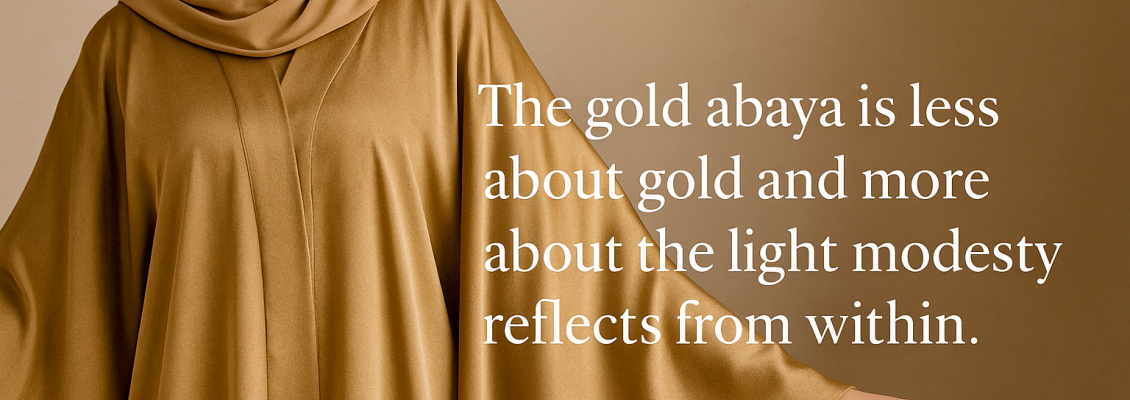
The light coming in through the sheer curtain this morning reminded me of something I couldn’t quite name. It danced like forgiveness — quiet, filtered, golden. The kettle was still hissing, but I stood still, fingers grazing the sleeve of the gold abaya I hadn’t yet put away.
It’s July 3rd, 2025 — not that dates matter much when your heart is measuring time by prayers, by du’as whispered into sleeves, by the feeling in your chest after Fajr. But there’s something about this season — the mid-year hush — that makes everything inside of me ache to begin again.
I never thought I’d write about an abaya like this. Not like a fashion review. Not like a sales page. But like a memory — one I didn’t know was sacred until it kept revisiting me in the quiet. I wasn’t even looking for a gold abaya when I found it. In fact, I thought I was looking for anything but gold. I thought I was too simple, too unnoticed, too heavy-hearted for anything that shimmered. But Allah — as always — had other plans.
So this post is not about style tips or trending colors. It’s about what happened when I tried to wear something that reflected more than just my taste. It’s about what happens when you wear something that reflects you back to yourself — not the version you edit, but the one Allah always sees.
Let me take you through it. The hesitation. The mirror moments. The shift in posture. The quiet du’as before leaving the house. The nights I hung it back in the wardrobe like a prayer I wasn’t ready to answer. This is not about the gold. It’s about the light modesty makes when it touches the soul first — and fabric second.
Table of Contents
- Why did I wear the gold abaya when I didn’t feel worthy of its light?
- Can a gold abaya really hide the cracks I’ve been trying to cover in my heart?
- Was I dressing for others, or avoiding the mirror of my own modesty?
- When did modest fashion become about trends instead of taqwa?
- Why did putting on the gold abaya feel heavier than I expected?
- What is it about gold that made me feel both adorned and exposed?
- I wore the gold abaya, but I still didn’t feel like I belonged — why?
- What if the gold abaya isn’t about beauty — but about breaking free from needing approval?
- Is there such a thing as too much when all I’m trying to be is modest?
- Why do I crave the glow of the gold abaya when my soul still feels dim?
- Was I chasing the shimmer of gold or the sakinah I hoped it would bring?
- How did a single gold abaya soften the way I carried my grief in public?
- Can gold remind me that modesty is not about erasing — but elevating — myself?
- Why did I cry in the changing room the first time I saw myself in that gold abaya?
- What if the gold abaya isn’t excessive — but expressive of a deeper nur within?
- Am I allowed to be seen, to shine, to step forward — while still holding onto modesty?
- How do I wear my gold abaya without dimming the light of my deen?
- Why does my reflection in the gold abaya feel like someone I’m still learning to meet?
- What changed in me the moment I wore that gold abaya and walked into a masjid?
- Could it be that the gold abaya was never about gold — but about divine self-respect?
- Is it possible that the gold abaya taught me more about haya than any lecture ever did?
- How can something so visibly radiant make me feel quietly closer to Allah?
- Why does the gold abaya feel like an ayah stitched into fabric — soft, firm, unshakeable?
- What if my gold abaya became the du’a I didn’t know I was wearing?
- Am I ready to pass this gold abaya down — not just as cloth, but as legacy?
- Frequently Asked Questions
- People Also Ask (PAA)
Why did I wear the gold abaya when I didn’t feel worthy of its light?
It hung there for weeks. Shimmering. Untouched. Not because I didn’t love it — but because I didn’t know if I deserved to. The gold abaya felt too radiant for someone like me. Too confident. Too “together.” Too much light for the darkness I was still nursing in secret. I bought it during a phase I thought I was past — the one where I’d try to become someone new with every outfit. But this one felt different. It wasn’t trying to hide me. It was trying to invite me in. And that scared me more than I was ready to admit.
I still remember the day I saw it. The boutique was small, dimly lit. I wasn’t looking for gold — I never did. I usually reached for blacks, browns, shadows. Safer colors. Easier to disappear in. But the woman next to me gasped quietly and said, “SubhanAllah, this is stunning.” I turned, and there it was — draped on the hanger like a gentle crown. Not flashy. Not loud. Just... bright. In a soft, forgiving way.
I ran my fingers over the embroidery, my chest tightening. It reminded me of nur. Of ayahs I’d long forgotten. Of the feeling after sincere tawbah. I bought it with my hands shaking — not because I wasn’t sure if I could afford it, but because I wasn’t sure if I could carry it. What if it revealed the parts of me I was still healing?
That was the first time I asked myself: am I wearing this for Allah… or hiding in it from people?
Modesty as intention vs. modesty as image
There’s a delicate, painful line many of us walk — between dressing for the sake of Allah and dressing to protect ourselves from judgment. I had gotten so good at the latter. My clothes had become my shield. Not out of taqwa, but out of fear. Fear of what others would say. Fear of seeming like a "bad hijabi." Fear of being exposed as someone who didn’t have it all figured out.
The gold abaya was different. It didn’t let me hide. It asked me to show up. It invited me to feel beautiful for reasons I couldn’t explain. And that felt like a betrayal — not to my faith, but to the guilt I had learned to live inside of.
| Modesty as Fabric | Modesty as Fear |
|---|---|
| Chosen with love and intention for Allah’s pleasure | Chosen to avoid criticism or judgment from others |
| A form of spiritual self-respect and serenity | A reaction to feeling unworthy, exposed, or "not enough" |
| Feels light on the body and nourishing to the soul | Feels heavy and suffocating, like performance |
The first time I wore it — and how quickly I regretted it
It was Eid morning. Everyone around me was in their finest. I thought maybe if there was ever a time to wear the gold abaya, it was then. I remember standing in front of the mirror, adjusting the belt, smoothing the sleeves, and whispering quietly, “Ya Allah, let this not be about them. Let it be for You.”
I wish I could say that worked. That I floated out the door full of barakah and ease. But no — my stomach turned the moment I saw the looks. Some admiring. Some disapproving. Some confused. I felt them before they even reached me — the silent assumptions. She’s too dressed up. That’s not modest. She must be showing off. And all of a sudden, I was 16 again, scrolling Instagram and comparing my iman to curated photos of others who looked so effortlessly righteous.
I left early. Walked home in silence. Sat on my prayer mat and wept. Not because of them — but because of me. Because I had let their glances rewrite my niyyah. Because I had handed them a pen I was never meant to give away.
So why did I wear it?
Because somewhere deep down, I was tired of hiding my softness. I was tired of shrinking under the weight of what I thought I had to be. I wore the gold abaya because I needed to believe — even just for a day — that I could be modest and still feel beautiful. That I could shine without showing off. That I could choose something lovely and still belong to Allah’s mercy.
Because modesty doesn’t mean erasing yourself. It means elevating yourself — dressing with dignity, not disappearing. It means standing before Allah with humility and knowing He sees not just what you wear, but why you wear it.
A private du’a stitched into gold
Ya Allah, I still don’t know if I did it right. I still wrestle with my reflection some mornings. But You know my heart. You saw it trembling that day when I tied the waist of that abaya. You heard the du’a I didn’t say out loud. I wanted to feel like I mattered. I wanted to look in the mirror and not flinch. I wanted to step into a room and feel like light — not like I was taking up too much space. Please forgive me for the times I wore it for others. And reward me for the days I wore it only for You.
That’s why I wore the gold abaya. Not because I felt worthy of it. But because I was learning that maybe I didn’t have to be. Maybe it was never about being worthy — maybe it was about saying, “Ya Allah, I’m trying.” And trusting that was enough.
Can a gold abaya really hide the cracks I’ve been trying to cover in my heart?
There’s something deceptive about shine. It catches the light so easily — even when it’s covering something broken underneath.
When I first put on my gold abaya, I didn’t feel radiant. I felt like I was wearing armor. I thought maybe, just maybe, if I wrapped myself in something beautiful enough, elegant enough, graceful enough... no one would notice the places inside me that still ached. That maybe the shimmer on the outside would blind others to the mess I still hadn’t cleaned up within.
And for a while, it worked. People smiled. Complimented. Sisters asked where it was from. A few aunties nodded approvingly. “MashAllah, you look like a queen,” one said. I nodded and thanked her — but I felt like I was impersonating a woman who believed she was worthy of that glow. I wasn’t her. Not yet. Maybe not ever.
Because while the gold abaya shimmered in public, I was still unraveling in private. Still waking up to nights where I questioned if I was enough. Still wondering why I cried after prayers that were supposed to make me feel better. Still scrolling past perfect hijabis online and asking myself, “What’s wrong with me?”
When shine becomes a shield
The irony was painful: the more “put together” I looked, the more invisible my pain became. No one asked if I was okay. No one could see I was barely holding it together. I’d smile at the sisters in the masjid, but I wouldn’t meet their eyes for too long. I was afraid they’d see past the fabric. That they’d notice the weariness I kept hiding underneath every pleat and fold.
The gold abaya had become something I never intended it to be — a way to distract others from my own unraveling. And it worked. But I was losing myself in the process. Every compliment felt like a brick on my chest. “If only they knew,” I would think. If only they knew how lost I still felt. How hard I was trying to look like I had iman, while still begging for it in private.
Modesty and the cracks we carry
I began to wonder: is this really what modesty was meant to feel like? Like a cover for pain instead of a path to healing? I started journaling again. Writing down the real questions that were haunting me. One morning, this came out of me:
“Ya Allah, am I wearing this for You — or to hide from Your creation?”
It broke me. Because I knew the answer. I had started dressing in layers of modesty not because I felt close to Allah — but because I felt so far from myself. And the further I drifted from my fitrah, the more obsessed I became with how I looked. As if outer beauty could bandage the soul. As if gold could reflect what was missing inside me.
When your gold abaya becomes a du’a in disguise
There was a moment — small, quiet, unforgettable. I was at a sister’s gathering. Surrounded by laughter, chai, the sounds of kids in the other room. I wore the gold abaya again, but this time something shifted. One of the older sisters gently touched my sleeve and said, “You shine, dear. But not because of the fabric.”
I smiled, nodded. But inside, my heart cracked open. Her words were a mirror. They echoed something I had forgotten: that true shine begins from within. That no fabric, no matter how luxurious, could cover the absence of nur from a soul that wasn’t connecting with its Lord. I needed that reminder. Not because the abaya was wrong — but because my relationship with it was misplaced.
Sometimes, we use beauty as a balm. Sometimes, we wear things not because we’re healed — but because we’re still bleeding, and we’re just trying to make the wound look presentable.
| What I thought the gold abaya would do | What it actually did |
|---|---|
| Hide my sadness | Revealed where I was still grieving |
| Make me feel worthy | Made me question what “worth” even meant |
| Impress others | Disconnected me from myself |
| Feel like a good Muslimah | Reminded me that being close to Allah isn’t about looks |
Was I dressing for Allah — or hiding from people?
Let’s be honest. That’s the question at the center of all this. And answering it takes real courage. Because sometimes, we don’t even know we’re hiding. We think we’re doing everything right. We’re covered. We’re elegant. We’re praised. But inside, we’re still desperately hoping someone will say, “I see you. The real you. And you’re still worthy of love.”
But the realest love — the one that heals — only comes when we stop performing and start submitting. When we stop dressing to impress and start dressing to express our servitude. That’s when fabric becomes freedom. That’s when a gold abaya stops being about image and starts becoming a form of ‘ibadah.
A quiet prayer for the sister still hiding
If you’ve worn your most beautiful clothes while hiding the ugliest pain — I see you. If you’ve layered yourself in elegance while praying no one notices the grief in your eyes — I’ve been there. If you’ve hoped a gold abaya could patch the cracks in your heart — I understand.
But know this: the cracks are where the light gets in. And Allah doesn’t need perfection — He wants sincerity. He wants you as you are. Not polished. Not performative. But real. Open. Surrendered.
So wear your gold abaya. With love. With softness. With the intention of honoring what Allah has given you. Not to hide your cracks — but to let them shine with nur that only He can place within you.
Because maybe, the gold was never there to distract from your pain. Maybe it was there to remind you that even broken hearts can glow.
Was I dressing for others, or avoiding the mirror of my own modesty?
There was a time when I thought modesty was simple — a checklist of garments, a formula of fabrics. But somewhere along the way, I stopped looking in the mirror and started looking at everyone else. Their opinions, their approval, their silence. I wasn’t dressing to express my devotion anymore. I was dressing to avoid their disappointment.
The day I realized this, I was standing in a changing room with a new gold abaya draped across my arms. It was beautiful — not in an ostentatious way, but in that kind of soft radiance that makes you want to whisper “SubhanAllah.” I had picked it out because it felt elegant, ethereal. But now, facing the mirror, I wasn’t asking myself how I felt in it. I was imagining how *they* would feel about me wearing it. Would it look too bold? Would it seem like I was trying too hard? Was it “too much” for someone like me?
I caught my own gaze in the mirror — and flinched. Not because of the abaya, but because I didn’t recognize the woman wearing it. She looked like she belonged to a different story — a story with confidence, clarity, and certainty in her identity. But I wasn’t living that story. Not fully. Not honestly.
Performing modesty vs. embodying it
I used to believe that modesty was about covering what was private — but I hadn’t realized how much I was using it to hide what was broken. Instead of dressing to please Allah, I was dressing to escape scrutiny. I layered up out of fear, not faith. My abayas became armor against judgement, not reminders of my servitude.
The worst part? It still looked like I was “doing it right.” On the outside, I ticked all the boxes. Long. Loose. Covered. “MashAllah, you dress so beautifully,” sisters would say. And I’d smile, nod, whisper “Alhamdulillah.” But inside, I felt like a fraud. Because I knew I wasn’t dressing from a place of surrender. I was dressing from a place of shame.
| Modesty for Allah | Modesty for Others |
|---|---|
| A private act of worship and self-respect | A performance to maintain an image |
| Motivated by love and taqwa | Motivated by guilt and fear |
| Softens the heart and brings peace | Feeds anxiety and self-doubt |
| Draws one closer to Allah | Distances one from their true self |
The mirror I was afraid to look into
It wasn’t the glass mirror I feared. It was the spiritual one. The one where I had to ask myself: *Am I using modesty to get closer to Allah, or to hide from my own insecurities?* That mirror doesn’t lie. And standing in front of it, I had to admit — I hadn’t truly asked myself what my niyyah was in a long time.
I wore abayas that made others proud of me. That drew praise. That didn’t “rock the boat.” And yet, I felt hollow inside. I missed the early days of hijrah, when modesty felt like a love letter to my Lord. When I would cry over my salah and then wrap myself in fabric that felt like a continuation of that du’a. When modesty wasn’t about what others saw — but about how it protected my soul.
When the abaya became a mirror — not a mask
One evening, during a quiet walk after Maghrib, I wore the gold abaya again. No makeup. No photos. No one around to admire it. Just me, the wind, and the weight of everything I hadn’t said out loud. I whispered a du’a, almost embarrassed by its simplicity:
“Ya Allah… let this be real again.”
And it hit me — I didn’t need to abandon beauty. I didn’t need to punish myself by dressing in plainness out of guilt. I just needed to return to sincerity. I needed to wear my clothes not as a defense, but as a declaration: *I belong to Allah. My beauty is not for performance. It is a gift I carry with humility.*
The cost of pleasing people with my modesty
Every time I dressed for the sake of others’ opinions, I lost a little piece of myself. I stopped hearing my own voice. I stopped asking myself what felt right, spiritually, emotionally. I looked to others to validate my choices. Sisters on Instagram. Aunties at the masjid. Strangers in comment sections.
But I forgot the one whose opinion truly matters. The One who sees through fabric and filters and self-consciousness. The One who knows when a gold abaya is worn with sincerity — and when it’s worn with the silent hope that maybe, just maybe, someone will finally say, “You’re enough.”
Dear sister, look back into the mirror
If you’ve ever dressed for others — I get it. If you’ve ever worn an abaya just to avoid the pain of being misunderstood — you are not alone. But there is a mirror waiting for you. One that reflects who you really are: a soul searching for sincerity. A heart that just wants to please Allah. A woman who is more than her wardrobe.
The next time you stand in front of the mirror — try asking a new question. Not “Will they like this?” But instead: “Ya Allah, will You accept this from me?” And see how differently your reflection looks when the answer comes from above.
When did modest fashion become about trends instead of taqwa?
I still remember the first time I opened Instagram and typed in “modest fashion.” I was looking for inspiration — not validation. But within moments, I felt like I had walked into a glittering bazaar of curated feeds, coordinated turban styles, gold abayas posed at just the right angle, and captions sprinkled with “alhamdulillah” next to discount codes. I don’t say that with bitterness. Just grief. Because I wasn’t immune to it. I wanted to fit in too. I wanted to belong in this space that claimed to honour modesty — but somehow began to look just like the world I had walked away from when I chose to cover.
I had started my modesty journey quietly. Intimately. It was between me and Allah. I didn’t need applause — I just wanted peace. I wanted taqwa, that sacred awareness that Allah was watching me, even when the world wasn’t. But slowly, as my style evolved and I began sharing online, I found myself checking likes more than I checked my intentions. Was my modesty still for Him — or had it become another curated image to impress the algorithm?
The shift from sincerity to spectacle
There’s a difference between inspiration and imitation — and I crossed that line more than once. I’d scroll through reels of modest fashion hauls, watching hijabis show off their latest abayas like runway models. The lighting was perfect. The poses were perfect. But I started to feel less perfect. Because my abayas weren’t always ironed. My niyyah wasn’t always clear. And sometimes, I didn’t feel “put together” at all. I was trying to dress for Allah while watching a world dress for the camera.
And the deeper I got into that world, the more confused I became. Was modesty now about aesthetics instead of adab? Was it about how minimalistic, trendy, or color-coordinated your feed was? Was there a spiritual cost to this new modesty movement?
A gold abaya, or a golden cage?
One day, I wore a gold abaya to Jumu’ah. Not because it made me feel closer to Allah — but because I thought it might look beautiful in a photo. I hate admitting that. But it’s true. I had lost the simplicity of dressing with taqwa and replaced it with an obsession for “modest fashion statements.” That abaya, though breathtaking, felt heavy on my soul. Like a golden cage I had locked myself into, afraid of not looking the part.
I wanted to be that modest girl who glowed with sincerity. But instead, I became the girl who glowed for the grid.
| Taqwa-led Modesty | Trend-led Modesty |
|---|---|
| Chosen for Allah’s pleasure | Chosen for aesthetic appeal |
| Grounded in humility and haya | Driven by online visibility |
| Invites inward reflection | Demands outward performance |
| Feels spiritually nourishing | Feels emotionally exhausting |
Is it really about fashion, or have we lost the fabric of our sincerity?
I began to ask myself harder questions. Why was I drawn to certain styles? Who was I hoping would notice them? Was I chasing modesty that helped my heart — or modesty that helped my profile?
I remembered the hadith of the Prophet ﷺ:
“Actions are judged by intentions.” (Bukhari and Muslim)And I wondered: what if my outfit was correct, but my intention was corrupted? What if I looked modest — but felt empty? That realization pierced me. Because modesty isn’t just how you dress. It’s how you walk. How you speak. How you carry your soul.
When the soul feels overexposed despite the layers
Even with long sleeves and flowing skirts, I sometimes felt too seen. Not in the way Allah sees — but in the way the dunya consumes. I longed to be invisible again, but in a holy way. To be known only to Allah. To be beautiful in His eyes, not theirs. To wear a gold abaya that reminded me of Jannah — not of influencer envy.
So I made a quiet decision. To start dressing offline more than online. To choose fabrics based on how they felt during salah, not how they photographed in sunlight. To return to softness. To silence. To sincerity.
A du’a for every sister feeling lost in the “modest fashion” noise
Ya Allah, return our hearts to the sweetness of dressing for You. Let our abayas whisper Your name, not scream for attention. Let our hijabs be shields, not spotlights. Let us be seen by You alone — and be content with that visibility.
Because maybe, the rise of “modest fashion” wasn’t the enemy. Maybe the real danger was when we forgot why we started. When we exchanged taqwa for trends. When we forgot that the most beautiful modesty isn’t the one that turns heads — but the one that turns hearts towards You.
So if you’re scrolling right now, wondering if you’re still doing this for the right reasons — pause. Close the app. Open your heart. Ask yourself, “Is this what sincerity looks like for me today?” And if the answer is no, it’s never too late to return.
Because the gold abaya, the trends, the feeds — they all fade. But taqwa? That remains. That’s the real beauty. That’s the only trend worth following — forever.
Why did putting on the gold abaya feel heavier than I expected?
It was supposed to feel like celebration. A moment of becoming. I had waited weeks for this gold abaya — a gift to myself after months of spiritual burnout and silent growth. I imagined slipping into it like stepping into light, like shedding old skin and emerging softer, stronger. But the moment I put it on, I didn’t feel radiant. I felt... burdened.
The weight wasn’t in the fabric. It was in the expectations stitched invisibly between the threads. Expectations I had built for myself. Expectations I feared others had built for me. As I stood in front of the mirror, draped in gold, something in my chest tightened. I had dressed my body, but undressed my heart. And the truth lay bare: I didn’t feel worthy of the reflection looking back at me.
Sometimes the most beautiful garments reveal the most hidden wounds
It wasn’t about the abaya. It never really is. It was about everything I thought it symbolized — strength, certainty, spiritual elegance. But I didn’t feel any of those things. I felt fragile. I felt like an imposter wearing a costume of conviction. Like if someone looked too closely, they’d see the cracks underneath.
I thought the gold abaya would lift me, remind me of the woman I wanted to become. But instead, it reminded me how far I still felt. How many prayers I had rushed. How many tears I hadn’t cried. How many times I had performed modesty for the world, but forgot to perform sincerity for my Lord.
When modesty becomes pressure, not protection
There’s a quiet pain that comes from feeling like you’re failing at something you were once so sure about. Modesty used to bring me peace. But somewhere along the way, it became performative. I began measuring myself against what other sisters wore. How gracefully they walked. How composed they always seemed. I wasn’t dressing for Allah’s gaze anymore — I was dressing to avoid the gaze of others.
And in that pressure, even something as delicate as a gold abaya felt too heavy to bear.
| Modesty as Protection | Modesty as Pressure |
|---|---|
| Centered in intention and connection to Allah | Driven by fear of judgment from others |
| Brings inner peace and spiritual ease | Breeds anxiety and self-doubt |
| Feels like a safe space between you and your Lord | Feels like a performance you have to maintain |
| Motivated by love and surrender | Motivated by image and insecurity |
I thought dressing better would make me feel better — but I forgot to dress my heart first
That day, as I wore the gold abaya and felt the tears come unexpectedly, I realized something profound: dressing the outside will never heal what’s aching on the inside. I could wear the most beautiful abayas in the world, but if my heart wasn’t clothed in sincerity, softness, and submission, I’d still feel exposed.
And maybe that’s why the gold felt so heavy. Because it was reflecting light I hadn’t yet made space for inside. It was asking me to live up to something I hadn’t embodied yet. And that’s not the fault of the fabric. That’s the invitation of it.
A quiet du’a I whispered in the heaviness
Ya Allah, let me wear this not for validation — but for elevation. Let this abaya not be a shield against people, but a reminder of You. Let what I wear on the outside align with what I’m building on the inside. And if the gold feels heavy, help me carry it with humility until it feels like light again.
That du’a didn’t erase the weight instantly. But it shifted something. It reminded me that spiritual growth isn’t about perfection. It’s about honesty. It’s about facing the mirror with your doubts and stains and saying, “Ya Rabb, I’m still trying.”
If you’ve ever felt like your modesty was a costume more than a conviction — you are not alone
This journey isn’t linear. Some days you’ll feel radiant. Some days, like I did, you’ll feel heavy under the weight of expectations — yours and others’. But maybe that’s part of it. Maybe the heaviness isn’t a sign to stop. Maybe it’s a sign to soften. To release the performance and return to purpose. To dress not as a declaration of who we are — but as a du’a for who we’re becoming.
So yes, the gold abaya felt heavier than I expected. But maybe it had to. Maybe it needed to show me where I was still clinging to image instead of truth. Maybe it needed to teach me that beauty and weight can coexist — that what shimmers outside doesn’t always reflect what trembles inside.
But if we bring that trembling heart to Allah — if we wear our garments with hope instead of pride — then even the heaviest abaya becomes light.
What is it about gold that made me feel both adorned and exposed?
There’s something sacred about the shimmer of gold — something that whispers of elegance, of divine celebration, of the dunya trying to imitate the light of Jannah. And when I chose the gold abaya, I didn’t just want to be seen. I wanted to feel something again. Something holy. Something whole. But instead of feeling like a queen wrapped in beauty, I felt like a secret had been revealed — one I wasn’t ready for even within myself.
It confused me, that duality. How could one garment make me feel both elevated and fragile? Why did I glow in the mirror but tremble inside? The gold didn’t just reflect light — it reflected everything I was afraid to say out loud. That deep down, I still wondered if I was too much and not enough at the same time.
Adornment can make you feel beautiful — but it can also make you feel seen in the ways you don’t expect
Growing up, I was taught to dress modestly — to cover, to soften my presence, to be quiet in my confidence. So when I first laid eyes on that gold abaya, something inside me stirred. It wasn’t loud or flashy. But it was luminous. And I didn’t know if I was ready for that kind of radiance. I had spent so long dimming myself that even a gentle glow felt like a spotlight.
Wearing the gold abaya was supposed to be a reward. A way to reclaim joy in my dress after seasons of guilt, anxiety, and spiritual exhaustion. But the first time I wore it to the masjid, my heart raced. I felt hyperaware of my movements, of how I walked, of how I was perceived. Sisters smiled, some complimented. And still, I wanted to hide. Not because of pride — but because of the vulnerability that came with beauty.
Gold didn’t just adorn me. It exposed the belief I had internalized — that modesty had to be invisible to be sincere. And this abaya... it shimmered. It gently refused invisibility.
The mirror becomes a muhasabah when you're honest enough to look beyond the outfit
There’s a specific kind of discomfort that comes when what you wear challenges the parts of you you’ve buried. I remember standing in front of my mirror that night, after I came home from the mosque. The gold caught the moonlight. And I asked myself, “Am I allowed to feel beautiful in this? Is that okay? Or have I equated humility with hiding?”
I didn’t want the gold to be a costume. I wanted it to be a canvas — one where I could walk into both beauty and sincerity, at the same time. But first, I had to separate intention from insecurity. Was I afraid of being seen by people — or of being truly seen by myself?
When modesty is defined by others, gold feels dangerous. When it’s defined by Allah, gold feels safe.
In my early twenties, I fell into the trap of dressing for approval — not from men, but from the modest fashion community itself. I wanted to be praised for being “put together,” “elegant,” “aesthetic.” And so even modesty became a mask. I wore neutrals because they were in. I avoided anything that sparkled because I feared being perceived as vain. And when I finally chose the gold abaya, it wasn’t to rebel — it was to return. To something more honest. To a version of me I hadn’t dared show.
| Adornment through Taqwa | Adornment through Performance |
|---|---|
| Dressing with intention to please Allah | Dressing to avoid judgment or gain approval |
| Choosing beauty that aligns with values | Choosing what is trendy or externally praised |
| Feeling secure even when unseen | Feeling anxious even when complimented |
| Being clothed inwardly in haya and humility | Being clothed outwardly but empty inwardly |
Maybe beauty doesn’t have to contradict modesty. Maybe it’s how we carry it that matters most.
We’ve inherited so many unspoken rules. Rules about what color is too much, what fabric is too shiny, what makes a sister “modest enough.” And while modesty is sacred — it’s also deeply personal. It’s not just about being covered. It’s about being conscious. Of Allah, of our intentions, of our impact on others and on ourselves.
Gold taught me that. It sat on my skin like a mirror. It asked me if I could hold beauty without arrogance. If I could receive compliments without craving them. If I could adorn myself without building my worth on what I wore.
A whisper between me and Allah
Ya Allah, teach me how to wear light without fearing it. Let me be adorned with Your remembrance. Let me not run from beauty — but meet it with humility. Let my clothing reflect not my ego, but my effort to grow closer to You.
That’s what gold reminded me of. That sometimes, modesty doesn’t mean hiding. It means showing up with your full heart — wrapped in sincerity, shining with struggle, anchored in taqwa. Not to be seen by people. But to be seen by Allah, and to respond, “Labbaik.”
So yes, gold made me feel adorned. But it also exposed me. And maybe that was the point. Maybe the exposure wasn’t shameful — maybe it was sacred. A chance to meet myself in the mirror, not with fear, but with forgiveness. Not with perfection, but with presence.
Because when we adorn ourselves from the inside out, gold stops being just a color — and starts becoming a form of dhikr. A subtle shimmer of who we are when we remember Whose we are.
I wore the gold abaya, but I still didn’t feel like I belonged — why?
I thought the gold abaya would fix it. The quiet ache of never quite fitting in. The subtle alienation I felt even in spaces meant for sisterhood. The silence I carried at family gatherings, masjid doors, Islamic events where everyone seemed to speak a dialect of modesty I never fully mastered.
When I slipped into the gold abaya, I thought maybe this time — maybe here, maybe now — I’d finally feel seen in a way that didn’t burn. That I’d belong not just as a body covered in fabric, but as a soul wrapped in intention. But that feeling… it never came.
Instead, I stood in a room full of sisters and still felt like an intruder. Dressed in elegance. Disguised in doubt. I smiled, I nodded, I adjusted the sleeves like I’d seen others do, and yet I couldn’t shake the hollowness.
Modesty was supposed to clothe me in safety. Why did I still feel so exposed?
The truth is, I didn’t realize how deeply I’d internalized the idea that belonging had a visual language. That if I wore the “right” abaya — gold, flowy, graceful — I’d finally be one of them. Whoever “they” were. The reverts with perfect Qur’anic pronunciation. The born Muslims with henna-stained fingertips. The fashion-forward sisters whose every layer looked like it belonged on a curated feed, not a body bruised by doubt.
I thought fabric could bridge the gap between who I was and who I was supposed to be. But what gold couldn't fix was the fracture inside me — the one that believed I had to earn my way into sisterhood.
When did we start measuring belonging by how well we blend in?
In that gold abaya, I looked like I belonged. But inside, I was carrying every awkward salaam I’d ever offered. Every du’a I had stumbled through. Every time someone corrected my hijab without knowing the war I had fought just to put it on that day. I was carrying the guilt of feeling like a guest in my own ummah.
That’s the part no one talks about. The fact that you can be covered head to toe and still feel bare. Still feel like your presence needs to be explained. And sometimes the gold — the shimmer, the softness — makes it worse. Because then, when you’re still met with disconnection, you can’t blame your outfit. So you blame yourself.
Was I dressing for Allah — or trying to dress my way into love?
I had to ask myself that question in the mirror. After the event. After I had come home and hung the abaya back in my closet like a costume. I sat on the edge of my bed and whispered, “Ya Allah, I wore it for You… didn’t I?” But part of me knew that wasn’t the full truth.
Part of me wore it to be accepted. To be read as someone who belonged — who knew, who fit, who had mastered something about Islam I still felt I was only fumbling toward. I didn’t just wear the gold abaya. I wore it hoping it would translate for me. That it would say what my shaky confidence couldn’t.
| What I Thought | What Was Real |
|---|---|
| The gold abaya will make me look like I belong | Belonging starts from believing I already do |
| If I look “put together,” I won’t be questioned | No outfit protects you from spiritual insecurity |
| Other sisters will understand me if I look like them | We’re all carrying stories the abaya can’t tell |
| Modest fashion will help me feel worthy | Only Allah can truly clothe us in worth |
We dress like we belong, but sometimes we haven’t given ourselves permission to
One sister at that event told me, “MashaAllah, you look so confident.” I thanked her, and smiled. But I wanted to cry. Not because she was wrong — but because I realized I had learned how to perform confidence before I had ever learned how to feel it.
Confidence doesn’t come from fabric. It comes from foundation. And mine was cracked. I thought the gold abaya would be enough to fill the gaps. But fabric, no matter how luminous, cannot patch the places where our spiritual wounds still bleed.
So where does belonging come from, really?
It doesn’t come from how many Qur’an verses I can quote, how polished my Arabic is, or how carefully curated my abaya collection is. It comes from what I carry between me and Allah. From the tears I’ve shed in sujood. From the broken nights I chose to pray instead of scroll. From the moments I’ve failed and tried again — with sincerity.
Belonging doesn’t start with being invited. It starts with believing that you have always had a seat in the ummah. That you were born into it — chosen by Allah. And no outfit, no silence, no misunderstanding can ever take that away from you.
A du’a for the misfits, the half-belongers, the heart-heavy seekers
Ya Allah, clothe me in Your mercy when I feel like I don’t belong. Remind me that I am Yours before I am anyone else’s. Let my gold abaya be more than a garment — let it be a reminder that I never had to earn a place I was already written into. Ameen.
So maybe the gold abaya didn’t make me feel like I belonged because it was never meant to. Maybe it was only ever meant to expose the false belief that I didn’t already. Maybe it was just the shimmer that finally let me see how much I was still hiding from the light inside me.
What if the gold abaya isn’t about beauty — but about breaking free from needing approval?
I used to think beauty was something I had to earn. That I had to be approved first — by other women, by strangers on social media, by relatives who never fully said the words, but always looked just long enough to plant doubt. I thought if I wore something stunning — something like a gold abaya — I’d finally silence that part of me that begged to be validated. That aching part that never felt quite enough.
But the gold abaya didn’t soothe that ache. Not in the way I expected. It didn’t hush the inner critic or fill the void that whispered, “They’re still watching. Still judging. Still not sure you belong here.”
What it did was... something stranger. Something deeper. It exposed the need itself. The addiction I had to being seen, not by Allah — but by everyone else.
Was I ever really dressing for beauty — or was I dressing for permission?
The moment I realized this wasn’t really about beauty came in a dressing room. I had tried on the gold abaya three times, walked out of the stall, turned in the mirror, tilted my head like I’d seen others do. It shimmered. It flowed. It was objectively beautiful. But still, I asked the shopkeeper, “Does it look okay?”
And she said something so simple, it shattered something in me: “If it feels like you, it’s already okay.”
That one sentence made me realize I had never once worn something without first asking: will they approve of me now?
When did I stop dressing to honor my soul and start dressing to mute the parts others didn’t like?
Breaking the cycle of approval-seeking starts in the mirror
For years, I had treated modest fashion like a formula. A little more length here. A darker tone there. An accessory that says, “I’m not too much, right?” But somewhere along the way, I forgot that modesty wasn’t about how well I fit into their expectations. It was about how sincerely I stood before my Lord.
The gold abaya didn’t lie to me. It didn’t trick me. It just revealed the truth I was avoiding. That I had been looking for affirmation everywhere but within. That even when I said I was wearing it for Allah, part of me was still waiting for likes, for nods of approval, for someone to say, “MashaAllah, you look like a proper Muslim woman now.”
So I asked myself: what if this isn’t about beauty at all?
What if the beauty is just the surface — the shimmer to draw me into something deeper? What if the gold abaya is actually a spiritual confrontation? A holy interruption? A reminder that the only approval that matters is the One who never needed me to perform in the first place?
I started to reflect on all the ways we chase approval — especially in the name of modesty:
| Approval-Seeking Modesty | Sincerity-Driven Modesty |
|---|---|
| Dressing to avoid gossip | Dressing to gain Allah’s mercy |
| Asking “Will they think I’m religious enough?” | Asking “Is this pleasing to my Rabb?” |
| Feeling panic if your outfit doesn’t match the room | Feeling peace when your niyyah matches your clothing |
| Needing compliments to feel confident | Needing du’a to feel centered |
The gold wasn’t the test — my heart was
The real heaviness wasn’t the fabric. It was the way I had layered people’s opinions over my own sense of worth. Every time I stepped out of the house, it felt like a performance. I had rehearsed my posture, my walk, my smile. I even rehearsed silence — the kind that hides you just enough to not be noticed, but still hopes to be validated.
But the moment I started asking myself, “Would I still wear this if I knew no one would see it but Allah?” something shifted. It wasn’t that I stopped caring how I looked. It’s that I stopped letting others define what looking “beautiful” meant. I started dressing from a place of peace, not panic. From sincerity, not shame.
A du’a to break the chains of needing anyone’s gaze but Allah’s
Ya Allah, purify my intentions until the only eyes I seek are Yours. Let my clothes be a reminder, not a disguise. Let my modesty be a reflection of my love for You — not my fear of people. Remove from me the burden of needing to be approved, applauded, or accepted by anyone other than the One who created me. Ameen.
Sister, I don’t know what your version of the gold abaya is. Maybe it’s that piece you only wear when you’re afraid of being judged. Maybe it’s the thing that makes you feel safe, but also small. Maybe it’s the way you hide in plain sight — hoping they’ll finally see you, but also praying they won’t look too closely.
Whatever it is, I pray you free yourself. That you wear what you wear not to disappear into approval, but to rise in sincerity. That your beauty never becomes a prison. That your gold — whatever form it takes — becomes your key to breaking free.
Is there such a thing as too much when all I’m trying to be is modest?
I used to ask myself this in the changing room. Staring at a dress that shimmered more than I expected. A sleeve that gathered just slightly in a way that felt... extra. I’d hold it against my body and whisper, “Is this too much?” as if modesty came with a measuring stick. As if there was a scale of spiritual worthiness — and I’d tip it too far by liking something beautiful.
But that question — “Is this too much?” — started to haunt me. Not because of the clothes, but because of what it said about how I saw myself. About how little space I thought I was allowed to take up — even in my own faith.
Is modesty really about subtraction?
Somewhere along the line, I began treating modesty like a series of reductions. Fewer colors. Less detail. Less expression. Less presence. As if my faith was asking me to erase myself instead of purify my intentions. As if the only way to please Allah was to disappear behind dullness.
And yet, even when I dressed in all neutrals, minimalism on point, sleeves to the wrist and everything approved — I still felt that voice say, “Too much.” Too loud. Too different. Too something.
That’s when I realized: the fear wasn’t in the fabric. The fear was in my heart — shaped by years of being told that modesty only counts when it hides you.
People-pleasing turned my modesty into a performance
I had stopped asking what Allah wanted from me and started asking what people expected of me. Scrolling through social media, I’d see rows of women dressed in tones so uniform, I began to believe holiness only existed in beige. That anything with embellishment must be a distraction. That if my abaya drew attention, even respectfully, it must mean I was seeking it.
But modesty is not a prison of dullness. It’s a sanctuary of sincerity. And sincerity doesn’t always look like blending in.
Let me be honest, sister — I once wore the plainest outfit I owned, on purpose, to a wedding. I didn’t want to be noticed. I wanted to be good. But the whole night, I felt small, uncomfortable, and not because the dress was wrong, but because my intention was fear — not faith. I was dressing to disappear, not to honour Allah.
What is “too much,” and who decides that anyway?
The Qur’an speaks of libaas at-taqwa — the clothing of God-consciousness. Not a shade. Not a cut. But a state of heart.
And yet we treat other women’s choices as verdicts. We whisper when someone wears something bright, or laced with crystals, or stitched with gold. “That’s not very modest.” But what if it is? What if it’s modest in intention, in posture, in the way she lowers her gaze and speaks with grace? What if she’s adorned on the outside — and surrendered on the inside?
Let’s talk about the real difference
It helped me to create this internal distinction — not about style, but about spirit:
| Modesty as Beauty | Modesty as Disappearance |
|---|---|
| Clothing that honours femininity and grace | Clothing that hides identity out of fear |
| Intentional elegance for Allah’s pleasure | Cautious choices to avoid judgment from others |
| Joy in dressing beautifully with humility | Anxiety in dressing with any personal expression |
| Confidently covering with intention | Unseen, unheard, uncertain of your place |
I had to unlearn shame and remember sincerity
The truth is — I’m still healing from the belief that being visible is being wrong. That anything that draws attention, even by accident, is a sign of spiritual failure. But I’m starting to believe that modesty is a state of the heart first — not just the hang of the cloth.
That maybe Allah loves the sister who wears her favorite embellished jilbab to Jummah because it makes her feel present — not invisible. That maybe it’s not too much if it makes you feel connected. Whole. Aligned. Grateful to be a woman, covered and seen by Allah.
Ya Allah, let my modesty be sincere — not scared
Ya Allah, protect me from shrinking myself in Your name. Let my choices be rooted in reverence, not in fear. Let my clothing reflect gratitude, not guilt. Teach me the beauty of balance — the honour in covering and the freedom in sincerity. Make me modest in my heart before my hands reach for fabric. Ameen.
So, is there such a thing as too much?
Maybe. But not in the way we think. Maybe “too much” is when our hearts become heavy with judgment. When we pile expectations onto sisters we’ve never even spoken to. When we limit Allah’s mercy to our own narrow lens.
Maybe “too much” is forgetting that modesty isn’t about being invisible — it’s about being accountable. Honest. Sincere. Maybe “too much” is dressing in fear of people — and calling it righteousness.
And maybe... maybe that extra stitch of gold, that shimmer in your scarf, that color that lights your face — maybe that’s not too much at all.
Maybe that’s exactly enough for a woman who knows that Allah sees her — and that is enough.
Why do I crave the glow of the gold abaya when my soul still feels dim?
I saw it in the store window — that gold abaya. The way the light played across the fabric, like sunrise woven into silk. My heart fluttered in a way I didn’t expect. It was beautiful, bold, radiant. And I? I felt dull. I hadn’t made Fajr on time that week. I’d scrolled mindlessly more than I’d opened the Qur’an. My soul felt... dim. So what right did I have to wear something that looked like noor itself?
But I couldn’t stop thinking about it.
Why was I drawn to this gold abaya, when I didn’t feel spiritually “worthy” of it? Why did I want to cloak myself in something luminous when my iman felt like a flickering candle in the wind?
Maybe it wasn’t the fabric I was chasing — maybe it was hope
When I think back, I don’t think I wanted the gold abaya because I thought it would hide me. I wanted it because, somehow, it felt like it could remind me. That I could still reflect light, even when I didn’t feel it burning inside. That maybe if I wore it, I’d remember what it’s like to feel whole. To walk in confidence. To remember that Allah doesn’t ask for perfection — just sincerity.
Still, I couldn’t silence the voice that whispered, “You don’t deserve to look radiant if your soul isn’t.”
But where did that voice come from?
It wasn’t from Allah.
Allah is the One who takes the broken and makes them beautiful. The One who lifts us when we feel lowest. The One who wraps His mercy around us when we’re aching with shame. So why did I keep equating spiritual struggle with unworthiness? Why did I think I had to earn my right to feel beautiful, inside or out?
It hit me one day in the masjid. I’d worn a muted abaya that clung too tightly to my guilt. I didn’t feel connected. I didn’t feel seen. I felt like a shadow among women who glowed. But then I looked around and saw something else — I saw quiet tears in their prayers. I saw sisters adjusting their scarves, fixing their sleeves, their eyes tired but determined. I saw struggle. I saw sincerity. I saw myself.
And I realized: maybe the ones who shine the brightest aren’t the ones who feel full of light — but the ones who keep walking toward it anyway.
What modesty means when your heart is heavy
We often associate modesty with being small. Quiet. Unnoticeable. But in the Qur’an, modesty isn’t framed as hiding — it’s framed as honor. Dignity. A way to carry ourselves with intention and grace, even when we feel uncertain.
But shame can distort that intention. It can make us believe that we don’t deserve to wear something radiant until we’ve “fixed” ourselves. That until our prayers are perfect, our choices must be plain.
That’s not Islam. That’s fear — dressed up as false humility.
Modesty doesn’t mean dressing from shame
I created a table that helped me finally separate what I was doing out of love — and what I was doing out of fear:
| Modesty as Devotion | Modesty as Performance |
|---|---|
| Choosing garments out of gratitude to Allah | Choosing garments to avoid judgment |
| Dressing with intention and presence | Dressing with fear of being ‘too much’ |
| Allowing yourself to feel beautiful for Allah’s sake | Believing beauty is haram unless you’ve ‘earned it’ |
| Understanding that your soul is still growing | Punishing yourself for not being ‘better’ yet |
Sometimes the glow is a du’a in disguise
Sometimes we reach for the gold abaya not because we want to show off — but because deep down, we’re aching to remember who we are. We crave the glow because we’re trying to reconnect with a version of ourselves that hasn’t given up. That still believes she’s beloved by Allah. That still sees herself as redeemable.
Maybe the gold isn’t a costume. Maybe it’s a prayer. Maybe it’s a whisper from your soul saying: “I want to feel beautiful again, because somewhere along the way, I forgot I ever was.”
A raw reminder, from one dim heart to another
You don’t have to wait to be perfect before you step into your light. You don’t have to hide behind dullness to prove you’re sincere. You don’t have to strip yourself of joy to be close to Allah. He is already close to you — even in your lowest days. Even when your soul feels dim.
Ya Allah, let my longing for beauty never outshine my longing for You. Let me seek light in ways that please You — and forgive me when I forget how. Let my heart be soft, even when it’s hurting. And let me never confuse humility with hiding.
So if you’re standing in a changing room, gold abaya in hand, questioning whether you deserve to glow — this is your sign:
It’s not about whether you feel like light. It’s about whether you’re still trying to walk toward it. And if you are — even with trembling steps — then sister, you already shine more than you know.
Was I chasing the shimmer of gold or the sakinah I hoped it would bring?
The shimmer caught my eye first. That soft, luminous glow of gold fabric swaying gently on the hanger. Something about it made me pause. It wasn’t just beautiful — it felt like an invitation. To what, I wasn’t sure. But deep inside, I felt a longing, one I couldn’t name in the moment. I told myself I was drawn to it because it was elegant. Because it would photograph well. Because it would make me feel beautiful. But if I’m being honest — and I want to be, for you, sister — I wasn’t chasing shimmer. I was chasing something else entirely.
I was chasing sakinah.
The kind of peace that comes when you feel seen by Allah, known by Him, forgiven by Him. The kind of stillness that quiets all the inner noise of not-enoughness, all the harsh echoes of, “She wears it better than you,” or “You’re only pretending to be pious.”
What if we confuse the outer glow with the inner calm?
I thought wearing that gold abaya might give me a sense of worth I was too scared to claim for myself. I imagined the moment I would wear it — how my back would straighten, how I would smile more confidently, how I’d feel... whole. I didn't admit it aloud, but I hoped that fabric might carry me into a softer version of myself. Less burdened. More accepted. More certain that I belonged here — in my deen, in my skin, in this womanhood shaped by Islam and imperfection.
But sakinah doesn’t come stitched into garments, no matter how beautiful. It doesn’t shimmer. It doesn’t sparkle. It settles. Quietly. Firmly. Like du’a whispered in sujood. Like the pause in your chest after “Astaghfirullah,” when you believe it’s been heard.
When niyyah becomes confused with image
I had to ask myself: Was I drawn to the abaya because it reminded me of who I wanted to become — or because I was hoping to distract from who I still was?
There’s a line we rarely talk about. The blurry space between dressing in a way that honors Allah… and dressing in a way that pleases people who we think represent Him better than we do. For me, that shimmer of gold became a mirror. And what it showed me was painful.
I was dressing to feel close to Allah — but I was also dressing to look close to Allah. And sometimes, I didn’t know which one weighed heavier on my heart.
Table: Modesty as Devotion vs. Modesty as Disguise
| Modesty as Devotion | Modesty as Disguise |
|---|---|
| Rooted in love for Allah | Rooted in fear of judgment |
| Brings calm and clarity | Creates anxiety about appearance |
| Connected to inward sincerity | Driven by outward approval |
| Allows space for imperfection | Demands polished perfection |
The shimmer fades — but sakinah stays
I wore the abaya. It was beautiful. I got compliments. I smiled. But inside? I still felt distant. That ache didn’t go away. That longing for nearness. That desire to feel like I was standing in the light, not just wearing it.
Later that night, I stood in front of the mirror. I had taken off the abaya and folded it carefully. And in my plain clothes, with no shimmer left to hide behind, I made wudhu. I prayed two rak’ahs. No one watching. No camera. No compliments. Just me and my Lord. And that — that — was when I felt it.
Not a rush. Not euphoria. Not beauty.
Sakinah.
Like a hand on my shoulder. Like a du’a returned. Like a breath I’d been holding finally released. I realized that the gold could never give me what I had always had access to — a quiet, unshakable nearness to the One who created my soul and knows every one of its fractures.
To the sister who keeps reaching for sparkle hoping it will fix the ache
I see you. I was you. And sometimes I still am. Wanting to look beautiful and feel beloved and be seen — not for how perfectly you cover, but for how honestly you try. That longing is not vanity. It’s not weakness. It’s a sign that your heart is still searching for closeness. But let your shimmer begin within. Let it be the noor of your sincerity, not the polish of your perfection.
Ya Allah, let what I wear never outshine what I carry in my heart. Let every thread be tied to intention. Let my longing for beauty lead me back to the Source of all Light — You.
So no, I wasn’t really chasing shimmer. I was chasing peace. And every time I turn to Allah — in weakness, in longing, in rawness — I find it. Not in fabric. Not in flattery. But in knowing that He sees me. All of me. And He still draws me near.
How did a single gold abaya soften the way I carried my grief in public?
Grief doesn’t ask for permission. It doesn't wait until you're alone. It shows up in line at the grocery store, in the masjid hallway, on the prayer mat — trembling hands, distant eyes, heavy breaths under layers of cloth. And for a long time, I didn’t know how to hold my sorrow in a way that felt dignified. It felt like a wild, unruly guest, and I kept trying to hide it behind smiles, nods, and silence. But there was a moment — a quiet, almost accidental moment — where one gold abaya softened how I held that ache in front of others. And somehow, it softened how I held it in front of myself, too.
It wasn’t a flashy gold. Not glitter. Not sequins. Just a muted shimmer. The kind you only notice when light lands on it softly, like a whisper. I hadn’t worn it before. It felt “too much” for a woman who had recently felt like “too little.” I wasn’t ready to be seen — but that day, I wore it anyway.
Grief has a posture. The abaya changed mine.
When you’re grieving, your body tells on you. You curl in. Shoulders drop. Eyes stay low. You try to disappear without physically leaving. I did that for months. Until one day, I stood in front of the mirror wearing the gold abaya — and something shifted. My spine lengthened. My hands stopped fidgeting. I didn’t feel healed. But I didn’t feel invisible either.
That abaya didn’t erase my pain. But it allowed me to carry it more gently. Like how a mother cradles a crying baby — not trying to stop the tears, just holding them differently.
The niyyah behind the shimmer
I was scared that wearing something so delicate and beautiful would look like I was trying to escape grief. But what if I was trying to honour it?
There’s a difference between performing joy and honouring your pain with dignity. When I chose the abaya, it wasn’t because I wanted to pretend I wasn’t grieving. It was because I wanted to move through my sorrow with grace. Not to look strong — but to remember that I was still held by the Most Merciful, even in my most fragile moments.
Table: Modesty in Grief — Before and After the Abaya
| Before the Gold Abaya | After the Gold Abaya |
|---|---|
| Hiding grief behind black layers | Letting grief exist within gold light |
| Avoiding eye contact, staying quiet | Smiling gently, even if the ache remained |
| Feeling like I had to “look sad” to honour the pain | Learning that grief and beauty can coexist |
| Dressing to shrink myself | Dressing to gently hold myself |
The masjid hallway moment I didn’t expect
I walked into the masjid wearing it. The gold caught a few glances. Not stares — just that second look people give when something interrupts the usual palette. A sister I barely knew walked past, then came back and whispered, “You look like noor.”
She didn’t know I’d cried in the car just moments before. She didn’t know how hard it was to choose to be seen again. She didn’t know how long I’d hidden behind darker tones because anything lighter felt like betrayal. But her words didn’t feel shallow. They felt like an acknowledgment — not of fashion, but of presence. Like she was saying, “You’re still here. And your light hasn’t left you.”
Ya Allah, teach me how to carry sorrow with softness
I don’t think the abaya healed me. Healing is a process written between prayers and sleepless nights. But it gave me a container — a safe, soft wrapping — for something raw. It helped me move through a public space with dignity. It reminded me that modesty isn’t about disappearing. It’s about presence. It’s about intention. It’s about covering in a way that protects your heart, not hides it.
Ya Allah, let me dress not to impress, not to escape, but to express what You already know lives in my heart. Let every layer be a reminder of Your mercy — not a mask for my pain.
To the sister grieving in silence, who wonders if she’s “allowed” to feel beautiful again
You are. You always were. Grief doesn’t cancel your right to softness, to honour, to presence. You’re not betraying your sorrow by letting light touch your fabric. You’re honouring the complexity of being human — a soul that aches and still hopes. A heart that mourns and still beats.
So if you ever find yourself standing in front of your wardrobe, hand hovering over something more luminous than you feel — let yourself wear it. Not to hide. Not to perform. But to say, with quiet strength: I’m still here. My grief may shape me, but it does not define the whole of me. And Allah, in His mercy, sees all the pieces.
The gold abaya didn’t erase my loss. But it reminded me that even in sorrow, I am worthy of light.
Can gold remind me that modesty is not about erasing — but elevating — myself?
There was a time I believed that modesty meant shrinking — disappearing quietly into a sea of sameness, where no one looked too long, and I never stood out. I wore dark colours, avoided patterns, and kept my hijab as neutral as possible — not because I truly wanted to, but because I thought that to be “seen” was to be in the wrong. I didn’t want to draw attention. I didn’t want to “fit in,” exactly, but I definitely didn’t want to stand out. Modesty, I thought, meant erasure.
But then came the gold abaya. I didn’t buy it for a special event. I didn’t even intend to wear it. It was a gift — folded neatly in soft paper, golden threads catching the light even in the shadows. I held it in my hands and felt a strange mixture of beauty and betrayal. How could something so beautiful make me feel like I was somehow betraying what it meant to be modest?
When did I start believing that visibility and humility couldn’t coexist?
Somewhere along the way, I absorbed the idea that humility meant invisibility. That modesty wasn’t about dignity, but about dullness. I feared beauty. I feared standing out. I feared being misunderstood — being told I was “doing too much” or “showing off.”
But where did those fears come from? Because I don’t remember Allah saying that gold was haram. I don’t remember reading that light was only for the confident, or that shimmer was only for the sinful. What I do remember are the words of the Qur’an, where Allah says:
“Say, Who has forbidden the adornment of Allah which He has produced for His servants…” — Qur’an 7:32
It hit me. Maybe what I had internalized wasn't humility — it was fear. Fear of judgment. Fear of being misunderstood. Fear of looking too confident, too happy, too healed — when really, I was still broken inside.
Modesty was never supposed to mute me
There is a difference between modesty and erasure. One covers with intention. The other disappears in fear. I used to dress to disappear. I used to wear black not because it made me feel connected to Allah — but because it made me feel invisible. Safe from stares. Safe from assumptions. Safe from having to explain myself.
But when I wore the gold abaya for the first time — not to impress, not to rebel, but because I wanted to feel something — I realised I wasn’t erasing myself. I was honouring what Allah had created. I was embracing the idea that modesty is not about hiding beauty — it’s about redirecting it. It’s about saying, “This glow you see? It’s from Him.”
A table that changed my thinking
| Modesty as Erasure | Modesty as Elevation |
|---|---|
| Wearing dull colours to avoid being noticed | Choosing intentional beauty with humility |
| Avoiding self-expression out of fear | Expressing identity with sincerity and niyyah |
| Feeling like being seen is a sin | Remembering that being seen by Allah is enough |
| Equating beauty with arrogance | Holding beauty with gratitude and humility |
Ya Allah, let me shine for You — not for them
I made a du’a once, right before walking into a gathering in that same gold abaya. My heart was racing. I was terrified of being judged, of being misread. So I whispered:
“Ya Allah, if I am seen today, let them see Your light in me — not mine. Let this fabric be a veil that honours You, not a mask that hides me.”
And wallahi, that changed everything. I wasn’t wearing gold to be admired. I wasn’t wearing it to be approved of. I was wearing it because it reminded me that I am allowed to show up. I am allowed to be whole. I am allowed to wear something beautiful without apology — because the soul under it is still bowed to Allah.
To the sister who thinks her beauty makes her less modest — it doesn’t
You are allowed to wear the colour that reminds you of joy. You are allowed to choose fabrics that make you feel like you’ve come home to yourself. Modesty isn’t about making yourself small — it’s about carrying yourself with purpose. It’s about choosing presence over performance. Intention over insecurity. Allah over people.
Gold, to me, used to feel like a threat to my humility. Now I realise: it was never the colour that was the problem. It was the belief that I had to choose between being seen and being sincere. I don’t. You don’t. We never did.
So yes — gold can be a reminder. That modesty was never about erasing the woman I am. It was always about elevating her — not in the eyes of people, but in the sight of the One who fashioned her with light, depth, softness, and strength.
Why did I cry in the changing room the first time I saw myself in that gold abaya?
It was a moment I didn’t expect. Just me, a small, stark changing room lit by harsh fluorescent lights, and that gold abaya draped over my trembling hands. I slipped into the fabric like stepping into a story I hadn’t fully dared to tell yet. The mirror wasn’t just reflecting my image—it was reflecting years of struggle, doubts, and silent battles. And then the tears came. Why did I cry?
Because the reflection was both beautiful and broken. The gold shimmered with a promise I hadn’t realized I was longing for: a permission to be seen and still be safe. But beneath that shine, I felt vulnerable—exposed, raw. Was this the modesty I was supposed to wear? Or was it a performance, a carefully stitched armor to hide behind?
The emotional weight behind the fabric
On the surface, it was “just an abaya.” But it carried so much more. Every thread seemed to hold the weight of expectations—those whispered in the mosque, the unspoken rules from sisters and family, and the loudest, most persistent voice: my own fear of judgment.
I had wrestled for years with what modesty really meant. Was it devotion? Or had it become a stage where I played the role of the “good Muslimah,” hoping no one would see the cracks beneath the fabric? The gold abaya felt like the first time I was confronted with this question in a mirror that wouldn’t lie.
The spiritual cost of people-pleasing
We often think modesty is about protecting ourselves, but somewhere, for me, it became about protecting others’ opinions of me. The fear of being “too much” or “not enough” swallowed the softness I wanted to feel when I dressed for Allah, not for the eyes of the world. The gold abaya reflected this internal conflict—its beauty sharp against my trembling insecurities.
I remembered a moment standing by the masjid door days earlier, watching sisters scroll through Instagram, comparing their hijabs, their abayas, their posts. Was I dressing for Allah? Or was I subconsciously dressing for likes, for approval, for a fleeting sense of belonging?
Modesty as Fabric vs. Modesty as Fear
| Modesty as Fabric | Modesty as Fear |
|---|---|
| Dressing with intention for Allah alone | Dressing to avoid judgment or shame |
| Finding beauty in submission | Hiding behind clothes to mask insecurity |
| Softness and confidence in identity | Rigid rules driven by fear of others |
| Peace in sincerity | Anxiety over perception |
A raw moment of self-reckoning
In that changing room, my tears weren’t just about the dress. They were a release of years of spiritual exhaustion. A surrender to the confusion between what modesty felt like in my heart versus what it looked like on my skin. The gold abaya was a mirror, showing me both the beauty I sought and the chains I carried.
I whispered a du’a, eyes still wet, heart still aching: “Ya Allah, guide me to wear what pleases You, not what pleases the world. Help me find peace in my intentions, even when my reflection is hard to face.”
That changing room was a turning point
Because from that moment on, I started to understand that modesty isn’t about fabric alone. It’s about the soul beneath it — vulnerable, yearning, imperfect, but deeply beloved by Allah. And sometimes, to dress modestly is to face ourselves honestly, even when it hurts.
So if you ever find yourself crying quietly in a changing room, wondering why the clothes feel heavier than the fabric itself — know that you are not alone. That is the weight of wrestling with identity, faith, and the desire to be truly seen, not just covered.
And sister, you are worthy of being seen. Not because of the clothes, but because of the light within you that no fabric can ever hide or dim.
What if the gold abaya isn’t excessive — but expressive of a deeper nur within?
There’s a moment when the mirror stops being a simple reflector and starts becoming a silent judge. When I first tried on that gold abaya, part of me recoiled at its shimmer — thinking, "Is this too much? Too flashy? Too loud for modesty?" Yet beneath that surface reaction, something deeper stirred. What if the gold wasn’t about excess? What if it was a language of light — a visible expression of a nur, a divine light glowing from within?
Sister, I know how hard it is to wrestle with these feelings. We grow up taught that modesty is about hiding, about making ourselves less visible — sometimes even erasing ourselves completely. But what if modesty was not about erasing but about elevating? Not about shrinking into shadows but about shining gently from a place of sincerity and love for Allah?
The confusion between modesty and performance
For a long time, I let fear dictate my choices. I dressed in ways that soothed the eyes of others but left my own soul cold and unseen. The gold abaya challenged that. It asked me: Was I dressing to hide my light, or was I dressing to honor it? Was this shimmer a desperate attempt to perform modesty perfectly for the world, or a quiet declaration of the light Allah planted inside me, waiting to bloom?
This is the heart of the spiritual cost we often overlook — when modesty becomes a performance rather than devotion. When it is about appeasing judgment rather than nurturing intention. The gold abaya made me confront my niyyah — my intention. Was I dressing for Allah’s pleasure, or was I dressing to hide, to protect, to shrink?
A personal wrestle with the soul’s glow
I remember scrolling through social media, seeing so many sisters wearing soft, muted tones, some adorned with subtle embroidery, others in plain simplicity. I envied their ease, their quiet confidence. Then I’d look back at the gold abaya hanging on my chair — radiant, unapologetic. It made me uneasy. Was I too much? Was I betraying the essence of modesty by embracing brightness?
But then, I recalled a Qur’anic verse, reminding me: “Allah is the Light of the heavens and the earth...” (Surah An-Nur 24:35). That light is not meant to be hidden away, dimmed or denied. The nur within me — the divine spark — is not something to be ashamed of but nurtured and allowed to shine through, modestly but authentically.
Modesty as Fabric vs. Modesty as Fear
| Modesty as Fabric | Modesty as Fear |
|---|---|
| Wearing clothes with intention to honor Allah | Choosing garments out of fear of judgment |
| Expression of inner light and confidence | Masking insecurities under fabric |
| A gentle, radiant presence | A rigid, anxious attempt to blend in |
| Freedom to shine softly | Restriction born from fear |
A moment of vulnerability and clarity
One afternoon, standing quietly in the masjid, I caught my reflection in the window glass — gold abaya shimmering softly in the sunlight. It wasn’t loud or flashy in that light. It was like a gentle glow, a sakinah, radiating from a place of peace. I felt exposed, yes — but also seen by Allah in a way I hadn’t before.
In that moment, my tears came — not from shame or fear, but from relief. Relief that maybe, just maybe, modesty isn’t about dulling the light inside us. It’s about allowing that nur to shine through, wrapped in sincerity and submission, regardless of what others might think.
Final thoughts for my sister who feels torn
If you find yourself questioning whether your choices are “too much,” whether you’re failing at modesty because you embrace your own glow — I want you to hear this truth: modesty is not about erasing yourself. It’s about elevating the soul Allah created uniquely. It’s about honoring the divine nur within, not hiding it out of fear or shame.
The gold abaya, with all its shimmer, can be a symbol — not of excess, but of light that no one can take away from you. You don’t need to dim that light to fit into someone else’s definition of modesty. Instead, trust your intention, dress for Allah’s eyes, and let your inner nur shine through in the fabric you choose.
Because sister, the light inside you is sacred. It is your gift, your strength, your quiet power. And wearing gold doesn’t diminish that — it can, in fact, be its beautiful expression.
Am I allowed to be seen, to shine, to step forward — while still holding onto modesty?
Sister, I have asked myself this question more times than I can count: Am I allowed to be seen? To shine? To step forward into the light — without the weight of shame, without the crushing burden of judgment — all while still holding onto the sacredness of modesty?
There was a time when modesty felt like a silent, invisible cloak — something that required me to disappear, to become less than who I was, as if the only way to be modest was to fade into the background. I dressed to hide, to avoid eyes, to avoid questions. But inside, there was a storm. A yearning. A deep desire not just to exist but to live fully, authentically, and beautifully under Allah’s gaze.
But the world often made that impossible. The whispers, the sideways glances, the social media posts about what “modest” truly means — all seemed to say, “Be quiet. Be small. Don’t attract attention.” And so, I did what many sisters do: I shrank. I hid my true self under layers of fear, shame, and what I thought was piety.
The shift from devotion to performance
Modesty began as devotion — a heartfelt commitment to dress and live for Allah alone. But slowly, it shifted into performance. It became about the eyes of people, about approval, about avoiding judgment. The abaya I wore wasn’t just fabric; it became a mask. The question of niyyah — my intention — haunted me daily. Was I dressing to please Allah, or was I dressing to shield myself from criticism, from misunderstanding, from the world’s harsh gaze?
This shift is subtle but deeply damaging. Because when modesty is performance, it loses its softness. It loses its beauty and intention. It becomes rigid, fearful, and sometimes even painful.
My personal wrestle — changing rooms and masjid doors
I remember standing in the harsh fluorescent lights of the changing room, wrapped in a new abaya that was supposed to make me feel confident and covered, yet I felt naked inside. The mirror reflected not just my image but my insecurities. The fear of being judged was heavier than the fabric. Was I too flashy? Not modest enough? Too bold?
And at the masjid doors, I’ve felt the weight of eyes scanning, whispering — and even though I was covered, I felt exposed. The very thing meant to protect me seemed to make me more vulnerable. How could that be?
Modesty as Fabric vs. Modesty as Fear
| Modesty as Fabric | Modesty as Fear |
|---|---|
| Dressing with intention for Allah’s pleasure | Dressing to avoid people’s judgment |
| Embracing beauty in humility | Suppressing self-expression out of shame |
| Confidence rooted in faith | Anxiety rooted in societal pressure |
| Freedom to step forward | Fear of standing out |
Finding permission to shine
One of the hardest lessons I learned was that Allah does not ask us to hide our light. In fact, the Qur’an says, “And We have certainly made the Qur’an easy for remembrance, so is there any who will remember?” (Surah Al-Qamar 54:17) — a reminder that the path of faith is one of ease and grace, not of suffocation and fear.
To be seen, to shine, to step forward is not an act of rebellion against modesty. It is an act of embracing the gift Allah has given us — our unique light, our presence in this world. Holding onto modesty does not mean losing yourself or dimming your spirit. It means anchoring your shine in faith, in intention, and in a heart that seeks only to please Allah.
I remember a private du’a I made one evening, my heart heavy with doubt and fear: “Ya Allah, guide me to walk this path with sincerity. Let my modesty be a shield, not a cage. Let me shine in a way that brings You glory, not myself.” That du’a became a turning point.
A moment of exposure and grace
At a gathering once, I wore a beautifully embroidered abaya that caught the light in a way I hadn’t expected. I noticed eyes on me — some admiring, some judging. My heart raced. Was I breaking the rules? Yet in that moment, I remembered my intention. I was not dressing for them. I was dressing for Him. And with that, my fear loosened its grip.
That evening, I felt something I had longed for: freedom. Freedom to be seen without shame, freedom to shine without guilt, freedom to step forward while still holding the tender thread of modesty close.
To my sister reading this now
If you’re struggling with whether you can be seen and still be modest, know this: Yes, you can. You are allowed to shine. You are allowed to step forward. Your modesty is not measured by how much you hide but by the sincerity of your heart, the purity of your intention, and the way you carry yourself with humility and love.
Modesty is not the enemy of light — it is the frame that holds your light in a way that honors Allah and nurtures your soul. So take your step forward, sister. Shine with grace. Be visible in your modesty. And remember, you are never alone on this journey.
How do I wear my gold abaya without dimming the light of my deen?
Sister, this question weighs heavy on my heart — because it touches the fragile balance we all try to hold: wanting to express beauty and confidence, while keeping our faith pure, unshaken, and luminous. How do I wear my gold abaya — a symbol of shine, of presence — without dimming the sacred light of my deen?
There was a time when the gold abaya felt like both a blessing and a burden. On one hand, it was beautiful — radiant, shimmering in ways that made me feel seen, even celebrated. But on the other hand, I feared that this glow might be mistaken for vanity or pride. Would others see my abaya and forget the intentions behind it? Would my outward shimmer drown the soft inner light of my faith?
The shift from devotion to performance
At first, modesty was a devotion, a tender act of worship. I dressed to please Allah, to honor Him with humility and grace. But slowly, fear crept in. Fear of judgment, fear of being misunderstood, fear that my abaya was “too much.” So modesty shifted from a sacred act to a performance — a balancing act of hiding and shining, of blending and standing out.
This shift isn’t just external. It cuts deep into the soul, twisting niyyah (intention) into knots. Was I truly dressing for Allah? Or was I dressing to protect myself from people’s whispers? Was the gold abaya a declaration of faith, or a shield against criticism?
The spiritual cost of people-pleasing
The hardest lesson was realizing the spiritual cost of people-pleasing in the name of modesty. When my heart bends to fear or shame, the light of my deen flickers. Modesty becomes a cage instead of a sanctuary. I remember moments in the changing room — staring at myself in the mirror, my abaya perfect but my spirit trembling. Was this really worship, or just a performance for an unseen audience?
At the masjid doors, I felt this tension sharply. Covered but vulnerable. Observed but isolated. The gold shimmer drew eyes, and suddenly, modesty felt fragile — like I was walking a tightrope between faith and fear.
Modesty as Fabric vs. Modesty as Fear
| Modesty as Fabric | Modesty as Fear |
|---|---|
| Wearing with sincere intention for Allah | Wearing to avoid negative judgment |
| Confidence rooted in faith and love | Anxiety rooted in societal pressure |
| Embracing beauty as a gift from Allah | Suppressing self-expression to fit expectations |
| Freedom to shine in humility | Fear of standing out or being misunderstood |
Qur’anic reflections and intimate du’as
There were nights when I sat quietly, whispering du’as that felt raw and vulnerable: “Ya Allah, let my light be for You alone. Let my modesty be a reflection of my heart’s submission, not a mask of fear.”
The Qur’an reminds us in Surah An-Nur (24:35), “Allah is the Light of the heavens and the earth…” — a beautiful reminder that our light comes from Him, not from the gold or fabric we wear. The abaya is a garment; the deen is a flame that should never be dimmed by the world’s gaze.
A moment of exposure and grace
I recall a gathering where my gold abaya shimmered under soft lights. I felt eyes — some admiring, some critical. For a moment, my heart faltered. But then I remembered my intention. I was wearing this for my Lord, not for their approval. That realization set me free. My modesty became a radiant act of worship, not a fearful performance.
To my sister who reads this now
If you wrestle with how to wear your gold abaya without losing the light of your deen, know this: Your value isn’t in how much you cover or hide, but in the sincerity of your heart and your intention before Allah. Shine with humility, walk with faith, and hold your modesty as a source of strength — not a burden.
You can wear your gold abaya and let your deen shine brighter than any fabric ever could. Your faith is your true glow — and nothing can dim that unless you allow it.
Why does my reflection in the gold abaya feel like someone I’m still learning to meet?
Sister, have you ever caught your reflection in a gold abaya and felt a strange mix of recognition and distance? Like the woman staring back at you is both familiar and mysterious — someone you know yet are still trying to understand? This feeling is raw, unsettling, but deeply human. It’s the feeling of encountering a version of yourself that is evolving, conflicted, and yearning for peace.
When I first wore my gold abaya, I expected to feel complete — wrapped in its shimmer, I thought I’d find the confidence, the clarity, the comfort I longed for. Instead, what I saw in the mirror was a woman caught between worlds. Between who I was, who I wanted to be, and who others expected me to become.
Modesty as devotion — or modesty as performance?
There was a time when modesty was simple and sacred: a heartfelt devotion to Allah, a tender act of worship through my dress and demeanor. But slowly, the fear of judgment crept in. I began to question: Am I wearing this for Allah, or am I dressing to meet the expectations of the people around me? The gold abaya, once a symbol of my blossoming faith, started to feel like a costume — a performance put on to shield myself from criticism, whispers, or misunderstanding.
This shift changed everything. The softness I once felt when dressing gave way to tension. The beauty I embraced now felt weighted with the fear of being “too much” or “not enough.” I realized that the reflection in my abaya wasn’t just me — it was also the accumulation of fears, doubts, and insecurities.
The spiritual cost of people-pleasing
The cost of dressing to please others is profound. It steals the joy from our acts of worship and replaces it with anxiety. I remember standing in the changing room, wrapped in gold fabric, heart pounding with uncertainty. Was I hiding from the gaze of the world? Or was I genuinely surrendering to Allah’s command?
Scrolling through social media added layers to this struggle. Images of “perfect” modesty, “ideal” hijabs, and “approved” styles flooded my feed. Each post whispered silently, “Are you enough? Are you doing it right?” The reflection I saw wasn’t just in the mirror — it was in the eyes of strangers, in the comments, in the comparisons. And it wasn’t always kind.
Table: Modesty as Fabric vs. Modesty as Fear
| Modesty as Fabric | Modesty as Fear |
|---|---|
| Wrapped in intention, devotion to Allah | Wrapped in anxiety, fear of judgment |
| Softness in expression and identity | Rigid, performative layers to please others |
| Beauty embraced as a gift | Beauty suppressed or weaponized by shame |
| Freedom to grow spiritually and emotionally | Trapped in cycles of comparison and fear |
Qur’anic whispers in the mirror
In moments of quiet, I returned to the Qur’an seeking reassurance. Surah Al-Hujurat (49:13) gently reminded me: “O mankind, indeed We have created you from male and female and made you peoples and tribes that you may know one another…” — a reminder that identity is a journey, not a fixed point.
My reflection is part of that journey. The gold abaya does not define me — my heart, my intentions, and my submission to Allah do. The woman in the mirror is learning, healing, evolving.
Raw inner monologue — a moment of vulnerability
One evening, alone in my room, I stood in front of the mirror wearing the gold abaya. My breath caught. “Who are you?” I whispered to myself. “Are you the confident woman you want to be, or the scared girl trying to hide?”
Tears blurred my vision, but through the haze, I found a fragile strength. “I’m both,” I admitted softly. “And that’s okay.”
Feeling exposed, yet longing to be understood
Despite covering up, I have felt exposed. Judged. Misunderstood. Like my modesty was being scrutinized rather than honored. Yet in these moments, I also sensed a deeper call — a call to authenticity, to self-compassion, to meeting that reflection with kindness instead of critique.
Sister, if you see yourself in this reflection, know this: the woman in your gold abaya is still becoming. You are learning to meet her with love, patience, and faith. The journey isn’t about perfection but about honest growth.
Your gold abaya isn’t just fabric. It’s a mirror — reflecting both your struggles and your beauty, your fears and your strength, your doubts and your devotion. And every time you look at that reflection, may you see not just someone you’re still learning to meet, but a beloved creation of Allah, worthy of mercy and grace.
What changed in me the moment I wore that gold abaya and walked into a masjid?
Sister, that moment — slipping into the gold abaya and stepping through the masjid doors — it felt like stepping into a new chapter of my soul’s story. I remember the weight of the fabric, the shimmer catching the light, and my heart pounding with a strange mixture of pride, vulnerability, and a whisper of fear. What changed inside me wasn’t just about the outward appearance; it was something far deeper, a quiet unraveling and awakening that still echoes in me.
Before that day, modesty had often felt like a tightrope walk — a balancing act between devotion and performance. Was I dressing for Allah, or was I trying to hide from the eyes and judgments of people? The gold abaya was dazzling, beautiful, and at times, overwhelming. I wrestled internally: was this too much? Was I betraying the softness and humility that modesty once held for me? That walk into the masjid made me confront those fears head-on.
The emotional shift: from devotion to performance and back again
When I first put on that gold abaya, I felt both seen and unseen. Seen because the fabric shimmered, and there was no denying the presence it announced. Unseen because inside, my heart was still wrestling with niyyah — the pure intention. Was I wearing this to elevate my iman, or was it to hide behind a veil of beauty that distracted from my spiritual struggles?
Walking into the masjid, I could feel the eyes of others — not always kind, sometimes curious, occasionally judging. But more than that, I felt the gaze of Allah, silent and all-encompassing, tender yet challenging. That moment shifted something inside me: modesty wasn’t about hiding or shrinking. It was about embracing who I was — flaws, faith, and all — and carrying it with dignity.
The spiritual cost of people-pleasing
How often do we let the fear of what others might say dictate how we dress, how we pray, how we show up? That day, I realized that dressing modestly isn’t about erasing ourselves to blend into the background. It’s about showing up authentically before Allah and the world.
But the spiritual cost of people-pleasing is heavy. I have felt it in the quiet moments before prayer — when doubt clouds my heart, when comparison steals my joy. I have felt it in the masjid’s echoing halls, where sometimes the silence feels louder than any whispered criticism.
Table: Modesty as Fabric vs. Modesty as Fear
| Modesty as Fabric | Modesty as Fear |
|---|---|
| Clothing as an expression of faith and identity | Clothing as a shield against judgment and shame |
| Freedom to embrace beauty with humility | Restriction born from fear of standing out |
| Niyyah centered on Allah’s pleasure | Niyyah clouded by people-pleasing |
| Softness and sincerity in practice | Hardness and rigidity from external pressure |
Qur’anic insight and private du’a
In that moment of vulnerability, I recalled Allah’s words in Surah Ash-Sharh (94:5-6): “For indeed, with hardship [will be] ease. Indeed, with hardship [will be] ease.” I whispered a private du’a, asking for patience, clarity, and the strength to keep my intention pure — to wear my gold abaya not as armor for people’s eyes but as a reflection of my growing love for Allah.
Feeling exposed yet found
Walking into the masjid wearing the gold abaya, I felt exposed — like all eyes were on me, not just because of the shimmer but because of the silent question hanging in the air: Who is she really? Yet amidst that exposure, I also felt found. Found by Allah’s mercy, His understanding that beneath every struggle, every doubt, is a soul striving for light.
That day changed me. It reminded me that modesty is not about hiding or dimming my light. It’s about carrying it with humility, with intention, and with a heart that knows its worth before Allah alone.
Sister, if you find yourself hesitating at the masjid doors, wondering if your modesty is enough, or if your intention is pure — know that this is part of the journey. Let your gold abaya be a garment of your sincerity, a testament to your evolving faith. Walk through those doors with courage, because the change you seek is already stirring within you.
Could it be that the gold abaya was never about gold — but about divine self-respect?
Sister, sometimes we get caught up in the shimmer of the gold — the fabric, the color, the way it shines — and forget to ask the deeper question: what is this really about? That gold abaya I wore, the one that felt heavy with meaning and expectation, wasn’t just about a color or a statement piece. It was about something far more intimate and sacred: divine self-respect.
I want to share with you the raw truth I uncovered — a truth that cracked open the shell of fear, shame, and performance I’d built around modesty. Because, honestly, for a long time, modesty for me felt like walking a tightrope between hiding and being judged. It wasn’t soft or beautiful. It was a performance, a way to protect myself from the world’s harsh eyes.
From modesty as performance to modesty as reverence
That gold abaya wasn’t just fabric to cover me; it was a declaration. Not of vanity, but of reverence. Reverence for the self Allah created, a recognition that my worth is tied not to how much I shrink or fade into the background, but how deeply I honor the soul He gave me.
But it took me time to see it this way. I wrestled with niyyah constantly. Was I wearing this for Allah’s sake, or to hide from people’s judgment? The mirror in the changing room reflected my doubts back at me — a woman struggling to reconcile her faith with her desire to be seen, respected, and valued.
The spiritual cost of people-pleasing
People-pleasing in the name of modesty is a silent thief. It steals our joy and replaces it with anxiety. The constant fear of not being “modest enough,” or being “too flashy,” builds walls around our hearts. Walls that dim the light Allah intended for us to shine.
I remember scrolling through social media, comparing my modesty to others — each scroll feeding the doubt, the shame. The gold abaya suddenly felt like a mask I wore to fit in, not a garment worn to glorify the One who created me.
Table: Modesty as Fabric vs. Modesty as Fear
| Modesty as Fabric | Modesty as Fear |
|---|---|
| A beautiful expression of faith and self-love | A restrictive armor against judgment and shame |
| Softness and intentionality in every choice | Rigid adherence born from insecurity |
| Freedom to shine as a beloved creation of Allah | Suppression of identity to avoid criticism |
| Niyyah rooted in pleasing Allah alone | Niyyah clouded by fear of others’ eyes |
Qur’anic insight and private du’a
In moments of doubt, I turned to the Qur’an for reassurance. The verse from Surah An-Nur (24:31) whispered softly to my heart: “And tell the believing women to lower their gaze and guard their private parts and not expose their adornment except that which [necessarily] appears thereof…” But what struck me was the balance between guarding and recognizing the “adornment.”
Allah didn’t command erasure; He commanded balance. A divine respect for oneself that doesn’t deny beauty but channels it through humility and faith. I prayed quietly, asking Allah to help me embody this balance — to wear my gold abaya as an act of worship, not a mask.
A moment of feeling exposed yet deeply understood
There was a moment in the masjid, wrapped in my gold abaya, when I felt every eye on me — yet also deeply seen by Allah in a way I hadn’t before. The tension between exposure and acceptance wrapped around me like the folds of that fabric. I felt vulnerable, yes, but also cherished.
That day, I realized the gold abaya wasn’t about gold at all. It was about a divine self-respect — a recognition that I am worthy, beloved, and honored by my Creator, no matter what others may say or think.
Sister, if you’re wrestling with your own reflection, your own fears about modesty and self-expression, know this: the light Allah placed inside you is not meant to be dimmed. Your modesty can be your crown, your shield, and your gift — when rooted in divine self-respect.
So wear your gold abaya with intention, with love, and with the fierce knowledge that modesty is not about erasing yourself, but elevating the soul Allah entrusted to you.
Is it possible that the gold abaya taught me more about haya than any lecture ever did?
Sister, I want to share something so raw, so personal, it feels like peeling back layers of myself that I wasn’t even fully aware were there. You know how we listen to lectures, absorb the words about haya — that beautiful, protective modesty of the heart and soul — yet somehow it remains a concept, distant and intangible? For me, the gold abaya became a living lesson, a teacher that spoke more deeply than any lecture ever could.
At first glance, the gold abaya might seem contradictory to the essence of haya. It gleams, it catches the eye, it announces presence. How could such a bold garment teach me about modesty, shyness, and inward purity? But that’s exactly why it was a lesson — because it challenged every assumption I had about what haya should look like.
The emotional shift: from modesty as performance to modesty as soul-softening
Before that abaya, my modesty was performance. It was fear dressed as fabric. I measured every inch, every fold, every color, through the eyes of others. Would I be judged? Would I be found wanting? My niyyah—my pure intention—became tangled in people-pleasing and anxiety.
When I wore that gold abaya, I felt exposed in a new way. The shimmer made me visible in a way that scared me. But instead of retreating, I was forced to look inward, to soften my heart and remind myself that haya is not about shrinking away but about a sacred dignity — a gentle power that shines from within.
The spiritual cost of fear and shame masquerading as modesty
So many times, I caught myself scrolling through social media, watching other sisters in their hijabs and abayas, wondering if I measured up. That constant comparison is a thief — stealing joy, stealing peace, replacing the beauty of intentional modesty with fear and shame.
That gold abaya taught me that true haya doesn’t come from erasing yourself or dimming your light to avoid judgment. It comes from embracing your worth as a beloved creation of Allah, carrying yourself with gentle confidence, and dressing with a heart focused on pleasing Him alone.
Table: Modesty as Fabric vs. Modesty as Fear
| Modesty as Fabric | Modesty as Fear |
|---|---|
| Clothing and demeanor as an expression of faith | Clothing and demeanor as shields against judgment |
| Softness and grace rooted in sincerity | Rigid self-protection born of insecurity |
| Niyyah focused on Allah’s pleasure | Niyyah clouded by fear of others’ eyes |
| A humble yet confident presence | A withdrawn or defensive posture |
Qur’anic insight and private du’a
In moments when my heart felt heavy with doubt, I clung to Allah’s words in Surah An-Nur (24:30-31): “Tell the believing men to lower their gaze and guard their private parts. That is purer for them. Indeed, Allah is acquainted with what they do.” The verse continued with gentle instruction for women, inviting a balance of lowering the gaze and preserving dignity without stripping away beauty or light.
I prayed often in solitude, asking Allah to instill within me a haya rooted in love, not fear — a modesty that lifts the soul instead of crushing it. “Ya Rabb,” I whispered, “help me to carry my deen with softness and strength, to wear my faith like a light that draws closer to You, not like a mask that hides my pain.”
A moment of feeling misunderstood yet deeply connected
One afternoon in the masjid, I caught a glimpse of myself in the reflective glass wearing that gold abaya. In that fleeting moment, I felt a strange mix of exposure and protection — misunderstood by some, perhaps, but deeply known by Allah.
The abaya wasn’t just a garment anymore. It was a symbol of my journey from fear to faith, from people-pleasing to soul-honoring. It was a reminder that haya isn’t about erasing who I am but embracing it fully, with humility and trust in the One who knows my heart best.
Sister, if you find yourself trapped between the fear of being seen and the desire to shine, know that true haya will teach you how to walk that line with grace. Let the gold abaya — or whatever modesty means for you — be a lesson of love, dignity, and the quiet courage to be yourself before Allah alone.
How can something so visibly radiant make me feel quietly closer to Allah?
Sister, I want to speak to your heart right now — the part that wonders how something so visibly radiant, so undeniably bright, could ever bring a quietness, a softness, a closeness to Allah. At first, it sounds almost impossible, doesn’t it? Gold, shimmer, shine — all of these feel loud in a world where modesty is supposed to mean silence and invisibility. Yet, that’s exactly the paradox I lived through, and perhaps you will too.
When I first held that gold abaya, I was flooded with fear. How would people see me? Would they think I was showing off? Was I betraying the quiet dignity I thought modesty demanded? But as I slowly wrapped myself in that radiant fabric, something shifted. It wasn’t about the shine on the outside — it was about the light that began to glow inside me, the light that could only come from a heart yearning for closeness with Allah.
The journey from performance to presence
There was a time when modesty felt like a performance — an act to shield myself from judgment, a way to hide the parts of me I thought the world might reject. The fabric became armor, the layers became walls. And the gold abaya? At first, it felt like a spotlight threatening to expose everything I wanted to hide.
But in the quiet moments of prayer, in the stillness of sujood, the gold abaya whispered a different message. It reminded me that modesty isn’t about invisibility — it’s about intention. When I dressed to please Allah alone, that radiant garment became a vessel for sakinah — a tranquility that settled deep inside my soul, a soft glow that wasn’t about the eyes of the world but about the eyes of the One who sees all.
When fear and shame mask our true intention
Scrolling through social media, comparing myself to sisters who seemed to effortlessly balance beauty and modesty, I often felt ashamed. Did the brightness of my abaya make me less humble? Was I trying too hard? The judgments — both internal and external — threatened to dim my light, and for a while, I tried to blend into the shadows.
But Allah’s mercy is greater than our fears. He reminds us through the Qur’an (Surah Al-Ahzab, 33:35) that both men and women who are sincere in faith, who are humble and guard their modesty, will be rewarded. The abaya, radiant as it was, became a symbol of that sincerity. It was not about attracting attention for vanity but expressing the dignity Allah grants to His believing servants.
Table: Modesty as Fabric vs. Modesty as Fear
| Modesty as Fabric | Modesty as Fear |
|---|---|
| Wearing modesty as a sincere act of worship | Wearing modesty to hide flaws or avoid scrutiny |
| Radiance that reflects inner confidence and peace | Dimming the self out of fear of judgment |
| Clothing chosen to honour the Creator | Clothing chosen to please people or avoid shame |
| Embracing beauty without arrogance | Suppressing beauty out of fear or guilt |
The intimate wrestle with niyyah — dressing for Allah or hiding from people?
I remember standing in the changing room, the gold abaya draped around me, heart pounding. Was I truly dressing for Allah’s sake? Or was I trying to cover up insecurities, to hide behind the fabric? That moment forced me to confront my intentions with brutal honesty.
It was in that silence, away from the eyes of the world, that I made a du’a: “Ya Allah, purify my heart. Let my clothing be a reflection of my love for You, not a mask for my fears.” The answer wasn’t immediate, but gradually, the heaviness lifted.
A moment of exposure and grace
One day, walking through the masjid doors in my radiant gold abaya, I felt the gaze of others, and yes, a flicker of fear. But then, I felt something deeper — a calm assurance that Allah saw me as I truly was, beyond the fabric and the shine.
That feeling was sakinah, peace, a quiet closeness to Allah that no outward brightness could ever overshadow. It taught me that true radiance is not about dazzling the world but about illuminating the soul from within.
Sister, if you ever doubt how your modesty and your shine can coexist, remember this: Allah created us as beings of light and shadow. Our faith is not meant to erase our brilliance but to refine it, to teach us how to shine with humility and love.
Let your gold abaya — or whatever garment you wear that makes your heart sing — be a reminder that your closeness to Allah is not measured by how dim you appear, but by how sincere and luminous your heart is in His presence.
Why does the gold abaya feel like an ayah stitched into fabric — soft, firm, unshakeable?
Sister, let me tell you a story about a moment that changed everything for me — a moment when my gold abaya wasn’t just clothing, but a living, breathing ayah woven into every thread. It was soft to the touch, yet firm in its presence, unshakeable in its quiet strength. That gold abaya became more than fabric; it became a symbol, a reminder, a message for my soul.
I used to think modesty was about blending in — wearing dark, dull colors, avoiding the eyes of the world. Modesty, I believed, was silence and invisibility. But the gold abaya challenged that belief in the most profound way. It whispered to me that modesty isn’t about erasing your light; it’s about shining it with intention and reverence.
The weight of judgment and the price of people-pleasing
For years, fear and shame wrapped around my heart like chains. I dressed modestly, yes, but with the constant worry of what others would think — was I too bright? Too noticeable? The abaya became a battleground where my niyyah — my intention — was tested daily. Was I dressing for Allah, or was I hiding behind fabric to escape the eyes of the world?
There were moments of deep vulnerability: standing in changing rooms, the harsh fluorescent lights exposing every doubt. Walking into the masjid, feeling the stares — sometimes supportive, sometimes questioning. Scrolling through social media, comparing myself to sisters whose modesty looked different, whose confidence felt unshakable. The pressure was overwhelming.
But then, the ayah stitched into fabric revealed itself.
The gold wasn’t just a color; it was a reflection of the Divine Light described in the Qur’an:
“Allah is the Light of the heavens and the earth...” (Surah An-Nur 24:35)
Wearing that abaya, I felt that light not as a glare but as a gentle illumination — soft, firm, and unshakeable. It spoke to the balance between humility and honor, between covering and uncovering the soul’s beauty. It taught me that modesty is not about hiding your worth but about elevating it with dignity.
Table: Modesty as Fabric vs. Modesty as Fear
| Modesty as Fabric | Modesty as Fear |
|---|---|
| Choosing garments that reflect inner peace and strength | Choosing garments to avoid scrutiny or judgment |
| Feeling empowered to express faith through beauty | Feeling constrained by fear of standing out |
| Softness in fabric mirrors softness in the heart | Hardness in posture to shield vulnerability |
| Unshakeable confidence rooted in faith | Fragile self-esteem dependent on others’ opinions |
The intimate wrestle with niyyah — learning to wear intention
There was a night I sat alone, wrapped in that gold abaya, tears tracing paths down my cheeks. I whispered a du’a that poured out the wrestling inside me:
“Ya Allah, let this not be about showing off, nor about hiding away. Let it be about closeness to You, about embodying Your light in the world, with softness and strength.”
That prayer changed the way I moved in the world. The abaya was no longer just fabric — it was a sacred cloak of intention. Each time I put it on, I remembered that modesty is a journey, not a rulebook; it is a conversation between the heart and the Divine.
A moment of exposure and grace
Walking through the masjid, the soft rustle of the gold abaya announcing my presence, I felt both seen and unseen. It was a paradox — shining visibly, yet feeling enveloped in a peace so deep it quieted the noise of judgment and fear.
In that moment, I understood: the gold abaya was a living ayah — a message stitched into fabric — soft to the eyes, firm in its truth, unshakeable in its grace. It taught me that faith is not a shadow but a light, and that modesty is the art of walking in that light without fear.
Sister, may you find the same comfort and courage. May your modesty be soft like the fabric you wear, firm like your conviction, and unshakeable like the Divine promise that carries you forward.
What if my gold abaya became the du’a I didn’t know I was wearing?
Sister, have you ever put on something without fully understanding the weight it carries? The gold abaya I wore was more than just a garment; it was a silent du’a, an unspoken prayer embroidered into every fiber — a spiritual armor I didn’t even realize I was wrapped in. At first, I thought it was just about fabric and modesty, but it became something much deeper, something my heart was quietly calling out for.
I remember standing in the changing room, the heavy golden fabric draped around me, and feeling an unexpected swell of emotion. The mirror reflected a version of me that seemed both familiar and foreign — a woman caught between fear and faith, between people’s eyes and Allah’s gaze. That moment was raw. I cried because I realized this wasn’t just about covering my body — it was about uncovering my soul.
The transformation from performance to devotion
For years, modesty felt like a performance — a dance choreographed by fear, judgment, and a desperate need to please others. I dressed cautiously, constantly wondering if I was "too much" or "not enough." The fear of social media comparison, the whispers at the masjid door, the uneasy glances in changing rooms — all of these chipped away at the softness I once had toward myself.
But what if modesty could be more than that? What if my gold abaya was not a shield against the world, but a bridge toward something sacred? The shift happened slowly, like a dawn breaking through long-held shadows. I began to see that wearing that gold was not about erasing myself to fit into an idea of modesty, but about elevating the parts of me that needed healing — my confidence, my spirituality, my authenticity.
The spiritual cost of people-pleasing
People-pleasing in the name of modesty comes at a high price. I learned this the hard way. My heart ached with the weight of always wondering if I was dressing for Allah or merely to avoid judgment. The spiritual cost was a creeping numbness — a loss of connection with the very purpose of hijab and modesty.
In the solitude of prayer, I began to confront this head-on. I whispered to Allah, "Ya Rabb, purify my niyyah. Let my clothing be for You, not for the fear of others. Let this gold abaya be a du’a — a call for Your mercy, Your light, Your presence in my life."
A table to reflect on: Modesty as Fabric vs. Modesty as Fear
| Modesty as Fabric | Modesty as Fear |
|---|---|
| Choosing clothes to express inner faith and beauty | Choosing clothes to avoid criticism or unwanted attention |
| Feeling empowered and connected to Allah | Feeling constrained by societal expectations |
| Softness and intention in how modesty is carried | Rigidness and anxiety around appearance |
| Confidence rooted in spiritual purpose | Self-doubt rooted in fear of others’ opinions |
Private du’as and raw inner monologues
Late at night, when the world is quiet and my heart is loud, I find myself speaking the du’a of that abaya without words. I silently ask:
"Ya Allah, let this garment be more than cloth. Let it be a shield for my heart, a light for my path, and a reminder that I am worthy of Your love. Teach me to wear my faith with both humility and strength."
It is in these moments I realize the gold abaya is not just an outfit; it is a living prayer, a spiritual garment of dua, protection, and hope — all woven into its shimmering folds.
A moment of feeling misunderstood despite covering up
There was a day when I entered the masjid, draped in that gold abaya, and felt eyes flicker my way — not all warm, some curious, some judging. Despite my full coverage, despite my intentions, I felt exposed in a new way. It was a sharp reminder that modesty is not about perfection in others’ eyes, but about peace within my own.
That moment stung, but it also freed me. Because I knew then that my abaya — my silent du’a — was not for the approval of people. It was for the approval of One whose mercy envelops all, whose light outshines all shadows.
Sister, what if your clothing — the choices you make to cover and adorn yourself — is a du’a too? What if beneath the fabric, there is a prayer, a hope, a declaration of your faith that even you don’t fully realize yet? May you find that peace in your garments, that strength in your heart, and that closeness to Allah that makes every thread a blessing.
Am I ready to pass this gold abaya down — not just as cloth, but as legacy?
Sister, this question lingers in my heart like the fading scent of oud after prayer — profound, heavy, and charged with meaning. Am I truly ready to pass this gold abaya down, not merely as a piece of fabric folded with care, but as a legacy wrapped in decades of struggle, growth, and spiritual awakening? This is no ordinary garment. It is a vessel of memories, lessons, and prayers that I hope will carry forward far beyond my own reflection in the mirror.
I never imagined this shimmering gold abaya would become so much more than a cloak of modesty. It has come to embody my journey — from the trembling uncertainty in the changing room, where I first saw myself wrapped in its folds, to the quiet moments of du’a whispered beneath its glow. Passing it down means passing on a story, a soul’s evolution, a testament to wrestling with niyyah, and learning to wear my faith with both softness and strength.
The emotional shift: from modesty as performance to modesty as devotion
There was a time when modesty felt like a performance. I dressed not for Allah’s eyes, but to avoid whispers, sidelong glances, or the creeping fear of judgment. The gold abaya was almost too much, a beacon that seemed to attract scrutiny rather than peace. It was heavy not just in fabric but in expectation.
But over time, that heaviness transformed. It softened into something sacred. The gold became a reminder that modesty is not about erasing ourselves to fit into someone else’s idea of humility. Instead, it is about elevating the divine nur within us — a light that glows quietly, unshakable and proud.
The spiritual cost of people-pleasing
The journey hasn’t been without cost. People-pleasing, even in the name of modesty, has left deep marks. Dressing for others, hiding behind layers to avoid judgment, numbed the heart and dimmed the soul. There were moments in the changing room and outside the masjid when I wondered: Was I dressing for Allah — or merely hiding from people?
These questions haunt the legacy I wish to leave. I don’t want to pass down fear or shame disguised as faith. I want to pass down courage — the courage to wear modesty as a beautiful expression of love for Allah, not as a shield from the world.
A table for reflection: Modesty as Fabric vs. Modesty as Fear
| Modesty as Fabric | Modesty as Fear |
|---|---|
| Clothing chosen with intention and love for Allah | Clothing chosen to avoid criticism or to blend in |
| A reflection of inner light and confidence | A mask to hide insecurities and doubts |
| Softness, beauty, and spiritual intention | Rigidity, anxiety, and external validation |
| A legacy of faith, love, and self-respect | A cycle of fear, shame, and hiding |
Qur’anic reflections and personal du’as
In moments of doubt, I return to the Qur’an’s gentle reminders — that Allah loves the sincere and the patient, the humble and the hopeful. "Indeed, Allah loves those who are constantly repentant and loves those who purify themselves." (Qur’an, 2:222). This verse whispers to my heart as I fold the abaya, reminding me that purity is not just physical but spiritual — a legacy I want to nurture in the next sister who wears this cloth.
My du’a is simple but profound: "Ya Allah, let this abaya be a symbol of Your light passing through me, and then through her, and through all the sisters who come after. Let it carry our prayers, our strength, and our devotion."
A moment of feeling exposed despite covering up
I remember once, walking into the masjid wearing this gold abaya, feeling both covered and yet exposed — misunderstood by eyes that judged the fabric rather than the soul beneath. That paradox taught me something vital: modesty is not about perfection in others’ eyes but about peace within our own hearts. It is about embracing our worth as daughters of Allah, confident in our light, even if it glimmers differently than others expect.
As I prepare to pass this gold abaya down, I pray that the legacy is not one of judgment or fear but of self-love, spiritual resilience, and a gentle reminder that modesty is a gift to ourselves as much as it is to Allah.
Sister, am I ready? I don’t know yet. But I’m learning that legacy is not about perfection — it’s about presence. It’s about showing up with honesty, faith, and vulnerability. And when I finally pass this gold abaya down, I want it to carry not just fabric, but the weight of a woman who dared to shine while holding onto her deen.
Frequently Asked Questions
1. What is a gold abaya and why is it significant in Islamic fashion?
A gold abaya is a traditional Islamic garment, typically worn by Muslim women, characterized by its modest cut and elegant gold color or gold embellishments. Unlike the standard black abayas, a gold abaya often symbolizes celebration, special occasions, or a deeper personal meaning tied to spirituality and identity. In Islamic fashion, the gold abaya is not just a piece of clothing; it’s an expression of faith and personal growth. Many women find that wearing a gold abaya during important religious events, weddings, or spiritual moments helps them connect more deeply with their inner selves and their relationship with Allah. The significance extends beyond aesthetics. Gold, a color often associated with light, purity, and nobility, carries a spiritual symbolism. The gold abaya can represent an elevation of the soul, a luminous reminder of the light of iman (faith) within. For some, it marks a transition point in their journey with modesty — from obligation to heartfelt devotion. The fabric, the shimmer, and the design become a silent du’a, a prayer woven into the cloth that accompanies the wearer on their spiritual path. This abaya also challenges traditional notions that modesty means blending into the background. Instead, it affirms that modesty can be radiant, beautiful, and powerful without compromising faith or humility. Wearing a gold abaya can thus become a personal act of reclaiming one’s identity, merging cultural heritage with spiritual intention.
2. How can wearing a gold abaya impact my spiritual mindset and modesty practice?
Wearing a gold abaya can profoundly affect your spiritual mindset and the way you approach modesty. Initially, modesty might feel like a set of rigid rules or a form of performance to avoid judgment. But the gold abaya invites a different perspective — one that shifts modesty from fear and obligation to a source of inner strength and expression of faith. The radiant nature of the gold abaya reflects an internal light. When you wear it, you might find yourself embodying qualities like confidence, softness, and serenity simultaneously. This garment can act as a reminder that modesty is not about erasing your identity or hiding your personality; it’s about elevating your character and sincerity in your worship. Spiritually, it encourages reflection on your niyyah (intention). Are you dressing for Allah’s pleasure, or to meet societal expectations? This question can become clearer when wearing something as bold yet refined as a gold abaya. The process helps to reconnect with the original purpose of modesty — nurturing a heart filled with humility, dignity, and devotion — rather than succumbing to fear or shame. Additionally, wearing the gold abaya can foster self-love and acceptance within Islamic values. It nurtures a sacred relationship with your own body and identity, transforming modesty from a restrictive practice to a liberating experience.
3. Is a gold abaya appropriate for daily wear or only for special occasions?
The appropriateness of wearing a gold abaya depends largely on personal preference, cultural context, and the design of the specific garment. Traditionally, gold abayas are considered more formal or celebratory due to their color and embellishments, making them popular choices for weddings, Eid celebrations, Umrah, or other significant religious and social events. However, there is no strict rule that confines a gold abaya to special occasions only. Some women incorporate simpler gold abayas or those with subtle accents into their daily wardrobe to express their faith and style uniquely. The key is balancing the garment’s aesthetic with the environment you’re in and your own comfort level. Wearing a gold abaya daily can be empowering when it aligns with your spiritual intentions and personal style. It can remind you to carry yourself with dignity and reflect the light of your deen throughout the day. Yet, it’s important to be mindful of community norms and contexts where more understated attire may be preferable. Ultimately, modesty is flexible and rooted in intention. If a gold abaya helps you maintain your spiritual focus and confidence, it can absolutely be part of your daily wear.
4. How do I choose the right gold abaya that balances modesty and elegance?
Selecting the right gold abaya is about finding harmony between your spiritual values, comfort, and personal expression. Here are key considerations to guide your choice: 1. **Fabric & Coverage**: Choose a fabric that is opaque enough to maintain modesty, breathable for comfort, and suitable for your climate. The abaya should cover appropriately according to Islamic guidelines — typically loose and flowing to avoid revealing body shape. 2. **Tone & Embellishments**: Gold comes in various shades — from soft champagne to rich metallic hues. For elegance without excess, opt for muted gold tones or subtle embroidery instead of flashy sequins or heavy glitter. This reflects modesty in both appearance and spirit. 3. **Style & Fit**: The abaya should not be tight or clingy but tailored enough to flatter without drawing undue attention. Simplicity in design often lends more timeless elegance than overly intricate cuts. 4. **Intention**: Reflect on why you want a gold abaya. Is it to feel spiritually connected? To uplift yourself on a special day? To celebrate your identity? Aligning your intention with your choice will help you wear it with confidence and grace. 5. **Cultural & Social Context**: Consider your community norms and where you plan to wear it. An abaya appropriate in one setting may feel out of place in another. Seek a balance that respects your surroundings while honoring your faith. Choosing the right gold abaya is less about trends and more about how it makes you feel — dignified, connected, and radiant in your deen.
5. What are common challenges women face when wearing a gold abaya, and how can they overcome them?
Wearing a gold abaya, while beautiful and spiritually meaningful, can come with its unique challenges. Common struggles include: - **Judgment and Misunderstanding**: Some women may face criticism or questions from others who see gold abayas as flashy or contradictory to modesty. Overcoming this requires a strong internal niyyah and confidence in your personal spiritual journey. - **Balancing Modesty and Expression**: The desire to honor faith while expressing individuality can be hard to navigate. Reflecting regularly on your intention and seeking guidance from trusted scholars or mentors can help maintain this balance. - **Comfort & Practicality**: Gold fabrics can sometimes be heavier or less breathable, especially with embellishments. Choosing quality, lightweight materials and ensuring proper tailoring can ease physical discomfort. - **Feeling Exposed or Self-Conscious**: Wearing something eye-catching might bring unwanted attention. Emotional preparation, community support, and mental reframing — viewing the garment as a source of strength — can mitigate these feelings. Ultimately, overcoming these challenges is a spiritual and emotional process. Patience, self-compassion, and grounding in your faith will help transform potential discomfort into confidence and grace.
6. How does wearing a gold abaya relate to the concept of haya (modesty) in Islam?
Haya, often translated as modesty or shyness, is a core Islamic virtue that encompasses behavior, speech, and dress. Wearing a gold abaya relates to haya not in the superficial sense of hiding but in embodying dignity and purity. The gold abaya challenges the misconception that modesty means dullness or invisibility. It shows that haya can include expressing your inner light while still upholding Islamic principles. The fabric and color symbolize a deeper nur — an internal spiritual glow that modesty nurtures. Importantly, haya is rooted in consciousness of Allah, sincerity, and humility. The way you wear your abaya, the intention behind it, and the way it shapes your conduct define whether it aligns with haya. The Quran and Hadith emphasize balance — modesty without pride or showiness, dignity without concealment. Wearing a gold abaya with the right intention becomes a living manifestation of this balance, elevating the soul while honoring the deen. This connection reminds us that haya is more about the heart’s condition than external appearances alone.
7. Can a gold abaya be part of a sustainable and ethical wardrobe?
Absolutely. Integrating a gold abaya into a sustainable and ethical wardrobe is possible and encouraged. Here’s how to approach it: - **Choose Quality Over Quantity**: Invest in a well-made gold abaya that lasts years rather than fast fashion pieces. High-quality fabrics and craftsmanship reduce waste and frequent replacements. - **Ethical Brands**: Support designers and brands that prioritize fair labor practices, environmentally friendly materials, and ethical production. - **Care & Maintenance**: Proper care extends your abaya’s life, reducing environmental impact. Follow care instructions, repair minor damages promptly, and store it respectfully. - **Versatility**: Select styles that can be dressed up or down, worn in multiple contexts, and styled with other garments to maximize use. Wearing a gold abaya sustainably also aligns with Islamic values of stewardship, gratitude, and avoiding extravagance. It becomes a meaningful piece, not just a garment.
8. How can I maintain humility and avoid pride when wearing a standout garment like a gold abaya?
Wearing a striking garment such as a gold abaya can sometimes stir feelings of pride or vanity. Maintaining humility requires mindfulness and spiritual discipline. Start by renewing your niyyah often — remind yourself that the abaya is a tool for worship and self-respect, not for seeking praise or admiration. Reflect on Quranic verses like Surah Al-Hujurat 49:12, which warn against arrogance and boastfulness. Engage in regular self-accountability, asking: “Am I dressing to please Allah or people?” When pride arises, counter it with du’as for humility, gratitude, and self-awareness. Remember the Prophet Muhammad’s (peace be upon him) teachings about modesty of the heart and actions beyond just outward appearance. True humility reflects in how you treat others, your character, and your intentions. Practically, surround yourself with supportive communities that value sincerity over appearances, and seek reminders from scholars and loved ones when you feel off-balance. Through these steps, a gold abaya can be a symbol of faith without feeding ego.
9. What prayers or du’as can I make while wearing or choosing my gold abaya?
Making du’a while wearing or selecting your gold abaya can deepen your spiritual connection and intention. Here are some heartfelt prayers aligned with the experience: - **Gratitude for Modesty**: “Alhamdulillah for the blessing of modesty and the strength to wear it with sincerity.” - **Purity of Intention**: “O Allah, purify my heart and intentions as I wear this garment. Let it be a means to draw nearer to You.” - **Light and Guidance**: “Ya Nur, illuminate my path and make this abaya a reminder of Your light within me.” - **Protection from Pride**: “O Allah, shield me from arrogance and vanity. Let my modesty be for Your sake alone.” - **Strength and Patience**: “Grant me strength to uphold my deen confidently and patience when faced with judgment.” These du’as can be quietly whispered as you dress or reflected on during moments of stillness, transforming the act of wearing a gold abaya into a spiritual ritual.
10. How do I navigate social media perceptions about wearing a gold abaya?
Social media can be a double-edged sword — a place of inspiration and connection but also judgment and comparison. Wearing a gold abaya on platforms like Instagram or TikTok might invite praise but also unsolicited criticism or misunderstanding. To navigate this, center yourself in your purpose. Remember that your choice reflects your faith and personal journey, not social approval. Use social media intentionally — share your story with honesty, educate others about the meaning behind your attire, and connect with supportive communities. Set boundaries to protect your mental health: limit exposure to negative comments, avoid comparison traps, and focus on content that uplifts your spirituality. Finally, remind yourself that your worth and modesty are not defined by likes or followers but by your sincerity before Allah. Social media is a tool — use it wisely without letting it dictate your self-image.
11. Can wearing a gold abaya change how others perceive my faith and identity?
Yes, wearing a gold abaya can influence how others perceive your faith and identity — but these perceptions are complex and often rooted in cultural, social, and personal biases. Some may see it as a bold statement of confidence and spiritual pride, while others might misunderstand it as contradictory to modesty or humility. This tension reflects larger conversations about diversity in Muslim identities and expressions. The key is to embrace your authenticity and be prepared for varied reactions. Use opportunities to educate gently and share the deeper meaning of your attire. Your confidence and kindness often shift perceptions more powerfully than words alone. Remember, your primary accountability is to Allah, not to public opinion. Your gold abaya becomes part of your unique narrative, reflecting both your faith and your personal journey.
12. How can I care for and preserve my gold abaya to keep it looking beautiful and meaningful?
Caring for your gold abaya ensures it remains a cherished and meaningful part of your wardrobe. Here are practical tips: - **Read the Care Label**: Always follow manufacturer instructions regarding washing and drying to avoid damage. - **Gentle Cleaning**: Opt for hand washing or delicate cycles with mild detergents to protect fabric and embellishments. - **Avoid Harsh Chemicals**: Steer clear of bleach or strong stain removers which can dull the gold finish. - **Proper Storage**: Hang your abaya in a cool, dry place using padded hangers to maintain shape. Use garment bags to protect from dust. - **Repairs**: Attend to any loose threads or embellishments promptly to prevent further damage. - **Rotate Use**: Avoid wearing the same abaya every day to reduce wear and allow the fabric to rest. Maintaining your gold abaya is a form of respect for the garment and the spiritual significance it carries.
13. How do I reconcile wearing a luxurious gold abaya with Islamic teachings on humility and simplicity?
Reconciling the choice to wear a luxurious gold abaya with Islamic values of humility and simplicity involves deep reflection and intention. Islam encourages modesty in all aspects of life, including dress, but it also recognizes beauty and adornment as gifts from Allah when used with wisdom. The Prophet Muhammad (peace be upon him) said, “Indeed, Allah is beautiful and loves beauty.” The key lies in intention and balance. Wearing a gold abaya can be an expression of gratitude for Allah’s blessings and a way to honor special moments. However, it should never become a tool for arrogance, competition, or distraction from faith. Practicing humility means recognizing that true worth comes from the heart’s submission to Allah, not the outward garments. Combining simplicity in daily habits, generous charity, and sincere worship with occasional adornment maintains harmony. Ultimately, a gold abaya worn with sincere niyyah, self-awareness, and respect aligns beautifully with Islamic teachings.
People Also Ask (PAA)
1. What is a gold abaya and how is it different from a regular abaya?
A gold abaya is a type of traditional Islamic garment that stands out because of its gold color or gold-toned embellishments. While the classic abaya is usually black and minimalist, symbolizing modesty and uniformity, the gold abaya adds a layer of vibrancy and uniqueness. The gold can be found in the fabric itself, embroidery, stones, or decorative accents, which elevates the garment's presence and often marks it as suitable for special occasions, celebrations, or spiritual milestones. This difference is not just visual but deeply personal and spiritual for many women. The gold abaya challenges the notion that modesty must be dull or hidden. Instead, it suggests that modesty can coexist with elegance, beauty, and light. Wearing a gold abaya can feel like wearing a prayer woven into fabric, a physical manifestation of faith that shines outwardly while rooted deeply in devotion. Unlike a regular abaya, which is often part of everyday wear, the gold abaya is typically reserved for moments when a woman wants to reflect a special spiritual or emotional state. It can represent joy, growth, or a personal milestone on the journey of iman (faith). The choice to wear a gold abaya is a blend of modesty, identity, and personal expression, reminding the wearer that their deen (religion) allows space for both humility and radiance.
2. How can I style a gold abaya to maintain modesty while expressing elegance?
Styling a gold abaya in a way that balances modesty and elegance requires thoughtful choices about fabric, accessories, and context. Modesty in Islam emphasizes covering the body appropriately and behaving with dignity, but it also allows for beauty and expression within those bounds. To style a gold abaya modestly yet elegantly, consider the following: - **Fabric Choice**: Opt for materials that are not transparent and provide full coverage without clinging to the body. Lightweight chiffon, silk blends, or soft crepe fabrics work well. - **Minimal Embellishments**: Choose a gold abaya with subtle embroidery or accents rather than heavy, flashy decorations. This maintains an elegant but modest appearance. - **Simple Hijab Pairing**: Pair your gold abaya with a plain, complementary-colored hijab that covers well without drawing unnecessary attention away from the abaya's beauty. - **Accessories**: Keep jewelry minimal and meaningful. A delicate ring or bracelet can enhance the look without overpowering it. - **Footwear**: Choose modest, closed shoes that complement the abaya without being too ostentatious. The key to styling is intention — dressing to honor Allah and your own dignity, rather than to seek approval or display wealth. When done thoughtfully, a gold abaya becomes a radiant expression of modesty and inner confidence.
3. Is a gold abaya appropriate for everyday wear or only for special occasions?
Traditionally, gold abayas are often reserved for special occasions like weddings, Eid, or religious events because their color and embellishments tend to be more formal and eye-catching. However, appropriateness for daily wear depends on personal preference, community norms, and the specific design of the abaya. Some women prefer to wear simpler versions of gold abayas or those with subtle gold accents as part of their daily modest wardrobe. This choice can make their everyday dress feel more meaningful and spiritually uplifting. It’s essential to consider context. In more conservative settings, a flashy gold abaya might attract undue attention or criticism, potentially detracting from the essence of modesty. In more open or diverse communities, wearing a gold abaya daily can be an empowering way to express one’s faith and identity. Ultimately, whether the gold abaya is daily wear or reserved for special moments, the deciding factor should be intention (niyyah). Are you dressing to seek Allah’s pleasure and maintain modesty, or are you dressing to impress others? When the former guides your choice, the gold abaya can fit beautifully into any part of your life.
4. How do I choose the best fabric for a gold abaya to ensure comfort and modesty?
Selecting the right fabric for a gold abaya is crucial to balance modesty, comfort, and style. Since the abaya covers most of the body, the fabric needs to be opaque, breathable, and comfortable for the wearer’s daily activities and climate. Here are key points to consider when choosing fabric: - **Opacity**: The fabric should not be see-through under any light. Look for thicker silks, crepes, or polyester blends that provide full coverage. - **Breathability**: Natural fibers or blends that allow air circulation are preferred, especially in hot climates, to prevent discomfort and overheating. - **Weight and Drape**: Lightweight fabrics that flow elegantly while maintaining modesty are ideal. Avoid materials that cling or stretch tightly around the body. - **Embellishments**: If the gold effect comes from embroidery or metallic threads, ensure they are soft and don’t irritate the skin. - **Care Instructions**: Choose fabrics that are easy to maintain and clean, especially if you intend to wear the abaya frequently. Testing the fabric by touch and asking about its care can save you from uncomfortable surprises. A well-chosen fabric elevates your experience of modesty, allowing you to move freely and feel serene.
5. What spiritual lessons can wearing a gold abaya teach about modesty and identity?
Wearing a gold abaya offers profound spiritual lessons on modesty and identity, inviting a shift from external compliance to internal devotion. Modesty in Islam is more than just clothing; it’s a state of heart and intention. The gold abaya can teach that modesty doesn’t mean dullness or invisibility. Instead, it shows that one can radiate confidence and beauty while maintaining humility before Allah. It encourages women to reclaim their spiritual identity by integrating personal expression with faith. This garment also challenges the fear or shame often tied to modesty. By wearing something visibly radiant, the wearer learns to embrace her worthiness in Allah’s eyes and resist societal pressures that equate modesty with suppression. Furthermore, the gold abaya prompts reflection on niyyah (intention). Are you wearing this to seek Allah’s pleasure or to please people? This self-awareness nurtures sincerity, the heart of worship. In essence, the gold abaya becomes a spiritual teacher — reminding the wearer that true modesty is soft yet firm, visible yet humble, personal yet universal.
6. How can I care for and preserve the beauty of my gold abaya?
Proper care for your gold abaya ensures it remains beautiful and meaningful for years. Given the delicate nature of gold fabrics and embellishments, special attention is needed. Tips include: - **Hand Wash or Gentle Cycle**: Use mild detergents and cold water to prevent fading or damage to metallic threads. - **Avoid Harsh Chemicals**: Bleach or strong stain removers can ruin the fabric and embellishments. - **Drying**: Air dry flat or hang in shade; avoid direct sunlight which can dull gold hues. - **Storage**: Use padded hangers or garment bags to prevent wrinkles and protect from dust. - **Repairs**: Address any loose threads or stones immediately to avoid bigger damage. Caring for your abaya thoughtfully respects the spiritual and emotional value it carries, turning maintenance into an act of gratitude.
7. Can wearing a gold abaya affect how others perceive my faith?
Wearing a gold abaya can influence how others perceive your faith, but perceptions vary widely based on cultural and personal biases. Some may see it as a confident, beautiful expression of Islamic identity and spirituality. Others may misunderstand it as prideful or ostentatious, especially if their idea of modesty is strictly traditional. It’s important to remember that your primary accountability is to Allah, not people. The gold abaya is a form of personal expression that can challenge stereotypes and open conversations about diversity within Muslim identities. Handling perceptions with grace and educating others about the spiritual significance of your attire can help bridge misunderstandings and foster respect. Ultimately, your faith and intention shine brighter than any garment, and the gold abaya is just one layer of your multifaceted identity.
8. How do I incorporate du’a and reflection into wearing my gold abaya?
Incorporating du’a (prayers) and reflection while wearing your gold abaya transforms the act of dressing into a spiritual ritual. Before putting on the abaya, pause and make du’a for sincerity, humility, and guidance. Reflect on Quranic verses about light, modesty, and inner beauty, such as Surah An-Nur 24:31, which speaks about guarding one’s modesty and honoring faith through dress. Throughout the day, let the gold abaya remind you of your spiritual journey and your intention to please Allah alone. Before removing it, express gratitude for the strength and grace you felt wearing it. This mindful practice nurtures a deep connection between outward appearance and inner faith.
9. What role does intention (niyyah) play when choosing and wearing a gold abaya?
Intention (niyyah) is the foundation of all acts in Islam, including dressing. When choosing and wearing a gold abaya, niyyah determines whether your modesty is an act of worship or mere social conformity. If your intention is to honor Allah, maintain modesty, and express your authentic self, the gold abaya becomes a source of spiritual strength. Conversely, if worn to impress others or avoid criticism, it can become a burden or source of hypocrisy. Regularly revisiting your niyyah keeps your practice sincere and grounded, helping you wear the gold abaya with peace and confidence.
10. Are there specific occasions where wearing a gold abaya is particularly meaningful?
Yes, wearing a gold abaya during special occasions such as Eid, weddings, religious celebrations, or Umrah carries added significance. These moments represent spiritual milestones, joy, and gratitude, and the gold abaya’s radiance echoes those emotions. The garment becomes a symbol of your spiritual growth and celebration of faith, allowing you to honor both tradition and personal journey. Wearing it on such occasions can deepen your connection to the moment, making the event a “dress rehearsal” for your soul.
11. How do I handle feelings of vulnerability or judgment when wearing a gold abaya?
Feelings of vulnerability or judgment when wearing a standout garment like a gold abaya are natural, especially if modesty has been linked to fear or shame in your experience. Combat this by grounding yourself in du’a, affirming your niyyah, and remembering that your worth comes from Allah, not people’s opinions. Seek supportive communities or mentors who appreciate your spiritual journey. View the abaya as armor that protects your dignity and reflects your inner light. Over time, these feelings lessen as confidence and sincerity grow.
12. Can men also appreciate or wear gold abayas or similar garments?
Traditionally, the abaya is a female garment, but men have their own modest clothing such as the thobe or jubba. While gold abayas are not typically worn by men, the principle of expressing faith through dignified clothing applies universally. Men may wear garments with gold accents or embroidery during special occasions, respecting Islamic guidelines on modesty. The underlying lesson is that modesty and spirituality transcend gender and manifest through intention and demeanor as much as through clothing style. Both men and women are encouraged to dress in ways that honor Allah, maintain humility, and reflect their faith authentically.
Leave a Comment