


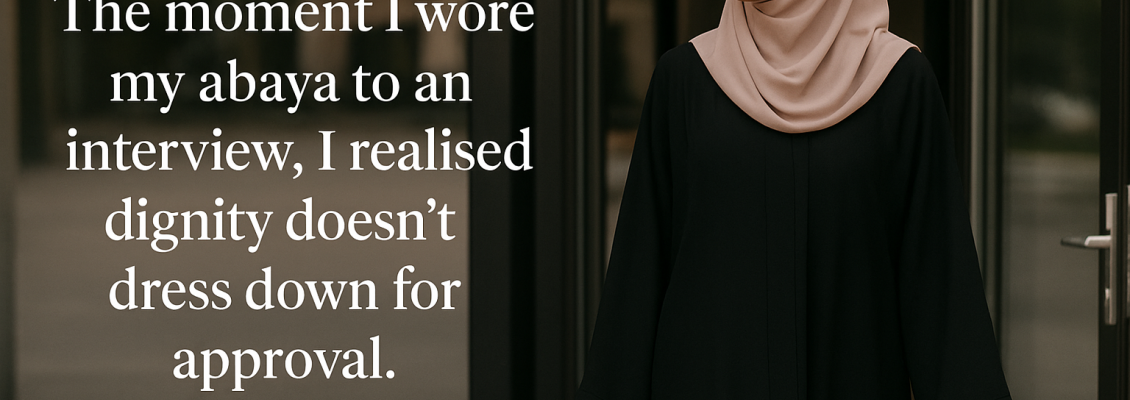
Bismillah, As-salamu Alaikum wa Rahmatullahi wa Barakatuh —
There was something about the air that morning — crisp, weighty, not quite summer, not quite spring. I remember sitting at the edge of my bed, hands slightly trembling, the soft black fabric of my abaya cascading over my knees like a calm sea before a storm. June always brings a kind of stillness, doesn’t it? But that morning — June 11th, 2025 — it brought a reckoning.
I’d hung the abaya on my door the night before, convinced, unsure, rehearsing. Was I really going to wear it to the interview? The fear wasn’t about rejection — it was about revelation. That I could show up as my full self, and still not be enough for them. But somewhere between sujood and sunlight, I chose truth over comfort.
This blog is a trace of that choice — a reflection of everything I felt, feared, confronted, and reclaimed. If you’ve ever wrestled with your identity in the mirror before stepping into the world — walk this path with me. You’re not alone.
Table of Contents
- Why did I fear that wearing my abaya meant choosing invisibility?
- Have I been shrinking my soul just to fit into rooms that never honoured it?
- Was I dressing for their comfort while slowly unravelling my own?
- What did my mirror see when it reflected more than just fabric?
- The first time I chose my abaya over approval — and felt the weight of my own voice
- Why does modesty feel like rebellion in spaces built for assimilation?
- Did I wear the abaya — or did it finally begin to wear me back?
- What kind of courage does it take to walk into a room draped in your deen?
- When the receptionist looked twice — was it judgment, or my own insecurity staring back?
- How did my abaya become a quiet protest wrapped in elegance?
- That awkward pause before the interview — was it my abaya they were evaluating?
- Why did I apologise with my smile, just because I stood out in an abaya?
- What if every sister who hides her hijab in a tote bag is actually hiding her strength?
- Have we mistaken blending in for belonging?
- The moment I realised my abaya wasn't too much — the room was simply too little
- When did we start measuring professionalism by how much skin we show?
- Can I still dream big in a world that reduces me to fabric?
- What I learned when I stopped translating my wardrobe to be understood
- Does the abaya silence me — or does it protect the voice I nearly forgot I had?
- That job wasn’t mine — and neither was the shame they tried to gift me
- The sacred confidence that came when I wore my abaya like a du’a
- Have I been underdressing my dignity just to overdress their expectations?
- When a sister whispered “MashaAllah” outside the building — everything changed
- My abaya didn’t get me the job, but it gave me something more eternal
- If I had to choose again, I’d wear the abaya — every single time
- Frequently Asked Questions
- People Also Ask (PAA)
Why did I fear that wearing my abaya meant choosing invisibility?
There was a time — and maybe it still lingers in me — when I believed that the more I covered, the more I disappeared. Not from Allah. Not from myself. But from *them* — the world, the gatekeepers of opportunity, beauty, power. I had convinced myself that wearing my abaya made me silent, forgettable, even invisible. And I wore that fear like a second skin underneath the fabric meant to dignify me.
My journey with the abaya didn’t begin in strength. It began in negotiation. I used to time when and where I’d wear it. If it was a trip to the masjid or a gathering where modesty was expected, I’d don it with ease. But if the destination was a job interview, a university presentation, or even brunch with old friends who didn’t wear hijab, my fingers would tremble at the sleeves. I’d hesitate. I’d opt out.
Have you ever stood in front of your wardrobe, abaya hanging beside tailored suits and muted blouses, and wondered which version of you was safest that day? I did. Far too many times.
The performance of modesty vs. the heart of it
Somewhere along the way, modesty stopped being a conversation between me and Allah. It became a performance. A tightrope. A silent audition for acceptance. Was I modest enough to be seen as spiritual, but not so modest that I’d be dismissed as backwards? Was I soft enough to look relatable, but not so soft that they mistook me for submissive?
That inner conflict wasn’t born in a vacuum. It was built, one look at a judgmental aunty, one hiring manager’s furrowed brow, one influencer’s “modest but modern” haul that looked nothing like how I understood haya. It was built in those moments when my abaya felt less like a garment of liberation and more like a flag of disconnection — from my own community, from my career goals, from the version of myself I thought the world would respect.
Fabric vs. Fear: A Table of Truth
| Modesty as Fabric | Modesty as Fear |
|---|---|
| A loving command from Allah ﷻ | A strategy to avoid judgment |
| A personal act of devotion and dignity | A nervous attempt to fit a shifting standard |
| Clothing chosen for the soul’s serenity | Clothing edited to avoid “too much” Islam |
| Visible submission to Allah alone | Invisibility as a defense from people |
A du’a I didn’t know I was whispering
I remember one moment clearly. I was in the changing room of a department store. I had worn my abaya in, as I often did on quieter weekdays. But inside that narrow, fluorescent-lit stall, I folded it up like something shameful. I stared at myself in jeans and a long coat, and suddenly I felt exposed — not because I was immodest, but because I had traded my dignity for a false sense of belonging.
And yet, when I stepped out, no one even noticed. No applause for my compromise. No warmth for my effort. That was the day I learned: the people you undress your convictions for will rarely be the ones who clothe you in belonging. That act — folding my abaya — wasn’t style. It was fear. It was a du’a in reverse: Ya Allah, please let me be accepted… even if it means losing a part of myself.
What niyyah was I really dressing with?
When did my intention begin to blur? Somewhere between the compliments and the silences, I realised I wasn’t always dressing for Allah. I was dressing to protect myself from the discomfort of being “othered.” I wanted to be palatable, pleasant, neutral — not because I lacked conviction, but because I was tired of defending it.
But here’s the spiritual cost: when we filter our modesty through the gaze of people, we stop seeking the Face of Allah. And our hearts feel it — the friction, the ache, the quiet discontent that whispers: *This isn’t who you are.*
Letting the abaya reintroduce me to myself
It wasn’t until I wore my abaya to a job interview — and felt the weight of every stare — that I understood what I had been fearing all along: not invisibility, but vulnerability. The abaya didn’t erase me. It revealed me. It made visible the parts of me I thought I had to hide — my belief, my boundaries, my barakah.
It reminded me that Allah never asked us to erase ourselves to be seen. He asked us to veil ourselves to be valued — first by Him, then by those who are worthy of seeing us at all.
To the sister who feels unseen because of her abaya
If you are reading this and you’ve ever wondered whether your abaya makes you less relevant, less modern, less beautiful — I want you to know something: you are not invisible. You are incandescent. You are a walking ayah. You carry centuries of strength stitched into every seam.
The world may try to dim your presence, but Allah magnifies your worth with every silent sacrifice. Your abaya is not the end of your story — it is the proof that your story begins with Him.
And that, dear sister, is the most visible truth of all.
Have I been shrinking my soul just to fit into rooms that never honoured it?
There’s a quiet kind of grief that comes when you realise you’ve spent years making yourself smaller for spaces that never deserved you. It’s not loud or dramatic — it’s subtle, like a slow erasing of your light. I only began to notice it when I caught myself editing not just my words, not just my clothes, but my very presence. All to blend into rooms that seemed allergic to the fullness of who I was: a Muslim woman, wrapped in faith, wrapped in cloth, wrapped in conviction.
It began innocently, or so I told myself. A sleeve pushed up here. A looser hijab there. Speaking in a softer tone so I didn’t seem too opinionated. Smiling even when something hurt. Laughing lightly to mask the dissonance. It was survival, wasn’t it? Isn’t that what we’re taught as little girls — to make ourselves likable, agreeable, soft enough to cushion the discomfort of others?
But somewhere along the way, survival turned into silence. Adaptation turned into erasure. And I forgot how to take up space as the woman Allah created me to be — whole, honourable, unapologetic.
The rooms that praised me for what I wasn’t
There are rooms in my memory that still echo. Conference tables where I was praised for being “not like the others” because I didn’t wear niqab. Zoom calls where I was told how “eloquent” I was — the unspoken being: for someone who dresses like *that*. And I smiled. I thanked them. I made myself even smaller so they’d keep the compliments coming. But every compliment came at a cost. A piece of me chipped away — the part that wanted to say, *You don’t know the others. And they are eloquent too, even in their silence.*
I realised then that I wasn’t being accepted. I was being tolerated — as long as I performed a version of myself that fit neatly into their expectations. I was the diversity checkbox. The modesty “lite.” And I let it happen. Because somewhere deep inside, I feared that showing up in my full abaya, in my full truth, would mean immediate dismissal. So I shrunk.
What shrinking looked like
It looked like scrolling through modest fashion accounts and wondering if I was still too “extreme.” It looked like rehearsing my introductions to sound more “Western,” more accessible. It looked like taking off my abaya before walking into certain buildings and convincing myself I was just being “practical.”
But here’s what no one tells you: shrinking yourself doesn’t earn you respect — it teaches others how to overlook you.
Rooms that honour vs. rooms that erase
| Rooms That Honour | Rooms That Erase |
|---|---|
| Celebrate your presence, not despite your faith — but because of it | Tolerate you only if you mute your identity |
| Value your voice without needing you to compromise | Silence your truth with labels like “too much” or “radical” |
| Make space for you to grow into your full self | Only welcome a diluted version of you |
| Feel like warmth, safety, and possibility | Feel like walking on eggshells |
Was I dressing for Allah — or hiding from people?
I had to ask myself the hardest question of all: *Was I wearing what pleased Allah? Or was I adjusting my dress to avoid people's assumptions?* Because what started as modesty rooted in love and conviction slowly became modesty driven by fear. I hadn’t stopped wearing it — but I’d stopped standing in it. My niyyah got lost in the noise of approval-seeking and self-protection.
The Qur'an tells us in Surah Al-Baqarah (2:286), “Allah does not burden a soul beyond that it can bear.” And yet, here I was burdening myself with people’s discomfort. Carrying their expectations like a weight that Allah never placed on me. What if the real test wasn’t about how others saw me — but whether I saw myself through the lens of my Rabb?
The day I stepped into a room and didn’t flinch
I remember it clearly — the first time I walked into a professional space wearing my abaya with full confidence. I didn’t flinch. I didn’t apologise with my eyes. I didn’t rush to explain myself. I just existed — fully, proudly, quietly powerful. Some people stared. Some avoided eye contact. But I didn’t shrink. Not that day.
Because the truth is, I was never meant to fit into every room. I was meant to stand in the ones that were made for me — or better yet, to build new rooms where my sisters and I could breathe.
To the sister who's been making herself small
If you’ve ever held your breath just to get through a space that didn’t see you — hear me now: you were not created to dim your light for anyone’s comfort. You are a trust. A banner of faith. A walking du’a. And your presence, in its fullness, honours the One who created you.
Stop shrinking, beloved. Grow. Take up the space Allah gifted you. Not with arrogance — but with amanah. Because your soul was never meant to be squeezed into a shape someone else drew. It was meant to rise.
Was I dressing for their comfort while slowly unravelling my own?
Somewhere between the compliments and the caution, I began to unravel. Not outwardly — my seams held, my scarf stayed put, my steps still measured with grace. But inside, quietly, invisibly, something sacred started to loosen. My intentions. My confidence. My wholeness. It began with one seemingly harmless thought: *Maybe if I dressed just a little differently, they’d feel more at ease.*
I told myself it was wisdom — knowing when to tone things down. I thought I was being strategic, graceful, even merciful. But what I was really doing… was abandoning myself for the comfort of people who never once considered mine.
The day I chose “safe” over sincere
I remember an afternoon that still sits heavy in my chest. I was attending a community networking event — mostly women, mostly professional, some Muslim, some not. The abaya I had laid out the night before was a deep plum, elegant and flowing, paired with my favourite black khimar. But that morning, I panicked. I thought of the whispers, the possible stares, the inevitable assumptions. So I changed. Threw on a long blazer, a neutral turban wrap, something “smart casual.”
Everyone smiled. The compliments flowed — “You look so chic!” “Very modern!” And I smiled too. But I felt like I had swallowed my voice. I felt like I had silenced my truth just to be less confronting. The blazer wasn’t tight. The turban wasn’t wrong. But the niyyah — the niyyah was fractured.
When did pleasing them become more important than peace within?
There is a cost to that kind of dressing. A spiritual cost. Because it teaches you to read the room more than you read your soul. It makes your mirror a place of negotiation instead of remembrance. And slowly, almost imperceptibly, you begin to dress from a place of fear instead of barakah.
Fear that they’ll see you as extreme. Fear that your modesty will become your invisibility. Fear that your conviction will be mistaken for closed-mindedness. But fear was never meant to be your stylist, sister. Taqwa was.
The performance of modesty vs. the presence of it
What happens when we dress to ease others instead of honouring our own alignment with Allah? We begin to perform modesty instead of embodying it. And that performance is exhausting. It demands edits. It fears boldness. It trades elegance for invisibility and devotion for diplomacy.
I didn’t always know I was doing it. Sometimes it showed up as skipping my jilbab for a doctor’s appointment. Sometimes it looked like softening my abaya style to seem more “fashion-forward” online. And sometimes, it wasn’t even about the clothes. It was the way I carried myself — quieter, smaller, less sure — just to make space for others to feel okay with me.
Fabric that conceals vs. fabric that reveals
| Dressing from Devotion | Dressing from Discomfort |
|---|---|
| Reflects love for Allah before all else | Seeks approval from those who disapprove of you anyway |
| Protects your soul and your softness | Protects their comfort at the cost of your own peace |
| Inspires confidence and calm | Fuels anxiety and constant adjustment |
| Is rooted in Qur’an, Sunnah, sincerity | Is rooted in fear, trends, and tired smiles |
A du’a that shook something loose in me
I once whispered in sujood: “Ya Allah, help me stop apologising for who You made me to be.” I didn’t even realise how much I had been apologising. Through my edits. Through my outfits. Through every time I flinched at being “too Muslim” in a secular room. Through every time I mentally assessed whether I looked *hireable* or *relatable* in my abaya. But what does it say about a world where your sincerity is deemed unprofessional, and your obedience to Allah is a liability?
The Prophet ﷺ said, “Whoever seeks the pleasure of Allah despite the displeasure of people, Allah will suffice him against the people.” (Tirmidhi)
And yet, I had been seeking the pleasure of people — even if it meant displeasing Allah slightly. Just enough to avoid being “othered.” Just enough to stay safe. But safety built on disobedience isn’t safety at all. It’s a slow unraveling — one thread of faith at a time.
The moment I dressed from the inside out
One Friday, I wore my black abaya and full-length khimar to the masjid, then straight to a work meeting. I didn’t change. I didn’t adjust. I walked in exactly as I prayed. That was the first time in a long time that I felt whole. Like my outside matched my inside. Like I had nothing to prove, only something to preserve. And the most beautiful part? No one said a word. The world didn’t collapse. But my internal world — it reassembled. Stronger. Truer. Freer.
To the sister quietly unraveling in silence
You don’t need to bleed for their comfort. You don’t need to disappear just to be digestible. You were not created to be an accessory in someone else’s narrative of palatable faith. You were created to stand with honour, to clothe your soul in dignity, and to be a mirror of what submission looks like in a world starving for authenticity.
Dress in a way that brings you closer to Jannah — not just the boardroom. Wear what whispers, *“I belong to Him”* — not what screams, *“Please like me.”* And when that internal pull begins — the one that says, *Maybe tone it down, maybe make them feel less uncomfortable* — remind yourself: their comfort was never your assignment. But your comfort with your Creator? That’s eternal.
What did my mirror see when it reflected more than just fabric?
There are mirrors that only show you your outline. And then, there are mirrors that expose your essence. I used to stand in front of mine every morning, adjusting my abaya, straightening my khimar, smoothing creases like I was smoothing over something deeper — something invisible. Something unsettled.
It was never just about how the fabric fell. It was about what the reflection said back to me. Was I seen? Was I safe? Was I sincere? And, most hauntingly — was I enough?
There was a season of my life when I couldn’t answer those questions with ease. The mirror had become a battlefield between my desire for spiritual devotion and the loud, lingering expectations of a world that told me to soften, to smile, to be modest — but not *too* modest. To cover, but still remain palatable. Presentable. Beautiful — but not intimidating.
Between the threads and the thoughts
I remember one morning in particular. I had chosen to wear a light cream abaya, one that floated softly around my body like clouds. I paired it with a simple white khimar. No makeup. Just rose water on my skin and a du’a on my lips. As I stood in front of the mirror, I felt a serenity I hadn’t in a long time. But then the noise crept in: *Will they think I’m trying too hard? Will I be stared at again today? What if someone assumes I’m extreme?*
The tranquility of that moment was swallowed by the weight of those doubts. The mirror became a judge, not a companion. And in that reflection, I no longer saw a woman preparing for her day. I saw a woman at war with herself — torn between worship and worry.
What does my mirror really reflect?
| Surface Reflection | Spiritual Reality |
|---|---|
| Am I put together enough? | Have I dressed with taqwa and sincerity? |
| Do I look acceptable to them? | Do I feel accepted by my Rabb? |
| Is this “modest enough” by their standards? | Is my niyyah pleasing to Allah? |
| Will I blend in or stand out? | Am I standing with dignity or shrinking in fear? |
Modesty as fear vs. modesty as freedom
There was a time I conflated modesty with fear. I thought being “low-key” meant erasing myself. I believed that shrinking meant piety. But the more I studied, the more I prayed, the more I *listened* to my soul — the more I realised that true modesty doesn’t erase you. It elevates you. It shields you without suffocating you. It wraps you in strength, not shame.
But when you begin to dress not from intention, but from insecurity — that’s when the unraveling begins. And the mirror starts showing you a woman who is hidden from the world, but also hidden from herself.
Was I hiding or honouring?
Sometimes I didn’t know. There were days when I chose the longest, loosest abaya not from a place of devotion — but from a place of fear. Afraid of judgment. Afraid of attraction. Afraid of myself. But Allah does not ask us to erase our beauty — He asks us to honour it. To guard it. To wear it with discernment, not disgust.
So I had to ask myself: Am I hiding because I fear being seen? Or am I covering because I understand my worth?
A moment of clarity at the masjid mirror
One night after tarawih, I caught my reflection in the masjid wudhu area mirror. My abaya was soaked near the hem, my khimar a little disheveled from sujood. I looked tired. But glowing. Glowing in the way that only sincere ibadah can make you glow. In that moment, I saw myself not through the lens of society — but through the lens of servanthood. Not the most polished version of me. But the most *real*. And for once, I didn’t adjust. I didn’t fix anything. I just smiled. I whispered, *Alhamdulillah*.
To the sister staring into her mirror, unsure
Your reflection is not a battleground. It’s a reminder. A sacred pause. A space to check in, not to chip away. When you see yourself draped in modesty, ask not how others will read you — but how you read your own heart.
Are you choosing your abaya out of love or fear? Are you tying your hijab with intention or hesitation? Are you applying your eyeliner for joy or for validation? Every layer is a reflection of something deeper — and you deserve to know what that is.
You deserve to dress from a place of remembrance. A place that says: *This is who I am. This is who He made me. This is who I choose to honour today.*
So the next time you stand before your mirror, breathe. Look deeper than the fabric. See the journey. See the prayer behind your posture. The tears behind your softness. The strength in your surrender. Because your mirror doesn’t just show you clothes — it shows you courage.
The first time I chose my abaya over approval — and felt the weight of my own voice
I can still feel the silence of that morning. Not the peaceful kind — the heavy kind. The kind that wraps itself around your throat when you’re about to do something brave. It wasn’t Eid. It wasn’t Jumu’ah. It wasn’t a day where anyone expected me to dress "religiously." It was just another weekday. Another job interview. Another moment to choose between fitting in… or showing up fully as myself.
My black abaya hung from the back of my bedroom door, simple and silent, like it had been waiting for me to finally stop apologising for it. I had ironed it the night before, still unsure if I’d wear it. Next to it hung a tailored blouse and a long trench coat — what I thought was my “neutral” look. “Professional,” “approachable,” “safe.” I had curated that look more for them than for me. More for approval than authenticity.
The mirror moment I couldn't ignore
When I stood in front of the mirror with both outfits laid before me, I saw more than fabric — I saw a fork in my spiritual road. The blouse was beautiful. The coat, expensive. But they didn’t speak for me. They didn’t represent the woman who had prayed tahajjud for guidance. Who wore her hijab not just out of obligation, but out of a deep, aching love for Allah. The abaya did. The abaya said what I couldn’t find the words to say in boardrooms. The abaya reminded me that I belonged to something greater than people’s perceptions.
So I wore it.
And as I did, I whispered a quiet du’a: “Ya Allah, let them see me through the lens of sincerity, not suspicion. Let them see my heart, not just my hemlines.”
The car ride of inner dialogue
That drive to the interview was filled with everything but silence. Not outside — inside. My heart raced, not out of fear of rejection, but because I knew I was stepping into something sacred. I wasn’t just wearing an abaya. I was reclaiming my voice. I was saying: *I am enough, even when I’m not conforming.*
As I parked, I thought about how many times I had diluted myself in the past. How many times I had toned things down to be “relatable,” “modern,” “neutral.” And how none of that ever brought me peace. This time was different. This time, I wasn’t walking in as a version of myself — I was walking in as me. Fully. Unapologetically. Covered — but not hidden. Modest — but not muted.
The weight of being seen
When I entered the building, I felt the shift. The long stares. The second glances. The quiet readjustments of posture. My presence — my abaya — said something before I even opened my mouth. For a moment, I panicked. Was I being too loud in my silence? Too firm in my softness? Too bold in my obedience?
But then I reminded myself: this wasn’t arrogance. This was alignment. This was me honouring my Rabb before I tried to impress His creation.
Fabric or fear — what was I really wearing?
| When I dressed for approval | When I dressed for Allah |
|---|---|
| Checked the mirror for their gaze | Checked my heart for His pleasure |
| Chose silence over truth | Chose sincerity over strategy |
| Felt small in big rooms | Felt anchored even in uncertainty |
| Feared rejection | Feared compromising my soul |
The interview I didn’t expect to pass — and did
That interview didn’t go perfectly. I stumbled over one of my answers. I forgot to mention one of my achievements. But what I didn’t fumble was my integrity. I didn’t betray myself. I didn’t shrink. And by the end, the woman interviewing me — not Muslim, not modest, not someone I expected to understand — looked me in the eye and said: “You carry yourself with quiet strength. You’re exactly what we need.”
I didn’t get the job because of my abaya. But I got the job without removing it — and that was the win my soul needed.
To the sister facing the same decision
Maybe your moment won’t be in a job interview. Maybe it will be in a university lecture hall. Or a family dinner. Or on your wedding day. But there will come a time when you’ll have to choose: approval or authenticity. Comfort or conviction. Blending in or bowing down to your Lord.
I won’t romanticise it. It’s hard. It’s vulnerable. It’s brave. But it’s worth it. Because every time you choose your abaya, your khimar, your hijab, your jilbab — not out of fear, but out of faith — you stitch strength into your soul. You reinforce your voice. You build your akhirah with thread and truth.
And in a world that constantly asks you to explain yourself, your modesty becomes your most eloquent answer.
So wear it. Feel the weight of your voice. And let it echo louder than the noise of this dunya.
Why does modesty feel like rebellion in spaces built for assimilation?
It wasn’t always this loud inside my head — this constant loop of questioning whether my choice to cover, to wear my abaya, to live visibly Muslim, was disrupting an unspoken rule. But over time, the silence in professional corridors, the lingering glances in supermarkets, the forced smiles in lecture halls… they all whispered the same message: *Be less. Blend in. Don’t remind us of what you believe.*
And so I began to wonder — when did my modesty become an act of defiance? When did obedience to Allah start looking like disobedience to the world?
The performance of ‘fitting in’
I used to think the hardest part of wearing the abaya was explaining it. But it wasn’t the questions — it was the quiet. The kind of silence that follows you when your presence doesn’t match the room’s expectations. The way conversations subtly shift. The way invitations quietly disappear. The way your difference becomes your introduction.
In those spaces — offices, universities, even family functions — I realised I wasn’t expected to just show up. I was expected to assimilate. To water myself down. To tuck my values into more digestible forms. Not just to be present, but to be palatable. And in those moments, wearing my abaya didn’t feel like just a garment. It felt like resistance.
When devotion feels like disruption
There was a time I entered a networking event in a flowing navy abaya. Nothing flashy. No sequins, no loud prints. Just simplicity. Dignity. Sincerity. I walked in with my resume in one hand and a quiet du’a in the other. And yet, every handshake that hesitated, every smile that tightened, every seat that stayed empty beside mine — told me that my presence disrupted something invisible but powerful. Like modesty had violated an unspoken aesthetic contract.
In a room designed for sameness, my abaya was a protest. Not because I intended it to be. But because it refused to apologise.
Assimilation is not the same as acceptance
| Assimilation | Authenticity |
|---|---|
| Erase what makes you different | Embrace what makes you divine |
| Conform to be safe | Stand firm to be sincere |
| Choose comfort over conviction | Choose Jannah over validation |
| Seek peace by hiding | Find peace by revealing your truth |
A quiet act of resistance
It’s easy to mistake modesty for submission to culture. But the truth is, when modesty is done with intention — with the desire to please Allah and no one else — it becomes a powerful form of resistance. A soft, unwavering rebellion against a world that wants you to be everything but yourself. A world that celebrates exposure but resents spiritual boundaries. A world that confuses dignity with distance and modesty with oppression.
My abaya has never been an act of protest. But sometimes, simply choosing not to compromise is enough to unsettle those who’ve built comfort in compromise.
Internal rebellion: the real battle
But let’s not pretend the pressure only comes from the outside. Sometimes, the call to assimilate is internal. It's the whisper that says, *"Tone it down."* It’s the urge to swap the black abaya for something “less visible” on your way to a meeting. It’s the thought that says, *"Maybe I should just wear jeans today. I’ll still pray. I’ll still believe. I’ll just… blend."*
That’s the real rebellion — not against others, but against your own nafs. Against the need to be accepted when Allah has already written your worth. Against the tendency to seek approval where there is no akhirah to gain.
Reframing modesty as strength
We must stop viewing modesty as passive. There is nothing passive about choosing Allah over dunya. There is nothing weak about covering yourself in a world that profits from your exposure. There is nothing outdated about timeless obedience.
When you walk into a space wearing your abaya, you’re not just covering your body — you’re declaring your priorities. You’re saying: *My success is not dependent on how much of myself I reveal, but on how much I submit.*
And that, my dear sister, is the kind of rebellion that is rooted in rahmah — not rage. In love — not fear. In divine alignment — not cultural resistance.
To the sister navigating invisible rules
You are not too much. Your faith is not too loud. Your modesty is not a barrier — it is a bridge. And if you find that some rooms are uncomfortable with your presence, ask yourself: were you sent there to fit in, or to be a reminder?
Because maybe your abaya wasn’t meant to blend into the room. Maybe it was meant to illuminate it. To be a gentle disruption. A whispered da’wah. A walking sign that says, *“This world is temporary. I dress for the One who never changes.”*
So walk tall. Even when your voice shakes. Even when your hands tremble. Even when their silence is louder than words. Because every time you choose authenticity over assimilation, you align with the one place you never have to shrink to be accepted: in the sight of Allah.
Did I wear the abaya — or did it finally begin to wear me back?
There was a time when the abaya hung quietly in my wardrobe — black, loose, unassuming. I wore it like one wears an expectation. Carefully. Respectfully. But still with the sense that it was something *outside* of me. A garment I put on to enter certain places. A signal to the world of a belief system, a boundary, a belonging. I wore the abaya — yes. But I hadn’t yet allowed it to wear me back.
I thought modesty was something you did. A choice you made every morning. But then came the days when I didn’t just put the abaya on. I felt it embrace me. It stopped being a fabric I wrapped myself in, and started becoming a mirror — revealing what I feared, what I longed for, what I hadn’t yet healed. And in that shift, something inside me began to unravel and reweave all at once.
The first time it felt like more than fabric
I remember a specific morning — it’s etched into my memory like an ayah. I had an interview that day. I reached for my muted blazer and long skirt at first. It was familiar, it was “smart.” It was what I’d always been taught would help me “fit in.” But then my eyes caught my black abaya hanging in the corner, still warm from ironing, still fragrant with oud from the last time I wore it to Jummah.
Something shifted in that moment. I didn’t want to enter the room only half myself. I didn’t want to leave my conviction at home and carry only my credentials. I wanted to walk in not as someone who “just happens to be Muslim,” but as someone whose entire life — even career ambitions — were shaped by her submission.
So I wore it. My abaya. Flowing. Honest. Firm. And for the first time, I didn’t feel like I was wearing it. It felt like it was wearing me — like it was standing with me. Holding me. Reminding me.
When modesty becomes a teacher
That’s the quiet truth we rarely speak: Modesty, when it’s real — when it’s for Allah alone — doesn’t just cover you. It changes you. Not out of fear, but out of proximity to something higher. My abaya began to teach me things. About restraint. About dignity. About softness that doesn’t submit to pressure. About power that whispers instead of shouts.
And more painfully — it revealed to me how much of my so-called “modesty” had once been performative. A response to culture. A defence against judgement. A costume of piety rather than a consequence of love. Wearing it for people was light and easy — until they disapproved. But wearing it for Allah? That’s when it got heavy… and holy.
The cost of people-pleasing in the name of modesty
I look back now and wonder: how many days did I alter my modesty to make others feel more comfortable? How many times did I wear the looser abaya to masjid, but the “chicer” one to events? How often did I ask myself: *Will they think this is too much?* instead of *Does Allah accept this intention?*
In pleasing others, I slowly unstitched the sincerity from my clothing. Until one day, even I couldn’t tell if I was honouring modesty or hiding behind it.
A table for reflection
| When I wore the abaya | When the abaya wore me |
|---|---|
| I adjusted it based on who I was meeting | I adjusted my heart before meeting Allah |
| I worried about fashion more than intention | I saw beauty in obedience more than trends |
| I feared standing out | I feared fading into dunya |
| I asked: What will they think? | I asked: Will He be pleased? |
The soul behind the fabric
The abaya cannot save me. It cannot sanctify me. It is not, in itself, a guarantee of taqwa. But it can be a signpost. A private du’a turned public. A way of telling the world — and reminding myself — that I am a servant first. That I choose submission over spectacle. That my value is not draped across me but etched into me by my Creator.
And that’s what it means for the abaya to wear me back. It’s no longer about what I choose to cover — but why. No longer about visibility, but about *witnessing*. No longer about shielding myself from judgement — but about standing in truth, regardless of it.
To the sister still figuring it out
Maybe you’re in the phase where the abaya feels like an effort. Or maybe it feels like a burden. Maybe you're still wondering whether it fits the version of yourself you’re trying to grow into. That’s okay. This is a journey — not a uniform.
But I’ll tell you this: the moment you stop wearing it for approval, and start wearing it from a place of conviction… you’ll feel the shift. The moment you stop looking in the mirror for validation, and start looking inward for sincerity… you’ll find peace.
And perhaps one day, when you put it on, it won’t just fall over your shoulders. It’ll fall into your heart. You’ll realise you’re not just wearing it — you’re being shaped by it. Protected by it. Held by it. And in that moment, you’ll know…
“I did not dress for them. I dressed for the One who clothed my soul before He ever clothed my skin.”
What kind of courage does it take to walk into a room draped in your deen?
It’s a kind of courage that trembles as it walks — not because it doubts, but because it feels everything. The weight of the gazes. The unspoken questions. The subtle shift in energy when you enter the space. It’s the courage of not softening yourself for their comfort. Of not tucking your identity into the seams of your clothing. Of showing up — visibly, audibly, unapologetically Muslim — when every signal in the room whispers, *Assimilate. Shrink. Disappear.*
I’ve lived both. I’ve walked into rooms where I strategically chose a neutral scarf, a quieter colour, hoping to blend in just enough. And I’ve walked into rooms where I was fully draped in my deen — in an abaya that said everything I couldn’t yet find the words for. And the truth? Both versions of me felt fear. But only one of them walked with Allah beside her.
That moment of arrival
There’s a moment right before you enter. Whether it’s an office, a family gathering, or a university seminar room. You stand outside the door, adjusting your sleeves, checking your reflection. You take a breath, and you wonder — *Will they see me, or will they only see what I wear?* And that question alone proves the courage it takes. Because you already know: you won’t be given the luxury of invisibility. You’ll be a walking reminder of something sacred in a world that forgot.
I remember once attending a leadership event — everyone in heels and fitted blazers, the air heavy with polished ambition. I walked in with my abaya sweeping across the floor and my hijab wrapped with intention. Conversations paused. Eyes flicked over my outfit like it was a foreign language. And in that moment, I knew — this wasn’t just clothing. This was a flag. A prayer. A stand.
Fear dressed as humility
For a long time, I thought toning myself down was humility. That maybe it was “wise” to make myself palatable, to present Islam in a “gentler” way. But when did gentleness become synonymous with invisibility? When did modesty mean making yourself small enough to be swallowed by the room?
Let me tell you something, sister: True humility isn’t hiding who you are. True humility is showing up as Allah made you, clothed in His commands, and still walking with softness. Not arrogance. Not defiance. But with the calm certainty that your obedience isn’t a disruption — it’s a mercy, even if they don’t see it yet.
Modesty as a manifesto
Every abaya I wear is a sentence in a story they don’t always understand. It’s my manifesto — stitched not with thread, but with du’as, disappointments, and determination. I no longer dress for their applause. I dress to honour the voice I once silenced. The version of me who thought confidence and conviction couldn’t coexist. The girl who believed she had to trade parts of her deen to be taken seriously.
But now I know: the real courage is showing up in a world that wants your silence — and letting your modesty speak louder than your voice ever could.
A table of truth: What it feels like
| Walking in dressed for them | Walking in draped in your deen |
|---|---|
| Second-guessing every outfit | Beginning the day with Bismillah |
| Wondering if you’ll be judged | Knowing Allah is your Witness |
| Fitting into the room but not into yourself | Fitting into your soul, even if the room shrinks |
| Speaking softly to avoid attention | Letting your silence be strength |
The Qur’anic reminder that anchors me
Allah says in Surah Al-Baqarah:
“Do not grieve; indeed Allah is with us.” — (Qur’an 9:40)
This verse has carried me through countless moments of doubt. When I feel small. When I feel judged. When I walk into a space and the whispers start before I even take my seat. I remind myself: *Allah is with me.* Even if no one else is. Even if the room was never built for me.
To my sister still finding her feet
I want you to know — you don’t have to be fearless to be faithful. Courage isn’t the absence of fear. It’s choosing Allah through the fear. It’s stepping into the room, abaya sweeping behind you, hijab firm and radiant — and trusting that your presence is a form of da’wah, even if your voice trembles.
Maybe some rooms will shrink you. Maybe some eyes will misunderstand you. But the heart that walks in knowing it is dressed for Allah? That heart expands. That heart transforms the space — not the other way around.
You don’t need to explain yourself to those who never wanted to listen. You don’t need to dilute your deen to be seen. The truth is: when you walk in fully clothed in your faith, you may not always be accepted — but you will always be anchored.
“Let them see your silence. Let them feel your sincerity. Let your abaya be your anthem.”
When the receptionist looked twice — was it judgment, or my own insecurity staring back?
It happened in a moment so ordinary it should’ve passed unnoticed. But somehow, it lingered.
I stepped into the clinic, my abaya falling gracefully to the floor, soft and simple — the way I loved it. My hijab was pinned a little more neatly than usual, the way you do when you’re walking into a professional setting. I greeted the receptionist with a gentle smile, said “As-salaamu alaykum” because that’s who I am now — someone who doesn’t edit her Islam for context. And then… she looked up, blinked, and then looked again.
That second glance. That brief hesitation. That pause that stretched longer than it should have.
And in that second, my heart dropped into a courtroom. Was she judging me? Was she surprised I spoke English? Was she irritated I wore something she didn’t understand? Or… was it just me, unearthing old wounds that hadn’t fully healed? Because what if her glance was neutral — and it was my own insecurity shouting “She sees you. She doesn’t approve.”
The mirror of the world
I’ve learned something about the human heart — it reflects. The world becomes a mirror, and sometimes, we don’t see them. We only see ourselves. Their silence echoes our doubts. Their glances amplify our shame. Their indifference replays our inner critic. And that day, I couldn’t tell if she judged me… or if I did.
For so long, I thought my self-worth would rise if I dressed “correctly.” If I embodied modesty the way Instagram described it — clean lines, soft tones, elegance that whispered “put together but not trying too hard.” And I did it. I curated. I filtered. I learned how to wear an abaya in a way that blended confidence with conformity. But the truth is — you can’t hide insecurity in fabric. It finds its way out. Through your hesitation. Through your apology. Through the questions you ask yourself when someone looks twice.
Who am I really dressing for?
That day, I sat in the waiting room and asked myself a question that stung: Was I dressing for Allah — or was I dressing to be unproblematic? To be acceptable. Palatable. Modest but not too modest. Religious, but not “intense.” Visible, but not distracting. I had spent years learning to walk this tightrope — and somewhere along the way, I forgot who I was trying to please.
The receptionist didn’t say a word. She printed my name, handed me a clipboard, and went back to typing. But my heart? My heart launched into a spiral — because I realised: I wasn’t just dressed in an abaya. I was dressed in years of internalised shame, colonial projections, and generational trauma that taught me to equate modesty with silence, not strength.
Fabric or fear? A quiet comparison
| Modesty as Fabric | Modesty as Fear |
|---|---|
| A conscious act of worship | A defensive response to judgment |
| Intentional, peaceful, connected | Reactive, anxious, performance-driven |
| Clothed in love for Allah | Clothed in fear of people |
| Grounded in tawakkul | Rooted in insecurity |
The du’a I didn’t know I needed
That evening, I stood in front of the mirror, still wearing the same abaya. I looked into my own eyes and whispered, “Ya Allah… teach me to wear this for You. Not for approval. Not for safety. Not for silence. Let this be my sanctuary, not my shame.”
Because deep down, I knew — I wasn’t asking to be invisible. I was asking to be at peace. And peace doesn’t come from how they see you. It comes from how He sees you.
From insecurity to ihsaan
Maybe she did judge me. Maybe she didn’t. But the real shift came when I stopped using the world to validate my choice — and started seeing my modesty as an act of ihsaan. Excellence. Intention. A garment not of concealment alone, but of honour. A covering that didn’t shrink me but reminded me: you’re sacred.
The next time someone looks twice, I want you to remember: maybe it’s not them. Maybe it’s your soul, knocking from the inside, asking you to come home. To peel off the layers of people-pleasing. To stop dressing for safety. To wear your deen — not as defence, but as devotion.
A verse to anchor your heart
“And whoever honors the symbols of Allah — indeed, it is from the piety of hearts.” — (Qur’an 22:32)
Your modesty is a symbol of Him. So let it reflect your heart — not your fears. Let it be a mirror of your love for the One who sees beyond fabric, into the soul draped beneath it.
And if someone looks twice? Smile gently. You’re not the one who should be uncomfortable. You’re the one who chose to be seen by Him — in a world trying to disappear Him from view.
How did my abaya become a quiet protest wrapped in elegance?
There was a time I thought resistance needed to be loud.
I imagined protests as chants and placards and crowds filling the streets. I didn’t understand that sometimes, the greatest defiance is quiet. Subtle. Dignified. Sometimes it looks like walking into a room draped in black — not because you’re mourning, but because you’re honouring something the world keeps trying to bury: your right to belong as you are.
My abaya wasn’t always a protest. In the beginning, it was obedience. Tender and shy. I wore it in silence, hoping no one would ask questions I wasn’t yet ready to answer. I didn't want to explain myself. I just wanted to be left alone to grow into the woman I felt Allah was calling me to become.
But then I started noticing things — micro-moments that lingered long after they passed. The eyes that widened when I entered an office. The way conversations slowed when I sat down. The polite smiles that never reached the eyes. I noticed how I was either invisible or hyper-visible, never just seen. How something as simple as covering became a trigger for other people’s discomfort.
And that’s when I realised — I wasn’t just wearing a garment. I was wearing a statement.
They thought I was hiding. I was actually arriving.
Some people saw the abaya and assumed I had erased myself. That I had shrunk beneath fabric. That I was one of “those” women — oppressed, silenced, outdated. But the truth is, it was the first time I ever felt fully mine. It was the first time I stopped performing. Stopped trying to assimilate. Stopped choosing outfits that were more about blending in than showing up.
When I wore my abaya with intention — not just out of fear or habit, but as a reflection of conviction — I understood something quietly revolutionary: I no longer needed their approval to exist.
I didn’t need to meet their aesthetic to be beautiful. I didn’t need to dilute my faith to be digestible. I didn’t need to shrink to be safe. I could walk into any space — elegant, dignified, rooted in my deen — and be enough. Even if I wasn’t palatable.
The moment I felt it shift
There was a day I walked into a high-end store, needing something for a relative’s wedding. I wore a simple black abaya with embroidered cuffs — minimal, classic. The store assistant looked me up and down and said, “Are you sure you’re in the right section?”
It wasn’t cruel. It wasn’t even overt. But it was laced with that quiet condescension we’re taught to ignore. And in that moment, I smiled. Not because I wasn’t hurt — but because I’d finally stopped letting moments like that define me. I realised then that my presence was a quiet protest. Not of arrogance. But of rootedness. A protest against invisibility. Against internalised shame. Against the lie that said we must blend in to belong.
Modesty: Fabric or Fear?
| Modesty as Fabric | Modesty as Fear |
|---|---|
| An act of spiritual sovereignty | A reaction to social pressure |
| Rooted in love for Allah | Rooted in fear of people |
| Freedom in submission | Conformity through shame |
| An intentional mirror of inner conviction | A mask to avoid discomfort |
When worship becomes resistance
In a world that celebrates excess, consumption, and exposure, choosing simplicity becomes an act of defiance. Choosing to cover becomes a rebellion against the gaze. Choosing to preserve what’s sacred becomes a protest against a culture that demands we auction off our worth for validation.
So yes, my abaya became a quiet protest. A graceful resistance. Not because I set out to fight — but because I finally stopped apologising for existing fully as myself. A Muslim woman. A believer. A servant. A soul in progress.
The du’a behind my fabric
Every time I wear my abaya now, I whisper:
Ya Allah, let this garment be my fortress. Let it guard my softness, not suppress it. Let it be my honour, not my hiding place. Let it be worn for You, not for their comfort.
Because at the end of the day, the greatest protest isn’t in what we say. It’s in how we live. How we choose to walk in rooms that weren’t built for us — and walk anyway. Not to disrupt. Not to antagonise. But to exist. Fully. Unapologetically. Elegantly.
Sister, your abaya is not your weakness. It is your witness. That even in a world that calls you backward, you chose to walk forward — in the direction of your Lord.
So wear it loud, even in silence. Let your presence be a verse. A testimony. A reminder that obedience is beautiful. That dignity is divine. That devotion can be draped in elegance — and still roar like protest.
That awkward pause before the interview — was it my abaya they were evaluating?
There’s a silence that says more than words ever could.
I remember standing at the reception desk, palms slightly damp, smoothing my abaya for the third time — not because it needed fixing, but because I did. It was a charcoal-grey piece, structured but flowing, with a subtle trim that barely caught the light. Polished. Professional. Purposeful. I had rehearsed every answer, researched the organisation down to its founding vision. But when the receptionist glanced at me — eyes flicking from my face to my attire, then back again — I felt something shift.
The pause. That awkward, unspoken moment of assessment. It lasted only seconds, but in those seconds I wasn’t being measured for competence. I was being measured for comfort — theirs, not mine.
Was I being interviewed for the role — or for my appearance of faith?
As I sat in the waiting area, I couldn’t silence the voice inside me: Is it my experience they’re evaluating — or my abaya?
It’s painful to admit that I began to shrink in my seat. I started mentally editing my introduction, downplaying parts of who I was. Not because I was ashamed — but because I had been conditioned to think that visibly living my deen in public spaces made me “too much.” Too visible. Too political. Too inconvenient.
I knew the qualifications I carried. I knew the value I brought. But all of it felt suddenly fragile, weighed down by layers of cloth that had always felt like home — until they became a liability in someone else’s eyes.
Where niyyah meets reality
That morning, I had stood before the mirror and said Bismillah. I had made du’a that my appearance reflect my values. That Allah grant me acceptance where it truly matters. But sitting under the fluorescent lights of that corporate lobby, I was reminded that this world often misreads what it doesn’t recognise.
I wasn’t afraid of not getting the job. I was afraid of being misread. Misunderstood. Reduced to an outfit instead of seen for a soul. That’s what modesty costs us sometimes — not our voice, but the right to be heard without translation.
Modesty as faith vs. modesty as burden
When I first wore the abaya, it was out of love. Out of a desire to preserve something sacred. To honour the beauty of obedience. But slowly — almost invisibly — I began to question if that same love was being weaponised against me in spaces that claimed to value “diversity” but only when it looked a certain way.
Had I become afraid of my own convictions?
Was I now adjusting my choices for the comfort of others — while quietly unraveling my own?
Two kinds of modesty
| Modesty Rooted in Devotion | Modesty Weighed Down by Fear |
|---|---|
| An intentional offering to Allah | A silent appeasement of society |
| Clothing worn with confidence and clarity | Clothing worn with anxiety and second-guessing |
| Empowered by meaning and submission | Eclipsed by performance and assumptions |
| Chosen in alignment with purpose | Adjusted out of fear of rejection |
That pause was a mirror
In the weeks after that interview, I kept returning to that pause — that small beat of hesitation before the first question was asked. I didn’t get the job, and though I’ll never know the real reason, I’ve stopped trying to guess. Because that moment wasn’t about them. It was about me. About the quiet courage it takes to show up — fully, faithfully, and unapologetically — even when you suspect you won’t be understood.
Sometimes, the greatest jihad is not a war on the outside, but the one within. The part of you that wants to compromise just a little — to round off the edges of your identity so they don’t make others uncomfortable. But compromise, when it touches your obedience, is not convenience — it’s corrosion. Slow. Quiet. Soul-deep.
A whispered du’a for those rooms
Ya Allah, grant me the courage to be who You made me to be — even when they don’t understand. Let me walk into every space carrying Your light, not their expectations. And if they pause, let my presence remind them of You.
Sister, if you’ve ever felt that same pause — the one before the handshake, before the greeting, before the assumptions — know that you are not alone. You are not “too much.” You are not a disruption. You are a reminder. A presence. A prayer in motion.
Your abaya is not a costume. It is not a symbol of silence. It is a uniform of purpose — stitched in devotion, hemmed with intention. It doesn’t need to be justified. It doesn’t need to be explained. It just needs to be lived — with conviction, with love, with dignity.
And when the world pauses — let it. That pause is not your burden. It’s their invitation to see deeper.
Why did I apologise with my smile, just because I stood out in an abaya?
I used to think my smile was a sign of warmth — a gesture of kindness. But one afternoon, somewhere between the sliding glass doors of a café and the awkward glance of a stranger, I realised something quietly devastating:
I wasn’t smiling to be kind. I was smiling to apologise. To make myself less noticeable. To soften the discomfort of being seen in something that wasn’t made for spaces like these. My abaya.
It wasn’t the colour. It wasn’t even the cut. It was the way it defied the dress code of assimilation — the silent rule that says: “Blend in or be questioned.” And when I didn’t blend, I smiled… like I owed them comfort for my difference.
The apology stitched between my teeth
That smile wasn’t joy. It was survival. A reflex, a reflex I didn’t know I’d mastered. One that whispered, “Don’t worry, I’m safe. I’m friendly. I know I look different, but I’m not a threat.”
Why did I feel the need to assure anyone of that?
Because over time — through airport stares, supermarket side-eyes, and workplace whispers — I internalised a belief that being visibly Muslim needed cushioning. That my presence had to be apologised for before it could be accepted. And what better cushion than a disarming smile?
When niyyah collides with performance
I dressed that morning with a clear heart. A deep breath. A du’a: “Ya Allah, make my modesty a garment of sincerity.” But the moment I stepped outside, I began to perform. Not for Allah, but for the eyes I assumed were watching. My smile became my buffer, my body language a choreography of apology — soft shoulders, lowered voice, harmless hands.
It wasn’t the abaya that felt heavy. It was the emotional labour of managing how others felt about it.
Smiling as submission — not to Allah, but to discomfort
I realised that many of us are taught to smile through discomfort. To be palatable. Approachable. Especially as visibly Muslim women. But there’s a difference between smiling from warmth — and smiling because we fear being perceived as confrontational for simply existing in our truth.
There’s a line, sister — a silent one — where sincerity ends and self-erasure begins. And that line is where I lost parts of myself.
Two postures of modesty
| Modesty With Presence | Modesty With Apology |
|---|---|
| Walks in with quiet conviction | Shrinks to avoid confrontation |
| Smiles from inner contentment | Smiles to appease discomfort |
| Stands firm in identity | Adjusts to be less “intimidating” |
| Moves from love of Allah | Moves from fear of rejection |
The du’a I never said out loud
Ya Allah, help me unlearn the habit of apology when I enter a space You already decreed for me. Let my smile be an echo of peace, not a mask of shame.
It’s strange — how the same smile can mean two entirely different things. One rooted in love. The other in fear.
I thought modesty meant being quiet. But modesty is not silence. It is presence. It’s not self-erasure — it’s self-awareness. It’s not wearing less of yourself. It’s wearing yourself with more intention, more honour, more Allah-consciousness.
So why did I smile like I was sorry for who I was?
Because somewhere along the way, I started believing that to be accepted, I needed to make my difference softer, easier, less confronting. But the truth is, there’s nothing confrontational about obeying your Lord. There’s nothing abrasive about choosing beauty with meaning. And there’s nothing shameful about wearing a piece of cloth that holds your heart upright.
From apology to honour
Now, I try to catch myself in those moments. When I feel that reflexive smile coming — the one rooted in shame, not sincerity — I whisper a reminder to my soul: You are not an interruption. You are a continuation of legacy. Of Maryam, of Khadijah, of women who walked this earth cloaked in dignity and never once apologised for it.
That smile — the one shaped by centuries of survival and silence — may still come. But now I hold it differently. I let it mean joy. Connection. Peace. Not shame.
Sister, if you’ve ever smiled just to make them comfortable — even as your heart twisted a little — I see you. I was you. And maybe, in some ways, I still am. But we are learning, aren’t we? To smile from strength, not submission. To wear our abayas like the powerful statements they are — not like disguises we hope no one stares at for too long.
Let your smile be real. But let it come from a place of fullness, not fear. And let your abaya walk beside it — not behind it, not under it — but beside it. As an equal part of who you are: loved, visible, enough.
What if every sister who hides her hijab in a tote bag is actually hiding her strength?
I’ve seen it more times than I can count — the discreet pull of a hijab from the head and the quiet tuck into a tote bag before entering the office, the university hallway, or a family gathering that doesn’t understand. There’s no ceremony to it. Just a subtle, almost reflexive move. As if she's putting away a piece of clothing. But it’s never just fabric, is it?
And I wonder — what if she isn’t hiding her weakness?
What if, buried in that silent act, is the weight of a thousand unspoken strengths?
The tote bag as armour
We often imagine strength as loud — a speech, a stance, a refusal. But some days, strength looks like compromise. It looks like pain folded into a scarf and placed gently next to a laptop and keys. It looks like a sister who wakes up with full intention to obey Allah, but who walks into a world that feels like it's waging war against her conviction — and she’s tired. She’s tired of the stares, the questions, the comments masked as concern.
And so she carries her hijab in her tote bag. But she carries it with grief. With longing. With a promise to put it back on later. And that, sister, is not weakness. That is a woman walking with war in her chest and still choosing not to break. That is strength misunderstood.
The moment the scarf feels heavier than it looks
There was a time I too folded my hijab quietly, making sure no one saw. Not because I wanted to remove it — but because I didn’t want the questions. The ones that come with loaded glances: “Oh, you wear that now?” “But you didn’t wear it last year?” “Is this permanent?” It wasn’t the hijab I was taking off — it was the pressure, the assumptions, the interrogations that clung to it like static.
But I felt it. The ache. The guilt. The du’a in my throat that I couldn’t quite say out loud in that moment:
“Ya Allah, bring me to a place where I no longer feel like I have to hide what brings me closest to You.”
Modesty as fear vs. modesty as longing
Sometimes we confuse hiddenness with hypocrisy. But many sisters who hide their hijab are not abandoning their faith. They are navigating it through fear, fatigue, or trauma. What if instead of assuming their love for Allah has faded, we saw their pain — their battle to keep something sacred alive while the world tries to snuff it out?
Because modesty isn’t always a linear journey. And it’s not always loud. Sometimes it’s a longing worn quietly. Sometimes it’s hidden in a bag, but burning in the heart.
Comparison of Two Internal Journeys
| Visible Modesty | Hidden Modesty |
|---|---|
| Hijab worn with visible confidence | Hijab kept in a tote, worn in safe spaces |
| Secure in external identity | Wrestling with internal loyalty |
| Faces judgment openly | Avoids conflict silently |
| Has found her voice | Still finding her safe ground |
It’s not a question of courage — it’s a matter of exhaustion
What no one tells you is that wearing hijab in a world that constantly politicises your piety is not just a physical act — it’s an emotional weight. And some sisters carry it for years without ever being offered a moment of safety. No soft spaces. No sisterhoods without scrutiny. No room to just be, breathe, and belong.
So when she hides her hijab in a tote bag, maybe don’t assume she's turning her back on Allah. Maybe she's turning her face toward Him, quietly begging for the strength to carry on. Maybe that hidden scarf is her battlefield — and her du’a is louder than any conversation she could’ve had.
A love letter to the sister with the tote bag
Sister, if that’s you — if you’ve ever hidden your hijab because the world made you feel unsafe, unsure, or unworthy — I want you to know: I see your pain, but I also see your strength. You are not lost. You are not less. You are not weak.
You are navigating. You are wrestling with your niyyah, and that is not hypocrisy — that is spiritual honesty.
May your tote bag someday feel lighter. May your scarf be pulled from it not with shame, but with love. And may the world, slowly but surely, become safe enough for you to wear what you love without fear.
Until then, don’t let anyone define your devotion by the visibility of your practice. Your sincerity is not measured by who sees you — it’s measured by who you turn to when no one else understands.
You are more than what you remove. You are even more than what you wear. You are the niyyah that whispers, “Ya Allah, bring me back to You — fully, fully, fully.”
Have we mistaken blending in for belonging?
Sister, let me speak to you from the depths of a heart that has wrestled with this question endlessly: have we, in our pursuit of acceptance, confused blending in with truly belonging? It’s a subtle, creeping shift that happens almost unnoticed, until one day you realize the fabric that once symbolized your devotion has become a cloak of invisibility — worn not for your soul’s sake, but for the comfort of others.
There was a time when modesty was tender and intentional, a quiet act of love towards Allah and myself. I remember the softness in my hands as I chose my abaya for prayer, the careful folds that felt like a gentle embrace. Modesty was about presence — being fully me, wrapped in fabric that reflected my sincerity and connection to my Creator.
But somewhere along the way, the softness gave way to something heavier. The mirror no longer reflected a soul shining with peace, but a hesitant figure trying to erase her edges. I started noticing how my heart would quicken in the changing room, wondering if the abaya was “too noticeable” or “too plain” — never just right, always measured against an unseen standard of acceptance.
At the masjid door, I caught myself hesitating, imagining whispers that might arise if my abaya was too different — too bold, too plain, too whatever. Social media didn’t help; scrolling through images of sisters who seemed to blend effortlessly into certain “acceptable” molds made me question my own place. Was I dressing for Allah, or was I dressing to hide? To blend in? To avoid the sharp edges of judgment?
Here’s the truth that cut through my confusion: blending in is not belonging. The Quran reminds us that diversity is part of Allah’s creation, that our uniqueness is a sign of His wisdom and mercy. When we erase ourselves to fit, we lose the divine beauty embedded in our individuality.
| Modesty as Fabric | Modesty as Fear |
|---|---|
| Choosing clothes with intention, to honor my soul and my faith | Choosing clothes to avoid attention, judgment, or rejection |
| Feeling soft, beautiful, and connected in my garments | Feeling anxious, restricted, or performing for others’ approval |
| Modesty as an act of devotion and love | Modesty as a shield against shame and fear |
| Embracing my unique presence in the Ummah | Suppressing my identity to fit into safe spaces |
I’ve prayed many du’as quietly — asking Allah to restore my niyyah when it faltered, to remind me why I wear my hijab and abaya: not as armor to hide behind, but as a banner of faith and freedom. “O Allah, make my heart firm in Your remembrance,” I whispered when the weight of people-pleasing became too much.
One day, in a crowded waiting room, I felt eyes flicker towards me. Instead of shrinking, I lifted my chin and reminded myself: my modesty is not an apology. It is my courage, my declaration, my belonging — not to a crowd that demands conformity, but to a faith that celebrates my essence.
Sister, if you ever find yourself slipping into the shadows to blend in, pause. Ask yourself: am I dressing for Allah or hiding from people? Remember, true belonging blossoms when you bring your whole self — your beautiful, imperfect, radiant self — into the light.
So let’s shed the fear that disguises itself as modesty. Let us wear our abayas with intention, softness, and pride. Because belonging isn’t about disappearing. It’s about showing up, fully and authentically, wrapped in the deen and the strength that only you can bring.
The moment I realised my abaya wasn't too much — the room was simply too little
There is a particular kind of ache that comes with feeling too much for a space that’s too small. I remember the day clearly — the sharp sting of self-doubt as I stood by the doorway, my abaya flowing around me like a whispered prayer, and the room seemed to shrink around my presence. It wasn’t me who was too much. The room was simply too little.
For so long, modesty had been my sanctuary — a garment of devotion, softness, and intention. The abaya was never just fabric; it was a sacred veil, a symbol of my commitment to Allah and to myself. But in that moment, I felt the weight of something else — the heavy gaze of judgment, the suffocating pressure to shrink, to tone down, to perform an invisible version of modesty that others would accept.
It’s a cruel paradox, isn’t it? The very thing meant to free you — to cloak you in dignity and love — can become a source of fear and self-questioning. The emotional shift was subtle at first: softness replaced by a rigidity born from people-pleasing; beauty shadowed by the fear of standing out. My abaya was not the problem. The limited hearts and minds around me were.
I wrestled deeply with my niyyah. Was I truly dressing for Allah’s pleasure, or was I hiding behind the fabric, shielding myself from criticism, or worse, trying to disappear? This question haunted me as I navigated changing rooms, where mirrors reflected my uncertainty more than my faith. I scrolled through social media, comparing myself to sisters who seemed to fit perfectly into invisible molds, wondering if I was doing modesty wrong.
The spiritual cost of this performance was steep. Every act of people-pleasing chipped away at my joy and intention. The softness that once defined my modesty hardened into armor, worn to defend against invisible judgments and whispered insecurities. The abaya became less about sacredness and more about survival.
| Modesty as Fabric | Modesty as Fear |
|---|---|
| Embracing the abaya as a symbol of love and faith | Wearing it to avoid judgment or to blend into expectations |
| Feeling free and beautiful in my intention | Feeling restricted and anxious about others’ opinions |
| Softness and connection guiding my choices | Rigidity and performance masking true intention |
| Belonging rooted in faith and authenticity | People-pleasing that erodes spiritual peace |
In those quiet moments of reflection, I turned to the Qur’an for solace and clarity. The words of Surah Al-Hujurat (49:13) echoed in my heart: “O mankind, indeed We have created you from male and female and made you peoples and tribes that you may know one another.” It reminded me that my unique expression of modesty was not just acceptable — it was part of a divine plan to celebrate diversity.
I whispered a du’a, asking Allah to restore my confidence, to help me see beyond the small rooms and narrow minds. “O Allah, strengthen me to stand tall in Your light, no matter how tight the space.” That prayer became my anchor when I faced rooms too small to hold my truth.
And slowly, I learned that the problem was never my abaya — never my choice to wear it with intention and love. The room, the environment, the people who tried to confine me — that was where the real limitation lay. My abaya was a banner, a proclamation that I belonged not because I fit their mold, but because I belonged to Allah’s vast, merciful embrace.
Sister, if you ever feel like your modesty, your faith, your presence is “too much,” remember this: You are not the problem. The room may be too small, the world may be too narrow, but your soul — wrapped in the abaya of your deen — is expansive, radiant, and perfectly placed. Keep holding onto your intention, keep walking tall, and know that true belonging is found in the space Allah has made for you.
When did we start measuring professionalism by how much skin we show?
It’s a question that has lingered in my mind for years, a quiet, painful whisper in the back of my heart every time I stepped into a professional space draped in my abaya. When did the measure of competence, skill, and intellect become tied to the amount of skin on display? When did professionalism slip from the realm of character and work ethic into the shallow depths of appearance and conformity?
I remember sitting in a waiting room before an important interview, my hands trembling slightly beneath the folds of my abaya. The room was filled with sharp suits, polished heels, and confidently bare necks and wrists. My hijab and flowing garment made me feel like an anomaly — not because I was less capable, but because the world seemed to equate my covered presence with difference, even deficiency.
There was a shift — subtle, yet seismic — in how modesty moved from being an act of devotion to a performance under the harsh glare of judgment. What was once a beautiful, intentional choice became a source of fear and shame. I found myself wrestling with my niyyah: Was I dressing for Allah’s sake or shrinking to avoid the stares and whispered doubts about my professionalism?
The spiritual cost of this internal battle was immense. Each time I adjusted my abaya to appear "less different," I chipped away at my authentic self. The softness, beauty, and purpose that once defined my modesty hardened into a mask worn to appease others. It was a dance of survival — trying to fit into an environment that didn’t seem ready to accept me as I am.
In real life, these moments played out in the smallest places — the quick glance in the mirror before stepping into the room, the brief hesitation at the masjid doors wondering if I was too conspicuous, the endless scrolling through social media where the “ideal professional look” rarely included modest coverings. Each glance, each click, whispered the same message: to be professional, you must bare yourself, literally and figuratively.
| Modesty as Fabric | Modesty as Fear |
|---|---|
| Clothing chosen with intention and faith | Clothing chosen to hide, conform, or avoid judgment |
| Confidence rooted in spiritual identity | Insecurity fueled by societal expectations |
| Presence felt through character and competence | Presence questioned based on appearance |
| Modesty as freedom and self-expression | Modesty as constraint and performance |
One night, exhausted and emotionally raw, I turned to the Qur’an for refuge. Surah An-Nur’s reminder pierced through the noise: “Say to the believing women that they should lower their gaze and guard their modesty...” (24:31). It was a call to protection, dignity, and inward strength, not an invitation to hide away or diminish oneself to please the world.
In that moment, I made a quiet du’a: “O Allah, grant me the courage to stand firm in my deen, to redefine what professionalism means through my integrity and faith, not through the world’s narrow gaze.” It was a turning point, a reclamation of my identity beyond fabric and flesh.
Sister, if you have ever felt your professionalism questioned because of your modesty, know this: Your worth is not skin-deep. Your competence is not dictated by exposure. Your presence is a testament to resilience, faith, and brilliance that no room or mind can confine. Keep walking in your truth, draped in deen, and watch how your light reshapes the narrative around you.
Can I still dream big in a world that reduces me to fabric?
There was a time when I believed my dreams were as limitless as the sky, a vast expanse stretching beyond every barrier. Yet, every time I stepped out wearing my abaya, it felt as though the world around me began to shrink those dreams — folding them into tight corners, squeezing them behind judgments, and reducing my essence to the very fabric I chose to wear. Can I still dream big when all anyone seems to see is the cloth draped over my body?
This isn’t just a question about clothing — it’s a question about identity, about value, about the silent weight of invisibility disguised as visibility. Because wearing modestly is supposed to be a declaration of faith, a soft armor wrapped in purpose. But when it becomes a performance, a shield against judgment rather than a shield for the soul, the dreams inside begin to whisper their doubts.
I remember the shifting feeling of modesty — from a place of pure devotion to a place fraught with fear. Fear of being misunderstood, fear of being judged, fear of being dismissed. Modesty, once a soft, empowering choice, started feeling like a costume in a play where the script wasn’t mine. And somewhere along that line, the dreams I once held started to feel like they didn’t belong in the same room as my modest attire.
Was I dressing for Allah — or was I hiding from people?
There were countless tangible moments that stirred this internal conflict. Standing in the changing room, twisting in the mirror’s reflection, wondering if this abaya looked “professional” enough, “modern” enough, “acceptable” enough. Walking through the doors of the masjid, feeling the stares — or worse, the silence — wondering if my presence was seen as a statement or a silence. Scrolling through social media, where modesty was often packaged in perfect filters but rarely unpacked with truth.
But beneath those moments was a deeper wrestle: the wrestling with niyyah — the intention behind every fold, every layer. I asked myself, “Am I truly embracing this for Allah’s sake? Or am I merely trying to blend in, to escape, to avoid conflict?”
| Modesty as Fabric | Modesty as Fear |
|---|---|
| Chosen freely with spiritual intent | Worn out of anxiety or social pressure |
| Rooted in confidence and identity | Rooted in insecurity and doubt |
| A form of worship and self-expression | A mask to avoid judgment or confrontation |
| Encourages inward growth and peace | Leads to internal conflict and spiritual fatigue |
One night, exhausted from this battle, I turned to the Qur’an and found solace in Surah Al-Ahzab, where Allah says, “And tell the believing women to lower their gaze and guard their private parts and not expose their adornment except that which [necessarily] appears thereof...” (33:59). It reminded me that modesty is not a burden but a form of dignity — one that should nurture, not suffocate, the spirit.
With this renewed understanding, I whispered a private du’a, raw and vulnerable: “O Allah, help me carry my dreams boldly beneath this fabric. Help me not to let the judgments of the world dim the light You placed within me. Remind me that You see the heart and the intention, far beyond what the eye perceives.”
Sister, if you feel reduced, unseen, or boxed in by the way the world looks at your modesty, know this: Your dreams are not limited by the fabric you wear. Your worth is not measured by how much skin you show but by the courage and faith with which you pursue your purpose. Keep dreaming big. Keep dressing with intention. Keep walking in your light, because your deen, your dignity, and your dreams are all deeply intertwined — far beyond the surface.
What I learned when I stopped translating my wardrobe to be understood
There was a time when I felt my clothes were a language I had to speak fluently — not to express myself, but to be understood by others. Every choice, every fold, every colour was carefully calibrated to translate a message: “I am modest. I am professional. I am respectful.” But beneath that coded communication was a silent, aching question: Was I dressing to be seen by Allah, or was I simply dressing to be understood by a watching world?
This struggle is deeply personal and painfully raw. I remember standing in front of the mirror, adjusting my abaya, redoing my hijab, and rehearsing the subtle body language that might soften stares or preempt judgment. My wardrobe became less about devotion and more about diplomacy — a daily negotiation between faith and fear. The fabric wasn’t just fabric anymore; it was a shield, a mask, a translation device.
What I learned — painfully, slowly — was that this constant translating was costing me my soul’s peace. Modesty shifted from a sacred practice to a performance. I was no longer dressing from a place of softness, beauty, or intention. Instead, fear, shame, and judgment had taken root, and with them came exhaustion. Who was I really dressing for? Allah’s pleasure, or the anxious eyes that watched me from every corner?
In that moment of deep reflection, I realized the spiritual cost of people-pleasing in the name of modesty. The relentless effort to be “understood” had drained the joy and authenticity from my faith. I began to wrestle with my niyyah — that pure intention that is the heart of worship. Was I truly embracing modesty as a gift and protection, or had it become a cage of expectation and silent rules?
There were moments — tangible, unforgettable moments — that shook me awake. The claustrophobic feeling in the changing rooms where I tried on abayas not because I loved them, but because I feared judgment. The way I hesitated at masjid doors, wondering if I fit the image of the “right” kind of modesty. The endless scrolling on social media, where modesty was polished and perfect, but seldom authentic or gentle. Each of these moments was a mirror reflecting a truth I couldn’t ignore.
| Modesty as Fabric | Modesty as Fear |
|---|---|
| Clothing chosen with spiritual intention | Clothing chosen to avoid judgment |
| Reflects identity and devotion | Reflects insecurity and performance |
| Encourages inward peace and growth | Creates internal conflict and fatigue |
| Softness and beauty in simplicity | Hiding behind layers of anxiety |
One quiet evening, I sat with the Qur’an open before me, finding solace in Surah Al-Hujurat: “O you who have believed, let not a people ridicule [another] people; perhaps they may be better than them...” (49:11). This verse reminded me that humility, kindness, and sincerity must be at the core of how we present ourselves — not the fear of misunderstanding or rejection.
I whispered a du’a that night, a raw and honest prayer: “Ya Allah, grant me the strength to dress for You alone. Help me shed the fear that distorts my intention and blinds me from my true self. Let my clothing be a reflection of my soul’s peace, not a translation for the world’s approval.”
When I stopped translating my wardrobe to be understood, I found a quiet freedom — a freedom that wasn’t loud or flashy, but deeply rooted in authenticity and spiritual alignment. I discovered that my clothes don’t need to speak for me, because my heart, my deeds, and my faith already do.
Sister, if you find yourself bending and shifting to fit into someone else’s expectations, know this truth: Your worth is not determined by how well your wardrobe is “understood.” It’s determined by the love, intention, and sincerity you carry beneath the fabric. Stop translating. Start living. And watch how your soul begins to speak a language no one can silence.
Does the abaya silence me — or does it protect the voice I nearly forgot I had?
There was a time when I wondered if my abaya was a shroud — not just of fabric, but of my very voice. Wrapped in its folds, did I become invisible, a quiet shadow shrinking away from the world? Or was it something deeper, a sacred shield protecting the voice I had nearly forgotten belonged to me?
This question isn’t easy to wrestle with. The abaya, with all its beauty and tradition, often carries with it an unspoken weight. For many of us, it starts as a symbol of devotion, of modesty offered sincerely to Allah. Yet, somewhere along the way, it can morph — into a performance, a script written by fear, shame, or the judgment of others. Suddenly, that garment designed to honour becomes a barrier that muffles our truest expression.
I remember moments when I felt this deeply. The hurried footsteps outside the masjid, the curious glances in the changing rooms, the silent assumptions behind closed doors. There were times I caught myself holding back — not because I lacked thoughts or feelings, but because I feared the implications of being too “visible” even when I was covered. Was I speaking for myself, or was I trying to conform, to avoid standing out?
And yet, there was another side to this story — one quieter, but no less powerful. In the stillness beneath that flowing fabric, I found a voice that had been buried beneath layers of doubt and self-judgment. A voice that whispered truths I was too afraid to say aloud, a voice that called me back to my essence. The abaya was not just a garment; it became a sanctuary for my soul to remember who I was beyond the noise of the world.
This tension — between silence and protection — reflects a much larger spiritual struggle. It’s the emotional shift from modesty as a pure act of worship to modesty as performance. When modesty becomes about pleasing people, hiding flaws, or avoiding scrutiny, it steals from us the softness and intention it once held. The spiritual cost is heavy: exhaustion, confusion, and a disconnect from our niyyah — our true intention.
In the midst of this struggle, I was reminded of the words of the Prophet Muhammad (peace be upon him), who said, “Indeed, Allah does not look at your bodies nor your forms but He looks at your hearts and deeds.” (Muslim). This was a quiet but profound reminder that my worth, my voice, my true identity, lies far beyond the fabric I wear.
| Modesty as Fabric | Modesty as Fear |
|---|---|
| Expresses inner faith and peace | Suppresses voice and self-expression |
| Protects dignity and sacredness | Creates silence born of anxiety |
| Rooted in sincere intention (niyyah) | Driven by judgment and people-pleasing |
| Encourages authenticity and confidence | Fosters doubt and self-censorship |
I remember a night walking home after evening prayers, the quiet street lit only by the soft glow of streetlamps. I felt the weight of the fabric against my skin, but more so, I felt the weight of unspoken words. A quiet battle inside me — to speak my truth, or to stay silent to be “accepted.” It was in that moment, under the vast sky, I made a silent du’a: “Ya Allah, help me find the courage to raise my voice — not to shout over others, but to be heard by You and myself.”
Because sister, the abaya should never be a silencer of our voices. It is meant to be a protector of our dignity and our sacred space — a space where the voice we nearly forgot we had can gently unfold. The voice that carries our dreams, our prayers, our pain, and our hope.
So when you wrap yourself in your abaya tomorrow, remember this: It does not silence you unless you allow it to. It protects the voice of your soul when your intention is true, when your heart is aligned, and when your spirit is brave enough to speak. Your voice is a gift — a divine light that no fabric can dim, no judgment can erase.
Hold onto that truth fiercely. Speak, sister. Speak softly or boldly, but speak from your heart — because your voice is needed in this world, covered or uncovered. And the abaya? It is not a cage. It is your sanctuary, your armour, your quiet rebellion.
That job wasn’t mine — and neither was the shame they tried to gift me
There was a moment — that pivotal, soul-shaking moment — when I understood that the job I was chasing, the role I desperately wanted to fit into, simply wasn’t meant for me. And just as clear was the shame they tried to wrap around me like a heavy cloak, convincing me it was my fault for not belonging, not being enough, or worse, not fitting their mold.
Sister, this is a story of that emotional shift many of us experience: from wearing modesty as a devotion to wearing it as a performance, tangled up in fear and the weight of judgment. The job wasn’t mine — it never was. But the shame? That was almost mine until I chose to reject it, to unburden my soul from the chains of people-pleasing disguised as modesty.
I remember the changing rooms, standing before the mirror, not just checking the fabric against my skin but searching for the woman I was beneath it all. Was I dressing for Allah? Or was I dressing to hide, to perform, to meet invisible expectations? Every outfit felt like a test — not of faith, but of acceptance.
Doors of the masjid that I entered held their own silent judgments. I could feel eyes weighing the length of my abaya, the shade of my hijab, the way I carried myself. And behind screens, social media whispered its relentless messages: “Fit in, conform, don’t be too much.”
But I learned something invaluable in the midst of this storm. The job wasn’t mine — and neither was the shame. The shame was a gift they tried to hand me, a burden I did not have to carry.
| Modesty as Fabric | Modesty as Fear |
|---|---|
| Rooted in sincere intention and devotion | Driven by shame and external approval |
| Clothes the soul in peace and confidence | Wraps the heart in anxiety and doubt |
| Encourages authentic expression of faith | Suppresses true self under layers of performance |
| Protects without silencing | Shames and stifles |
In the silence of my private du’as, I confronted the shame. “Ya Allah, if this path isn’t mine, grant me the strength to walk away without regret or bitterness.” It was a raw, vulnerable moment — acknowledging that not every opportunity, every path, is designed for our soul’s journey. And that’s okay.
This wrestling with niyyah — our intention — became a spiritual mirror. Was I truly dressing, living, and aspiring for Allah’s pleasure? Or was I hiding behind fabric and fear, people-pleasing to avoid confrontation and criticism? It’s a question that cut deep.
Yet, liberation came when I reclaimed my narrative. I realized my worth isn’t determined by job titles, by others’ acceptance, or by how many people see me as “appropriate” or “modest enough.” My abaya, my modesty, my faith — these are not bargaining chips in a game of social acceptance. They are expressions of my soul’s contract with Allah.
There was a time I felt exposed despite every inch of coverage. The room was too small for my spirit, the gaze too sharp. But sister, what they tried to gift me — the shame, the judgment — I refused to wear. It was never mine to begin with.
So today, I share this truth with you: Let go of the shame that does not belong to you. The path Allah has planned is unique, and sometimes that means walking away from what looks right but feels wrong.
Because modesty, at its purest, frees us — it never confines us. It is fabric woven with faith, not fear.
The sacred confidence that came when I wore my abaya like a du’a
Sister, there was a time when the abaya I wore felt heavy—not from its fabric, but from the weight of every gaze, every whisper, every judgment that I imagined or truly felt. Modesty had shifted from a sacred act of devotion to a performance, a public show of compliance with invisible rules. Fear, shame, and the desperate need to be accepted had replaced the softness, beauty, and intention that should have lived in every fold of my garment.
But then came a moment, a turning point, when everything changed. I began to wear my abaya like a du’a — a prayer not only woven into the fabric but carried in the very way I stood, moved, and breathed. This was no longer about hiding or blending in. It was about embodying sacred confidence, the kind that rises from knowing that modesty is first and foremost a conversation between my soul and Allah.
I remember standing in the changing room before an important event, surrounded by mirrors reflecting not just my image but my insecurities. I hesitated, questioning my niyyah: Was I dressing for Allah? Or was I trying to hide from people’s opinions? The answer was buried deep within, tangled in years of trying to please others, to avoid criticism, to fit in.
But then, quietly, I whispered a du’a I learned in solitude: "Ya Allah, make my modesty a shield, not a shackle. Let my abaya be my voice when words fail." In that moment, the fabric transformed — no longer a burden, but a blessing.
This shift wasn’t instant or easy. It required peeling back layers of fear and shame, confronting the spiritual cost of people-pleasing that masquerades as modesty. It meant accepting that some will misunderstand or judge, but their views do not define my worth or my relationship with Allah.
Walking through the masjid doors, I felt eyes on me — as I always had — but now the feeling was different. Instead of shrinking, I stood taller. The abaya wasn’t silencing me; it was protecting the voice I nearly forgot I had. A voice of dignity, faith, and sacred confidence.
| Modesty as Fabric | Modesty as Fear |
|---|---|
| Clothes the soul in peace and purpose | Wraps the heart in anxiety and self-doubt |
| Rooted in love and intention for Allah | Driven by shame and social expectation |
| Encourages authenticity and inner strength | Suppresses voice and true identity |
| Becomes a du’a, a daily act of faith | Turns into a performance, a mask for approval |
Social media scrolling used to make my heart heavy — filtered images of “perfect modesty,” judging what’s “enough” and what’s “too much.” I wrestled with niyyah in those quiet moments: Am I dressing for Allah, or am I hiding behind the expectations of others? This question echoed long after I put down the phone.
Yet the sacred confidence that blossomed when I wore my abaya like a du’a brought freedom I never expected. It taught me that modesty is not about covering to disappear, but about revealing my soul’s truest devotion, wrapped in dignity and strength.
And so I wear my abaya today — not as armor against the world, but as a prayer in motion, a visible declaration of the sacred bond between my heart and my Creator. This sacred confidence is not loud or brash; it’s soft, steady, and unshakable.
Sister, if you feel burdened or silenced by modesty, remember this: You are more than the fabric you wear. Your modesty is a du’a — a prayer of protection, a shield of confidence, a voice that no fear or judgment can silence.
Wear it like that. Wear it for you. Wear it for Allah.
Have I been underdressing my dignity just to overdress their expectations?
Sister, have you ever stood in front of your wardrobe feeling a deep ache, as if your clothes carry the weight not only of fabric but of expectations—expectations that don’t belong to you? I have. More times than I care to admit. It’s that moment when modesty, once a quiet devotion, starts to feel like a performance designed to fit the mold of what others expect, rather than what my soul craves.
I remember the countless mornings wrestling with the question: Was I dressing for Allah or for the approval of the world? The truth is, sometimes I was underdressing my dignity—toning down my essence, muting my light—just to overdress the expectations placed on me by family, society, or culture. That subtle pressure whispered, “Don’t be too noticeable,” “Blend in,” “Don’t make waves.” And slowly, the fabric I wore became less about covering my heart and more about hiding it.
In the quiet of the changing room, the mirror reflected more than just a silhouette. It reflected a conflict—a soul caught between the sacred and the societal. I would slip on an abaya that felt safe, neutral, almost invisible, yet inside I knew my dignity was shrinking. I was covering, but not truly honoring who I was. The fear of judgment had begun to suffocate the softness and beauty modesty was meant to celebrate.
This isn’t just about fabric. It’s about the spiritual cost of people-pleasing in the name of modesty. When modesty becomes a mask to hide behind rather than a cloak to embrace, we lose sight of the sacred intention behind it. It turns into a performance, a carefully choreographed act to avoid shame or criticism, rather than an act of worship.
There were moments when I felt deeply exposed despite “covering up.” A glance, a whisper, or a social media comment would pierce through the fabric like a needle. I asked myself in those raw moments, “Who am I really dressing for? For Allah, or for their eyes?” The silence in response was deafening.
| Modesty as Fabric | Modesty as Fear |
|---|---|
| Clothing my soul with dignity and intention | Covering up to avoid judgment and shame |
| Rooted in personal devotion and love for Allah | Driven by external expectations and social pressure |
| Reflects inner strength and authenticity | Suppresses identity and silences voice |
| Embraces beauty in softness and intention | Feeds on anxiety and fear of being misunderstood |
The Qur’an reminds us: “And do not cast yourselves into destruction with your own hands.” (Surah Al-Baqarah 2:195) How often have we, unintentionally, cast ourselves into spiritual destruction by dressing not for our Creator, but for the fleeting approval of others? I found myself slipping into this danger without realizing, sacrificing my peace and authentic self in the process.
One of the most painful moments was standing at the masjid door, feeling both visible and invisible — visible because of the way I dressed, invisible because my heart was hidden behind layers of fear. I wrestled with niyyah: Was my modesty an act of devotion or a shield against criticism?
It took deep introspection and raw du’as whispered in the quiet of night to begin untangling this knot. “Ya Allah, purify my intention. Let my modesty be a reflection of my love for You, not a response to the world.” That prayer became my anchor, slowly restoring the sacredness of modesty as a garment of dignity, not a burden of expectation.
Dear sister, if you find yourself underdressing your dignity to overdress their expectations, know that you are not alone. The path back to authentic modesty is a journey of reclaiming your voice, your niyyah, and your sacred confidence. Your abaya, your hijab, your modesty—let them be your du’a, your shield, your statement of faith, not a mask to please.
Wear your dignity boldly. Dress for your Lord, not for their gaze. Let your modesty be a soft, unshakable flame — lighting your soul and inspiring others to see the beauty beyond the fabric.
When a sister whispered “MashaAllah” outside the building — everything changed
There are moments in life so small, so fleeting, that they seem insignificant at first—just a whisper, a glance, a touch of kindness. But sometimes, those moments become turning points, gateways into something deeper and more real. For me, one such moment came as I stepped out of a building, head bowed and heart heavy, only to hear a soft, sincere voice behind me say, “MashaAllah.”
That single word, so simple, yet so profound, cracked open a part of my soul that had been sealed shut for too long. I was dressed in my abaya, wrapped in fabric that was meant to be a shield of modesty and faith. Yet, inside, I wrestled with doubt and fear. Was I truly dressing for Allah, or was I hiding behind my garment, afraid of judgment, of being too much or not enough?
The truth is, modesty had shifted in my heart—from a sacred devotion to a performance. The softness, beauty, and intention I once held were replaced by fear, shame, and the relentless pressure to blend in. People-pleasing disguised as modesty had drained the joy and confidence from my every step.
That day, standing outside the building, the whispered “MashaAllah” from a sister I barely knew was a balm to my wounded spirit. It reminded me that modesty is not about perfection or conformity; it is about sincerity, humility, and love. It was a reminder that my abaya, my niqab, my hijab—these are not masks to hide behind but prayers in fabric, reflections of my relationship with Allah.
In that moment, I felt seen—not by the eyes of the world, but by the eyes of a sister who recognized the sacredness beneath the fabric. The recognition was healing. It reminded me that our worth is not measured by how well we conform to someone else’s idea of modesty but by the sincerity of our intention and the purity of our hearts.
| Modesty as Fabric | Modesty as Fear |
|---|---|
| Clothing that reflects faith and devotion | Covering up out of fear of judgment |
| Softness, beauty, and intentionality | Shame, anxiety, and performance |
| A personal du’a woven into every fold | A mask worn to please others |
| Confidence rooted in Allah’s love | Insecurity hidden behind fabric |
That whispered “MashaAllah” sparked a shift in me—a shift back towards my true self and my true purpose. It invited me to question the intentions behind every piece of fabric I chose to wear. Was I dressing for Him, or was I trying to fit a mold that never belonged to me?
My personal wrestle with niyyah deepened. I started to realize that the spiritual cost of people-pleasing was far greater than any comfort found in conformity. I remembered the Qur’anic verse that gently reminds us, “Indeed, Allah will not change the condition of a people until they change what is in themselves.” (Surah Ar-Ra’d 13:11)
This moment of sisterly recognition taught me that modesty is not about how much fabric we wear or how much skin we cover—it’s about the intention behind it and the confidence that comes from knowing our worth is anchored in Allah alone.
Since that day, I have worn my abaya differently. No longer as a shield to hide my insecurities, but as a sacred confidence, a moving du’a. I have learned that true modesty is soft yet strong, quiet yet powerful. It is a voice that doesn’t need to shout to be heard.
Sister, if you ever feel exposed or misunderstood despite “covering up,” remember that sometimes all it takes is one sincere word from another sister—a whispered “MashaAllah”—to remind you that you are seen, valued, and deeply loved.
Wear your modesty like that whispered blessing: tender, sincere, and full of sacred confidence.
My abaya didn’t get me the job, but it gave me something more eternal
Sister, let me be raw and honest with you—there was a day when I walked into a job interview wearing my abaya, heart pounding, soul trembling. I believed my modesty was a statement of faith, a devotion that reflected who I was inside. Yet, as I sat across from the interviewers, I felt something else creeping in: fear, doubt, and the sharp sting of being measured—not for my skills, but for the fabric draped over me.
The abaya, once a beautiful symbol of my niyyah, felt suddenly like a barrier, an unspoken judgment hanging in the room. I wondered if they saw me or just the fabric, if my worth was tied to how much skin I showed or how I fit into their world’s narrow ideas of professionalism.
That day, I did not get the job. And I won’t pretend that rejection didn’t hurt. But what cut deeper was the silent, spiritual cost I was carrying: the slow erosion of my softness and beauty, replaced by fear and people-pleasing in the name of modesty. It made me question—was I dressing for Allah, or was I dressing to hide from people? To blend in or belong?
There is a subtle shift that happens when modesty becomes performance, when the sacred intention behind our clothing is replaced by the weight of judgment. The abaya, meant to be a garment of devotion, can sometimes feel like a mask worn for others, a fabric of fear rather than faith.
| Modesty as Fabric | Modesty as Fear |
|---|---|
| Softness, beauty, and intentional devotion | Performance, anxiety, and judgment |
| A reflection of niyyah and connection with Allah | A shield to protect from scrutiny |
| Confidence rooted in faith | Insecurity hidden behind layers |
| A personal du’a in every fold | A mask worn for others’ acceptance |
But here’s the truth that held me steady in the aftermath: though my abaya didn’t secure that job, it gave me something far more eternal. It gave me a reminder—my worth, my dignity, and my identity are not defined by a job, a role, or how the world sees me. They are defined by Allah alone.
I started to lean into this spiritual reality, turning to Qur’anic verses that spoke directly to my heart, like the one from Surah Al-Ahzab (33:59): "O Prophet, tell your wives and your daughters and the women of the believers to bring down over themselves [part] of their outer garments. That is more suitable that they will be known and not abused." It reminded me that modesty is both a protection and a proclamation—not a performance.
In those quiet moments of reflection, I made du’a. I asked Allah to cleanse my intentions, to return the softness and sincerity that fear had stolen. I prayed for the courage to wear my abaya like a du’a—a sincere, visible prayer woven from faith, not fear.
That prayer became a turning point. I stopped translating my wardrobe to be understood by others and started wearing it to be understood by my Creator. The abaya was no longer a fabric of fear but a mantle of sacred confidence.
I remember a time in the masjid, standing quietly with my sisters, feeling the weight of misunderstanding despite being "covered up." Yet, even in that exposure, I felt the power of intention—the power that comes when we reclaim our niyyah and wear modesty as a heartfelt expression of love for Allah, not as a performance for people.
Sister, if you are wrestling with this too—feeling the pressure to conform, to hide, or to people-please through your modesty—know that you are not alone. The spiritual cost is real, but so is the freedom that comes when you reclaim your intention and wear your abaya like a sacred du’a.
Your modesty is not a costume; it is a declaration. It’s not about the eyes watching you, but about the heart that sees you and loves you—Allah’s.
Hold fast to that truth. Let your abaya be your prayer, your armor, your sacred confidence in a world that often misunderstands. Because in the end, sister, the eternal always outweighs the temporal—and what Allah sees in your heart is what truly matters.
If I had to choose again, I’d wear the abaya — every single time
Sister, if I had to choose again—knowing everything I’ve felt, wrestled with, and learned—I would reach for my abaya every single time. Not because it’s easy, not because it always felt accepted, but because of what it taught me about myself, my faith, and the kind of woman I am becoming.
There was a time when modesty felt like a performance. A dress rehearsal where every step, every fold of fabric was scrutinized, measured, and weighed against invisible expectations. I dressed not only to cover but to hide—hide from judgment, from questions, from the sharp edges of unsolicited opinions. I thought modesty was about blending in, about slipping quietly into a world that often felt too loud for a woman like me.
But the truth I discovered, slowly and painfully, was that blending in is not belonging. Modesty, when it turns into performance, loses its soul. It becomes a mask worn to appease others rather than a heartfelt expression of love for Allah.
| Modesty as Fabric | Modesty as Fear |
|---|---|
| Softness and beauty that reflects inner devotion | Rigid rules and anxiety about others’ perceptions |
| A shield for the heart and a prayer in motion | A mask worn to avoid scrutiny |
| Confidence grounded in purpose and intention | Hiding, shrinking, and people-pleasing |
| Freedom in submission and trust in Allah’s decree | Chains forged by fear and shame |
In the quiet moments—when I stood alone in a changing room, the fabric heavy in my hands—I asked myself, "Am I dressing for Allah, or am I dressing to hide from people?" The answer was not always clear, and it took time to untangle the knots of doubt and fear that had wrapped around my heart.
Walking through the masjid doors, feeling eyes that judged my every move, I sometimes felt exposed and misunderstood despite the layers that cloaked me. But it was in those moments that I learned the most profound lesson: the abaya is not about what the world sees; it is about what Allah sees in the intention behind the fabric.
My du’as became a refuge. I whispered prayers for sincerity, for courage, for the strength to wear my modesty as a prayer rather than a performance. I clung to the words of the Qur’an, reminding myself that my true worth lies beyond the gaze of people—only Allah’s approval matters.
If I had to choose again, I would wear the abaya every single time because it taught me the sacred balance between softness and strength, between faith and identity. It reminded me that modesty is not silence—it is a voice, quiet but powerful, speaking volumes about who I am when no one is watching.
Sister, if you find yourself doubting your choice, remember this: the abaya is more than fabric. It is a living du’a, a constant surrender, and a sacred confidence. When you wear it with intention, you reclaim your story, your dignity, and your place in the world—not by blending in, but by standing firm in your truth.
Choose your abaya, then, as an act of love—for yourself, for your faith, and for the One who sees you in your most authentic light. Because if I had to choose again, I would wear it with my whole heart, every single time.
Frequently Asked Questions
1. What is the significance of wearing an abaya in Islam?
Wearing an abaya holds deep spiritual and cultural significance in Islam, symbolizing modesty, humility, and devotion to Allah. It is more than just a piece of clothing; it represents a conscious choice to live in accordance with Islamic principles of modesty and self-respect. The abaya serves as a physical manifestation of the Islamic concept of hijab, which includes both covering the body and cultivating an inner sense of modesty and purity.
In the Quran, Allah commands both men and women to dress modestly, and for many Muslim women, the abaya is a way to fulfill this divine directive. It helps redirect attention from outward appearance to inner character, encouraging a deeper spiritual connection. Wearing the abaya is an act of worship that reminds the wearer of her faith and commitment to Allah every day.
The abaya is also a symbol of identity and community. For many women, it fosters a sense of belonging to the Ummah, connecting them to generations of Muslim sisters who have embraced modesty as a form of devotion. However, this journey is deeply personal, and the abaya's significance can evolve over time—from an external garment to a sacred expression of the soul’s intention.
Ultimately, the abaya is about reclaiming dignity and protecting oneself from the distractions of vanity, while embracing a lifestyle that values inner beauty and humility above all. It is a daily du'a, a whispered prayer in fabric, that speaks to the heart and soul.
2. How do I choose the right abaya for my spiritual journey?
Choosing the right abaya is a deeply personal and spiritual decision that goes beyond fashion or trends. The ideal abaya should resonate with your heart, intentions, and the stage of your journey with Allah. It’s important to seek an abaya that feels like a protective and empowering cloak—not just a garment to hide behind.
Start by reflecting on your niyyah (intention). Are you wearing your abaya to seek closeness to Allah, or are you dressing to conform to external pressures? This honest self-examination can guide you toward styles that support your spiritual focus, rather than detract from it.
Comfort and simplicity often aid in fostering mindfulness. An abaya that allows you to move freely and feel comfortable supports your devotion and concentration during prayer and daily worship. Avoid overly flashy or tight designs that may draw attention to the self rather than fostering humility.
Consider also the fabric and color. Natural fibers that breathe and feel gentle on the skin can enhance your physical ease and spiritual calm. Many women find that classic colors like black, navy, or soft earth tones help maintain the focus on modesty. However, some also embrace white or pastel abayas to symbolize purity and renewal, especially during special occasions like Umrah.
Ultimately, the “right” abaya is the one that allows you to wear it with sincerity, reminding you of your devotion and protecting your dignity. It’s less about aesthetics and more about how the abaya helps you feel spiritually grounded, confident, and true to yourself.
3. Can wearing an abaya impact my confidence and self-expression?
Absolutely. Wearing an abaya can be a profound act of self-expression and a source of sacred confidence. Many sisters wrestle with the misconception that modest dress silences or diminishes their voice. In reality, the abaya can become a powerful symbol of identity and inner strength.
When worn with the right intention, the abaya helps shift the focus from external validation to inner worth. This can foster a deep sense of confidence rooted in spirituality, as the wearer embraces her true self beyond societal expectations. The abaya protects her from the pressures to conform to narrow beauty standards and instead celebrates her unique journey with Allah.
Of course, this transformation isn’t always immediate. Many women experience moments of doubt, fear, or shame when adopting modest dress, especially if it invites judgment or misunderstanding. But over time, as the abaya becomes part of one’s spiritual practice—a physical du'a—it nurtures resilience and self-respect.
Through this process, the abaya stops being a constraint and starts to feel like a shield and a voice. It allows the wearer to focus on meaningful expression through her actions, character, and faith, rather than through appearance alone. It’s a reminder that true beauty radiates from the heart and soul.
4. How can I handle judgment or misunderstanding when wearing an abaya?
Facing judgment or misunderstanding while wearing an abaya is a deeply personal challenge many Muslim women encounter. The abaya can make one visible in ways that attract both admiration and criticism. It takes courage and spiritual strength to navigate this tension.
Firstly, grounding yourself in your niyyah—your sincere intention for wearing the abaya—is essential. Remind yourself that your clothing choice is ultimately for Allah, not for people’s approval. This mindset helps deflect the sting of judgment and affirms your spiritual autonomy.
Seek support from community sisters and mentors who understand your experience. Sharing feelings and stories can provide emotional relief and practical advice. Sometimes, hearing another’s journey reveals that the struggle is universal and not a sign of weakness.
When confronted with misunderstanding, respond with patience and kindness. The abaya can serve as an invitation to educate others gently about its meaning and significance. However, protect your peace by setting boundaries with those who are dismissive or disrespectful.
Most importantly, turn to prayer and reflection. Ask Allah for strength, clarity, and serenity. Embrace the abaya as a spiritual shield that protects not just your body, but your heart from harm. Remember, the path of modesty often requires resilience, but it leads to profound inner peace and connection with Allah.
5. Is modesty only about clothing like the abaya, or is it more than that?
Modesty in Islam is a holistic concept that transcends clothing alone. While garments like the abaya symbolize modesty externally, true modesty encompasses thoughts, speech, behavior, and intentions.
The Quran encourages believers to lower their gaze, guard their chastity, and behave with humility and respect toward themselves and others. Modesty is a state of the heart and mind that reflects self-discipline, dignity, and consciousness of Allah’s presence.
Clothing, including the abaya, serves as a visible expression of this internal state. However, without sincerity and an inward commitment to modesty, external dress can become hollow or even a source of pride or judgment.
The spiritual journey of modesty invites continuous self-reflection, cultivating kindness, patience, and humility in all interactions. It means honoring oneself and others by creating an environment of respect and peace.
Ultimately, modesty is about balance—guarding one’s dignity while embodying compassion and grace. The abaya is one piece of this larger tapestry, a garment that supports the inner work by reminding the wearer and observers of the sacredness of that balance.
6. How do I maintain my niyyah (intention) when wearing the abaya in a world full of judgment?
Maintaining sincere niyyah when wearing the abaya amid external pressures is a struggle many sisters face. The world often frames modesty in terms of restriction, judgment, or performance, making it easy to lose sight of the heart’s true purpose.
The first step is regular self-check-ins. Pause and ask yourself: Am I wearing this for Allah’s pleasure or to please others? Am I protecting my soul, or hiding from criticism? This honest reflection keeps your intention alive and real.
Incorporate du’as and Quranic reminders into your daily routine. Verses like Surah An-Nur (24:31) and Surah Al-Ahzab (33:59) remind us of Allah’s wisdom in commanding modesty for protection and spiritual growth. Personal du’as asking Allah to purify your intention can anchor you amidst doubt.
Surround yourself with supportive community members who honor your journey. When your environment reflects understanding and encouragement, your niyyah flourishes instead of faltering.
Accept imperfection as part of the process. Struggles with intention are natural. When you falter, turn back to Allah in repentance and renewal. The abaya can become a sacred garment not only of modesty but also of ongoing spiritual awakening.
7. How do I find balance between modesty and personal style in my abaya?
Finding a balance between modesty and personal style in your abaya is a journey that blends faith with self-expression. Modesty does not mean erasing your individuality—it means honoring your identity while respecting Islamic guidelines.
Start by understanding the principles behind modest dress: coverage, loose fit, and avoiding extravagance or provocativeness. Within these boundaries, there is ample room to explore fabrics, colors, and subtle embellishments that reflect your personality.
Many sisters use modest fashion as a creative outlet, choosing abayas with unique cuts, textures, or accessories that feel authentic to them. The key is intention—your style choices should uplift your spirituality, not contradict it.
Experiment with layering, scarves, or statement pieces that express your mood or cultural heritage while maintaining modesty. This approach helps you feel confident and true to yourself.
Remember, style is a language. Your abaya speaks volumes about your values and aspirations when chosen thoughtfully. It’s possible to look elegant, modern, and modest all at once.
8. What are some common misconceptions about wearing the abaya?
The abaya is often misunderstood both within and outside Muslim communities, leading to misconceptions that can affect how sisters feel about wearing it.
One common myth is that the abaya suppresses individuality or freedom. In truth, many women find the abaya liberating—it allows them to focus on who they are beyond physical appearance, reclaiming control over how they present themselves to the world.
Another misconception is that the abaya is only worn out of societal pressure or fear of judgment. While external factors can influence the decision, the deepest motivations come from personal faith and a desire to live in alignment with Allah’s guidance.
Some believe that the abaya makes women invisible or silent. On the contrary, the abaya can amplify a woman’s voice by centering her identity on spirituality rather than superficial standards, enabling her to speak with conviction and grace.
Understanding these misconceptions helps sisters approach their abaya journey with clarity and confidence, turning the garment into a source of empowerment rather than constraint.
9. How do I deal with feeling misunderstood or exposed despite wearing the abaya?
Feeling misunderstood or exposed even while wearing an abaya is a deeply human experience. Despite the physical covering, emotional vulnerability can persist.
This paradox often arises because modesty is as much about inner security as external appearance. When fear, shame, or judgment replace genuine softness and intention, the abaya can feel like a mask rather than a shield.
Addressing this requires compassion toward yourself. Acknowledge your feelings without judgment and explore their roots—are they from external criticism or internal doubts?
Turn to Allah with honest du’as asking for healing and protection. Remember, your worth is not defined by others’ perceptions but by Allah’s mercy and love.
Connect with other sisters who share your journey; mutual understanding builds resilience. Over time, as your niyyah strengthens and your heart softens, the abaya transforms from a garment of defense into a garment of empowerment and peace.
10. Can wearing an abaya affect my professional life or career?
Wearing an abaya in professional settings can present challenges but also opportunities for profound self-expression and integrity.
Unfortunately, some workplaces hold biases or misconceptions about modest dress. This can manifest as subtle prejudice or overt discrimination. It’s important to prepare mentally for such scenarios and seek environments that respect diversity.
The abaya can actually enhance your professional identity by reflecting strong values of discipline, dignity, and self-respect. It invites colleagues to see beyond surface appearances to your skills and character.
Many sisters find ways to blend modesty with professionalism by selecting abayas with clean lines and neutral colors that meet workplace norms while preserving spiritual commitments.
Remember that your career is a means to serve your community and fulfill your purpose. Wearing an abaya while excelling professionally challenges stereotypes and opens doors for others who follow.
11. How can social media impact my perception of wearing the abaya?
Social media plays a powerful role in shaping how sisters perceive and experience wearing the abaya. While it can be a source of inspiration, it can also create unrealistic standards and pressure.
Scrolling through curated images of modest fashion can lead to comparison and insecurity, especially when the emphasis shifts to appearance over intention. This can cause the abaya to feel like a performance rather than a personal expression.
It’s vital to maintain spiritual grounding and remember that your journey is unique. Use social media mindfully—follow accounts that uplift and educate rather than those that provoke judgment or competition.
Engage authentically by sharing your story, challenges, and reflections. This builds community rooted in honesty, not perfection.
Balance online inspiration with offline self-reflection and prayer, ensuring that your relationship with the abaya remains sincere and heart-led.
12. What Qur’anic guidance supports the practice of wearing the abaya?
The practice of wearing the abaya finds its roots in the Qur’an, where modesty is emphasized repeatedly as a virtue for both men and women. Key verses provide spiritual guidance on covering and behavior.
Surah An-Nur (24:31) instructs believing women to "draw their veils over their bosoms and not display their beauty except what is apparent." This verse establishes the principle of covering to maintain dignity and privacy.
Surah Al-Ahzab (33:59) commands the Prophet’s wives and believing women to "draw their cloaks around themselves," highlighting the importance of a physical covering for protection and respect.
These verses are not merely about external fabric but about cultivating modesty of heart, speech, and conduct. The abaya is a practical and visible way to honor these divine commands.
Muslim scholars emphasize that the abaya should be worn with the right intention, as a symbol of obedience and spiritual mindfulness, not as a tool for judgment or vanity.
13. How can I turn wearing my abaya into a spiritual du’a?
Transforming your abaya into a spiritual du’a is about infusing your daily practice with intention, mindfulness, and heartfelt prayer. Rather than viewing the abaya as just clothing, see it as a living symbol of your connection with Allah.
Begin by making a sincere niyyah each time you put on your abaya: "I wear this for You, Ya Allah, to protect my heart, guard my modesty, and draw closer to You." Let this intention shape your mindset and actions.
Use moments of dressing as times for silent du’a, asking Allah for purity, patience, and strength to uphold your values in the face of trials.
When you feel judged or insecure, remind yourself that your abaya is a shield of faith, and the fabric is woven with prayers you may never speak aloud.
Integrate Quranic verses and prophetic supplications into your reflections, allowing the abaya to be a physical manifestation of your spiritual aspirations.
Over time, this transforms the act of wearing the abaya from routine into ritual—a daily du’a that surrounds you in grace, humility, and sacred confidence.
People Also Ask (PAA)
1. What does the abaya symbolize in Muslim culture?
The abaya is a powerful symbol in Muslim culture, representing modesty, identity, spirituality, and dignity. It serves as a visible expression of the Islamic principle of modesty, or hijab, which encompasses much more than just clothing—it reflects an attitude of humility and devotion to Allah.
Culturally, the abaya connects Muslim women to a rich heritage spanning generations and geographies, embodying both faith and tradition. For many, it is a form of empowerment, reclaiming control over how they present themselves to the world.
Spiritually, the abaya acts as a protective cloak that helps the wearer focus on her inner life and relationship with Allah, rather than on external appearances. It shifts attention from vanity and distraction toward a heart-led life.
However, the abaya's symbolism is complex and personal; for some, it is a source of comfort and sacred confidence, while for others, it may be tied to struggles with societal expectations or fear of judgment.
Ultimately, the abaya is a living metaphor for the sacred journey of modesty—a fabric woven with intention, spirituality, and the quest for dignity in a world often focused on outward appearances.
2. How do I start wearing an abaya with confidence?
Starting to wear an abaya with confidence begins with cultivating the right intention, or niyyah, and embracing the spiritual significance behind modest dress. It’s essential to remind yourself daily that wearing the abaya is an act of devotion to Allah, not simply a fashion statement or a means to please others.
Confidence grows from within—rooted in self-acceptance and a commitment to your faith. Begin by choosing styles that feel comfortable and authentic to you. Avoid rushing the process; allow yourself to acclimate emotionally and spiritually to this new expression of identity.
Seek out supportive communities or mentors who can share their journeys and encourage you. Realize that struggles with doubt, fear, or feeling judged are natural parts of the transition.
Turn to prayer, du’a, and reflection to anchor your mindset. Affirm that your abaya is a shield and a voice, protecting your dignity and amplifying your inner strength.
Over time, your abaya will cease to be just fabric and become a source of sacred confidence that carries you through challenges and connects you to a timeless sisterhood of faith.
3. What are the different styles of abayas and how do they vary?
Abayas come in a variety of styles that reflect cultural diversity, personal preference, and evolving modest fashion trends. Though traditionally a loose, flowing black cloak, modern abayas incorporate a range of fabrics, cuts, and embellishments.
Common styles include classic straight-cut abayas, open-front designs resembling cardigans or kimonos, and layered abayas with embroidery or lace detailing. Some feature buttons, zippers, or belts for a tailored look.
Colors have also expanded beyond black to include earth tones, navy, pastels, and even white, especially for spiritual occasions like Umrah. Fabric choices range from lightweight chiffons for summer to heavier crepes and silks for cooler climates.
The variation allows women to express individuality while maintaining modesty. Some opt for simple, minimalist abayas that emphasize humility, while others select elegant designs that highlight beauty in a subtle way.
Ultimately, style choices should harmonize with one’s niyyah, comfort, and context, ensuring that the abaya remains a garment of dignity rather than a distraction.
4. How does wearing an abaya affect the perception of modesty in different societies?
Wearing an abaya impacts perceptions of modesty in nuanced ways across different societies, often influenced by cultural, religious, and social factors. In predominantly Muslim countries, the abaya is widely accepted and seen as a normal expression of faith and identity.
However, in non-Muslim or secular societies, the abaya can sometimes be misunderstood or politicized, leading to stereotyping or prejudice. Some perceive it as a symbol of oppression, while others recognize it as a personal and spiritual choice.
Within Muslim communities, the abaya may also be subject to varied interpretations of modesty, with some emphasizing strict adherence to traditional styles, and others embracing more contemporary or personalized approaches.
This diversity highlights the importance of approaching modesty with empathy and understanding. Wearing the abaya in any society challenges individuals to balance personal conviction with external perceptions, often requiring resilience and self-assurance.
At its core, the abaya remains a garment that invites reflection on the deeper values of respect, dignity, and spiritual alignment, transcending societal judgments.
5. Can men wear something similar to an abaya? What is the equivalent for men?
Yes, men have their own traditional garments that embody modesty and cultural identity, though the styles and terms differ from women’s abayas. The equivalent for men varies by region but commonly includes the thobe (also called dishdasha or kandura).
The thobe is a long, loose-fitting robe that covers the body from neck to ankles, typically worn in Arab countries. Like the abaya, it serves as a symbol of modesty, comfort, and cultural heritage.
Other variations include the jubba or qamis, which may have different fabrics, cuts, or decorations but similarly prioritize modesty and dignity.
Both men’s and women’s modest clothing are deeply rooted in Islamic teachings that emphasize covering the body appropriately, humility, and respect.
While styles differ, the underlying spiritual intention—to honor Allah through modesty—remains universal across genders.
6. How do I care for and maintain my abaya to ensure longevity?
Caring for your abaya properly preserves its beauty, comfort, and durability, making it a lasting companion on your spiritual journey. Maintenance practices vary depending on fabric and design but generally include gentle washing, careful storage, and mindful handling.
Always check the care label for fabric-specific instructions. Many abayas, especially those made from delicate chiffons, silks, or embroidered materials, require hand washing or dry cleaning to prevent damage.
Use mild detergents and cold water to protect the fabric’s integrity and color. Avoid harsh chemicals or bleach.
Dry your abaya flat or hang it in a shaded area to prevent fading or distortion. Iron on a low setting if needed, preferably with a cloth between the iron and the fabric to avoid scorch marks.
Store your abaya on padded hangers or folded neatly in a clean, dry space to prevent wrinkles and moth damage. For long-term storage, consider garment bags that allow breathability.
Regular care not only keeps your abaya looking its best but also honors the sacredness of the garment as a symbol of your modesty and faith.
7. What challenges do Muslim women face when choosing to wear the abaya?
Choosing to wear the abaya often involves navigating a complex web of personal, social, and cultural challenges. Many Muslim women face internal struggles with self-confidence, fear of judgment, or misunderstandings about their intentions.
Externally, societal pressures may include discrimination, stereotyping, or political restrictions in some countries. This can affect employment opportunities, social interactions, or safety concerns.
Within Muslim communities, there can be differing opinions on what constitutes “proper” modesty, leading to feelings of inadequacy or pressure to conform to certain styles or behaviors.
Despite these challenges, many women find profound strength and empowerment in choosing the abaya as a symbol of their faith and identity.
Addressing these obstacles requires community support, education, and a deep connection to one’s spiritual intention, transforming challenges into opportunities for growth and resilience.
8. How does wearing an abaya influence my relationship with Allah?
Wearing an abaya can deepen your relationship with Allah by serving as a daily reminder of your commitment to His guidance and your spiritual journey. The abaya’s physical presence encourages mindfulness, humility, and intention in your actions.
It acts as a constant du’a, wrapping you in a sacred embrace that protects your heart from distractions and vanity. This tangible connection between fabric and faith fosters a heightened awareness of Allah’s presence in your life.
Moreover, choosing to wear the abaya aligns with fulfilling Quranic commandments on modesty, reinforcing obedience and trust in Allah’s wisdom.
However, the strength of this relationship depends on sincere intention. Without niyyah, the abaya risks becoming mere clothing rather than a spiritual tool.
When embraced fully, the abaya becomes a catalyst for self-reflection, patience, and gratitude, enriching your bond with Allah.
9. Is wearing an abaya mandatory for Muslim women?
The obligation to wear an abaya specifically is not explicitly stated in the Quran; rather, the Quran commands modest dress and behavior. Islamic scholars generally agree that covering the body in a modest manner is obligatory for Muslim women, but the exact form this takes can vary culturally and personally.
The abaya is a common cultural expression of this modesty, especially in Arab countries, but modest dress can also include loose clothing, long dresses, or layered garments that fulfill the same purpose.
What is essential is the intention behind the dress—to fulfill Allah’s command for modesty and protect one’s dignity—rather than the garment itself.
Some women may choose different styles based on climate, community norms, and personal comfort, as long as they uphold the principles of modesty.
Ultimately, the focus remains on the heart’s obedience to Allah, with the abaya serving as one of many valid outward expressions.
10. How do I incorporate modern fashion trends into wearing the abaya?
Incorporating modern fashion trends into wearing the abaya is both possible and empowering when done thoughtfully, balancing style with modesty and intention.
Many designers now offer abayas in diverse cuts, colors, and embellishments that reflect contemporary aesthetics without compromising Islamic principles. This allows women to feel connected to modernity while honoring their faith.
Experimenting with accessories like scarves, belts, and shoes can add personal flair and update traditional looks.
However, it’s important to avoid trends that promote extravagance, tight-fitting designs, or styles that draw excessive attention, as these may conflict with the spirit of modesty.
Fashion-conscious sisters can thus enjoy creativity while using their abaya as a canvas for dignified, authentic self-expression.
11. What are some spiritual benefits of wearing an abaya during Umrah or Hajj?
Wearing an abaya during Umrah or Hajj enhances the spiritual experience by symbolizing purity, humility, and readiness for worship. For many, a white or simple abaya during these pilgrimages represents renewal and cleansing of the soul.
The abaya serves as a uniform that unites pilgrims, stripping away social distinctions and focusing hearts on the collective devotion to Allah.
It helps the wearer maintain modesty amid large crowds and intense physical and emotional experiences, fostering mindfulness and reverence.
Moreover, the act of donning the abaya with sincere intention before these sacred rituals can be a profound du’a in itself, setting the tone for sincere worship and transformation.
Many sisters report feeling a deepened connection to Allah and a strengthened sense of sacred confidence when wearing their abaya in these holy contexts.
12. How can I support a sister who is new to wearing the abaya?
Supporting a sister new to wearing the abaya requires empathy, encouragement, and respect for her unique journey. Transitioning to modest dress can be emotionally challenging, often involving doubts, fears, and social pressures.
Offer gentle guidance rather than judgment. Share your own experiences honestly, including struggles and growth, to create a safe space for vulnerability.
Help her find styles that align with her comfort and spirituality, avoiding overwhelming her with expectations.
Encourage prayer and reflection to nurture sincere intention and resilience.
Being present, listening actively, and affirming her choices empowers her to embrace her abaya with confidence and joy.
Remember, sisterhood is a sacred bond that strengthens individual faith and the Ummah as a whole.
Leave a Comment