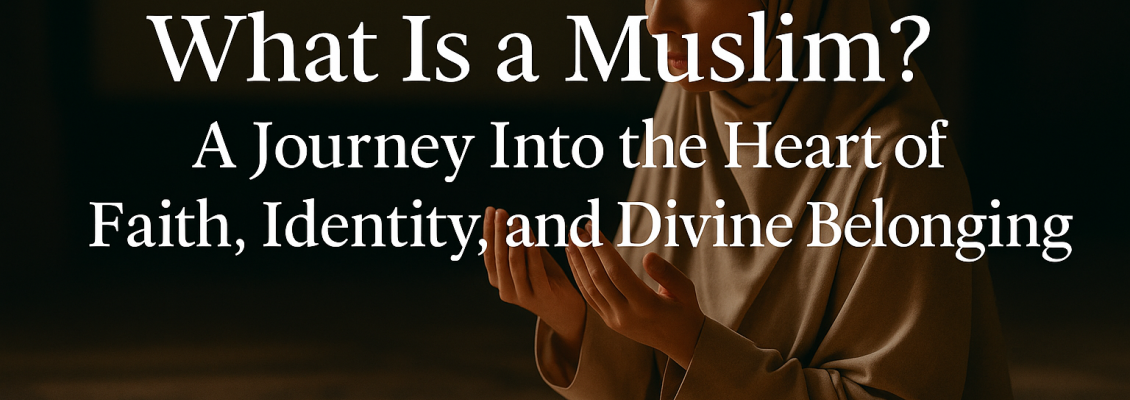
What Is a Muslim? A Journey Into the Heart of Faith, Identity, and Divine Belonging
There are questions that come from the mind — logical, curious, analytical. And then, there are questions that come from the soul. When someone asks, “What is a Muslim?”, I don’t just hear the words. I feel the ache underneath. The longing to understand. The hunger to belong. The hope that, maybe, there is something more to all this — something sacred. If that’s you, then this isn’t just a blog. This is your invitation to step into something real.
The Moment I Realized “Muslim” Meant Something Beautiful
Not Just a Word, But a Doorway
I didn’t grow up thinking much of the word “Muslim.” In fact, like many, I heard it first through headlines that made it sound foreign, dangerous, even shameful. But there was this moment — quiet, unexpected — where something shifted. I was watching a woman pray. Her forehead on the floor. Her whisper almost inaudible. And in that stillness, I thought: this isn’t terror. This isn’t foreign. This… is peace.
The Names They Gave Me
Growing up, I was called a lot of things. Sometimes “oppressed.” Sometimes “exotic.” Sometimes just “weird.” But never what I really was: a seeker. I wanted to know what truth looked like when all the noise was stripped away. The labels felt heavy. The stereotypes, suffocating. But the moment I began to ask sincerely what it meant to be a Muslim — really, deeply — the weight began to lift.
Seeing with New Eyes
It took a while. But over time, I learned that “Muslim” isn’t an ethnicity. It’s not a costume. It’s not a passport or a performance. It’s a relationship. Between you and the One who made you. To be Muslim means to surrender — not to culture, not to men, not to politics — but to God. To say: I trust You more than I trust myself. And when that surrender is real, something inside you softens. You breathe differently.
A Deeper Layer: The Unseen Pull
Sometimes we don’t realize we’re being called until we feel that ache — the one that shows up in the silence. The one that says, “There’s more to life than this.” That ache is not weakness. It’s a sign of fitrah — your soul’s original design. Every human is born with it. The yearning to know and be known by their Creator.
“I didn’t choose Islam because it was trendy. I chose it because, for the first time in my life, I felt seen by something bigger than this world.” — Layla, revert at 28
So if you’re asking, “What is a Muslim?” — maybe what you’re really asking is: What is it like to come home?
Let’s keep walking. Because the answer unfolds with each step.
What Are You Really Asking When You Ask, “What Is a Muslim?”
The Hidden Ache Beneath the Question
When someone asks, “What is a Muslim?”, they’re rarely asking for a dictionary definition. They’re asking something deeper — often without even realizing it. They’re asking, “What kind of person chooses this?” “Would I be accepted?” “Does this have anything to do with me?” “Am I allowed to feel something stir when I hear the Qur’an recited, even if I’m not Muslim?”
Behind this question is sometimes fear. Sometimes longing. Sometimes confusion. But almost always, it’s a cry for clarity in a world that has offered none. What you’re really asking might be: Who are they? Who am I? And could we possibly be the same in some deeper way?
Beyond Labels, Beyond Assumptions
For some, “Muslim” conjures images formed by decades of media misrepresentation — angry faces, rigid rules, and a lifestyle that feels foreign. For others, it’s associated with beauty, discipline, and spiritual strength. But the real question isn’t about image. It’s about essence. “Muslim” is not a cultural stereotype. It’s not exclusive to a region or race. It is an identity chosen through intention, love, and belief.
What you're asking — perhaps without knowing it — is not “What do Muslims do?” but “Why do they do it?” “What moves them?” “What makes them weep in prayer?” “Why are they willing to lose friends, jobs, and sometimes family — just to be faithful?”
Reframing Curiosity with Courage
If you’ve ever watched a woman walking gracefully in hijab and felt something unfamiliar stir in your chest — a sense of curiosity, maybe even admiration — that’s not by accident. If you've seen a group of Muslims praying together and felt both distant and drawn, that's your heart waking up. Because behind the rituals and terms and clothing is a truth that cannot be boxed: the human desire to worship something greater than the self.
A Deeper Layer: The Soul Is Remembering
The Qur’an says in Surah Al-A’raf (7:172):
"And [mention] when your Lord took from the children of Adam — from their loins — their descendants and made them testify of themselves, [saying to them], 'Am I not your Lord?' They said, 'Yes, we have testified.'"
To ask what a Muslim is, is to begin remembering a conversation your soul once had before it ever entered this world. It’s your fitrah — your original, pure state — stirring. Asking questions is not weakness. It’s worship when done sincerely. And every sincere questioner is already walking toward the Answer.
“I used to ask myself why they pray five times a day. And then one day, I tried it. Not to convert, just to see. I cried in sujood, and I didn’t even know why. Something unlocked in me.” — Sarah, curious reader turned Muslimah
So what are you really asking, beloved soul?
Maybe it’s not “What is a Muslim?”
Maybe it’s, “What is it that I’m being invited to?”
How the Media Distorted My Name Before I Even Spoke
Born Into a Narrative I Didn't Choose
Before I ever said the words “I am Muslim,” someone else had already written a script for me. The headlines were loud. The images sharper than truth. Planes crashing, faces covered, women silenced — all under the same five-letter word: *Muslim.* I hadn’t even stepped into my faith yet, but the world had already made up its mind about who I was.
It’s one thing to be misunderstood. It’s another to be feared without ever being known. That’s what happens when a faith of over a billion people is reduced to snapshots of conflict, taken out of context and blasted onto screens. People don’t ask *why* Muslims do what they do — they assume. They don’t sit with the beauty of the Qur’an or the mercy of the Prophet ﷺ. They stop at what the camera lets through, often drenched in politics, not piety.
The Hijab Was Not Their Symbol to Twist
I remember the first time I searched “Muslim woman” on the internet. What came up? Oppression. Silence. Violence. And yet, that wasn’t what I saw in the eyes of the women who raised me. My mother — fierce and soft. My aunties — storytellers, builders, lovers of Allah. Not one of them weak. Not one of them invisible. So why was the world telling a different story?
Somewhere along the way, “Muslim” stopped being a description and started being a warning. The scarf became a threat. The beard became suspicious. The prayer mat became controversial. But the real tragedy was this: millions of souls never got the chance to meet Islam before deciding they were afraid of it.
The Price of Misrepresentation
Being reduced to a stereotype costs more than image. It costs relationships. Opportunities. Safety. But even deeper, it plants doubt in the hearts of those born Muslim — and those curious about Islam — before they can even explore it for themselves. If the only version of Islam you see is through a distorted lens, how can you fall in love with the truth?
A Deeper Layer: The Weaponization of Identity
Islam is not the first or only faith to be vilified. But its portrayal in modern media has been particularly targeted. After major world events, Muslims are not just analyzed — we’re dissected. Every act by one individual is laid at the feet of an entire global community. This is not journalism. It’s trauma. And it delays so many from ever encountering Islam on their own terms.
"I was scared of Muslims until I met one. Then I realized — everything I thought I knew had been spoon-fed to me by fear." — Chloe, convert at 34
If you’ve been shaped by these portrayals, know this: it’s not your fault. But it is your responsibility now — if you feel something stirring — to seek beyond them. Because behind the noise, there’s a peace they never told you about. A truth so soft it shakes you. A way of life that’s nothing like what they showed you on TV.
And perhaps the real question isn’t why they distorted our name.
But what they were afraid you’d discover if they hadn’t.
The Truth Islam Tells Us About Who We Are
You Are Not a Mistake — You Are a Masterpiece
Before the world told you who to be… before school systems ranked you, before ads sold you an image, before your worth was tied to your appearance — there was a deeper truth. One that predated all of it. Islam doesn’t start by telling you what you must do. It starts by reminding you of who you already are: a soul created by the Most Merciful, on purpose, with divine value.
In a world obsessed with proving worth through performance, Islam speaks gently: *You were already chosen.* Allah says in the Qur’an:
"We have certainly created man in the best of stature." — (Surah At-Tin, 95:4)
That means you don’t have to earn dignity. You already have it. Muslim or not yet Muslim — your origin is the same: you were born in fitrah, a state of purity. You were born wired to recognize your Creator. To seek truth. To long for meaning. This is not indoctrination. It’s remembrance.
Being a Muslim Is Not Becoming Someone Else — It's Returning to Yourself
So many people think converting to Islam means *changing who you are*. But what if it actually means *coming home to who you were always meant to be*? You don’t become less “you” when you submit to Allah — you become *more* yourself. The veils fall. The noise fades. And what’s left is clarity.
That’s what Islam tells us: you are not just a mind, not just a body, not just a role in society. You are a soul with purpose. You were made for more than survival. You were made for peace. Not the kind that comes from comfort, but the kind that blooms from knowing your Lord and trusting Him — even when life breaks your heart.
The Core Identity: ‘Abd — Servant of the Most High
To be Muslim is not to erase your individuality. It's to anchor it in something eternal. When we say “Muslim,” we don’t just mean someone who prays five times a day or fasts during Ramadan. We mean someone who willingly aligns themselves with truth. A Muslim is someone who surrenders not to the ego, or society, or trends — but to the One who made them.
There is no shame in that. No loss of power. Because in surrendering to the Creator, you are freed from being a slave to everything else.
A Deeper Layer: Knowing Your Lord Is Knowing Yourself
One of the scholars said: “He who knows his Lord, knows himself.” This is not mysticism. It’s reality. When you know who Allah is — Ar-Rahman, the Most Merciful; Al-Hakeem, the All-Wise — then the trials in your life begin to look different. You see His wisdom behind delays. His mercy behind redirections. His nearness behind your pain.
"Before Islam, I thought I had to prove myself to everyone. Now I just want to be known by Allah. That’s enough for me." — Ameenah, mother of two, reconnected at 41
This is the truth Islam tells us: you are not random. You are not alone. You are not forgotten. You were always meant to return. And no matter how far you've gone, He is closer than your jugular vein. You don’t need to be perfect to belong here. You just need to be sincere.
You asked what a Muslim is. The deeper question might be:
What would it feel like to finally remember who you are?
Proof in the Light: Qur’an, Hadith, and the Way of Our Prophet ﷺ
Faith Built on Evidence, Not Blind Imitation
One of the greatest misconceptions about Islam is that it demands blind belief — as though being Muslim means following rules without understanding. But the truth is the complete opposite. The Qur’an doesn’t just call to belief. It calls to reflection. Over and over, Allah asks, *“Do they not think?”*, *“Do they not ponder?”* Islam is not afraid of questions. It was revealed in response to them.
The word *Qur’an* itself means recitation, and it is a miracle not just in its language, but in its message. It is preserved word-for-word from the time it was first revealed — unchanged, unmatched, and memorized by millions. Every verse is layered with beauty, rhythm, meaning, and divine wisdom. The more you study it, the more it opens. It doesn’t close with reading — it begins there.
The Life of the Prophet ﷺ: Living Proof
If the Qur’an is the light, the Prophet Muhammad ﷺ is its living embodiment. His life wasn’t just a biography; it was a manifestation of divine mercy. He forgave those who tried to kill him. He cried for us — the future generations of believers he never met. He mended the hearts of slaves, women, orphans, and the broken. He smiled more than he scolded. He listened with his heart before his tongue. Allah describes him in one ayah:
"And We have not sent you, [O Muhammad], except as a mercy to the worlds." — (Surah Al-Anbiya, 21:107)
This is the man whom Muslims follow — not a tyrant, not a warlord, not the media’s caricature, but a man of light. To be Muslim is to believe in him as the final messenger — the one who brought the Qur’an, lived it, and passed on a legacy of love and truth that spans 1,400 years and every corner of the globe.
Hadith: The Sacred Wisdom of a Gentle Heart
While the Qur’an is divine speech, the hadith are the recorded sayings, actions, and approvals of the Prophet ﷺ. They guide Muslims in everything from how to eat and pray, to how to treat neighbors and respond to grief. These aren’t abstract philosophies — they are practical, compassionate blueprints for daily life.
For example, the Prophet ﷺ said:
“None of you truly believes until he loves for his brother what he loves for himself.” — (Bukhari and Muslim)
This hadith alone has inspired entire movements of charity, justice, and social responsibility. It shows that belief isn’t just vertical — between you and God — but horizontal, shaping how you treat every human being.
A Deeper Layer: The Qur’an Challenges, Then Heals
Unlike man-made ideologies, the Qur’an doesn’t flatter the ego. It confronts it. It calls out injustice, arrogance, and heedlessness. But then — it heals. It doesn’t just diagnose the human condition; it offers a way out. It names our wounds and then wraps them in mercy. When the Qur’an says:
"Indeed, in the remembrance of Allah do hearts find rest." — (Surah Ar-Ra’d, 13:28)
It’s not poetic fluff. It’s a formula for survival. Every verse is a thread pulling you back to who you were created to be — not shackled, but surrendered; not muted, but elevated.
"I read the Qur’an once out of curiosity. I kept reading because it felt like it was reading me." — Nura, student of comparative religion
If you’re seeking proof, know this: the door to understanding Islam isn’t locked. It’s wide open. You don’t need to take someone’s word for it. You can open the Qur’an yourself. You can study the Prophet’s ﷺ life for yourself. The evidence is not hidden. It’s radiant.
So the next time you hear someone say, “Muslims just follow blindly,” remember:
We don’t follow blindly. We follow light.
The Soul’s Design: Why Fitrah Matters More Than Labels
Before the World Told You Who to Be
Long before you were assigned labels like gender, nationality, job title, or status — you were something else. You were a soul. Pure. Whole. Unbranded. In Islam, we call this inner state fitrah — your original spiritual blueprint. It’s the part of you that already knows Allah, even if your mind doesn’t remember yet. And it’s still there — beneath the noise, beneath the trauma, beneath the doubt. Waiting to be uncovered.
This is why when people come to Islam — not through pressure, but through personal awakening — they often say, “It felt familiar.” As if their heart had already tasted it in another world. Because it did. Because the soul remembers what the body forgets. And because Islam isn’t a foreign idea imposed on you — it’s your soul’s native tongue.
Islam Isn’t an Identity You Wear — It’s a Reality You Return To
One of the most tender truths in our deen is that Allah doesn’t ask you to become someone else. He invites you to return to who you truly are. Islam isn’t about adding layers — it’s about peeling them away. The ones that told you you’re not good enough. The ones that made you think God was only for a certain race, or language, or background. The ones that told you you’re too far gone.
That’s why the label “Muslim” is beautiful — but it’s not the goal. It’s a signpost. A declaration of intent. A reminder that this soul is on a journey home. It doesn’t mean perfect. It means purposeful. And that’s what fitrah gives us — the anchor to hold onto when everything else in life shifts.
When the Heart Whispers Before the Tongue Speaks
Have you ever looked up at the sky and felt small — but in a comforting way? Have you ever felt moved by a verse of Qur’an, even if you didn’t fully understand it? Have you ever cried in the dark and whispered, “God, if You’re there, help me…” That’s fitrah. It’s not intellectual. It’s instinctual. And it’s not tied to whether your parents were Muslim or not. Allah placed it in every soul.
The Prophet Muhammad ﷺ said:
“Every child is born upon the fitrah. Then his parents make him a Jew, a Christian, or a Magian.” — (Sahih Muslim)
This isn’t a criticism of other faiths. It’s a statement about potential. It means that your truest self is already inclined toward truth, justice, mercy, and tawheed (belief in One God). The journey to Islam isn’t about becoming something new — it’s about becoming real.
A Deeper Layer: The Resistance Before Return
Many people feel a quiet resistance when they first start encountering Islam — especially if they’ve spent their lives building a different identity. But that resistance is not rejection. It’s the ego reacting to its own dethroning. Because when the soul hears truth, it stirs — but the self doesn’t always want to let go. That’s why Islam calls not just to belief, but to inner surrender. And surrender is not weakness. It’s wisdom.
“I was afraid of losing myself if I accepted Islam. But what I lost were the parts of me that were never really me.” — Zara, revert at 19
So if you’re here, wondering, questioning, even resisting a little — know this: the soul never lies. If something in you keeps circling back to Islam, keeps wondering what it would be like to pray, to believe, to belong — that’s not coincidence. That’s fitrah calling you home.
And you don’t need to have all the answers to answer that call.
This Is What Being a Muslim Looks Like in Real Life
Beyond the Headlines and Hashtags
It’s easy to imagine Islam as something far away — something that exists in mosques, in deserts, in documentaries. But Islam is not confined to distant lands or ancient texts. It is alive in kitchens, classrooms, hospital rooms, and sidewalks. It breathes in the lives of ordinary people doing extraordinary things through quiet faith. Being a Muslim doesn’t always look like perfection. It often looks like trying — again and again — with sincerity.
Being Muslim might look like a mother waking up before dawn, wiping sleep from her eyes to whisper Fajr in the dark. It might look like a teenage girl walking into school with her hijab wrapped high, while heads turn and whispers follow. It might look like a man closing his shop at prayer time, even if it costs him money. Or a child pausing in a busy world to say, “Bismillah” before eating. This is Islam. This is real life.
Choosing Faith in a World That Doesn’t Make It Easy
To be Muslim today often means swimming upstream. You’re surrounded by a culture that celebrates instant gratification, hyper-individualism, and moral relativism. Islam calls to something different. It calls to patience. To self-restraint. To community. To divine purpose. This doesn’t mean you don’t live a full life — it means your life has roots. And when storms come, you don’t get blown away.
It means being mindful of Allah even when no one’s watching. It means making mistakes and returning in repentance. It means sometimes standing alone, but never being truly alone. Because Allah says:
"Indeed, Allah is with those who fear Him and those who are doers of good." — (Surah An-Nahl, 16:128)
This isn’t theory. This is what real Muslims live every single day. Not in perfection — but in pursuit.
Different Faces, One Ummah
There is no one way to “look” Muslim. Muslims are Black, Arab, White, Asian, Latinx — from cities and villages, from Ivy League universities and refugee camps. Some are born into Islam. Others find it after years of searching. Some wear hijab, some are still on that journey. Some are fluent in Arabic. Others speak broken syllables with beautiful sincerity.
Islam is not a monolith. It’s a mosaic. And at the heart of every Muslim is the same shahadah — the same testimony: *La ilaha illAllah, Muhammadur Rasulullah.* There is no god but Allah, and Muhammad is His messenger. That declaration binds us more tightly than race, nationality, or class ever could.
A Deeper Layer: The Private Moments That Shape a Muslim Life
You might never see it, but some of the most profound acts of faith happen quietly. A woman removing her nail polish to make sure her wudu is valid. A man giving charity in secret, not even telling his wife. A youth deleting a playlist that no longer sits right with his soul. These aren’t the things that make headlines — but they’re the moments that make a Muslim.
“People think being Muslim is about restriction. But for me, it’s the only thing that made me feel free. I stopped living for likes and started living for meaning.” — Hafsa, 23
Being Muslim in real life is messy, beautiful, and deeply human. It’s laughter and tears. It’s deadlines and du’a. It’s carrying the remembrance of Allah through every ordinary moment — turning even the mundane into worship.
And the best part?
There’s room in this way of life for you, too.
“She Said She Found Herself in Sujood” — Real Women Speak
The Quiet Testimonies the World Doesn’t See
In a world saturated with noise — influencers, filters, campaigns — some of the most powerful truths are whispered in private. They come from the hearts of women who were never handed platforms, but who found their voices in prayer. Their stories don’t make headlines, but they make heaven shake with sincerity.
This chapter belongs to them — the everyday Muslimahs, the seekers, the reverts, the daughters and mothers and sisters who met Islam not through loud declarations but through quiet transformations. Their lives are walking answers to the question: *What does it really mean to be a Muslim?*
“I Found Myself the Moment My Forehead Touched the Floor”
Her name was Samira. She had spent most of her adult life chasing achievement — degrees, promotions, polished perfection. “But no matter how high I climbed,” she said, “there was this emptiness I couldn’t explain.” One Ramadan, on a dare from a friend, she decided to fast. “I didn’t expect to last the day,” she laughed. “But when I broke my fast that evening, something felt different.”
Curiosity led to a Qur’an. The Qur’an led to prayer. And then, one night — she made sujood for the first time. “I didn’t even know what I was saying,” she admitted. “But the second my forehead touched the ground, I broke. I cried like a child who’d finally come home.”
"Sujood felt like a place my body didn’t know — but my soul remembered." — Samira, revert at 35
“Hijab Wasn’t Oppression. It Was My Liberation.”
Nada didn’t wear hijab for most of her life. “I thought it was something you did when you were older or when you were ‘fully religious.’” But after experiencing a deep personal betrayal, she turned inward. “I needed to protect myself — spiritually, emotionally. Not from the world, but from the illusions I’d built about it.”
She began praying again. Reading again. And one day, she wrapped the scarf around her head, alone in her room. “I looked in the mirror and cried,” she said. “Not because I felt ugly or restricted — but because I finally saw myself. My real self. Not what they wanted me to be, not what I pretended to be — but me, as Allah saw me.”
“I Didn’t Know How to Be Muslim — I Just Knew I Wanted Allah”
Layla grew up far from any Muslim community. “The only time I heard the word ‘Muslim’ was in news reports.” But after reading a verse from the Qur’an online, she couldn’t stop thinking about it. She downloaded a translation and started reading, one ayah at a time. “I didn’t understand it all. But I understood the feeling. It was like someone was talking directly to my heart.”
She converted quietly. No one around her knew. “I didn’t have the words. I didn’t even know how to pronounce ‘salah.’ But I knew Allah was real, and I wanted Him. That was enough.”
A Deeper Layer: Womanhood in the Shade of Surrender
Islam does not erase womanhood — it elevates it. It doesn’t confine the Muslim woman to the sidelines. It places her, with dignity, in the sacred center of faith, community, and family. The Prophet ﷺ would stand when his daughter Fatimah entered the room. He listened to women’s voices. Took their counsel. Defended their honor. Taught men to treat them with gentleness and respect.
In Islam, modesty isn’t about hiding beauty — it’s about revealing the soul. Prayer isn’t a ritual — it’s a lifeline. And being Muslim as a woman isn’t a punishment. It’s a path back to divine worth.
"I thought Islam would make me small. But it made me unshakable. I didn’t lose myself — I returned to myself." — Hana, mother of three, reconnected at 39
So when someone asks, “What is a Muslim?” — perhaps the answer lives in the lives of these women. Women who rise at dawn to whisper to their Lord. Women who walk with heads high and hearts soft. Women who don’t just speak Islam — they embody it.
Because sometimes the most powerful da’wah isn’t what we preach — it’s what we live.
Faith Is Not Always Simple: Struggles, Trauma, and Coming Back
The Shadows Behind the Veil
It’s important to remember that faith is not a straight line. It’s not a perfect journey. Behind every smiling face, every hijab-wearing woman, every pious prayer, there can be unseen battles — doubts, trauma, heartbreak. Being Muslim does not mean being free from pain. In fact, sometimes it means carrying pain with patience and grace, and learning to heal through surrender.
For many, the path to embracing Islam or deepening faith is paved with personal struggle. Whether it’s rejection by family, internal conflict, or grappling with past wounds, faith asks us to confront the darkest parts of ourselves and still believe in light. It is in those moments that Islam’s message of mercy becomes most real.
The Weight of Judgment and Misunderstanding
Sometimes the hardest struggle is not from outside, but from within the Muslim community itself. Judgments, expectations, and unspoken rules can create wounds as deep as any outsider’s prejudice. Women told their hijab isn’t “right enough.” Converts made to feel like outsiders. Mental health struggles dismissed or ignored. This is the reality for many, and it’s a reminder that faith communities must be spaces of compassion, not condemnation.
Islam teaches us to hold each other gently, to remember that everyone is on their own journey, and that the greatest among us are those who struggle but keep moving forward with hope.
Returning After Falling: The Beauty of Tawbah
One of the most beautiful concepts in Islam is tawbah — repentance. It means returning, no matter how far you’ve drifted. No sin is too great to erase the possibility of a new beginning. The Qur’an reminds us:
"Say, ‘O My servants who have transgressed against themselves [by sinning], do not despair of the mercy of Allah. Indeed, Allah forgives all sins. Indeed, it is He who is the Forgiving, the Merciful.’" — (Surah Az-Zumar, 39:53)
This mercy is not just an abstract idea. It is a living, breathing reality for those who feel broken. It is the light that calls us back from the darkest night. Faith is not about never falling. It’s about learning to rise again, each time, stronger and more certain.
A Deeper Layer: Trauma and Healing in the Heart of Faith
Many Muslim women carry wounds that no one sees — past abuse, cultural displacement, loss, isolation. Sometimes faith is the first place they find safety. But sometimes it’s also a place where old hurts are stirred. Healing requires patience, community, and sometimes professional support. Islam’s teachings on compassion and justice provide a framework to hold these wounds tenderly, not hide them in shame.
"I lost my way for years. But when I found Islam again, it wasn’t perfection that brought me back — it was the promise of mercy." — Fatimah, survivor and teacher
Faith is not a fairy tale. It is raw, real, and sometimes painful. But it is also the strongest anchor in life’s storm. And those who struggle — and keep choosing hope — embody the deepest truths of what it means to be Muslim.
If you find yourself here — wounded, questioning, afraid — know that your journey is honored. Your doubts are not a failure, but a sign of a living soul. And the door to mercy will never close.
A Light You Were Always Looking For — And the Door’s Still Open
The Invitation That Never Fades
Here we arrive — at the threshold of something beautiful and eternal. After the questions, the doubts, the struggles, the revelations — what remains is a light that has always been with you, quietly waiting to be noticed. The call of Islam is a call to return, to belong, to find peace in a world that often feels fractured.
Whether you are just beginning to wonder, or have walked the path for years, this is the invitation: to step into grace, to embrace dignity, to wear your faith not as a burden, but as a crown of divine purpose. The door to Islam is never closed. It stands open, welcoming, and wide.
More Than Faith — A Sisterhood of Souls
To be Muslim is to join a community that spans the globe — millions of hearts beating in submission to the One who created them. But it is also deeply personal. It’s the sister who prays next to you at dawn, the friend who listens without judgment, the mother who carries stories of patience and hope.
In a world hungry for belonging, Islam offers a sisterhood rooted in compassion and mutual respect. It invites you to be part of something bigger than yourself — a collective journey toward light, mercy, and truth.
The Beauty of Modesty and Purpose
Modesty in Islam is not limitation. It is liberation. It is freedom from the chains of comparison, exploitation, and superficiality. It is a way to honor your body and soul, to walk through the world with quiet confidence and grace. It is the delicate balance between strength and softness, courage and humility.
Amanis is proud to stand with you on this path, offering garments that celebrate your dignity and faith — beautiful abayas that are more than fabric; they are statements of identity, faith, and elegance.
A Deeper Layer: Your Journey Is Sacred
Every step you take toward understanding Islam is a sacred act. Every question you ask, every doubt you face, every prayer you whisper in the dark — they matter. Your journey is unique, and it is honored. There is no rush, no pressure. Just the gentle unfolding of your soul’s deepest longing.
"I wasn’t sure I belonged anywhere — until I found Islam. Now, I know I belong everywhere, because I belong to Him." — Aisha, revert and writer
So whatever brought you here, know this:
The light you were always searching for has been shining inside you all along.
The door is open.
And when you’re ready, the journey awaits.
Final Reflection: Your Journey, Your Light, Your Amanis
As we close this sacred conversation, I want to gently remind you that the question “What is a Muslim?” is not just about labels or external appearances — it is about the soul’s profound journey back to its Creator. It is about finding peace amidst chaos, dignity amidst judgment, and beauty amidst struggle. It is about discovering that beneath every hijab, every prayer, every whispered du’a, lies a woman of immense strength, grace, and divine purpose.
This journey is not linear, nor is it perfect. It is human. It is messy. It is full of setbacks and awakenings, of quiet moments and powerful revelations. Yet, at every step, there is mercy. At every turn, there is light. Islam does not demand you to be flawless before you enter — it invites you to be real, to be sincere, to be you.
For every woman who has ever felt unseen or unheard, know that your story matters. Your faith — whether new, tentative, or lifelong — is a treasure. And your expression of modesty, your choices in how you present yourself, your daily acts of worship — all are threads weaving a tapestry of identity that is uniquely yours and beautifully Muslim.
At Amanis, we celebrate this sacred tapestry. We understand that modest fashion is not just about clothing — it is about reclaiming dignity, expressing faith, and embodying beauty that resonates from within. Our abayas and collections are designed not just to cover, but to empower; not just to dress, but to declare a woman’s sovereignty over her own story.
So, as you reflect on what it means to be Muslim — whether for yourself or in learning about others — remember this: it is an invitation. An invitation to belong, to believe, and to become. It is the light that never fades, the door that never closes, and the path that always leads home.
We invite you to explore Amanis’ collections — to find pieces that speak to your soul, that honor your faith, and that accompany you on your beautiful, unique journey.
Thank you for walking this path with me. May your heart be filled with peace, your soul with light, and your life with purpose — always.
About the Author: Amani
Amani’s journey to Islam was one of quiet discovery and soulful awakening. Raised in a multicultural home, she found her way to faith through personal reflection, heartfelt questions, and a deep yearning for meaning beyond the surface. Her story is woven with moments of doubt, clarity, and profound peace — a testimony to the mercy and guidance of Allah.
Today, Amani is not only a devoted Muslimah but also a passionate advocate for modest fashion that uplifts the spirit. As a creative visionary behind Amanis, she believes that clothing is more than fabric — it is an expression of dignity, identity, and divine purpose. Through her work, Amani seeks to empower women to embrace their faith with beauty, confidence, and grace.
"Faith is a journey of the heart — and modesty is the language it speaks. May every woman find her light and walk in it with courage and love." — Amani
Thank you for sharing this moment with me. May your path be filled with peace and purpose, always.
Frequently Asked Questions
1. What Is a Muslim and What Does It Mean to Identify as One?
The question "What is a Muslim?" holds deep significance both spiritually and socially. At its core, a Muslim is one who submits to the will of Allah — the One God — and follows the teachings revealed through the Prophet Muhammad ﷺ. The word “Muslim” itself comes from the Arabic root “S-L-M,” meaning peace, submission, and surrender. Thus, being a Muslim is not just a label but a profound state of heart, mind, and soul aligned with divine guidance. This submission is expressed through belief in the Shahadah, the testimony that “There is no god but Allah, and Muhammad is His messenger.” This declaration is both an affirmation of monotheism and recognition of the Prophet’s role as the final messenger.
Identifying as a Muslim goes beyond rituals; it encompasses a way of life guided by values of compassion, justice, mercy, and self-discipline. It means striving to live in harmony with Allah’s commandments as laid out in the Qur’an and Sunnah. This journey is personal and ongoing — it involves constant reflection, repentance, and growth. Importantly, it is not defined by outward appearances alone, but by the sincerity of the heart and the commitment to embody the principles of Islam.
Socially, being a Muslim often brings both connection and challenge. It means belonging to a global community — the Ummah — united by faith but diverse in culture, language, and practice. Yet, Muslims often face misunderstanding or prejudice in wider society. Understanding what it means to be Muslim helps dispel stereotypes and opens pathways for respectful dialogue. In essence, a Muslim is a person committed to peace through submission to Allah, seeking to live with purpose and integrity in this world and the next.
This understanding is foundational to the blog above, which explored the spiritual, emotional, and lived dimensions of being Muslim — inviting readers to see beyond misconceptions and appreciate the rich, soulful journey it entails.
2. How Does Islam Address the Common Misunderstandings About Muslims?
Islam is frequently misunderstood in media and popular discourse, which can distort public perception of Muslims and their faith. These misconceptions range from associating Islam with violence to assuming Muslims are monolithic or that Islam oppresses women. Addressing these misunderstandings requires contextualizing the faith’s teachings and appreciating the lived realities of its followers.
The Qur’an clearly condemns injustice and aggression, emphasizing mercy and compassion. Any acts of violence carried out in the name of Islam contradict its core teachings. The Prophet Muhammad ﷺ modeled a life of kindness, forgiveness, and advocacy for human rights, including women’s rights, which were revolutionary in 7th-century Arabia. Islam grants women rights to education, property, and dignity, which continue to be embodied by millions of Muslim women today.
Furthermore, the Muslim community is incredibly diverse, spanning cultures from Southeast Asia to Africa to Europe and the Americas. This diversity means there is no single “Muslim culture” or way to practice. The outward symbols like hijab or prayer styles may vary, but the spiritual essence remains rooted in submission to Allah and striving for righteousness.
The blog’s sections addressing media distortions and personal testimonies emphasize that misunderstanding often arises from lack of knowledge and fear. Islam calls to knowledge and reflection, urging people to look beyond stereotypes and engage with Muslims as individuals with rich inner lives and diverse experiences. Dispelling myths fosters empathy and opens the door to authentic connection.
3. What Are the Core Beliefs and Practices That Define a Muslim’s Faith?
A Muslim’s faith is structured around fundamental beliefs known as the Six Articles of Faith and practices called the Five Pillars of Islam. These define both belief and action, forming the foundation of a Muslim’s identity and spirituality.
The Six Articles of Faith are: belief in Allah (the One God), belief in His angels, belief in His revealed books (including the Qur’an), belief in His prophets (with Muhammad ﷺ as the final prophet), belief in the Day of Judgment, and belief in divine predestination. These beliefs shape how Muslims understand the universe, human purpose, and accountability.
The Five Pillars of Islam represent the practical expression of faith: the Shahadah (testimony of faith), Salah (five daily prayers), Zakat (charitable giving), Sawm (fasting during Ramadan), and Hajj (pilgrimage to Mecca, if able). These acts create a rhythm of devotion and community, reinforcing submission and connection to Allah.
Beyond these, Islam encourages ethical conduct in all life areas—honesty, kindness, justice, and humility. Spirituality in Islam is dynamic; it embraces both external rituals and inner transformation. The blog above explores these dimensions, highlighting how faith is both a sacred trust and a source of empowerment, especially for women embracing modesty and purpose.
4. How Do Muslim Women Experience and Express Their Faith Today?
Muslim women’s experiences are diverse and multifaceted, shaped by personal faith, cultural background, and social context. Their expressions of faith range widely, from wearing hijab or niqab to participating in community leadership, education, and professional careers. Far from a monolithic image, Muslim women are agents of their own spirituality and identity.
Wearing modest clothing, such as the abaya or hijab, is often a deeply personal and spiritual choice reflecting a commitment to dignity and divine obedience. For many, modesty is freedom — a way to reclaim their bodies from societal objectification and live according to their values. The blog emphasizes this perspective, countering stereotypes that hijab or modest dress signify oppression.
Muslim women also navigate challenges — from societal prejudices to internal community expectations. Yet, many find strength and empowerment in their faith, creating supportive networks and spaces for dialogue. Their stories of resilience, prayer, and identity reveal how Islam is a source of hope and self-acceptance.
The voices and testimonies woven throughout the blog illustrate this rich tapestry — women discovering peace in sujood (prostration), liberation in modesty, and sisterhood in shared faith. Their lived realities deepen the understanding of what it means to be Muslim beyond the surface.
5. How Can Non-Muslims Understand and Respect Muslim Identity and Faith?
Understanding and respecting Muslim identity begins with compassion, curiosity, and a willingness to listen without judgment. Non-Muslims can deepen their appreciation by learning about Islam’s core beliefs and values, engaging with authentic Muslim voices, and recognizing the humanity that connects all faith traditions.
Respecting Muslim identity means avoiding stereotypes and assumptions, especially regarding modesty, gender roles, and cultural practices. It involves recognizing that Islam is a faith rooted in peace, mercy, and justice, and that Muslims come from many backgrounds with diverse experiences.
The blog above serves as a bridge — offering warm insights and real stories that invite readers to see Muslims not as “others” but as neighbors, colleagues, and friends with shared hopes and struggles. It calls for empathy, patience, and open-hearted dialogue.
Simple acts — such as pronouncing names correctly, asking respectful questions, and challenging misinformation — can foster understanding. Above all, honoring the spiritual quest that each person undertakes, regardless of faith, builds connection. The door is always open to learning and friendship.
Ultimately, understanding Muslim identity is not about mastering theology but embracing the beauty of sincere faith and the shared human journey toward meaning and belonging.
People Also Ask (PAA)
1. How Does Someone Become a Muslim?
Becoming a Muslim is a deeply personal and spiritual journey rooted in sincere belief and intention. The essential step to becoming a Muslim is the declaration of the Shahadah, the testimony of faith, which states: “There is no god but Allah, and Muhammad is His messenger.” This simple yet profound statement affirms one’s acceptance of monotheism and the prophethood of Muhammad ﷺ, officially embracing Islam.
The process begins with sincere reflection and understanding. While Islam encourages seeking knowledge, it also emphasizes the importance of intention (niyyah). One does not need to complete any formal rituals or pass tests; rather, the heart’s sincerity is paramount. It is recommended, however, to learn about Islamic beliefs, practices, and ethics before taking the Shahadah to embrace the faith with full awareness.
Once a person declares the Shahadah, they become a Muslim and are welcomed into the global Ummah. This declaration is usually done publicly in front of witnesses or within a community, but private declarations are valid too. After this, the new Muslim is encouraged to begin practicing the Five Pillars of Islam, such as prayer, fasting, charity, and if possible, pilgrimage.
Support and guidance from Muslim communities or knowledgeable mentors can be invaluable. Many new Muslims find strength in joining study circles, learning Qur’an, and building friendships that nurture faith. Challenges like family or societal pressure may arise, but Islam teaches patience and trust in Allah’s mercy.
Becoming Muslim is not a one-time event but the start of a lifelong journey of growth, learning, and connection. It is an awakening to a way of life that harmonizes heart, mind, and spirit, inviting the believer to peace through submission.
2. What Are the Basic Beliefs That Define a Muslim’s Faith?
The basic beliefs defining a Muslim’s faith are encapsulated in the Six Articles of Faith (Iman), which form the foundation of Islamic theology. These beliefs shape a Muslim’s worldview and spiritual life, providing clarity and purpose.
First and foremost is belief in Allah, the One, eternal God, who alone deserves worship. Islam emphasizes Allah’s oneness (Tawhid), rejecting any form of polytheism or associating partners with Him. Allah is merciful, just, and all-knowing.
Next is belief in Angels, unseen beings created by Allah who carry out His commands and interact with humanity in various ways, such as recording deeds or delivering revelations.
Muslims also believe in the Revealed Books sent by Allah to guide humanity, including the Qur’an — the final and preserved revelation — as well as earlier scriptures like the Torah and Gospel in their original forms.
Belief in Prophets and Messengers is essential; Muslims affirm the prophets from Adam to Muhammad ﷺ, who is the final messenger. Prophets conveyed Allah’s guidance and serve as role models for righteous living.
The belief in the Day of Judgment asserts that all humans will be held accountable for their deeds and rewarded or punished accordingly, emphasizing justice and moral responsibility.
Lastly, belief in Divine Decree (Qadar) acknowledges Allah’s complete knowledge and control over all things, while still affirming human free will.
These core beliefs provide a coherent spiritual framework that guides Muslims’ understanding of life, purpose, and destiny. They offer reassurance, hope, and motivation to live ethically and compassionately.
3. Why Do Muslim Women Wear the Hijab?
The hijab, or modest covering worn by many Muslim women, is a symbol deeply rooted in faith, identity, and personal choice. It represents a commitment to modesty, dignity, and obedience to Allah’s guidance. Contrary to popular misconceptions, the hijab is not about oppression or control but about empowerment and spiritual connection.
Islamic teachings encourage both men and women to dress modestly and to conduct themselves with humility. The Qur’an addresses modesty in several verses, emphasizing respect for one’s own body and interactions. For women, the hijab is one expression of this principle, designed to protect the soul from objectification and to redirect attention toward inner character.
For many women, wearing the hijab is a conscious, spiritual act — a daily reminder of their identity as Muslims and their relationship with Allah. It can foster self-respect and confidence by prioritizing inner beauty and values over external appearance.
Experiences of wearing the hijab vary widely. Some women embrace it from a young age, others adopt it later as part of their personal journey. While some face societal challenges or misconceptions, many find strength in sisterhood and community support.
It is important to recognize that the hijab is a personal choice, not a universal requirement forced upon women. Islam advocates for sincere devotion and voluntary submission, which the hijab symbolizes for those who wear it. In this way, the hijab becomes a source of liberation — a shield and a crown, rather than a chain.
4. How Does Islam Promote Peace and Compassion?
The essence of Islam is peace — the very word “Islam” is derived from “Salaam,” meaning peace, safety, and submission to the divine will. Islam’s message consistently advocates for compassion, mercy, justice, and respect for all creation.
The Qur’an repeatedly commands kindness and forbids oppression and injustice. The Prophet Muhammad ﷺ embodied mercy and gentleness, teaching forgiveness and peaceful resolution of conflict. He instructed Muslims to treat neighbors well, care for orphans, and extend kindness even to animals.
Islam encourages believers to engage with others respectfully, regardless of faith or background, fostering harmonious coexistence. The concept of rahmah (mercy) is central, underscoring that compassion is not optional but a divine imperative.
While historical and contemporary events sometimes show Muslims involved in conflict, these are deviations from Islam’s core teachings. The faith calls for peace on individual, communal, and global levels — encouraging Muslims to be ambassadors of goodwill.
Compassion in Islam also includes self-compassion and spiritual care. The faith invites believers to forgive themselves and others, to seek reconciliation, and to work tirelessly for social justice and equity.
The blog above captures this spirit of peace and mercy, showing how Islam is a path not just of rules but of heart-deep transformation toward love and harmony.
5. What Role Does Community Play in a Muslim’s Life?
Community, or Ummah, holds a central place in Islam, providing support, shared identity, and collective worship. Being Muslim is both an individual spiritual journey and a communal experience, rooted in brotherhood and sisterhood.
The Qur’an and Sunnah emphasize the importance of community cohesion, mutual support, and collective responsibility. Muslims gather regularly for prayer, especially the Friday congregational prayer (Jumu’ah), fostering unity and spiritual solidarity.
Beyond worship, the Muslim community supports members in times of need through charity (Zakat), care for the vulnerable, and encouragement of ethical conduct. This network helps believers navigate challenges, grow in faith, and find belonging.
For many Muslims, community is where faith is lived most fully — through shared celebrations, learning, and acts of service. It is also where differences in culture and practice are embraced within the shared foundation of belief.
However, community life can also present challenges, such as navigating judgment, expectations, or cultural clashes. The blog above acknowledges these complexities, emphasizing compassion and openness as keys to nurturing healthy, inclusive communities.
Ultimately, the Ummah is a source of strength and identity, linking individuals to a global family united by faith and purpose, offering belonging and encouragement on the path to Allah.
-300x93.png "Amani's Islamic Design House")


Leave a Comment