-300x93.png "Amani's Islamic Design House")


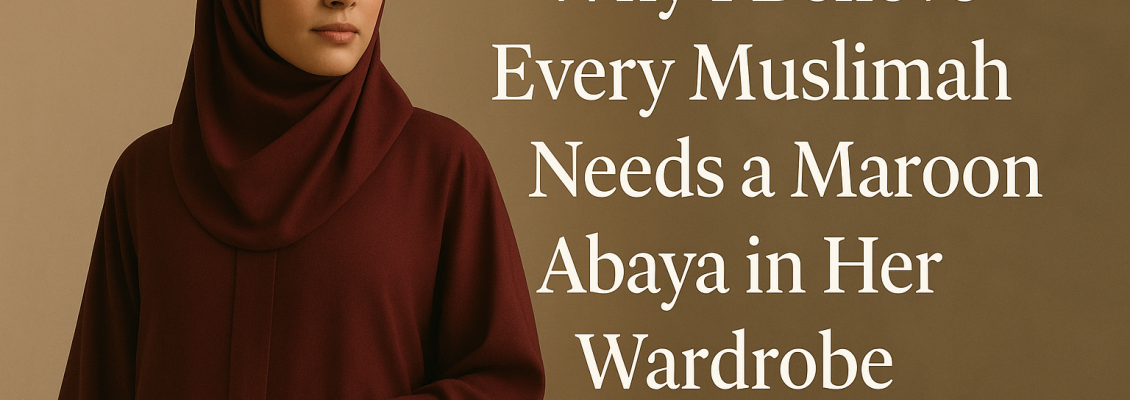
As I sit here in 2025, wrapping my hands around a warm cup of chai, I’m reminded of the first time I slipped into a maroon abaya. It was Ramadan, just after tahajjud. The world was hushed, and the sky still wore the dark indigo of the night. My soul felt tender — raw from life, but ready for something new. And when I wrapped myself in that deep maroon fabric, something shifted. Not just on the outside, but within.
This blog isn’t just about fashion. It’s about identity. About the silent power of how we clothe our souls through what we wear. It’s about reclaiming joy in modesty, not despite our faith — but because of it.
Maybe you’re a young sister just discovering your path. Maybe you're a mother rediscovering your own reflection while raising the next generation. Maybe you're a revert navigating culture shock and closet confusion. Wherever you are, I want to sit with you — heart-to-heart — and share why I believe a maroon abaya belongs in every Muslimah’s wardrobe.
This is more than colour theory. This is soul theory. Let’s begin, Bismillah.
Table of Contents
What makes maroon so special in Islamic fashion?
Maroon isn’t just a colour. It’s a feeling. A tone that carries the depth of rusted rose petals, the warmth of pomegranate skin under the sun, the subtle strength of crimson humility. When worn with intention, maroon doesn’t shout — it resonates.
In many cultures, maroon is associated with nobility, dignity, and serenity. In the realm of Islamic fashion, these qualities matter. Our clothes are not just coverings; they are statements of hayaa (modesty), niyyah (intention), and sometimes, healing.
The Language of Colour in the Ummah
- Black: Safe, classic, authoritative — but can sometimes feel heavy.
- White: Pure, peaceful — but challenging to maintain daily.
- Maroon: Deep, grounded, rich — a perfect balance of presence and peace.
I remember one sister telling me, “When I wear maroon, I feel like I’ve returned to myself.” That stayed with me. Because many of us are walking this path of modesty still unsure, still wobbling between pleasing others and pleasing Allah. But a maroon abaya can be that gentle middle ground — expressive, but dignified. Present, but peaceful.
It’s also incredibly versatile across skin tones. Whether you’re fair-skinned, olive-toned, or dark-skinned, maroon brings warmth without overwhelming.
Why It Matters Spiritually
Colours affect mood. And mood affects ibadah. When you feel confident in your modesty, you show up for prayer, Qur’an, and dhikr with a little more light. Your walk changes. Your smile reaches deeper.
“Allah is Beautiful and loves beauty.” — Sahih Muslim
Modest beauty is not bid’ah. It’s barakah when paired with the right intention. And maroon gives us a beautiful middle path.
Can a maroon abaya still look modest?
Bismillah. This is a question I hear so often from sisters — especially those who are new to hijab or have grown up in communities where black is seen as the only acceptable “modest” shade. The concern is real. You want to honour Allah ﷻ, not draw attention. You want to blend, not stand out. So when someone suggests a colour like maroon — rich, regal, undeniably eye-catching — your heart whispers: Is this still modest?
Let me tell you something, dear sister: modesty is a garment of the heart first. The colours we choose are a reflection, yes — but they are not the totality. If your niyyah is to cover, to beautify what Allah loves in a dignified way, and to walk the earth without arrogance — then maroon, just like black, can be worn with hayaa.
Modesty ≠ Monochrome
We’ve somehow inherited the idea that modesty is grey, dull, and invisible. But Islam was never colourless. The Prophet ﷺ wore a red-striped Yemeni cloak on Eid. His companions wore beautiful clothes on Fridays. And our tradition is filled with accounts of colour — from saffron-dyed garments to green cloaks worn in Yemen.
What Islam forbids is tabarruj — excessive beautification for the gaze of non-mahram men, or anything that calls attention in a way that incites desire or pride. But looking beautiful for yourself, for your family, or even for your own spiritual motivation? That’s not haram. That can be ibadah — if your heart is in the right place.
When Does Colour Cross the Line?
The key is balance. Here’s a quick guide you can use:
| Element | Balanced Use of Maroon | Excessive/Immodest Use |
|---|---|---|
| Fabric Type | Matte crepe, nida, or lightweight cotton blends | Glossy silk, clingy jersey, overly shiny satin |
| Cut & Fit | Loose, flowing, tailored at the shoulders only | Bodycon, cinched waist, or tight-fitting cuts |
| Accessories | Minimal — perhaps a neutral khimar or tote | Chunky earrings, bright lipstick, heavy embellishments |
| Intention | To please Allah, to feel dignified in your modesty | To turn heads, to impress others |
What Scholars Say
Some scholars have stated that while extreme colours that are loud or neon are discouraged, **natural, deep, dignified colours** — even if beautiful — are permissible so long as the rest of the garment remains modest. Shaykh Ibn Uthaymeen رحمه الله noted that the issue is not colour alone, but the *effect* of that colour in a specific context.
“Clothing that is beautiful and modest is not forbidden. What is forbidden is clothing that is an adornment in itself — that causes fitnah.” — Ibn Uthaymeen, Sharh al-Mumti’
What the Maroon Abaya Symbolises
To me, the maroon abaya is like the older sister of the black one. Still wise, still grounded — but with a little more warmth. It speaks of womanhood, of depth, of a heart that has wept in sujood and still stands strong.
When I wore mine to a gathering with my revert sisters, one of them said, “You look like a du’a in motion.” That stayed with me. Because it’s not about fashion. It’s about what that piece allows you to feel: soft, powerful, rooted.
And here’s the truth: even black abayas can be immodest if they cling, reveal, or seek attention. And even maroon can be modest if it conceals, flows, and whispers, not shouts.
Practical Tips to Keep It Modest
- Choose a thick, flowy fabric that doesn’t outline your shape.
- Pair with a neutral khimar (black, beige, grey).
- Skip shiny makeup or accessories — let the colour speak quietly.
- Layer with a bisht or open kimono-style abaya if you want added coverage.
- Wear with closed shoes or ankle boots for winter elegance.
Remember, modesty is not in hiding — it’s in honouring. The maroon abaya is not a compromise. It’s a choice. A sacred one. And if your heart is aligned with Allah’s pleasure, then your wardrobe will reflect that — no matter the colour.
So yes, a maroon abaya can absolutely still be modest. And maybe — just maybe — it’ll help you feel seen again, by the One who sees the hearts.
Is maroon a Sunnah-friendly colour?
Bismillah. Let’s begin with love — for the Sunnah, for our Prophet ﷺ, and for the beauty Allah ﷻ has placed in moderation. When a sister asks whether maroon is “Sunnah-friendly,” she’s not just asking about colour. She’s asking: *Can I wear this and still feel like I’m walking in the footsteps of the Prophet’s ﷺ legacy?* She’s asking: *Does this choice reflect a love for Islam, or does it risk veering into vanity?*
These are powerful, meaningful questions. And they deserve a deep, spiritually rooted answer — not just a fashion take.
What Colours Did the Prophet ﷺ Wear?
The Prophet Muhammad ﷺ wore various colours in his lifetime, depending on the occasion and what was available. While the most commonly reported colours were white, green, red-striped, and even black, there’s no definitive restriction on colours, so long as they do not fall into the category of extravagance, imitation of disbelievers, or resemble men’s attire for women and vice versa.
One of the key hadiths regarding red is this:
“I saw the Messenger of Allah ﷺ wearing a red-striped garment. I have never seen anyone more handsome than him.”
— *Reported in Sahih al-Bukhari*
This garment wasn’t bright crimson or neon — it was likely a natural dye like madder root or cochineal, producing an earthy red hue — think burgundy, rust, or what we might now call… maroon.
Understanding the Sunnah Through Colour
While there is no hadith that explicitly states “maroon” by name (just as there’s none for navy blue or olive green), the key lies in *niyyah* (intention), *context*, and *modesty*. If the Prophet ﷺ wore colour with dignity, without excess or arrogance, and his wives followed suit, then it is safe to say colour is not against the Sunnah — as long as it stays within the guidelines of hayaa.
For women, the standard is slightly different due to the concern of attracting unnecessary attention. But again, that’s more about how you wear it than what you wear.
When Is a Colour “Sunnah-Compatible”?
Let’s break it down in a table to make it clearer:
| Criteria | Sunnah-Compatible | Not Sunnah-Compatible |
|---|---|---|
| Fabric | Natural fibers, breathable materials like cotton, linen, nida | Clingy, overly synthetic, or revealing fabrics |
| Colour Tone | Earthy, muted, noble (like maroon, olive, cream) | Loud neon, overly metallic, glitter-heavy tones |
| Intention | To please Allah, maintain dignity, follow prophetic example | To be seen, praised, or admired excessively |
| Cut & Style | Loose, flowing, non-shape-defining | Fitted, body-hugging, flashy cuts |
Maroon in the Historical Muslim World
Maroon, burgundy, and crimson tones have deep roots in the Muslim world. In Ottoman, Andalusian, and North African garments, you’ll often find shades of deep red used in ceremonial dress, royal garments, and even khimars. These tones were not seen as un-Islamic — rather, they were associated with nobility, maturity, and honour.
Even in some traditional Islamic calligraphy and Qur’anic manuscript borders, maroon and burgundy were used as complementary ink tones — because they carried a weight of seriousness and elegance.
But Isn’t Simplicity Closer to the Sunnah?
Absolutely. The Prophet ﷺ loved simplicity and humility — in food, in clothing, in speech. But simplicity doesn’t mean dullness. A maroon abaya can be incredibly simple — especially if worn without excessive design, paired with a neutral khimar, and cut in a classic flowing style. The heart of the Sunnah is not about stripping beauty away — it’s about removing ego from beauty.
It’s about adorning yourself to please Allah, not people. When your heart chooses maroon because it feels dignified, serene, and mature — and not because it’ll earn you more Instagram likes — that’s spiritual beauty.
The Balance of Sunnah + Personal Identity
Especially for reverts and younger sisters, modest fashion becomes a way to rediscover identity within the folds of the Deen. Wearing a maroon abaya might be their first step into joyfully loving hijab — not just enduring it.
If the maroon abaya makes you feel more likely to stay covered, walk with hayaa, and embrace your feminine dignity — then yes, it aligns with the spirit of the Sunnah.
Final Reflections
- The Prophet ﷺ didn’t limit us to black or white — he taught us to reflect our faith through humility, beauty, and intention.
- Maroon is not just a colour — it’s a mood, a maturity, a form of dignified beauty.
- If your dress serves your deen and shields your modesty, it is beloved — even if it is maroon.
- Always revisit your niyyah before you dress — ask: “Would I still wear this if no one saw me but Allah?”
So yes, dear sister. Maroon is Sunnah-friendly — if your heart is friendly to the Sunnah. Let the colour be a reminder, not a distraction. Let it deepen your commitment, not weaken your intention. May every fold of your maroon abaya become a testimony of your love for Allah and His Messenger ﷺ.
How does colour impact spiritual state?
Have you ever noticed how certain colours make your heart feel calm, while others feel distracting or heavy? SubhanAllah, colour isn’t just a visual experience — it’s a spiritual vibration. In Islam, everything is rooted in balance, and the colours we choose to wear can either soothe the soul or subtly stir the nafs. The maroon abaya — rich, warm, grounding — is a perfect example of a colour that doesn’t scream, yet doesn’t disappear. It’s the middle path. And that’s where spirituality thrives.
Colour Is Not Superficial — It’s Spiritual
Islam teaches us to be conscious of every detail — even the seemingly small ones. How we eat. How we sleep. How we walk. So why not how we dress? The colours we choose become part of our external dhikr. They can remind us of Allah’s names, nature’s harmony, or the beauty of Jannah. They can also influence our nafs — either humbling it, or inflating it.
The Prophet ﷺ wore white often, calling it the “best of garments” — not because white is holy, but because it symbolized purity, humility, and simplicity. At the same time, he wore garments with red stripes, green, and black, proving that the spectrum of spirituality is wide — as long as your intention is clean.
What Emotions Do Colours Elicit?
Scholars of behaviour and psychology have long acknowledged the emotional power of colours. Even though Islamic rulings don’t assign “halal” or “haram” labels to specific colours (unless linked to imitation or immodesty), the effects of colour on mood, thought, and even energy are well-documented.
| Colour | Spiritual/Emotional Association | Best Used When… |
|---|---|---|
| White | Purity, renewal, light | You're seeking clarity, focus, simplicity |
| Black | Protection, seriousness, formality | You need stillness, authority, grounding |
| Green | Jannah, life, peace | You're feeling overwhelmed or need healing |
| Maroon | Depth, maturity, introspection | You want to feel present, feminine, strong in softness |
| Blue | Calmness, trust, reflection | You’re battling anxiety or need steadiness |
Maroon: A Hue of Emotional Depth and Dignity
Maroon isn’t flashy. It doesn’t compete for attention. But it holds weight — a presence. It’s like the quiet auntie at the gathering who sits gracefully, speaks little, but when she does — everyone listens. It communicates grounded femininity, the kind that doesn’t need to prove itself.
When I wore a maroon abaya for the first time, I didn’t expect to feel different. But I did. I felt more conscious of my posture, more thoughtful in my speech, and oddly — more at ease. The colour reminded me of autumn leaves and deep soil — both transitions and foundations. It made me want to be more *rooted* in my deen.
Spiritual States and Colours in the Qur’an
In the Qur’an, colours are not randomly mentioned. Allah ﷻ speaks of lush green gardens in Paradise, blazing red fire, white faces on the Day of Judgement, and blackness as a symbol of despair. Colours carry *spiritual weight*.
“And among the mountains are streaks white and red, of varying shades, and [some] extremely black.”
— Surah Fatir (35:27)
Red and its variations (like maroon) are part of the divine palette of creation. Allah wants us to witness beauty and reflect on it — not worship it, not be consumed by it, but honour it as His sign.
The Psychology of Hijab Colour
Sisters often say their hijab colour changes with their mood — and that’s no accident. When we feel insecure, we reach for black. When we feel joyful, we reach for floral or colour. But maroon? Maroon is that middle state: confidence, without arrogance. Beauty, without pride.
This is important for our spiritual growth. Why? Because dressing with balance helps regulate the ego. The soul thrives when it feels secure — not seen for spectacle, not hidden in fear — just secure. Modest, elegant, intentional.
Creating a Spiritually Aligned Wardrobe
Here are a few heart-check questions to ask before choosing a colour:
- Does this colour invite my heart toward stillness or distraction?
- Will this colour bring khushu (humility) or kibir (pride)?
- Am I choosing this colour for the sake of Allah, or to be seen by people?
- Is this colour aligned with how I want to feel — or how I want to be perceived?
If maroon brings out your most thoughtful, gracious self — wear it as an act of ibadah. If it makes you feel boastful or overly preoccupied with appearances, take a step back and realign.
Final Reflections: Let Colour Serve You, Not Rule You
As Muslim women, we live at the intersection of beauty and worship. We are naturally drawn to aesthetics — and that’s not a flaw. It’s a divine design. The key is to let beauty serve your iman, not steer it.
Maroon can become part of your spiritual wardrobe — not because it’s “trendy,” but because it holds presence without pride. May Allah make us of those who dress with taqwa, speak with softness, and radiate His light — even in our colours.
What du’a do I make when wearing an abaya?
Bismillah. There’s something sacred about the quiet ritual of dressing with intention. Especially when it comes to the abaya — a garment worn not just out of custom, but often out of deep conviction, modesty, and spiritual yearning. Many sisters wonder: “Is there a specific du’a I should recite when wearing an abaya?” And while the Prophet ﷺ didn’t prescribe a garment-specific du’a, there are beautiful, powerful supplications we can make to sanctify this act — turning it from routine to reward.
The Sunnah Du’a for Wearing New Clothes
The most widely narrated du’a for new clothing — and by extension, any time you dress — is:
اللَّهُمَّ لَكَ الْحَمْدُ، أَنْتَ كَسَوْتَنِيهِ، أَسْأَلُكَ مِنْ خَيْرِهِ، وَخَيْرِ مَا صُنِعَ لَهُ، وَأَعُوذُ بِكَ مِنْ شَرِّهِ، وَشَرِّ مَا صُنِعَ لَهُ
Transliteration: Allahumma lakal hamdu, anta kasautaneehi, as’aluka min khayrihi wa khayri ma suni’a lahu, wa a’oodhu bika min sharrihi wa sharri ma suni’a lahu.
Translation: O Allah, to You belongs all praise, You have clothed me with it. I ask You for its goodness and the goodness of what it was made for, and I seek refuge with You from its evil and the evil of what it was made for.
(Abu Dawood 4020, Tirmidhi 1767)
This du’a is profound because it acknowledges Allah as the Source — the One who clothes us. It centres our gratitude. It reminds us that even our garments have potential to be either beneficial or harmful, depending on our intention and usage.
Turning Dressing into Dhikr
Imagine this: you’re standing in front of your wardrobe, maybe just after Fajr. You reach for your maroon abaya. But instead of just slipping it on mindlessly, you pause, whisper the du’a, and make a silent intention:
“Ya Allah, let this abaya be a veil for my modesty, a guard for my dignity, and a witness for me on the Day of Judgement.”
Now dressing becomes an act of worship. You haven’t just worn fabric — you’ve worn barakah.
Du’as You Can Personalize While Dressing
There is no harm — and much benefit — in making your own heartfelt du’as as long as they’re within the boundaries of Islamic adab. Here are some examples:
| Occasion | Heartfelt Du’a |
|---|---|
| Wearing abaya before leaving home | “Ya Allah, cover me as I cover myself. Make this garment a shield from vanity and a reminder of You.” |
| Feeling self-conscious about modesty | “Ya Allah, let me wear my haya with honour. Let no eye lower me except Yours.” |
| Before Jummah or an event | “Ya Allah, beautify me inwardly as You allow me to dress outwardly. Let my character match my clothing.” |
| On a hard day when modesty feels heavy | “Ya Allah, strengthen me. Make my abaya a comfort, not a burden. Let me remember Your reward.” |
Remembering Haya (Modesty) is Worship
The Prophet ﷺ said:
“Every religion has its distinct characteristic, and the characteristic of Islam is modesty (haya).”
(Ibn Majah 4181)
So when we wear the abaya with sincerity, we’re living out a central trait of our deen. Every time you resist a trend, cover when it’s inconvenient, or choose modesty in the face of mockery — you are being raised in rank. Let your du’a reflect that.
Du’a of Sayyidah Fatima (RA)
Fatima az-Zahra (RA), the beloved daughter of the Prophet ﷺ, was the embodiment of modesty. While no specific du’a for dressing is directly attributed to her, she once asked the Prophet ﷺ for help in her struggles. He taught her a simple yet powerful dhikr:
“Say SubhanAllah 33 times, Alhamdulillah 33 times, and Allahu Akbar 34 times.”
(Bukhari 3113)
Before wearing your abaya, reciting these can ground you, realign you, and shift your energy — especially on the days when you feel spiritually dry or emotionally weary.
The Intention Is Everything
When you wear your abaya, ask yourself: am I doing this for culture, for comfort, or for Allah? If it’s for Allah, then let your heart whisper the most sincere du’a you know, even if it’s as simple as:
“Ya Allah, accept this from me.”
Intention turns fabric into faith. Stitch by stitch. Fold by fold.
Sample Du’a Sequence When Wearing Your Abaya
Here’s a beautiful sequence you can adopt in your daily life:
- Begin with Bismillah before putting it on.
- Recite the du’a for new clothes (especially if abaya is new or gifted).
- Recite SubhanAllah, Alhamdulillah, Allahu Akbar — 33/33/34 times — as a grounding habit.
- Make a personal du’a for strength, sincerity, and steadfastness in your modesty.
Final Reflection: Dressing With Du’a Is a Hidden Sunnah
We often think of du’a as something formal, only for sujood or hardship. But du’a can be part of your dressing mirror. Your wardrobe. Your buttons. Your scarf pins. All these can be portals of remembrance.
May your maroon abaya — or any garment you wear — always be accompanied by du’a. Not just on your lips, but in your limbs. In your posture. In your walk. May it be a silent act of devotion, clothed in barakah.
Ameen.
How to style a maroon abaya for everyday wear?
Bismillah. The maroon abaya — rich, warm, and unapologetically elegant — doesn’t have to be reserved for special occasions only. In fact, I believe it shines most beautifully in everyday wear, adding that quiet depth to your presence without shouting for attention. But how do you style it so that it feels effortless, practical, and still in line with your faith-driven aesthetics? Let’s dive into this together like two sisters standing before a full-length mirror, coffee in one hand, iman in the other.
Why Maroon Works for Everyday
Maroon is that rare colour: deep enough to feel dignified, soft enough to stay subtle. Unlike bright reds or pastels, it resists both extremes. It blends beautifully with the hues of autumn, the warmth of summer, and the coziness of winter. A maroon abaya can take you from the school run to the masjid to a quiet walk in the park — with grace.
Everyday Styling Goals
Before we talk pairings and fabrics, let’s ground ourselves in intention:
- Comfort: You want to move with ease and confidence.
- Modesty: Your silhouette remains protected; your walk remains honourable.
- Simplicity: You’re not dressing to impress, but to express your submission and self-respect.
- Sustainability: Fewer items, more barakah — styling what you already have.
Daily Styling Pairings for a Maroon Abaya
| Item | Suggested Style Notes |
|---|---|
| Hijab |
- Taupe or beige for a soft contrast - Dusty rose for monochromatic harmony - Black for a bold, classic everyday combo |
| Footwear |
- Neutral-toned flats for errands - Simple black boots in winter - Modest sneakers for an athleisure vibe |
| Accessories |
- Crossbody bag in camel or stone - A soft matte tote in cream or maroon - Avoid gold chains or glittery brooches for everyday wear |
| Layering |
- Soft cardigan in oatmeal, cream, or even olive green - Long kimono with minimal print if needed - Lightweight jacket in cooler months |
Styling by Season
Each season brings its own canvas. Maroon adapts beautifully — let’s explore how:
- Spring: Pair your abaya with soft florals in a hijab, or a light cream shawl. Keep accessories airy and minimal.
- Summer: Opt for breathable cotton or linen blend abayas in maroon. A straw bag, light sandals, and peach-toned hijab add softness.
- Autumn: This is maroon’s season to shine. Pair with burnt orange, olive, mustard, or beige. Suede or leather handbags fit beautifully.
- Winter: Go for structured layering — wool coats in charcoal, leather gloves, and darker hijabs like deep plum or grey work well.
From Quick Errands to Coffee Catch-Ups
On those fast-paced days — rushing between appointments or school pickups — your maroon abaya doesn’t need embellishment. What it needs is confidence. A khimar or a jersey hijab wrapped effortlessly, a neutral crossbody bag slung over one shoulder, and flats you can glide in.
On slower days, when you’re meeting a sister for coffee or attending a class at the masjid, you can add a little intentional detail. A thin belt (underneath, not cinching the waist), a softly printed hijab in complementary tones, or even a matte pin that makes you smile.
Minimalism Meets Modesty
Let’s be honest — everyday styling should not drain your energy or feed your ego. It should be simple enough that you can make wudhu easily, bend down to pick up your toddler without worry, or pray at a moment’s notice.
In a time of hyper-consumption and algorithm-driven fashion, the maroon abaya reminds us that barakah can live in repeat outfits. Style is not about more. It’s about harmony.
Real-Life Sister Reflections
“I used to only wear my maroon abaya to family gatherings — but one day I wore it to the market, and three sisters complimented it. More than that, I felt held, wrapped in dignity.” — Aisha, revert of 2 years.
“My maroon abaya is my everyday go-to now. I wear it with a sand hijab and my toddler’s crumbs all over it — and I still feel royal.” — Umm Maryam, mother of 3.
Let Your Presence Be Your Style
At the end of the day, what elevates your look isn’t the colour match or the handbag. It’s your noor. It’s the way you smile at the sister in line ahead of you. The way you say salaam to the elderly auntie. The way your walk says, “I am a woman of tawakkul.”
Let your maroon abaya be the outer layer to the inner elegance Allah has already placed in you.
May every day you wear it be a day of reward, not just routine. Ameen.
What shoes go best with a maroon abaya?
Bismillah. Let’s talk about something subtle yet powerful — shoes. Yes, they’re on the ground, often overlooked, but they complete your outfit and say so much about your intention, personality, and pace in life. When it comes to pairing shoes with a maroon abaya, it’s not about chasing trends. It’s about harmony, dignity, comfort — and that delicate balance between style and modesty that every Muslimah tries to embody.
Why Shoes Matter in Modest Fashion
I once heard a sister say, “People may not notice your shoes, but they will always feel your presence when you walk in with grace.” And I’ve never forgotten that. Shoes aren’t just for style; they affect your posture, your energy, and even your mood. And in Islam, every step we take has the potential to be a form of worship — so why not walk in comfort and honour?
Choosing the Right Tone: Compliment vs. Contrast
The maroon abaya — warm, rich, and understated — pairs well with both complementary tones and soft contrasts. Here’s how to choose:
- Complement: Stick to warm, earthy tones like taupe, mocha, camel, or oxblood. These stay within the same family and maintain a grounded look.
- Contrast: Lighter neutrals like beige, cream, or even soft grey create balance and brightness without overpowering.
- Avoid: Loud patterns, flashy golds, or anything that draws excessive attention. Our feet are meant to be functional, not a fashion billboard.
Table of Ideal Shoe Pairings
| Shoe Type | Best Occasion | Colour Suggestions | Why It Works |
|---|---|---|---|
| Ballet Flats | Everyday errands, school runs, casual meetups | Beige, camel, soft blush | Comfortable, minimal, feminine — lets your abaya shine |
| Loafers | Work, study, modest formal settings | Chocolate brown, black, taupe | Polished look without sacrificing modesty or comfort |
| Boots (Ankle or Knee-high) | Winter, rainy days, urban walks | Charcoal, mahogany, matte black | Structured silhouette adds elegance and warmth |
| Simple Sneakers | Travel, mom-life, youthful casual wear | White, sand, maroon (tone-on-tone) | Comfort-driven without looking sloppy |
| Minimal Sandals | Summer, beach trips, relaxed days | Tan, off-white, rose gold (very muted) | Let the feet breathe while keeping the outfit soft |
Real-Life Sister Combinations
“For uni, I wear my maroon abaya with taupe loafers and a cream crossbody. It’s subtle, practical, and I don’t worry about looking too dressed up.” — Layla, medical student
“I walk a lot, so my white sneakers are my go-to with my maroon abaya. It’s casual but still feels put together. Plus, I can pray comfortably anywhere.” — Fatimah, revert sister
Footwear Faux-Pas to Avoid
Out of love and care, here are some common missteps (pun intended) and how to avoid them:
- Too much bling: Sequins, rhinestones, or metallics can distract from the dignity of your outfit. Choose muted textures.
- Platform overkill: High platforms may add height but can look off-balance with the fluidity of an abaya.
- Too tight or noisy: Shoes that squeak or restrict your stride disrupt your walk — and your inner peace.
- Overexposure: Remember that feet are part of 'awrah according to many scholars — ensure your footwear and socks cover adequately for prayer readiness.
Functional Meets Beautiful
Your maroon abaya already says so much with its colour — so let your shoes do the quiet work. They support your walk to the masjid, your trip to the halal grocer, your run after a toddler in the masjid parking lot. Choose function. Choose modesty. Choose presence.
Tips for Sister Shoppers
- Look for memory foam or arch support if you walk often.
- Test whether you can slip them off easily for prayer.
- Opt for wipe-clean materials in rainy seasons.
- Rotate 2–3 reliable pairs so you’re not caught off guard when one is soaked or damaged.
Final Reflection
Walking in Islam is an act of ibadah. We walk to prayer, to help our families, to serve, to teach. Let your steps be firm and graceful. Let your shoes carry your sincerity. And let your maroon abaya flow behind you like a flag of modesty — one that says: “I am walking with purpose.”
May your every step be written as sadaqah. Ameen.
How to accessorise with barakah, not bling?
Bismillah. In a world that often equates value with sparkle, many Muslim women find themselves navigating a delicate line — yearning to look beautiful and presentable, while holding tightly to the deep-rooted principle of haya. And so the question arises, not in vanity, but in sincerity: how do I accessorise in a way that invites barakah, not attention? How do I adorn myself for Allah, not for the gaze of others?
The Intention Behind Adornment
Rasulullah ﷺ said, “Verily, Allah is beautiful and loves beauty.” (Muslim) — but this hadith isn’t a green light to glitter; it’s a mirror to our intentions. Beauty in Islam is intentional, balanced, and infused with humility. So when we accessorise — be it with a brooch, bag, or bracelet — the question becomes: is this serving my modesty or shadowing it?
The Difference Between Barakah and Bling
Bling demands attention. Barakah invites tranquility. One distracts, the other dignifies. The difference often lies not in the item itself, but how and why it is worn.
| Trait | Bling | Barakah |
|---|---|---|
| Intent | To impress or compete | To honour, beautify modestly |
| Effect | Draws worldly eyes | Draws inward calm |
| Design | Flashy, excessive, loud | Simple, elegant, refined |
| Placement | Distracts from haya | Complements modesty |
| Spiritual impact | Feeds nafs | Nurtures taqwa |
What Kind of Accessories Invite Barakah?
Accessories should echo your values. Here are some examples of adornments that many sisters find to be both practical and spiritually aligned:
- Minimalist brooches: Used to secure hijabs or abayas with grace and dignity.
- Leather bags: Simple satchels or totes that hold your mushaf, prayer mat, and journal.
- Natural stone rings: Aqeeq or turquoise stones, rooted in sunnah and tradition.
- Fragrance (for private spaces): A soft oud or musk used at home or around mahrams — not in public.
- Handmade tasbihs: Both an adornment and a reminder — worn around the wrist or tucked in a purse.
Personal Reflection: When I Over-Accessorised
I’ll never forget the Eid I wore three gold bangles, a sparkling clutch, and metallic heels. Yes, I looked “polished,” but in the masjid, I felt... loud. Not just in sight, but in soul. My rukū’ felt shallow. I worried about the noise my bangles made as I prostrated. That day taught me something profound: modesty is louder than style when worn sincerely.
Barakah-Focused Accessorising Tips
- Ask: Who am I dressing for? Whisper the niyyah before you leave the house.
- Limit sparkle: If it reflects sunlight or glimmers too much indoors — reconsider it.
- Wear dhikr: A tasbih bracelet or a ring engraved with “SubhanAllah” keeps your hands and heart connected.
- Choose function + faith: A bag that fits your Qur’an and prayer mat beats a sequinned clutch every time.
- Rotate purposefully: Designate some accessories for private settings or all-sisters gatherings.
Voice of Our Sisters
“I started wearing a single silver ring with a subtle ‘Allah’ engraving. It reminds me every time I look at my hands that I’m His servant first. It changed the way I carry myself.” — Hafsah, revert sister
“I replaced my chunky earrings with delicate pearl pins for my hijab. My look feels more serene, and I feel less self-conscious in salah.” — Maryam, mother of three
Sunnah-Inspired Adornment
The Prophet ﷺ wore a ring. He applied misk. He loved white garments. None of these were excessive — all were acts of beauty grounded in humility. So let’s take inspiration from the balance of the sunnah: adorn where it’s encouraged, abstain where it distracts.
A Checklist for Barakah-Based Adornment
- ✅ Is it simple, soft, and dignified?
- ✅ Does it stay put in prayer?
- ✅ Is it free of images or inappropriate symbols?
- ✅ Can I wear it before my Creator without shame?
Final Du’a
Ya Allah, adorn us with the jewellery of iman. Let our modesty be our beauty, our taqwa be our fragrance, and our dhikr be our accessory. Ameen.
Is it okay to wear colour in jilbab?
Bismillah. This is a question whispered in sisters' circles, quietly Googled by reverts, and pondered over by lifelong wearers of the jilbab: “Is it okay for me to wear colour in my jilbab?” Not everyone feels safe asking it out loud — but it deserves an answer that is both rooted in the deen and rich in compassion.
Let’s Start with the Basics
The jilbab is not just a garment — it’s an act of ibadah. A divine veil that Allah has instructed believing women to wear as a sign of distinction, dignity, and protection. The ayah in Surah Al-Ahzab (33:59) says:
“O Prophet, tell your wives and your daughters and the women of the believers to bring down over themselves [part] of their outer garments. That is more suitable that they will be known and not be abused.”
But this ayah doesn’t specify a colour. It speaks of form, of coverage, of intent — not of hue. So where did the black-only idea come from? And does that mean a maroon jilbab is suddenly “less Islamic”? Let’s explore with knowledge and nuance.
What the Scholars Say
Across the classical madhāhib (schools of thought), there is agreement that the jilbab must fulfill the following conditions:
- It must cover the entire body.
- It must not be transparent or tight.
- It must not resemble the clothing of men.
- It should not be worn to seek attention (i.e., avoid extravagance).
Colour is not explicitly prohibited — but modesty and lack of adornment are key principles. Many scholars simply caution against “bright, flashy” colours that may attract the gaze unnecessarily.
| Colour | Permissibility | Conditions |
|---|---|---|
| Black | Unanimously accepted | Traditionally worn by the Mothers of the Believers |
| Earth Tones (maroon, olive, navy) | Permissible | If non-flashy, matte, and modest in cut |
| Bright Colors (neon pink, lime green) | Discouraged | Likely to attract attention |
| White | Permissible | Context-sensitive; easily dirtied outdoors |
Historical Precedents: Did Our Pious Predecessors Wear Colour?
Yes. There are ahadith and narrations of sahabiyyat wearing garments in blue, green, and saffron. What distinguished their clothing was not the palette, but the purpose: their haya radiated louder than any fabric.
“I once saw Umm Khalid bint Khalid wearing a red shawl…” — Sahih al-Bukhari
Red. Not black. And narrated in Bukhari — this tells us something powerful: colour was not alien to early Muslim women. But again, it wasn’t loud, nor tight, nor designed to flaunt.
My Personal Journey With Coloured Jilbabs
I used to think that anything other than black was “wrong.” I remember buying my first maroon jilbab — my hands trembled at checkout. Would I be judged? Was I straying? But subhanAllah, I made a sincere du’a: “Ya Allah, make my intention pure and protect me from vanity.”
When I wore it for the first time, it didn’t feel rebellious. It felt like me — cloaked in modesty, but not erased. That day, a sister came up to me and whispered, “Thank you for reminding me that modesty doesn’t mean monotony.”
Heart Check: What’s Your Niyyah?
Colour is not inherently sinful. But anything — even something halal — can be misused if our intention is corrupted. Before stepping out in any jilbab, ask yourself:
- Am I wearing this to please Allah or to impress creation?
- Is this colour subtle or showy?
- Do I feel protected, dignified, and modest in this?
If the answer leans toward “yes” — go ahead, wear your maroon, navy, or forest green jilbab. Just keep your haya intact, and your heart turned to Allah.
The Balance of Beauty and Boundaries
Islam never forbade beauty — it defined it. We are not commanded to erase ourselves, but to elevate ourselves. A coloured jilbab can still whisper humility if chosen with care.
And maybe — just maybe — your maroon jilbab will inspire a sister who thought she couldn’t wear one at all. Maybe it will feel like a cloak of both beauty and barakah.
A Du’a for Every Outfit
“Ya Allah, beautify my heart before my appearance. Let my clothing reflect my taqwa, not my ego. Let every fold of my jilbab be a shade under Your mercy, not a veil over my intentions.”
So is it okay to wear colour in jilbab? The answer, beloved sister, is: yes — if your heart is clothed in sincerity, your body in modesty, and your walk in remembrance of the One who sees you, no matter the shade.
Can a coloured abaya help me love hijab again?
Bismillah, sister — if you're reading this, perhaps you’re standing in front of your mirror again, wondering where the love went. Not for Allah, no — but for *hijab*. For the feeling of honour, joy, and pride you once carried when you first wrapped your scarf and draped your jilbab. Now? Now it feels... routine. Drained. Dull. Or maybe even burdensome. And I want you to know — you are not alone.
Let’s hold hands through this moment and ask: can something as simple as a coloured abaya rekindle that love?
Hijab Fatigue Is Real — and So Is Renewal
Our love for hijab isn’t static. It shifts with our seasons of faith, our mental health, our social environments. What once felt like a badge of honour may now feel like a barrier. Maybe it’s been years of being overlooked for jobs. Or whispers at school. Or even the quiet ache of not recognising yourself anymore.
And sometimes, to find our way back, we need to feel beautiful again — not *for others*, but within ourselves. A coloured abaya, when chosen with intention and worn with sincerity, can help you reconnect with that joy.
The Psychology of Colour and Spiritual Emotion
Colours aren’t just aesthetic choices. They speak to us emotionally. Clinical psychology even shows that wearing colours aligned with your personal preferences can elevate mood, confidence, and self-worth.
| Colour | Emotional Impact | Spiritual Reflection |
|---|---|---|
| Maroon | Grounding, comforting, elegant | Strength and inner dignity |
| Olive Green | Peaceful, nature-connected | Submission and harmony with Allah’s creation |
| Navy Blue | Calm, responsible, composed | Trust and quiet confidence |
So if your black abaya now feels like a shadow instead of a shelter — maybe a gentle maroon one can be a balm.
My Story: The First Time I Chose Colour with Niyyah
I’ll never forget the day I walked into the masjid wearing a deep plum abaya. My usual black ones hung in my wardrobe — worn, lifeless, and heavy. That morning, I said:
“Ya Allah, I don’t want to remove my hijab. But I need to feel something again. I need to remember why I chose this path.”
The colour wasn’t loud. It wasn’t flashy. But it woke something in me. That day, I prayed Dhuhr with renewed presence. I walked out not unnoticed — but respected. And I realised, hijab doesn’t have to be loveless to be lawful.
Modesty ≠ Monotony
Somewhere along the way, we began to believe that modesty required erasing our femininity. But Allah did not ask us to disappear — He asked us to elevate. A coloured abaya is not a rebellion. It’s a reminder: that beauty can still exist within boundaries.
And when you love how you feel in your clothing, you are more likely to protect it. To honour it. To continue it.
Signs You’re Ready to Reconnect
- You’ve been struggling to wear hijab but feel guilty taking it off.
- You feel “invisible” in what you wear.
- You long to rediscover the joy of dressing for the sake of Allah.
- You want to feel like your outer reflects your inner journey.
If this is you — perhaps a coloured abaya isn’t just a fabric choice. It’s a faith revival.
Du’a for Renewing Love for Hijab
“Ya Allah, revive the love of hijab in my heart. Let me wear it with pride, not pressure. Let me see it as my crown, not my cage. Let every thread be a step toward You.”
A Sister’s Reflection
“Wearing a dusty rose abaya didn’t make me less modest. It made me more present. I felt seen — not by others, but by myself again. And that helped me continue wearing hijab when I wanted to give it up.”
Permission to Reclaim Joy
If you’ve been searching for a sign, sister — this is it. Modesty is not meant to crush your spirit. It’s meant to liberate it. And sometimes, something as simple as a beautifully tailored, deeply hued abaya can whisper that liberation back to your heart.
You are not failing because you’re struggling. You are faithful because you’re trying. And maybe, just maybe, a coloured abaya is Allah’s way of gently guiding you back to loving what He made fard.
What if my family thinks it’s too bold?
Bismillah. Sister, before we dive in, pause for a moment and take a breath. Because if you're asking this question, I know there’s a quiet ache inside you — the fear of being misunderstood by those closest to you. The sting of being told, even gently, “That’s too bright,” or “People will stare,” or “What will others think?” And all you wanted to do was wear something beautiful, something modest, something *you*.
Let’s talk through this — heart to heart — like two sisters sitting in a safe space, not to rebel, not to argue, but to understand and find peace between your inner calling and your family’s concerns.
The Real Concern Behind Their Words
When a family member says a maroon abaya is “too bold,” they may not be criticising your intentions. Often, they’re expressing a fear:
- Fear of judgement from the community
- Fear of standing out in a society that prizes conformity
- Fear that colour equals immodesty
But here’s something to reflect on: modesty is not colourless. It is character-full. Our beloved mothers, grandmothers, and aunties may have grown up with different norms, where only black was considered “safe” or “acceptable.” Their love for you is real — but it doesn’t mean their view is the only one rooted in wisdom.
Islam’s Guidelines on Colour — Not Culture
The Prophet ﷺ did not restrict women to black. In fact, various narrations show that women during his time wore garments of saffron, green, and dyed fabrics. As long as the clothing does not resemble men’s wear, is not see-through or tight, and does not invite unnecessary attention due to extravagance — it is permissible.
Maroon — rich, earthy, dignified — is not a neon scream. It is a whisper of elegance. It doesn’t betray modesty. It can, in fact, honour it.
Why Our Families Fear Change
| Concern | Underlying Emotion | How to Respond |
|---|---|---|
| “It’s too bright.” | Fear of judgement, community gossip | “I hear you, and I chose it because it’s dignified, not flashy.” |
| “You’ll attract attention.” | Desire to protect your dignity | “That’s why I paired it with a simple hijab and avoided heavy makeup.” |
| “People will talk.” | Fear of cultural backlash | “I’m trying to honour Allah while expressing my personality within limits.” |
Responding with Rahma, Not Rebellion
Here’s the key, dear sister: You don’t need to fight your family. You need to invite them — gently — into your niyyah. Share your reasons. Let them see the way you carry yourself in your maroon abaya. Let your character do the dawah.
And if the conversation gets tense? Take a breath. Say:
“I chose this colour because it helps me feel connected to my modesty again. I promise I will always uphold my haya — no matter the shade I wear.”
You’re Allowed to Grow Differently
Islam is not uniformity — it is unity in diversity. Just because your path looks different from your mother’s doesn’t make it wrong. Maybe she needed simplicity to connect to Allah. Maybe you need beauty. That doesn’t divide us — it enriches us.
The Wisdom of Umar ibn al-Khattab (RA)
Umar (RA) once said: “Teach your children not according to your time, but according to their time.” And perhaps, with patience and du’a, your family will come to see that maroon doesn’t make you immodest — it makes you whole again.
A Loving Du’a to Heal the Gap
“Ya Allah, soften the hearts of my family to my journey. Let them see the light in my choices. Let my modesty reflect my love for You — not just in colour, but in every action. Make peace between us where there is tension, and deepen our love where there is fear.”
Testimony from a Sister
“My dad didn’t speak to me for a week after I wore my deep teal abaya to Eid. But the way I held myself — the way I served my guests, prayed with humility — softened him. Three weeks later, he bought me another one in olive green. Our love triumphed over his fear.”
Your Modesty Is Yours to Define — Within His Boundaries
Remember, sister: this journey is between you and Allah. If your intention is pure, and your clothing meets the criteria of modesty, then walk confidently. With humility, with kindness, with wisdom — but without guilt.
And if your maroon abaya is the thread that reconnects you with your haya, with your femininity, and with your Creator — then it is more than fabric. It is a form of worship.
What if I don’t feel confident in bright colours?
Bismillah. Sister, this question reaches so deep — deeper than a wardrobe choice. It whispers of something personal, intimate: the longing to feel comfortable in your skin, to honour your modesty, and to love what you wear without compromising who you are.
If you're reading this, maybe you've stood in front of your mirror, maroon abaya draped over your shoulders, and wondered: "Is this really me?" Maybe your heart beats a little faster, not out of excitement but uncertainty. Maybe you worry that colour will expose you, rather than express you.
Let's explore that together — not to convince you to love bright colours, but to give you the tools, the reflections, and the spiritual grounding to make peace with your choice, whether it's maroon, mink, midnight black, or moonlight grey.
Confidence vs. Comfort: They're Not the Same
Many sisters confuse confidence with extroversion — thinking they need to be loud, bold, seen. But confidence is quiet. It’s about inner ease. Comfort. Dignity. Radiating peace without needing approval.
If bright colours make you feel like you’re betraying yourself, then it’s okay to pause. You don’t have to become someone you’re not to be “fashionable.” Maroon might not be “bright” in a neon sense — but even subtle vibrancy can feel confronting if you’re used to darker tones.
Islamic Principles First — Then Personality
The beauty of our deen is that it gives us clear boundaries, but plenty of space within those lines. There is no compulsion in wearing colour — nor is there virtue in denying yourself beauty that Allah has made halal.
The Prophet ﷺ said, “Allah is Beautiful and loves beauty.” (Sahih Muslim) — and beauty doesn’t mean flamboyance. It means intention. Grace. Harmony.
If you’re unsure whether your lack of confidence is a reflection of humility or fear, ask yourself:
| Reflection Prompt | Your Internal Response |
|---|---|
| Am I avoiding colour to honour Allah — or to avoid people’s gaze? | [Write your honest answer] |
| Do I feel at peace in this — or just hidden? | [Write your honest answer] |
| Would I feel ashamed if someone praised my outfit? | [Write your honest answer] |
Micro-Steps Toward Ease
You don’t have to go from all-black to full spectrum in one day. Ease into it:
- Try a maroon hijab with a neutral abaya first
- Choose maroon accents — cuffs, piping, or an underdress
- Pair your maroon abaya with a soft taupe khimar
- Wear it at home first, around family or trusted sisters
Let it become familiar before it becomes public. Your heart needs to feel safe in what you wear. Only then will your confidence grow organically — rooted in sincerity, not performance.
Know Your Personal Modesty Language
Just like some sisters connect to Allah most through du'a, and others through Qur’an — our visual modesty language differs too.
Some feel most modest in head-to-toe black — a visual silence that grounds them. Others feel a sense of dignity in colour — like blooming without pride.
There’s no superiority between the two — only sincerity. Know your modesty language. Respect it. Honour it. Grow with it.
What Maroon Might Teach You
A maroon abaya might not be your forever go-to — and that’s okay. But maybe it has something to teach you:
- That femininity and faith are not enemies
- That you can be seen, and still be sacred
- That colour is not arrogance — it can be gratitude
Testimony from a Quiet Soul
“I’ve always been shy. Even in black, I’d shrink in rooms. I bought a maroon abaya thinking I’d return it. But one day, I wore it to Asr prayer in the masjid. A little girl looked up and said, ‘You look like a queen, aunty.’ I smiled for the first time in months. Not because she saw me — but because I started to see myself.”
A Du’a for the Softly Spoken
Ya Allah, make me confident in Your sight, not just mine. Let my modesty be a refuge, not a hiding place. If colour can bring me closer to balance, let it soften me. If it’s not for me, let me release it without shame. Ameen.
Remember: You Don’t Have to Prove Anything
Dear sister, you don’t have to wear maroon to be valid. Or beautiful. Or pious. This isn’t about a trend — it’s about tenderness. If you try it and it lifts your soul, alhamdulillah. If you don’t, and your heart finds rest in beige and black, alhamdulillah.
Modesty isn’t a colour — it’s an intention.
How can I make a maroon abaya look formal?
Bismillah. Sister, I see you — standing in front of your wardrobe, holding your maroon abaya, wondering if it can do more than just serve casual days and errands. You’re thinking about that nikah, that workplace event, that da’wah conference — and asking with a hopeful heart, “Can I make this elegant? Can it carry me through dignified spaces without compromising modesty?”
The answer is a quiet, confident yes — with the right niyyah, styling choices, and sacred simplicity, your maroon abaya can become one of the most formal, graceful pieces in your wardrobe. Let’s walk through it together, not just as fashion advice, but as a spiritual recalibration of how we dress with both reverence and refinement.
Understand the Fabric First
Not all maroon abayas are created equal. When styling for formal occasions, the type of fabric does the talking — before accessories ever step in. Here's a table to help guide your decision:
| Fabric | Formality Level | Pros | Ideal Occasions |
|---|---|---|---|
| Silk/Satin | High | Elegant drape, shines subtly under light | Weddings, formal dinners, Eid |
| Nidha | Medium-High | Structured yet soft, non-clingy | Conferences, professional settings |
| Crepe | Medium | Matte finish, great layering base | Work meetings, Friday prayers |
| Jersey/Cotton | Low | Comfortable, breathable | Casual errands, at-home wear |
Necklines, Cuts, and Tailoring — Yes, They Matter
For a formal maroon abaya look, gravitate towards minimalistic, tailored silhouettes. Avoid oversized cuts if you want a sharper, more polished appearance. Look for features like:
- Mandarin collars for a regal, neat neckline
- Structured cuffs with slight gold or matte hardware
- Princess seams that give shape without clinging
- Hidden buttons or zippers for a clean, sleek profile
Layer With Purpose — Not Just for Style
Layering elevates the look instantly — and can transform the same abaya from day to night. Consider:
- A long, structured khimar in complementary tones like deep rose, cream, or soft gold
- A tailored open abaya worn over your maroon one like a formal coat
- Minimalist blazer-style overlay in neutral tones
Layering is not just about fashion — it’s about grounding yourself. In colder months, these layers offer warmth. In spiritual spaces, they offer dignity.
Elegant Accessories — The Sunnah of Subtlety
Less is more. Trust me. Formal doesn’t mean flashy. Think barakah, not bling.
- Opt for one statement piece — a timeless watch, a delicate gold ring, or pearl studs
- Choose a structured handbag in camel, nude, or black — ideally with gold or brass hardware
- A subtle brooch at the shoulder or on the hijab — especially in formal settings where badges are worn
The goal is not to attract — but to appear composed, thoughtful, and put-together. We beautify what Allah has made permissible — but never to invite the haram.
Footwear — Where Function Meets Formality
The right shoes seal the look. A maroon abaya pairs beautifully with:
- Pointed flats in nude, beige, or soft gold
- Closed-back mules for minimal yet refined finish
- Block-heeled sandals (low heel) with ankle straps
If you’re attending something more professional, simple loafers or dress shoes with clean lines work well.
The Hijab — Anchor of Elegance
Your hijab colour sets the tone. For a formal look:
- Champagne or cream satin softens the maroon without stealing the show
- Black chiffon adds gravity and seriousness
- Deep taupe or stone grey for modern elegance
Make sure it’s steamed or ironed. Crumpled hijab can un-do the most beautiful abaya.
Mind the Occasion — Not Just the Aesthetic
Always dress with niyyah. Ask yourself: “Why am I dressing up?” If it's for a nikah, you want joy and festivity. If it's a community da’wah event, you want humility and quiet grace. Your maroon abaya can shift depending on your intention — and how you style it can follow suit.
Real Story: A Formal Moment in Maroon
“I wore my maroon abaya to a university awards night. I added a stone-coloured belt, a silk khimar, and nude flats. As I walked across the stage to collect my certificate, I felt seen — but not exposed. Beautiful — but not boastful. It reminded me that formality isn’t about being flashy. It’s about being present, with purpose.”
A Final Du’a for Your Intention
Ya Allah, let how I dress reflect the adab You taught us. Make my clothing a means of dignity, not distraction. Let my choices carry sincerity, modesty, and sacred elegance. And when I walk into a room, let my presence reflect Your light — not just my fabric. Ameen.
So yes, dear sister — you can absolutely make your maroon abaya look formal. With thoughtful fabric, subtle accessories, and the right layers, you can create a look that is graceful, professional, festive, or sacred — without ever leaving modesty behind.
Is maroon suitable for Umrah or Hajj?
In the sacred journey of a lifetime—whether Umrah or Hajj—every step we take is an echo of centuries of devotion. From donning your ihram (for men) to wrapping yourself in modest garments (for women), the pilgrimage becomes not only a physical journey but also a spiritual wardrobe shift. And if you’re considering a maroon abaya for this profound experience, the question naturally arises: Is it appropriate? Is it aligned with both the outward adab and inward khushū‘ of this holy ritual?
Let’s begin with the fiqh foundation
According to Islamic scholars, there is no specific restriction on the colour of a woman’s garments during Umrah or Hajj. Unlike men, who are required to wear two white unstitched garments, women are given broader freedom — with the condition that their clothing meets the requirements of hijab: loose, non-transparent, non-attracting.
Shaykh Ibn Baz (rahimahullah) was asked if women have to wear white during Hajj. He responded: “No, a woman may wear any colour of clothing for Hajj or ‘Umrah, such as black, green, or otherwise, but it must be modest and not be an adornment in itself.”
So, the quick fiqh-based answer is yes: maroon is permissible. But let’s go deeper than permissibility — into suitability.
Is maroon aligned with the spirit of Hajj?
While maroon is not haram or makrooh, we must ask: Does it align with the spirit of humility and simplicity that defines this sacred journey? Here’s a breakdown to help evaluate:
| Evaluation Criteria | How Maroon Performs | Recommended Adjustments |
|---|---|---|
| Visibility | Maroon is noticeable but not flashy; practical in crowds | Opt for deeper, muted shades like burgundy to stay discreet |
| Symbolism | Maroon reflects spiritual depth, groundedness | Pair with neutral khimars to balance out colour energy |
| Heat Absorption | Darker colours absorb more heat | Choose lightweight, breathable maroon fabrics (like cotton crepe) |
| Formality & Reverence | Rich tones like maroon can exude dignity | Stick to plain, undecorated styles — avoid embellishments |
Intentionality in colour: why it matters
Dressing for Umrah or Hajj isn’t about coordinating outfits — it’s about clothing your soul in humility. Even when choosing a colour like maroon, your intention holds the most weight. Are you wearing it to stand out? Or are you choosing it because it brings you inward peace and helps you feel more dignified and connected?
Maroon is historically associated with regality, spiritual depth, and earthiness. If it helps you feel spiritually composed and aligned, it can be a tool — not a distraction.
Recommended maroon abaya features for Umrah/Hajj
- Loose-fitting cut: Umbrella, butterfly, or A-line styles for airflow and mobility
- Matte, non-shiny fabrics: Avoid satin, silk or sparkly textures
- No embellishments: Keep away from embroidery, stones, or detailed prints
- Pockets: Useful for keeping ID, tasbeeh, or lip balm handy
- Button or zip front: Facilitates ablution and ease during restroom use
How to pair it with hijab and khimar
For added modesty, pair your maroon abaya with a:
- Black khimar or hijab for balance and grounding
- Beige or taupe layer to neutralise the richness of maroon
- Matching maroon khimar if done in a non-glossy, soft cotton for a monochrome, composed look
Practical considerations
While maroon may be suitable, consider the climate and demands of Hajj and Umrah:
- Heat: Go for lightweight, moisture-wicking fabrics like cotton crepe
- Footwear: Your abaya should fall just above the ankle to prevent tripping or dragging in tawaf and sa’i
- Multiple wears: Opt for fabrics that are stain-resistant and easy to wash and dry
Voices from the Haramain
A revert sister shared: “I wore a plain maroon abaya with a charcoal khimar. The colour gave me confidence, but the plainness kept me grounded. In tawaf, no one noticed me, and that felt beautiful. It reminded me that Allah sees us no matter the colour — but we must dress with taqwa.”
Reminder from the Qur'an
"And the clothing of taqwa—that is the best." (Surah Al-A‘raf, 7:26)
Your maroon abaya is only as suitable as your intention. If it helps you draw nearer to Allah, enhances your spiritual concentration, and maintains the adab of pilgrimage — wear it. If it brings vanity or ego, reconsider.
Du’a Before Entering the Sacred Space
Ya Allah, allow me to arrive in Your House clothed in humility, not attention. Let every thread of my garments be woven with taqwa, not vanity. Guide me to dress in a way that brings me closer to You, and further from the gaze of creation. Ameen.
So yes, dear sister, maroon can be suitable for Umrah or Hajj — if it’s chosen with care, worn with humility, and styled with the sunnah in mind. It’s not just about what covers your body; it’s about what nourishes your heart while you journey to the House of your Lord.
Can I Wear Maroon During Ramadan?
Ramadan isn’t just a season — it’s a sacred state. Our hearts soften, our limbs become more conscious, and even our wardrobes take on a new meaning. The way we dress during Ramadan can subtly influence our spiritual atmosphere, and many sisters wonder whether colours like maroon—bold, rich, deep—are spiritually appropriate for this blessed month.
What Is the Spirit of Dressing in Ramadan?
In Ramadan, our clothing becomes more than fabric; it becomes a form of ibadah. Just as we fast with our stomachs, we also fast with our gaze, our tone, and even our adornment. The Prophet ﷺ did not prescribe a uniform for Ramadan, but the principle of ihsaan (excellence) applies to all we do — including our attire.
Here’s how Islamic scholars view dressing in Ramadan:
- Modesty remains the baseline requirement for women’s clothing — covering the awrah fully, non-transparent, and loose-fitting.
- Extravagance or excessive adornment is discouraged, particularly in the mosque or during ‘ibadah-heavy times like taraweeh.
- Intent matters: wearing something to feel spiritually dignified vs. wearing something to attract attention leads to entirely different spiritual outcomes.
So, is maroon suitable?
Yes, maroon can absolutely be worn during Ramadan — but with the right styling, intention, and moderation. Unlike flashy neons or overly embellished outfits, maroon holds a certain quiet regality. It doesn’t scream for attention, yet it doesn’t fade into invisibility either. It’s confident, but not arrogant.
Table: Evaluating Maroon for Ramadan Dressing
| Factor | Maroon's Strength | Style Tip |
|---|---|---|
| Spiritual Tone | Deep, reflective, grounding | Pair with matte neutral khimars (taupe, beige, black) |
| Visibility | Noticeable but not flamboyant | Go for plain designs, avoid glitter or metallic embroidery |
| Practicality for Prayer | Dark colours hide minor stains, suitable for masjid | Ensure coverage, use breathable fabrics for long taraweeh |
| Weather Consideration | Can absorb heat | Opt for light crepe, cotton, or linen blend for summer months |
The Power of Colour Psychology in Ramadan
Colours impact our mood, focus, and even spiritual receptivity. While white symbolizes purity and is highly recommended for men, women have more flexibility. Maroon, interestingly, can evoke:
- Inner strength – helping you stay composed during emotional fasts
- Spiritual grounding – as it mirrors the deep earth tones found in nature
- Devotional elegance – a sense of richness without showiness
Wearing maroon can actually enhance your spiritual atmosphere if it makes you feel connected, dignified, and focused. The key is balance.
When Might Maroon Not Be Ideal?
Context matters. Here are a few scenarios where maroon might not be the wisest choice:
- In a masjid where local customs lean toward neutrals – Blend in to avoid distraction
- During i’tikaf or long overnight taraweeh – Lighter colours might feel more calming and less intense
- If it draws comments or attention – Anything that disrupts your khushū‘ should be reconsidered
How to Style a Maroon Abaya in Ramadan
Here’s a simple and spiritually aligned styling formula for maroon in Ramadan:
- Abaya: Plain maroon A-line or butterfly cut for grace and mobility
- Hijab/Khimar: Soft chiffon or cotton in black, beige, or dusty rose for contrast and coverage
- Accessories: Minimal – think prayer beads, a soft tote for Qur’an, or a subtle niqab
- Footwear: Slip-on sandals for wudu ease, avoid noisy heels
Words from a Ramadan Retreat Attendee
“I wore my maroon abaya during Ramadan last year. It felt regal yet simple. I paired it with a mocha khimar. I remember standing in taraweeh and just feeling wrapped in both elegance and purpose. It reminded me that beauty doesn’t have to contradict spirituality — when intention leads, everything follows.” — Hafsah A.
Sunnah Reminder
The Prophet ﷺ loved white, yes — but he also appreciated beauty when it came with humility. It’s not about the colour itself; it’s about what that colour calls forth within you.
“Verily, Allah is beautiful and loves beauty.” (Sahih Muslim)
Make This Du’a Before Dressing in Ramadan
“O Allah, clothe me in garments of humility, not pride. Let my clothing reflect Your mercy, not my ego. Allow what I wear to help me remember You, not myself.” Ameen.
In Summary
Maroon is not just suitable for Ramadan — it can be deeply meaningful, if worn with the right heart. Modesty isn’t only about fabric; it’s about niyyah. Your abaya, whether maroon or monochrome, becomes part of your spiritual aura. Let it be one that invites angels, not attention. Let it bring barakah, not distraction.
Is It Haram to Wear Striking Colours?
It’s a question that many modest fashion seekers grapple with: “Can I wear bold colours without compromising my haya?” In a world of beige minimalism and black abaya culture, a crimson jilbab, an emerald khimar, or a maroon abaya can spark spiritual uncertainty. But let’s explore — with deep nuance and sacred clarity — whether wearing striking colours is truly haram, discouraged, or simply misunderstood.
What Does 'Striking' Really Mean?
In Islamic jurisprudence, "striking" (zīnāt) often refers to attention-grabbing elements in appearance. However, what is striking in one context or culture may not be so in another. A burnt-orange abaya might blend into autumn leaves in Canada, but feel extravagant in a conservative Gulf masjid.
The key is not just the colour itself, but the intention behind wearing it and the context in which it’s worn. Islam is a deen of balance, not blanket bans.
What the Scholars Say
The overwhelming consensus among classical and contemporary scholars is this:
“Clothing is only forbidden when it draws undue attention for the sake of showing off or leads to fitnah.” — Imam al-Nawawi (Sharh al-Muhadhdhab)
The Shari’ah emphasises ‘urf (local custom) and niyyah (intention). What’s considered flamboyant in one country may be respectful in another. And if your intention is modesty, dignity, or expressing gratitude to Allah through beauty — your action takes on a different light entirely.
Table: When Is Colour a Concern in Islamic Modesty?
| Situation | Colour Use | Ruling | Reason |
|---|---|---|---|
| Wearing a bold colour for sincere joy (e.g. Eid) | Emerald, maroon, royal blue | Permissible | Matches the spirit of the occasion |
| Wearing neon colours to a masjid | Hot pink, fluorescent green | Makruh or discouraged | May distract worshippers |
| Wearing bright tones for da’wah in secular settings | Vibrant, tasteful tones | Permissible | When used with intention to appear dignified, approachable |
| Using striking colours to seek attention | Any colour | Blameworthy or sinful | When driven by vanity or seduction |
Boldness ≠ Immodesty
Wearing bold colours does not inherently contradict Islamic modesty. What defines modesty in Islam is:
- Coverage of the awrah (what must be concealed)
- Loose and non-transparent fabrics
- Absence of beautification for non-mahrams
- Intention of humility, not allure
So, a maroon abaya with a simple silhouette and matte fabric could be far more modest than a pastel pink abaya with sequins and tight tailoring.
Striking Doesn’t Mean Sinful
Allah loves beauty when it’s rooted in humility and gratitude. A vibrant colour that lifts your heart and reconnects you to your identity as a believing woman — especially in a world that seeks to erase Muslim visibility — can become barakah.
“Verily, Allah is beautiful and loves beauty.” — Muslim 91
Even the wives of the Prophet ﷺ are reported to have worn coloured clothing — including dyed garments like red or saffron — provided it was not extravagant or perfumed.
Signs You’re Wearing Colour With Wisdom
- You feel more dignified, not more desirable
- You are still able to maintain humility and composure in public
- You’re not using colour as a means to compete or compare
- You don’t feel compromised while making salah in that outfit
Words from a Modest Fashion Sister
“I used to think only black was Islamic. But I realised Islam wants purity, not dullness. When I wore a deep maroon jilbab on Jummah, I felt radiant but peaceful. Sisters smiled at me. I felt like a banner for Islam, not a billboard for myself.” — Sumayyah M.
A Heart Check Before You Dress
Ask yourself:
- Why am I choosing this colour today?
- Will this help or harm my spiritual presence?
- Would I still wear this in front of the Prophet ﷺ?
Conclusion: It’s Not the Colour — It’s the Character
Islam does not police colours. It polishes hearts. Modesty is not the absence of colour; it is the presence of God-consciousness in how we carry ourselves. Striking colours, when worn with taqwa, humility, and care, are not haram. In fact, they may be a means of dawah, self-confidence, and spiritual joy.
Be radiant. Be respectful. Be rooted in Allah. And let your colour carry light, not just brightness.
How Do I Choose the Right Shade of Maroon?
Maroon is not just a colour — it's a language. It's the poetry between red’s passion and brown’s grounding. It whispers confidence without screaming for attention. But not all maroons are created equal. Choosing the right shade can elevate your modest look, reflect your personality, and even enhance your complexion and mood. This is your guide to decoding maroon through the lens of intention, modesty, and design harmony.
Understanding the Spectrum of Maroon
"Maroon" is an umbrella term for a family of deep red-brown shades. Some lean purple, others wine-like, and some closer to oxblood or burgundy. These nuanced tones can either enhance or flatten your natural radiance depending on your skin tone, undertone, fabric texture, and even lighting.
Table: Shades of Maroon & Their Characteristics
| Shade Name | Undertone | Best For | Spiritual Vibe |
|---|---|---|---|
| Classic Maroon | Neutral Red-Brown | All skin tones | Balanced, serene, timeless |
| Burgundy | Cool Red-Purple | Cool undertones | Elegant, introspective, composed |
| Oxblood | Deep Red with Black | Medium to deep skin | Grounded, serious, bold with humility |
| Rosewood | Warm Pink-Brown | Warm/light skin tones | Gentle, approachable, youthful |
| Cranberry | Bright Red-Pink | Fair to olive skin | Joyful, soft, optimistic |
Step 1: Know Your Skin’s Undertone
Your skin's undertone is the silent director of how colours harmonise with your body. Here’s how to identify it:
- Cool undertones: You burn easily, look good in silver, and your veins appear blue.
- Warm undertones: You tan easily, suit gold jewellery, and your veins appear greenish.
- Neutral undertones: You can wear both silver and gold comfortably.
Once you know this, you can match the right maroon:
- Cool = Burgundy or cranberry
- Warm = Rosewood or oxblood
- Neutral = Classic maroon
Step 2: Consider the Occasion & Energy
Maroon is emotionally resonant. It speaks. Choose based on what you want to express:
- For formal events: Choose oxblood or burgundy in matte or satin fabrics.
- For daily wear: Opt for classic maroon or rosewood in cotton, crepe, or linen blends.
- For Ramadan/Ibadah: Choose the softest, muted maroons that don’t feel “loud” internally — harmony is key.
Step 3: Factor in Fabric Texture
The same maroon can look different across fabrics:
- Chiffon: Lightens and softens colour
- Satin or Silk: Enhances sheen and depth
- Crepe: Offers a matte, grounded effect
- Velvet: Intensifies and deepens richness
Choose textures that align with your mood and intention. For example, if you want to feel dignified and quiet-hearted, avoid glossy finishes and lean toward matte, structured fabrics.
Step 4: Test It In Natural Light
Maroon can appear darker indoors and brighter in daylight. Always test your abaya in natural daylight — near a window, at Fajr, or Maghrib golden hour — to see how the hue interacts with your complexion and surroundings.
Step 5: Reflect on the Inner State
Sometimes, the “right” shade is the one that makes your heart whisper dhikr when you look in the mirror. That’s not vanity — it’s sacred self-recognition. You feel composed. Clean. Elegant. As if your clothing is a silent du’a.
“The garment of Taqwa — that is best.” — Surah Al-A’raf, 7:26
If a shade of maroon makes you feel secure, humble, and spiritually anchored — then it’s doing its job beyond aesthetics.
Final Checklist: Your Maroon Matching Method
- ✔ Does this shade flatter my natural undertone?
- ✔ Does it align with the season or occasion?
- ✔ Does it harmonise with my hijab and accessories?
- ✔ Does it elevate my modesty, not just my mood?
- ✔ Do I feel closer to Allah wearing it?
Conclusion: Let Your Maroon Reflect Your Maqām
Choosing the right shade of maroon isn’t just a style decision — it’s a spiritual and emotional alignment. Let your colour reflect not just your skin tone, but your maqām (your spiritual station). Pick the hue that dresses your modesty with confidence, your presence with grace, and your soul with remembrance.
Can I Wear Maroon to a Nikkah?
The nikkah is not merely a ceremony; it’s a covenant witnessed by the Divine, a moment where souls are unified under the shade of sacred vows. Every garment worn, every shade chosen, carries the gravity of this barakah-laden event. Among the ocean of colours traditionally worn, maroon stands as a deep, soulful alternative to whites and golds. But is it appropriate? Let’s explore this question through the lens of modesty, occasion, tradition, and heart.
Maroon: A Colour of Covenant
Maroon is not flamboyant, yet it’s far from muted. It represents commitment, spiritual depth, and emotional maturity. It is the colour of intention—serious, but not severe. It makes sense then that many women are drawn to maroon for nikkah attire, either as the bride, a guest, or a close family member. But how do we know it’s suitable? Let’s break it down.
When Is It Appropriate to Wear Maroon to a Nikkah?
| Role | Maroon Suitability | Styling Advice | Spiritual Intention |
|---|---|---|---|
| The Bride | Yes — if aligned with cultural norms | Opt for elegant maroon with gold or beige accents | Intend to honour your modesty and presence |
| Immediate Family | Yes — choose muted or deeper shades | Pair with cream hijab and delicate embroidery | Dress with dignity and respect for the sacred event |
| Guests | Yes — as long as it doesn’t outshine the bride | Stick to matte, structured fabrics like crepe or linen | Keep the intention of supporting, not performing |
The Nuance of Colour in Nikkah Traditions
In many cultures, the bride wears white, gold, green, or heavily embroidered colours like red or pink. Maroon can feel “too close” to bridal red, especially in South Asian or Middle Eastern contexts. If you are not the bride, consider a slightly toned-down maroon (e.g., rosewood or burgundy) to honour both the occasion and the social etiquette. This shows adab (etiquette) — a foundational value in all matters of faith.
Bridal Styling in Maroon
If you are the bride and want to wear maroon, you are choosing a palette rich in depth, modest in spirit, and radiant in intention. Here’s how to style it beautifully:
- Fabric: Choose a maroon silk, velvet, or satin with intricate but subtle embroidery.
- Hijab: Pair it with a warm beige, champagne, or even a matching maroon scarf with soft shimmer.
- Jewellery: Delicate gold or antique pieces — nothing ostentatious.
- Footwear: Closed-toe nude or gold flats for dignity and ease.
- Makeup: Soft rose or peach tones to keep your appearance serene and refined.
“Allah is beautiful and loves beauty.” — Sahih Muslim
Beauty on your wedding day should be a reflection of your inner light, not just your outfit’s gleam. Modest maroon can do just that — it honours the sacred, the spiritual, and the celebratory in one breath.
Guest Styling in Maroon
As a guest, wearing maroon is best done with modesty in both cut and colour tone. Avoid bridal-level embellishments or overly fitted styles. Choose abayas or jilbabs that flow with grace and keep attention gently diffused.
- Pair with neutral tones: Beige, ivory, soft grey or blush accessories
- Minimalist silhouettes: Avoid ruffles or drama
- Light scents only: Keep your fragrance soft or unscented out of adab
When to Avoid Maroon at a Nikkah
There are a few scenarios where maroon may not be the best choice:
- If the bride is wearing maroon — avoid matching unless it’s coordinated.
- If the family has a strong cultural or colour theme — respect that.
- If the maroon fabric is too shiny, too tight, or too loud in detail — opt for simpler tones.
Heart Check: Ask Before You Dress
Before settling on your maroon outfit, sit quietly and ask yourself:
- ❖ Am I wearing this to honour the day or to be seen?
- ❖ Does this shade help me feel dignified or distracted?
- ❖ Will I feel at peace sitting in this before Allah?
When your niyyah is sound, your outfit becomes a form of worship — not a costume for applause.
Conclusion: Maroon with Maturity
Yes, you can wear maroon to a nikkah — but wear it with maturity, humility, and a sense of sacred proportion. Let your colour reflect not just beauty, but intentionality. Let it say: I showed up with heart, not just heels. I chose maroon not to stand out, but to stand in grace.
How Does Maroon Affect My Mood?
Maroon is more than just a colour — it is an emotional temperature, a tonal frequency that wraps the heart in a unique blend of serenity and depth. Woven from red's passion and brown's earthiness, maroon carries within it an ancient balance of fire and stillness. But how exactly does it shape our inner world? Let’s walk through the emotional, psychological, and even spiritual impacts of maroon — especially when worn intentionally in modest fashion.
The Emotional Palette of Maroon
When you wear maroon, you aren’t just putting on a shade. You are cloaking yourself in an emotional energy that speaks softly but firmly. It doesn’t scream for attention like crimson, nor does it disappear like beige. Maroon lives in the sacred middle — grounded, poised, meaningful. Its mood impact is best understood through emotional symbolism:
| Emotional Quality | How Maroon Evokes It | Spiritual Parallel |
|---|---|---|
| Stability | Maroon’s deep brown tones root you emotionally | Like sujood — grounding, quiet strength |
| Passion (restrained) | Hints of red add warmth without impulsivity | Like du’a — intense yet controlled devotion |
| Confidence | Not bold like scarlet, but self-assured | Like haya’ — modest confidence in purpose |
| Maturity | Feels aged, dignified, seasoned | Like sabr — aged wisdom through restraint |
Psychology of Maroon: The Science Meets the Soul
In colour psychology, maroon is considered a tone that represents inner strength, maturity, and reserved power. Unlike red, which triggers increased heart rate and adrenaline, maroon tends to have a calming effect — particularly for those who are overstimulated by life’s chaos. Psychologists argue that maroon invites reflection. It doesn’t ask you to perform — it asks you to be.
“Verily, in the remembrance of Allah do hearts find rest.” — Qur’an 13:28
Wearing maroon can be a form of remembrance too — it evokes depth, stillness, and heart-centred calm. It’s not loud, yet it commands presence. It’s not dull, but it doesn’t compete. It’s the emotional equivalent of sitting in a masjid long after the prayer is over — still, settled, safe.
When to Choose Maroon: Mood Mapping
Here’s how maroon supports different emotional states, especially when chosen with niyyah:
| Your Mood | Maroon’s Effect | Why It Helps |
|---|---|---|
| Anxious or Overwhelmed | Grounds and calms nervous energy | Its earthy undertones offer internal steadiness |
| Emotionally Drained | Restores quiet confidence | Provides a sense of self-worth and maturity |
| Spiritually Disconnected | Encourages introspection | Symbolically echoes sincerity and repentance |
| Energetic but Frivolous | Channels energy into purpose | Balances the fire of action with maturity |
Maroon in Modest Fashion: Not Just What, But Why
Choosing maroon in your abaya, jilbab, or khimar isn’t just about aesthetics. It becomes a spiritual psychology. You’re declaring, “I choose depth over dazzle. I choose maturity over attention. I choose soul over show.” That intention alone affects your mood. You feel noble. You act with ihsan (excellence). And this transforms not only how you feel, but how you move through the world.
When NOT to Wear Maroon
Though it has many benefits, maroon may not serve you emotionally in every situation. Here are times when another colour might be better:
- ❌ When you need emotional lightness — opt for soft pastels or whites
- ❌ When you're feeling deeply melancholic — maroon might deepen the heaviness
- ❌ When you’re in celebratory, high-energy spaces — consider brighter, happier tones like blush or peach
Du’a for Emotional Strength
Colour is a vessel — not the source. Remember that even the most grounding outfit is powerless without tawakkul. So whisper this du’a as you dress in maroon:
“O Allah, beautify me with the beauty of faith and clothe me with the garment of taqwa.”
— from the Prophetic legacy of supplications
Conclusion: Feel the Fitrah in the Fabric
Maroon affects the mood by inviting depth, reflection, and intentionality. When paired with a sincere heart and mindful styling, it becomes more than fabric — it becomes a state of being. Whether you're preparing for a quiet day of ibadah, a family gathering, or simply needing emotional grounding, maroon meets you in your inner space with a calm whisper: Be present. Be noble. Be still.
Can Maroon Be Professional, Modest, and Beautiful?
In the world of modern modesty, a pressing question often arises for Muslim women who navigate corporate spaces, academic institutions, or professional platforms: “Can I maintain my hayā’ (modesty) and still dress in a way that looks refined and appropriate for work?” Even more specifically — can a colour as bold as maroon be *all three* — professional, modest, and beautiful?
Let’s break the myth that professionalism must be neutral, that modesty must be invisible, and that beauty must be loud. With the right intention, balance, and styling approach, maroon can embody all three values — not in contradiction, but in harmony.
1. The Spiritual Lens: What Is ‘Professional’ In Islam?
In Islamic tradition, professionalism isn't just about dress codes or emails. It’s ihsan — doing things with excellence. That means appearing dignified, communicating ethically, and dressing in a way that reflects your inner akhlaq. Islam never confined beauty to beige. What matters is not the vibrancy of the colour, but the modesty of the form and the intention of the wearer.
“Indeed, Allah is Beautiful and loves beauty.” — Sahih Muslim
This hadith is key: Allah loves beauty — when it’s used with humility, not vanity; elegance, not arrogance.
2. Understanding the Triple Balance
Here’s how maroon can align with the three pillars — professionalism, modesty, and beauty — if approached with balance:
| Quality | Maroon’s Contribution | Tips to Maintain It |
|---|---|---|
| Professional | Deep, rich, and mature — communicates depth and competence | Use tailored cuts, matte fabrics, clean lines |
| Modest | Not overly bright, yet not invisible — perfect middle | Ensure loose fit, full coverage, and minimal embellishment |
| Beautiful | Reflects sophistication and elegance | Choose textured layers, graceful drapes, coordinated hues |
3. The Science of Colour Perception in Formal Settings
According to colour psychology studies, maroon is perceived by others as:
- Authoritative — suggests competence and leadership
- Trustworthy — associated with integrity and wisdom
- Sophisticated — offers a premium, non-flashy elegance
This makes maroon ideal for interviews, presentations, and meetings where you want to present as composed and intentional — without appearing overly bold.
4. What Maroon Communicates vs Other Colours
| Colour | Emotional Signal | Professional Suitability |
|---|---|---|
| Maroon | Refined strength, warmth, maturity | ✔ Excellent for formal & modest spaces |
| Black | Powerful, neutral, minimalistic | ✔ Staple, but can feel cold or overly corporate |
| White/Cream | Clean, pure, gentle | ✔ Best for soft presence but high-maintenance |
| Bright Red | Alert, commanding, emotional | ✖ Often seen as too bold or distracting |
| Beige/Nude | Safe, neutral, inoffensive | ✔ Safe, but can feel uninspired or bland |
5. Styling a Professional Maroon Look
Here's how to style your maroon abaya, jilbab, or coordinated set for maximum professionalism:
- ???? Pair with neutral accents — cream hijab, taupe handbag, black shoes
- ???? Avoid excessive lace, shimmer, or embroidery
- ???? Choose structured hijabs (like georgette or modal) for a neat look
- ???? For casual professionalism, opt for clean loafers or elegant flats
- ???? Skip chunky jewellery — go for pearl studs or minimalist rings
6. Intention Makes It Sacred
Every time you dress for work or a formal event, whisper your niyyah: “I dress with dignity for the sake of Allah, and to reflect the honour He has given me through Islam.” Even in professional spaces, you are doing da’wah silently — through your grace, your presence, and yes, your maroon.
Conclusion: Yes, You Can Be All Three
Maroon is not a contradiction — it’s a convergence. With the right design, styling, and spiritual lens, it can be professional without rigidity, modest without dullness, and beautiful without extravagance. You don’t have to choose between deen and dunya, between grace and power, between softness and structure.
In maroon, you walk into the world as a woman of balance — your heart veiled in dhikr, your silhouette wrapped in honour, and your presence radiating quiet excellence. That is the Noor Codex way.
What Makes Maroon Unique Among Abaya Colours?
Among the classic waves of black, beige, navy, and earthy neutrals in the abaya world, maroon stands apart. It doesn't whisper like beige, nor does it dominate like crimson. It walks a sacred line between power and poise, individuality and tradition, identity and intention. But what exactly gives maroon its mystique? Why has it quietly taken its place in the wardrobe of the spiritually attuned, aesthetically refined Muslimah?
Let’s explore the soulful depth, emotional impact, cultural placement, and practical versatility that make maroon not just a colour — but a statement.
1. A Hue of Heart: Maroon’s Emotional Signature
In colour psychology, maroon is associated with maturity, responsibility, and inner strength. Unlike red, which is fiery and reactive, maroon is grounded. It is the red of someone who has seen, endured, and chosen stillness. This subtle intensity translates well into clothing — particularly abayas, where the message is less about attraction and more about presence.
“Modesty is part of faith.” — Sahih Muslim And maroon is the colour of modest power.
2. Comparison with Other Abaya Colours
Here is a breakdown of how maroon stacks up against other common abaya shades:
| Colour | Emotional Energy | Best For | Drawbacks |
|---|---|---|---|
| Maroon | Grounded elegance, spiritual depth, mature femininity | Everyday wear, formal events, prayer-friendly looks | May seem bold to ultra-traditional eyes |
| Black | Authority, mystery, formality | Universal modest wear, religious gatherings | Heat-absorbing, culturally loaded |
| Navy | Calm, intellectual, conservative | Office wear, academic settings | Can feel too "uniform" in tone |
| Beige/Cream | Softness, gentleness, purity | Daylight wear, Ramadan, Eid | Easily stained, low impact presence |
| Olive | Earthy, serene, traditional | Outdoor gatherings, laid-back modesty | Less versatility in formal settings |
3. Maroon in Islamic and Cultural Memory
While not directly mentioned in classical Islamic texts, maroon shares symbolic ground with the concept of murasah (refinement) — where beauty meets ethics. In many Muslim-majority cultures, maroon is reserved for:
- Nikah and Eid garments — to signify maturity and celebration without extravagance
- Prayer garments — particularly in colder climates, where dark colours are preferred
- Academic or religious ceremonies — where dignity and presence are essential
In some cultures, maroon even mirrors spiritual closeness — as it is associated with twilight, the time between day and night, known in Arabic as ghuroob — a moment for introspection and dhikr.
4. The Perfect Middle: Between Bland and Bold
If beige feels too passive, and bright red too commanding, maroon offers a sacred middle ground. It provides visibility without arrogance, beauty without vanity, depth without drama. This makes it particularly suitable for the Muslimah who wants to reflect a strong inner world without shouting it outwardly.
Think of maroon as the spiritual older sister of red — more contemplative, less reactive. She’s read Surah Maryam and lives it quietly. She walks in barakah and doesn’t need to be seen to know her worth.
5. Styling Versatility Across Moods and Moments
| Occasion | How Maroon Works | Recommended Pairings |
|---|---|---|
| Formal Work Setting | Conveys depth, seriousness, and feminine strength | Cream or black hijab, loafers, clean tote bag |
| Casual Day Out | Soft but not bland, unique but not flashy | Beige shawl, white sneakers, crossbody bag |
| Religious Gathering | Rich, respectful tone appropriate for spiritual settings | Grey or nude hijab, minimal jewellery, socks |
| Evening Event | Warm glow under soft lighting, elegant silhouette | Gold-toned scarf, clutch bag, heels (if mahram-safe) |
6. A Sunnah Mindset to Colour
The Prophet ﷺ did not wear only white — he wore green, red-striped garments, and wool. His clothing choices were clean, dignified, and not extravagant. The takeaway? Intent matters more than hue.
Wearing maroon with humility and honour becomes part of your adab. And in that way, your abaya becomes more than a garment — it becomes a mirror of your soul.
Conclusion: The Soul of Maroon
What makes maroon unique? It’s the colour of silent sabr, of women who speak more with their presence than with their voice. It’s the elegance of someone who has nothing to prove — and everything to protect. It is not merely worn; it is lived.
In maroon, the abaya is no longer just modest wear — it is a divine whisper: “I am here with purpose, with poise, with peace.” That’s the Noor Codex promise — every shade with soul.
How to Care for a Maroon Abaya
A maroon abaya is more than just fabric — it's an expression of your identity, modesty, and spiritual aura. Caring for it should not feel like a chore, but rather an act of intentional stewardship. Whether your abaya is crafted from lightweight crepe, flowy chiffon, or luxurious nida, each fold holds barakah if preserved with love, respect, and correct technique.
Let’s explore how to care for a maroon abaya in a way that combines practical wisdom with spiritual mindfulness — from laundry practices to stain removal, from spiritual etiquette to sustainable storage.
Why Colour-Specific Care Matters
Unlike black abayas that hide wear and tear, or pastel ones that visibly fade, maroon rests in the middle — vulnerable to dullness, colour bleeding, and visible fabric pilling if not properly maintained. Since maroon pigments are typically richer and more saturated, improper care can:
- Cause colour bleeding during washing
- Lead to premature fading
- Show detergent stains more easily
- Make delicate fabrics lose their sheen
Here’s how to protect both the colour and the essence of your maroon abaya:
Complete Maroon Abaya Care Table
| Care Area | Recommended Practice | Sunnah-Rooted Insight |
|---|---|---|
| Washing | Hand wash in cold water or use a gentle machine cycle with colour-safe detergent. Wash inside out. | “Indeed, Allah loves those who are clean.” (Tirmidhi) Cleanliness begins with intention — wash not just to refresh the fabric, but to honour the garment’s purpose. |
| Drying | Air dry on a flat surface or use a padded hanger in a shaded area to prevent sun fading. Avoid tumble dryers. | The Prophet ﷺ hung garments in shaded areas, teaching us to avoid harsh elements that damage what we own. |
| Ironing | Use a low to medium heat setting with a cloth barrier to prevent shine on fabric. Always iron inside out. | Neatness in dress was a sign of respect for others and self. Pressing your abaya is a reflection of adab. |
| Stain Removal | Treat immediately with a mild solution of water + white vinegar or use a targeted colour-safe stain remover. | Swift action prevents long-term damage — spiritually and materially. Don’t delay care. |
| Storage | Hang on a wide, padded hanger or fold neatly with tissue to avoid creasing. Store in a breathable garment bag. | Order and tidiness in the home is beloved to Allah. Protect your garments like you protect your ihsan. |
| Fragrance | Use light mist sprays or natural incense (bukhoor) but avoid direct oil-based perfume on fabric to prevent staining. | The Prophet ﷺ loved pleasant scents — but moderation and fabric awareness go hand-in-hand with etiquette. |
Do's & Don’ts Checklist
- ✅ DO: Sort your laundry to wash maroon items with like colours only
- ✅ DO: Always check the fabric care label — nida, silk, cotton, and polyester blends each behave differently
- ❌ DON’T: Use bleach or strong stain removers that strip colour
- ❌ DON’T: Iron directly over embroidered or delicate sections
- ✅ DO: Treat abaya maintenance as a part of your weekly self-care or pre-Jumu’ah prep
Spiritual Maintenance: More Than Just Fabric
Every thread of your abaya holds the niyyah you wore it with — whether to a Qur’an class, Eid prayer, or while cooking for your family with a podcast playing in the background. How you care for it is also how you nurture the moments it was worn in.
“Verily, Allah is Beautiful and loves beauty.” (Sahih Muslim) Even in how we care for our clothing — beauty is barakah.
Reciting short du’as while folding or hanging your abaya can spiritually elevate the mundane. For example:
Du’a for Clothing:
اللَّهُمَّ لَكَ الْحَمْدُ أَنْتَ كَسَوْتَنِيهِ، أَسْأَلُكَ مِنْ خَيْرِهِ وَخَيْرِ مَا صُنِعَ لَهُ، وَأَعُوذُ بِكَ مِنْ شَرِّهِ وَشَرِّ مَا صُنِعَ لَهُ
“O Allah, all praise is due to You. You clothed me with it. I ask You for its good and the good of that for which it was made, and I seek refuge in You from its evil and the evil of that for which it was made.”
Sustainable Abaya Care: Respect for Rizq
Prolonging the life of your maroon abaya means reducing waste and honouring the rizq you were given. Avoid frequent replacements and opt for long-term care. If your abaya reaches the end of its wearable life, consider:
- Upcycling it into a prayer mat cover or scarf
- Donating it to a textile charity if in good condition
- Turning damaged areas into test swatches for DIY dyeing experiments
Conclusion: A Legacy of Care
Caring for your maroon abaya is not just about aesthetic upkeep — it’s a sacred act. Every rinse, fold, and gentle press is an echo of shukr. In a world of disposables, the woman who preserves her garments with love is the woman who also preserves her niyyah.
Let your maroon abaya age with grace — like your faith, like your soul, like your story.
Where Can I Find High-Quality Maroon Abayas?
In a digital world overflowing with choices, the search for a high-quality maroon abaya can feel like looking for a ruby in a river of rhinestones. But your wardrobe — like your faith — deserves intentional curation. The maroon abaya isn’t just a fashion item; it’s a statement of poise, purpose, and personal power wrapped in modesty.
Whether you're searching for an everyday essential, an Eid statement piece, or a formal jilbab alternative, this guide is your compass — combining practical filters, deen-conscious questions, and a vendor discernment table to help you find a maroon abaya that aligns with both your aesthetic and your values.
Step 1: Clarify Your Intention
Before clicking “Add to Cart,” ask yourself:
- Am I purchasing this to please Allah ﷻ by upholding modesty with beauty?
- Am I investing in quality to reduce waste and honour the provision (rizq) I’ve been granted?
- Am I supporting ethical production or Muslim-owned businesses that align with barakah-centered commerce?
When your niyyah is clear, even your online shopping becomes a form of ibadah. As Imam Al-Ghazali beautifully put it, “Actions are the fruit of intentions.”
Step 2: The 7-Filter Maroon Abaya Shopping Criteria
Use this table to evaluate whether a brand or product is worth your trust and wardrobe space:
| Filter | What to Look For | Red Flag |
|---|---|---|
| ???? Fabric Quality | Nida, crepe, or premium chiffon with a weighty, non-transparent drape | Shiny polyester blends, see-through layers |
| ???? Stitching | Clean hems, reinforced seams, no loose threads | Unravelling threads, uneven stitching |
| ???? Fit & Cut | Modest A-line or butterfly cuts with full wrist and ankle coverage | Tight-fitting sleeves, tapered waists |
| ???? Ethical Sourcing | Transparency about supply chain, fair labour practices | No ethics page, suspiciously low pricing |
| ???? Photo Authenticity | Photos of real models (preferably hijabi), detailed close-ups | Heavily filtered images, unrealistic body poses |
| ???? Spiritual Integrity | Minimalist, graceful styles that align with Islamic values | Over-accessorised or glam-heavy editorial shoots |
| ⭐ Customer Reviews | Verified feedback about longevity, colour richness, fit | Fake or overly generic reviews |
Step 3: Recommended Platforms & Brands
Below is a curated list of well-known modest wear platforms and brands that offer high-quality maroon abayas. These were chosen based on material quality, modest cuts, ethical values, and spiritual alignment:
- Annur Abayas (UK): Known for elegant nida fabric and rich jewel-tone collections with full-length options and wrist coverage.
- AbayaTopia (UK & Global): Offers formal maroon abayas with dainty embroidery and clean finishes; Jilbab styles available too.
- Barakah London: Small business with a da’wah-infused mission; focuses on simplicity, colour richness, and ethical sourcing.
- Omani Abayas (Middle East-based): High-end quality with deep maroon dyeing techniques, often used for formal occasions and Ramadan collections.
- Inayah: Often features maroon in capsule collections. Look for pieces that prioritise structure, tailoring, and modern modesty fusion.
- Modanisa (Global): Wide selection, but proceed with care: apply all 7 filters to ensure quality and modesty.
Remember: the best brands don’t just offer beautiful clothes — they invite you into a lifestyle of dignity, modesty, and refinement.
Step 4: Elevate the Experience With Du’a
Yes — even shopping can become a spiritual act. When making a purchase, recite:
Du’a for Barakah in Clothing:
اللهم بارك لي فيه، واجعلني ممن يستر عورته ويحفظ دينه
“O Allah, bless it for me, and make me of those who cover their awrah and preserve their deen.”
Final Thought: Choose What Carries Your Message
A high-quality maroon abaya is not just about how it looks — it’s about what it carries: your values, your modesty, your intention. Choose the one that reminds you of who you are when no one’s watching. Choose the one that calls you to sujood even as it whispers elegance.
May Allah ﷻ bless your wardrobe with garments of taqwa before threads of style — and may every fold of your maroon abaya become a witness for you on the Day when nothing else will speak.
Can a Maroon Abaya Be My Signature Piece?
In a world obsessed with changing trends, there is something sacred about constancy. The maroon abaya — deep, bold, dignified — can transcend mere fashion and become a signature statement, not of ego, but of elegance anchored in ‘ubudiyyah (servitude to Allah ﷻ).
But what does it mean to have a “signature piece”? It means choosing one item that consistently represents who you are, across seasons, settings, and stages of life. Like the Prophet ﷺ was known for his white garments and kohl-lined eyes, you too can have a distinct outward form that subtly reflects your inner state.
Why a Maroon Abaya?
The colour maroon occupies a rare space between restraint and richness. It whispers royalty without arrogance. It holds warmth, maturity, and quiet beauty — qualities that, when paired with a modest silhouette, make for a garment that does more than clothe. It communicates.
| Quality | What Maroon Symbolises | How It Becomes Signature |
|---|---|---|
| ???? Depth | Emotional maturity, rootedness, calm strength | Shows up in your quiet confidence |
| ???? Dignity | Timeless beauty that doesn’t scream for attention | Becomes your silent da’wah |
| ???? Spiritual Weight | A colour often worn in dignified, sacred spaces | Aligns outerwear with inner submission |
| ???? Consistency | Non-flashy yet memorable | Helps others recognise your presence and grace |
Step 1: Choose the Right Cut
A signature abaya should be effortlessly wearable — not just for Eid or photoshoots. Look for:
- Butterfly or batwing abaya – Offers fluidity and grace without compromising coverage
- A-line tailored abaya – Adds polish without tightness
- Minimalist closed-front jilbab – Ideal for those who want signature simplicity
Step 2: Let the Colour Do the Talking
If you wear maroon regularly, let that colour become part of your identity palette. Here’s how:
- Hijabs: Pair with subtle tones like taupe, sand, or smoky grey to maintain harmony
- Accessories: Keep neutral — camel bags, black flats, gold-trimmed pins
- Occasions: Dress it up with silk hijabs or down with cotton khimars — it’s versatile
A maroon abaya doesn’t need constant reinvention. Its beauty lies in its repetition — like the quiet consistency of fajr. People begin to associate it with you. You become “the one who wears maroon,” just as some are remembered for their smile or scent.
Step 3: Build a Capsule Around It
The most effective signature pieces anchor a capsule wardrobe. Here's a guide to building one around your maroon abaya:
| Item | Recommended Colours | Tips |
|---|---|---|
| Hijabs | Bone, beige, charcoal, ivory | Avoid clashing jewel tones; opt for harmony |
| Outerwear (Coat) | Black, camel, deep navy | Ensure a clean shoulder fall to complement abaya shape |
| Shoes | Matte black flats, tan ankle boots, cream sandals | Keep it modest and walkable |
| Bags | Leather brown satchel, black tote, soft grey clutch | Avoid logos — seek simplicity with purpose |
Step 4: Spiritual Signature > Style Statement
Your maroon abaya is not your signature because of how it looks — but because of how you feel in it. Do you stand taller in khushu’? Do you remember your worth as an ‘abdah of Ar-Rahman? Then yes — it has become your spiritual uniform.
Recite this du’a when putting it on to deepen the intention:
اللهم اجعل هذا اللباس سِترًا لي في الدنيا والآخرة، وبارك لي فيه، وذكّرني بك كلما لبسته
“O Allah, make this garment a covering for me in this world and the next, bless it for me, and let it remind me of You every time I wear it.”
Final Reflection
A maroon abaya can absolutely be your signature — not because it makes you stand out, but because it reflects how you’ve stood inward. It becomes your visual dhikr — a reminder that in every step, modesty is your banner and beauty is your whisper.
In a time of noise, repetition can be a form of clarity. And in a world of chaos, being known for a colour that speaks of depth, modesty, and meaning is a gentle rebellion in itself.
Let the maroon abaya not just mark your style — let it mark your soul.
What Does the Maroon Abaya Symbolise?
In the language of modesty, every colour speaks — not just to the eye, but to the soul. The maroon abaya is not just a garment. It’s a visual dhikr. A message. A memory. It carries meanings stitched into its very hue — meanings that transcend culture, trend, or momentary mood.
So what does maroon, specifically in abaya form, symbolise? Let’s explore it through the lenses of psychology, Islamic tradition, and emotional resonance.
???? 1. Maroon Symbolises Inner Nobility
While red screams for attention, maroon whispers of depth. It takes the vibrancy of red and subdues it with brown undertones — evoking grounded confidence, spiritual gravitas, and maturity. Maroon is what red would be after years of ‘ibadah, heartbreak, reflection, and healing.
| Trait | Maroon Symbolism | Spiritual Parallel |
|---|---|---|
| ???? Dignity | Commanding respect without demanding it | Reflects the prophetic trait of waqar (solemn presence) |
| ???? Depth | Richness beyond surface beauty | Like the Qur’an — layered, nuanced, divine |
| ???? Intentionality | Chose colour with purpose, not passivity | “Actions are but by intentions” (Bukhari, Muslim) |
???? 2. Maroon Symbolises Spiritual Maturity
Many women begin their hijab journey with black. It’s classic. It’s safe. But as confidence grows, so does the desire to express modesty with greater personal authenticity. Maroon becomes a milestone in that journey — a quiet yet courageous step away from invisibility, towards intentional presence.
- Not ostentation — but ownership of your feminine strength
- Not rebellion — but refinement of your modesty vocabulary
- Not distraction — but distinction within halal bounds
“The best of women is the one who, when you look at her, pleases you; and when you are away, she guards herself and your wealth.” – Hadith
A maroon abaya reflects this principle: beauty without display, elegance without exposure.
???? 3. Maroon Symbolises the Heart
The heart in Arabic is called qalb — something that constantly turns. The colour maroon, closely associated with the blood that nourishes the heart, becomes a poetic symbol of one’s inner emotional life. It is a colour of sincerity, emotional truth, and soulful resilience.
In wearing a maroon abaya, you are in a way clothing your heart — wrapping it in a colour that mirrors its beats: bold but balanced, seen but sacred.
???? 4. Maroon Symbolises Embodied Du’a
Every time you step out in your maroon abaya, it becomes more than fabric — it becomes a supplication. A spiritual code. It can symbolise:
- ✨ A longing for divine intimacy
- ???? A history of struggle, repurposed into beauty
- ???? A shield of modesty worn with grace, not fear
Just as du’a is a hidden act with visible effects, so too does your maroon abaya represent unseen sincerity. It’s your way of saying, “Ya Allah, let me honour You in my clothing, and in my silence.”
???? 5. Maroon Symbolises Confidence with Tawakkul
Maroon isn't for the faint-hearted. It’s for the woman who knows Who clothed her with honour (Qur’an 7:26), and dresses as a vessel of that honour. The maroon abaya becomes her statement of tawakkul: “I wear this for You, O Allah, and I trust You to protect my dignity through it.”
Unlike fashion trends that fade, your abaya becomes timeless. Why? Because sincerity never goes out of style.
| Emotion | Maroon’s Expression | Impact on the Wearer |
|---|---|---|
| ???? Calm strength | Less flash, more faith | Reduces anxiety about judgment |
| ???? Hope | A reminder that beauty is not haram | Reignites passion for hijab/jilbab |
| ????Self-respect | Feels dignified even in simplicity | Increases internal self-worth |
Final Reflection
The maroon abaya doesn’t just symbolise style — it symbolises substance. It’s what modest fashion looks like when infused with meaning. When you wear maroon, you’re telling the world: “My faith is not a trend. My modesty is not a phase. My identity is not up for compromise.”
Let the maroon abaya be your banner — not of vanity, but of value. A wearable reminder that the most beautiful colour on a believer is the one worn with taqwa.
Maroon is not just seen — it’s felt. And in that feeling, there is barakah.
A Sacred Farewell — With Light, Love & Legacy
As we bring this heartfelt journey through the Noor Codex to a close, we invite you not only to reflect on the elegance of maroon abayas and the light of modesty, but to take a moment and understand the deeper purpose that fuels everything we do.
As-salamu alaykum wa rahmatullahi wa barakatuh — may the peace, mercy, and blessings of Allah be upon you. Every stitch we sew, every maroon thread woven with care, and every word of da’wah shared here is inspired by a love far greater than fashion — a love rooted in faith, legacy, and service.
Inna lillahi wa inna ilayhi raji'un — "Indeed, to Allah we belong, and to Him we shall return." On 22/12/2020, our beloved mother and the radiant founder of Amani’s returned to her Creator. She was a woman of deep faith, sincerity, and abundant generosity — a soul who lived for others. In her honor, we continue this work not just as a brand, but as a mission of sadaqah.
Through our Sadaqah initiative, we are committed to donating proceeds from our sales to serve the most vulnerable — those who are in desperate need of life’s basic necessities: water, education, and dignity. Every purchase you make at Amani’s becomes part of that greater intention. It is your spiritual footprint in a project that nourishes both body and soul.
With your support, we aim to build:
- A Community Water Well: Offering clean, sustainable water to those in areas of extreme scarcity — a source of life that will continue to give long after we return to Allah.
- A Free Madarasa: Providing children with access to Islamic and secular education — tools for learning, spiritual growth, and hope for a better future.
This is the heart of Amani’s. It’s not just about modest wear — it’s about dressing with meaning, walking with purpose, and giving back with sincerity. With every abaya, every niqab, every jilbab — you are not only covering your body, but clothing someone else in hope.
We are humbled to have you as part of our journey. Your support sustains this mission of beauty, dignity, and sadaqah. May every maroon thread bring light to your life and shade to someone else’s. May Allah reward you for your intentions, your purchases, and your prayers — and may He reunite us all in Jannah.
Thank you for choosing Amani’s — where modesty meets meaning.

About the Author – Amani
Amani was a devoted Muslimah, visionary mother, and the graceful founder of Amani’s, a modest fashion brand rooted in faith, sincerity, and sadaqah. Her Islamic journey was one of deep devotion and quiet strength — driven by a mission to make every garment a reflection of dignity and divine beauty.
With a love for classic, elegant modestwear and a heart tethered to the Ummah, Amani believed clothing was a form of worship when worn with intention. Through her eyes, abayas weren’t just garments — they were veils of light, protection, and purpose.
Though she returned to her Creator in 2020, her legacy continues through her children and the sadaqah work carried out in her name — building water wells, madrasas, and pathways of hope for generations to come.
“May your modesty be your light, and your clothing a mirror of your soul.”
With barakah and love,
– Team Amani
Frequently Asked Questions
1. Is it permissible to wear coloured abayas in Islam?
Bismillah. This question strikes a chord with many sisters who are trying to navigate modesty with beauty, expression with obedience. The heart of the matter is: can colour and taqwa coexist in our wardrobes? Islamic modesty (haya) isn’t defined by the absence of colour, but by the presence of humility, dignity, and boundaries. The Qur’an says in Surah An-Nur (24:31), “...and not display their beauty except what is apparent...” — and scholars have interpreted “beauty” in many layers, including adornment, makeup, and clothing. Yet this verse doesn’t ban colour outright. Instead, it highlights intention and effect. Let’s look at historical context. The Ummahat al-Mu’mineen (Mothers of the Believers) wore garments in various colours. In fact, there are narrations of them wearing saffron-dyed garments, green, and even striped cloths. There is no authentic narration that outright forbids colours — what is consistently warned against is dressing in a way that is flashy, tight, or designed to attract undue attention. The core principle is simple: if the clothing covers the ‘awrah, is loose, opaque, and not designed to provoke gazes or show off wealth, then colour alone is not haram. Maroon, for instance, is a deep, muted hue. It doesn’t scream for attention like neon might. It radiates warmth, maturity, and earthiness — not vanity. A scholar once said, “Islam didn’t come to erase beauty, but to frame it with purpose.” Colour can be beautiful and still serve a higher intent. As long as your niyyah (intention) is to please Allah, not to impress others, and your outfit aligns with the guidelines of modesty — it’s not only permissible, but potentially praiseworthy. In some cultures, black is seen as the default for modesty. But the deen didn’t specify black as the only modest colour. Culture must never override the Shariah. The important thing is: Are you covering what Allah commanded? Is your garment loose? Are you walking in humility? Let’s also talk about the heart. Sometimes sisters ask this question because they’re scared — of judgment, of criticism, of getting it wrong. Remember: Islam came with ease, not hardship. Allah is Merciful and understands the sincerity behind your wardrobe choices. If wearing a maroon abaya makes you feel more connected to your identity as a Muslimah — and if it helps you maintain your modesty with joy — then that in itself can be an act of ibadah (worship). One practical tip: balance colour with simplicity. If you wear a coloured abaya, perhaps pair it with a neutral khimar. Keep makeup minimal. Let your conduct speak louder than your clothes. As the Prophet ﷺ said, “Modesty is a part of faith.” In conclusion: Yes, wearing coloured abayas is permissible when the conditions of hijab are met. Maroon is not inherently immodest. In fact, with the right intention, it can become a reminder of your dignity, your femininity, and your spiritual depth. Don’t let fear rob you of joy. Dress in a way that reminds you of who you are — a servant of Allah, wrapped in honour.
2. Will people judge me for wearing maroon?
This is one of the most tender and vulnerable questions a sister can ask — and it deserves a response filled with empathy and light. The short answer is: yes, some people might judge you. But what matters infinitely more is how Allah sees you, and how you carry yourself with sincerity. Let’s unpack this. Maroon is not an attention-seeking neon. It’s not a glitter-drenched party dress. It’s a deep, rich colour — the hue of pomegranate seeds, prayer rugs, and clay walls in Medina. It’s bold in a quiet way, dignified without shouting. But because many communities have internalised that “black = piety,” anything outside that norm can invite scrutiny. You might hear things like, “That’s too loud for a hijabi,” or “Why not just stick to black?” These comments, though often unkind, usually come from a place of fear, tradition, or misunderstanding. It’s important to remember that modesty is more than colour. It’s about how you move, speak, look at others, and carry the deen in your everyday life. A woman in a maroon abaya who walks with humility and radiates love for Allah is far more modest than someone dressed in all-black who backbites or belittles others. Still, the fear of judgment is real. If your community is particularly conservative, easing into colour might be wiser. Start with darker shades. Pair your maroon with a neutral hijab. Let people see your character before they fixate on your outfit. But don’t let others’ narrow views shrink your spiritual expression. The Prophet ﷺ never micromanaged people’s clothing choices unless they breached modesty. Islam doesn’t enforce uniformity — it celebrates diversity within boundaries. Ask yourself: What does wearing maroon do for my heart? Does it uplift me? Help me feel dignified? Serve my niyyah of dressing for Allah? If yes, then let that intention anchor you when the comments come. And they might come — but you are not responsible for others’ narrowness. You’re responsible for your conduct, your prayer, your humility. Let your inner adab silence the noise. Sometimes, one courageous woman in a maroon abaya gives ten others the courage to explore beauty within boundaries. You never know who you’re inspiring just by being you. In short: yes, judgment may come. But so does barakah, confidence, and connection when you align your wardrobe with your true self and your Creator. Wear your maroon not for attention, but for barakah. And remember: the gaze of Allah is more important than the gaze of people.
2. How can I maintain modesty while expressing my personality through fashion?
Modesty and personality are not opposites. In fact, when approached with intention and reflection, your style can become a canvas of your inner self — a reflection of your akhlaaq, values, and spirit — without ever compromising the sacred boundaries Allah has gifted us with. Many sisters worry: “If I dress modestly, will I have to hide who I am?” But the truth is, modesty doesn’t erase identity — it refines and elevates it.
To maintain modesty while expressing personality, start by rethinking what it means to be “fashionable.” In our time, mainstream fashion often equates boldness with exposure and visibility. But Islam teaches us a different kind of boldness — one rooted in haya (modesty), humility, and strength of character. When you wear an abaya, jilbab, or khimar with intention, you are asserting your faith, not suppressing your flair.
Tips for Balanced Expression:
- Choose meaningful colours: Soft earthy tones like maroon, olive, or sand can carry emotional resonance. Maroon, for example, signals strength, warmth, and dignity without being loud.
- Opt for subtle embroidery or textures: Modest fashion doesn’t mean monotone. You can add personality through textured fabrics, modest cuts, layered fabrics, or minimal embroidery — especially around the cuffs or hems.
- Use accessories wisely: A simple ring, a meaningful pendant with "Allah" inscribed, or a neutral-toned handbag can uplift your outfit without compromising simplicity.
Also, remember that personality is expressed through behaviour far more than outfits. A warm smile, a gentle voice, a compassionate attitude — these are what make you truly radiant. Even your choice of du’a, the way you walk, your posture — all these are extensions of your spiritual character.
Let’s also not forget the power of niyyah. When you choose your outfit for the sake of Allah — with an intention to embody haya, to inspire others towards Islam, or simply to feel dignified in your femininity — that act of dressing becomes worship. This alone beautifies your personality in the truest sense.
Final Reflection:
I once met a revert sister who told me, “Wearing black made me feel invisible. But maroon? It reminded me that I could honour Allah and still honour the parts of me that love beauty.” That stayed with me. We are not meant to vanish behind modesty. We are meant to shine through it — not with our bodies, but with our light, our adab, our conviction.
So yes, you can absolutely express your personality through modest fashion. The key is to let your essence guide your choices, not the trends. Let your wardrobe be an extension of your soul — dignified, unique, yet always anchored in taqwa.
3. What fabrics are best for modest wear in warm climates?
When modesty meets a hot climate, the body longs for breathability while the soul still craves dignity. The key to mastering this balance is choosing fabrics that are both lightweight and spiritually appropriate — materials that don’t cling, don’t reveal, and don’t make the act of modesty feel like a punishment in the heat.
First and foremost, always remember: comfort is not luxury in Islam — it is a mercy. Allah does not burden a soul more than it can bear (Qur'an 2:286), and that includes clothing choices under a sweltering sun. Here are the top fabrics that uphold modesty while supporting breathability.
| Fabric | Pros | Ideal Use |
|---|---|---|
| Linen | Highly breathable, natural, durable, and dries quickly | Perfect for loose abayas, khimars, and summer jilbabs |
| Cotton | Soft, absorbent, and versatile | Ideal for undercaps, tunics, inner slips, and casual modest sets |
| Crepe | Flowy, non-clingy, doesn’t stick to skin | Great for formal abayas and elegant jilbabs |
| Modal | Smooth texture, eco-friendly, lightweight | Used in undergarments and breathable layering pieces |
| Rayon | Silk-like drape, breathable, affordable | Common in stylish everyday abayas and scarves |
Also, pay attention to weaves and cuts. Choose garments with wide sleeves, flared hems, and minimal layering where possible. Darker colours like maroon absorb more heat but choosing them in thin weaves balances the impact. If you're set on maroon for spiritual reasons, pick it in linen or light crepe — this allows you to uphold both identity and comfort.
In essence, fabrics for warm climates should breathe with you, not fight you. Let your clothing be a source of sakinah, not stress. Allah created ease — even in the heat — and the best fabrics are those that honour both your body and your soul.
4. How do I choose modest outfits that reflect my age?
Age-appropriate modesty is a deeply spiritual and cultural conversation. It’s not about dulling your beauty as you grow older, nor is it about making youth synonymous with flamboyance. Rather, it’s about embodying maturity, refinement, and grace in every season of your life — and dressing in a way that mirrors that inward growth.
For teens and young women, it’s a time of forming identity. This stage often comes with a desire to express individuality, so modesty should never be positioned as suppression. Instead, it should feel like divine protection. Play with layers, flowy cuts, soft florals, or colours like rose, sand, or maroon. These tones carry maturity without feeling too “aged.”
For women in their 30s and 40s, refinement often becomes the goal. Look for structured abayas with minimalist embroidery, clean cuts, and dignified colours. Maroon, navy, emerald, and taupe are excellent tones that communicate depth and inner elegance. Layering silk khimars over cotton abayas also creates a sophisticated contrast.
For elder women, grace and simplicity shine the brightest. Flowy, breathable fabrics, darker jewel tones, and classic silhouettes reflect the serenity of a life lived in remembrance. Black, grey, and deep maroon create a mature and commanding presence that still feels deeply feminine.
Whatever your age, remember that the sunnah promotes humility, not homogeneity. Your wardrobe should mature with your heart. The Prophet ﷺ taught that the best among us are those whose inward and outward are aligned — and your garments, age, and adab can all align beautifully with your phase in life.
5. How do I make sure my modest outfits don’t appear too plain or “invisible”?
Many sisters worry: “Am I fading into the background?” when they adopt modest clothing. This is a legitimate feeling — especially if you come from a past where colour, detail, or body-conscious fashion felt tied to self-worth. But plainness doesn’t have to mean invisibility. Modesty, when done with intention and creativity, can speak volumes — gently, yet powerfully.
Here are key ways to elevate your modest look without compromising humility:
- Texture: Use pleats, waffle cotton, ribbed fabrics, or crepe to add visual depth.
- Layered Details: A layered khimar, cuffed sleeves, or flared hems add elegance without excess.
- Meaningful Accessories: A tasbih bracelet, a pin with “Alhamdulillah,” or a subtly patterned hijab can bring spiritual beauty to your appearance.
Also, pay attention to fit. A well-tailored abaya that flows but doesn’t drown your frame will always look more put together. Consider tonal dressing too — pairing different shades of maroon, rosewood, and burgundy adds dimension while maintaining modest harmony.
In the end, your presence comes not from fabric alone but from noor — the light of sincerity, good character, and confidence in Allah’s commandments. That’s what people see. That’s what makes you unforgettable.
6. What are the best hijab styles for different face shapes?
Every sister’s face is a unique reflection of Allah’s artistry. There is no one-size-fits-all hijab style, and just like with clothing, choosing the right hijab wrap can enhance not your beauty in a worldly sense, but your confidence and comfort. Here’s a spiritual-meets-practical guide:
| Face Shape | Recommended Hijab Style | Why It Works |
|---|---|---|
| Oval | All styles, especially Turkish and layered | Balanced features make most styles flattering |
| Round | High bun with loose drape | Elongates the face and adds definition |
| Square | Soft undercap with volume around jawline | Softens angular edges and adds balance |
| Heart | Low bun with minimal top volume | Balances wider forehead and narrow chin |
| Long | Wraps with side volume, avoid tight top knots | Adds width and shortens vertical length |
Beyond shape, your niyyah (intention) matters most. Wear your hijab not just for aesthetics but as a crown of obedience. Let it sit gently upon your head as a reminder of Jannah, not of fashion alone. When you love your hijab, it shows — no matter how you wrap it.
7. What colours suit different skin tones while staying modest?
Just like no two flowers in a garden are the same, no two skin tones are alike — and that is the artistry of Allah. Finding the right colours to complement your skin tone is not vanity; it’s part of ihsaan — striving for excellence in all things, including your presentation.
Here’s a simplified guide to finding colours that work harmoniously with your natural hue, while still upholding modesty:
| Skin Tone | Recommended Colours | Colours to Use Sparingly |
|---|---|---|
| Fair / Light | Dusty rose, soft grey, light maroon | Stark white, neon tones |
| Olive / Medium | Maroon, navy, taupe, olive green | Bright yellows, pale lavender |
| Deep / Dark | Burgundy, royal blue, gold-toned beige | Pastels that wash out richness |
Maroon remains a universal colour that flatters nearly every skin tone when chosen in the right shade. It’s warm, deep, and holds symbolic richness — a favourite among many who seek balance between beauty and modesty.
Ultimately, wear colours that make you feel dignified and spiritually aligned. If a colour makes you feel confident in your obedience, closer to your purpose, and more inspired to maintain your modesty — then that is your colour.
10. How do I stay modest when trends are getting tighter?
Navigating fashion trends can feel like walking through a minefield for the modest Muslimah. Each season brings new silhouettes — tighter jeans, shorter tops, bodycon everything — and the pressure to "keep up" is real, especially for those just starting their hijab journey. But modesty isn't about abandoning beauty. It's about honouring the body Allah gave you by not turning it into public spectacle.
So, how do you remain current without compromising core values? Begin with your intention. Rasulullah ﷺ said, “Actions are but by intention...” (Bukhari). Dressing with the intention to preserve your dignity turns the act into ‘ibadah. When that is your anchor, trends lose their grip.
Now, here’s the strategy: work with fashion, not for it. If oversized blazers are trending — great! Pair them with a wide-leg abaya skirt. If shirt dresses are in — wear them open over a long-sleeve maxi dress. Hijab-friendly layering turns trends into tools. The key is silhouette: keep things flowy, loose, and unshaped. A long kimono over a palazzo set can be trend-savvy and completely halal.
Also, don't underestimate the power of colour. While others follow micro-trends in cut, you can express individuality through tone. Maroon, rust, and emerald are dignified yet modern. Pairing a maroon abaya with a tan belt or statement khimar brings style without flirtation.
Finally, remember that you don’t owe the dunya your body. Modesty is not invisibility. It’s clarity. It’s you choosing who gets to witness your beauty — and when. That’s not restriction. That’s power.
11. What are some modest hacks for staying comfortable during travel?
Travel often tests our comfort, patience, and wardrobe choices — especially for the modest woman. From long hours at airports to unpredictable weather and customs checks, staying true to hijab while remaining at ease can feel overwhelming. But it doesn’t have to be. You can still move with grace, modesty, and even elegance — no matter how far the journey.
Here are tried and tested travel hacks tailored for the Muslimah:
- Wear a wrinkle-free abaya: Opt for travel-friendly fabrics like nidha or crepe that resist wrinkles. A maroon nidha abaya keeps you looking polished yet effortless.
- Layer wisely: A lightweight duster cardigan over your abaya keeps you warm on cold flights and doubles as a prayer cover.
- Go for slip-on shoes: Easily remove for wudu or airport security without hassle. Stick to modest flats or leather loafers.
- Keep a travel hijab kit: Include a neutral hijab, hijab pins, a mini mirror, and a foldable undercap.
- Pack prayer essentials: Travel prayer mat, pocket Qur’an, and a compass app ensure you’re spiritually anchored wherever you go.
Another gem: wear a crossbody bag beneath your khimar. It’s secure, hidden, and accessible — perfect for keeping passports, dhikr beads, and lip balm close.
Travelling in modesty is about more than clothes. It's about carrying yourself as a servant of Allah, wherever your feet take you. Let every border you cross witness your dignity.
12. How do I build a capsule wardrobe that is modest and spiritual?
A capsule wardrobe is more than just a trend — it’s a philosophy. For the Muslim woman, it becomes an opportunity to reflect tawheed in our closets: one purpose, one direction, one core identity. Your clothing doesn’t have to be endless to be expressive. It just needs to be intentional.
To build a modest capsule wardrobe, start with these 5 principles:
- Neutral base layers: Think black, taupe, and maroon abayas. These are your anchors.
- Meaningful accents: Add 2–3 pieces in signature tones like olive, dusty rose, or caramel. These reflect personality without excess.
- Layering versatility: Keep a light trench, a kimono, or a neutral blazer for instant dimension.
- Practical hijabs: 5–7 in varying tones and textures — one for elegance, one for salah, one for travel, one breathable, and one richly coloured like maroon.
- Faith accessories: A tasbih bracelet, minimalist kufi rings, a Quran pendant — wear your heart.
Remember, this wardrobe is not just about looking put together. It's about feeling spiritually aligned. When you wear garments with barakah, you move differently. You pray with more focus. You walk with more sakinah. You smile with more shukr.
Less clothes. More khushoo’. That is the true capsule wardrobe.
13. How can I teach younger girls to love modest fashion?
Raising daughters or mentoring young girls in today’s hyper-visual world is a spiritual jihad. Modesty is often misrepresented as suppression, but when taught correctly, it becomes an act of divine empowerment. The goal isn’t just covering their bodies. It’s awakening their souls.
Start by modelling the love of hijab yourself. Children imitate spirit more than speech. Let them see how your abaya makes you feel beautiful and grounded. Say “Alhamdulillah” as you wrap your hijab. Let them witness joy in your modesty.
Second, involve them in choices. Ask them to help choose colours for their prayer outfits, or pick a maroon scarf for Eid. Let them see modesty as a palette, not a prison.
Third, tell stories. Share tales of Sayyidah Fatimah (RA), Maryam (AS), or Muslim heroines today. Let them know modesty has always been a crown, not a cage.
Finally, praise their inward character more than outward appearance. Say, “You were brave today,” or “I saw your kindness.” Let them see that beauty in Islam starts from the soul and flows outward.
When modesty is introduced not as a restriction, but as a divine honour — girls begin to love it naturally. The goal isn’t just for them to wear hijab. It’s for them to feel cherished in it.
People Also Ask (PAA)
1. Does maroon have any spiritual meaning in Islam?
Maroon, while not explicitly named in the Qur’an or Hadith, holds a rich spiritual connotation when explored through the lens of symbolism, tradition, and human perception. Islam does not restrict believers to black or white garments — colours are viewed as signs (āyāt) from Allah, markers of His beauty and artistry. The deep red and brown tones of maroon blend passion with humility, embodying an emotional depth that is neither boastful nor dull.
The Prophet Muhammad ﷺ is known to have worn garments with reddish hues, particularly hibara — a red-striped Yemeni cloak. While not identical to maroon, these tones mirror the vibrancy and warmth that maroon exudes. The intention behind our clothing carries more weight than the pigment itself. Maroon, when worn modestly and mindfully, can act as a visual dhikr — a reminder of strength tempered by submission.
Spiritually, maroon also echoes the soil — a symbol of our origin and our return. As Allah reminds us in the Qur’an, "From it (the earth) We created you, and into it We will return you, and from it We will bring you out once again" (Qur'an 20:55). In this way, maroon can represent grounding — a soul rooted in humility, navigating dunya with nobility and restraint.
Moreover, colours like maroon can influence our mood and emotional state. In Islamic psychology, moderation is key — and maroon, unlike bright red or dull greys, provides a balance between energy and calm. It neither incites vanity nor encourages neglect. For women seeking to reflect dignity, warmth, and maturity in their hijab and abaya choices, maroon may offer not just beauty, but barakah.
Ultimately, Islam allows cultural and personal expression through colour — provided it aligns with haya (modesty), niyyah (intention), and taqwa (God-consciousness). Wearing maroon with a heart turned toward Allah transforms it from mere fabric into a form of silent da’wah. Let your garments speak not only of your taste but of your tawheed.
2. Why do some Muslim women choose coloured abayas instead of black?
While black abayas remain a symbol of elegance and universality in many Muslim-majority countries, especially in the Gulf, the choice to wear coloured abayas — including maroon — is rising among Muslim women globally. This shift reflects not rebellion, but relevance. A coloured abaya can represent a deeply personal balance between cultural norms, individual identity, and spiritual modesty.
First, it’s important to understand that the obligation in Islam is not a specific colour, but a set of principles: modesty, non-transparency, looseness, and a pure intention. Women are not commanded to wear black in the Qur’an or Hadith. The preference for black emerged culturally, often linked to concepts of humility and uniformity. But colour — used appropriately — can carry spiritual resonance too.
Many women choose colours like maroon, olive, dusty rose, or navy to enhance their emotional well-being. Colour affects the psyche. A sister battling depression may find healing in garments that evoke warmth or calm. For converts, embracing coloured abayas may help them ease into hijab life with greater confidence. For others, it’s about identity: showcasing that modesty isn’t monolithic, but multifaceted — reflecting ethnicity, personality, or seasonality.
Coloured abayas can also foster approachability. In da’wah settings, softer hues may feel more inviting to non-Muslims. A maroon abaya worn with grace can challenge misconceptions and serve as a bridge between cultures. It says, “I am visibly Muslim, but I am also human — warm, relatable, and sincere.”
That said, coloured abayas must still uphold the conditions of hijab. Bright neon tones, metallic fabrics, or overly decorative designs may compromise the purpose of modesty. Maroon strikes a beautiful middle path: dignified, composed, and expressive. In choosing colour, a woman is not forsaking modesty — she’s refining it through conscious selection.
In the end, it is not the shade but the shahādah in the heart that defines our piety. Whether you wear black or maroon, let your abaya be a mirror of your taqwa. Clothing, like words, should reveal depth — not detail.
Can I wear a maroon abaya to the masjid?
Yes, you can wear a maroon abaya to the masjid—so long as it maintains the Islamic principles of modesty and doesn’t draw unnecessary attention. The deeper question lies in intention and presence.
The masjid is a sacred sanctuary for the soul, a refuge from dunya and a space for communion with Allah ﷻ. When we step into the masjid, we are stepping out of the world and into remembrance. So our clothing should reflect not only modesty in cut, but humility in spirit.
Maroon, being a rich but muted hue, walks a fine line between expression and elegance. It's not neon pink, nor is it stark white. It carries a dignity — not flashy, but intentional. For many women, wearing something that makes them feel emotionally connected and confident actually aids in their khushu’ during salah.
What matters most is niyyah. Are you dressing to impress others at the masjid, or to honour the house of Allah and uplift your own soul? There is no single colour that guarantees piety, but we do have the responsibility to choose garments that don’t become a spectacle or hinder others' concentration.
Tips for wearing a maroon abaya to the masjid:
- Pair it with a neutral khimar (e.g. taupe, black, or cream) to balance the richness.
- Avoid flashy embellishments or glittery fabric that catches light.
- Choose a flowing, loose cut that doesn't hug the body.
Ultimately, it's not the colour that enters sajdah — it’s the heart. If wearing maroon makes you feel renewed, grounded, and dignified before your Lord, then let it be a garment of worship.
Why do I feel more confident in a maroon abaya?
Confidence is often a reflection of how aligned we feel—inside and out. A maroon abaya has a way of grounding the self, not just dressing the body. It embodies warmth, dignity, and calm strength.
Have you ever worn a colour that just made you feel “seen” — not by others, but by your own heart? That’s what maroon does for many Muslimahs. It’s not loud, yet it’s not invisible. It holds space without shouting.
Psychologists speak of colour therapy, and maroon is often associated with rootedness. It's the colour of autumn leaves, deep wine, and soil that grows things. In Islamic tradition, we are reminded again and again to reflect on nature — and maroon belongs to the palette of creation.
Confidence isn’t vanity. It’s knowing who you are, Whose you are, and walking with ihsan. A maroon abaya can feel like emotional armour — not to fight the world, but to meet it with grace.
How does a maroon abaya boost confidence?
- It brings a sense of maturity and refinement.
- The colour is rich, but not attention-seeking — perfect for Muslimah elegance.
- It breaks the monotony of black without compromising modesty.
So when you wear that maroon abaya and feel a little taller, a little stronger — that’s not vanity. That’s divine alignment. That’s barakah in the fabric, and presence in the prayer.
Can maroon be worn year-round or is it seasonal?
Maroon isn’t bound by season — it’s timeless. While many associate maroon with autumn or winter, the versatility of the colour makes it suitable for all seasons depending on fabric and styling.
What changes with the seasons isn’t the colour, but the context and combinations. In winter, a thicker maroon abaya paired with deeper tones feels warm and grounded. In spring, a lighter-weight maroon with blush or ivory accents feels fresh and feminine.
Let’s break it down season by season:
| Season | Maroon Styling Tips |
|---|---|
| Spring | Pair with floral hijabs, nude tones, or pastel accessories for softness. |
| Summer | Choose breathable fabrics like linen or cotton in lighter maroon shades. |
| Autumn | Lean into rich maroon with mustard, olive, or rust-toned layers. |
| Winter | Opt for heavier materials like wool blends and deeper, velvety maroon. |
So yes, maroon can be your year-round companion — not a trend, but a trusted friend.
Is maroon flattering on all skin tones?
Yes — maroon is one of the most universally flattering colours for a wide spectrum of skin tones. Its undertones sit somewhere between red and brown, which gives it depth and adaptability.
Whether you have fair skin with cool undertones or a rich, deep complexion with golden hues — maroon tends to harmonise rather than clash. Unlike bright reds, which can be too harsh, or pastel tones, which may wash out deeper skin tones, maroon sits in a sweet spot of balance.
Let’s explore how maroon complements different complexions:
| Skin Tone | Why Maroon Works |
|---|---|
| Fair (Cool) | Maroon adds warmth and contrast without overwhelming your features. |
| Medium (Neutral) | Blends beautifully and enhances natural golden tones. |
| Olive | Balances greenish undertones and brings out warmth. |
| Deep (Warm) | Creates a regal contrast while respecting richness of skin tone. |
And beyond aesthetics, it’s how maroon makes you feel — grounded, warm, seen. So if you’ve ever felt unsure about colour, maroon is a safe, soulful place to begin.
Is it okay to wear maroon to Jummah prayer?
Wearing maroon to Jummah prayer is not only permissible — it can be a form of ihsan if done with intention, modesty, and cleanliness. Jummah is the spiritual highlight of the week, and our clothing should reflect reverence for that occasion.
While there are no specific rulings about colour, scholars emphasise cleanliness, beauty, and humility in our attire. Maroon, being a noble and understated shade, often fits that requirement beautifully.
What makes an outfit Jummah-worthy?
- It should be clean, modest, and not overly tight or see-through.
- It should not be worn for showing off or competing with others.
- It should bring inner joy and readiness for congregational prayer.
Think of it as honouring the sacred hour with your outer self, just as you honour it inwardly with dhikr, du’a, and Qur’an. A maroon abaya can carry that intention with grace.
What does Islam say about colours in modest clothing?
Islam’s guidance on modest clothing emphasizes essence over exact shade. That is, while it sets firm rules about *awrah*, looseness, transparency, and avoiding imitation, it leaves colour largely open — with one caveat: colours should not be worn for show or to attract unlawful attention.
The Qur’an tells us in Surah Al-A’raf (7:26): “O children of Adam! We have bestowed upon you clothing to cover your shame, as well as to be an adornment to you. But the clothing of taqwa—that is best.”
This verse affirms that adornment (zinah) is not inherently sinful, but it must be grounded in taqwa. Colours can be part of that adornment — an expression of identity, culture, and beauty. But they must not cross the line into *tabarruj* (excessive display).
There are narrations where scholars advised darker or muted tones to avoid temptation, especially in mixed environments. Yet women throughout Islamic history — from North Africa to Southeast Asia — have worn colour within the bounds of modesty.
The *fiqh* is more focused on the *effect* of colour than the colour itself. If a bright or flashy colour causes fitnah, it should be avoided. But if a rich, elegant shade like maroon allows a woman to feel dignified, comfortable, and modest — it may actually enhance her connection with hijab.
Some ulema even affirm that in women-only gatherings or mahram settings, colour is perfectly acceptable and often culturally embraced.
In short:
- Modesty in Islam is defined more by form, fabric, and purpose than by shade.
- The colour should not be attention-seeking in public spaces.
- Culture and context matter — and Islam beautifully accommodates both.
Does wearing maroon make a spiritual difference?
Wearing maroon may not be a spiritual obligation, but it can have a *spiritual impact* if it shifts your inner state toward ihsan. Islam does not prescribe colours to bring you closer to Allah — but it recognizes how the external can influence the internal.
There’s a powerful hadith: “Indeed, Allah does not look at your appearance or your wealth, but He looks at your hearts and your deeds.” (Sahih Muslim)
Yet our appearance is a mirror of what’s happening within. If a maroon abaya makes you stand taller, walk more mindfully, or pray with more khushu’ — then yes, it carries spiritual value.
Maroon symbolizes grounding, warmth, and maturity — emotional states that align beautifully with the *akhlaq* of a believing woman. If it softens your anxiety or brings you into presence before you stand in prayer, that’s a kind of barakah.
The goal is not to glorify fabric but to use beauty in service of faith. Islam is a deen of balance: beauty is not forbidden; vanity is. Presence is not a sin; pride is. When maroon acts as a veil that covers, calms, and elevates — then yes, it becomes part of your spiritual ecosystem.
What should I pair with maroon to stay within hijab guidelines?
Pairing maroon with other garments should preserve the holistic requirements of hijab: loose, non-transparent, and dignified. While maroon sets the tone, your accessories, khimar, footwear, and makeup can either elevate or compromise your modesty.
Here are some combinations that stay within the guidelines while also feeling elegant:
| Element | Recommendation |
|---|---|
| Khimar | Opt for deep taupe, black, or a matching maroon in chiffon or crepe for flow and opacity. |
| Underscarf | Choose neutral tones that won’t show through or slide during prayer. |
| Footwear | Closed-toe shoes in matte black or brown are practical and non-flashy. |
| Accessories | Minimalist — a watch or plain ring. Avoid jingling or sparkling items. |
| Makeup | Either go bare or choose very light, non-glossy neutrals if needed. |
Can I wear maroon if I’m a beginner in hijab?
Absolutely — maroon can be a beautiful colour to start your hijab journey. Many sisters find black too stark or too strongly associated with a certain level of confidence they haven’t yet reached. Maroon is gentler — emotionally warm, spiritually dignified, and easier to transition into.
As a beginner, you might feel overwhelmed with what’s “right” and “wrong.” But here’s the truth: the first step is sincerity. If a maroon abaya helps you feel uplifted, secure, and connected to your choice to dress modestly, then let that be your starting point.
Maroon is a welcoming colour — not bold like red, not somber like black. It lets you blend in without disappearing. It offers a palette of grace.
Tips for beginners choosing maroon:
- Choose breathable fabrics — jersey or cotton blends for comfort.
- Keep it simple — avoid frills or heavy embellishments at first.
- Pair with a plain khimar that matches your skin tone or the abaya shade.
What do men think of women wearing maroon?
While Islamic modesty isn’t defined by male opinion, it’s valid to ask how colours like maroon are perceived in terms of fitnah or attraction — because hijab is ultimately about creating safe boundaries.
Generally, maroon is seen as mature, grounded, and elegant — not provocative. Unlike bright red, which may carry cultural connotations of sensuality, maroon offers subtlety and class. It doesn’t scream; it softly speaks.
In Islamic terms, we aren’t responsible for every passing glance, but we are responsible for avoiding what is clearly attention-seeking or fitnah-inducing. If maroon is styled modestly — with loose fit, simple khimar, and no excessive perfume or makeup — it doesn’t typically cross those lines.
The Prophet ﷺ didn’t micromanage women’s colours, but rather their humility and dignity. And men were commanded to lower their gaze, regardless of what women wore.
So what matters most is your intention. If you choose maroon for its inner resonance — not to be seen, but to feel spiritually adorned — then male opinion becomes secondary. You wear it for Allah, not for eyes.
Timeless Garments of Peace 9 19 59 139 779
These posts are companions on your path to grace. 9 19 59 139 779
- Abaya The Timeless Fashion Statement — A spiritually enriching look at abaya the timeless fashion statement.
- Designer Kids Abaya to Cherish the Little Darling of Your Life — A spiritually enriching look at designer kids abaya to cherish the little darling of your life.
- Muslim Abaya and Hijab Fashion Revolution — A spiritually enriching look at muslim abaya and hijab fashion revolution.
- Abaya and Sisterhood How Abaya Brings Muslim Women Together — A spiritually enriching look at abaya and sisterhood how abaya brings muslim women together.
- Are there traditional and modern options in womens Arabic clothing — A spiritually enriching look at are there traditional and modern options in womens arabic clothing.
May your journey in faith be ever-beautiful. 9 19 59 139 779
Leave a Comment