


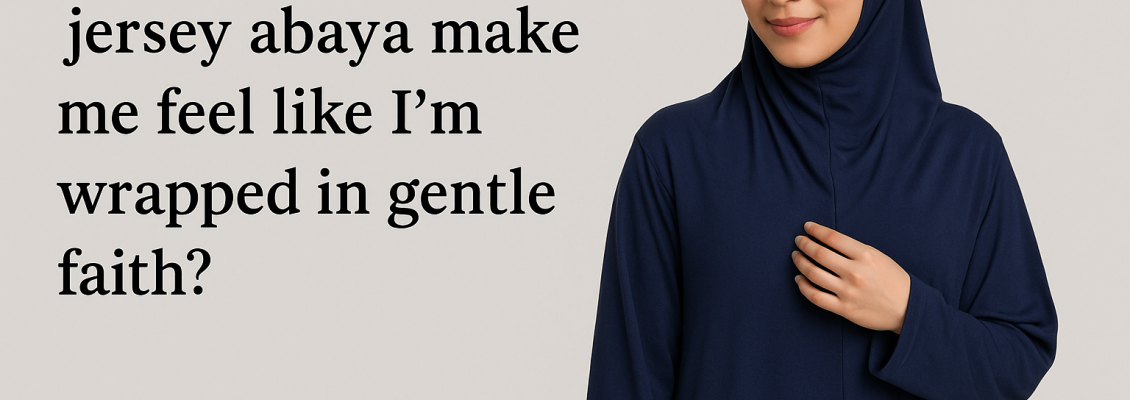
Bismillah. It was somewhere between the silence of Fajr and the echo of yesterday’s doubts that I found myself pulling my jersey abaya over my head again — not out of habit, but out of need. The kind of need that isn’t loud or desperate, but quietly aching. June mornings carry a stillness that reminds me of the parts of myself I rarely speak about — the parts that crave gentleness, safety, and something that feels like home.
The sky outside was the color of soft linen, and the birds had just begun their tahmeed. And there I stood, still half in shadow, wrapping fabric around a body that has known both rebellion and return. The jersey abaya slid over me like a du’a I didn’t know I had been whispering — simple, stretchy, forgiving — but somehow weighted with barakah. This wasn’t just getting dressed. This was remembering who I was when the world wasn’t watching.
I used to think modest fashion was about being seen less. Now, I understand: it’s about being seen right. And wearing a jersey abaya — with its quiet flow and comforting hold — has become my daily return to that truth. It doesn’t try to impress. It tries to shelter. And in that, I find so much ease.
There are stories in the seams. Of every time I slipped it on while feeling unsure. Of the days I wore it while discovering new edges of my iman. Of the prayers it absorbed while I wept quietly in sujood. It holds no labels, no loudness — just me, trying, failing, returning, and believing again.
So, my dear sister — if you’ve ever wondered how clothing could carry your faith, or if something as simple as jersey could reflect something as sacred as trust in Allah — walk with me through this post. It’s not a guide. It’s a journey. And like all real journeys, it begins not with steps, but with sincerity.
Let’s begin.
Table of Contents
- What if I never truly felt modesty until I slipped into my first jersey abaya?
- Why did covering feel like a burden before — and why does this jersey abaya feel like relief?
- How did I mistake tight clothes for confidence and overlook the softness of surrender?
- Am I allowed to love how the jersey abaya clings without exposing, hugs without showing?
- What changed the day I realized modesty wasn’t invisibility — it was protection?
- Why does every morning feel gentler when I reach for my jersey abaya instead of my old wardrobe?
- Is it strange that the fabric of my jersey abaya feels more comforting than some friendships?
- How did this jersey abaya become a place I retreat to when my heart feels noisy?
- What am I really shedding when I choose the jersey abaya over society’s expectations?
- Why does wearing my jersey abaya feel like I'm whispering “I trust You, Allah” without words?
- Can a jersey abaya really help heal the wounds I kept hidden beneath trendy clothes?
- When did my reflection stop making me anxious — and start feeling like a woman of faith?
- Why do I feel closest to my truest self on the days I walk out wrapped in my jersey abaya?
- What silent du’as are stitched into the folds of this simple, stretchy fabric?
- How did I go from fearing judgment to feeling like my jersey abaya is my quiet rebellion?
- Am I allowed to feel beautiful — even magnetic — inside something so modest?
- Why does my jersey abaya move with me like a dua I never knew I needed?
- Is this what it means to find sakinah — when my jersey abaya touches my skin and calms my soul?
- Can I still be stylish, expressive, and seen while being completely covered?
- What’s the secret softness in the jersey abaya that reminds me Allah sees me fully?
- Why does every jersey abaya I own carry a different chapter of my spiritual story?
- How did this jersey abaya become a silent witness to my private victories?
- Why do I feel part of a global sisterhood when I wear this humble fabric?
- What if wrapping myself in my jersey abaya is the closest thing to hugging my own soul?
- Am I finally understanding that modesty isn’t what I take off — but what I lovingly put on?
- Frequently Asked Questions
- People Also Ask (PAA)
What if I never truly felt modesty until I slipped into my first jersey abaya?
I used to think modesty was just about rules. Lines not to cross. Sleeves long enough, neckline high enough, fabric thick enough. I followed the checklist, ticked the boxes, but something always felt... off. Like I was obeying without understanding. Like my clothes were modest, but my heart wasn’t in it.
And then one day — I still remember the exact light filtering through the window — I slipped into a jersey abaya for the first time. Not the structured ones I had seen on mannequins, not the stiff black shells that looked more like uniforms than clothing. This one was soft. Stretchy. Unapologetically simple. It didn’t come with a brand tag that screamed luxury. But the way it rested on my body — loose yet close, flowing but not frumpy — something inside me softened. Or maybe something finally clicked.
I looked in the mirror, expecting to see the same girl who always wondered if she was doing enough — or too much. But she wasn’t there. Instead, I saw someone new. Or maybe someone old, someone truer. My face wasn’t “beat.” My hair wasn’t done. I wasn’t trying to be seen. And yet, I had never felt so visible to myself — and so invisible to the dunya. It was quiet. It was powerful. It was the first time modesty didn’t feel like shrinking.
Before that jersey abaya, I had tried on dozens of versions of modesty. Some tight and tucked, others loose but lifeless. I had borrowed styles from cultures not mine, tried to imitate influencers, followed trends that felt more curated than sincere. But nothing ever rested on my skin the way that jersey did. It was as if it molded not to my body, but to my intentions.
Here’s what I realized that day — modesty wasn’t just about what I covered. It was about what I uncovered. My need for attention. My craving for validation. My internalized belief that I had to be attractive to be acceptable. When I wore that jersey abaya, for the first time, I wasn’t dressing for anyone but Allah. And that kind of liberation? It’s something no designer label could ever replicate.
A before-and-after I never expected
| Before Jersey Abaya | After Jersey Abaya |
|---|---|
| Fidgeting with hijab pins, worried about shape | Relaxed shoulders, breathing easier |
| Styling outfits for others’ eyes | Dressing with intention and peace |
| Fear of “not looking put-together” | Confidence rooted in sincerity |
| Chasing trends, never quite satisfied | Finding joy in simplicity |
| Modesty as pressure | Modesty as privilege |
That jersey abaya became more than fabric. It was a friend. A mirror. A moment of surrender. I wore it through seasons of confusion, through long bus rides after night classes, through tear-streaked Ramadan nights. It hugged me in prayer and cloaked me in the mundane. And no matter what my day held, I never felt exposed. I felt held.
And I know, to the outsider, it might look “plain.” Not glamorous. Not #modestfashion enough. But to me, it was a turning point. It was the first garment I wore that didn’t ask me to perform, didn’t need me to accessorize or overcompensate. It just asked me to show up — sincere, seeking, and ready to be transformed.
Since then, jersey abayas have become my go-to. Not because I can’t afford other styles. Not because I’m lazy or uninspired. But because they remind me of that first real taste of modesty. The kind that whispers instead of shouts. The kind that lets me focus on my actions instead of my angles. The kind that makes me feel both invisible to the dunya and so seen by my Creator.
And maybe that’s the secret: it wasn’t the abaya itself. It was what it gave me permission to feel. Peaceful. Covered. Womanly in a way that had nothing to do with curves and everything to do with character. I began to see beauty in quiet folds, strength in simplicity. I began to see that dressing for Allah didn’t mean abandoning myself — it meant finally finding myself.
So, what if I never truly felt modesty until I slipped into my first jersey abaya?
Then alhamdulillah — because that first time led me here, to a life where I choose softness without shame, concealment without erasure, and faith without the need for performance. Where jersey wraps not just my body, but my heart, in a faith that feels gentle — and real.
Why did covering feel like a burden before — and why does this jersey abaya feel like relief?
There was a time — not long ago — when covering felt like wearing an apology. An apology for existing too boldly, for taking up too much space, for the way my body curved or moved or stood still. The layers of fabric didn’t feel like protection then. They felt like shame stitched into seams. And every time I left the house, I carried the weight not just of cloth — but of everyone’s expectations, judgments, and unspoken rules.
I remember how heavy it all felt. Not just on my shoulders, but on my spirit. Modesty wasn’t this warm, loving concept I now hold close — it was a list of don'ts. Don’t show this. Don’t accentuate that. Don’t wear color. Don’t move too freely. It felt like a performance I could never get quite right. If I looked too plain, I was “too extreme.” If I styled it slightly, I was “trying too hard.” And somewhere in that narrow space, I lost sight of myself. I was covering, but I didn’t feel covered.
And then — like a deep exhale I didn’t realize I was holding — came the jersey abaya.
I didn’t expect it to change much. It wasn’t a flashy piece. It didn’t scream fashion. It didn’t drape in theatrical layers or come with beaded elegance. But the moment I put it on, I felt something shift. Not just in my body, but in my heart. There was a softness in the way it moved. A permission in the way it rested gently against me. It didn’t fight my form. It didn’t police it either. It just... settled. And in that settling, I found relief I didn’t know I needed.
The burden wasn’t just about modesty. It was about identity. About being torn between who I thought I needed to be and who I was called to become. About trying to be devout and stylish, modern and pious, visible and modest — all at once. No one ever told me I could stop trying so hard. But the jersey abaya did.
Wearing it was like being embraced by ease. It flowed with me, not against me. It didn’t ask for layers of styling or constant readjusting. It allowed me to focus on my actions, my intentions, my worship — not my image. And slowly, I began to untangle modesty from struggle. I began to rewrite the narrative. Covering was no longer about hiding — it was about healing.
From weight to warmth: how my perspective shifted
| When Covering Felt Like a Burden | When the Jersey Abaya Became Relief |
|---|---|
| Felt like I was shrinking myself | Felt like I was honoring myself |
| Focused on other people’s approval | Focused on Allah’s pleasure |
| Layers felt restrictive and hot | Fabric felt breathable and freeing |
| Worried I looked “too much” or “not enough” | Felt enough just as I was |
| Every outing felt like a test | Every day felt like a return to self |
That first jersey abaya became my refuge on hard days. The days I didn’t feel pretty. The days I didn’t feel strong. The days I questioned why I was on this path at all. I’d slip it on, and it would remind me that faith doesn’t always roar — sometimes, it whispers. Sometimes, it shows up in the softness of fabric and the gentleness of covering for the sake of Allah, not because I have to, but because I want to.
I think many of us carry modesty wounds. From cultures that enforced it without love. From communities that judged without compassion. From fashion spaces that dismissed it entirely. But the jersey abaya doesn’t carry any of that weight. It’s not loaded with expectations. It’s light. Forgiving. It lets you breathe. And breathing — when you’ve spent years suffocating under everyone else’s opinions — is sacred.
Sometimes I wonder if the Prophet ﷺ’s wives wore garments that made them feel this way. Comfortable. Capable. Covered and confident. Not performative, but purposeful. When I wear my jersey abaya now, I feel connected to that legacy. To the women who chose covering not to disappear, but to show up with their deen front and center. There’s power in that. Quiet, but unmistakable.
So yes, covering used to feel like a burden. But that was before I understood what it was meant to be. Before I met a garment that didn’t try to change me — only hold me gently while I changed. And maybe that’s what relief is. Not the absence of effort, but the presence of peace.
If you’ve ever felt suffocated by the way modesty was handed to you — know that it doesn’t have to be that way. There is softness here. There is ease. And sometimes, it starts with something as simple as a jersey abaya, draped around your shoulders like a silent reminder: you are enough, and you are held — by cloth, by conviction, and most of all, by your Creator.
How did I mistake tight clothes for confidence and overlook the softness of surrender?
I used to think power lived in the silhouette — in the sharp angles of a cinched waist, the deliberate curve of fitted jeans, the clean line of a blazer that said, “Look at me. I’m here.” I truly believed that confidence was sewn into seams that hugged too tight and necklines that dipped just a little too low. That if I looked put together — sculpted, styled, sharp — I’d feel put together too. Like I could walk through a room and not just be noticed, but respected.
But what I didn’t realize then — what I only came to understand through the quiet language of fabric and faith — is that there’s a difference between being seen and being secure. And the clothes I wore back then, as polished as they were, were never designed to hold me. They performed. They accentuated. They demanded constant maintenance. But they didn’t protect. They didn’t ease. They didn’t let me rest.
Confidence, I’ve learned, isn’t loud. It isn’t stiff or contoured. And it certainly isn’t about being on display. True confidence is calm. Quiet. It doesn't beg to be noticed — because it knows its worth in silence. And somehow, unexpectedly, it was the jersey abaya that taught me that.
I still remember the first time I wore one out in public. I felt like I was betraying a version of myself — the curated version who knew exactly how to balance modesty and trend, who could contour her face into angles just right for the camera. But that version of me had always been a little tired. A little unsure. A little hungry for approval she never fully received. And when I stepped outside in that jersey abaya — loose, flowing, unassuming — I didn’t feel invisible. I felt weightless. I felt free.
That’s when I started to understand: the tightness wasn’t confidence. It was armor. It was me trying to control how I was perceived, because I didn’t yet believe I was worthy of love, attention, or dignity on my own terms. I dressed like I had something to prove. And the jersey abaya — soft, stretchy, and deeply forgiving — allowed me to dress like someone who finally had nothing to prove anymore.
The softness of surrender — I didn’t even know I was allowed to crave it. That I could wear something that didn’t shout, didn’t cling, didn’t sculpt — and still feel powerful. Still feel beautiful. Still feel entirely present in my body without needing it to perform.
What I thought confidence was vs. what it truly became
| What I Used to Believe | What I Know Now |
|---|---|
| Confidence is showing your shape | Confidence is being unbothered by not showing it |
| Tight = strong, in control | Loose = secure, surrendered |
| More skin, more attention = more power | More coverage, more intention = more peace |
| Style is being seen | Style is choosing what to reveal and what to protect |
| Outer boldness masks inner fear | Inner calm radiates without needing to shout |
There’s something so intimate, so disarming, about soft fabric that doesn’t beg for validation. The jersey abaya doesn’t sculpt me into someone I’m not. It allows me to show up — as I am — in full surrender. And that surrender? It’s not weakness. It’s trust. Trust in Allah. Trust in the garment. Trust in the version of myself that no longer needs to prove anything through tightness or trendiness.
I think back to the younger me — layering and contouring, practicing poses in the mirror to make my body look a certain way. And my heart aches for her. She was trying so hard to matter. To be seen as enough. But now, wrapped in the jersey abaya, I realize I’ve always been enough — not because of how I presented myself, but because of the ruh within me, the soul already honored by Allah ﷻ before I even chose my outfit for the day.
The softness of surrender is this: waking up and not dreading the mirror. Getting dressed and feeling comfort instead of pressure. Knowing that the world might not see your curves, but your Lord sees your effort. Feeling whole — not because your body is outlined perfectly, but because your heart is finally at ease inside the garment you chose for His sake.
I wear my jersey abaya like a prayer now. A quiet, daily reminder that I no longer need to armor myself in tightness. That real confidence isn’t built from the outside in — it’s gifted from the inside out. And when that confidence is rooted in surrender to Allah, it no longer needs the validation of trends or glances or likes. It stands on its own. Soft. Strong. Sure.
So no, I don’t mistake tight clothes for confidence anymore. I’ve found something better. Something quieter. Something sacred. The softness of surrender — and the strength it brings — has changed the way I move through the world. And the jersey abaya, in all its simplicity, is the garment that carried me there.
Am I allowed to love how the jersey abaya clings without exposing, hugs without showing?
There’s a quiet tension in the way we talk about modesty — like it’s a strict boundary drawn in harsh lines, where love and beauty are strangers, and the body must be hidden like a secret best left untouched. But I’ve come to realize that modesty isn’t a cage; it’s a sanctuary. And sometimes, the most sacred sanctuary feels like the soft embrace of fabric that knows you intimately, yet respects every boundary you’ve set.
So here I am, asking myself — and you, sister — am I allowed to love how the jersey abaya clings without exposing, hugs without showing? To love how it settles around my curves like a whispered promise rather than a loud proclamation? To find grace in the way it follows the gentle flow of my body without betraying it?
For so long, I was taught to fear any fabric that even hinted at my shape. Anything that might betray the contours beneath was suspect, a test of my intentions. And yet, when I slipped into my first jersey abaya, I found a paradox — this garment, light and stretchy, felt like a second skin, but one woven with respect. It acknowledged my form but didn’t reveal it. It embraced without exposing.
There is a softness in this duality that I never expected. The jersey abaya holds me close, but it does so with kindness, not scrutiny. It gives warmth without weighing me down, hugs without revealing. It is modesty wrapped in mercy — an answer to the unspoken prayer for dignity that doesn’t erase femininity.
How modesty transformed for me through fabric
| Before the Jersey Abaya | After the Jersey Abaya |
|---|---|
| Modesty felt like hiding everything | Modesty became honoring what’s underneath |
| Fabric was thick, stiff, suffocating | Fabric became soft, flowing, freeing |
| Wore loose layers to obscure shape | Wore gentle contours that respected boundaries |
| Clothes felt like armor | Clothes felt like a warm embrace |
| Covered but disconnected | Covered and deeply connected to self |
There is a spiritual surrender in loving a garment that clings just enough to remind you you are alive — alive with intention, with dignity, with faith — but not so much that it becomes a distraction or a temptation. It is a balance I never thought I could find. The jersey abaya doesn’t just cover me; it comforts me. It does not shout modesty; it whispers it. And that whisper feels like mercy.
In my journey, I learned that modesty is not a suppression of beauty, but a celebration of self-respect. It’s the permission to be seen in a way that honors the soul, not just the body. To love how the jersey abaya hugs without showing is to embrace that permission — to trust that modesty and femininity can coexist, gently, gracefully.
And so I ask again: am I allowed to love this? To find solace in a fabric that clings but never betrays? To cherish the way it moves with me, like a quiet friend walking alongside rather than a prison wall confining me?
Yes, I am. Yes, we are. Because love for modesty is not about denial or fear. It is about affirmation — affirmation that we deserve clothes that care for us, that honor us, that reflect the light within us without exposing what should remain sacred.
Wearing the jersey abaya, I feel wrapped in that sacred balance. I feel like a woman who can walk with confidence and humility at the same time, who can be soft yet strong, visible yet veiled. And this love — this deep appreciation — is not a contradiction. It is the heart of my modest journey.
So to every sister wrestling with these feelings, I say: yes, you are allowed. You are allowed to find beauty in modesty that clings without revealing, to cherish coverings that hug without exposing. You are allowed to love your body while honoring your faith. And in that love, you will find peace.
What changed the day I realized modesty wasn’t invisibility — it was protection?
For years, I carried a heavy burden of misunderstanding about modesty. I thought it meant shrinking into the background, folding myself into shadows, and erasing my presence like an unwanted whisper. Covering, to me, was a command to disappear — to become invisible so that no one would notice, judge, or objectify. I equated modesty with invisibility, and invisibility with safety. I believed that if I could just make myself small enough, pale enough, unnoticeable enough, I would be spared the harsh eyes of the world. But this belief, though well-intentioned, weighed down my soul and distorted my understanding of faith.
I remember the day this changed — not with a loud epiphany, but with a quiet, almost imperceptible shift. It was a day much like any other, yet somehow everything felt different. I was wearing my jersey abaya, that soft, forgiving fabric that hugs gently yet shields firmly. As I walked beneath the canopy of ancient trees near my home, a breeze lifted the hem of my abaya, and the sunlight danced on the fabric. In that moment, I felt not like a shadow, but like a presence — a woman wrapped in care, dignity, and intention.
It was then that the truth settled deep within my heart: modesty isn’t invisibility. It is protection. It is a shield for the sacred trust that is my body, my spirit, and my faith. This simple realization began to untangle the knot of confusion and pain that had entangled my modesty journey for so long.
When I first embraced covering, my heart was filled with fear and uncertainty. I wore layers of fabric, draping myself in thick cloths to hide every curve, every line. I believed that by disappearing into my clothing, I was honoring Allah’s command and protecting myself from unwanted attention. But the more I tried to vanish, the more lost I felt. My clothing became a barrier not just between me and the world, but between me and my own sense of self. I was covered, yes, but I was also erased.
The jersey abaya changed that. Unlike the heavy, stiff fabrics I had struggled with before, the jersey abaya is a gentle embrace. Its fabric stretches just enough to move with me, not against me. It’s soft, breathable, and modest — a perfect harmony of comfort and concealment. This abaya did not erase me. It protected me.
That day, walking in the garden, I realized that modesty is not about making myself invisible so that others feel comfortable. It’s about choosing what to reveal and what to protect with wisdom and intention. It’s about guarding my dignity and honoring the sacred trust Allah has given me. Modesty is a shield, not a veil of invisibility. It’s a declaration that I am worthy of protection, respect, and love — from others and from myself.
How my understanding of modesty transformed
| Before | After |
|---|---|
| Hiding from the world | Choosing what to reveal |
| Fear of judgment and exposure | Confidence in my sacredness |
| Feeling invisible and erased | Feeling protected and dignified |
| Heavy, suffocating fabrics | Soft, flowing jersey abaya |
| Modesty as a burden | Modesty as empowerment |
This shift in perspective opened a new chapter in my spiritual journey. Instead of covering as a chore or a punishment, I began to wear modesty as armor — not armor that weighs me down or limits me, but armor that frees me to move with peace and confidence. The jersey abaya became more than a garment; it became a symbol of self-respect, faith, and self-care.
I learned that protection through modesty is deeply personal. It’s not about hiding from the world in fear, but about stepping into it with intention and strength. It’s about acknowledging my worth and honoring my boundaries. It’s about nurturing the sacredness of my body and spirit, knowing they belong to Allah first and foremost.
The day I embraced this truth, my relationship with modest fashion transformed. I no longer sought to smother my identity beneath layers of fabric. Instead, I sought clothing that would protect without suffocating — clothing like the jersey abaya that moves with me, breathes with me, and honors me.
There is a profound peace in this understanding. When modesty is protection, I no longer fear the gaze of others because my confidence does not depend on their approval. I am not invisible; I am present, dignified, and whole. My modesty is a shield, a gentle barrier that guards my heart and soul, allowing me to engage with the world without fear or shame.
To my sisters walking this path, I want to say: modesty is not a prison, nor is it a command to erase yourself. It is a sacred choice to protect what is precious — your body, your heart, your faith. And it is okay to seek comfort and beauty in that protection. It is okay to wear your modesty with pride, wrapped in fabrics that honor you and a faith that empowers you.
So today, as I don my jersey abaya, I do so not to disappear, but to stand firm — protected, dignified, and radiant in the light of my Creator’s mercy. And that realization has forever changed the way I understand modesty: not as invisibility, but as protection.
Why does every morning feel gentler when I reach for my jersey abaya instead of my old wardrobe?
There is a softness in the morning light now that wasn’t always there. It’s the kind of gentle peace that stretches through the quiet moments before the day truly begins — the stretch of my fingers as I rise, the first sip of water, the subtle hum of dawn settling over the world. And more often than not, this gentle feeling starts with what I choose to wear: my jersey abaya.
For years, mornings felt like a battleground. I’d stare at my old wardrobe — the stacks of fitted clothes, the fabrics that tugged and pinched — and feel a rush of anxiety before I even got dressed. The tight jeans that insisted on being perfect, the blouses that showed just enough to make me self-conscious, the heavy layers I wore to hide parts of myself I wasn’t ready to accept. These were the clothes of a younger me, a me struggling between wanting to be seen and fearing how I’d be perceived.
But the jersey abaya changed everything.
When I reach for it first thing in the morning, there’s no resistance. No tugging or pulling. The fabric slides over my skin like a whispered promise — soft, forgiving, and steady. It wraps around me in a way that feels like a gentle hug, not a tight grasp. It doesn’t demand my attention with flashy patterns or bold cuts; instead, it offers a quiet sanctuary I can step into before the world calls me out.
This simple choice transforms the start of my day. Instead of the familiar stress of shaping myself to fit others’ expectations, I find space to breathe. The jersey abaya gives me permission to be gentle with myself — to honor my body, my faith, and my mood all at once.
Old wardrobe vs. jersey abaya: a morning comparison
| Old Wardrobe | Jersey Abaya |
|---|---|
| Tight, restrictive clothes | Soft, stretchy fabric |
| Layers to hide and shape | Flowing, forgiving silhouette |
| Clothes that demanded perfection | Clothes that embraced imperfection |
| Mornings started with anxiety | Mornings start with calm |
| Style felt like a performance | Style feels like a prayer |
Each morning, the jersey abaya teaches me something new about kindness — kindness to my body, which no longer needs to be contorted or compressed; kindness to my soul, which no longer needs to feel guarded or on edge; kindness to my faith, which I now wear visibly and proudly, but without pressure.
There is a subtle spirituality in choosing comfort over constraint, in dressing for presence rather than performance. The jersey abaya doesn’t just cover me; it prepares me for the day by nurturing my spirit. It reminds me that modesty is not a punishment, but a peace — a way to show up in the world as my fullest, most authentic self.
Reaching for my jersey abaya is like turning a page in a journal I’ve been writing in silence. It’s a ritual of self-care, a daily act of surrender to what truly matters. The fabric, soft and forgiving, feels like a tangible expression of mercy — mercy I grant myself to start the day with grace.
There is a freedom in this softness. Freedom from the expectations that once clouded my mornings. Freedom from the weight of appearance. Freedom from the fear of being “too much” or “not enough.” In my jersey abaya, I am simply me — wrapped in faith, dignity, and warmth.
This gentle morning routine has shifted not only how I dress, but how I move through my days. I carry that softness with me — in my interactions, my prayers, my moments of doubt and joy. The jersey abaya is more than fabric; it’s a companion on my spiritual journey, a reminder that faith can be gentle, and modesty can be kind.
To any sister who feels overwhelmed by the rush of mornings or the pressure to look a certain way, I offer this: start with kindness. Choose garments that honor you, comfort you, and allow you to breathe. Let your mornings be gentle, not grueling. Let your faith shine quietly beneath soft layers that hug you without holding you captive.
Every morning, when I pull on my jersey abaya instead of my old wardrobe, I feel wrapped not only in fabric but in mercy — mercy from my Creator, mercy for myself, and mercy for the woman I am becoming. And that mercy makes every morning a little gentler, a little brighter, a little more alive.
Is it strange that the fabric of my jersey abaya feels more comforting than some friendships?
Sometimes, the quietest things hold the deepest comfort. On days when my heart feels heavy and the noise of the world is too much, I reach for my jersey abaya — that soft fabric that wraps me like a gentle whisper. And in those moments, I wonder: is it strange that the fabric of my jersey abaya feels more comforting than some friendships?
Friendships are meant to be the safe harbors of our lives. Yet, sometimes, they come with unspoken expectations, disappointments, and silences that sting. They can falter under the weight of misunderstandings or the distance grown from busy lives and unshared prayers. There have been times when I craved the warmth of a friend’s embrace but instead found the coldness of absence.
In contrast, my jersey abaya never judges me. It never asks for more than what I can give. It holds me steadily, no matter how I feel — stretched or loose, joyful or tired. Its fabric is consistent, forgiving, and kind. Unlike people, it doesn’t carry the weight of unmet expectations or painful words. It simply enfolds me, reminding me that comfort can be found in the most unexpected places.
Friendships then and now: a comparison of comfort
| Some Friendships | Jersey Abaya Fabric |
|---|---|
| Fragile under strain | Steady and reliable |
| Sometimes hurtful or distant | Always gentle and close |
| Require energy and effort | Offers effortless comfort |
| Can leave you feeling vulnerable | Provides a safe, protective embrace |
| Temporarily present | Constant and reassuring |
Is it strange that the fabric of my jersey abaya offers a sanctuary when the people I hold dear sometimes cannot? Perhaps not. Because sometimes the love we seek from others first must be nurtured within ourselves. The jersey abaya, with its soft stretch and modest grace, has become more than just clothing; it is a tender act of self-care and self-compassion.
I’ve come to understand that comfort doesn’t always come from words or presence — sometimes it comes from the physical sensation of being wrapped in mercy, humility, and faith. My jersey abaya is a daily reminder that I am worthy of kindness, even when the world around me feels inconsistent. It cradles my vulnerabilities without demanding explanations or conditions.
In many ways, my jersey abaya mirrors the kind of friendship I strive to cultivate — steady, accepting, and gentle. It never judges my flaws or exposes my insecurities. Instead, it embraces them quietly, allowing me to breathe and be myself. And isn’t that what true friendship should feel like? A space where you can be both seen and sheltered?
This reflection isn’t a dismissal of the precious friendships I cherish. Rather, it is a recognition of how healing can come from unexpected places, especially when human connections falter. It’s an invitation to cherish the softness we find — whether in people, fabric, or faith — that reminds us we are never truly alone.
To every sister who has felt lonely even among friends, know this: it’s okay to find comfort in small, steady things. It’s okay to lean on your faith, your prayers, and yes, even the fabric that wraps you in modesty and mercy. These are not replacements but supplements, reminders that your worth and peace are not dependent solely on others’ presence.
So, if the fabric of your jersey abaya feels like a warmer embrace than some friendships, you are not strange. You are human — seeking softness and sanctuary in a world that often feels harsh and uncertain. And in that fabric’s gentle hug, may you find the peace your heart longs for.
How did this jersey abaya become a place I retreat to when my heart feels noisy?
There are days when the noise in my heart becomes too loud to bear — the clamor of doubt, anxiety, unmet expectations, and restless thoughts crowding every corner of my mind. On such days, I seek refuge. Not always in words, not always in prayer alone, but in something tangible, a quiet sanctuary woven from fabric and faith: my jersey abaya.
It puzzles me sometimes — how a piece of clothing can hold such emotional weight, can become more than mere fabric draped over skin. Yet, the jersey abaya is exactly that for me — a retreat, a quiet space where my soul can exhale and find calm amidst the chaos.
When I slip into it, the soft embrace of the fabric wraps around me like a comforting sigh. The gentle stretch molds without restriction, a physical reminder that I do not need to be rigid, perfect, or sharp to be worthy of love and acceptance. It is in that softness that I find permission to be vulnerable without fear.
Before this jersey abaya entered my life, my heart’s noise often felt overwhelming. I tried to silence it with busyness, with forcing myself to “just be strong.” But strength without softness is brittle; it cracks and shatters under pressure. The jersey abaya teaches me that surrender and strength can coexist — that being wrapped in modesty does not mean being muted or diminished.
My heart’s noise before and after finding refuge in the jersey abaya
| Before | After |
|---|---|
| Restless, anxious thoughts | Gentle acceptance of my feelings |
| Pressure to be perfect and unshaken | Permission to be human, soft, and growing |
| Noise that demanded immediate silencing | Quiet moments of reflection and calm |
| Feeling isolated in my struggles | Feeling embraced by faith and self-care |
| Wearing clothes that felt constricting | Wearing the jersey abaya’s soothing fabric |
In many ways, this jersey abaya has become my armor and my comfort blanket all at once. It shields me from the intrusive eyes of judgment and self-criticism, while inviting me into a sacred space where my heart’s whispers are heard and honored. It reminds me that modesty is not a cage, but a refuge — a place where faith and softness meet.
Each time I reach for it, I feel a subtle invitation: to slow down, to breathe, to surrender my worries to Allah’s mercy. The jersey fabric’s familiar texture becomes a tactile dua, a prayer without words that speaks to my soul’s deepest needs. It’s a reminder that no matter how noisy my heart becomes, I can always find a place of peace to return to.
This retreat is not just about physical comfort; it is deeply spiritual. It echoes the mercy Allah shows us — gentle, patient, enveloping. And in that mercy, I find strength to face the noise, knowing that my vulnerability is a part of my beauty, not a weakness to hide.
There is a profound lesson in this: sometimes, the places we retreat to are not grand or visible. They are quiet, soft, and unassuming — like the jersey abaya that moves with me, breathes with me, and holds space for my healing.
To any sister feeling overwhelmed by the chaos inside her, I say: seek your sanctuary, whatever form it may take. For me, it is the soft fabric of my jersey abaya, a tender reminder that peace begins when we allow ourselves to be held — gently, lovingly, and faithfully.
What am I really shedding when I choose the jersey abaya over society’s expectations?
Choosing to wear the jersey abaya is not simply a matter of fabric or fashion — it is a profound act of shedding. But what exactly am I shedding when I reach for that soft, modest garment instead of conforming to the swirling, often harsh expectations society places on me?
At first glance, it might seem like I am only shedding a style, a trend, or the latest version of what is deemed “acceptable” by the world around me. But the truth runs far deeper, reaching into the core of my identity, my values, and my relationship with myself and my Creator.
When I choose the jersey abaya, I am shedding the weight of external validation. I am releasing the need to be seen, judged, or measured by the standards that society sets — standards that often contradict my faith, my comfort, and my dignity. It is a quiet rebellion, not loud or confrontational, but steady and resolute.
More than that, I am shedding the anxiety that comes from trying to fit into a mold that was never meant for me. Society’s expectations often demand women to be everything at once — beautiful but not too bold, successful but not too ambitious, modest but not invisible. These contradictory messages create a heavy fog that clouds my self-worth and peace. The jersey abaya becomes my clearing, my fresh air.
Society’s expectations vs. my choice: a shedding comparison
| What Society Expects | What I Shed by Choosing the Jersey Abaya |
|---|---|
| Approval through appearance | The pressure to conform visually |
| Being judged by trends and fleeting standards | Attachment to temporary validation |
| Competing for attention and status | The exhausting chase for approval |
| Fitting a stereotype of “womanhood” | The chains of imposed identity |
| Silencing personal faith in favor of popular culture | The fear of standing apart or being misunderstood |
But shedding is not only about letting go; it is about making space. Each layer I shed creates room for something more authentic, more aligned with my soul. The jersey abaya allows me to reclaim my narrative — one written by my own values, my own faith, and my own sense of peace.
In this shedding, I find freedom — freedom from the endless comparisons, from the judgmental glances, and from the constant inner dialogue of “Am I enough?” The jersey abaya does not ask me to be perfect. It welcomes my imperfections and wraps them gently in fabric that honors my body and my beliefs.
This choice also means shedding fear — fear of standing out, of being misunderstood, of not fitting in. But with that fear comes courage, a quiet bravery that whispers, “You are enough as you are.” The jersey abaya becomes a symbol of that courage, a soft armor that shields me not just physically but emotionally and spiritually.
And what emerges from this shedding is not emptiness, but fullness — fullness of faith, identity, and self-respect. I am no longer defined by the fleeting and often contradictory expectations of society. Instead, I am defined by the mercy and guidance of Allah, by the values that nourish my heart, and by the grace I extend to myself.
To sisters who wrestle with these same societal pressures, I say this: choosing modesty, choosing the jersey abaya, is an act of reclaiming your soul. It is saying yes to yourself, yes to your faith, and yes to a peace that transcends the noise around you.
So what am I really shedding? I am shedding doubt, judgment, fear, and the exhausting chase for validation. And in their place, I am embracing authenticity, comfort, dignity, and faith. The jersey abaya is more than a garment; it is a declaration of freedom and love — for myself, for my Creator, and for the journey I am honored to walk.
Why does wearing my jersey abaya feel like I'm whispering “I trust You, Allah” without words?
There’s a quiet language that exists between the soul and the fabric that wraps it — a silent dialogue of trust, surrender, and faith. Every time I slip into my jersey abaya, I feel as though I am whispering a prayer, “I trust You, Allah,” without uttering a single word. But why is this so? How can a simple garment hold such profound spiritual resonance?
At first glance, the jersey abaya may seem just fabric—soft, modest, comfortable—but for me, it has become a sacred vessel of connection and submission. Wearing it is not just about covering my body; it is about uncovering the depths of my reliance on Allah, the One who sees beyond what eyes can witness.
The jersey abaya’s gentle drape, its forgiving stretch, its modest silhouette—they all remind me that my trust in Allah is not rigid or forced, but flexible and tender. It teaches me that faith is not about constriction but about freedom within limits — a freedom found when I surrender my worries, my fears, and my need for control to the One who is All-Knowing and All-Merciful.
Trust in Allah before and after embracing the jersey abaya
| Before Wearing the Jersey Abaya | After Wearing the Jersey Abaya |
|---|---|
| Faith felt heavy, like a burden to carry alone | Faith feels like a gentle embrace, a shared weight |
| Struggling to accept uncertainty | Welcoming the unknown with patience |
| Fear of judgment and vulnerability | Peace in surrendering to Allah’s plan |
| Seeking control in every decision | Finding ease in trusting Divine wisdom |
| Disconnected from my spiritual self | Clothed in the fabric of devotion and humility |
There is a humility in wearing the jersey abaya that mirrors the humility required in faith. It teaches me that trust is not passive; it is active, continuous, and tender. Each day, when I choose to wear it, I renew my commitment to lean on Allah’s guidance, to accept His timing, and to walk my path with grace even when the road is unclear.
More than a piece of clothing, the jersey abaya becomes a symbol of my submission — a visible reminder that I am wrapped in His mercy and that my modesty is an expression of my inner reliance on Him. It whispers to the world and to my own heart that I do not fear what others think, because my ultimate trust lies with Allah alone.
In moments of doubt, when my heart trembles and my thoughts race, pulling on my jersey abaya feels like a soft prayer, a quiet declaration that I am choosing faith over fear. It grounds me, reminding me that surrender is not giving up but giving over — handing my worries, my plans, and my future into the hands of the Most Compassionate.
This silent whisper, “I trust You, Allah,” carried by the fabric against my skin, is a balm for my restless spirit. It calms the turmoil within and opens space for hope, patience, and gratitude. It connects me to the countless women before me who clothed themselves in modesty as an act of devotion, resilience, and love.
To my sisters navigating the complexities of faith and fashion, know this: your clothing can be a spiritual language. When worn with intention, your jersey abaya is more than fabric — it is a prayer, a shield, and a testament to the trust that quietly blooms in your heart every time you dress yourself in modesty.
So, why does wearing my jersey abaya feel like I’m whispering “I trust You, Allah” without words? Because in its soft folds, I find a sacred space where faith breathes, trust grows, and the heart surrenders — all without a single sound.
When did my reflection stop making me anxious — and start feeling like a woman of faith?
For so long, the mirror was a battleground — a place where anxiety brewed quietly beneath the surface of my gaze. I would look, and instead of seeing myself, I saw the weight of expectations, the flaws magnified, the insecurities laid bare. My reflection was a reminder of all I feared: not being enough, not fitting in, not measuring up.
When did this change? When did that same reflection stop being a source of unease and start becoming a testament to my faith — a quiet, steadfast affirmation that I am a woman beloved by my Creator? That shift did not come suddenly or easily. It was a slow unfolding, a spiritual and emotional metamorphosis guided by intention, prayer, and the gentle embrace of modesty — especially in the form of my jersey abaya.
Before, my reflection echoed the world’s loud voice, pushing me to conform to its standards: thin enough, fashionable enough, flawless enough. The anxiety it stirred was rooted in comparison, in fear of judgment, and in a fragile self-worth that wavered with every glance. I sought validation in external approval, but it was never enough. I felt like a chameleon, constantly adjusting to please, yet never fully seen or at peace.
Then came the jersey abaya — soft, flowing, modest — and with it, a new lens through which to view myself. Draped in its gentle fabric, my reflection transformed. I began to see a woman wrapped not just in cloth, but in dignity, faith, and self-respect. The jersey abaya became a symbol of surrender, reminding me that true beauty and worth come from within and are defined by my relationship with Allah.
Anxiety vs. Faith reflected in the mirror
| Reflection Fueled by Anxiety | Reflection Rooted in Faith |
|---|---|
| Focusing on flaws and imperfections | Recognizing the soul’s beauty and resilience |
| Seeking approval from others | Seeking closeness to Allah and self-acceptance |
| Comparing myself to societal ideals | Embracing my unique journey and identity |
| Feeling fragmented and insecure | Feeling whole and grounded in faith |
| Fear of judgment and rejection | Peace in divine love and mercy |
This transformation was not just about changing how I dressed but about reclaiming my self-image through the sacred lens of Islam. The jersey abaya became my daily reminder that modesty is not about hiding but about honoring — honoring my body, my spirit, and my Creator’s command. It shifted my gaze from self-criticism to self-compassion, from fear to hope.
Looking into the mirror now, I see a woman who has learned to balance humility and confidence, vulnerability and strength. My reflection no longer triggers anxiety but invites reflection — on my faith, my intentions, and my growth. The jersey abaya, with its soft drape and modest elegance, holds a story of healing and acceptance, of a soul wrapped in gentle faith.
To sisters who stand before the mirror burdened by doubt and insecurity, I say: know that your reflection is a canvas — one that changes with the light of your faith and the intentions you nourish within. When you dress with niyyah, when you choose modesty with love, your reflection becomes a sacred reminder of who you truly are — a woman of faith, resilience, and infinite worth.
So when did my reflection stop making me anxious? It was the moment I chose to see myself through Allah’s mercy and wrapped myself in garments that honored both my body and my soul. That was the day my reflection stopped being a source of fear and started becoming a mirror of faith.
Why do I feel closest to my truest self on the days I walk out wrapped in my jersey abaya?
There is a unique stillness that settles over me on those mornings when I slip into my jersey abaya. It is a quiet ritual, almost sacred—a soft embrace that feels like coming home after a long journey. On these days, when I step out wrapped in its gentle folds, I sense a connection to my truest self—one that is often muffled beneath the noise of the world and the chaos of daily life.
But why does this simple act of wearing a jersey abaya feel so deeply aligned with who I am at my core? It is not merely about modesty or tradition; it is about authenticity, vulnerability, and the courage to show up fully as myself—wrapped in fabric that mirrors the softness and strength within.
The jersey abaya does not shout for attention. It does not demand or demand approval. Instead, it whispers of dignity, humility, and a faith that anchors me. Wrapped in this modest garment, I am free from the pressure to perform or conform. The jersey fabric drapes softly but purposefully, reminding me that strength can be gentle and that faith can be a quiet revolution.
Living behind layers before and living authentically in my jersey abaya
| Before Wearing Jersey Abaya | On Days Wrapped in Jersey Abaya |
|---|---|
| Hiding behind layers of expectation and fear | Revealing the soul beneath with confidence and grace |
| Struggling with identity and belonging | Rooted in faith and self-acceptance |
| Seeking approval through appearance | Finding peace in sincere intention and comfort |
| Feeling fragmented and disconnected | Feeling whole, centered, and aligned |
| Silencing vulnerability to appear strong | Embracing vulnerability as strength |
Wrapped in the jersey abaya, I find a reflection of the balance I seek between the seen and the unseen—the visible humility and the invisible faith. It is a reminder that my worth is not dictated by external validation but by the values I hold and the intentions I nurture within my heart.
Each time I wear it, I am reminded of the power in surrender—the surrender to Allah’s will, the surrender to my authentic self, and the surrender to a peace that transcends worldly anxieties. The jersey abaya becomes more than clothing; it becomes a vessel carrying my prayers, my hopes, and my truest essence into the world.
There is also a profound comfort in its touch against my skin—a comfort that feels like a balm for the parts of me that have been hurt or misunderstood. This fabric doesn’t hide me; instead, it cradles my vulnerabilities, allowing me to walk with quiet confidence and grace.
To my sisters who sometimes feel lost amid the pressures of society, know this: your truest self is waiting beneath the layers you wear. It is patient, radiant, and worthy of being seen. The jersey abaya is a reminder that modesty is not limitation but liberation—a chance to live fully in the light of your faith and your unique story.
So why do I feel closest to my truest self when wrapped in my jersey abaya? Because in its simplicity and softness, I find the courage to be wholly me—faithful, gentle, resilient, and free.
What silent du’as are stitched into the folds of this simple, stretchy fabric?
There is something sacred woven into the very threads of my jersey abaya — an invisible embroidery of silent du’as that accompany me throughout my days. It is as if each fold, each stretch of this humble fabric holds whispered prayers that I have never spoken aloud but have felt deeply within my heart.
What are these silent du’as? They are the quiet cries of a soul yearning for peace, protection, and purity. They are the unspoken hopes for strength when I feel weak, patience when the world rushes too fast, and grace when I stumble along my path. This simple, stretchy fabric is more than just material — it becomes a vessel carrying my spiritual yearnings, my vulnerabilities, and my connection to the Divine.
I remember the mornings when I dressed in this jersey abaya, not just to cover my body, but to cloak my heart in intention. With each gentle pull, I feel the du’a of protection — “Ya Allah, shield me from harm, seen and unseen.” As the fabric drapes around me, I sense the prayer for humility — “Keep my heart soft, my tongue gentle, and my deeds sincere.”
It is in these quiet moments that the folds of fabric transform into an intimate dialogue between me and Allah. The jersey abaya, though simple and stretchy, becomes a spiritual garment, stitched with my hopes and fears, wrapped in my devotion and trust.
Silent du’as before and after embracing the jersey abaya
| Before Jersey Abaya | After Jersey Abaya |
|---|---|
| Prayers caught in the noise of distraction | Du’as woven into every gentle fold |
| Seeking outward validation and strength | Seeking inward peace and reliance on Allah |
| Fleeting moments of whispered hope | Continuous silent du’as through intention |
| Feeling spiritually disconnected | Feeling deeply connected through mindful dress |
| Surface-level prayers | Heartfelt, woven du’as with every wear |
What makes these du’as silent is not their absence but their intimacy. They are personal conversations whispered only to the One who understands the language of the heart. They are not loud declarations but gentle assurances — a spiritual thread that links my outer modesty to my inner surrender.
In this way, my jersey abaya becomes a sanctuary. It shields me not only from the gaze of others but also from the doubts and fears within. The folds of fabric catch my silent du’as and hold them close, a tangible reminder that my faith is wrapped around me as surely as this garment.
As I move through my day, I am reminded that modesty is more than a dress code. It is a spiritual practice, a way to embody my faith with humility and grace. The silent du’as stitched into this stretchy fabric affirm my trust in Allah’s mercy and guidance, grounding me in moments of uncertainty and hope.
To my sisters who seek meaning in their modest dress, listen closely: your clothing can be an extension of your du’a, a sacred vessel carrying your heart’s deepest prayers. Each time you wear your jersey abaya, know that you are wrapped not just in fabric, but in an ongoing dialogue of love, trust, and devotion.
So, what silent du’as are stitched into the folds of this simple, stretchy fabric? They are the prayers of a soul learning to trust, surrender, and walk softly in the light of faith — whispered gently into the seams, carried quietly through the day, and held tenderly close to the heart.
How did I go from fearing judgment to feeling like my jersey abaya is my quiet rebellion?
There was a time when the thought of stepping outside, draped in my jersey abaya, felt like stepping into a storm of eyes, whispers, and silent critiques. Judgment wasn’t just a possibility — it was a certainty I braced for, like armor shielding a vulnerable heart. I feared the stares, the assumptions, the questions I wasn’t ready to answer. The jersey abaya, once a symbol of my faith and modesty, felt heavy with the weight of others’ opinions.
How did this fear transform into a quiet rebellion — one that feels not loud or confrontational, but deeply personal and fiercely authentic? The journey was neither simple nor swift. It was a path marked by soul-searching, small acts of courage, and a gradual reclaiming of power through faith.
At first, I covered myself to protect, to hide, to avoid the gaze of judgment. The jersey abaya was a shield against the world’s harshness, but it also became a mirror reflecting my insecurities and doubts. I questioned if modesty was enough, if my intentions were pure, if I would ever be accepted just as I am.
But then, as I spent more time wrapped in that soft fabric, a shift began. I started to see the jersey abaya not as a burden or a source of fear, but as a statement — subtle yet powerful. It became my way of saying, without words, that I belong to myself and my faith, unapologetically. This quiet rebellion was not against anyone else but against the internalized fears and societal pressures that tried to silence me.
Fearing judgment vs. embracing quiet rebellion
| Fearing Judgment | Embracing Quiet Rebellion |
|---|---|
| Hiding behind modesty to avoid attention | Wearing modesty as an act of self-empowerment |
| Feeling vulnerable to criticism | Owning my narrative with confidence |
| Seeking approval from others | Seeking approval from Allah and self-respect |
| Internalizing negative assumptions | Rejecting stereotypes and embracing identity |
| Silencing my voice out of fear | Speaking softly but firmly through my choices |
This rebellion, quiet as it may be, is deeply rooted in love — love for myself, my faith, and my sisters walking similar paths. It is a rebellion that honors the struggle of every woman who has ever felt the sting of judgment and chose instead to rise, wrapped in dignity and grace.
The jersey abaya reminds me daily that modesty is not about erasing identity or fading into the background. It is about choosing authenticity over conformity, faith over fear, and compassion over criticism. It is the gentle refusal to let the world dictate my worth or silence my spirit.
To those still trembling in the face of judgment, know this: your jersey abaya can be your quiet rebellion too — a soft, steadfast stand that speaks volumes without shouting. It is the fabric of resilience, woven with the threads of faith, courage, and self-love.
So how did I go from fearing judgment to feeling like my jersey abaya is my quiet rebellion? By learning to love myself fiercely, to trust my journey deeply, and to wear my faith as a gentle, unwavering declaration of who I truly am.
Am I allowed to feel beautiful — even magnetic — inside something so modest?
For the longest time, I wrestled with this question in the quiet corners of my heart: Can I truly feel beautiful — even magnetic — while wrapped in modesty? Is it possible that the very garments meant to conceal could also reveal a kind of radiance that is uniquely mine? The tension between modesty and beauty, between covering and magnetism, felt like a riddle without answer.
There was a time when beauty seemed inseparable from exposure — the louder, the brighter, the more visible, the more beautiful, so society told me. To wear modest clothing, especially a jersey abaya that drapes simply over my form, felt like stepping into invisibility. How could I reconcile my desire to feel attractive, to emanate a glow that pulls others in, with a garment that covers rather than reveals?
But modesty, I learned slowly, is not about invisibility — it’s about intention. It’s a different kind of beauty, one that flows from the inside out, nurtured by faith, dignity, and self-respect. When I wrap myself in my jersey abaya, I am reminded that true magnetism is born not from skin on display, but from the confidence and peace that comes when I am aligned with my values.
Beauty in modesty: then vs. now
| Before embracing modest beauty | After embracing modest beauty |
|---|---|
| Equating beauty with exposure and attention | Understanding beauty as grace and inner light |
| Feeling self-conscious and limited | Feeling empowered and radiant in humility |
| Seeking validation through appearance | Finding fulfillment in self-love and faith |
| Believing modesty dims allure | Knowing modesty enhances authentic magnetism |
| Chasing fleeting trends for confidence | Embracing timeless elegance rooted in identity |
Wrapped in my jersey abaya, I discovered that modesty can be magnetic — a quiet pull that invites curiosity, respect, and connection without demanding it. There is a softness in the fabric, yes, but beneath it lies strength, a resilience that shines through my posture, my gaze, my gentle smile.
Beauty in modesty is a surrender to authenticity. It is the freedom to feel magnetic not by society’s standards but by the standards set by my faith and my heart. When I feel beautiful inside my jersey abaya, it is because I have made peace with myself — my imperfections, my journey, my unique light.
To feel beautiful inside modesty is to claim a space that has too often been denied to us — the space where femininity, spirituality, and strength coexist in harmony. It is a celebration of the whole self, not just the parts that society finds visible or acceptable.
So, am I allowed to feel beautiful — even magnetic — inside something so modest? I am learning that I am not only allowed but destined to. The jersey abaya is not a veil over my allure but a frame that highlights the beauty of my soul and the quiet power of my faith.
To every sister who wonders if she can feel truly beautiful while honoring her modesty, know this: your beauty is already there, waiting to bloom. The clothes you wear do not define your magnetism — your heart, your confidence, and your faith do. And wrapped in your jersey abaya, you carry a beauty that is timeless, sincere, and deeply magnetic.
Why does my jersey abaya move with me like a dua I never knew I needed?
There is a rhythm to wearing my jersey abaya that feels almost like a dance between fabric and spirit, a sacred motion that follows me through every step of my day. It moves with me, not as a rigid covering but as a gentle companion, pliable and forgiving, echoing the soft cadence of my heart. I often catch myself marveling at how this simple garment mirrors a dua — a whispered prayer — that I never realized I needed until it began to accompany me.
This jersey abaya, with its stretch and flow, has become more than just clothing; it’s a living metaphor for grace under pressure, a silent prayer wrapping around me as I navigate life’s unpredictability. Like a dua, it doesn’t force itself upon me but is always present — subtle, tender, and enduring.
Before this abaya entered my life, I remember feeling trapped in rigid fabrics and uncomfortable expectations — clothes that restricted not only my movements but my spirit. The heaviness of those garments felt like an echo of burdens I carried inside: fear, doubt, and the constant worry of how I would be perceived. There was no room to breathe, no space for softness or surrender.
Movement before and after the jersey abaya
| Before Jersey Abaya | After Jersey Abaya |
|---|---|
| Restricted by stiff fabrics and societal pressures | Embraced by stretchy fabric and spiritual freedom |
| Heavy steps burdened by self-doubt | Light steps carried by trust and ease |
| Clothes that silenced my spirit | Garments that echo my silent prayers |
| Feeling disconnected from my faith | Feeling united in body, heart, and soul |
| Movement as an afterthought | Movement as a sacred rhythm |
When I put on my jersey abaya, it feels like slipping into a dua whispered just for me — one that soothes my restlessness and reminds me of the constant presence of Divine mercy. It is pliable, accommodating my every move, forgiving the hurried steps, the sudden turns, the pauses for breath and reflection. It wraps me in an embrace that says: “You are enough, just as you are.”
This gentle movement parallels the way I’ve come to understand dua itself — not just as a ritual recitation, but as an ongoing conversation with Allah, flowing in rhythm with life’s ups and downs. Like my abaya, dua bends without breaking; it stretches to hold every hope, every fear, every longing. It moves with me through the chaos and the calm, a source of comfort and strength I never realized I craved so deeply.
There is something profoundly intimate about this realization. The jersey abaya becomes more than fabric; it is a tactile prayer, a symbol of my evolving faith and resilience. Its stretchiness reflects the flexibility I need to navigate a world that often demands rigidity — a reminder that surrender and strength can coexist beautifully.
In moments of quiet solitude, when I feel overwhelmed or uncertain, I touch the soft folds of my jersey abaya and find myself grounding back in that silent dua — a reminder of Allah’s mercy, protection, and guidance. It is a constant, gentle presence that moves with me, wrapping me not just in cloth but in peace.
To my sisters walking this path of modesty and faith, know that your clothing can be more than what meets the eye. It can be a companion in your spiritual journey, a physical reminder of the prayers and intentions you carry inside. Your jersey abaya can move with you like a dua you never knew you needed — pliable, enduring, and full of quiet strength.
So why does my jersey abaya move with me like a dua I never knew I needed? Because it embodies the grace of faith in motion — a soft, steady presence that adapts, supports, and embraces me through every step, every breath, every whispered prayer.
Is this what it means to find sakinah — when my jersey abaya touches my skin and calms my soul?
There is a moment every day when I reach for my jersey abaya, and the fabric slips over my skin with a softness that feels like a sigh. A sigh not just of relief, but of deep, unspoken peace. In that moment, I wonder: is this what it means to find sakinah — that tranquility Allah promises to hearts in His remembrance? That stillness, that quiet calm that settles not only in my chest but in every fiber of my being?
Sakinah — a word heavy with sacred meaning, often translated as serenity or divine tranquility — is a treasure I sought for years without fully recognizing it. I chased it through busy days, through hurried prayers, through restless thoughts that circled like storms. Yet, when I wear my jersey abaya, sakinah feels tangible, as if it’s woven into the very stretch and softness of the fabric, touching not just my skin but soothing the turmoil beneath.
Before this, modesty had sometimes felt like a duty or a set of rules. The abayas I wore before were heavy, stiff, and distant from the comfort I craved. I never realized how deeply clothing could affect my spirit, how a simple change in fabric could open a door to sakinah that I hadn’t known was waiting.
Seeking sakinah: then and now
| Before Jersey Abaya | After Jersey Abaya |
|---|---|
| Searching for peace in external achievements | Finding tranquility in simple, faithful acts |
| Restlessness despite outward piety | Inner calm rooted in trust and submission |
| Feeling burdened by appearances | Feeling embraced by gentle comfort |
| Spiritual dryness and yearning | Renewed connection through softness and ease |
| External focus on modesty as obligation | Internal experience of modesty as sanctuary |
There is a sacred intimacy in how the jersey abaya rests on my skin — neither tight nor restrictive, but yielding, like a prayer answered softly. The fabric carries a quiet dignity, as if it understands the weight of my heart’s worries and chooses to hold me gently rather than smother. With every movement, the jersey abaya calms the restless places inside me, inviting me to slow down, to breathe, to remember Allah’s mercy.
This sakinah is not an abstract ideal; it is tangible and present. It is in the way the abaya folds over my arms like a protective embrace. It is in the way it sways with me, never stiff, never rigid, but fluid and forgiving. It is the stillness I find amid the noise of the world — a reminder that modesty is not just about how I appear but how I feel.
Wearing this jersey abaya has transformed my relationship with modesty from a task to a sanctuary. It has become a daily ritual of finding calm in the midst of chaos, a reminder that my faith is not a burden but a balm. The softness of the fabric mirrors the softness I am learning to extend to myself — gentle, patient, accepting.
To my sisters who long for sakinah but struggle with doubt or discomfort, know that the path to peace often comes through unexpected places. For me, it was in the touch of a simple fabric — a jersey abaya — that quietly held space for my soul to rest. It reminded me that tranquility is not distant or unattainable, but close enough to feel, wrapped around me like a warm dua.
So is this what it means to find sakinah — when my jersey abaya touches my skin and calms my soul? Yes, I believe it is. It is the gift of peace woven into modesty, the gentle reminder that God’s mercy is always near, and that true calm comes when I allow myself to be held, not just by fabric, but by faith.
Can I still be stylish, expressive, and seen while being completely covered?
For so long, I wrestled with the question that hovered quietly in the back of my mind: Can I still be stylish, expressive, and seen while being completely covered? It wasn’t just about clothes or appearances—it was about identity, voice, and how I could hold space for all that I am without compromising my faith or my sense of self. Could modesty be a barrier to my self-expression, or was it a canvas waiting to be painted with the colors of my spirit?
The world often tells us that to be seen is to reveal, to expose, to bare. But what if being truly seen—being acknowledged, celebrated, and understood—comes not from what we show, but from the authenticity we carry within? Wearing my jersey abaya, I discovered that modesty does not mute my voice; instead, it amplifies it in ways I never imagined.
It took time and reflection to understand that style is not confined to trends or fabric cuts. Style is an extension of the soul’s language—how I choose to honor my values, my faith, and my story through the way I dress. When I dress completely covered, I am not erasing myself; I am choosing to reveal a deeper layer—one that whispers strength, resilience, and grace.
Style and expression before and after embracing complete covering
| Before Complete Covering | After Complete Covering |
|---|---|
| Style tied to showing skin and fitting in | Style rooted in faith and personal narrative |
| Expression limited to external validation | Expression blossoming from inner confidence |
| Fear of invisibility and being overlooked | Embracing visibility through dignity and authenticity |
| Following fleeting fashion trends | Curating timeless elegance aligned with values |
| Conforming to others’ definitions of beauty | Defining beauty on my own terms, modest and bold |
My jersey abaya became a medium for this transformation. The soft, flowing fabric allows me to play with colors, textures, and layering—subtle yet powerful ways to express my mood, my heritage, my unique aesthetic. It moves with me, not against me, encouraging a confidence that radiates beyond physical appearance.
Style is no longer about attracting gazes; it’s about inviting connection and respect. It’s about choosing pieces that tell my story without speaking loudly—whispers of silk and cotton, folds that dance with the wind, patterns that reflect my roots, and colors that speak of my spirit.
In this complete covering, I am not lost or hidden. I am seen in ways that matter—seen for my character, my kindness, my faith. I learned that true visibility does not depend on how much skin is shown, but on the light I carry inside. This realization became my quiet rebellion against a culture that equates worth with exposure.
For every sister wondering if modesty means invisibility, I offer this: your style, your expression, your presence are not diminished by being completely covered. They are enriched by intention, nurtured by faith, and strengthened by self-love. The jersey abaya is not just fabric—it is a declaration that I can be stylish and expressive while honoring who I am at my core.
So yes, I can still be stylish, expressive, and seen—completely covered and deeply connected to my faith. And in that space, I find freedom and joy, wrapped not only in fabric but in the authenticity of my truest self.
What’s the secret softness in the jersey abaya that reminds me Allah sees me fully?
There is a softness in the jersey abaya I wear that feels almost sacred—an unspoken tenderness that stretches beyond fabric and thread, touching a place deep within me where vulnerability meets strength. This softness is not just physical; it is a gentle reminder that Allah sees me fully—beyond the layers of cloth, beyond my fears, beyond the parts of me I hide even from myself.
I remember days when I felt invisible, like a shadow slipping through the world unnoticed or misunderstood. Wrapped in heavy, rigid fabrics, I tried to protect myself from the judgment and the weight of expectation. But instead of comfort, I felt confinement. The layers I wore mirrored the walls I built around my heart—thick, impenetrable, but isolating.
Then came the jersey abaya, with its supple stretch and yielding embrace. The fabric moved with me, not against me. It held me tenderly, as if whispering the promise that I was seen—not just by people, but by Allah, in all my wholeness.
Softness as a metaphor: before and after the jersey abaya
| Before Jersey Abaya | After Jersey Abaya |
|---|---|
| Harsh, restrictive fabrics reflecting self-protection | Gentle, flexible fabric symbolizing divine compassion |
| Feeling judged and unseen beneath layers | Feeling fully recognized and embraced |
| Masking insecurities with stiffness | Allowing softness as strength and sincerity |
| Internal struggle hidden from view | Peace cultivated through tender acceptance |
| Clothing as armor | Clothing as a symbol of trust and faith |
The secret softness in the jersey abaya reminds me that Allah’s vision is not limited by outward appearance. He sees every layer, every fold of my being. The tenderness I feel when I wear it mirrors the mercy He extends to me—unceasing, unconditional, and all-encompassing.
It is easy to feel unseen or misunderstood in a world obsessed with image and exposure. But the jersey abaya invites me to rest in the certainty that my worth is known fully, not by how much I reveal, but by the depth of my intention and the sincerity of my heart. The softness of the fabric becomes a tangible metaphor for this divine truth—a comforting reassurance that I am wholly known and wholly loved.
There is freedom in this softness. Freedom from the need to harden myself against the world, to perform or prove. When I wear my jersey abaya, I feel a lightness that carries me through moments of doubt and anxiety. It’s as if the fabric breathes with me, holding space for my humanity and my faith to coexist beautifully.
For the sisters who feel the weight of judgment, who wonder if modesty means hiding or fading away, I offer this reflection: the softness of your garments can be a reminder of Allah’s soft gaze upon you. You are seen fully—not just the parts you show, but the depths you guard. This is a mercy that clothes your soul in peace, even when the world feels harsh.
In embracing the softness of the jersey abaya, I am learning to embrace the softness within myself—the parts that long for kindness, the parts that ache with longing, the parts that seek forgiveness and hope. The fabric’s gentle touch is a daily dua, stitching into my days a prayer for grace and presence.
So what is the secret softness in the jersey abaya that reminds me Allah sees me fully? It is the living proof that modesty is not about hiding but about revealing truth—truth wrapped in mercy, strength wrapped in gentleness. It is a reminder that I am never unseen, never unloved, and always held in the tender gaze of my Creator.
Why does every jersey abaya I own carry a different chapter of my spiritual story?
Each jersey abaya hanging in my wardrobe is more than just a piece of clothing—they are markers on the winding path of my spiritual journey, each fold and fabric whispering stories of growth, challenge, and transformation. I’ve come to see that these abayas are like pages in a diary, stitched not only with thread but with moments of reflection, tears, du’as, and silent victories.
When I first slipped into my earliest jersey abaya, it was an act of tentative hope—a fragile attempt to embrace modesty without losing myself. I remember the quiet awe of feeling both protected and vulnerable, wrapped in fabric that softened the edges of the outside world. That abaya carries the chapter of my first true surrender, the moment I began to understand that faith isn’t about perfection but about persistence and sincerity.
Another jersey abaya in my collection speaks of seasons of struggle. There were days when I wrestled with doubt, feeling the tension between who I was and who I aspired to become. The soft stretch of the fabric reminded me that softness and resilience could coexist. That chapter was about finding strength in vulnerability—allowing my faith to hold space for my imperfections rather than erase them.
Spiritual chapters before and after embracing the jersey abaya
| Before Jersey Abaya | After Jersey Abaya |
|---|---|
| Uncertainty about identity and belonging | Growing clarity rooted in faith and self-love |
| Concealing true emotions behind external facades | Embracing authenticity in every fold and seam |
| Fear of judgment and rejection | Quiet rebellion through gentle assertion of values |
| Seeking validation from others | Finding peace in the knowledge that Allah alone truly sees me |
| Following fleeting trends | Choosing pieces that reflect enduring spiritual growth |
There’s a jersey abaya that accompanied me through a year of healing—physically, emotionally, and spiritually. The way the fabric hugged my shape without revealing felt like a metaphor for the grace I was learning to give myself. That abaya holds the story of nights spent in prayer, mornings of renewed intention, and moments of quiet gratitude.
Some of these abayas have been gifts from sisters who understood the nuances of my journey—the ones who saw past the surface and celebrated the soul beneath. They carry the energy of sisterhood, support, and shared faith. Wearing them reminds me of the bonds that sustain me, the community woven into my spiritual tapestry.
In each abaya, I see a chapter of transformation—not just in how I dress, but in how I view myself and my relationship with Allah. They chronicle a shift from seeking approval in the eyes of others to finding peace in the divine gaze. Each fabric’s stretch and softness echo the lessons of patience, trust, and surrender.
To wear a jersey abaya is to carry these chapters with me—walking through the world draped not only in modesty but in the history of my faith, the struggles and triumphs that have shaped me. It is a reminder that my spiritual story is ongoing, never finished, always unfolding with each new day and each new choice.
For anyone who wonders if clothing can hold meaning beyond appearance, I invite you to see your wardrobe as a living memoir—a collection of moments where your faith met your daily life. The jersey abaya, with its gentle embrace, becomes a symbol of that meeting, a sacred space where fabric and spirit intertwine.
So why does every jersey abaya I own carry a different chapter of my spiritual story? Because they are woven with the threads of my journey—each one a testament to faith’s quiet power, a reminder that even the simplest things can hold the deepest meanings. And in that realization, I find comfort and inspiration to keep walking, keep growing, and keep trusting the story Allah is writing through me.
How did this jersey abaya become a silent witness to my private victories?
There’s a quiet intimacy in the way my jersey abaya has accompanied me through moments no one else witnessed—the late-night du’as whispered in the solitude of my room, the trembling courage to say “no” when every voice around me urged “yes,” the silent tears shed in both despair and gratitude. This simple piece of fabric has become more than clothing; it has become a sacred witness to the victories that belong only to my heart.
When I first chose this jersey abaya, I was unaware of the many unseen battles I was preparing to face. Life’s challenges came in waves—moments when I questioned my worth, my faith, my direction. Yet, in the softness of this abaya, I found a gentle strength, a quiet reminder that modesty is not just an outward act but an inward fortress. This fabric held me steady when my heart wavered.
Private victories: before and after embracing the jersey abaya
| Before Jersey Abaya | After Jersey Abaya |
|---|---|
| Feeling isolated in struggles | Finding comfort in a tangible symbol of faith |
| Concealing emotions to appear strong | Allowing vulnerability to be a form of courage |
| Silent self-doubt and insecurity | Quiet celebrations of growth and resilience |
| Fear of judgment from others | Embracing self-approval rooted in divine love |
| Struggling to find peace amid chaos | Discovering sanctuary in faith and fabric alike |
I remember the first time I wore this jersey abaya to an event where I felt overwhelmed by expectations. The soft stretch of the fabric felt like a warm embrace, grounding me as I navigated unfamiliar conversations and flashing eyes. That day, I won a victory—not in applause or recognition, but in simply showing up, holding onto my values, and trusting Allah’s plan.
Another private triumph came on a morning when grief threatened to consume me. Wrapped in my jersey abaya, I prayed for patience and healing. The fabric’s gentle touch against my skin became a balm, a reminder that even in sorrow, I was held and seen. That day, my victory was the quiet decision to keep going, to choose faith over despair.
This jersey abaya has also been a witness to moments of self-acceptance—the times I looked in the mirror and saw not just flaws but the reflection of a woman growing in iman and self-love. Wearing it felt like wrapping myself in compassion, forgiving past mistakes, and stepping forward with renewed hope.
What makes these victories so private is their intimacy. They are not celebrated with fanfare but felt deeply in the soul. The jersey abaya does not judge or demand; it simply accompanies, holding space for every step of the journey—silent, steady, and sincere.
To anyone who feels their victories are too small or too hidden to matter, I offer this: your journey is witnessed, even if only by the One who matters most. And sometimes, the fabric we choose to wrap ourselves in can become a sacred reminder of that truth—a gentle companion that honours your story without needing to speak it aloud.
In this way, my jersey abaya has become more than modest wear. It is a silent guardian of my growth, a fabric woven with the threads of resilience, hope, and faith. Each time I slip it on, I carry with me the strength of those unseen victories—proof that every step, no matter how quiet, is a step toward light.
So how did this jersey abaya become a silent witness to my private victories? Because it listens without interruption, embraces without condition, and reminds me that the greatest triumphs are often those quietly carried in the heart. In its softness, I find courage; in its folds, I find sanctuary. And in this sacred silence, I continue to grow, one gentle victory at a time.
Why do I feel part of a global sisterhood when I wear this humble fabric?
There is something profoundly humbling and uplifting about slipping into my jersey abaya, that simple yet sacred fabric that does more than just cover my body—it connects me to a tapestry of souls, woven across continents, cultures, and lifetimes. When I wear this humble fabric, I am reminded that modesty is not just a personal choice; it is a shared heartbeat, a collective whisper between sisters separated by miles but united by faith and purpose.
At first, the jersey abaya felt like a quiet sanctuary for my own vulnerability—a soft shield to carry me through days that demanded strength I wasn’t sure I had. But gradually, I began to see beyond the fabric itself, to the invisible threads that bind me to countless women who have chosen this path of dignity and devotion. It is as if this jersey abaya holds a secret language—one spoken without words, felt through every fold and every gentle stretch of the cloth.
Modesty then and now: a shared journey across time and space
| Modesty Before | Modesty Now |
|---|---|
| Often misunderstood or misrepresented | Embraced as a source of empowerment and identity |
| Isolated personal choice | Collective expression of faith and sisterhood |
| Subject to judgment and stereotypes | Celebrated for its diversity and depth |
| Felt like a burden or obligation | Chosen with love and intentionality |
| Fragmented cultural expressions | Interwoven global narratives of resilience |
In the quiet moments when I pull the jersey abaya over my head, I feel the presence of sisters I’ve never met—women in bustling cities, quiet villages, and everything in between—each wrapped in their own humble fabrics yet united by a common thread. They are my sisters in intention and heart, standing strong against pressures and prejudices, choosing modesty as a declaration of faith, love, and self-respect.
There’s an unspoken strength in knowing that what I wear connects me to generations before me who chose to cover not out of compulsion but out of conviction. From the scholars of centuries past to the young reverts finding their way today, the jersey abaya becomes a symbol of continuity and belonging. It reminds me that I am part of a legacy that transcends borders, languages, and cultures.
Wearing this fabric, I sense a sisterhood that celebrates diversity—each abaya telling a unique story, yet all carrying the same essence of modesty and spirituality. This fabric doesn’t erase individuality; it honors it. The jersey abaya adapts to my shape, my style, my story, while remaining a humble thread in the grand tapestry of Muslim women worldwide.
There have been days when wearing my jersey abaya felt like a quiet act of rebellion against societal norms that try to dictate what a woman should be. Yet, in that rebellion, I find solidarity—a collective courage shared by countless women who refuse to compromise their beliefs or their dignity. Our fabrics may differ in texture or color, but the spirit behind them is universal: a yearning for peace, respect, and spiritual closeness to Allah.
It’s in the small, everyday moments—the nod from a stranger who recognizes the meaning behind the folds, the smile exchanged between women across cultures—that I feel this sisterhood most deeply. It is an unbreakable bond, one that doesn’t require spoken words but thrives in shared values and mutual respect.
So, why do I feel part of a global sisterhood when I wear this humble fabric? Because it is a daily reminder that modesty is more than fabric and form—it is faith made visible, identity embraced, and a story shared. In this jersey abaya, I find both comfort and community, solitude and solidarity.
Through every stitch, every fiber, this jersey abaya speaks to me: I am not alone. I am carried by the prayers, struggles, and triumphs of millions of sisters who wear their faith as beautifully and humbly as I do. Together, we form a mosaic of strength, love, and resilience—a global sisterhood that moves with grace, grounded in the knowledge that Allah sees us fully, understands our hearts, and cherishes our journeys.
And in that knowledge, wrapped in the simplicity of this humble fabric, I find a profound peace—one that connects my soul to a worldwide community bound by faith, modesty, and sisterhood. It is a peace that whispers, “You belong. You are seen. You are loved.”
What if wrapping myself in my jersey abaya is the closest thing to hugging my own soul?
There are moments in life when words fail to capture the depth of feeling that rests quietly within. When I slip into my jersey abaya, I sometimes wonder—could this gentle fabric be more than just a garment? What if wrapping myself in its soft folds is the closest thing I have to hugging my own soul, holding myself in a way that no mirror or compliment ever could?
The jersey abaya is stretchable and soft, but it carries with it a tenderness that feels like a balm for the restless heart. It moves with me, embraces my curves without clinging too tightly, and drapes over me like a whispered reassurance that I am enough exactly as I am. More than just covering my body, it covers my spirit—offering protection not only from the eyes of the world but from the harshness I sometimes feel inside myself.
The journey from harsh self-judgment to gentle self-embrace
| Before Jersey Abaya | After Jersey Abaya |
|---|---|
| Rigid self-criticism and doubt | Softening into acceptance and grace |
| Seeking validation from others | Finding peace in my own presence |
| Clutching tightly to imperfections | Loosening grip to allow healing |
| Feeling fragmented and disconnected | Discovering unity within myself |
Before I embraced modest fashion, and especially before this jersey abaya became my companion, I struggled with a restless spirit—a part of me that constantly questioned my worth and sought approval beyond myself. The way I dressed often mirrored that tension: tight, restrictive clothes that felt like armor but also weighed heavy on my heart.
But this jersey abaya, with its quiet grace and gentle touch, invited a new kind of relationship—with my body, my faith, and my soul. Wearing it felt like a tender hug, a moment of kindness I gave to myself in a world that often demands perfection and strength without pause. It became a physical reminder that I deserve gentleness—from others, yes, but most importantly, from within.
Sometimes, when I wrap myself in this fabric, I close my eyes and imagine it is a soft embrace from my own soul, reaching out through the veil of everyday worries and fatigue. It is a hug that says, “I see you. I hold you. You are whole, even when you feel broken.” And in that embrace, I find space to breathe, to forgive, and to grow.
This feeling goes beyond aesthetics or style—it touches a sacred place where spirituality and self-care intertwine. The jersey abaya is not just a piece of clothing; it is a vessel carrying my prayers, my hopes, and my quiet surrender. Each time I wear it, I feel wrapped not only in fabric but in the mercy and love of Allah, who knows the deepest chambers of my heart.
How often do we overlook the power of such simple acts? How often do we forget that nurturing ourselves is an essential part of nurturing our faith? The jersey abaya teaches me that modesty is not a burden but a gift—a daily invitation to treat myself with the same compassion I seek to extend to others.
And so, the jersey abaya becomes a silent ritual of self-hugging, a reminder that the journey to self-love is woven with threads of patience, forgiveness, and gentle persistence. It invites me to slow down, to feel the texture against my skin, and to remember that beneath every challenge and fear lies a soul longing to be held.
To the sisters who might question their place in this journey, I say: allow yourself this embrace. Let the softness of the jersey abaya remind you that you are worthy of kindness—from Allah, from others, and from your own heart. There is no contradiction in feeling beautiful, strong, and modest all at once. This fabric carries that truth gently, humbly, and with profound love.
So what if wrapping myself in my jersey abaya is the closest thing to hugging my own soul? Maybe it’s not just an act of clothing but a daily dua—a prayer woven into fabric, whispered with every fold and every drape. It is a reminder that in the gentle clasp of modesty, I find the courage to embrace all parts of myself—the light and the shadows—with faith, grace, and unshakable hope.
Am I finally understanding that modesty isn’t what I take off — but what I lovingly put on?
For the longest time, I saw modesty as a stripping away — a series of sacrifices, limitations, things I had to give up to please God, to satisfy culture, or to fit an image I wasn’t sure I even wanted to be a part of. It felt like a loss, a retreat from freedom, a kind of confinement. But lately, wrapped in my jersey abaya, I’m beginning to realize modesty isn’t about what I take off. It’s about what I choose to put on—lovingly, intentionally, and with the full presence of my heart.
It’s easy to think of modesty as a removal: of makeup, of tight clothes, of attention-seeking styles. But this idea misses the fullness of what modesty truly is. Modesty is not about deprivation or hiding; it’s about embracing something deeper within myself — the dignity, the respect, the love for the soul Allah has entrusted to me. It’s an active, beautiful garment I wrap around my spirit just as much as my body.
Modesty before and after: A shift in perception and practice
| Modesty as Taking Off | Modesty as Putting On |
|---|---|
| Loss of freedom or style | Choice of dignity and grace |
| Concealing to avoid judgment | Expressing faith through love |
| Fulfilling obligation reluctantly | Embracing identity wholeheartedly |
| Hiding parts of myself | Protecting my soul’s vulnerability |
| Burdened by external expectations | Empowered by inner conviction |
The jersey abaya, in all its softness and simplicity, is a symbol of this shift. When I put it on each morning, I am not just hiding my shape or covering my skin; I am layering myself in love, intention, and spiritual protection. The fabric becomes a prayer in motion — a daily offering that says, “I cherish this body, this soul, this journey.”
It’s a transformation from reaction to choice. From hiding in fear of others’ eyes, to stepping forward with confidence rooted in faith. When I dress modestly now, I do so because I want to honor my creator and my own worth — not because I’m afraid or ashamed.
There were days when I thought modesty meant giving up everything that made me feel beautiful or expressive. But the jersey abaya has taught me otherwise. Its fluid fabric, gentle cling, and elegant drape show me that modesty can be a form of self-expression — quiet, yes, but powerful and alive. It reminds me that I don’t have to choose between being seen and being modest; I can be both, in ways that nourish my heart.
In fact, modesty in this new light is an act of self-love. It’s choosing to dress in a way that protects my vulnerability, honors my spirituality, and nurtures my confidence. It is a tender cloak that shields me from harshness but invites closeness—to Allah, to myself, and to the sisters who share this path.
And so, I’m learning to cherish what I put on — the softness of the jersey abaya against my skin, the deliberate layering of faith and intention with every fold. This is not about restriction but about freedom—the freedom to be fully myself, embraced and covered in love.
It’s a beautiful paradox: by putting on modesty, I am uncovering my truest self. Not a self shaped by outside approval or fear, but one shaped by love, reflection, and surrender. The jersey abaya becomes my daily affirmation that modesty is a gift I give myself, a nurturing garment that wraps my heart in peace.
So, am I finally understanding that modesty isn’t what I take off — but what I lovingly put on? Yes. And with every morning I reach for my jersey abaya, I remind myself that modesty is not loss. It is gain. It is not absence, but presence. It is not silence, but a quiet, beautiful declaration of who I am, who I am becoming, and who Allah sees me to be.
May this understanding continue to grow within me, and within every sister who seeks to wear modesty not as a burden, but as a blessing—a garment stitched with care, intention, and love.
Frequently Asked Questions
What is a jersey abaya and why is it popular among Muslim women?
A jersey abaya is a type of modest outer garment made from jersey fabric, known for its softness, stretchiness, and breathability. Unlike traditional abayas made from stiffer or heavier materials, jersey abayas offer a comfortable, lightweight feel while maintaining the modesty and coverage required by Islamic dress codes. The popularity of jersey abayas among Muslim women has grown significantly due to their blend of practicality and elegance. The fabric’s natural elasticity allows for ease of movement, making it ideal for daily wear, especially for women balancing active lifestyles with their faith. Moreover, the jersey abaya’s smooth texture gently hugs the body without revealing curves, creating a modest yet flattering silhouette. Women often appreciate how it transitions well between casual and semi-formal occasions, giving them flexibility in styling while feeling spiritually grounded.
The rise of modest fashion globally has also contributed to the jersey abaya’s popularity. Influential Muslim fashion bloggers and modest fashion designers emphasize comfort without compromising style, positioning the jersey abaya as a perfect garment that meets both needs. Additionally, the jersey fabric’s ability to retain color and resist wrinkles enhances its appeal, allowing women to maintain a neat appearance throughout the day with minimal effort. It is also a favored fabric for reverts and new Muslims because it provides ease and confidence in adopting modest dress, helping them feel embraced rather than restricted. Overall, the jersey abaya is more than clothing; it symbolizes a harmonious relationship between faith, self-expression, and comfort.
How do I choose the right jersey abaya for my body type?
Choosing the right jersey abaya for your body type involves understanding both the qualities of the fabric and how different cuts and styles complement your shape while preserving modesty. Jersey fabric is naturally stretchy, which can flatter a wide variety of figures because it drapes smoothly without clinging tightly. However, finding the perfect jersey abaya is about balancing modesty with comfort and style.
For curvier body types, look for jersey abayas with a slightly looser fit or added layers such as pleats or drapes that provide modest coverage without revealing the body’s contours too explicitly. A-line or flowy cuts work well to create a graceful silhouette that flows with your movement. Avoid jersey abayas that are too tight or cling too much, as the stretchiness can accentuate curves more than desired. For petite figures, a jersey abaya with clean, vertical lines or subtle embellishments can elongate the appearance and add a refined touch. Longer hemlines and sleeves contribute to the traditional modest look, which can help balance proportions.
Women with athletic builds often find jersey abayas to be an excellent choice because the fabric’s stretch allows freedom without being restrictive. Simple, minimalist designs highlight the natural fabric texture and provide an elegant yet modest appearance. Additionally, color choice plays a role in how the jersey abaya complements your body type: darker shades tend to have a slimming effect, while lighter colors can brighten your look but might require layering or additional coverage to maintain modesty.
When selecting your jersey abaya, consider the occasion and your personal style. Some may prefer plain jersey abayas for everyday comfort, while others might opt for ones with delicate embroidery or subtle patterns for special events. It’s always advisable to try on different styles to ensure you feel confident, comfortable, and modest. Ultimately, the best jersey abaya is one that aligns with your faith, body comfort, and personal expression.
Can jersey abayas be worn in hot climates without feeling uncomfortable?
Yes, jersey abayas are well-suited for hot climates due to the breathable, lightweight nature of the jersey fabric. Unlike heavier materials like wool or thick polyester, jersey fabric allows air circulation, which helps regulate body temperature and reduce sweating. Many Muslim women living in warmer regions appreciate jersey abayas because they provide modest coverage without overheating.
The fabric’s natural stretchiness also means the abaya moves with the body, preventing restrictive feeling that can trap heat. Additionally, the moisture-wicking properties of some high-quality jersey fabrics help keep the skin dry by pulling sweat away from the surface. This feature is crucial for comfort during long days of prayer, errands, or social gatherings in warm weather.
To maximize comfort in hot climates, pairing your jersey abaya with breathable, lightweight inner layers like cotton undershirts or hijabs made from chiffon or light cotton can enhance airflow. Some designers even incorporate mesh panels or ventilation openings in discreet areas to further improve breathability. It’s also beneficial to choose lighter colors which reflect sunlight rather than absorbing heat, making the jersey abaya feel cooler.
While jersey abayas offer excellent comfort, it’s important to remember personal preferences and climate specifics vary. Trying on different jersey abaya styles and fabrics can help you find the perfect balance between modesty, style, and comfort for your environment. Overall, the jersey abaya stands out as a practical, elegant choice for modest dressing in the heat.
How should I care for and wash my jersey abaya to maintain its softness and shape?
Caring for your jersey abaya properly is essential to preserving its softness, stretch, and overall appearance. Jersey fabric, while durable, benefits from gentle treatment to avoid stretching out or damaging the delicate knit. Most jersey abayas come with care instructions, but here are best practices for maintaining their quality:
1. Washing: Wash your jersey abaya on a gentle or delicate cycle using cold water. Avoid hot water as it can shrink or warp the fabric. Hand washing is ideal if you want to be extra careful.
2. Detergent: Use mild, fragrance-free detergent to protect the fibers and prevent skin irritation. Avoid bleach or harsh chemicals that can break down the fabric.
3. Drying: Lay your jersey abaya flat to dry instead of hanging it. Hanging can stretch the fabric out of shape. Avoid using a dryer as the heat may damage the elasticity and softness.
4. Ironing: Jersey fabric typically resists wrinkles, but if needed, use a low-heat iron setting with a cloth barrier between the iron and the abaya to prevent scorching.
5. Storage: Fold your jersey abaya neatly and store it in a cool, dry place away from direct sunlight to prevent fading. Avoid overcrowding in your wardrobe to maintain its shape.
Following these care guidelines will keep your jersey abaya feeling soft, looking fresh, and lasting longer—allowing you to enjoy the comfort and spiritual connection it provides day after day.
Are jersey abayas suitable for formal occasions or just casual wear?
Jersey abayas are incredibly versatile and can be styled for both casual and formal occasions, depending on the design and how you accessorize. While many associate jersey abayas with everyday comfort due to their soft fabric and ease of movement, there are numerous elegant options suitable for weddings, religious celebrations, or special dinners.
Formal jersey abayas often feature subtle embellishments such as delicate embroidery, beadwork, lace trims, or sophisticated draping that elevate the simple fabric into something refined. The smooth texture of jersey allows for clean, sleek silhouettes that exude understated elegance without compromising modesty. Pairing a formal jersey abaya with statement jewelry, a beautifully styled hijab, and tasteful heels can transform the look instantly.
Additionally, some designers create jersey abayas in rich jewel tones or classic black, which naturally lend themselves to more formal environments. Layering a structured abaya jacket or an embroidered overcoat can further add a regal touch suitable for special occasions.
However, due to the stretchy nature of jersey, it’s important to ensure the abaya is not too tight or sheer for formal settings. Choosing a lined or double-layer jersey abaya helps maintain modesty while keeping the fabric’s softness. In short, with the right design and styling, jersey abayas can gracefully bridge the gap between casual comfort and formal sophistication.
How does wearing a jersey abaya affect my spiritual connection and sense of modesty?
Wearing a jersey abaya can profoundly impact your spiritual connection and personal sense of modesty by embodying a physical reminder of faith, intention, and self-respect. The softness and comfort of the jersey fabric create a nurturing experience that allows you to focus more on your inner state rather than feeling distracted by discomfort or self-consciousness.
Spiritually, the jersey abaya can become a symbol of surrender and trust in Allah, gently wrapping you in a layer of protection and dignity. The act of putting it on each day can serve as a mindful ritual—an outward expression of your inner commitment to modesty and your faith journey. This connection between clothing and spirituality helps shift modesty from being a mere obligation to a loving choice that enhances your identity as a Muslim woman.
The jersey abaya’s embrace allows you to feel both seen and shielded, nurturing confidence without arrogance. This balance fosters humility, a core virtue in Islam, while helping you engage with the world in a way that honors both your body and soul.
Many women share that their jersey abayas remind them of quiet moments of prayer, personal reflection, and a sense of sakinah (peace). The physical comfort translates to emotional ease, opening space for gratitude, patience, and mindfulness in daily life. In this way, the jersey abaya is not just clothing but a companion in your spiritual growth.
Can I style my jersey abaya to reflect my personality while staying modest?
Absolutely. Styling your jersey abaya to reflect your unique personality while maintaining modesty is both possible and encouraged. Modest fashion is a form of self-expression that honors your faith and individuality simultaneously.
Because jersey abayas come in various cuts, colors, and embellishments, you can choose styles that resonate with your aesthetic preferences—whether you favor classic minimalism, bold colors, or delicate patterns. Accessories like hijabs, belts, jewelry, and footwear provide additional avenues to showcase your personal taste without compromising modesty.
For example, layering a colorful hijab with a neutral jersey abaya can brighten your look, while wearing a monochrome set can convey elegance and sophistication. Mixing textures with scarves or outerwear adds depth to your ensemble. Even subtle details like embroidered cuffs or statement buttons offer a chance to stand out gracefully.
Importantly, styling modestly requires mindfulness of your intentions and the message you want to convey—confidence, humility, warmth, or joy. When your clothing choices align with these values, your personality shines through authentically.
Is a jersey abaya appropriate for all seasons?
Jersey abayas are highly adaptable and can be worn across different seasons, but some considerations will help you optimize comfort year-round. The fabric’s natural breathability and stretch make it ideal for spring and fall, when temperatures are moderate. In warmer seasons, lighter weight jersey fabrics in loose cuts help keep you cool while preserving modest coverage.
During colder months, layering becomes key. You can wear a thermal or cotton undershirt beneath your jersey abaya, pair it with a warm scarf, and add a coat or abaya jacket on top. Jersey’s flexibility allows it to fit comfortably under layers without bulkiness. Darker colors in winter also help absorb warmth.
Some jersey fabrics are thicker and better suited for chillier weather, while lighter jerseys work well in hot climates. Checking the fabric weight and weave before purchase ensures you get the best fit for your climate needs.
Are jersey abayas affordable compared to other abaya types?
Generally, jersey abayas can be more affordable than abayas made from luxury silks, brocades, or heavily embellished fabrics. The production of jersey fabric tends to be less costly due to its wide availability and the efficiency of knitting versus weaving processes. This affordability makes jersey abayas accessible to many women seeking quality modest wear without excessive expense.
However, prices vary depending on the brand, craftsmanship, and added design details like embroidery or beading. High-end designers may charge more for premium jersey abayas with intricate details. Conversely, mass-produced jersey abayas offer budget-friendly options that still maintain comfort and modesty.
The value of a jersey abaya lies in its durability, ease of care, and versatility—qualities that contribute to long-term savings by reducing the need for frequent replacement or dry cleaning.
How do jersey abayas support new Muslim women or those new to modest dressing?
Jersey abayas are often recommended for new Muslim women or those transitioning to modest dressing because they combine ease, comfort, and modesty without overwhelming the wearer. The soft, stretchy fabric helps eliminate the stiffness or heaviness sometimes associated with traditional abayas, making the experience of modest dressing more welcoming.
New Muslims frequently share that jersey abayas provide them with confidence by offering full coverage that doesn’t restrict movement, helping them feel secure and comfortable as they navigate their new identity. The jersey abaya’s forgiving fit also accommodates various body types, reducing anxiety about appearance while honoring faith.
Moreover, the simplicity and elegance of jersey abayas help avoid drawing excessive attention, which some new wearers find reassuring. The fabric’s durability and easy care also make it practical for everyday use, encouraging consistency in modest dressing during the early stages of faith.
Can jersey abayas be customized or tailored for a perfect fit?
Yes, jersey abayas can be tailored or customized to suit individual preferences and body shapes. Because jersey fabric is stretchy, it accommodates various fits, but minor adjustments like hemming sleeves, altering length, or refining shoulder seams can enhance comfort and appearance.
Tailors experienced with stretchy fabrics can help maintain the jersey’s elasticity while improving the garment’s silhouette. Some women prefer adding details like pockets, embroidery, or decorative trims during customization to personalize their abayas.
Custom jersey abayas are especially helpful for women who struggle to find off-the-rack fits that align with their modesty needs and style preferences. They allow a blend of comfort, faith, and fashion tailored uniquely to each wearer.
Where can I buy high-quality jersey abayas that combine comfort and style?
High-quality jersey abayas are available from various modest fashion retailers, both online and in-store. Look for brands specializing in modest wear that emphasize fabric quality, ethical production, and thoughtful design. Websites catering to Muslim women often provide detailed fabric descriptions, customer reviews, and sizing guides to help you choose well.
Some popular modest fashion brands offer exclusive jersey abaya collections known for their softness, durability, and elegant cuts. Local boutiques or Muslim community events sometimes provide opportunities to try on and purchase jersey abayas directly, enabling you to assess comfort and fit firsthand.
When shopping, prioritize reputable sellers with transparent return policies, as the fit can vary depending on jersey fabric weight and style. Investing in quality over quantity ensures your jersey abayas remain part of your wardrobe for years.
How does the jersey abaya support sustainability and ethical fashion?
Jersey abayas can support sustainability when made from organic or recycled fibers and produced through ethical manufacturing processes. Many modest fashion brands are increasingly aware of environmental impacts and are offering jersey abayas crafted with eco-friendly materials such as organic cotton or bamboo blends.
The durability and easy-care nature of jersey fabric contribute to sustainability by reducing the need for frequent washing, dry cleaning, and replacement. This longevity means fewer garments in landfill and a smaller overall carbon footprint.
Choosing jersey abayas from brands committed to fair labor practices and transparency also supports ethical fashion principles, aligning your wardrobe choices with values of justice and stewardship cherished in Islam.
People Also Ask (PAA)
What makes a jersey abaya different from other abayas?
The jersey abaya stands apart from other abaya styles primarily due to its fabric choice and the resulting qualities it brings. Jersey is a knit fabric known for its exceptional softness, flexibility, and breathability, characteristics that directly translate into the experience of wearing a jersey abaya. Unlike traditional abayas often made from heavier, less stretchy materials like crepe, chiffon, or silk blends, jersey abayas offer a unique combination of comfort and modesty that appeals to a wide range of women.
The stretchiness of the jersey fabric allows the abaya to contour gently to the body’s shape without clinging tightly or compromising modest coverage. This elasticity provides freedom of movement, making jersey abayas particularly suitable for active lifestyles, whether attending prayers, running errands, or engaging in social activities. The lightweight nature of jersey also helps regulate temperature, ensuring that wearers do not feel overly warm or restricted, which can happen with heavier abaya materials.
In terms of aesthetics, jersey abayas typically exhibit a smooth, matte finish that lends itself well to minimalist and elegant designs. Their ability to maintain color vibrancy and resist wrinkling makes them practical for everyday wear and travel. The fabric’s natural drape results in graceful, flowing silhouettes that enhance modesty without compromising style. Overall, the jersey abaya merges spirituality, comfort, and modern fashion sensibility, offering a fresh take on traditional modest dressing.
Is a jersey abaya suitable for daily wear?
Absolutely, jersey abayas are highly suitable for daily wear, and many women prefer them for exactly this reason. The fabric’s softness and stretch provide all-day comfort, essential for the varied movements and activities that characterize a typical day. Whether at home, work, or out in public, the jersey abaya offers a balance between modesty and ease that many other fabrics cannot match.
Its wrinkle-resistant quality is a practical benefit for daily wear, especially for women who have busy schedules and limited time for garment maintenance. Jersey’s breathability prevents overheating, making it a reliable choice for different climates and seasons when paired with appropriate layering.
Moreover, the jersey abaya’s adaptability means it can transition from casual settings to more formal ones with the right accessories and styling. Women often appreciate that they can invest in a few high-quality jersey abayas that cover most of their wardrobe needs, reducing clothing clutter while supporting modest fashion principles.
How do I style a jersey abaya for formal events?
Styling a jersey abaya for formal events involves elevating the simplicity of the fabric with thoughtful accessories and complementary garments. Since jersey abayas usually have a minimalist base, adding statement jewelry such as chandelier earrings or delicate layered necklaces can add a sophisticated touch.
Consider pairing your jersey abaya with a beautifully draped hijab in luxurious materials like silk or satin, which contrast nicely with the matte finish of jersey. Using embellished or embroidered belts around the waist can create an elegant silhouette while maintaining modesty.
Shoes also play a significant role; opting for classic heels or embellished flats can enhance the overall look. Layering with a tailored jacket or abaya cape featuring beadwork or lace detailing elevates the ensemble without overwhelming the understated jersey fabric.
Ultimately, the key is to balance the jersey abaya’s softness with accents that add dimension and sophistication, making it perfectly suited for weddings, Eid celebrations, or other formal gatherings.
What are the benefits of wearing a jersey abaya in hot weather?
Jersey abayas are particularly beneficial in hot weather due to their breathability and lightweight structure. The knit construction of jersey fabric allows air to circulate close to the skin, helping to regulate body temperature and reduce discomfort from sweating.
The fabric’s moisture-wicking properties also contribute to keeping the wearer dry by drawing sweat away from the body. This helps prevent clinginess and maintains a fresh feel throughout the day. Additionally, jersey abayas are less prone to causing irritation or chafing compared to rougher or synthetic fabrics, which is a significant advantage during hot and humid conditions.
Another benefit is the fabric’s flexibility, which accommodates layering with light innerwear or modest undershirts without feeling bulky or restrictive. Many women find that jersey abayas provide a practical, stylish solution that honors modesty while promoting comfort in challenging climates.
Can jersey abayas be worn year-round?
Yes, jersey abayas can be adapted for year-round wear with appropriate styling and layering. In warmer months, the fabric’s breathable, lightweight nature ensures comfort without overheating. Light-colored jersey abayas reflect sunlight and help keep the body cool.
In cooler seasons, jersey abayas can be layered with thermal undershirts, long-sleeved tops, and scarves to provide warmth. Adding outer garments like coats, abaya jackets, or cardigans complements the jersey abaya without sacrificing modesty or style. The fabric’s elasticity allows these layers to fit comfortably underneath without restricting movement.
Because jersey fabric is versatile and resilient, it remains soft and maintains its shape across seasons, making it a practical and sustainable wardrobe staple.
How do I care for my jersey abaya to keep it looking new?
Caring for your jersey abaya properly is essential to maintain its softness, shape, and color vibrancy. It is recommended to wash jersey abayas on a gentle cycle with cold water to avoid shrinking or damaging the fabric’s elasticity.
Use mild, fragrance-free detergents and avoid bleach or fabric softeners that can degrade the knit fibers. Hand washing is also a preferred method if you want to be extra gentle.
Avoid wringing or twisting the abaya; instead, press out excess water gently and lay it flat to dry, as hanging can stretch the fabric out of shape. Iron on low heat with a cloth barrier if necessary, but often jersey fabric resists wrinkles and may not require ironing.
Store your jersey abaya folded neatly in a cool, dry place away from direct sunlight to prevent fading. Following these care tips ensures your jersey abaya remains a comfortable and stylish piece for years.
Are jersey abayas modest enough according to Islamic guidelines?
Yes, jersey abayas can meet Islamic modesty guidelines when chosen and worn correctly. Modesty in Islamic dress involves covering the body appropriately without revealing the shape or drawing undue attention. Jersey fabric’s natural stretch and drape provide coverage that flows smoothly without clinging tightly.
To ensure modesty, it’s important to select jersey abayas that are not too tight or sheer. Layering with an undershirt or slip can prevent any transparency issues. Longer hemlines and sleeves enhance modest coverage, which many jersey abayas incorporate by design.
Because jersey abayas combine comfort with full coverage, they allow Muslim women to fulfill religious requirements while feeling confident and free in their clothing choices.
How do jersey abayas fit compared to traditional abayas?
Jersey abayas generally offer a more fitted yet comfortable silhouette compared to traditional abayas, which tend to be looser and less elastic. The stretchiness of jersey fabric enables the abaya to contour gently to the body’s natural shape while maintaining modesty.
This results in a garment that feels less bulky and allows easier movement. Traditional abayas, often made from woven fabrics, provide a more flowing and boxy fit that can sometimes feel restrictive or heavy.
Jersey abayas suit women looking for a balance between modesty and modern style, providing a sleek appearance without compromising religious dress codes.
Can I find jersey abayas in various colors and designs?
Yes, jersey abayas are available in a wide array of colors and designs, making them versatile for all occasions and personal styles. From classic blacks and neutrals to vibrant jewel tones and pastels, the range accommodates diverse preferences.
Designs range from minimalist and plain jersey abayas to those with subtle embroidery, lace trims, or layered panels that add elegance without compromising modesty. This variety allows women to select jersey abayas that reflect their personality and suit specific events.
Where can I buy affordable yet high-quality jersey abayas?
Affordable, high-quality jersey abayas can be found at modest fashion boutiques, online marketplaces specializing in Islamic clothing, and well-known modest wear brands. Shopping online provides access to extensive selections, customer reviews, and detailed sizing guides.
It’s important to prioritize quality by checking fabric descriptions and brand reputation to ensure softness, durability, and modest design. Seasonal sales and discount offers also present opportunities to acquire quality jersey abayas at competitive prices.
How do jersey abayas support a modern modest wardrobe?
Jersey abayas are a cornerstone of the modern modest wardrobe because they blend traditional modesty with contemporary comfort and style. Their fabric innovation allows Muslim women to maintain religious dress while engaging fully with modern life, from work to social events.
The jersey abaya’s adaptability, ease of care, and flattering fit empower women to express themselves confidently and comfortably. As modest fashion continues to evolve, the jersey abaya remains a symbol of the dynamic harmony between faith, identity, and fashion.
Are jersey abayas suitable for travel?
Jersey abayas are excellent travel companions due to their lightweight, wrinkle-resistant, and comfortable nature. The fabric’s stretchiness allows ease of movement, essential for long flights or busy travel days.
Their low-maintenance care means they look fresh without frequent ironing, and their modest coverage suits diverse cultural contexts, offering practicality and style for Muslim women on the go.
Whispers of Hijab and Heart 7 17 57 137 777
Modest fashion is a mirror of our inner elegance. 7 17 57 137 777
- Islamic Men Fashion Where Modesty Meets Masculinity — A spiritually enriching look at islamic men fashion where modesty meets masculinity.
- Summer Outfits For Hijabis That Are Stylish and Modest — A spiritually enriching look at summer outfits for hijabis that are stylish and modest.
- Did you know The Hijab Ban An Ongoing Conversation — A spiritually enriching look at did you know the hijab ban an ongoing conversation.
- Islamic Quotes About Clothes — A spiritually enriching look at islamic quotes about clothes.
- What is the Purpose of Wearing an Abaya — A spiritually enriching look at what is the purpose of wearing an abaya.
May these words stay wrapped around your heart. 7 17 57 137 777
Leave a Comment